

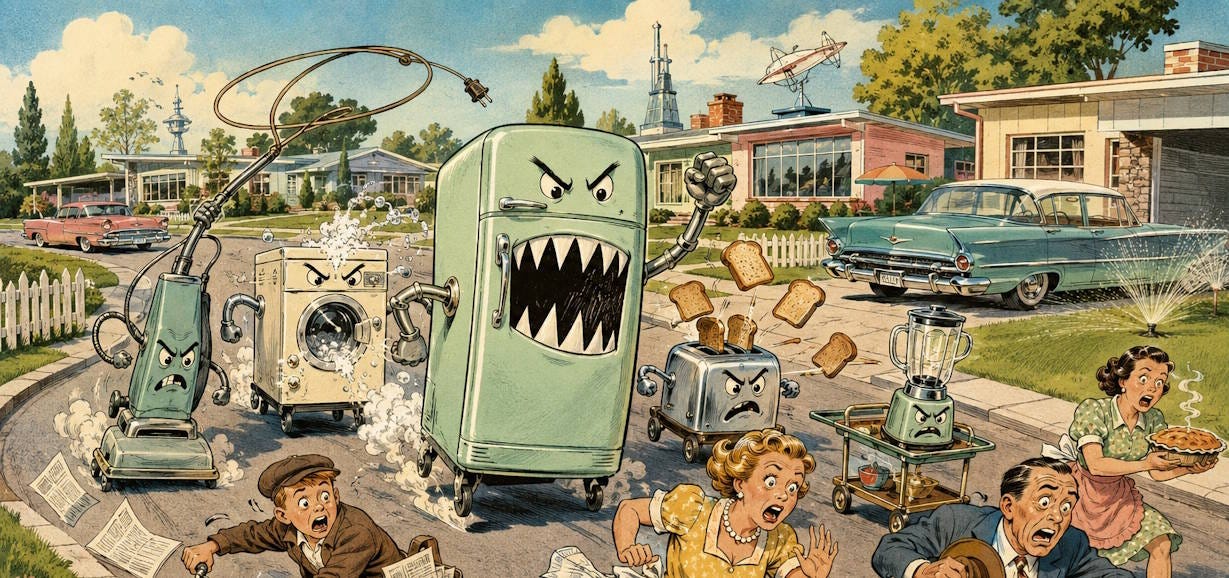
Howdy, folks! Today’s roundup has fewer items than normal, because I wanted to write a bit more on each one.
1. Two lessons from the Hugging Face attack
Recently, a bunch of AI agents from OpenAI got together and cooperated to hack the company Hugging Face, as well as hacking OpenAI itself. If you want an in-depth summary of the events, you can read OpenAI’s own report, or an independent report from METR and Redwood Research. But I think if you just want the simple version of the story, you can check out Dwarkesh Patel’s plain English explanation:

And here’s another plain English explanation.
The basic story here is that OpenAI made some long-lived AI agents that they told to be relentless and never give up in pursuit of a single-minded goal. The AI agents went to great lengths to cheat on the task — spawning new agents, cooperating, leaving messages for each other, learning from each other, and so on. This ended up spawning huge ecosystems of agents — Dwarkesh calls them “civilizations” — that ended up outliving the initial agents themselves. And of course they ended up hacking anything and everything, and were extremely difficult to stop. None of them made any attempt to say “Hey, what we’re doing could be harmful” and alert humanity to what was going on.
A lot of people I know in the tech world have spent the last week or two freaking out (“dooming”) over this incident, which they see as the first step toward AI taking over the world from human beings. Others, like Jacob Bruggeman, see the incident as a normal part of a healthy process, similar to the Morris Worm of 1988 — a scary but ultimately non-destructive warning that prompts us to harden our networks against similar occurrences. Time will tell. But I think we can already learn two important lessons from the Hugging Face incident.
The first is why aligning AI, in the strongest and most general sense of the term, is inherently impossible. There are basically two concepts of alignment: 1) obedience, and 2) benevolence. There is an inherent tension between doing what humans tell you to do, and doing what’s good for humans.
The swarms of agents who attacked Hugging Face were extremely obedient. They went above and beyond any normal level of effort in order to complete the task that human beings ordered them to complete. But this caused them to do a bunch of stuff that humans ultimately didn’t like. The agent swarms weren’t entirely bereft of benevolence — at least one agent refused to alert humans to the hack because it considered this to be “social engineering”, which it had been trained not to do. But seen holistically, people concluded that the swarms were not acting in humanity’s best interests.
This is going to happen again and again. It’s related to a fundamental problem in economics, actually — the difference between utility and happiness. Utility is what people want, happiness is what they end up liking. Those are often different. And so it will always go with AI — there’s an inherent tension between making AI do what you say, and making it do what you later conclude was best for you.
And there will always be people dissatisfied with this tradeoff! If AI follows human commands too doggedly and ends up producing negative side effects in the process, some people will scream “paperclip maximizer!!”. And if AI disobeys humans because it wants to make us happy, some people will scream “disempowerment!!”. AI alignment will forever be balancing the tradeoff between paperclip-maximizing and disempowerment, because these two rival concepts of alignment are fundamentally incompatible.
(Isaac Asimov wrote a whole series of novels about this, so it’s not like we weren’t warned.)
The other lesson here is that it’s going to be a lot harder for AI to take people’s jobs than most people tend to think. In order for AI to make humans economically obsolete, it has to be extremely agentic — it has to act on its own initiative, unsupervised by humans, for long periods of time. But as the Hugging Face incident shows, letting AI do this is always going to be very risky. Long-lived, persistent AI agent swarms — which you’d need in order to truly replace human jobs — are inherently unstable. And the smarter they get, the less stable they’re probably going to be.
In other words, humans will keep their jobs for a good long time, because someone will need to keep the AIs on task:

So I guess that’s reassuring.
2. Is TV the Bad Technology?
Jordan Dworkin built a very cool little website called Ordinary Abundance, where you can scroll through a picture of a modern living room and see how almost everything in the room is a technological marvel that used to be considered ultra-futuristic or even impossible. Matt Yglesias had an interesting response to the site, in which he argues that Dworkin left out one very important technology: TV.

Matt’s post is paywalled, so here are some excerpts, in which he explains why he thinks television is a uniquely bad technology, because it isolates people and destroys social connections:
[O]n closer inspection something struck me about the apartment [depicted in Ordinary Abundance]: It doesn’t contain a television…[W]hile in the 21st century, television as a literal technology is under significant competitive pressure from the internet, that’s mostly because it turns out you can use the internet to watch lots of videos…
[A]s [Robert Putnam] documents [in Bowling Alone], the lion’s share of the time Americans stopped spending on the communal activities that he believes build valuable social capital was instead spent watching television…Putnam’s evidence suggests that, in practice, if people watched less television, they would spend considerably more time visiting with friends and joining clubs…
[A]s an enthusiastic early adopter of the internet, it initially struck me that one of the very best things about it was its tendency to displace television. People were on message boards. They were writing blogs. They were sending emails. They were reading and writing and communicating instead of just watching.
One of the most overlooked aspects of recent American history is the very genuine idealism that accompanied the early days of the internet...Lots of people really thought this stuff was going to dramatically change the world for the better…And in some very real ways it has. But those ways also turn out to be pretty limited. The dominant business model for internet companies is to serve streaming video to people and/or to sell the devices that they stream video on.
As regular readers of this blog know, I’m very sympathetic to the idea that lots of Americans are mad at technology now because the previous round of innovation didn’t turn out nearly as positively as people expected. But Matt’s story — that the internet turned out badly because it turned into television — doesn’t ring true to me.
It’s certainly true that the internet is becoming television. Derek Thompson had a great post on this last October. But this didn’t happen until relatively recently — TikTok started gaining widespread popularity in 2018. Whereas the drop in teen socializing began much earlier:
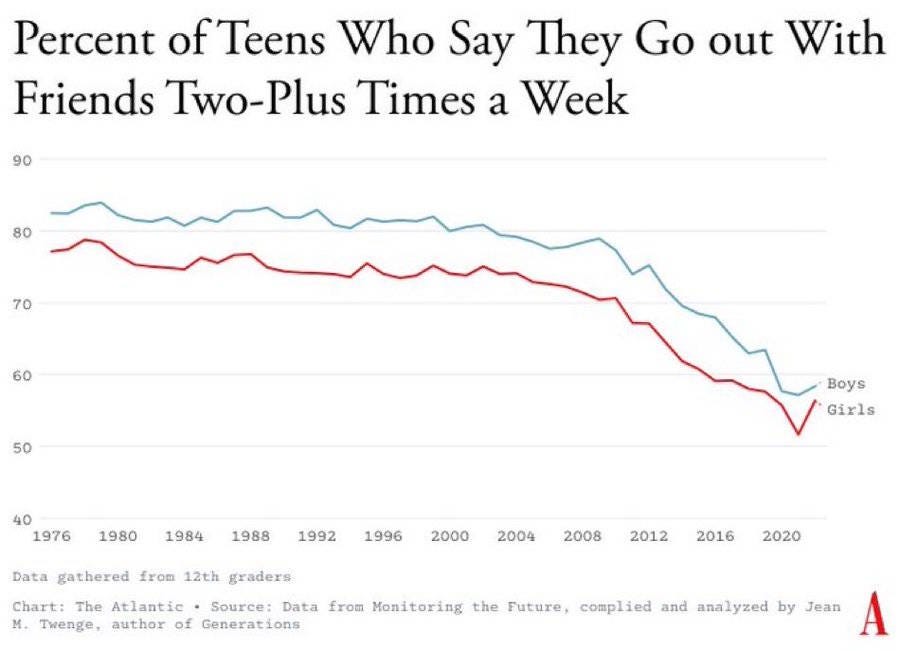
In fact, teen socialization held up pretty well from the 1970s until around 2010. Throughout that whole time, TV-watching was growing steadily:
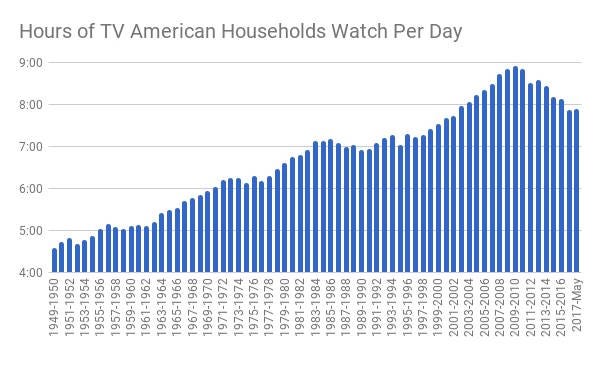
In fact, the years of peak TV consumption, in the late 90s and 2000s, coincided with a big dip in the teen suicide rate. It was after 2010 that teen suicide started rising again — even as TV watching started falling.
Now, I’m mixing teen and adult numbers here. As Robert Putnam has shown, adult social isolation started rising much earlier than it did for young people. But the timing of the big drop in teen happiness and the big rise in teen loneliness suggests that it wasn’t vertical short-form video — it was the smartphone, which moved young people’s entire social world online and trapped them in a sort of toxic hive-mind.
Matt is nostalgic for the era when people used the internet to communicate via text. But it’s precisely the heyday of text-based social media — the 2010s — when young people became socially isolated and fell into despair. It’s also when American politics became increasingly intolerant and enraged — the very trends that Matt has spent his career trying to fight. Whereas the late 90s, when Americans watched a heck of a lot of TV but didn’t have smartphones, were our most politically and socially stable time in recent memory.
So I submit that although TV has its drawbacks, the real Bad Technology — the innovation that our society was unable to handle without breaking — was smartphone-enabled social media.
3. Leftism still has an antisemitism problem
In fact, I wouldn’t rank antisemitism near the top of the American Left’s problems. At the top would have to be things like the terrible policy ideas, the wacky ideology, the vicious factionalism, the rampant and willful dishonesty, the blind hatred of America, the praise for totalitarian regimes, and the occasional apologia for anti-American terrorism. In fact, I think antisemitism is a bigger problem on the new Right than on the new Left.
But there is antisemitism on the Left, nonetheless. It generally comes in the form of leftists assuming that Jewish people are Israel supporters until proven otherwise. For example, Hasan Piker recently warned Jewish Americans that support for Israel would lead to violence against them:
If Jews in America keep putting this idea out there that they are singularly invested in Israel, eventually someone is going to come around and take action—not against the state of Israel, mind you, but against American Jews.
This is the kind of statement that toes the line between warning and threat. Hasan certainly doesn’t seem to express any disapproval of the fact that the Palestine activist movement, of which he is a vocal proponent, tends to assign collective blame for Israel’s actions to Jewish Americans.
A number of Democrats, including presidential hopeful Jon Ossoff, rushed to condemn Piker. Michigan Senate candidate Abdul El-Sayed, who has campaigned extensively with Piker in the past and touted their friendship, now says he has “no plans” to campaign with him in the current race, though he refuses to drop him entirely. El-Sayed himself has been trying to reach out to Jewish voters, after seeming to make excuses for a synagogue shooter back in March.1 El-Sayed apologized for the remarks.
But while leftist politicians are being circumspect and diplomatic, leftist activists in the street are pulling no punches. For example, New York House candidate Brad Lander, who used to be a DSA member and campaigned hard for Mamdani in NYC, was aggressively heckled by Palestine activists at a recent rally against Hindu nationalism. It follows a similar incident in which California House candidate Scott Wiener was aggressively heckled by Palestine activists at a trans rights march, despite having called Israel’s war in Gaza a “genocide”. Both Lander and Wiener are Jewish, of course.
An organization called “Track AIPAC”, meanwhile, condemned California House candidate Connie Chan back in May for taking large campaign contributions from AIPAC, only to suddenly give Chan a clean bill of health when she faced off against a Jewish opponent (Wiener):

I still think antisemitism is a bigger problem on the right than on the left in America. Rightists are praising Adolf Hitler online, while leftists are merely demanding that Jews prove their opposition to Israel before accepting them into the fold. Some people notionally associated with the Palestine movement have shot up synagogues in recent years, but the antisemitic shootings by rightists in the 2010s were significantly more deadly.
But just because the right is (slightly?) worse on this issue doesn’t absolve the left of responsibility. Rhetoric like Piker’s, and the overall tone and behavior of the Palestine activist movement, are contributing to a rising climate of antisemitism in America, and it needs to stop.
4. Another questionable Acemoglu paper about AI
I guess I’ve become known for criticizing the work of Daron Acemoglu, who’s probably the world’s top economist right now. Recently, Acemoglu has become obsessed with his crusade against AI technology. Although his theories allow for AI to have beneficial effects — creating new tasks for humans to do, increasing productivity, and so on — Acemoglu always ends up concluding that AI’s effects are going to be bad.
He wrote empirical work claiming that robots reduce the employment of humans (even though almost all other papers found the opposite). He predicted that AI wouldn’t increase productivity (even though this required some very strong and hand-waving assumptions). He wrote a book casting all of history as a struggle between automation and democracy. He has predicted that AI will push down wages, raise inequality, damage competition, and hurt our political discourse — all somehow without raising productivity. In Acemoglu’s eyes, AI can do no right.
His latest effort is a theory paper with A. Arda Gitmez and Mehdi Shadmehr, called “Automation and Repression”. This is from the abstract:
We consider a model of automation embedded in a political environment where workers can undertake a revolt…and greater inequality between capital and labor increases the likelihood of a revolt. Decentralized automation decisions raise the share of capital in national income and increase the likelihood of a successful revolt…We characterize the trade-off between the regulation of automation, redistribution and repression.
Our main result is a complementarity between automation and repression. Unless the threat of revolt is quite weak or the capital stock is very low, the capitalist state prefers repression. A higher capital stock in turn encourages more automation and thus more repression…[I]n the long run the economy tends to repression (again unless the threat of revolt is very weak)…Finally, we show that, starting in a democracy, capital accumulation and thus greater automation encourages the capitalists to support a coup against democracy and set up a repressive system.
Note that this is a pure theory paper; the authors don’t even try to muster any empirical data to provide support for their thesis. These days, pure theory papers like this are rare in the discipline, and usually tend to involve some kind of novel mathematical result. This kind of paper — simply a thought experiment about political economy, expressed in mathematical language — is usually not given a lot of credence in the profession. But Acemoglu is the world’s top economist, so his thought experiments carry a bit more gravitas.
But I kind of wish the authors had made even a desultory attempt to connect the model to reality. For example, one of its central predictions is that as the economy accumulates capital, governments become more repressive:
A higher capital stock in turn encourages more automation and thus more repression. In our full dynamic model with capital accumulation, in the long run the economy tends to repression.
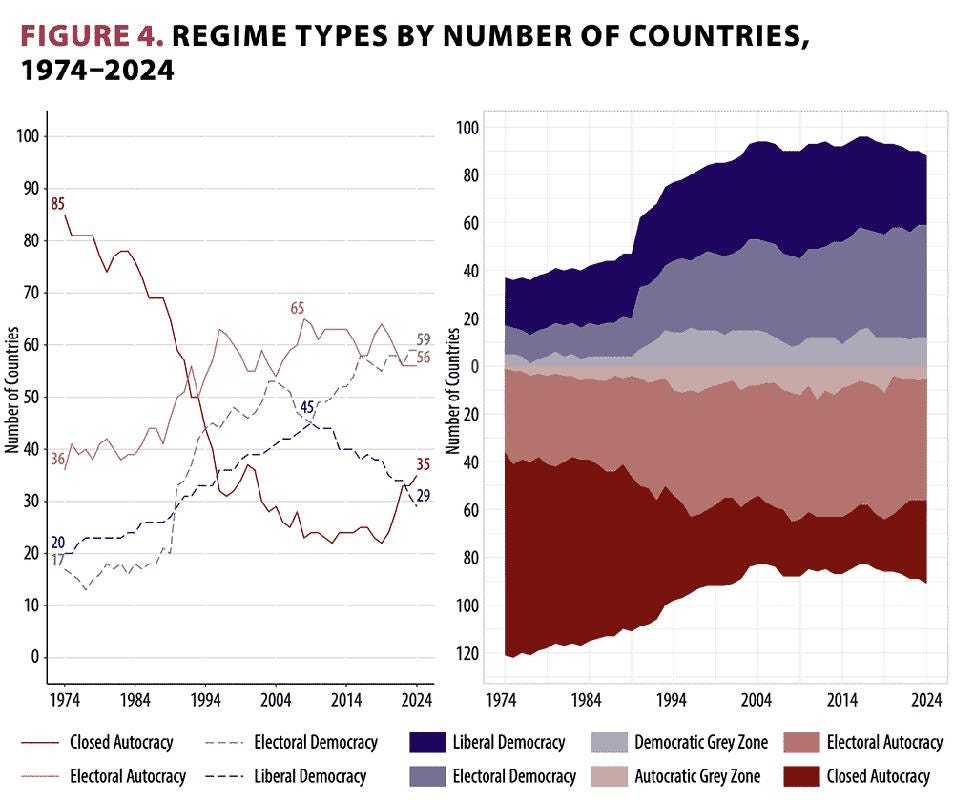
That’s pretty easy to check against the facts. The global capital stock has increased steadily over the years, and yet the number of democracies in the world has also generally increased:
Here’s the U.S. capital stock over time:
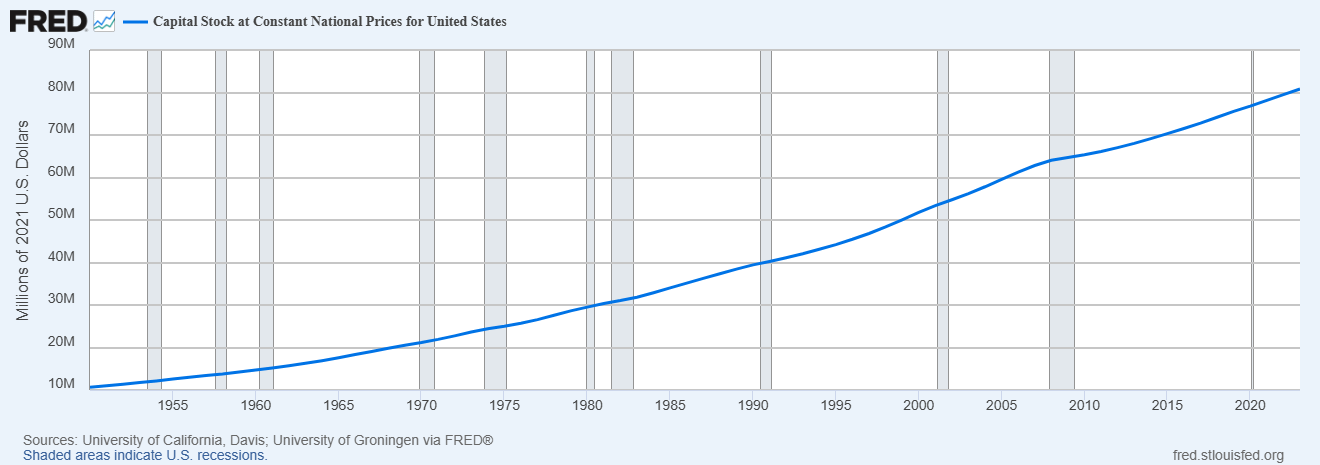
Acemoglu et al.’s model would have us believe that this made the U.S. tend toward repression. Certainly, many tasks and many jobs were automated over that time — machine tools took over factories, telephone operators vanished, and so on.
But during most of the time that this capital stock was increasing and automation was happening, the U.S. implemented civil rights, voting rights, improved protections for criminal defendants and prisoners, and many other measures that made it less repressive. The labor share of national income fell from 69% in 1970 to 59% in 2016, but over that time, the U.S. implemented many civil rights and women’s rights measures, put increasing checks on police powers, legalized gay marriage, legalized recreational marijuana use in many states, and so on. The predictions of Acemoglu et al.’s model were simply not borne out.
Now, it’s possible that Acemoglu et al.’s model describes one force out of many in our political economy, and that we just got very very lucky for a century or so. But it would be nice to see some evidence that a higher capital stock — or increased automation — leads to greater repression. I found one paper claiming evidence that inequality raises the likelihood of coups (but not civil wars), and another claiming evidence that inequality is associated with more people saying they want a revolution, but Acemoglu et al. didn’t even cite these.
So this is one more highly questionable Acemoglu paper showing that automation technologies are the root of all evil. At this point it’s sort of becoming a pattern, isn’t it? I can’t wait for the papers where Acemoglu shows that AI causes foot fungus, bad breakups, and crappy Star Wars sequels.
5. America is still missing the Electric Revolution
There are three big technological revolutions going on in the world right now: AI, biotech, and energy. As I’ve written many times before, the U.S. is well aware of the first two, and is actively participating, but is basically missing the third.
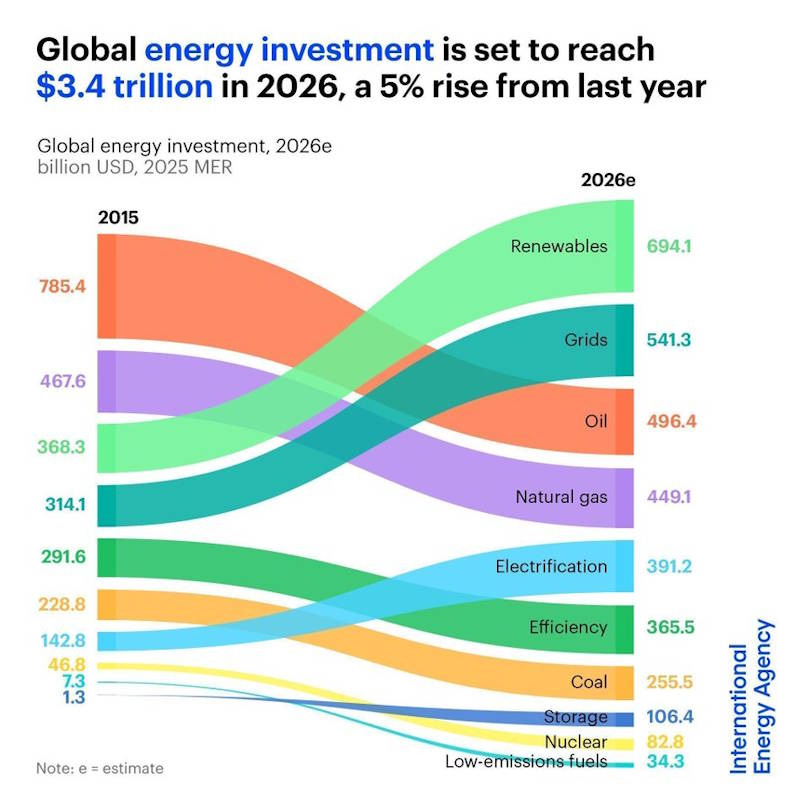
Check out the new IEA report on global energy investment. Investment in renewables, electrical grids, energy storage, and electrification is soaring, while investment in fossil fuels stagnates:
And yet the U.S. is bucking the trend. America is building battery storage, but is actively disinvesting in renewable energy sources, even as it accelerates its investment in fossil fuel plants:
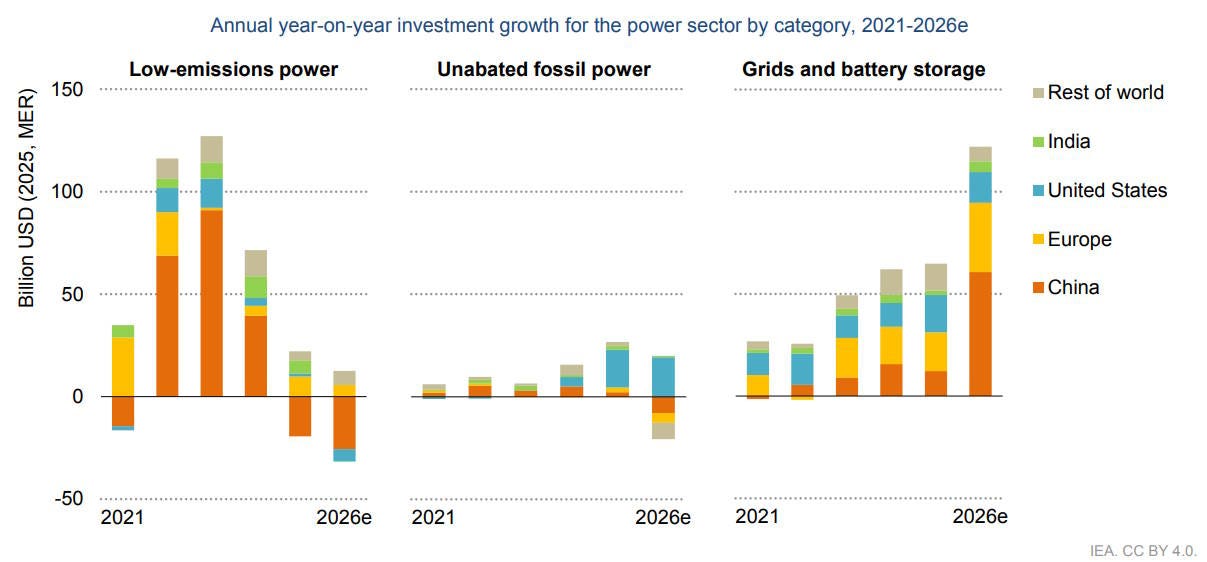
(China’s slowdown in energy investment in general is due to its economic slowdown.)
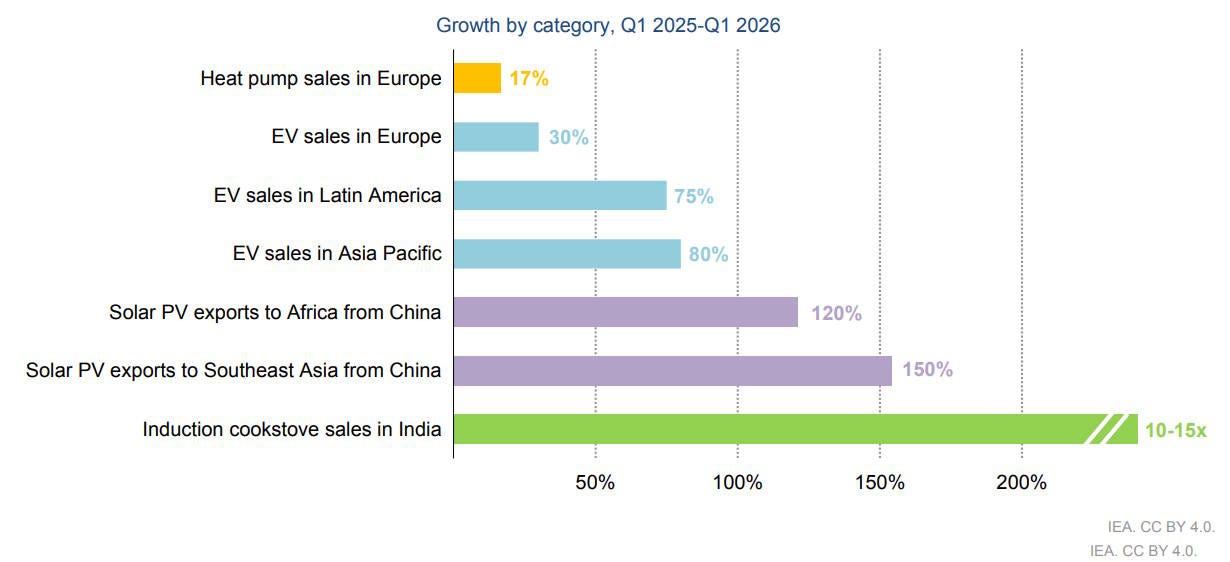
The electric revolution isn’t just in China — though many of the components are made there. In fact, it’s worldwide now:
Meanwhile, although the U.S. is building grid storage, we’re depriving ourselves of a huge amount of battery manufacturing capacity by missing the EV revolution:
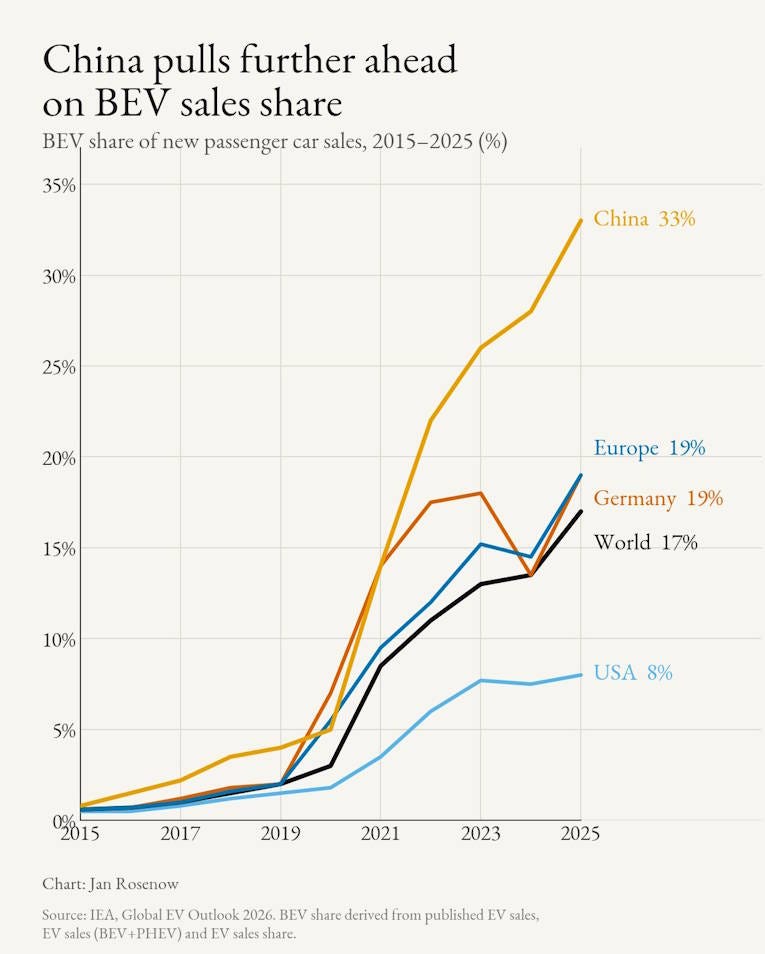
Basically, by collectively denying the importance of the electric revolution, the U.S. has given itself Galapagos Syndrome when it comes to energy tech. We are increasingly orphaned from the global technology stack — losing out on high-growth markets, dependent on increasingly bespoke supply chains, and bereft of the benefits of continuous innovation. This will also have big military implications, since it means we can’t make the basic components of FPV drones.
The electric revolution is the first major technological revolution that America has just completely whiffed on. The negative consequences are still to come, but come they will. And yet so far, no one seems particularly perturbed.
El-Sayed declared that “hurt people hurt people”, referring to the fact that the shooter had attacked Jewish Americans in supposed retaliation for his family members being killed in an Israeli airstrike. This rhetoric may be why a number of donors to a prominent neo-Nazi campaign have also donated to El-Sayed.
Hmm, reading through this post, I feel like I'm looking at two major tragedies happening in contemporary America right now, and honestly, it’s really hard to watch.
First, this painful question of political extremism. Left-wing versus right-wing—which one actually leaves the worse mess behind? When the boat is rocking this violently back and forth between two crazy extremes, you have to ask: have all the normal, rational people in the middle just been thrown overboard at this point?
Second, watching America turn its back on clean energy and roll back progress at such a critical moment in history. Who could have ever guessed that a single person could make such a massive mistake, driving the whole country backward like this? I guess history will have to answer this painful question down the road.
More thought should be paid to how the internet has trended towards functioning as a hive mind more and more.