

In 2006, well before Xi Jinping came to power, Chinese state television ran a 12-part miniseries called The Rise of the Great Powers. It was based on Paul Kennedy’s book, The Rise and Fall of the Great Powers, first published in 1989, and included interviews with the author, but also expanded on the source material. The show went through a bunch of historical examples of great powers — the Netherlands, Great Britain, France, Germany, Japan, Russia/USSR, and the U.S. — and tried to explain each one’s rise (and, if applicable, its fall). The implication was, of course, that China ought to become the next great power in the sequence.
I haven’t seen the series, but I’ve read Kennedy’s book, and its ideas are powerful and provocative. The most interesting idea is that countries become great powers due to their mastery of the most important technologies of the day — gunpowder, sailing ships, steam power, mass production, steel, the combustion engine, industrial chemicals, electricity, airplanes, and so on.1 The U.S., he argued, mastered the key technologies of the 20th century better than any other nation. To his list, we should add semiconductors, computers, and the internet.
There are some interesting unexplored corollaries of Kennedy’s idea. Although he attributes great-power decline to hubris and overstretch, it’s also possible to imagine that leading nations fall behind due to technological disruption. Britain’s industrial revolution made mercantile trade less pivotal as a source of national wealth, so the Netherlands fell behind. Britain failed to seize dominance of aviation and combustion engines the way the U.S., Germany, and (to a lesser degree) Russia did, so its early advantage in steam power became less important.
Today, everyone recognizes that artificial intelligence is the most important technology in the world — not just because of what it can do directly, but because of its potential to accelerate other technologies. Right now, the United States is leading in that industry, thanks to its pioneering role in AI research, but also to its mastery of semiconductors (along with its network of allies) and its skillful and timely use of export controls. Chinese AI models are officially nipping at the heels of Anthropic and OpenAI, but actually the gap is bigger than advertised. Here’s The Economist:
In reality, America’s lead is probably bigger than four months. Open-source models, many of them Chinese, tend to score better on public benchmarks than private ones, says Havard Tveit Ihle of the Norwegian Defence Research Establishment…[O]n private tests, America’s lead nearly doubled, to eight to ten months[.]
And here’s a chart from NIST, showing that Chinese models have been falling further behind lately:
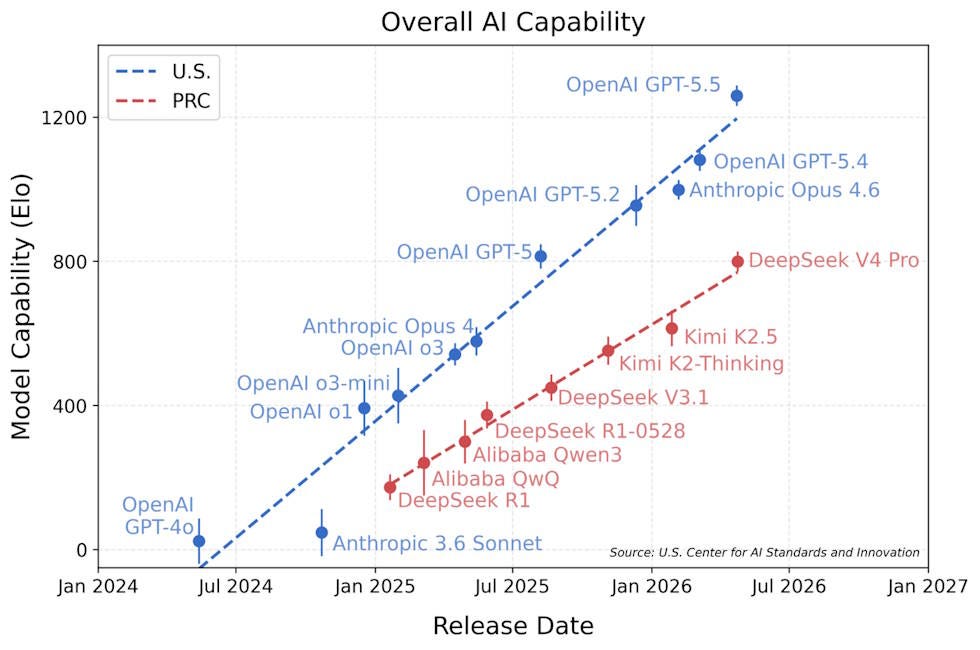
Ten months is a slender lead, and even slightly out-of-date models will have truly awesome capabilities — and will probably be able to make decent amounts of money as cheaper alternatives. But the U.S. has been executing a fairly competent strategy to dominate this crucial technology of the future.
But artificial intelligence is not the only tech revolution happening in the world today. Actually there are, roughly speaking, two other big ones: 1) electric technology, and 2) biotech. We’ll skip biotech for now (though China is making big strides here), and focus on the one that China is clearly dominating: electric technology.
