


The biblical story called the Judgement of Solomon isn’t just meant to illustrate what a wise king Solomon was. It’s also supposed to demonstrate a central principle of economics, and of society in general — that the world isn’t a fixed lump of resources waiting to be divided up. In the story, two women are arguing over which one is the real mother of a baby; Solomon proposes to cut the baby in half and give half to each woman, causing the baby’s actual mother to be instantly horrified. The lesson is that a baby is much more than the sum of two halves of a baby.
I feel like modern American leaders and intellectuals often forget this important lesson. There are plenty of thinkers and leaders on both the right and the left who think of society’s main task as slicing up and handing out a lump of “resources”. And yet when they make economic policy based on this idea, it keeps failing.
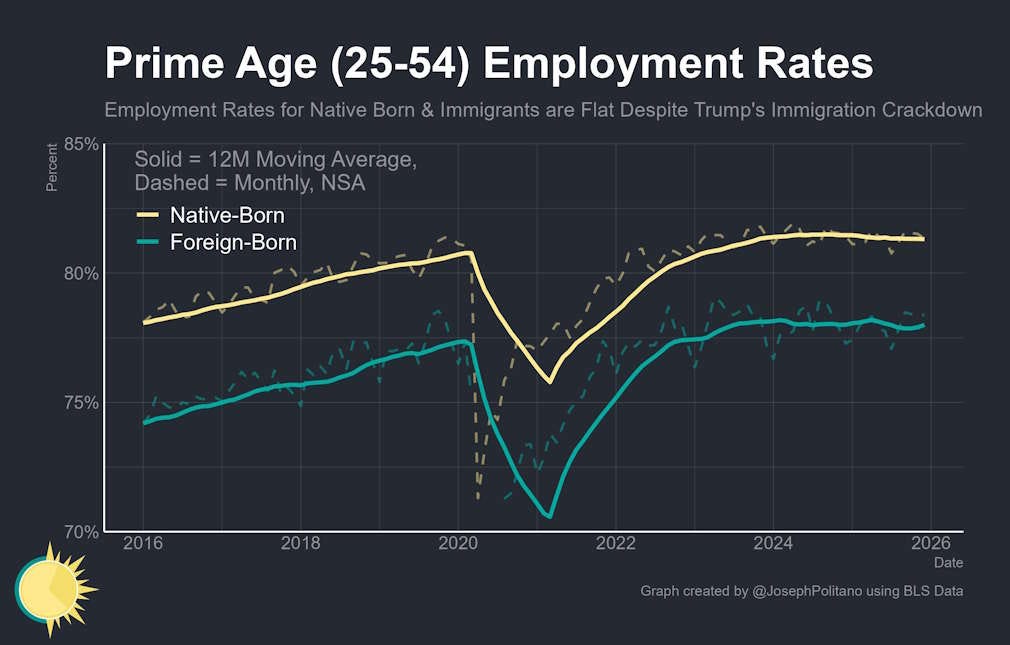
A prime example is Trump’s immigration crackdown. During the 2024 presidential campaign, Trump and his people swore up and down that kicking millions of illegal immigrants out of the country would result in a bonanza of jobs for the native-born. They probably still believe this. But people are now flowing out of the United States on net, and native-born employment rates haven’t risen:
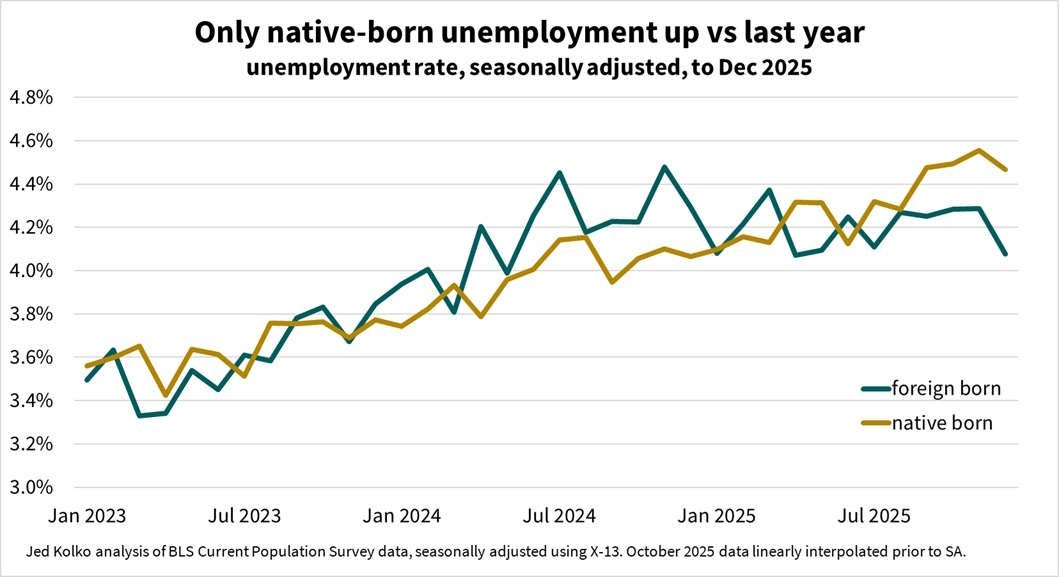
In fact, native-born unemployment has risen, even as immigrant unemployment has fallen slightly:
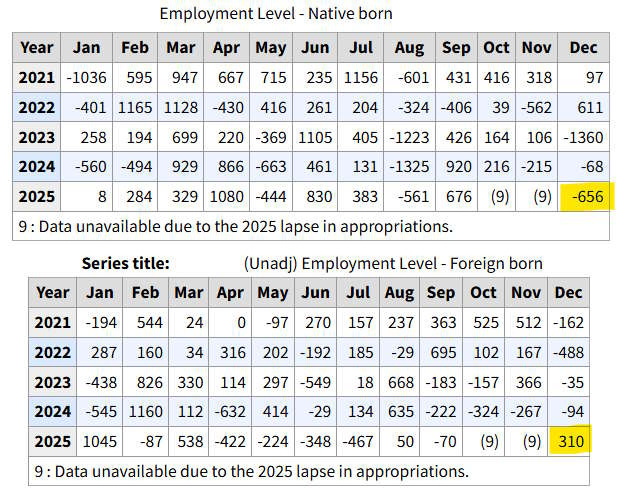
This isn’t just because immigrant laborers are becoming more scarce, either. In fact, despite Trump’s successful crackdown, the number of jobs held by immigrants actually rose in December, while the number of jobs held by native-born Americans fell:
If the Trump administration had bothered to ask economists, they would have replied that the overwhelming majority of the empirical evidence indicates that immigration — even low-skilled immigration — doesn’t take jobs from Americans. Immigrants also produce goods and services, growing the pie and creating labor demand that helps provide work for native-born workers. But the only economist they seem to have bothered to ask was George Borjas, a man who has spent his life unsuccessfully trying to prove that immigration is bad for America. The new jobs numbers illustrate the failures of Borjas’ zero-sum economics.1
Tariffs are another example. Trump and his people swore that tariffs would bring manufacturing jobs back to America, by reducing foreign competition. But while we do see a few heavily protected industries like steelmaking adding jobs, most manufacturing industries in the U.S. are hemorrhaging workers:
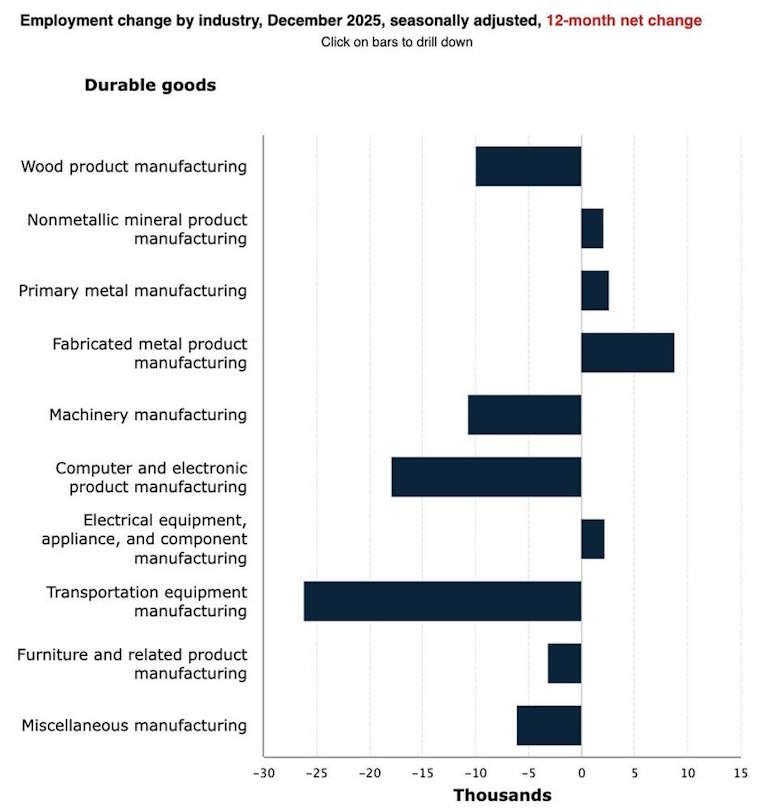
Joe Weisenthal notes how broad the pain in American manufacturing is:
It's not just that total manufacturing employment is shrinking. The number of manufacturing sub-sectors that are adding jobs is rapidly shrinking. Of the 72 different types of manufacturing tracked by the BLS, just 38.2% are still adding jobs. A year ago it was 47.2%.
If the administration had bothered to ask economists, they would have explained that since manufacturing uses a lot of intermediate goods, tariffs hurt American manufacturing more than they help. But the only economist Trump seemed to listen to on the topic was Peter Navarro, who seems to have a lot of gaps in his knowledge about trade.
Zero-sum thinking failed on immigration because the U.S. economy isn’t a lump of labor. It failed on tariffs because the global economy is not a lump of manufacturing.
Now it’s also probably going to fail Trump on geopolitics as well. Trump recently overthrew the leader of Venezuela, and he has made it clear in speeches and statements that one of the reasons he did this was to seize control of the country’s oil. Many of the less thoughtful figures on the right expect this move to deliver a bounty of mineral wealth to the United States:
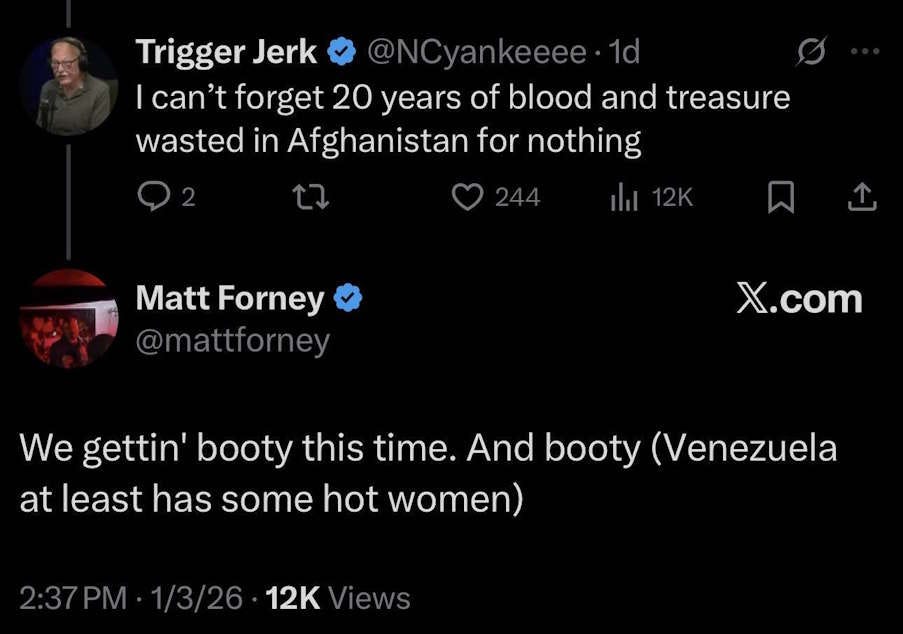
But whether removing Maduro was the moral thing to do, it’s unlikely to result in significant economic windfalls for the U.S. Oil majors are reluctant to invest, given the ongoing political chaos in Venezuela. In fact, the history of conquering and seizing oil fields for economic gain is not encouraging — witness how the U.S. failed to reap significant benefits from the Iraq War.
Or consider Trump’s desire to conquer Greenland. Simply adding a large chunk of land to America’s map would not mean riches for the U.S. economy. The U.S. already has access to Greenland’s natural resources and shipping routes; conquering the island would simply earn the enmity of both the Europeans and of Greenland’s people themselves. The U.S.’s previous relationship with Greenland was positive-sum and cooperative; switching to zero-sum piracy would not be an improvement.
So far I’ve been talking about the Trump administration. But there are also plenty of people in the progressive movement who think that economic policy should be mainly about redistributing “resources”. For example, many progressives and leftists believe that industrialization happened because European countries stole mineral wealth from other nations; some even think that poor countries are still being kept poor to this day by Europe and the U.S. buying their minerals for artificially low prices.
But as I wrote back in 2023, the former hypothesis is extremely dubious:
Imperialism is very old — the Romans, the Persians, the Mongols, and many other empires all pillaged and plundered plenty of wealth. But despite all of that plunder, no country in the world was getting particularly rich, by modern standards, until the latter half of the 20th century…So the fabulous wealth of the modern day can’t be due to plunder alone…
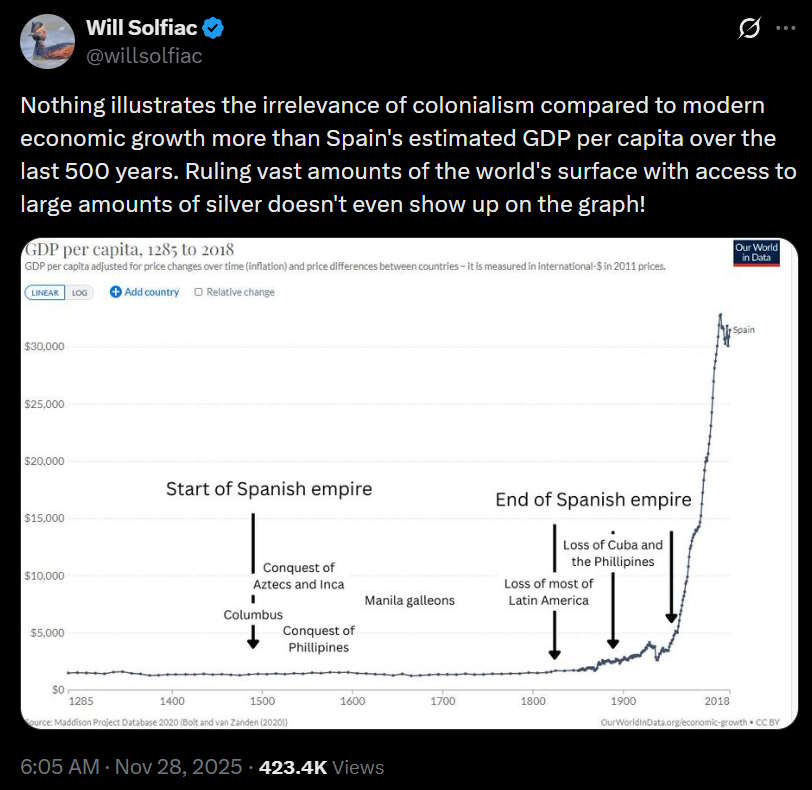
[I]t’s pretty clear that imperialist extraction was neither necessary nor sufficient for a country to get rich. South Korea, Singapore, Sweden, Denmark, Finland, Switzerland, and a number of other countries have gotten rich without ever having colonial empires, while Germany only had a small one for a very short time. Meanwhile, Spain and Portugal, which had vast and highly extractive colonial empires, were economic underperformers for a long time, and are still poorer than much of Europe.
Here’s a good tweet that makes the argument even more succinctly:
And leftists’ argument that poor countries are poor today because America and Europe refuse to pay sufficiently high prices for rocks — is obvious nonsense:
[N]ow, commodity prices are generally set on the world markets…the price of copper Chilean miners get is going to be about the same as the price American or Australian miners get. Rich countries might use dirty tricks to lower the global price of commodities…but they’d have to be willing to hurt their own miners too…And this would also involve screwing over rich countries like Australia that are primarily commodity exporters. Australia is very obviously not a poor country, so if we’re screwing over Australia through suppression of global commodity prices, we’re not doing it very much…
The idea that commodity exporters chronically undervalue their currencies also doesn’t fit with the recent history of these countries. Commodity-exporting nations are known for overvaluing their own exchange rates, in order to afford more imports.
With a few small exceptions, countries simply don’t get rich from “resources”; they get rich from reshaping resources into useful goods and services using human ingenuity and hard work.
Closer to home, progressives constantly talk about “resources” — a language that clearly invokes a lump of wealth. And yet progressive policies often end up making cities poorer, by taxing productive businesses to send money to useless but politically well-connected nonprofit groups. The California High Speed Rail Authority has not managed to create any high-speed rail whatsoever despite billions of dollars in spending, but brags about how many jobs that spending has created. It’s all redistribution and no production.
Perhaps in a rich country like America, where the pie grows only slowly and there are lots of opportunities for redistribution, it’s natural for people on both the right and the left to start thinking of the world as a lump of “resources” to be divvied up. But in reality, it’s production that maintains our high standard of living, and which creates the wealth necessary for redistribution to occur. A dangerously large number of Americans seem to have forgotten that.
The jobs numbers do not PROVE, by themselves, that immigration is benign for native-born American workers. But the mountain of careful causal research showing that immigration doesn’t displace native-born workers is evidence enough.
Surprised not to see rent control mentioned here as well, but it's yet another example of redistributing resources in ways that end up hurting cities rather than simply allowing the free market to build more abundant housing.
Immigration may not be zero sum, over the whole economy, but it sure feels zero sum locally sometimes. Maybe people can accept that as a tradeoff if it is done right, but it has been done the opposite of right. It really doesn't help the case that the government has decided to ignore its own laws on this on illegal immigration. California has even gone so comically far as to pass laws restricting employer use of e-verify to check immigration status.
And this also extends to legal visa programs. By law, H1-B visas are restricted to jobs where there is a labor shortage and it is not possible to hire a citizen. But then tech companies are laying off thousands of US citizens while continuing to employ and even apply for more H1-Bs in the same job. Every one of those visa applications is obvious and provable fraud by the hiring company. How can they say with a straight face that they can't find US citizens for those roles, when a week ago they employed those very citizens in those same jobs? But the government looks the other way.
It seems like the only time the government sees the need to obey the letter of the law is when millions of illegals flood the border filing false asylum claims. Apparently we have to let all of them in, and also pay for their rent and food, because that's just what the law says. No matter that they are obviously lying to take advantage, we just have to let them in because that's the law.