

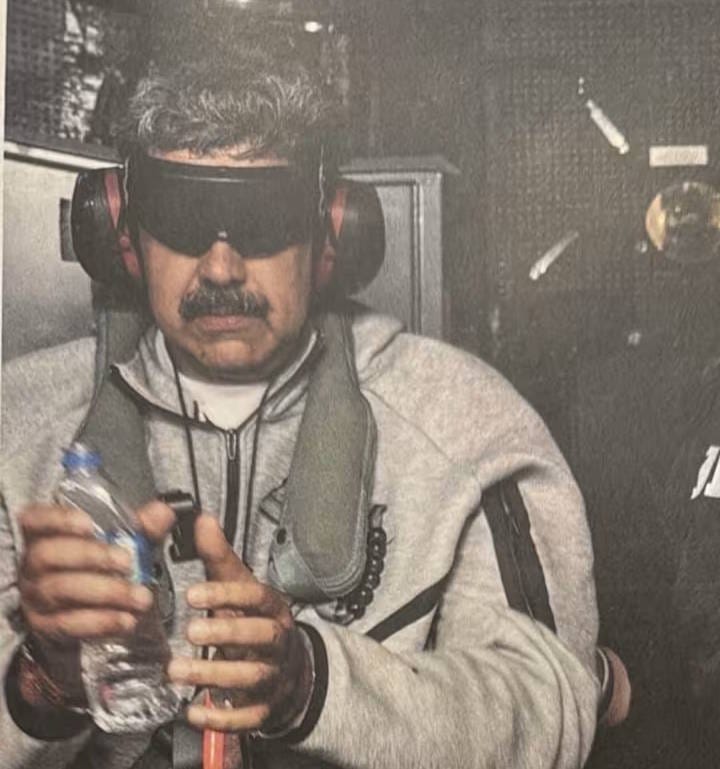
Nicolas Maduro was a particularly unsuccessful dictator. He devastated Venezuela’s economy by continuing all the worst aspects of the irresponsible economic policies of his predecessor, Hugo Chavez, reducing much of his population to abject poverty. He stole elections, suppressed dissent, and killed many thousands of regime opponents. Venezuelans are unlikely to mourn his removal from power at the hands of Donald Trump’s lighting raid on January 3rd.
And yet Maduro’s capture has suddenly thrown much of the world into chaos and uncertainty. Trump ordered the U.S. Military to abduct a foreign head of state without Congressional authorization — a naked display of power in defiance of every international norm that had prevailed since World War 2. The geopolitical implications of that fact are going to reverberate a lot more than the abduction itself.
A little over two years ago, in the aftermath of the October 7th attacks in Israel, I wrote that Pax Americana was effectively dead:
The world is a more ungoverned, lawless place than it was 20 or even 10 years ago…The world is starting to revert into a jungle, where the strong prey upon the weak, and where there is a concomitant requirement that every country build up its own strength; if your neighbor is a tiger, you should probably grow some claws of your own. Old scores that had to wait can now be settled. Disputed bits of territory can now be retaken. Natural resources can now be seized. There are many reasons for countries to fight each other, and now one of the biggest reasons not to fight has been removed.
In that post, I wrote that the end of Pax Americana was due to America no longer being able to carry out its function of “world police”. Superficially, Trump’s capture of Maduro might seem to imply the opposite. Trump had Maduro arrested on drug trafficking charges, which is pretty much the definition of a police action. And the fact that the U.S. was so easily able to snatch Maduro — easily evading Chinese-made radars that were designed to catch stealth aircraft — might suggest that reports of the decline of American power had been premature.
In fact, the lesson is the opposite. America’s seizure of Maduro was not done in order to enforce global or international norms — it was done, purportedly, in order to enforce American domestic law. Trump wasn’t acting as “world police” — he was acting as the American police, under the assumption that Venezuela might as well belong to America.
The raid also exposed how mercurial American power has become. Trump claimed that his arrest of Maduro was due to Maduro’s membership in a drug cartel called “Cartel de los Soles”, but later admitted that no such cartel exists. Later, Trump implied that seizing oil had been part of his motivation, announcing that Venezuela would turn over 50 million barrels of oil (several weeks’ worth of production) to the United States. But as Eric Levitz points out, this doesn’t make a lot of sense either — the U.S. is not going to be able to confiscate large amounts of Venezuela’s oil, and flooding the world market with crude will simply depress the margins of America’s own oil producers.
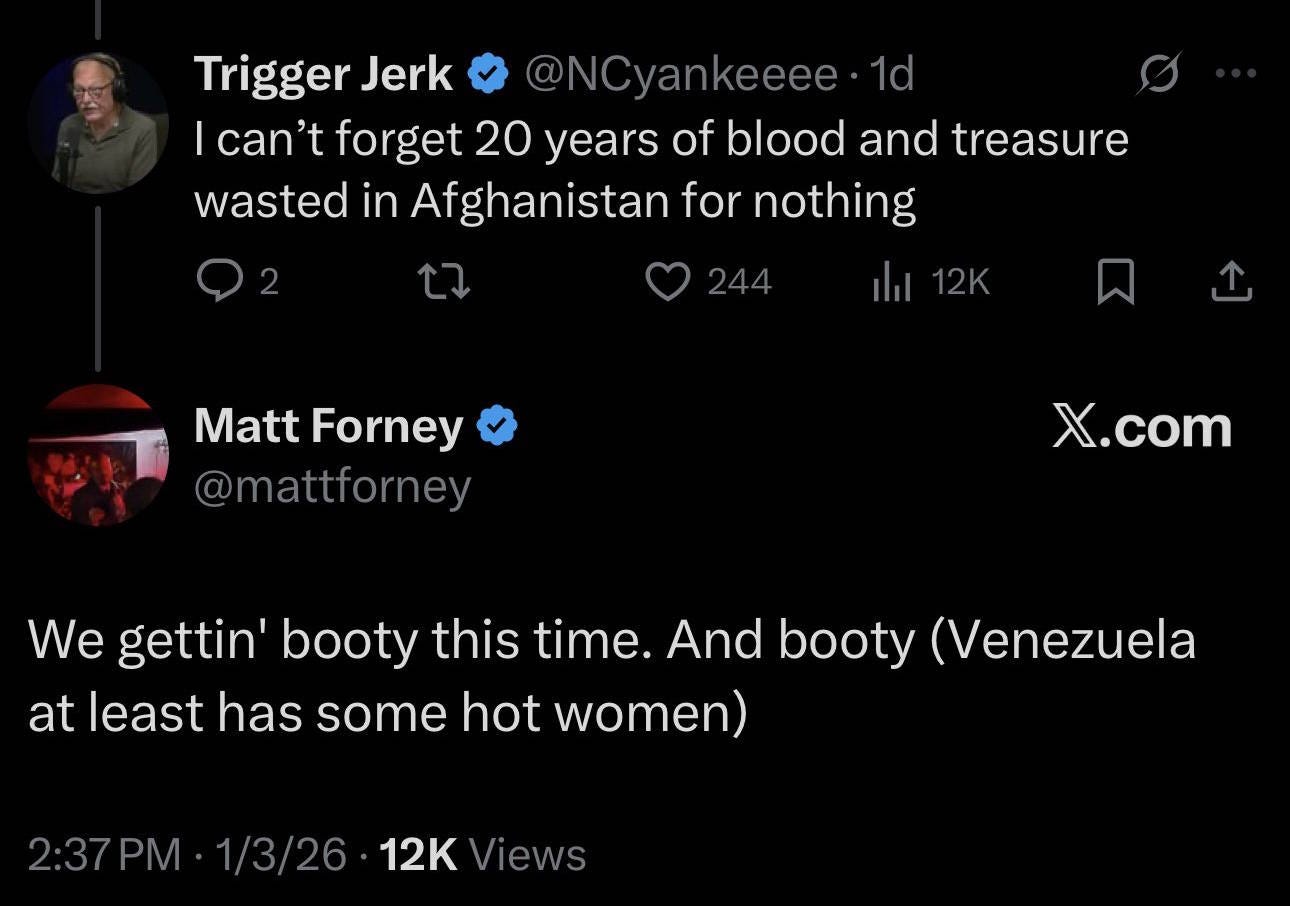
In the absence of a clear motivation for the abduction, wild theories are being thrown around. Was this a bid to deter China from attacking Taiwan, by limiting Venezuela’s oil exports to China? Was it part of a deal between Trump and Russia/China, allowing Trump to dominate the Western Hemisphere in exchange for letting Russia have Ukraine and letting China have Taiwan? Was it the prelude to a U.S. invasion of Greenland? I saw all of these theories thrown around on social media, as well as some…um…less plausible ones:
No one really knows why this happened, and it seems like no one really expects to know. And the absence of a clear motivation for the attack makes it even more disruptive to whatever still existed of the old world order. In my post back in 2023, I wrote:
If the U.S. threat of intervention doesn’t depend on whether or not you send your army outside of your borders — if the U.S. might just attack you anyway because they don’t like you — then the incentive to avoid interstate conflict is reduced.
I was talking about the Iraq War; although Trump’s seizure of Maduro was far less bloody, it’s disruptive for similar reasons. Under Trump, America has gone from a source of stability in world affairs to a source of chaos.
At the same time, though, it would be wrong to place all or even most of the blame on Trump for the breakdown in the old international order.
