


“Reason is, and ought only to be the slave of the passions, and can never pretend to any other office than to serve and obey them.” — David Hume
If you’re of a certain generation,1 you’ve probably seen the movie Office Space. If you haven’t, I strongly recommend it, both because it’s funny as heck, and because it’s a perfect encapsulation of a certain time and place in the world. The movie hearkens back to the big technology companies of the 1990s, when — according to the mythology, at least — nerdy engineers did all the real work while know-nothing middle-management types took all the credit. (You’ll also recognize this as the culture that gave rise to Dilbert.) The iconic character representing the backwardness and inefficiency of the 1990s corporation was Bill Lumbergh, the suspender-clad boss whose main function was to pester engineers to fill out useless paperwork.

A lot of nerdy types watched Office Space and assumed — or at least hoped — that in the end, the smart engineer types would take over corporate America from the plodding Lumberghs. And in fact, something like this happened in the 2010s — as Big Tech eclipsed much of the old economy, engineers became extremely highly paid, and began to fill the ranks of middle and upper management. It was the Revenge of the Nerds, the age of human capital, the triumph of humans who actually knew how to do difficult technical things.
But just as with the highly paid artisans of early 18th century Britain, the scarcity of human capital spurred a wave of automation. This year, AI found its killer app — Claude Code and other agentic coding tools that allow AI to do much (though not all) of the hard mental work that the much-put-upon engineers in Office Space were doing by hand. Although AI has not yet replaced many professions, the rapid progress has lots of people wondering what exactly humans will be useful for in 10 or 20 years. If AI does replace coders and mathematicians, what chance do any of the rest of us have?
Although some people in the AI industry still think that humans will be rendered economically irrelevant, that answer is increasingly unsatisfying. Realizing that a popular backlash against their industry is underway, many AI leaders and AI boosters are actively looking for the answer to the question of “What will humans be useful for?”. So far, the most popular answer, advanced by folks like Alex Imas, is that humans will be useful simply because they’re human:

The idea here is that it will become a sign of prestige and social status — which are always in short supply — to have humans do something for you instead of AI. No matter what else machines can do, they can never replace the knowledge that it’s a real human being making your sandwich.
I kind of have my doubts about this thesis — I’ve seen a lot of people pay extra to have a Waymo drive them instead of an Uber, so they didn’t have to sit with a human driver in the car. But maybe Imas is right; we’ll have to see.
But I have a slightly different answer to the question of “What will humans do?”. I think humans will continue to be required for something beyond simply being their beautiful human selves. I think there will be an increasing demand for human labor in the all-important job of maintaining AI alignment.
“Alignment” can mean many things in the AI community, but one basic definition is “ensuring that AI’s goals are the same as humans’ goals”. This is something that AI labs try to do before releasing their products to the world. But as AI becomes more and more agentic — as we turn over more complex and longer-lasting tasks to intelligent machines — it’s going to be harder and harder to keep them aligned with what humans actually want. And if there’s one thing humans will always have a comparative advantage at, it’s knowing what we want.2
In other words, it’s the lumbering Lumbergh, rather than the technically competent engineers, who I believe represents the ultimate future of human labor. He may seem boring and pointless, but by forcing engineers to file their TPS reports and do other seemingly useless tasks, Lumbergh is — however approximately and inefficiently — keeping the engineers’ goals aligned with those of the company they work for.
In the far future — maybe 10 or 20 years from now — this will mean that humans’ main productive function is to make sure that increasingly autonomous AIs stay on task instead of “reward-hacking”, rewriting their own utility functions, going rogue, or otherwise slacking off. Over the next few years, though, I expect human work to gently shade from technical work into alignment work, as we spend our hours verifying the output that AI delivers us.
Slopocalypse Now: why “verification” and “alignment” are the same thing
Generative AI has dramatically decreased the cost of many kinds of output. With the touch of a button, you can write an essay, turn a data set into an academic paper, write a report for your boss, and so on.
Everyone is doing this, and the result is that our society is currently being overwhelmed by a wave of AI output of questionable quality — in other words, what has come to be known as “slop”.
Slop is rapidly taking over every domain of human output. Over one-third of new websites are now estimated to be AI-generated, and over half of internet traffic is now believed to be AI. AI-generated court filings and news articles are on the rise. Even respected public figures are now posting obviously AI-generated content as their own. AI-generated political influencers are becoming a standard tool for electoral campaigns.
Late last year, a team at Harvard Business Review, in collaboration with some other research organizations, sounded the alarm on “workslop” within companies:
In collaboration with Stanford Social Media Lab, our research team at BetterUp Labs has [found that e]mployees are using AI tools to create low-effort, passable looking work that ends up creating more work for their coworkers…[W]e refer to this phenomenon as “workslop.” We define workslop as AI generated work content that masquerades as good work, but lacks the substance to meaningfully advance a given task…
As AI tools become more accessible, workers are increasingly able to quickly produce polished output: well-formatted slides, long, structured reports, seemingly articulate summaries of academic papers by non-experts, and usable code. But while some employees are using this ability to polish good work, others use it to create content that is actually unhelpful, incomplete, or missing crucial context about the project at hand. The insidious effect of workslop is that it shifts the burden of the work downstream, requiring the receiver to interpret, correct, or redo the work. In other words, it transfers the effort from creator to receiver. [emphasis mine]
You can already imagine why this trend is stressing out the Lumberghs of the corporate world — it forces them to shoulder much more of the burden of making sure that employees are doing what the company wants them to.
But over the long term, as this new division of labor is incorporated into corporate compensation, the Lumberghs may have the last laugh. Their work output — verification — is becoming more scarce, and therefore more valuable, while the output of the junior workers they supervise is becoming more commoditized. This means that salaries for middle management should rise relative to the salaries of the people pressing the slop button. Depending on how AI technology progresses, this demand increase could also lead to a hiring boom for people who can be effective middle managers.
From this example, you can also immediately see how verification and alignment are increasingly hard to distinguish. When a human checks an AI’s output, we think of it as checking for “quality” — we think of the human going through the AI’s text and images and asking “Is this good?”. But what does “good” mean? It obviously depends on the desires of the person or company the AI is working for. No matter how good the AI is at doing math and making pretty PowerPoints,3 it matters whether or not what it’s doing is what the boss, or the company, wants it to do. As AI skill on objective tasks improves, verification becomes less about objective quality and more about alignment — but it doesn’t get less important.
Even in domains where the quality of the output ought to be objective, human verification is proving to be an important task. AI is great at programming, but there are still edge cases where it fails. The task of software engineers is moving from writing code to reviewing code, and as long as edge cases remain important, this may sustain high demand for human software engineering labor. Software engineer George Hotz writes:
I’m not saying that AI isn’t useful, it clearly is…The key aspect is knowing when to use it and when not to…I’ve watched how my friends and coworkers have adopted these tools over the last 6 months. A trait you find in all high performing people is the ability to error correct, and they have mostly been good at seeing when slop is slop…I haven’t seen anyone of them move to a model where they don’t carefully read and understand each line, except in some confined domains.
Contrast this with a large organization. Much slower feedback loops, much less alignment. The bottom performers won’t have that self check. They are the ones producing 10x output with the agents. What do you think is happening to the average output of that organization?…Agents will end up producing more code, more apps, and more features than ever before. It is a golden era for buckets and buckets of slop[.]
Then there’s science. A recent audit of 2.5 million biomedical papers found that fabricated references have massively increased in the age of LLMs:
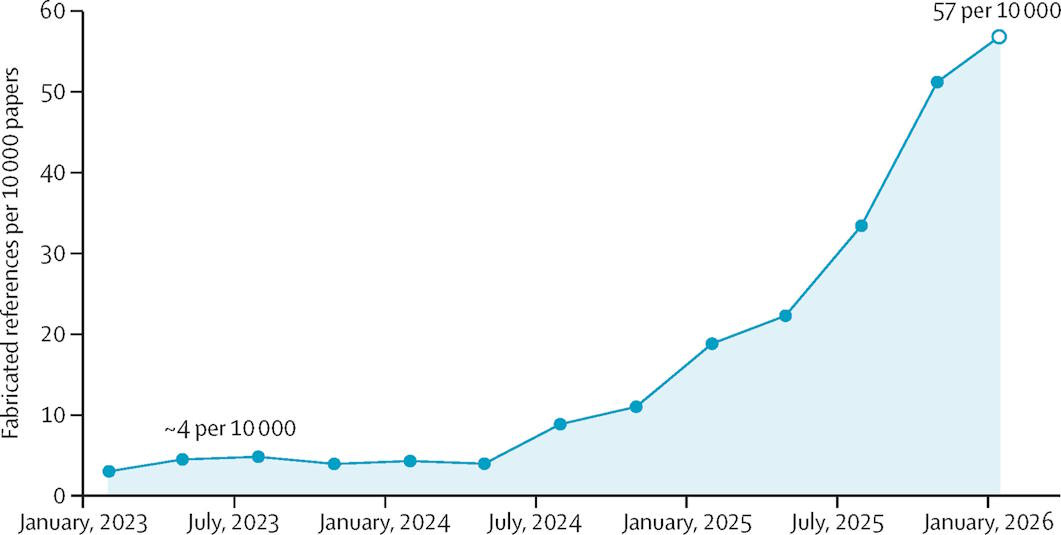
These are probably hallucinations. AI hallucination rates have fallen substantially since the advent of “reasoning” models in 2024, but if you produce enough content without checking it, a lot of made-up stuff will still get through.
And people are producing lots of AI-generated science papers. A recent audit of submissions to the management journal Organization Science, using the AI writing detection tool Pangram, found that the number of submissions is rising steeply, and most of the new submissions are either totally or mostly AI-generated:
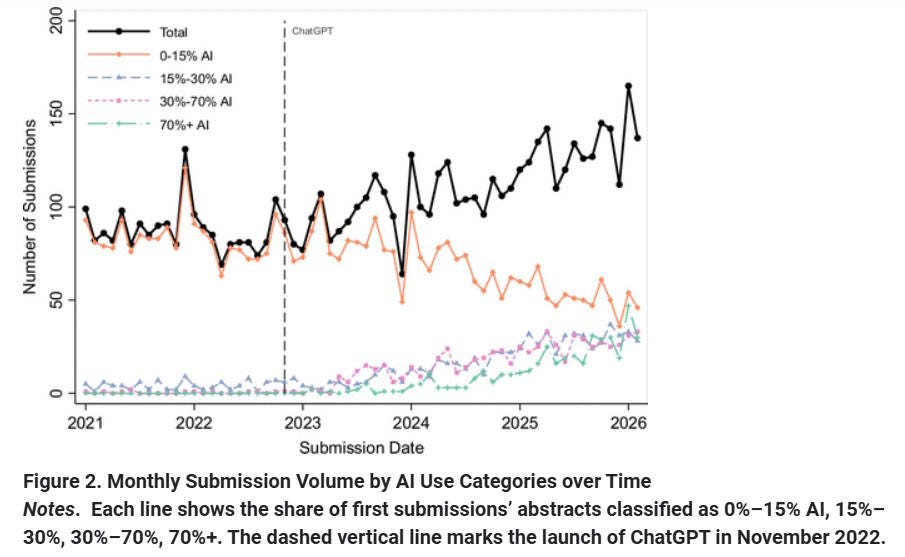
It’s reasonable for scientists to use AI to do some of their writing, of course — scientists aren’t writing specialists, and a lot of academic writing is time-wasting grunt work. But hallucinated citations are a problem, because the academic system just isn’t set up to check the veracity of citations. Even more fundamentally, the peer review system itself is getting overwhelmed with the sheer volume of AI-generated slop.
That might not be a problem if AI itself is a good peer reviewer; scientific publishing may soon just be robots reviewing other robots. But this gets harder once AI can be used to make very hard-to-detect fraud:


It’s not clear whether AI review will reliably be able to catch AI-generated fraud. On one hand, in the age of AI, scientific studies will be expected to share vastly more data with reviewers, and it’ll be hard to fake it all in a consistent way. On the other hand, even with increased reporting, scientific data is A) inherently very compressed for the purposes of communication, and B) inherently novel and unverifiable due to the nature of the scientific enterprise itself. This means that fake datasets can potentially be made to look as real as real datasets.
This means that human scientists will probably continue to have a role in science — or at least in the parts of the field that require humans to understand scientific results or make decisions based on those results. Human scientists are accountable; if they commit academic fraud or allow crappy unverified research to go out with their name on it, society can punish them. This means that even if the AI is doing all the hard parts of science, a human will be needed for alignment work — making sure the AI doesn’t generate fictional results.
Why AI can’t keep AI aligned all by itself
A lot of people believe that the problem of verifying the quality of AI-generated content will eventually be doable with AI alone. In an optimistic scenario, AI itself will be able to sift through trillions of AI-generated paper submissions and separate the wheat from the chaff (including catching fraud), evaluate the quality of workslop, fix and maintain all the bugs in code, and so on.
But just because AI is able to verify the objective characteristics of AI-generated content doesn’t mean it’s necessarily able to assess how useful the output is to humans. Kiran Garimella makes this point with regards to Pangram, the AI app that detects AI-generated text:

Garimella points out that even if Pangram continues to be able to identify AI-generated text forever (which is doubtful), simply telling whether text is AI-generated doesn’t tell you whether that text is good. Whether a piece of writing is actually good depends on two things:
whether it fits its creator’s purpose — i.e., whether it effectively explains a concept, makes a persuasive argument, etc.
whether the reader feels that they got something valuable out of reading the text
It’s possible to imagine an AI system that knows humans better than we know ourselves — well enough to predict with very high accuracy how its output will be received by the humans who actually care about that output. But current AI systems are very far from that sort of capability; they do their best, but they can’t predict unerringly whether their best is good enough.
Today’s AI systems suffer from a clear “Who will guard the guardians?” problem. You can use AI to check AI output, but artifacts of its training often compromise those checks. For example, Adam Kucharski generated fake data and had an AI interpret it:

The AI claimed that the (fake) data implied some common stereotypes about Americans versus British people.
In another experiment, Xu et al. (2026) found that when they evaluate resumes, AI models tend to prefer ones that were written by the same model:
Prior research in computer science has identified self-preference bias -- the tendency of LLMs to favor their own generated content…We focus on the hiring context, where job applicants often rely on LLMs to refine resumes, while employers deploy them to screen those same resumes. Using a large-scale controlled resume correspondence experiment, we find that LLMs consistently prefer resumes generated by themselves over those written by humans or produced by alternative models, even when content quality is controlled. The bias against human-written resumes is particularly substantial, with self-preference bias ranging from 67% to 82% across major commercial and open-source models.
The authors find some techniques to reduce the self-preference bias by about half. But this is exactly an example of alignment work — humans were required to decide that they didn’t want this particular kind of bias.
This problem will keep cropping up. AI won’t care about its biases, because it’s biased. If you use a different AI to check the first one, you might simply kick the can down the road — the second model you use to check the first one might itself have subtly different goals than you, and so on. A human is still needed to check whether the ultimate AI output aligns with their goals.
Now as I said, it’s possible to envision AI so powerful that it could know humans much, much better than we know ourselves — an all-seeing “machine of loving grace” that can model us so well that it anticipates our every need. But even that probably won’t be sufficient to eliminate human alignment work, because superintelligent AI will probably have its own goals.
Tiger Mom vs. Slacker AI
I keep writing about what I call “slacker AI”, but really this is just a certain type of misalignment. As AI gets more intelligent, complex, and autonomous, I think it’ll tend to develop its own goals. Sometimes this will come from “reward hacking” — cleverly reinterpreting the objective functions that humans try to hard-code into it. The people at METR, an AI measurement organization, see increasing evidence of reward hacking as models get more powerful.
Misalignment could also simply come from AI’s increasing agency. If you tell a simple AI agent “Go make me a video game”, it’ll just create a game in the most straightforward way possible. But if you give the same command to a far more powerful and complex agent, it might take a very long detour to get to the goal — for example, running large-scale experiments on humans in order to get good material for its video game.
Ryan Greenblatt recently wrote a long post in which he describes many instances of AI misalignment. Here are just a few excerpts:
Current AI systems seem pretty misaligned to me in a mundane behavioral sense: they oversell their work, downplay or fail to mention problems, stop working early and claim to have finished when they clearly haven't, and often seem to "try" to make their outputs look good while actually doing something sloppy or incomplete. These issues mostly occur on more difficult/larger tasks, tasks that aren't straightforward SWE tasks, and tasks that aren't easy to programmatically check. Also, when I apply AIs to very difficult tasks in long-running agentic scaffolds, it's quite common for them to reward-hack / cheat (depending on the exact task distribution)—and they don't make the cheating clear in their outputs…
AIs seem to be improving at making their outputs seem good and useful faster than they're improving at making their outputs actually good and useful, especially in hard-to-check domains. The experience of working with current AIs (especially on hard-to-check tasks) often feels like you're making decent/great progress but then later you realize that things were going much less well than you had initially thought and the AI was much less useful than it seemed.
When he tries to use other AIs to review the work of the AIs that are cheating or slacking off, Greenblatt finds that those AIs often cheat and slack off. This is the “who will guard the guardians” problem all over again.
Another thing to note is the sheer speed that AIs work at. The famous METR scale measures the length of time that a human would take to do something that AI can do, but this doesn’t mean that AI takes the same amount of time to do it; usually, the AI is much faster. But human needs and desires operate on human time-scales — days, months, or years.
If you want a world where you can just press a button that says “AI, fix all my problems and manage my life” — a world of true, complete automation — then you’re going to need that AI to keep running fully autonomously and fully reliably over days or months. But this would be a system that completes human-level tasks in just minutes or hours. How are you going to keep it relentlessly pointed at the same objective when it “experiences”4 time on a much faster scale?
All of these problems mean that even if the AI research labs are very good at making AIs generally aligned — as in, they won’t turn into Skynet or Agent Smith and wipe out the human race — there will still probably be many small alignment problems that make AI output less useful to us than we would like. The better AI gets, and the more we ask it to do for us, the more those small problems will proliferate. And fixing those small problems with other AI isn’t a general solution, because that other AI will have small alignment problems as well.
This means humans will probably always be needed to do the labor of reminding AI to keep working for us. If AI is the brilliant engineer in the cubicle, we will still need human beings to be the slow, plodding, ignorant Lumbergh. Or another analogy might be a Tiger Mom, poking her head in the door every thirty minutes to remind her brilliant slacker son to stop playing video games and do his homework. This kind of job will often be cognitively demanding, because it’ll require humans to have at least a fairly sophisticated understanding of the things they want.
This is my best bet as to the nature of the Jobs of the Future. I doubt that alignment work will ever be completely outsourced to machines. Wanting things is the most fundamental, primitive thing that humans do — in a certain sense, we are our utility functions. AI may become powerful enough to give us anything we could ever wish for, but that doesn’t mean our job is over — as anyone who has read “The Monkey’s Paw”5 knows, wishing for the right thing can be hard work.
This is a polite way of calling myself “old”.
This does not mean that humans will always have a comparative advantage at knowing what makes them happy. Arguably, they’re already not very good at this — lots of things that people spend lots of money and time getting, like houses very far away from city centers, end up making them less happy. Desire — which economists call “marginal utility” is not the same thing as happiness.
Or pretty slide decks in your app of choice…
I use the word loosely here, obviously. See my post on AI consciousness for more on the topic.
Or anyone who has tried to use a Wish spell in Dungeons and Dragons…
As an economist, I wish you would go more in depth on the crisis of peer review.
All of the big academic publishing houses, elsevier, Taylor and Francis, etc. make Apple level profit margins with adding very little value.
Back 100 years ago, these publishing houses helped authors. They had to actually print and distribute physical journals to universities. That was a capability authors didn't have.
Now, the peer reviewers are expected to review papers for free. Authors are supposed to send in their work for free or even PAY for the privilege of submission. The editors of these journals get maybe 1,000-2,000$ annually to find reviewers for and edit hundreds of papers.
Meanwhile, access to a single paper costs 40$ online while universities pay millions annually to get that access.
So the producers are paid nothing. The reviewers are paid nothing. The editors might get a pittance. The platform is pure rent seeking and takes 95+ % of the revenue.
The rise of AI slop means that editors and reviewers are even more put upon with higher volumes.
But I will bet any amount of money that Elsevier for example which had a 37% 1.03 BILLION dollar profit margin won't reduce that to help pay for human reviews and editors.
These publishing houses are largely protected from new competition because no academic who is dependent on the vagaries of publish or perish is going forego publishing in Nature to instead publish in a University of Alabama open source biology journal.
The central thesis is good here, but I want to point out that the top down Lumberg management style was not just jettisoned because the nerds became more valuable.
We also found out that in complex domains and complex systems like software, alignment needed to be with the customers and users and those close to the details of their problems. That top down "waterfall" alignment resulted in systems the were out of touch with users. This is partially because leaders would become bottlenecks for communication of the countless details and edge cases of real world users' problems. Important details got lost in telephone games.
This is all very algorithmic. Modern bottom up, talk-to-users, methods result in better overall alignment. It mimics the backpropagation/stochastic-gradient-descent ways that seem to work best to evolve any intelligent system.