

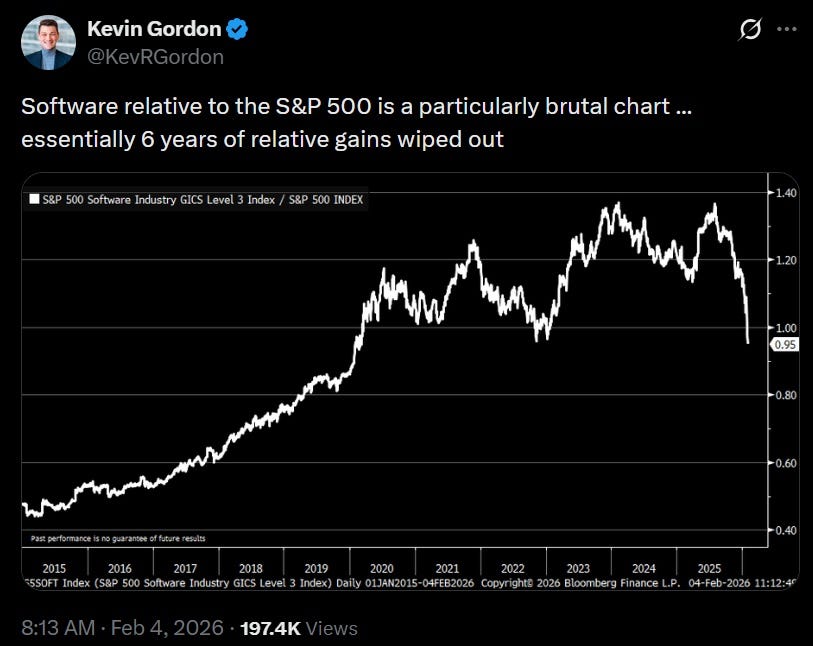
Software stocks crashed today. It’s never possible to be sure why something like that happens — this selloff may even be irrational — but everyone seems to agree that it’s being driven by the fear that AI is rendering a bunch of software business models obsolete. Here’s Bloomberg:
In the span of two days, hundreds of billions of dollars were wiped off the value of stocks, bonds and loans of companies big and small across Silicon Valley. Software stocks were at the epicenter, plunging so much that the value of those tracked in an iShares ETF has now dropped almost $1 trillion over the past seven days…
[T]his drubbing…was triggered [by] concern that AI is on the verge of supplanting the business models of a wide swathe of companies that doomsayers have long predicted were at risk…
AI startup Anthropic PBC released a new tool for legal work, like reviewing contracts…The latest developments raise the specter that AI leaders will overtake established industry players in innovation.
[I]t took a wave of disappointing earnings reports, some improvements in AI models, and the release of a seemingly innocuous add-on from AI startup Anthropic to suddenly wake up investors en masse to the threat. The result has been the biggest stock selloff driven by the fear of AI displacement that markets have seen. And no stocks are hurting more than those of software-as-a-service (SaaS) companies…Few in the software and data spaces have been spared…Shares of software companies including Microsoft, Salesforce, Oracle, Intuit Inc. and AppLovin Corp. tumbled, dragging down the technology sector and weighing on the broader stock market.
Software company valuations are approaching the levels they hit at the trough of the 2022 crash. Nor is this part of a broader market downturn:
Essentially, modern software companies have a stable of human software engineers who implement some sort of task for a client — keeping track of their sales leads, or helping with tax preparation, etc. The client pays the software company a fee to maintain access to that stable of human engineers. They are experts — master craftsmen who draw on a mix of esoteric knowledge, hard-won experience, raw IQ, and access to a vast community of other experts. They are the master weavers, the master potters, the artisan blacksmiths of the modern age.
And like those predecessors 200 years ago, their skills are in the process of being rendered obsolete by automation. Just as a power loom allowed an unskilled peasant to make cloth almost as good as what a master weaver would make — and at a fraction of the price — new AI coding tools are making it possible for relatively unskilled workers to turn out vast reams of software that’s almost as good, and far cheaper, than what a master software engineer would make.
This is “vibe coding”. At first, AI served as a kind of fancy autocomplete for people who already knew how to write code. But with the release of more and more powerful tools like Anthropic’s Claude Code — which assigns an AI “agent” access to your files and lets it keep repeating its efforts until it achieves high-quality results — it’s now possible for complete novices to learn how to make functional applications in hours, simply by telling AIs what they want in English. As these tools continue to improve, the amount of detail and technical knowledge that a user will have to have in order to create a working application will approach zero; software will be conjured up rather than crafted. Executives are already talking about creating software businesses with zero software developers.
Even the world’s greatest engineers are increasingly leaning on AI. Here’s Andrej Karpathy:
Given the latest lift in LLM coding capability, like many others I rapidly went from about 80% manual+autocomplete coding and 20% agents in November to 80% agent coding and 20% edits+touchups in December. i.e. I really am mostly programming in English now, a bit sheepishly telling the LLM what code to write... in words. It hurts the ego a bit but the power to operate over software in large "code actions" is just too net useful, especially once you adapt to it, configure it, learn to use it, and wrap your head around what it can and cannot do. This is easily the biggest change to my basic coding workflow in ~2 decades of programming and it happened over the course of a few weeks.
Karpathy notes that vibe coding helped him realize how much drudgery is involved in traditional software engineering. Dina Bass noted the same thing in a recent post:
But a lot of modern coding is repetitive and time-consuming work that isn’t creative at all, he said. “Engineering isn’t always beautiful code. It’s drudgery,” [Jeff] Sandquist [of Walmart Global Tech] said. “If we can get that off people’s plates, there won’t be nostalgia for that.”
In other words, software engineering was probably less of a “creative class” job than we had allowed ourselves to believe, and more of a “routine cognitive” task — the kind that’s especially vulnerable to automation.
This does not mean there will be no work for people with expertise in software, or no role for businesses that provide software. Code created purely by vibes will usually still have weaknesses, because the humans telling the AIs what they want don’t understand enough to make proper requests. Their software will have security flaws, tech debt, etc. Humans who understand these concepts — who have a detailed, nuanced understanding of what software is supposed to do — will probably be somewhere in the loop to fix problems, maintain code bases, and provide advice to vibe coders (all using AI tools as well, of course). But what they do will simply be different from what software engineers did until just a few months ago. It will be much less of a craft, and much more like setting up and maintaining a factory full of machines.
A great deal of ink has been spilled over the question of whether AI will render human workers obsolete en masse. This question is both catastrophic and unknowable, which is why it’s such a favorite topic. But no one disputes that a new technology can render existing stocks of human capital — the reservoirs of skills and expertise that certain highly paid workers have built up painstakingly over their whole careers — obsolete overnight. It has happened before, and it is happening again now.
Whether AI will do the same to every engineering and scientific discipline is still very much up in the air. We may soon have “vibe physics theory”, “vibe electronics”, “vibe airframes”, and so on — or we may not, if AI hits technological limitations that are as poorly understood as its explosive rise. But it seems certain that although software is particularly amenable to automation by AI1, the current technological revolution is not done upending the lives of various types of technical experts.
It occurs to me that this represents something momentous — the end of an economic age. My entire life has been lived within a well-known story arc — the relentless rise, in both wealth and status, of a broad social class of technical professionals. That rainbow may now be at an end. The economic changes — not just on careers, education, and the distribution of wealth, but on the entire way our cities and national economies are organized — could be profound.
The human capital economy was the Revenge of the Nerds
“All of this wealth attracted a dragon” — The Hobbit
