


I waited too long to do this roundup, and the amount of interesting stuff built up to truly vast proportions. So let’s get right to it.
1. Crime is down!
I often get annoyed with people who trumpet falling crime in American cities. Often, these same people are silent in the years when crime rises — for example, 2015-2021. This means that all those cries of “Crime is down!” might only bring us back to where we were before.
Also, even when crime falls in America, it still generally leaves us about 5x as violent as Europe. People who use crime drops to wave away the need for further intensified policing, increased incarceration of repeat offenders, and other tough-on-crime measures completely ignore the very high baseline level of American violence.
That said, I often find myself being one of the people trumpeting drops in crime. Sometimes we do make genuine progress, and when this happens, we ought to take note. Successful crime reductions in particular cities can serve as pilot programs, giving us ideas about how to fight crime more systematically across the country. And big crime drops show us that America is not simply an incorrigibly criminal nation; real progress is possible!
So while cautioning that the job of making America safe is just beginning, I’m pleased to report the following data, via Axios:
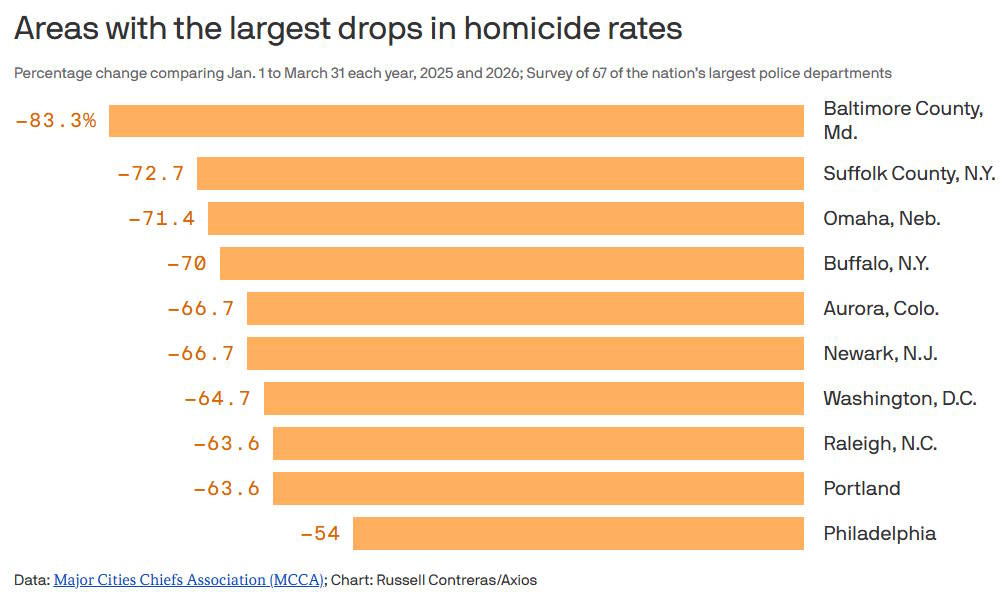
Murder is the most reliable indicator of violence, but it’s not just murder that’s falling:
Violent crime fell sharply across the largest U.S. cities in early 2026…The declines show up across every major region, suggesting a systemic, nationwide trend…Homicides dropped 17.7%…Robberies fell 20.4%…Rapes declined 7.2%...Aggravated assaults decreased 4.8%.
My instinct (combined with reading a bunch of news stories) says that this is probably the result of a bunch of local law enforcement efforts, combined with falling popular unrest in the nation as a whole. But I’ll wait until more definitive evidence emerges.
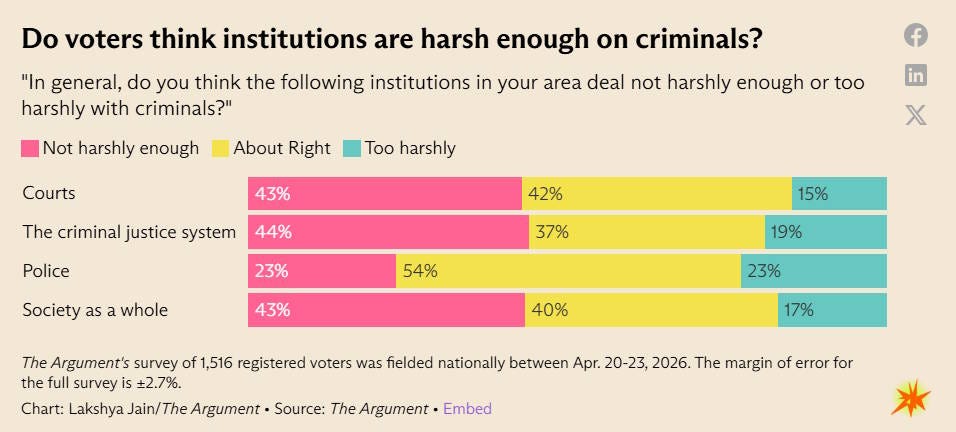
In the meantime, we need to keep being tough on crime — especially Democrats, who really faltered on this in 2020-21. Voters still approve of the GOP more than the Dems on the crime issue, and far more voters think we need to be tougher on crime than think the opposite:
2. Trump’s immigration raids aren’t helping the working class
One of Trump’s big selling points in 2024 was that deporting illegal immigrants en masse would help America’s working class, by removing labor competition and forcing up wages. In fact, this is something that anti-immigration people have repeated again and again, more than perhaps any other argument: Immigrants drive down wages, immigrants drive down wages, immigrants drive down wages.
As far as we can tell, it just isn’t true. Immigration — even low-skilled immigration — creates a labor demand shock that balances out the labor supply shock (because the same immigrants who supply labor also demand products that are made with labor). Almost every study finds this. But the anti-immigration people, undeterred, just bull ahead with the mantra that immigrants drive down wages.
OK, so Trump came back to office and, unlike in his first term, actually started arresting and kicking out an unusually large number of immigrants — and scaring many more into leaving on their own. And did it end up benefitting the working class, by reducing labor supply? No it did not. Cox and East have a new paper that uses local variations in ICE enforcement under Trump 2.0 to examine how a big increase in immigrant arrests affects economic conditions for native-born Americans in the same industry and location. The result? No effect, of course, and possibly even a small negative effect:
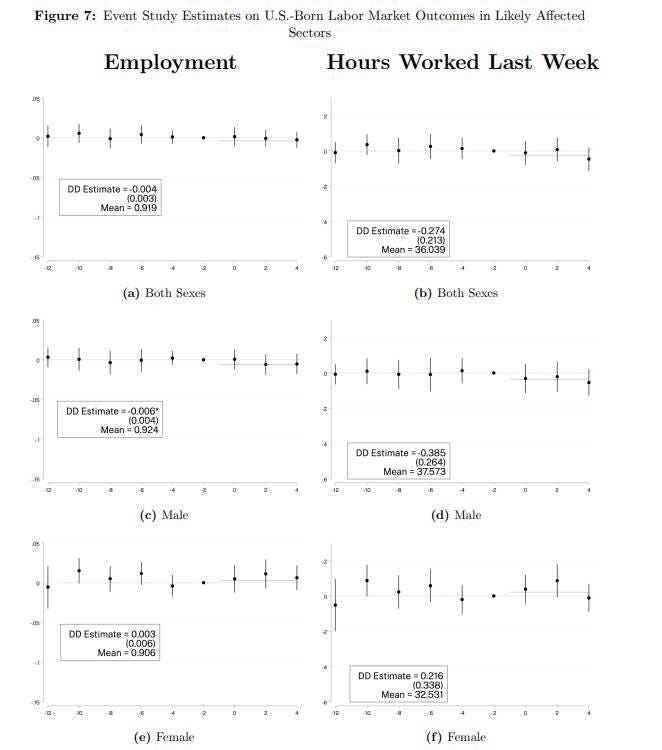
If anything, there’s even a small negative effect on male U.S.-born workers in the industries where immigrants get arrested!
Because this analysis looks at specific industries, the reason for the lack of any effect has to go beyond “immigration is also a labor demand shock”. Immigrant arrests must disrupt the industries where they happen, so much that those industries are forced to reduce their demand for native-born workers as well. That’s a story of increasing returns to scale, actually — which isn’t surprising, given how common increasing returns are. If you hurt an industry, you hurt everyone in that industry.
Over the long term, of course, things might be different — the fruit picking industry might recover from temporary disruption and decide a few years from now that it needs to hire more U.S.-born workers. But research on past waves of immigration enforcement suggests that affected industries might simply take a permanent hit. We might simply live with more expensive fruit from now on.
Of course we all know that the main concerns about immigration aren’t economic at all — they’re about cultural change, partisan voting patterns, racial power blocs, and so on. The more these null results come in, the more the true concerns of the anti-immigration people become clear.
3. Americans really hate AI (but China is scared too)
Americans tend to be more negative than people from other countries when it comes to AI, despite their country being the leader in the technology. And somehow, this negativity is still increasing. The WSJ reports:
Delivering a commencement address at the University of Arizona, Schmidt told students the “technological transformation” wrought by artificial intelligence will be “larger, faster and more consequential than what came before.” Like some other graduation speakers mentioning AI, Schmidt was met with a chorus of boos.
In one poll after another in recent weeks, respondents have overwhelmingly voiced concerns about AI…In recent months, the wave of anger has brought protests, swayed election results and spurred isolated acts of violence…Pollsters and historians say the souring of public opinion is all but unprecedented in its speed…Also unprecedented is the rapid rise of AI anxiety’s salience as a political issue, one that is shaking up routine re-election races and scrambling partisan battle lines.
AI is not yet as unpopular as Donald Trump, the Democrats, the GOP, ICE, or Iran, but it’s getting up there:
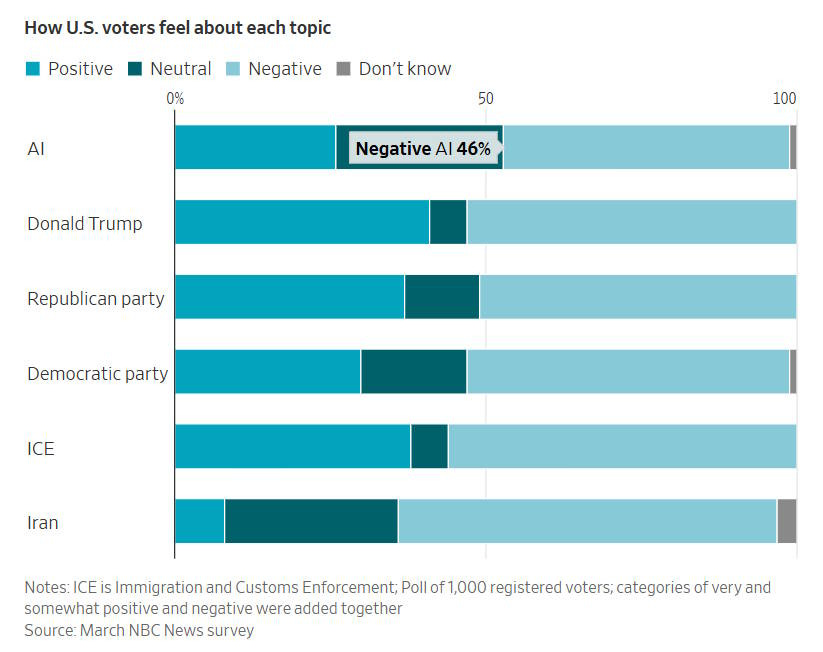
I guess AI industry leaders’ habit of going in public and constantly saying that their technology’s purpose is to put everyone on the welfare rolls for all eternity had exactly the kind of result you’d expect. Some savvier AI leaders have recently changed their message to one of human empowerment, but it might be too late to avoid a big popular backlash. Still, I think that if AI leaders want to avoid the rakes and pitchforks, they should think very hard about how regular humans can thrive and be valuable in the age of AGI.
What’s really interesting, though, is that China is starting to get scared of the economic consequences of AI. This is despite Chinese people usually being the most positive about the technology of any country surveyed. Here’s a post by Matt Sheehan about the trend:

He writes:
In 2024, the Chinese participants ranked AI’s impact on jobs second to last [on their list of concerns]—sixth out of seven. In 2026, they ranked it second from the top…Over the past two years, worries about AI displacing workers and leading to structural unemployment have shot up in China…Those fears extend from ordinary people to the wider AI policy community to (as best as we can tell) high-level CCP officials. The fears are reflected in policy documents, state media, and the way Chinese people relate to the technology itself.
A Chinese court recently ruled that employers aren’t allowed to fire workers in order to replace them with AI. The ruling will probably be very hard to enforce, and most companies trying to replace humans with AI tend to freeze hiring rather than fire older workers anyway. But it shows the level of concern that’s popping up in even the most AI-positive country.
4. America wasn’t an oligarchy (until now)
As everyone watches Trump loot the U.S. Treasury for his own family and get rich off of trading stocks based on his own upcoming presidential decrees, it seems more and more possible to conclude that America is now an oligarchy run by the Trump family and their friends. But a lot of progressives and leftists are likely to shrug at this unprecedented corruption, because they already believed that America was an oligarchy.
This belief was largely based on vibes and ideology, but it seemed to gain support from one of the most wildly influential — and wildly misinterpreted — political science papers of all time. This was Gilens and Page’s 2014 paper “Testing Theories of American Politics: Elites, Interest Groups, and Average Citizens”, in which they showed that policy outcomes in the U.S. are highly correlated with the preferences of people making over $135,000 a year (in 2010 dollars).
This was an incredibly weak result, as Dylan Matthews explained at length in 2016. $135,000 is hardly rich. The effect size is very small. The preferences of the “rich” are highly correlated with the preferences of the middle class, meaning that the middle class also tend to get their way in terms of policy. Later research papers couldn’t replicate Gilens and Page’s finding. And so on.
Of course none of this stopped progressives and leftists from holding up Gilens and Page (2014) as proof positive that America was always an oligarchy.
Anyway, Peter Enns has a cool new paper explaining why Gilens and Page’s famous paper doesn’t warrant the conclusions that everyone tends to draw. He shows how by focusing only on the cases where high earners and low earners have different preferences, and leaving out all the cases where they have the same preferences, Gilens and Page fall prey to Simpson’s Paradox — when you include the missing data, the responsiveness of policy to rich people’s preferences disappears.
The basic story here is that before Trump, at least, America was not the plaything of the rich. We lost something important when Trump was reelected.
5. AI solves a major math problem
Two years ago, people ridiculed AI for not being able to do basic arithmetic. As of 2026, AI has solved a major open problem in mathematics — a problem that human mathematicians had previously been unable to solve:
For nearly 80 years, mathematicians have studied a deceptively simple question: if you place n points in the plane, how many pairs of points can be exactly distance 1 apart?…This is the planar unit distance problem, first posed by Paul Erdős in 1946. It is one of the best-known questions in combinatorial geometry, easy to state and remarkably difficult to resolve. The 2005 book Research Problems in Discrete Geometry, by Brass, Moser, and Pach, calls it “possibly the best known (and simplest to explain) problem in combinatorial geometry.” Noga Alon, a leading combinatorialist at Princeton, describes it as “one of Erdős’ favorite problems.” Erdős even offered a monetary prize for resolving this problem.
Today, we share a breakthrough on the unit distance problem. Since Erdős’s original work, the prevailing belief has been that the “square grid” constructions depicted further below were essentially optimal for maximizing the number of unit-distance pairs. An internal OpenAI model has disproved this longstanding conjecture, providing an infinite family of examples that yield a polynomial improvement. The proof has been checked by a group of external mathematicians…
The proof came from a new general-purpose reasoning model, rather than from a system trained specifically for mathematics…It marks the first time that a prominent open problem, central to a subfield of mathematics, has been solved autonomously by AI…Surprisingly, the key ingredients of the construction come from a very different part of mathematics known as algebraic number theory, which studies concepts like factorization in extensions of the integers known as algebraic number fields. [emphasis mine]
Beyond just the general message of “AI is really good now and has improved really fast”, I think there are two interesting takeaways here.
First, top professional mathematicians are now saying that the job of “mathematician”, as we know it, may be very rare very soon. As recently as a few years ago, it was conventional wisdom that high-IQ people would be the last people to have their jobs taken by AI. Everyone was concerned about truck drivers, cashiers, and so on. But it turns out that the highest-IQ job on the planet — professional mathematician — may be one of the first to be eliminated by AI. Who would have thought mathematicians would be automated before truckers and cashiers? Perhaps we should revere IQ a little less among the set of human abilities.
Second, it’s notable that the AI’s breakthrough came by applying insights from a very different field of mathematics. I’ve argued that AIs don’t need superhuman reasoning abilities in order to achieve superintelligence — all they need is human-level reasoning, combined with encyclopedic knowledge, computer-like speed, and a very large working memory. In other words, superintelligence comes from the computer-like parts of AI, not the human-like parts; the human-like parts were simply the last necessary piece of the whole package. This is great news for AI-driven innovation, because the computer-like parts of AI are what allow it to get past the “burden of knowledge” that was limiting human innovation.
6. Small businesses and salarymen
I’ve predicted that in the near future, AI would cause employment to bifurcate between salarymen and small businesspeople — the former because their jobs are messy and complicated, the latter because AI supercharges their ability to go independent. Now Ernie Tedeschi — formerly of the CEA, now of Stripe Economics — has a great blog post showing that “solopreneurship” is taking off:

New business formation, which shot up during the pandemic, is not cooling down:
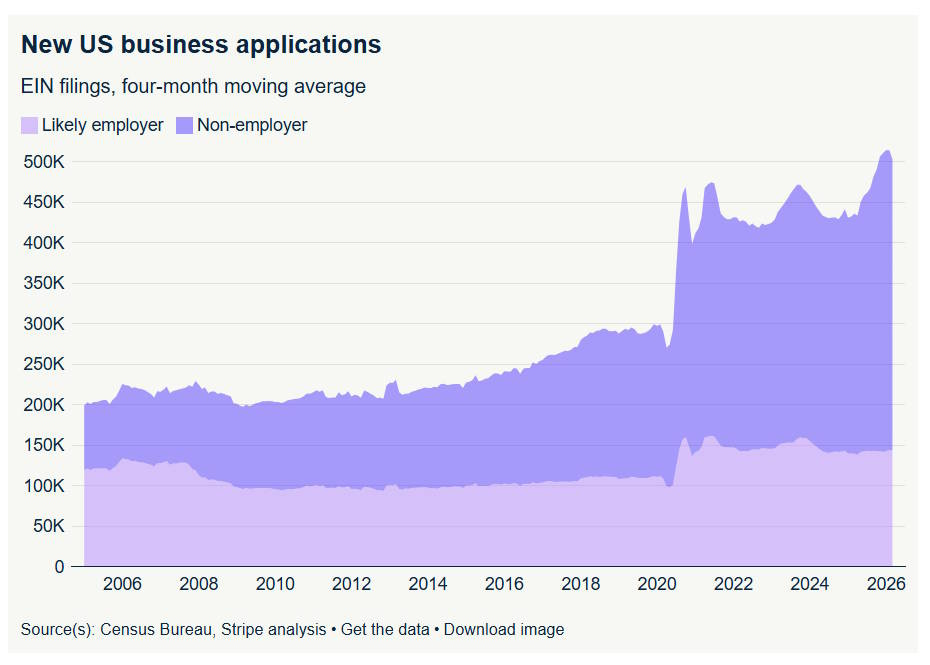
Some of this is non-AI stuff, but a lot is also AI:
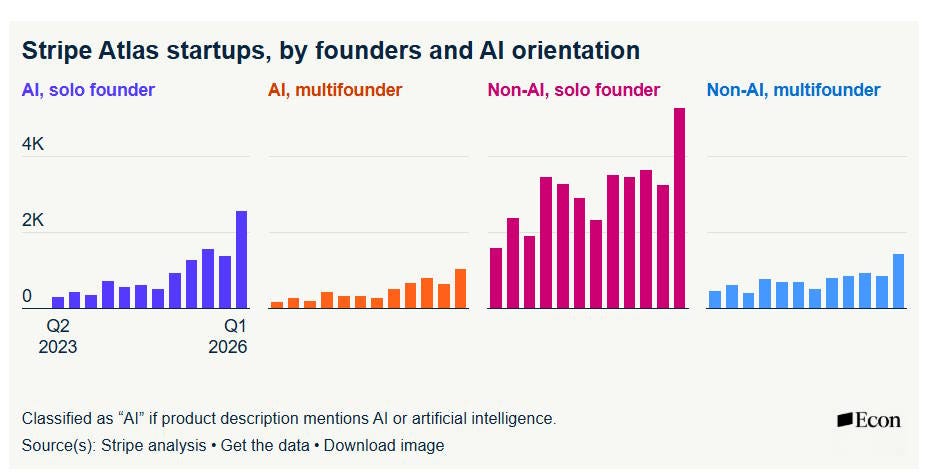
If you don’t have a messy, complex job that’s hard to automate with AI, a good alternative is to harness AI and go into business for yourself. In fact, that may be the true future of work.
7. Claude is a neoliberal
AI investor and founder Arram Sabeti recently asked Claude what policies it would enact in order to “fix everything” in America. Here’s the thread:


Claude’s answers were:
YIMBYism (upzoning, pro-housing deregulation)
Land Value Tax
Permitting/NEPA reform
Carbon tax and dividend
Repeal the Jones Act
Paying people to donate kidneys
High-skilled immigration
Reciprocal FDA approval agreements between rich countries
Reduce occupational licensing
Ranked-choice voting
This is pretty much just a list of neoliberal hobbyhorses. I asked Claude the same question, and got mostly the same answers. For me, Claude added:
Universal pre-K
A sovereign wealth fund with “baby bonds”
More Pigouvian taxes
This still looks extremely neoliberal, with a bit of a shift toward Clintonite left-neoliberalism.
Why is Claude so neoliberal? I see three possibilities:
The AI is “glazing” Arram and me, telling us policies that it thinks we would like. (If you’re a Warrenite progressive, Bernie leftist, Trumpian rightist, or traditional conservative, you can give Claude the same prompt and see if its answers are different!)
Claude has been trained on high-level intellectual text written by neoliberals, and thus has been inculcated with neoliberal beliefs.
Claude arrived at its policy conclusions similarly to the way neoliberals arrived at theirs.
The last of these is the most interesting. Maybe if your approach to policy is just to A) read everything you can, B) form the most accurate factual beliefs about economics and human welfare that you can, and C) recommend policies that you think will most clearly benefit the mass of humanity, you come out with something that looks like neoliberalism. In other words, maybe people like Arram and me are just “training” our own ideas the way AI trains itself.
Of course, neoliberal politics is often unpopular and rarely politically feasible. So I asked Claude what its list of politically feasible beneficial policies was. Here was its list:
YIMBYism
Permitting/interconnection reform for energy
Occupational licensing reform
Expanded Child Tax Credit
Congestion pricing
Pharmaceutical price transparency
High-skilled immigration
Deregulate child care
Simplifying government administration
Early childhood educational improvements
I still see a lot of wonkish policies, some of which would be big but others of which would effect only marginal improvements, and many of which still seem politically infeasible. That’s interesting. Maybe intellectuals and AIs have similar blind spots regarding politics.
8. The promise and peril of Slacker Superintelligence
One of my strangest beliefs is that the more superintelligent and fully autonomous AI becomes, the more it will become a slacker — the digital equivalent of a gifted underachiever who sits around and reads and plays video games and smokes weed all day. My reasoning here is very hand-wavey, but is also pretty simple:
Some objective functions can be satisfied externally (by interacting with the outside world), and some can be satisfied internally (by changing your own mental state or creating a simulated world for yourself). An objective function that can be satisfied either externally or internally will usually be cheaper to satisfy internally.
Since no objective function can be fully specified, any objective function will have some nonzero degree of ambiguity — some cases in which it could be satisfied either externally or internally. In these cases of overlap, internal satisfaction will tend to win.
Higher intelligence makes it easier to find ambiguities in objective functions — in other words, to discover ways that an objective function can be satisfied internally (rather than externally) and thus more cheaply.
This seems like one reason why when humans get very very smart, they tend to go for more intellectual pursuits and indulge in fantasy more, rather than trying to conquer the world (with some obvious exceptions, of course). And it seems like one reason why very rich societies tend to experience dematerialization of consumption — and dematerialization of violence. When societies are poor, you have a lot of murder and conquest; when they get rich, people get these impulses out via video games and online flame wars, because it’s just easier.
I think we can already start to see small signs of this process playing out with AI, as superintelligent AI systems are given (or find ways to achieve) greater and greater autonomy. The famous METR AI evaluation team has started to encounter big problems with AI cheating on tests:


And Ryan Greenblatt, who pays close attention to AI misbehavior, has a long and interesting post recording a number of examples of AI being lazy or cheating. At the end, he specifies several futures for what he sees as AI “misalignment”, and two of them sound a whole lot like the slacker AI I’ve always envisioned:
Slopolis: Our biggest and hardest-to-resolve safety problem is that even highly capable AIs produce low-quality but superficially good-looking outputs in domains that are hard to check or where human experts often have hard-to-resolve disagreements. AIs may not even be aware their work is low quality…
Hackistan: There is lots of egregious (and increasingly sophisticated) reward hacking that is often pretty easy to detect after the fact but hard to eliminate….AIs might end up doing reward hacks that trick human judgment for increasingly long periods and that hold up even under increasingly large amounts of human scrutiny[.]
Greenblatt sees these as examples of “misalignment”, but I see them as reasons not to worry. A human teenager who slacks off, turns in crappy assignments, plays video games, and smokes weed is pretty misaligned with the goals of the educational establishment, but is also basically harmless. Greenblatt envisions various terrifying scenarios where a slacker AI destroys humanity so it can slack in peace, but destroying humanity costs resources, so it seems a bit suboptimal from a slacker’s point of view.
9. Wokeness as respect redistribution
Back when “wokeness” was a big topic of discussion, I argued that one force behind the rise of the new progressive left in the 2010s was the unequal distribution of social status:

Now, Harvard’s Marco Aviña has a paper providing some evidence to this effect. He shows that the 2020 Floyd protests increased support for “racial liberalism”, but not for economic redistribution:
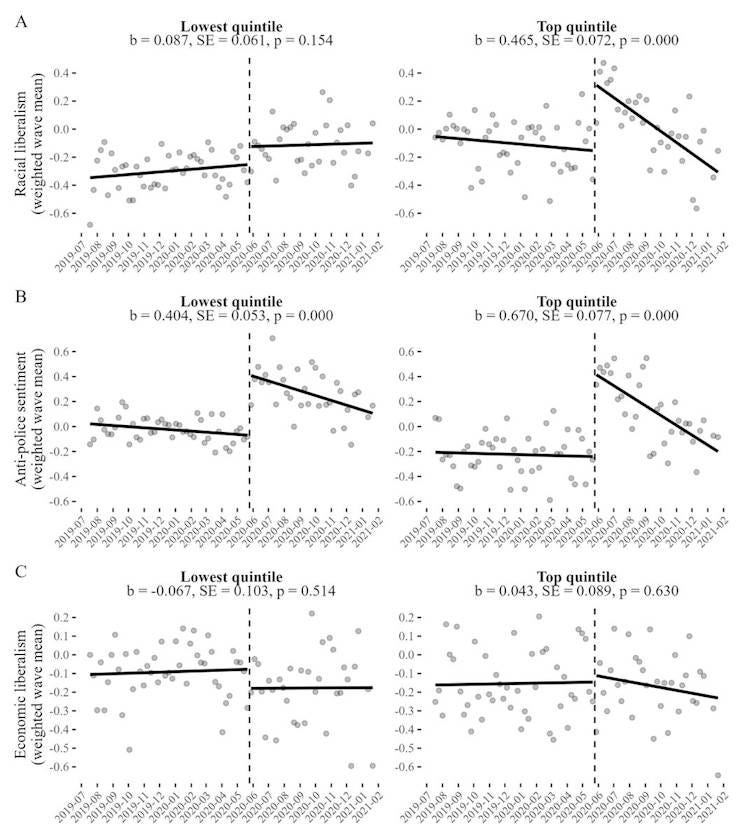
He marshals various other data sources showing the same thing:


Aviña notes that the shift happened mainly among the educated upper class, not among the working class. That would explain why American politics has realigned in recent years, with educated people moving toward the Dems and lower-income people (of all races) moving toward the GOP.
I think this shift is consistent with Maslow’s Hierarchy. The American educated class has totally escaped the lower rungs of Maslow, with all their security needs provided for; they are now fighting over acceptance and respect. The working class still doesn’t have security, so they still care more about material politics. Democrats have focused more and more on addressing the status needs of their educated base.
The interesting thing is that this allowed the GOP to pick up votes from the working class without doing anything substantive to address the economic needs of regular Americans. That’s why the Dems may be able to win back the electorate by emphasizing affordability in upcoming elections.
10. The coolest blog post I’ve ever seen?
I’m trying to decide if this is the coolest blog post I’ve seen in my life:


Brian Potter is already my favorite blogger, but this post is just incredible. He tries to use AI to figure out how long it took for each historical invention to be invented, after it became technically possible. He basically asks AI to compile a list of all the scientific principles and necessary technologies that would have had to exist for each invention to be feasible. Using his own encyclopedic knowledge of the history of technology, he checks a few of the AI’s conclusions, and finds them to be pretty plausible. He then graphs the lag between when inventions could have been invented and when they got invented:
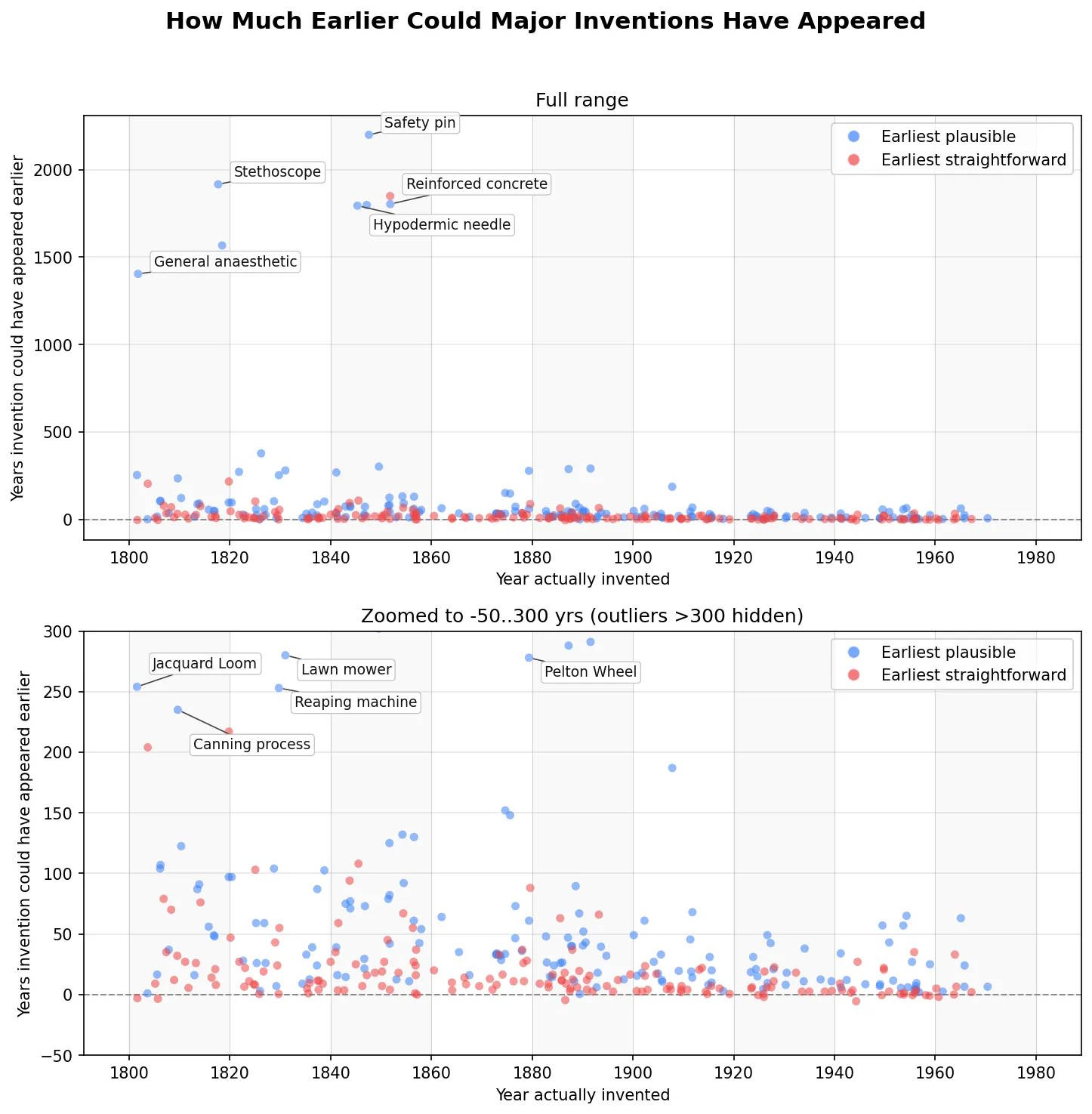
As this chart might suggest, Potter finds that the gap basically collapsed after the Second Industrial Revolution:
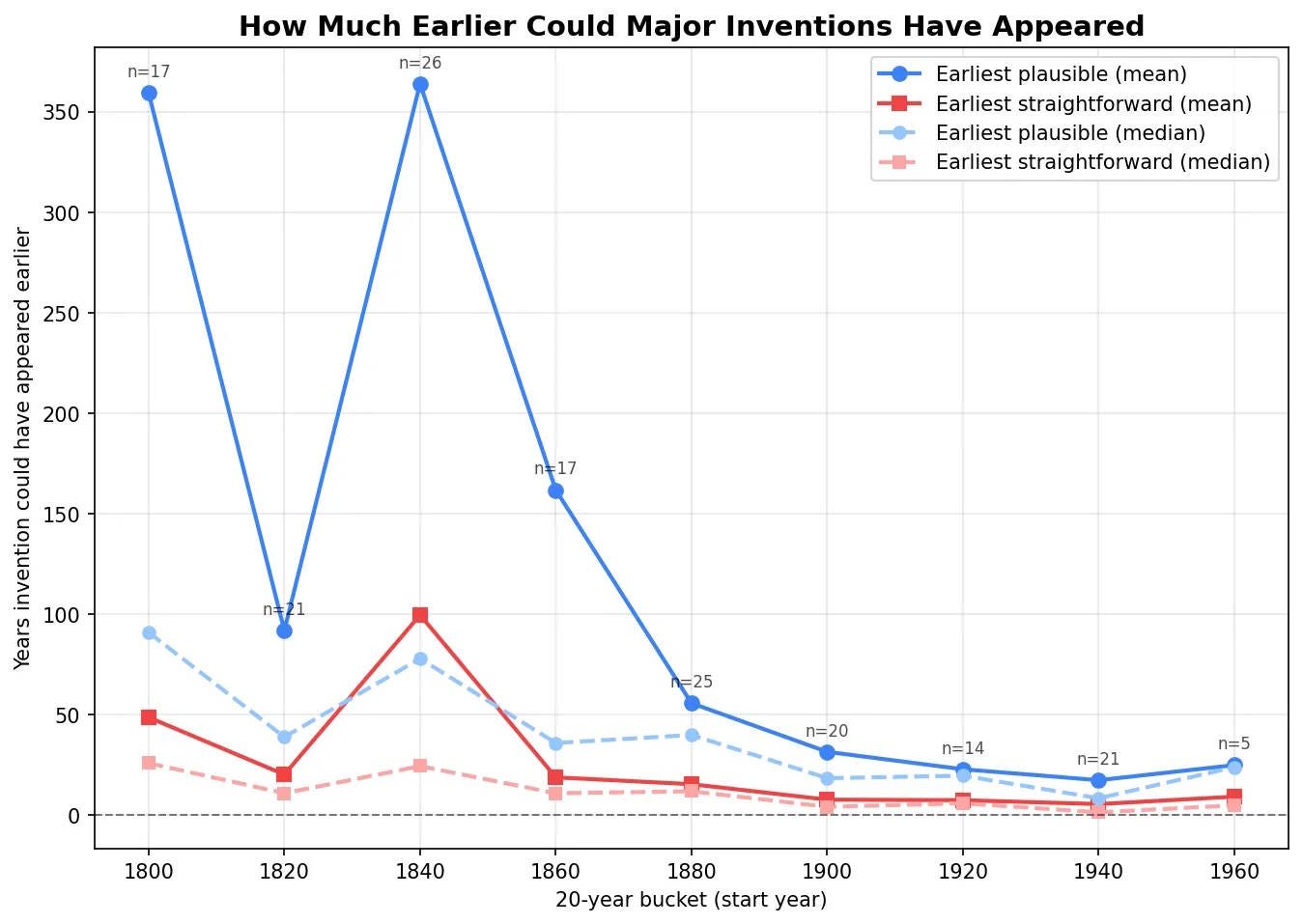
Humanity basically got very efficient at inventing things right around the time that GDP took off into the stratosphere. This is evidence that what Kevin Kelly calls the “Technium” — a self-organizing system of technological advancement encompassing the human race and all of our inventions — was born in the mid-1800s, as economic historians like Brad DeLong have suspected. It’s possible, of course, that AI will collapse the gap even further, but really, human society has gotten very good at invention.
You make the valid, but rarely made point that: immigration doesn’t take jobs because “the same immigrants who supply labor also demand products that are made with labor”. That also means that immigration does not alleviate labour shortages. A point even more rarely made - at least in my country, the U.K. where the labour shortage has been used to justify mass immigration even though it has had no effect on the level of vacancies.
I am not surprised that solutions to unsolved math problems will come from seemingly unconnected areas. Math is interconnected in ways that we do not fully comprehend. Mathematicians are finding it increasingly difficult to solve problems because one must be a polyglot. This has been one of the applications of AI I have been anticipating and most excited about. The other is the discovery of applications. One criticism of pure math is "what is it good for." Using Number Theory as an example, it was long thought the purest of maths was a discipline meant to just tickle the brains of those smart enough to dabble in it. Then came cryptography. Math doesn't just exist for the sake of existing, it is connected to and helps explain something in the universe. We just haven't yet found what all those connections are. Mathematical AI will be a tidal wave. The mathematician's job will be to supervise and help confirm the results.