

As regular readers of this blog know, I’m pretty ambivalent about trade barriers as an economic policy. On one hand I think targeted tariffs and other trade barriers can be used to protect strategic industries from surges in underpriced import competition, especially by geopolitical rivals. On the other hand, broad tariffs like the ones Trump has used are generally bad — they hurt domestic manufacturing by making intermediate goods more expensive, they limit scale for domestic companies, etc.
And yet I do think that Europe should erect much higher trade barriers — both tariffs and non-tariff barriers — against Chinese high-tech manufactured export goods. The basic reason is that it’s important to protect Europe’s nascent modern defense industry. But I also think that blocking Chinese exports might nudge China to change its economic model to one that benefits regular Chinese people more.
In other words, China-Europe trade has some unusual characteristics right now that make trade barriers a much smarter idea than usual.
First, let’s talk about what’s going on with the Chinese economy. For the past few years, China’s government has unleashed an unprecedented torrent of subsidies for high-tech manufacturing industries. This — along with structural factors about how the Chinese economy works — has resulted in China making big global market share gains in industries like autos, pharmaceuticals, and shipbuilding. No one knows just how much of China’s market share gains are a result of government support, but as Paul Hannon reports, the OECD estimates that it’s more than half:
Government subsidies have driven most of the increase in the global market share of Chinese businesses over the past two decades as they have received three to eight times more support than their competitors, the Organisation for Economic Cooperation and Development said Monday…The analysis is based on the OECD’s Manufacturing Groups and Industrial Corporations database, which includes subsidy estimates and financial information for 525 of the world’s largest manufacturing groups spread across 15 key industrial sectors…[T]he OECD database tracks the amounts that firms are actually given…
“Industrial firms based in China receive more subsidies than their competitors based everywhere else,” the OECD said…For Chinese businesses, however, the share of [market share] gains explained by subsidies was…60%.
The Rhodium Group has a deeper dive into China’s new industrial policy. Essentially, instead of selecting a few industries to specialize in, China’s leaders just want the country to dominate everything — not just manufacturing, but services as well:
China’s industrial strategy…is becoming more systemic and pervasive, extending across all layers of production, from upstream inputs and industrial equipment to downstream applications, services, and frontier technologies…China’s next-generation industrial policy represents a shift from targeted sectoral intervention to what can be described as an “industrial policy of everything.”…While [Made in China 2025] focused on a defined set of strategic emerging industries, current policy frameworks extend across mature sectors, foundational supply chain nodes, and frontier technologies alike…
Even in mature industries facing overcapacity and severe price pressures, Beijing is providing continued support and pushing firms to upgrade production technologies to gain market share and lower production costs, rather than cutting capacity…Services, relatively neglected in earlier rounds of industrial policy, are getting more attention[.]
Basically, China does not want1 to exist in a trading system, where goods are traded for other goods. China wants to make all the goods, and have other countries pay for those goods with debt.
There are two basic reasons China is doing this. The first is pure mercantilism; China is trying to export its way out of the economic slump created by its housing bust. The second, as the Rhodium Group report explains, is power. If China controls key segments of other countries’ supply chains, it can use the threat of export controls to bring those countries to heel.
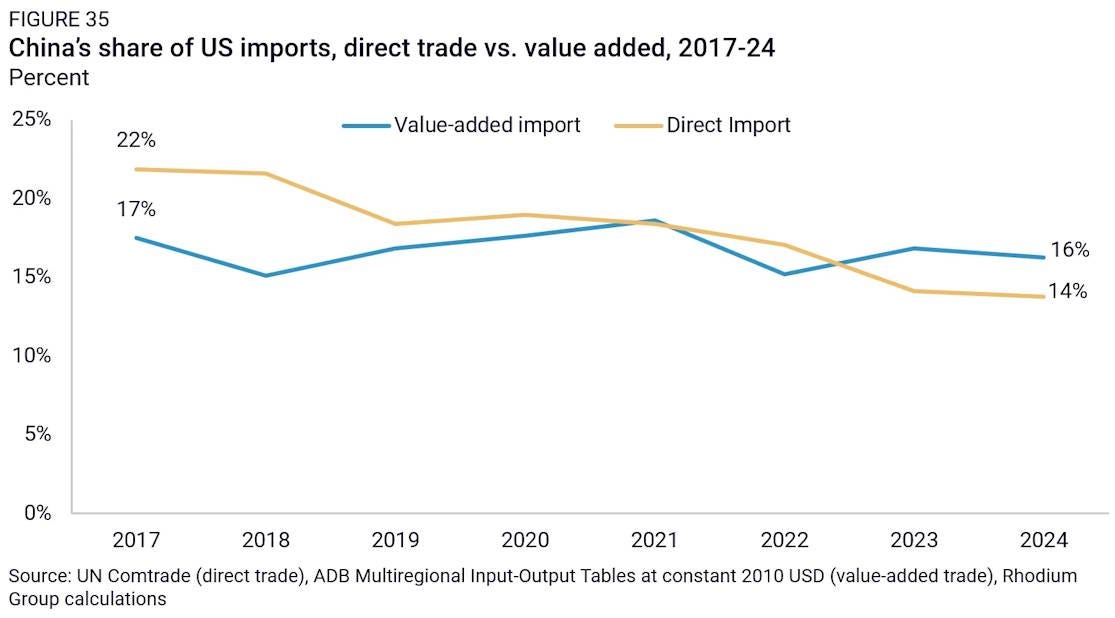
What should other countries do about this? The U.S. has chosen to respond with tariffs. These are of limited effectiveness, but they do appear to be doing something; even when you take into account the intermediate goods that China exports to America via third countries like Vietnam and Mexico, China’s share of America’s imports has fallen slightly from 2021 (or from 2017):
There are almost certainly much more effective tools that the U.S. could use to accelerate the decoupling of the two economies and reduce dependence on China…but since when has U.S. policy been driven by a desire for effectiveness?
The question is now what Europe and other developed countries — who have marginally more rational decision-making processes — are going to do about China’s attempt to dominate all tradable industries. One proposal — which Germany seems to be following so far — is to do nothing, and to simply let China make all the physical objects in the world, while focusing on services instead. This is essentially the proposal of Tej Parikh, who writes that China “has a comparative advantage in industrial policy itself”, and that trying to compete with China in any manufacturing industry is therefore doomed to fail.
This annoys me, because it represents a deep misunderstanding of the entire concept of comparative advantage! The theory of comparative advantage is about traded goods; it’s about which traded goods can be produced relatively more cheaply by which countries. If I’m better at making TVs than cars, and you’re better at making cars than TVs, then I’ll make TVs and you’ll make cars and then we’ll trade. That’s how comparative advantage works. This is why you cannot have a “comparative advantage in industrial policy”. Industrial policy is a production input, not a traded good. No one buys and sells industrial policy!
“OK, Noah,” you’re about to say. “Stop being a pedant. You know what he means. He means China is better at making anything and everything, because they use industrial policy for everything.”
Yes, I know that’s what he means. And yes, this reflects a deep misunderstanding of the concept of comparative advantage.2 Even if one country is better at making everything, it doesn’t have a comparative advantage in everything. That’s impossible. Every country has a comparative advantage at something!
That’s why in the theory of comparative advantage, trade is balanced. In the real world, China’s massive trade surplus means that trade is not balanced; much of the time, China isn’t trading goods for other goods, it’s trading goods for IOUs. That kind of unbalanced trade is something that just doesn’t happen in the theory of comparative advantage.
OK, so that was a bit of a rant. The real point here is that Parikh’s preferred solution — that every country except China should focus on innovation, and leave the making of everything to the Chinese — is simply ridiculous. First of all, it doesn’t deal at all with the issue of supply chain vulnerabilities. Second of all, China has an industrial policy for innovation, too — in fact, it’s China’s most important industrial policy. The idea of “We’ll do the innovation while China makes everything” sounds straight out of 2002 — and it was obviously wrong even back then.
The cold, hard fact is that Europe needs to do something, or risk losing its sovereignty to foreign conquerors. China — the very country that Europe’s free-traders are now suggesting should supply every single manufactured good — is waging a proxy war against Europe even as we speak. China trains Russian soldiers, provides Russia with battlefield intelligence in its war against Ukraine, helps out Russian defense manufacturers, and even does some defense manufacturing for Russia — in addition to buying Russian oil and keeping the Russian economy afloat.
And this is all while Russia is actively threatening to invade the EU. If Russia eventually does invade, Europe will need to make large amounts of drones to resist the invasion. All militaries that are not centered around large masses of drones are now obsolete — when NATO conducts war games against drone-equipped Ukrainian units, the Ukrainians easily triumph.
But both Europe and Ukraine cannot currently make drones from scratch without relying on Chinese industry. Many of the components and materials that go into making a drone are controlled by China — things like radio modules, lithium-ion batteries, electric motors, navigation cameras, and even carbon frames. Europe cannot currently make these — or can’t make many of them, at least.
If Russia were to invade Europe, China could simply decide not to sell Europe the components it needs to make drones. Why wouldn’t it? China has already proven itself perfectly willing to use export controls on rare earths and other upstream technologies to throttle other countries’ defense industries. And a Europe cowed and dominated by China’s most important ally would probably be more useful to Xi Jinping than a free and independent Europe that steers its own destiny.
If Russia invaded Europe and China simultaneously halted the export of drone components, Europe would be a lost cause. Unless Europe could assemble upstream industries for drone components from scratch before Russia’s drone-equipped armies marched across the Baltics and into Poland, the war would quickly be lost for lack of weapons.
Whether they realize it yet or not, Europe’s dependence on China for the manufacture of many key defense inputs puts it at China’s mercy. This is a downside to free trade that the folks who advocate a European retreat from manufacturing simply fail to engage with or acknowledge. It provides a strong rationale for putting up trade barriers against the import of certain intermediate goods — something that harms economic efficiency, but is necessary for defense.
When invading armies are burning your country to the ground, you should worry less about deadweight loss than about being dead.
But those who wring their hands about the economic losses should take heart. Blocking the import of Chinese goods might harm economic efficiency, but it could have some positive knock-on effects in terms of political economy.
For all China’s high-tech wizardry, its big industrial policy push doesn’t seem to be doing much to help the actual people of China.
The real estate industry, which previously created plenty of labor demand and broad-based wealth for regular Chinese people, is still in the dumps and may even be getting worse. The continued property bust is weighing on aggregate demand — Fixed-asset investment is shrinking, while retail sales have flatlined.
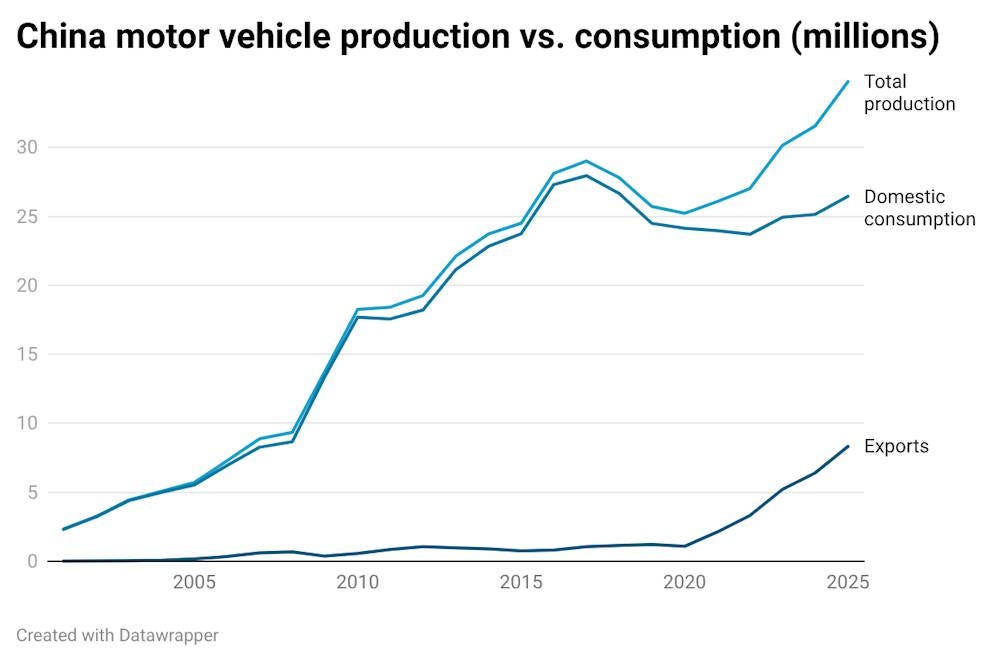
“Industrial policy for everything” was supposed to fill the hole left by real estate, but it isn’t doing a very good job of it. Because the rise in Chinese manufacturing output is being done mostly for export, regular Chinese people aren’t able to share in the bounty the policies are creating. For example, Chinese motor vehicle consumption is below where it was a decade ago, despite surging exports:
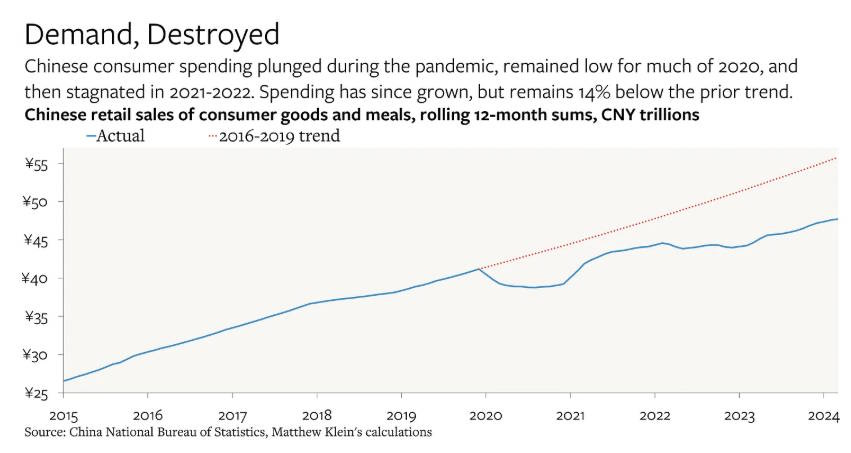
In fact, this shift dates back to the pandemic. Matt C. Klein has a good series of charts on China’s anemic consumption. Here’s an example:
This is often framed as China helping producers at the expense of consumers. But often it’s not even that. China’s industrial subsidies pay a bunch of different companies to produce the same goods, competing their profits to zero even as they also undercut the overseas competition. A prime example of this is the solar industry:
China’s solar exports have enjoyed a surge since the bombing [of Iran] began. But that will be small cheer to its companies…Domestic demand for their products is falling for the first time in decades because the country’s power grids—far and away the biggest market for solar panels—have become overloaded with the things. Solar-panel supply, meanwhile, is overabundant because of years of splashy investment in factories…Most companies have been running at a loss since 2024 because of brutal price wars; bankruptcies are mounting.
But it’s not just undifferentiated commodity products like solar that are suffering this fate; China’s vaunted auto industry, which came out of nowhere to leapfrog all other countries with its mastery of EVs, is locked in an endless brutal price war:
China’s efforts to cool its automotive price war are faltering as BYD Co. and rivals expand discounts to avoid ceding ground in the world’s largest car market…The average price reduction for BYD cars accelerated to 10% in March…Discounts by competitors…also edged higher…Regulators’ missives aimed at halting deflationary momentum have fallen on deaf ears so far, and industry observers say it won’t stop the discounting trend anytime soon.
China’s industrial policy is accomplishing its central goal of national greatness. China’s technology level is advancing, its companies are winning global market share, and it’s gaining control over key strategic technological choke points. But China’s workers, its savers, its investors, and even its entrepreneurs are on a treadmill, unable to enjoy the fruits of their country’s industrial dominance.
European trade barriers could potentially nudge China out of this toxic political economy. If Xi Jinping & co. see that they can’t forcibly deindustrialize the West by subsidizing infinite exports, their cost-benefit calculations may shift. Providing growing living standards for Chinese people might once again become the central goal of policy, as it was during the time of Deng Xiaoping, Jiang Zemin, and Hu Jintao.
So Europe should push back against the Chinese import flood, not just for their own security, but also for the sake of regular Chinese people. Fortunately, there are indications that European leaders have had enough of Xi’s little game, and are preparing to take real action. Hopefully this newfound resolve doesn’t get lost in the maze of European bureaucracy and inertia like so many other worthwhile initiatives.
This is a colloquial expression. Countries don’t want things; I’m taking about what the Chinese government, or at least Xi Jinping, wants for China.
Parikh is confusing comparative advantage with something called “competitive advantage”. In the theory of comparative advantage, competitive advantage — who makes which good more cheaply in the absolute sense — doesn’t end up mattering for the patterns of international trade. That’s why the theory is so brilliantly counterintuitive.
Noah, why do economists constantly ignore Wright’s Law and learning curves?
Manufacturing scales on learning curves; services and farming don’t. That alone makes manufacturing fundamentally special. Some economists seem skeptical that these curves even exist. I own two manufacturing companies, and I’d literally bet my life they do. And if we accept that they exist, doesn't that break the standard assumptions about free trade? If one country captures all the volume, they capture the entire learning curve and inevitably dominate the global market.
Look at Ricardo’s classic comparative advantage example. If it’s wine vs. cloth, you obviously want the cloth. Textile production has a learning curve and massive technological spillovers (the Jacquard loom literally led to the first computers). Wine doesn't. If Portugal had all the looms and the Brit’s had all the wine and farming, I think we would live in a much different world today.
Comparative advantage assumes efficiency is static. If Portugal starts out better at both, but Britain gets all the cloth production, a 10% learning curve changes everything. Give it ten years, and Britain gains an absolute advantage, swamps Portugal with cheap textiles, and wipes out their manufacturing base. Meanwhile, wine just stays wine.
This isn't an argument for pure mercantilism. Free trade between peers like the US, Europe, and Japan works because we trade advanced goods back and forth. We scale in different subcomponents without anyone trying to monopolize the entire global learning curve. But the idea that we should just surrender an entire industry like autos because another country is slightly more efficient is suicidal. You lose all the technological spillovers, and once you lose the manufacturing base they’re almost impossible to restart so the company that has them can own you. You have to separate high learning curve products from low ones. If a rival country aggressively targets all the learning curves and only buys our agriculture in return, that is a terrible deal. Who cares if they buy our soybeans? Soybeans don't have learning curves. When a country tries to capture the entire market for the things that actually matter, you have to throw up protectionist walls.
I’d love to see you write an article on learning curves and how they have the potential to break the rules of comparative advantage in some situations. Seems like that’s a more straightforward explanation of why a ricardian framework is wrong here.
I could agree with the analysis for many sectors, like medicines, drone parts, other military or duel-use products, and transport vehicles, but for 15-year and 30-year investments like batteries and grid electronics and solar, Europe (and the rest of the world) should buy everything China can make at the below-cost prices which China's government-driven internal competition makes available.
Heavily subsidize European production so that you build fundamental industrial capacity, but flood the grid with Chinese solar and wind and batteries to reduce dependence on Middle Eastern (and U.S.) fossil fuels. China could cut off solar panel exports, but if you've already installed much of what you need for the next 30 years, there will be time to develop replacements.
And Europe should realize that it needs Ukrainian military capacity as much as Ukraine needs Europe's financial and military support.