


It has come to my attention that the noted political scientist Henry Farrell has been writing some very testy responses to me. The first two, in 2024, totally slipped by unnoticed:

Thanks to the rise of Substack Notes, however, I was able to see the most recent installment in the sequence, which is mostly a repost of the first installment:
I apologize for missing the first two when they came out, and I’ll try to respond to these as well. But first let me note that all three of Henry’s blog posts are responses to my review of the book Power and Progress, by Daron Acemoglu and Simon Johnson, which I first wrote in 2024 and then republished recently:

Power and Progress was a strong contender for the worst nonfiction book I’ve ever read all the way through,1 though of course that ranking suffers from selection bias, since I’ve quit many worse books before finishing. I feel an irrational need to somehow make up all the hours I spent reading this ultimately unenlightening tome, which is probably why I took the time to write a 7,000-word critical review. At the very least, I was able to have some fun critiquing some abstruse arguments by some highly influential authors. And thanks to Henry, I get to have even more fun arguing about someone else’s arguments about my arguments! Thank you, Henry! I’m getting steadily less regretful about making myself finish that book.
At this point, if you’re still reading this post, you’re probably asking “Why is this interesting to me, someone who has not read Power and Progress and have never heard anyone bring it up?”. Well, the honest answer is that it’s probably not interesting, and you should probably be taking care of a pet rabbit instead of reading this post. But I suppose there’s one reason it might be interesting, which is that over the past decade or so, a fairly large portion of the left-leaning intellectual class in America has become fairly-to-very resentful of the American tech industry, and has spent an enormous amount of intellectual effort on criticizing that industry. Both Power and Progress itself, and Henry’s defense of the book, channel those ideas and appeal to that sentiment.
The core conceit of anti-tech thought is that a class of wealthy industrialists — the “techbros”, if you will — is hurting society by building and investing in technologies that have major negative side effects, and that the solution is to bring these industries under greater democratic control. Regular readers will know that I actually agree with that idea, in some form. I’ve written at length about how the combination of smartphone and social media technology has broken many things about our society. I’ve expressed concern about the catastrophic risks associated with AI technology, and devoted a fair amount of thought to AI’s potential to cause radical inequality. And I’ve advocated for all of those risks and harms to be addressed with policy — policy enacted by a democratically elected government.
Yet despite this, Henry thinks of me as a panglossian techno-optimist:
Dr. Pangloss is the parodic Enlightenment thinker who keeps on insisting that everything is for the best in the best of all possible worlds, as disaster and catastrophe unfold around him…Noah’s style of economics has a blind spot about panopticons.
As far as I can tell, there are two reasons that Henry thinks this. One is that he thinks I discount the political and social downsides of ubiquitous digital surveillance:
The panopticon may indeed have efficiency benefits. People can get away with far less slacking, if it works as advertised. But it also comes with profound costs to human freedom. And the technologies that are at the heart of the book’s argument - machine learning and related algorithms - bear a strong and unfortunate resemblance to Bentham’s panopticon. They too, enable automated surveillance at scale, perhaps making hierarchy and intrusive surveillance much, much easier and cheaper than they used to be…
Nobody particularly wants to work in an environment where algorithms are perpetually surveilling them, deciding whether they are hired or fired, with little or no recourse to human decision makers. From the perspective of management, algorithmic bedshitting is wonderfully efficient! It costs less, and is much less of a pain in the ass. And if drivers have to piss into bottles in their vans because they fear being punished by the algorithms, then so be it. This is a cost that they pay, not investors, nor managers, nor customers. Of course, human beings who care about fairness and dignity and such are likely to have a different sets of responses.
Henry is chiefly worried not about the death of privacy in and of itself, but about how ubiquitous digital surveillance could enable greater political and social control. He is worried about Big Brother. Harsher monitoring of workers is one example of that, but it’s certainly not the only example — already, in China, we can see ubiquitous monitoring being used as a tool of social control, and it’s not good.
To be fair to Henry, he’s got me here. I do sometimes worry about the advent of ubiquitous surveillance, but I’ve never really thought systematically about it, or written about it in detail. This was partly because actually creating privacy in the modern age seems like a hopeless task; to a rounding error, all of American society has welcomed Big Brother into their pockets, turned on “track location”, accepted cookies, uploaded their nudes to Snapchat, poured out their deepest emotions over Gmail and Microsoft Teams and Zoom, installed Chinese webcams in their houses, and in general exposed every bit of their lives to a vast, impersonal machine that at some level is owned by Elon Musk, Jeff Bezos, Mark Zuckerberg, etc.
What can I say or do that would alter this brute fact — that humanity has once again chosen to give their lives over to the machine? Progressives have been howling about tech company surveillance for over a decade, but they all still have The iPhone in their pockets. Shoshana Zuboff wrote a book about surveillance capitalism, with the main result being that people can now remark that Shoshana Zuboff wrote a book about surveillance capitalism.2 Spending my days carefully considering the social downsides of the fact that everyone puts their whole existence online feels like shooting nerf darts at an oncoming freight train.
So to be fair to Henry here, this is an important topic, and I should think more about it. I promise to write at length about universal surveillance in the future. But to be fair to myself, Power and Progress doesn’t really focus on the danger of panopticons either. Despite Henry’s claim that Acemoglu and Johnson “invoke the metaphor of the panopticon early, and return to it, explicitly or implicitly, throughout”, they only discuss digital surveillance for three pages (pp. 320-322 in the hardcover), and they only talk about it in the context of intensive monitoring of workers. As far as I can tell, they never once address Henry’s core concern, which is that digital surveillance will lead to broad political disempowerment.
So I only feel a little bad about not mentioning that in my review.
Am I a toady for the techbros?
Anyway, in addition to not thinking enough about panopticons, Henry thinks that I am Panglossian because I am not sufficiently alarmed by the power and the malevolence of the techbro class:
Noah has spent quite a lot more time in Silicon Valley than I have. I’d be startled if he hasn’t repeatedly seen punters fawning over self-evidently idiotic ideas propounded with great confidence by Silicon Valley founders and VC stars. I’ve seen a remarkable amount of this meself - and I’m only in SV occasionally (of course, Washington DC, where I live, has its own versions of this pathology). One of the great virtues of Margaret O’Mara’s fantastic history of Silicon Valley, is that it discusses how hype and lobbying as well as technological advances helped get Silicon Valley up and running…As I read it, this dynamic is the engine that drives Acemoglu and Johnson’s book - but it doesn’t feature at all in Noah’s summary…
Acemoglu and Johnson’s core claims, as I read them are…That the debate about technology is dominated by techno-optimists…That this dominance can be traced back to the social influence and agenda setting power of a narrow elite of mostly very rich tech people…That their influence, if left unchecked, will lead to a trajectory of technological development in which aforementioned very rich tech people likely get even richer, but where things become increasingly not-so-great for everyone else…
According to e.g. Rob Reich, democracy itself is an unappealing notion to many key people in Silicon Valley. The trajectory of technology, politics and growth that they want to direct us toward is not one that I actually want to be on. And I suspect that if Noah thinks about it a little, it isn’t one that he wants to be on either.
Let us ignore for a moment the fact that Henry sees the political opinions of the techno-industrialists as an anti-democratic monolith as well as the patent absurdity of citing Robert Reich as an authority on those opinions. (Update: Fortunately, it turns out that this is NOT the Robert Reich who shouts badly supported progressive memes on social media, but a Stanford scholar who makes a living criticizing philanthropic activities by rich people. Whew!!) Instead, let us merely observe that Henry sees the techbros, collectively, as an enemy of democracy, dignity, freedom, and so forth.
Henry perceives me as being too trusting of, enamored with, or favorably disposed toward this class of people. You can tell this by the header image he used on his most recent post. It’s a screenshot of a tweet of mine from last year:
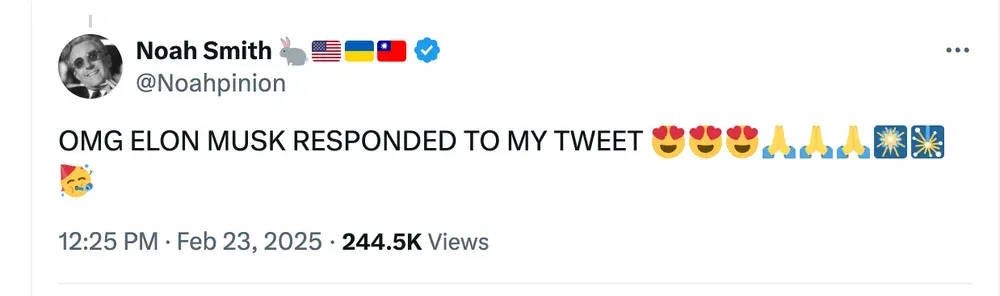
This screenshot makes it seem as if I am gushing with adulation for Elon Musk. But if you go to the actual tweet, you can see the context:
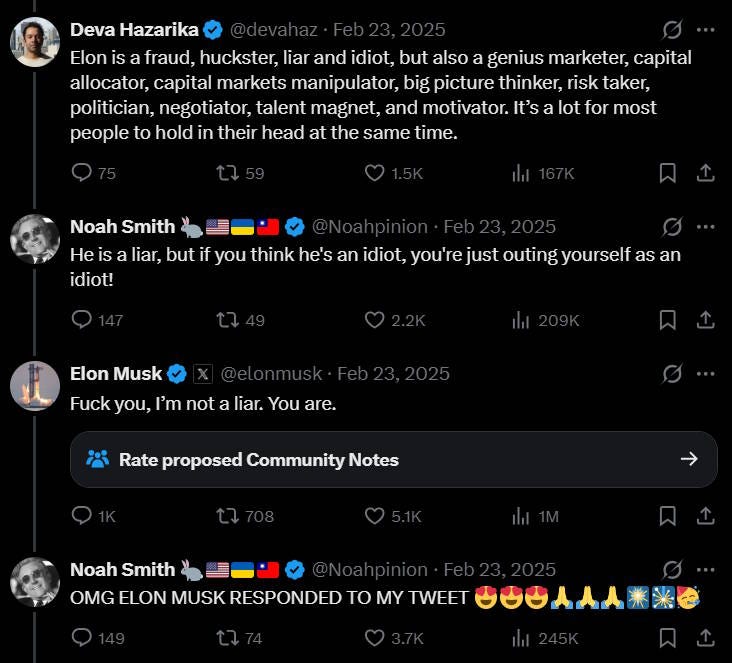
I will leave it to the reader to decide whether I was gushing with genuine adulation for a man who just told me “Fuck you” and called me a liar, or whether I was teasing the world’s richest industrialist for spending his time raging at bloggers on his own social media platform.
I doubt Henry Farrell actually saw the context of my tweet before he posted it. I know Henry fairly well; he is a good man, and not a malicious liar. He would not purposefully take a tweet out of context in order to falsely imply to his readers that I was gushing with adulation for Elon Musk. Instead, I strongly suspect that he saw someone else post that screenshot — probably on Bluesky or in some other lefty space — and simply assumed that it represented what whoever posted it wanted him to think it represented.
The reason I bring this up is not to execute a “gotcha” on Henry (though you have to admit, the full screenshot is kind of amusing). The reason I bring this up is to suggest that Henry’s perceptions of this debate are too clouded by class enmity toward the techno-industrialists and toward anyone who seems to make excuses or carry water for them.
I see this as symptomatic of a broader intellectual disease on the American left. Liberals have always been rightfully suspicious that the super-rich would use their wealth to sway political opinion. But before the 2016 election, attitudes toward tech companies were broadly benign on the left. What changed was the narrative that disinformation (“fake news”) on Facebook swung the election to Trump. An easy way to see the shift in sentiment is to look at New York Times coverage of Facebook before and after:
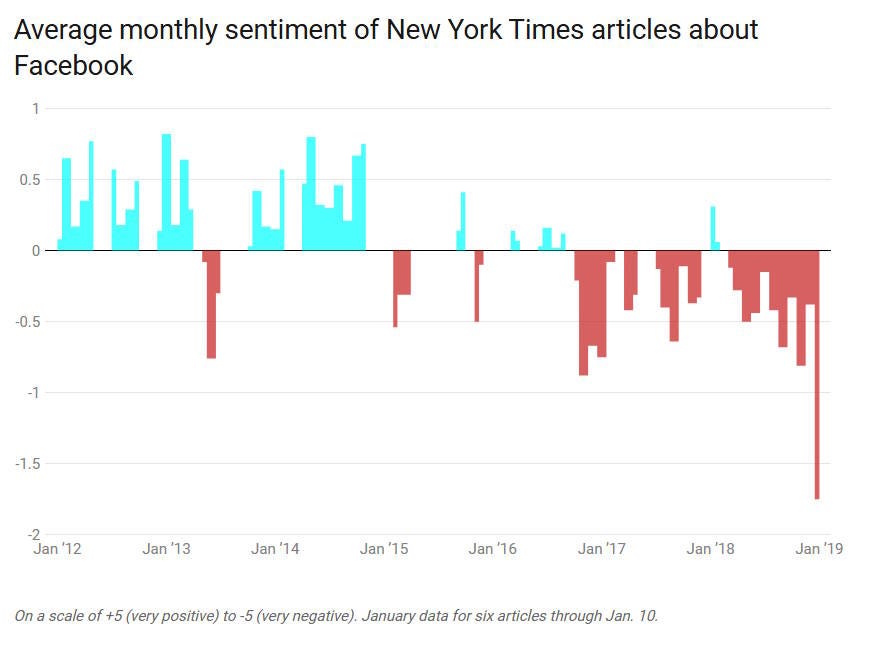
2016 was a trigger, but it wasn’t the sole cause of the breakup between lefty intellectuals and tech. There were many other forces pushing in that direction — conflicts over progressive values within tech companies, anger over rising rents due to tech companies moving into big cities, rich technocapitalists increasingly getting involved in policy through philanthropy and bumping up against existing players, and probably some resentment stirred by skyrocketing inequality among the educated classes.
The 2010s also saw the rise of the new antitrust movement — also called the New Brandeis movement — which made Big Tech its main target. The New Brandeisians explicitly framed antitrust as being about political power — the fear that companies would use their vast profits to buy elections and favorable legislation, or to influence society in other ways. The basic idea was to break up companies like Facebook not in order to reduce consumer prices, but in order to prevent those companies from destroying democracy. This approach didn’t win many victories against Big Tech in court — U.S. antitrust law doesn’t leave any room for breaking companies up for political reasons.3 But it did leave an intellectual legacy on the left.
Among many left-leaning intellectuals — if not among the general Democratic-voting public4 — animosity toward the techno-industrialist class has become utterly entrenched. You can go up to a liberal Resistance Mom in small-town Iowa and say you think Google and Amazon are great for America, and you’ll probably be fine. But if you say this at a lefty policy wonk conference, you will likely be immediately pegged as a toady for the techbros.
I believe that this class animosity has reached the point where it’s beginning to cloud some intellectuals’ judgement. Healthy suspicion of the influence of money in politics is one thing; seeing all of economic history as a clash between rich technologists and democracy is just silly. This, ultimately, was where Power and Progress failed as a book — it tried so hard to squeeze the entire history of technology into a post-2016 anti-techbro narrative that it ended up making numerous poorly supported claims and engaging in highly questionable historiography.
It also led to the book’s bizarre concept of “power”.
Why “power” shouldn’t mean “persuasiveness”
Most people would probably think that power involves the ability to coerce someone into doing something they don’t want to do — either to threaten them with violence, or to use your institutional authority to order them around, or something like that. If I convince you to change your mind, that doesn’t seem like power to me.
Except when Acemoglu and Johnson talk about the “power” that techno-industrialists wield, what they actually mean is persuasion. Here’s what I wrote in my book review:
The authors’ historical examples of [instances] when power determined the distribution of the benefits of technology include…the cotton gin increasing slaveowners’ profits in the American South, or lords extracting agricultural surplus from peasants in medieval Britain. These are instances of compulsion…
But Acemoglu and Johnson also spend a lot of time arguing that persuasion is also a form of power. They cite instances in which techno-optimists and businesspeople in 18th century England and 21st century America persuaded the public to enact pro-business policies, through articles, speeches, conversations, and so on…
The authors don’t venture to say exactly why these techno-optimists’ pro-business vision prevailed — they write that “an idea is more likely to spread if it is simple, is backed by a nice story, and has a ring of truth to it,” but they admit that “quite a bit of this process [of persuasion] is random,” and declare that “you are enormously lucky if you get the right idea, with just the right ring to it, at just the right time.”
I have to admit, this [explanation] kind of surprised me…For some reason, the techbros just wrote really good posts, and by doing so they ruled the world — at least until their luck ran out and the world turned against them, I suppose.
In fact, I have to confess that the entire chapter on power and persuasion left me bewildered. I do not understand why we should put accidental success in a nonviolent marketplace of ideas in the same conceptual category as chattel slavery and feudalism. It seems to yield neither understanding nor solutions. Perhaps the historical example of the cotton gin might give us some insight about how to explain the spread of laissez-faire economics, but simply labeling both things as varieties of “power” does not yield that insight. And the idea that persuasion is power doesn’t seem to suggest any kind of systemic fix for the problem that sometimes society is persuaded to do things that increase inequality.
It seems like Acemoglu and Johnson, confronting the question of why regular people bought iPhones and signed up for Facebook and shopped on Amazon and started talking to ChatGPT, simply decided that techbros must have tricked them into it.
It is this part of my review that Henry takes issue with, and which he spends most of his two posts attempting to rebut. So let’s address Henry’s criticisms.
Henry writes:
What Acemoglu and Robinson [sic] are saying is something quite different than what Noah depicts them as saying. For sure, they acknowledge that persuasion has some stochasticity. But they stress that it is not a series of haphazard accidents. Instead, under their argument, there are some kinds of people who are systematically more likely to succeed in getting their views listened to than other kinds of people. This asymmetry can reasonably be considered to be an asymmetry of power.
But did I really misinterpret what Acemoglu and Johnson wrote? Let me quote the book — specifically, the section “The Power of Ideas”, from pp. 72-74 of the hardcover edition:
Some ideas, especially when expressed in the right context and with conviction, have ample ability to convince. Ideas spread and become influential if they self-replicate, meaning if they convince and persuade many people, who then repeat and further propagate these concepts…All else equal, an idea is more likely to spread if it is simple, is backed by a nice story, and has a ring of truth to it. It also helps if it is advocated by individuals with the right type of social status—for example, those who have a demonstrated ability to lead and who are supported by respected cheerleaders, such as…finance and law school professors for Wall Street…
Where do compelling ideas come from? What determines whether an individual or group has the charisma or the resources to push such ideas? It is safe to say that quite a bit of this process is random. Creativity and talent matter, of course, and societies and their rules deeply influence who has social status and charisma and who can develop their talents and creativity…Prevailing beliefs and the attitudes of powerful individuals and organizations determine which ideas will appear compelling, rather than wacky or so ahead of their time as to be safely ignored. You are enormously lucky if you get the right idea, with just the right ring to it, at just the right time. [emphasis mine]
Acemoglu and Johnson state very clearly that:
The characteristics of ideas matter intrinsically, so that some ideas are inherently more persuasive than others.
Some part of the process of persuasion is due to luck — coming up with an inherently persuasive idea at the right time.
The authors clearly believe that persuasion is not entirely random; they believe that pre-existing hierarchies partially determine whose ideas get accepted. But at the same time, they believe that some part of persuasion — and therefore, some part of “power”, in their definition — is intrinsic to an idea itself, rather than to the status or authority of the person who comes up with an idea.
In other words, if I happened to write persuasively on my blog, and people listened to my ideas, then according to Acemoglu and Johnson I had power, despite my complete lack of institutional affiliation or status in any external hierarchy.
I argue that this is not a useful definition of power. If people’s position within some hierarchy or institution allows them to drown others out, so that only their voices get heard, then yes, that is a reasonable definition of power. But including coming up with inherently persuasive ideas in the definition of power seems pointless to me; it muddles two clearly distinct concepts together rather than separating and clarifying them.
It seems sort of like a definition intentionally designed to delegitimate consumer choice — to say that people bought iPhones and signed up for Facebook and shopped on Amazon and talked to ChatGPT because someone wielded power over them, rather than simply because they wanted to. And it seems like a definition designed to explain away the broad popularity of big tech companies as something nefarious and illegitimate.
Henry writes:
Under this definition, power is a kind of social influence…[I]f Noah himself does not believe in the importance and value of social influence, then why does he get up in the morning and fire up his keyboard to go out and influence people, and why do people support his living by reading him?
The answer to this question is: Because I don’t have power. If I had power, dear reader, I could just wave my hand and make you believe that industrial policy is useful, or that rabbits are underrated pets, or that Donald Trump is a corrupt fool. If I had power, I could just take your money, instead of having to offer you an experience you valued enough to pay for.5 But I don’t have power, which is why I have to hustle and work hard to come up with ideas that inherently make sense to you.
Henry doesn’t see it that way:
I imagine Noah would concede that social influence is a real thing! And if he were actually put to it, I think that he would also have to agree to a very plausible corollary: that on average he, Noah Smith, exerts more social influence than the modal punter argufying on the Internet. Lots of people pay to receive his newsletter; lots of other people receive it for free. That means that he is, under a very reasonable definition, more powerful than those other people. He is, on average, more capable of persuading large numbers of people of his beliefs than the modal reply-guy is going to be…This understanding of power is neither purely semantic nor empirically useless. Again, it may be really difficult to prove that Noah’s social influence has specific causal consequences in a specific instance.
What bothers me about this definition of “power” — and what should bother you — is that it’s tautological. Why does Noah have power? Because people like his arguments! And why do people like his arguments? Because he has power!
The problem with that definition isn’t that it’s empirically hard to falsify; it’s that it’s unfalsifiable. Under that definition, a powerless person can never convince anyone of anything; if you convinced anyone of anything, that means you had power, by definition. It is both semantic and empirically useless.6
But OK, OK. Let’s move past that point. Acemoglu and Johnson don’t say that persuasion is purely due to the inherent qualities of the ideas being put forth. They point out that people with money are able to use that money to broadcast their ideas more loudly. That’s certainly true! Marc Andreessen can buy a billboard saying “TECHNO-OPTIMISM IS GOOD”, but you can’t afford to buy your own billboard saying “NOPE, IT’S BAD”. As Henry puts it, “It’s silver, rather than silver tongues, that’s doing the work.”
In fact, I think that if Acemoglu and Johnson had stuck to this idea, rather than trying to claim that all persuasion is “power”, they would have been on far more solid ground. It’s absolutely reasonable to worry that rich people can use their money to subvert the democratic process, or trick people into buying their crappy cryptocurrencies, etc. In fact, it’s possible to envision a snowball effect here — if rich people can use their wealth to trick society into giving them even more money, and then use some of that money to just repeat the process, society might never escape. Whether that’s actually possible is a topic for another post, but it’s certainly worth worrying about!
Except Acemoglu and Johnson didn’t stick to that idea. They made a much bigger, much more expansive claim. They tried to argue that any persuasion, not just purchased persuasion, is power.
Why did they try to claim that? Because on some level, I think they know that Americans embraced Big Tech for a lot more reasons than simply because billboards and Super Bowl ads told them to. They realize — or at least, they strongly suspect — that the techno-optimist arguments of the 1990s, the 2000s, and the early 2010s carried real, inherent persuasive force that had little to do with the money in Bill Gates’ or Steve Jobs’ bank accounts.
Acemoglu and Johnson think Americans were wrong to embrace tech with the gusto they embraced it with. But Americans disagreed (and probably still disagree). Acemoglu and Johnson, looking back on what they see as a mistake by the American public, want to cry foul by associating the successful techno-optimist arguments of the 90s, 00s, and early 10s with things like chattel slavery and feudalism. But the Americans who embraced Big Tech were not serfs.
Henry believes — and claims, many times, in his two posts — that I think techbros managed to persuade Americans to embrace Big Tech simply by making good arguments in a free, equal, open, unfettered Marketplace of Ideas. In fact, I do not believe this. I believe that Americans embraced Big Tech — and tolerated the vast fortunes of techno-industrialists — because they liked the tech itself.
The Americans who loved the iPhone and canonized Steve Jobs did not do so because they read articles in Wired or TechCrunch or Gizmodo or the Whole Earth Catalog saying “iPhones are cool”. They were not brainwashed by advertising. They did not subscribe to Ayn Rand stories about how heroic engineers hold up the rest of society. They simply really really liked the damn iPhone. The iPhone was the only argument Steve Jobs really needed. Amazon was the only argument Jeff Bezos really needed. It wasn’t the marketplace of ideas; it was just the marketplace.
This is what the anti-tech intellectuals of modern-day America have forgotten. The left has always erred by discounting the abilities and importance of entrepreneurs; they imagine that if Jobs and Bezos had never existed, Apple and Amazon would have been built by gray men in flannel suits. They view the techbro class as parasites, draining unearned wealth from organizations that could run themselves just fine on their own.
But they are wrong. General Motors and Ford have struggled and failed for decades to make commercially viable electric cars, but only Elon Musk was able to do it. NASA struggled with spiraling costs and declining launch volumes for decades, but Elon Musk was able to create a company that out-launched China and NASA put together. Now at a time when America and its old-line companies are struggling to rebuild the semiconductor industry, the only man who seems able to build the requisite fabs is…Elon Musk, once again.
Elon Musk, I believe, is not a good man. He is a cruel and selfish man. I don’t believe he murdered millions of people when he dismantled USAID, but I believe it was still a terrible and immoral thing to do. And he has supported some of the worst politicians in America and elsewhere. And yet, he is an effective man — almost preternaturally so. In many domains, his individual entrepreneurial and organizational abilities are the only thing that has kept China from steamrolling the U.S. in key technological sectors.7
What do you do with a man like that? The only thing that makes sense is to utilize his talents as best you can, and do your best to prevent him from subverting the national interest along the way. The same goes for the rest of the techbro class. Only in a few eras do we decide to worship titans of industry like Steve Jobs. But in every era, we need them.
Ironically, Power and Progress — a book few people read, with little direct influence, and many of whose arguments were sheer nonsense — is going to win the intellectual battle it set out to fight. Popular fear of AI, and the data centers that power it, is leading to a grassroots democratic backlash against the very industry that Acemoglu and Johnson peg as the greatest threat.
No amount of Big Tech money or Marc Andreessen blog posts is going to stop this backlash. Henry Farrell’s worldview will be proven wrong, even as his policy ideas are vindicated. In the end, the government will probably end up quasi-nationalizing the big AI companies in some way, in order to ensure that this powerful technology serves the interest of the nation.
But where we go from there is not obvious. We could emulate the New Deal, and incorporate both technology and technologists into a unified drive for national prosperity and security. Or we could collapse into zero-sum status battles and petty class resentments, such that nothing can get done and our nation continues to slip into decline. Unfortunately, the anti-tech movement, out of a poverty of ideas, is currently steering us in the latter direction.
The other contender would be Debt: The First 5,000 Years.
Sorry, Shoshanna. You are great.
My favorite quote about how this went down:
Skeptics, however, tended to focus on the particular challenges of operationalizing Khan’s philosophy. One former official openly mocked the difficulties of advocating on behalf of Khan’s approach in the courts. “What am I going to do?” the person asked. “Go to court and say, ‘This cement merger threatens democracy’? … The whole approach is so incoherent.” These people worried that Khan’s high-minded objectives were unworkable in practice; that she was merely trying to reverse engineer a crackdown on Meta, Amazon, and other major tech companies that could be justified by gauzy and subjective rhetoric; and that she was not being forthright about her agenda.
It’s worth noting that the turn against Big Tech has been mostly an elite phenomenon; Democrats’ sentiment toward tech companies remains broadly positive, and hasn’t changed much over the years. The big exception is Elon Musk, whose support of Trump and whose DOGE activities made him, at least for a time, the most unpopular public figure in the country.
Of course, even if I had power, I wouldn’t take your money and make you agree with me. I’m not that much of a jerk!
To be fair, I can see a slight modification that would render the definition falsifiable — if still of dubious value. You could define some sort of credibility capital, built up over time by making good arguments, that you can then spend down by making bad arguments that people take on faith. This would require modifying Henry’s basic concept of power, so that it meant “credibility” instead of “persuasion” — successful persuasion would be an input into building credibility over time, and credibility would then give you temporary ability to convince people of bullshit for a while. But anyway, I don’t think Henry, or Acemoglu and Johnson, are particularly interested in a reputational capital model.
And those abilities will also end up curbing climate change more than the actions of any climate activist in history.
Thank you for this. It strikes me that the authors are conflating skill with power. Sales is a skill. Marketing is a skill. Innovation and entrepreneurship are skills. And if there's a few practices that Leftists absolutely detest and refuse to even acknowledge as disciplines that are worthy of study, it is sales, marketing, innovation, and entrepreneurship.
These, ironically, are the core functions of a business, and the essence of what makes capitalism work. Instead the usual focus is on investors, money, liquidity, and consumption which kind of misses the whole point of a business: to create a customer. These are practices that economists usually ignore in their models and writings because they assume rational actors and commodities. They ignore the lifecycle of products & services: from genesis/startup, custom builds, through productization, and eventual commoditization, as knowledge grows and costs & risk fall. These topics have mostly been focused on by a motley crew of writers that aren't exactly considered titans of economic theory: Schumpeter, Drucker, maybe a bit of Paul Romer in recent decades, and yeah, techbros. Though I don't think the techbros all have great insights here either as lately in particular they seem to have largely gone at least somewhat insane.
And so these skills become the equivalent of magical powers, rather than a means to wield meagre power effectively and thus gain more power. Anyone that's played a dungeon crawler knows this, or Sid Meier's Civilization and other empire building board games with tech trees like Twilight Imperium or Eclipse. "To see what is in front of one's nose requires a constant struggle" :-)
FYI, I'm pretty sure Henry was writing about Rob Reich the Stanford political scientist, not Robert Reich the former labor secretary.