


Howdy, folks! The theme of this week’s roundup is “self-inflicted harm by the world’s Great Powers”. I left Europe out of the mix this week, since their own improving growth, rearmament, decoupling from America, and successful pushback over Greenland makes them look a little less like a basket case. But the U.S., China, and Russia are each showing weakness in their own ways. For the U.S., the big problem is the MAGA ideology, which refuses to respect the law or interface with reality on many fronts. For China, the problem is Xi Jinping’s autocratic rule and the inevitable internal dissent this fosters. And of course for Russia, the problem is the Ukraine war. But I also note that India is being a lot smarter than the major powers, because it’s focusing on growth instead of on domestic disputes or dreams of empire.
1. The execution of Alex Pretti was totally predictable
Just a couple of weeks after ICE agents gunned down Renee Good in her car, some other ICE agents just carried out an execution-style killing of Alex Pretti in Minneapolis. There are plenty of videos, and here’s a detailed blow-by-blow of what happened (and here’s another if you want confirmation). Pretti was a protester who showed up with a holstered pistol, which is legal in Minnesota. He was filming ICE, and then went to help a woman who had been shoved by ICE agents. ICE tackled him to the ground, took away his gun, and then fired at least ten shots into Pretti, killing him.
Stephen Miller immediately claimed that Pretti had been a terrorist intent on massacring ICE agents, while JD Vance blamed protesters and Democrats for the killing. But Americans are not fooled, and the administration may have made a tactical error by denying the existence of Second Amendment rights. Some GOP Senators are calling for an investigation into the killing. Meanwhile, this just builds on the wave of anger at ICE that followed the killing of Renee Good; already, a majority of poll respondents in some polls favor abolishing ICE entirely.
Meanwhile, these killings are just the tip of the ICEberg, so to speak. Kyle Cheney has compiled a list of over 2,300 cases in which courts found that ICE illegally detained someone. The federal agency’s lawbreaking is systematic and flagrant, and the fact that the Trump administration has gone to the mat for this illegality leaves little doubt about the true nature of the MAGA movement.
There’s really not much to say about all this that I didn’t already say in my post two weeks ago:

The fundamental problem remains the same: The MAGA movement has convinced themselves that they’re in an existential race war, that mass deportations are the only way to win that race war, and that anyone who opposes those deportations is their existential enemy. That “Great Replacement” ideology is being used to recruit the ICE agents who carry out these killings, and is also the reason that Trump’s base bends over backward to justify each killing. Until we either A) assemble a sufficiently strong and durable political coalition to utterly defeat Great Replacement ideology, or B) disabuse large numbers of MAGA supporters of the idea that they’re in an existential race war, killings like this will probably continue.
2. Xi Jinping’s Great Purge
Xi Jinping is conducting yet another round of military purges. This one is the most far-reaching and astonishing purge yet:
Among China’s generals, one had long seemed immune to the sweeping purges of the high command in the past two years. Zhang Youxia, its most senior uniformed officer…was not just a personal friend of Xi Jinping, China’s leader. He was one of the few military commanders with combat experience, having fought with distinction in a war with Vietnam in 1979. That bolstered his authority as the senior of the two vice chairmen of the Central Military Commission (CMC), which commands the armed forces (and is headed by Mr Xi)…On January 24th the defence ministry announced that General Zhang, 75, and another member of the CMC, General Liu Zhenli, had been placed under investigation for “suspected serious discipline and law violations”….General Liu, who is 61, heads the joint staff department, which oversees operations, intelligence and training. Perhaps more pertinently, he is thought to have close personal ties to General Zhang as another veteran of the border war with Vietnam.
The investigations mean that Mr Xi has now, in effect, hollowed out his entire military leadership in a purge unmatched since the death of Mao Zedong in 1976.
It was later reported that Zhang, the top general who was purged, has been accused of leaking Chinese nuclear secrets to the United States. If you think that accusation sounds incredibly suspicious, you’re not alone. The real reason for the purge probably can’t be known, and may never be known.
The most popular theory seems to be that Xi wants to attack Taiwan immediately, and is purging his military establishment of any leaders who have doubts about starting a war. But the purges now seem too deep and too wide-ranging to be just about ensuring conformity with Xi’s goals and ideas. If what you really wanted to do was fight a war, would you really fire every single general who had combat experience? It seems doubtful. Stalin did fight World War II after he purged his own military leaders in 1936-38, but he would have preferred not to.
And would you really want to go to war with a bunch of military leaders who had just witnessed nearly all of their predecessors — who were themselves originally hired by Xi Jinping — getting denounced and punished?
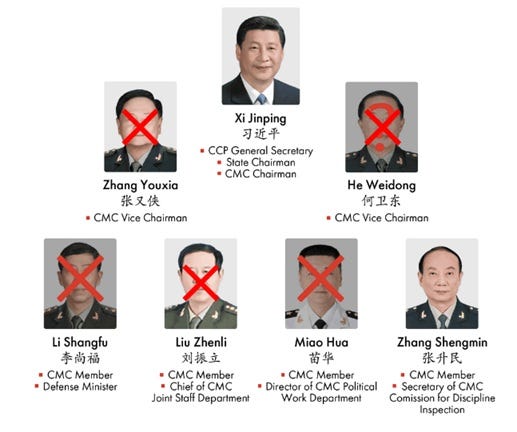
Nor does it seem likely that Xi is simply preemptively striking out against alternative centers of power who might someday defy his rule. When Xi attacked businessmen in the software and finance industries four years ago, it was conceivable that he thought the country could simply do without a powerful class of businessmen in those industries. But China can hardly do without generals. Whoever replaces the purged military leaders will still have power over the same military, and will presumably be just as much of a threat.
So although I have no information to this effect, logic suggests that there’s something more serious going on behind the scenes — perhaps a coup plot or something of the sort. In any case, this reinforces my argument that Xi’s personalistic rule is the main threat to Chinese global hegemony, especially as he ages without a clear successor:

3. Russia is losing a whole generation of men
In 2024, Russia recorded 1.22 million births. Presumably, about half of these — let’s say, 610,000 — were boys. That’s almost exactly equal to the number of Russian men Ukraine believes it can kill over the next year:
Ukraine aims to "kill 50,000 Russians per month," the country's new defense minister, Mykhailo Fedorov, said during a meeting with the media…"Last month, 35,000 were killed; all these losses are verified on video. If we reach 50,000, we will see what happens to the enemy. They view people as a resource, and shortages are already evident."
In other words, if Ukraine can accomplish its goal, it would wipe out an entire generation of Russian men — simply delete it from existence. Even the recent reported rate of 35,000 Russian deaths per month — 420,000 per year — is enough to mostly delete an entire generation, especially once you add those whose wounds will leave them alive but crippled. Russia is trying to supplement its forces with North Korean allies and African mercenaries, but their numbers are in the low tens of thousands at most — not nearly enough to change the story. Ukraine’s reports of Russian deaths may be modest overestimates, but they’re not far off from independent estimates.
The reason Russia is losing so many men is that assaults by armored vehicles have become pretty useless on the modern battlefield. Faced with the inability of tanks and other armor to make headway, Russia is resorting to “meat assaults” — basically, World War I tactics. These assaults are getting a ton of Russians killed, but are not managing to conquer much of Ukraine:
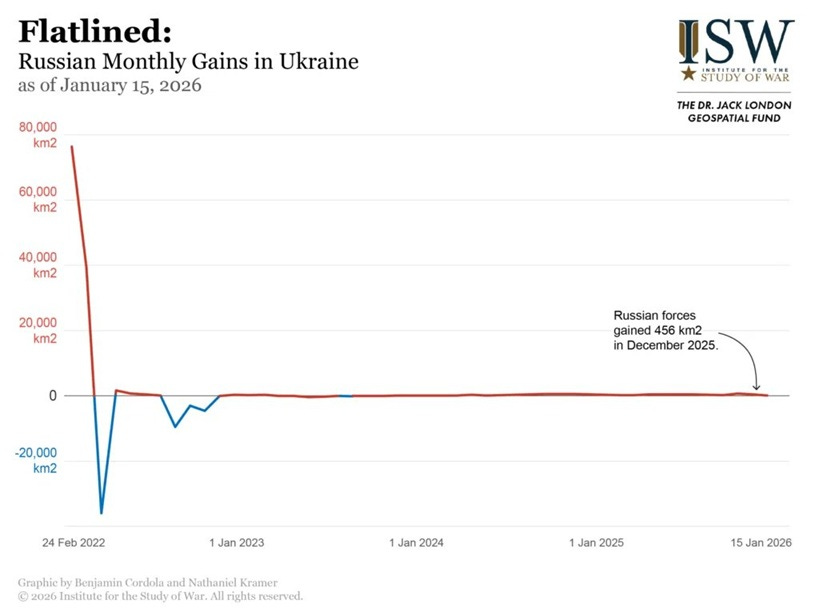
Of course Ukraine is taking grievous losses too, but warfare favors the defense, so they’re likely to be less. That doesn’t mean Ukraine will be in great shape after the war is over, but it does mean that Russia is really expending a vast number of its citizens’ lives for not much territorial gain — similar to what it was doing in WW1.
This doesn’t mean Europe can breathe a sigh of relief. If Ukraine does eventually fall and become a Russian satrapy, Russia will enslave millions of Ukrainians and send them to fight in the next war (likely against the Baltics, Moldova, and possibly Poland). That is exactly what Russia has done with the populations of the territories it has already conquered in Ukraine.
But what Russia’s losses show is that Europe’s strategy of defense is working. The longer Europe can support Ukraine, the less Russia will be able to recover from this disastrous military misadventure.
4. America’s medieval period
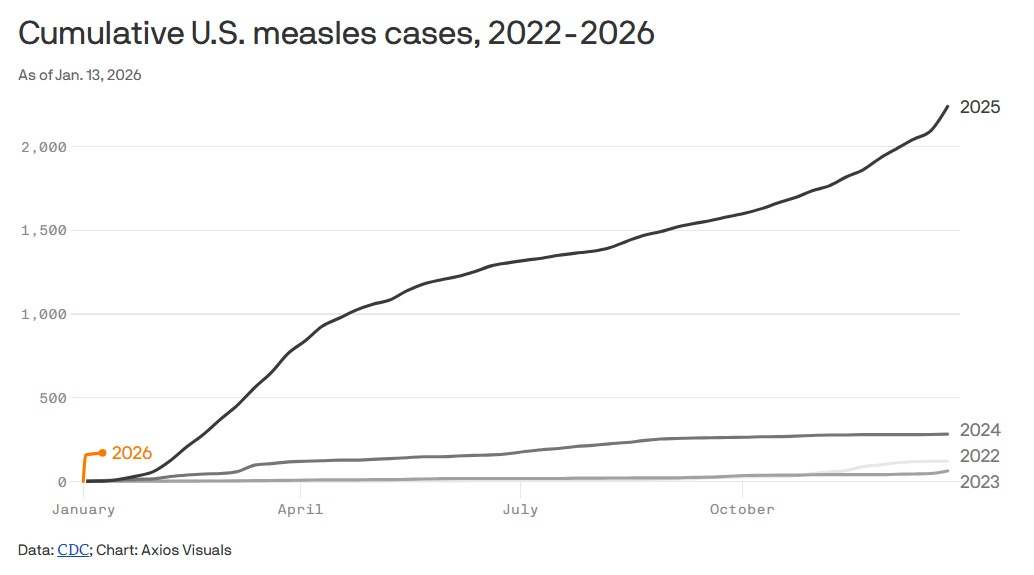
Here’s a scary chart of U.S. measles cases:
Axios reports:
This chart shows what it looks like to hit a 30-year high in measles cases — and why the U.S. is on track to lose its measles "elimination status."…We’ve all heard that cases are on the rise, but the reality is that they’re skyrocketing…It started with an outbreak in West Texas, and now infections are reported in nine states and hundreds are in quarantine due to a major surge in South Carolina.
Measles is skyrocketing for a simple reason, which is that fewer Americans are getting vaccinated; almost all of these cases are among the unvaccinated. And the reason for low vaccination rates is the antivax movement, which has spread from the leftist fringe to the conservative mainstream. The Trump administration could fight against this trend by reassuring everyone that measles vaccines are safe and effective, but as Axios notes, the Trump administration has sent mixed messages on the topic:
Health Secretary Robert F. Kennedy Jr. and other Trump administration officials have downplayed the health risks of the virus, and at times they’ve spread misleading claims about the MMR vaccine….They only said later that the MMR vaccine was the “most effective way” to prevent the transmission of the virus.
In fact, the Covid pandemic cemented opposition to vaccines as a core pillar of the new right-wing belief system in America. This isn’t just going to stop people from vaccinating their kids for measles — it’s going to negatively affect the progress of scientific research in the field. Here’s a report from Bloomberg:
Moderna Inc.’s chief executive officer said the company doesn’t plan to invest in new late-stage vaccine trials because of growing opposition to immunizations from US officials…“You cannot make a return on investment if you don’t have access to the US market,” Stéphane Bancel said…Regulatory delays and lack of support from US health officials are making the potential market size “much smaller,” he said.
Bancel’s comments are some of his strongest yet about the difficulties that vaccine makers face in the Trump administration. He joins a chorus of other pharmaceutical executives who have started to vent their frustrations with the government’s assault on immunizations…
Under the leadership of Health Secretary Robert F. Kennedy Jr., a vaccine critic, US officials have narrowed the population of people who are eligible for Covid vaccines, created confusion over how to get them and raised questions over their safety.
That’s pretty scary, given the increasing power of AI-assisted amateurs to create bioweapons in their garages! There’s also the chance it might slow down progress in mRNA cancer treatments, which are also vaccine-based. This might condemn lots of Americans to unnecessary death from cancer.
In fact, the assault on vaccine science is just the most egregious part of a general assault on science by the Trump administration:
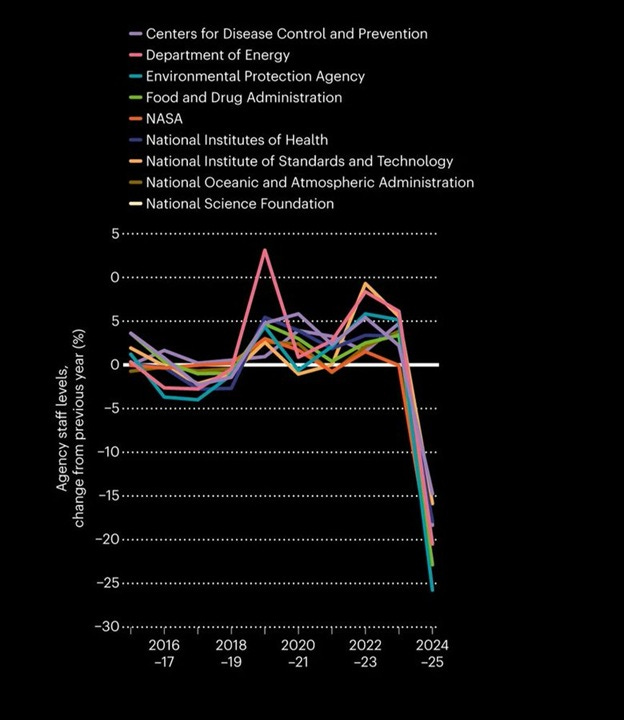
The example of the antivax movement shows that the MAGA folks don’t really care if the science they cancel happens to be stuff that saves lots of people’s lives. Their crusade against the progressive-leaning scientific establishment can’t be interrupted by such trivialities. Meanwhile, America continues its slow deterioration into anti-science, anti-technology medievalism. And America’s international position in scientific research continues to deteriorate:
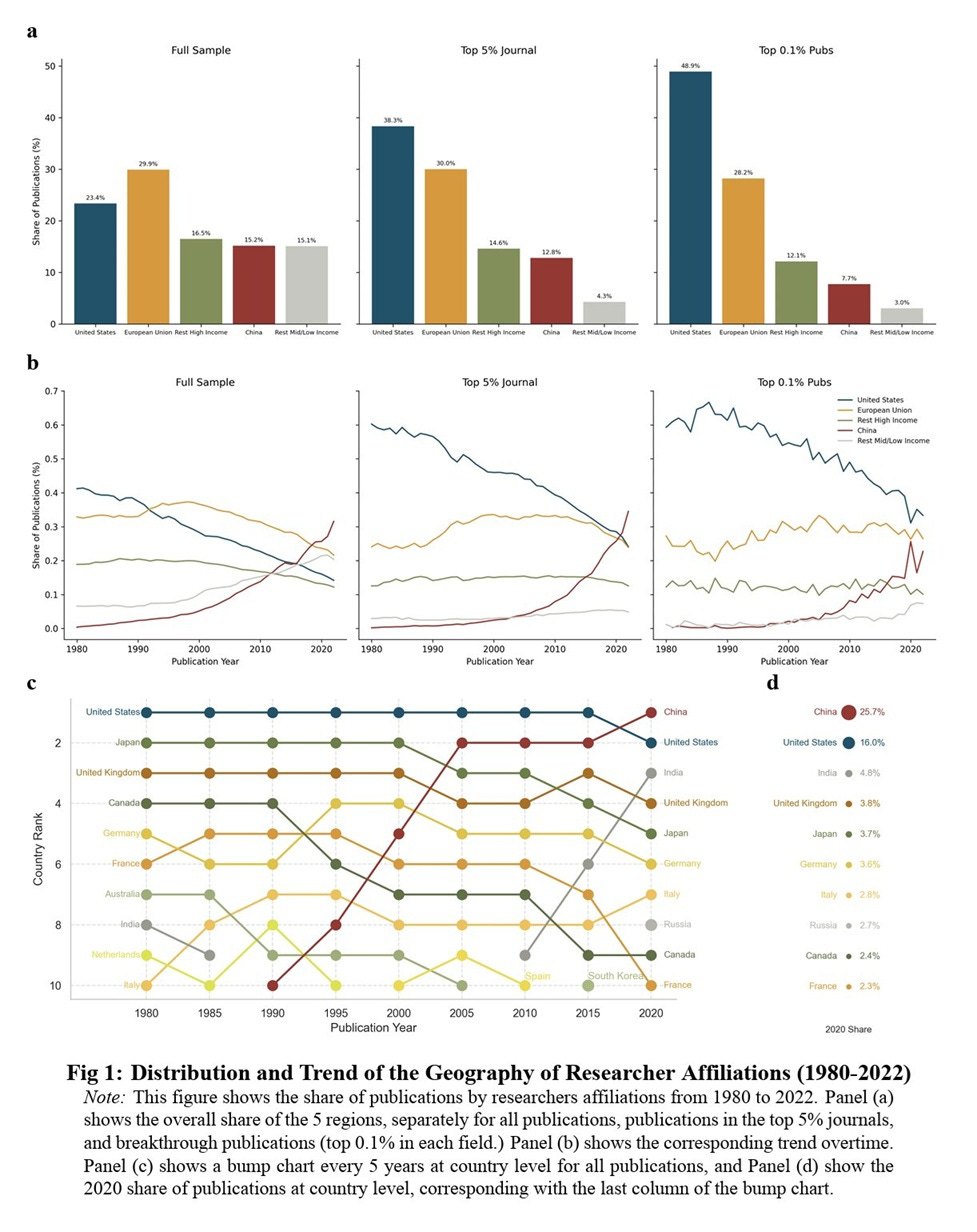
I suppose countries get the futures they choose for themselves.
5. India electrifies
So far the theme of today’s roundup has been the world’s Great Powers doing stupid stuff to harm themselves. But it’s worth noting that there’s one rising power that’s doing a lot of smart and effective things these days: India.
Where America has been weakening its own scientific establishment, India’s is growing rapidly in strength. Note India’s skyrocketing performance in the publication of the well-cited papers, overtaking the UK, Japan, and Germany in just a few years:
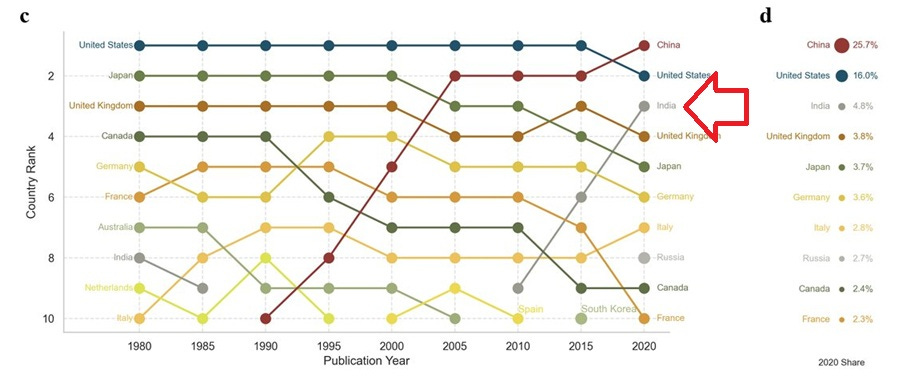
This rapid ascent — which mirrors China’s two decades earlier — undoubtedly contains some amount of fraud and self-dealing, just as China’s did (and does). But ultimately, China’s research turned out to be mostly real, and India’s will too.
India also seems to recognize the importance of electric technology — the essential physical technology of the future, which China has embraced and the U.S. has downplayed. A new Ember report shows some numbers on how fast India is electrifying. Here are three key charts, showing that India is embracing electric power even faster than China did:
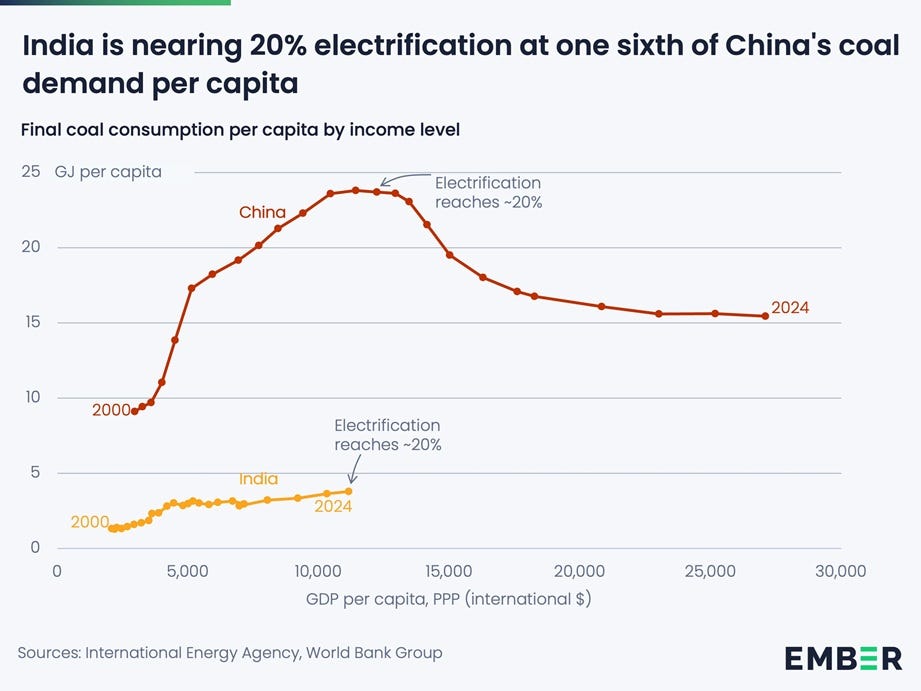
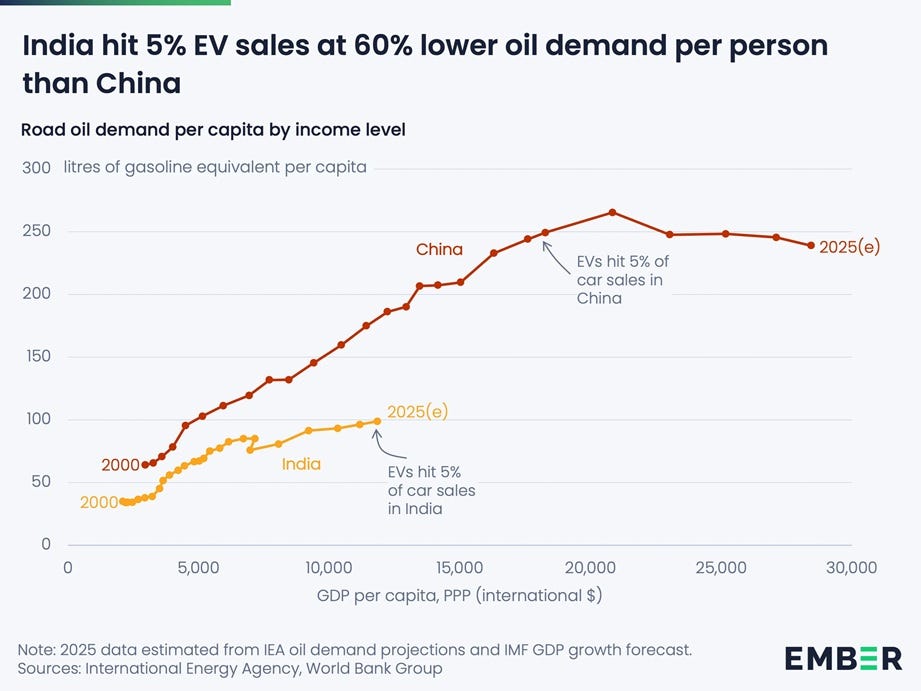
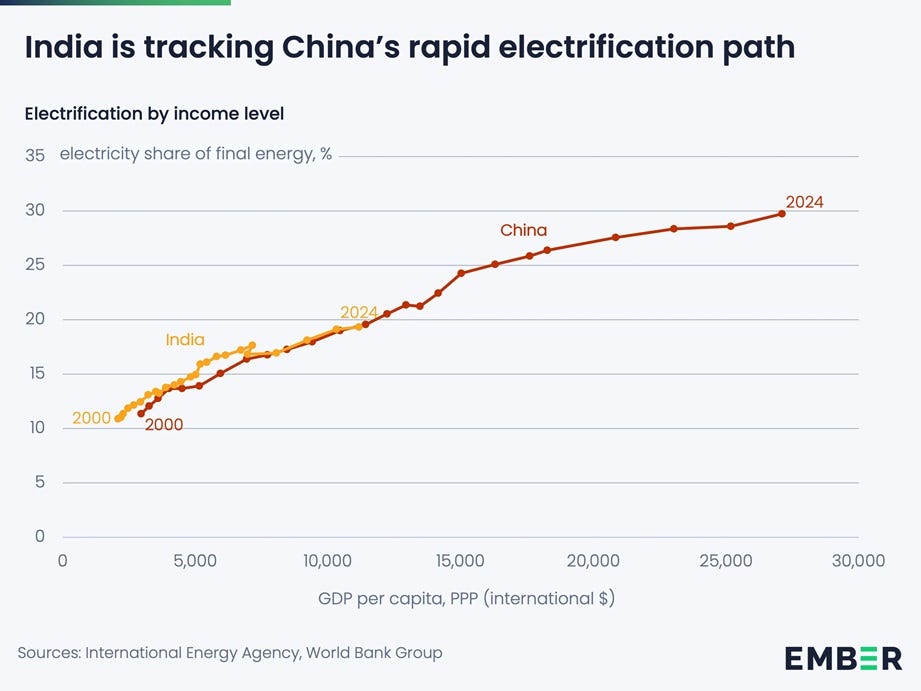
Ember notes that the potential advantages to India go far beyond climate and cheap power:
Another dimension to the electrotech revolution is manufacturing opportunities…If any country has the scale, capital and economic dynamism to become a major electrotech manufacturer alongside China, it is India…With Sino-American tensions showing few signs of easing and advanced economies scrambling to diversify their electrotech supply chains, the demand for alternative trading partners is only rising…
There are strong signs India is seizing the opportunity, starting with its electronics industry. India’s electronics industry is surging – nearly sixfold from $22 billion in FY2015 to about $130 billion in FY2025. Domestic mobile phone production alone has risen from 2 million units in 2014 to 300 million a decade later. This matters because, as China has shown, electronics is the gateway to electrotech. The capabilities built for consumer electronics spill over into solar panels, batteries, and EVs. A mobile phone, after all, has more in common with a solar panel than a gas plant does.
Indeed, this momentum is expanding beyond electronics. Solar module production now stands at 120 GW – a twelvefold increase over the past decade, and enough to make India self-sufficient. The shift into upstream components is similarly pronounced: solar cell manufacturing, virtually absent a decade ago, has expanded to 18 GW. Beyond solar, government production incentives are spurring domestic industries for batteries and electrolysers. India is positioning itself to capture a growing share of the global electrotech market.
China leapfrogged America, Europe, and Japan in electric technology; India may end up leapfrogging China.
One tailwind here will be India’s huge domestic market growth, which will give Indian manufacturing a big edge. The OECD now expects India’s economy to be bigger than China’s by the end of the century, due in large part to diverging population trends:
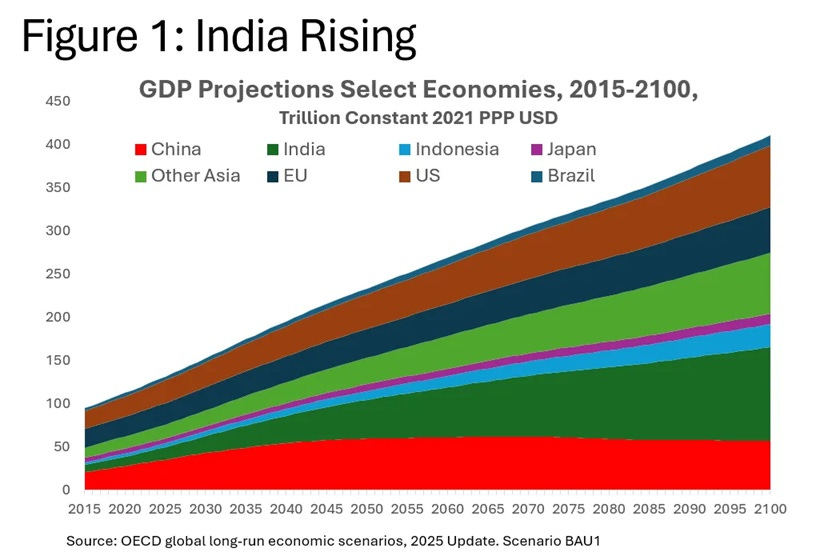
At a time when every other major power seems to be shooting itself in the foot, India is making smart moves and accelerating its development.
6. America’s economy isn’t nearly as bad as socialists think
So far this roundup has been pretty down on the United States, which is making some very stupid moves under Trump. So I think I’ll balance it out by pointing out that many criticisms of the U.S. are not true. For example, the left-leaning economists who have spent the last decade and a half decrying America as a failure of capitalist excess are being forced to come up with ever-less-credible reasons to pooh-pooh the strength of that capitalist approach. For example, Gabriel Zucman recently tweeted a chart which he claims as proof that income in the U.S. has been growing no faster than in Europe:
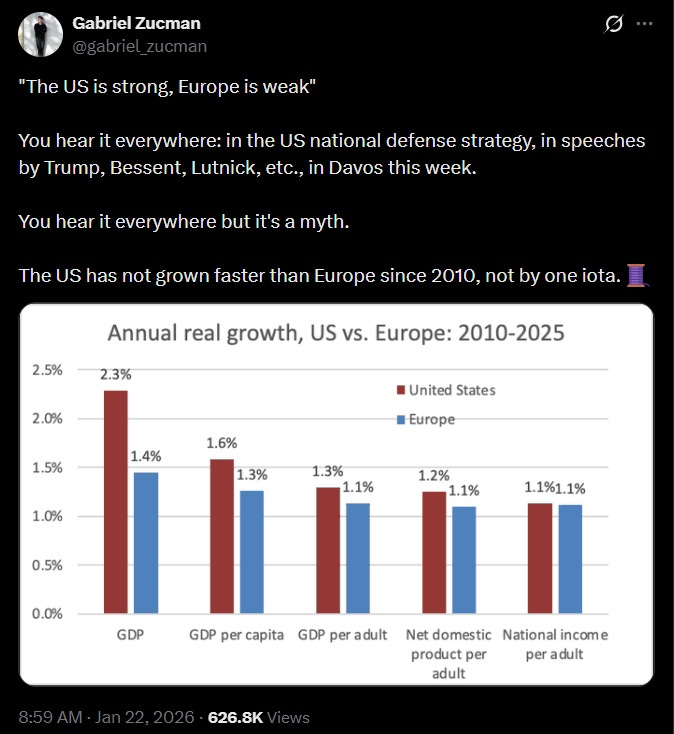
In fact, this chart doesn’t show what Zucman claims. First of all, Zucman’s claim that America hasn’t grown “one iota” faster than Europe is falsified by his own graph, in which the U.S. is ahead of Europe in every category. Second, there is no reason to think that GDP per adult (which I assume means GDP per working-age adult, for the math to work out) is a worse measure of income than national income per adult; the latter includes income from overseas investments, while the former includes only production within a country’s borders.
Third, Europe includes East Europe, which has been growing more quickly than West Europe as it completes its catch-up from the communist era. The major West European economies have all fallen behind the U.S. in recent years:
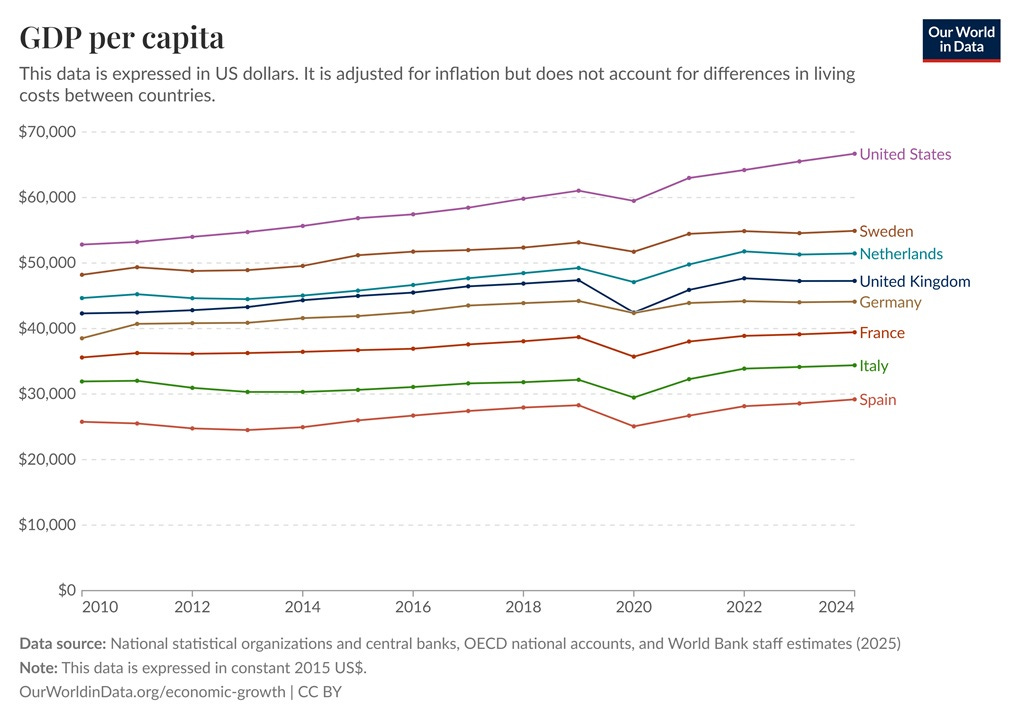
Note that the U.S. is richer, meaning that European countries should be catching up. Instead they’re falling behind. Something is wrong, and left-leaning economists like Zucman need to acknowledge that fact.
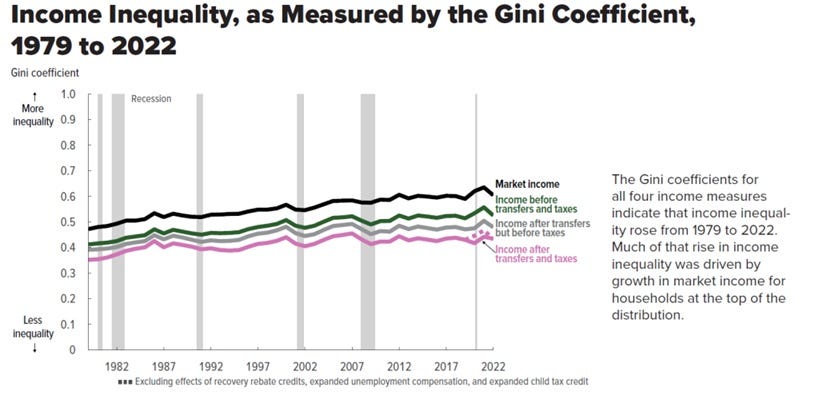
Meanwhile, the socialist conviction that America is a hellhole of ever-increasing inequality needs a major update. The Congressional Budget Office just published an analysis showing that once you account for the increasing generosity of the American welfare state, inequality in the U.S. hasn’t actually gone up much at all since the 1980s:
And Arin Dube finds that the compression in American wages — the strong rise in low-end wages since the early 2010s, coupled with anemic wage growth at the top of the distribution after the pandemic — seems to be persistent so far:
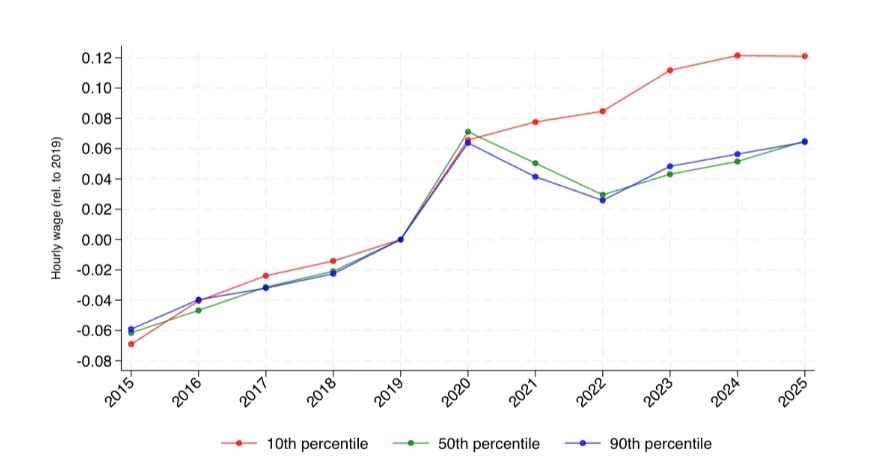
Socialists who keep repeating the mantras of the 2010s without looking at updated numbers sound increasingly out of touch with the facts. The U.S. has an inequality problem, but it’s not nearly as bad as socialists think, and U.S. growth really has been robust in recent years. Capitalism has not failed.
The current ICE situation in the US is a wild pendulum swing after decades during which the voters all over the West signalled their growing rejection of more immigration and the previous elites persisted in ignoring the message stubbornly.
I am a bit afraid that once the US administration changes again, it will be back to the Bourbon-style "they have forgotten nothing and learnt nothing" and thus priming the situation for future wild pendulum swings again. Much like the Bourbon restoration did in France.
Looking comparatively good by simply not self-destroying: 🇪🇺🤝🇮🇳