


About a month ago, I weighed in on an interesting debate over American vs. European living standards.
On one side, you have people who argue that Europe is much poorer than America, and is falling even further behind. Most of the people making this argument are Europeans themselves — especially economists like Mario Draghi, Philippe Aghion, Luis Garicano, and Antonin Bergeaud. They look with envy on the U.S. tech sector, which Europe has no real equivalent to, and they yearn for liberalizing reforms that would allow Europe to catch up.
On the other side, you have American liberals like Paul Krugman and Brad DeLong. They argue that Europe is not falling behind — that most of the gap in material living standards is due to Americans working more, and that America’s apparently faster productivity growth is an artifact of the way relative growth rates are measured.
This is an interesting debate, and in the end it comes down to some surprisingly technical measurement issues and data mysteries. I’ll have more to say on it in the future. But it’s really just the most recent exchange in a long-running debate over the “varieties of capitalism” — whether Europe’s stronger welfare and regulatory states deliver better outcomes for regular people, or whether America’s more free-market system is superior. I don’t think that debate is close to being settled — and may never be settled, since liberalizing reforms in Europe and expansions of welfare and regulation in America may shrink the differences between the two systems.
But there’s a second debate going on regarding Europe’s economy, with potentially far more devastating consequences. It’s the question of whether Europeans should be rich at all.
Instead of crowing about the superior performance of the European social model, leftist economists are increasingly arguing that Europeans are too rich, and ought to be poorer than they are. This was the upshot of a manifesto by Thomas Piketty and his World Inequality Lab, which I covered in my last roundup post. Piketty argued that “labour hour reductions, growth caps in rich countries, less material consumption, and changes in food habits” will be needed in order to beat climate change:


This is also the argument in a recent Guardian editorial by Piketty, Olivier De Schutter, Joseph Stiglitz, Jayati Ghosh, Kate Raworth, and Jason Hickel:
We live in an age of manufactured scarcity. In a world richer than ever before, roughly one 10th of the world’s population still lives in extreme destitution…
For decades, the recipe was simple: grow the economy, and poverty would gradually disappear. But the promise that economic growth would “lift all boats” has not been kept. While national incomes expanded, wages stagnated, work became more precarious and public services were cut. At the top, fortunes ballooned; at the bottom, families turned to food banks. Growth has become decoupled from shared prosperity…It has also become ecologically unsustainable…That is why we have come together to develop and support the “roadmap for eradicating poverty beyond growth”.
The essay — which was immediately identified by Pangram as being 100% AI-generated — was extremely vague on its plans for transforming the global economy. It often reads like a mishmash of buzzwords and slogans. Here’s a taste:
The real question today is not whether growth continues, but what kind of economies we are building, who they serve and whether they allow everyone to live in dignity within planetary boundaries…[W]e are united in the conviction that our economies must be redesigned around the fulfilment of rights and collective wellbeing within planetary boundaries, rather than maximising output at any cost. Human rights here are not an afterthought; they are the organising principle for how we measure progress, set priorities and resolve trade‑offs…All too often, policies affecting people in poverty are designed without them – and sometimes against them. When welfare systems are built around suspicion, sanctions and humiliating conditions, they deepen stigma and deter people from claiming their entitlements.
…And so on. In fact, this is pretty typical of degrowther writing. If you read their “research” papers, it’s also a bunch of stuff like this. Consider this excerpt from “Exploring degrowth policy proposals: A systematic mapping with thematic synthesis”, by Fitzpatrick et al. (2022), published in the Journal of Cleaner Production:
Degrowth is a multi-layered concept…It combines critiques of capitalism…colonialism…patriarchy…productivism…and utilitarianism…whilst envisioning more caring…just…convivial…happy…and democratic societies…Capturing the essence of degrowth is difficult because it carries at least three denotations…degrowth as decline of environmental pressures…degrowth as emancipation from certain ideologies deemed undesirable, like extractivism, neoliberalism, and consumerism; and...degrowth as a utopian destination, a society grounded in autonomy, sufficiency, and care.
Honestly, whatever AI wrote the Guardian op-ed did a better job than Fitzpatrick et al.
In fact, there’s a reason degrowthers write like this. They see degrowth as a grand project to unify and reinvigorate the political left — a Big Idea to fill the hole left by the collapse of communism in the 20th century. Each buzzword or stock phrase is a shout-out to a particular faction of the European left — “decolonial” leftists angry about colonialism, climate activists, old-line socialists still angry about “neoclassical economics”, unionists who want job guarantees, social democrats who care about housing and education and welfare, and so on. Leftism is famous for factional infighting over differences in doctrine and focus; the degrowthers want everyone on the left to know that they’re building the biggest of big tents.
But in practice, what unites the degrowthers is their conviction that Europeans ought to be poorer. The Guardian op-ed makes it clear that the postwar European social model is not enough:
Social protection and public services are essential, but they cannot indefinitely compensate for economies that by design generate poverty wages, insecure jobs and unaffordable housing.
Why do I say “Europeans ought to be poorer”, instead of “Westerners ought to be poorer”? Obviously, the degrowthers would love it if America also degrew. But in practice, no one in the U.S. is signing on to this agenda. American leftists dream of Green New Deals and government-funded megaprojects like high-speed rail. Progressives are focused on breaking up big companies in order to ensure free-market competition. Liberals like Krugman value living standards intrinsically — they trumpet the European model precisely because they think it makes average Europeans rich.
Degrowth has also notably failed to win much traction in Canada or Australia. Nor have rich countries in Asia shown any interest. Developing countries ignore the idea as well, trusting more in their ability to grow their own economies than in the promise of massive transfers from the Global North.
This is why in practice, the only people who are interested in degrowth are Europeans. The idea’s main proponents — Piketty, Jason Hickel, Kate Raworth, Timothée Parrique, and so on — are all Europeans.1 The degrowth conferences are mostly in Europe. Degrowth literature reviews show that it’s a “predominantly European movement”. The EU is the only government that has shown much interest in degrowth.
In other words, when degrowthers call for the “Global North” to make itself poorer for the sake of the planet — or for the sake of any number of other causes — they’re functionally addressing their message to Europe. Degrowth is a movement for European impoverishment.
It’s important to note how astonishing of a shift this is from the pitch leftists made a hundred years ago. Communism was supposed to be about abundance — the idea that central planning could out-produce the capitalist system, ensuring not just military might, but better material living standards for regular people. In the 1950s, Western leftists praised the growth “miracle” of the Soviet Union (and, occasionally, North Korea). Even back in 2006, Joseph Stiglitz — one of the few American authors of the Guardian article — praised Hugo Chavez’s Venezuela for supposedly promoting “higher growth”.
That famously didn’t work out, of course. The Soviet Union, North Korea, and post-Chavez Venezuela are not exactly places that we associate with widespread material abundance and successful economic development. But in the wake of that colossal failure, the European left is switching its sales pitch. Yes, the new line goes, leftism will make you poorer — but that’s a good thing, because you deserve it for the sins of colonialism, because it’ll be good for the climate, and because you really don’t need all those consumer goods anyway.
Astonishing.
Of course, as anyone following the saga of the degrowth movement knows, it’s pure snake oil — a whirlwind of factual distortions and poor scholarship that would make any serious researcher blush. When economists have read through the degrowth literature, they have found it to mostly be repetitions of the same old buzzwords, empty rhetoric, and unsupported assertions. Savin and van den Bergh (2024) write:
In the last decade many publications have appeared on degrowth as a strategy to confront environmental and social problems. We undertake a systematic review of their content, data and methods…Based on a sample of 561 studies we conclude that: (1) content covers 11 main topics; (2) the large majority (almost 90%) of studies are opinions rather than analysis; (3) few studies use quantitative or qualitative data, and even fewer ones use formal modelling; (4) the first and second type tend to include small samples or focus on non-representative cases; (5) most studies offer ad hoc and subjective policy advice, lacking policy evaluation and integration with insights from the literature on environmental/climate policies; (6) of the few studies on public support, a majority concludes that degrowth strategies and policies are socially-politically infeasible; (7) various studies represent a “reverse causality” confusion, i.e. use the term degrowth not for a deliberate strategy but to denote economic decline (in GDP terms) resulting from exogenous factors or public policies; (8) few studies adopt a system-wide perspective – instead most focus on small, local cases without a clear implication for the economy as a whole. We illustrate each of these findings for concrete studies.
A few economists, like Vincent Geloso, have done yeoman’s work studying and rebutting the claims of Jason Hickel, Kate Raworth, and other degrowthers:


I myself, of course, have written about Hickel’s ideas and reviewed Raworth’s book, and I’ve come to the same conclusions that Geloso has.
This pattern of intellectual sloppiness and utter disregard for the data is evident in the Guardian op-ed. “We’ve done the maths”, the headline proclaims, but neither the article nor the “roadmap” it promotes contain any math. The statement that “growth has become decoupled from shared prosperity” is simply false; the evidence is unequivocal that growth is good for the poor. No matter how you measure poverty, there is no country that has escaped poverty without growth, and there is no country that has substantial amounts of poverty after growth has occurred:
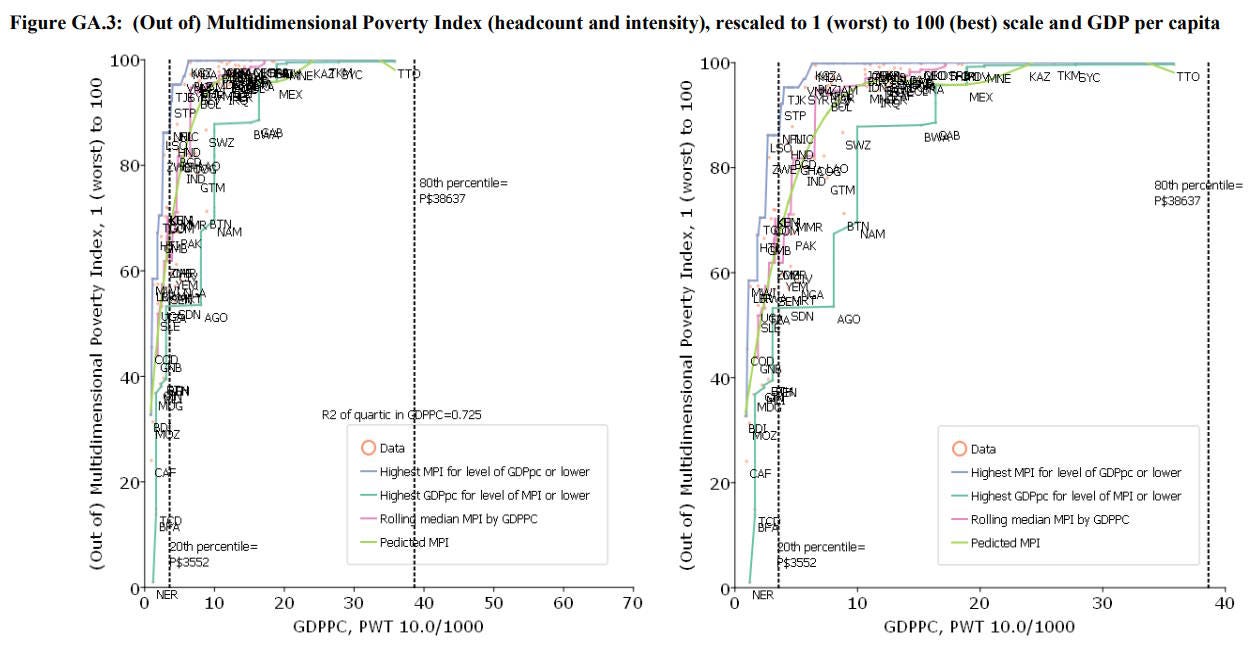
This relationship works in reverse, too. If degrowth gets serious purchase in European policymaking, regular Europeans will suffer. In keeping with degrowth’s mission to unite the entire political left, the Guardian op-ed promises all kinds of middle-class goodies: “investing in children, housing, health, education and transport through universal public provisioning”. As the authors surely know — and as any cursory attempt at actual “maths” would have easily shown — this will be utterly impossible if European countries are forced to degrow.
In other words, even as American conservatives look down their noses at “Europoors”, and liberals try to debunk the “Europoor” notion, European leftists are hard at work trying to make “Europoors” a reality.
But that’s not the only reason the degrowth program is pernicious. Right now, with America having turned inward in a spasm of rightist isolationism, Europe is one of the few remaining champions of the ideals of universal human rights set forth in the post-WW2 global order — a lonely, beleagured bulwark against the likes of Russia and China.
Right now, Europe is facing a dire military threat. Although economically and demographically it overmatches Russia, its militaries do not yet know how to use drones — and Russia’s does. Furthermore, Europe’s supply chains are utterly dependent on Chinese parts and materials; if China decides to cut Europe off during a Russian attack, while continuing to furnish Russia with everything it needs, Russia would have a good chance of triumphing.
In addition, European industry is facing a dire economic threat. Its manufacturers are bearing the brunt of the Second China Shock — the wave of massively subsidized exports that China is using to try to prop up its slowing domestic economy. This comes on top of the cutoff of Russian energy and Trump’s tariffs.
To embrace the poisonous nonsense of degrowth now — to shut down nuclear power plants, to regulate the AI industry out of existence, to forcibly shorten working hours, to bar the construction of houses and factories, etc. — would be to cripple one of the last few remaining economic engines of the free world, at precisely the time when it’s under its greatest external challenge.2
In other words, there has never been a better time to ignore the pronouncements of Thomas Piketty, Joseph Stiglitz, and the other rogue economists who want to turn “Europoor” from a slur into a grim reality.
I’m counting the UK as Europe. Sorry, Brexiteers.
One suspects that degrowthers know this, and that the anti-Westernism that has always animated far-left movements is an unspoken but important motivating force behind the movement.
The intellectual and ethical dishonesty of the de-growth group is made worse when it can offer no practical, politically feasible path to de-growth that would not at the same time require violent state-led suppression of normal economic life. Stiglitz and Co. ought to consider the COVID era - as perhaps the closest we came to implementing a set of de-growth type policies intended to shut down normal life. A shut down that under such circumstances proved to be politically feasible with minimal violence. Perhaps that’s exactly what these de-growthers are ultimately banking on. A series of catastrophic, external shocks - that would give them an excuse to experiment with de-growth policies. We all ought to be careful what Stiglitz & Co. wish for.
"The EU is the only government that has shown much interest in degrowth." It’s not a government! And this contradicted immediately by the Draghi report. No government in Europe wants degrowth: quite the opposite. The policy debates in the UK, Germany et al are about getting growth. The Greeks among others had degrowth during great financialcrisis, and have turned their economy around. And Poland? Wow. Any government that makes their people poorer won't survive.
It occurs to me that much of the wealth they're talking about appropriating, uh, doesn't exist because you can only get it when you crystallize it. And, uh, if you were to attempt to crystallize all of that wealth simultaneously, its value would go to nothing because, uh, wealth is as much about anticipating the future, i.e., a flow concept, as it is a stock concept in the present. And who is going to pay any attention to it if it's going to be appropriated? It'll disappear. It'll be like a Dutch tulip.
These guys are all economists at some point at somewhere That at some point they must know this is all fantasy. That their numbers don't work, that they're repudiating history, common sense, economic thinking, everything.
We're in one weird trick territory. I guess Katya Hoyer's Behind the Wall GDR seems to be their ideal society.
(PS: I don't want my work week cut in two!)