


Which society is a better place to live: the U.S., or Europe? This is a very difficult question, for several reasons. For one thing, “Europe” can mean several different things — it can mean the richest northwest European countries like Sweden and the Netherlands, or it can include slightly poorer West European countries like Spain and France and the UK, or it can include East European countries that are still catching up after the fall of communism.
More fundamentally, though, the comparison is hard because life in the two countries is so different. If you like living in an urban apartment, strolling past picturesque old buildings to cute cafes, and taking a lot of vacation every year, then Europe is obviously for you. If you like living in a giant suburban house and having a bunch of friends drive over to barbecue and watch TV on your giant screen, then America is obviously the right pick. If you want to work 80 hour weeks building the future of AI, you should probably live in the U.S. If you want government health insurance and job security, I recommend Europe. There are also differences in politics and culture.
In general, my intuition is that all rich countries are about equally good places to live. One reason to believe this is that migration between rich countries is generally pretty small — it’s not that hard to move between Europe and the U.S., but not that many people do it. Here’s a map of the net migration difference between some European countries and the U.S., as a percent of each country’s population, for 2024:
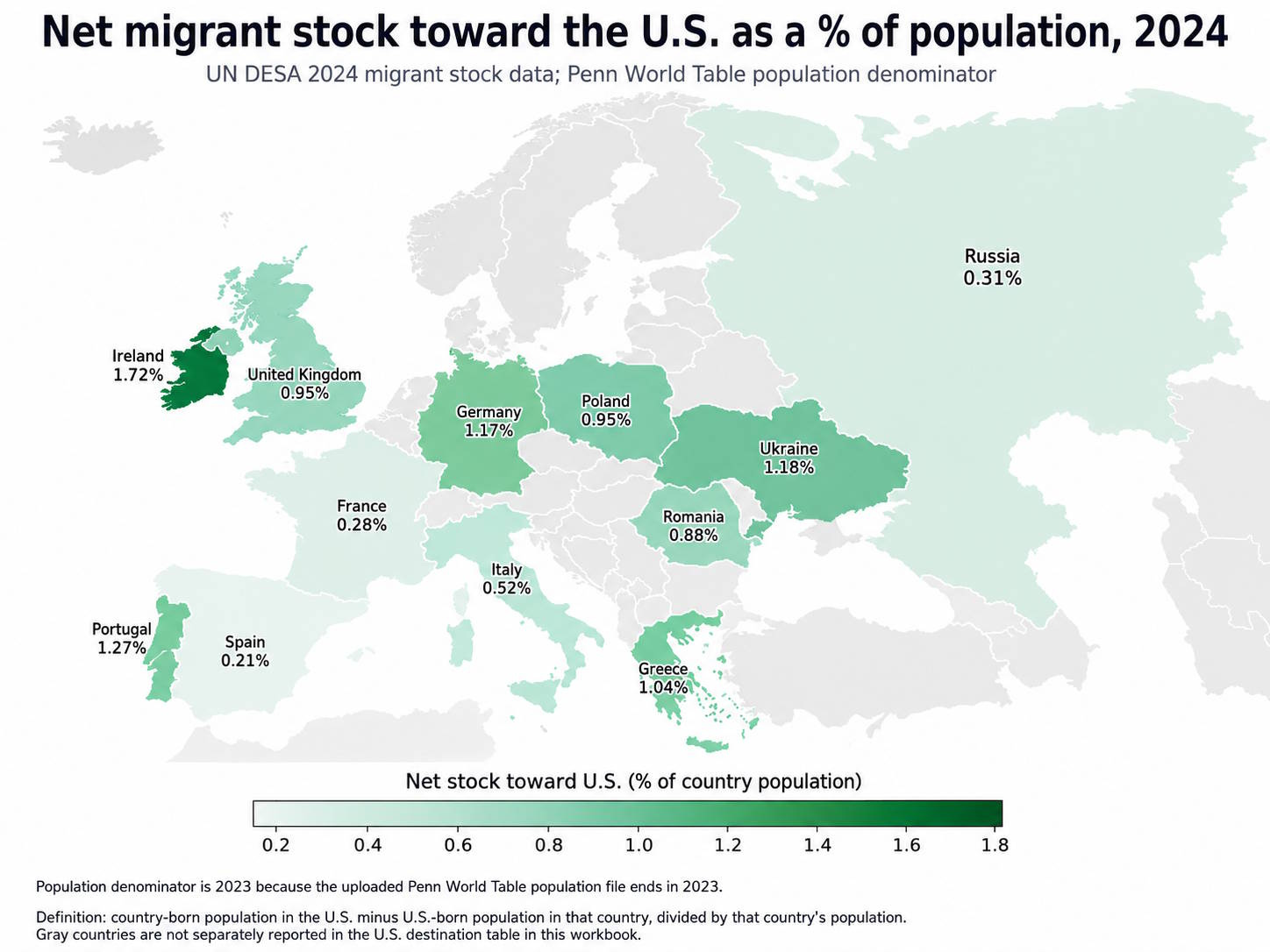
This means that if you take the number of Germans living in America in 2024, and subtract the number of Americans living in Germany, that net migration number is 1.17% of Germany’s population. In other words, the amount of migration between Germany and America is pretty small.
One thing to notice here, though, is that you don’t see any negative numbers on this map. There aren’t any European countries where significantly more people move from America to Europe than the reverse (for Switzerland it’s about equal). That means that to the extent that people vote with their feet, they choose America over Europe, even if they don’t do so in large numbers.
That’s not a slam-dunk case that America is better off, of course. The people who have the money and skills to move between the U.S. and Europe are probably disproportionately highly paid professional workers (who can earn more in the U.S.), while working-class people who would like to take advantage of Europe’s urban safety and generous welfare states find it harder to move. If there were open borders between America and Europe, we might see a different pattern.
If you ask people how satisfied they are in life, America comes in around the middle of the West European pack:
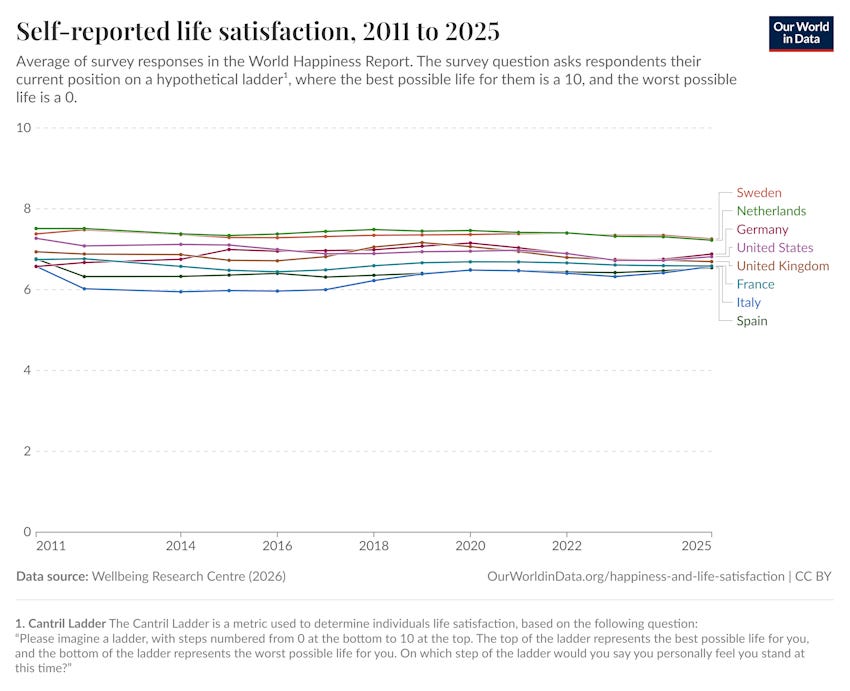
So my general impression is that Europe and America are about equally good places to live, and it mostly comes down to your own personal taste and your own personal circumstances. I believe that’s about the best answer we’ll ever get.
But an easier question to answer is: Who is richer, America or Europe? This is the subject of a recent debate in the econ blogosphere. It started when Joseph Sternberg wrote a WSJ op-ed entitled “What Happens When Europeans Find Out How Poor They Are?”. Paul Krugman responded with a widely read post arguing that Europe is not in economic decline:

Krugman followed this up with a technical post about how to measure different countries’ growth over time. Pieter and Luis Garicano responded at length to Krugman:

In fact, as Krugman notes, there are two very different questions here:
Is the U.S. richer than Europe?
Has the U.S. been growing faster than Europe in recent years?
The answer to this first question is: Clearly, yes. America is considerably richer than most European countries, although a few top European countries are only a little bit poorer.
The answer to the second question is: Maybe. In terms of living standards, Europe has kept pace with America, remaining a bit behind. In terms of productivity, though, Europe has stagnated while America has grown strongly.
This isn’t a great result for Europe, to be honest. Rich countries should ideally converge to the same level of income; the fact that Europe has failed to catch up with America is a real failure, even if it isn’t falling further behind. And America’s far faster growth in output per hour should be sounding alarm bells.
And even more fundamentally, the main point of comparison for Europe shouldn’t be America — it should be China, which is bankrolling the new Russian imperial project and threatening to outcompete European industry. Given the threats Europe faces, it can no longer afford to be the shabby, comfortable aristocrat of the world economy.
What the data says about the U.S. vs. Europe
There are a bunch of measures of material living standards across countries, and they pretty much all agree that the typical American is significantly richer, in material terms, than the typical European. I wrote about this back in 2022:

Let’s start with GDP. Sternberg compares GDP at market exchange rates; this measures purchasing power on world markets, but it isn’t a good comparison of living standards, since most things people consume aren’t purchased on world markets. I prefer PPP (purchasing power parity), which tries to take a country’s local prices into account.
But how do you compare countries over time? Often, when I do this, I just look at the PPP numbers over time. That’s not bad for a quick-and-dirty comparison, but it can run into some slight problems based on the fact that what people consume in different countries changes in different ways over time. In some cases, this difference can be a big deal. Another method is to use PPP for the starting year, but then to measure growth over time using each country’s own inflation numbers. The problem there is that sometimes the price differences of nontradable goods between different countries change in ways that local price changes won’t capture.
Krugman spends a lot of time discussing the difference between these two approaches — in fact, his second post is just an economic model that he uses to argue that comparing PPPs over time (i.e., what I usually do) is the better method for comparing America and Europe. But honestly, I’m not sure why he does this,1 since the two measures tell basically the same story. The Penn World Tables have time series called cgdpe and rgdpna, which represent the two methods Krugman is comparing. Here are the GDPs of some West European countries, expressed as a percentage of U.S. GDP:
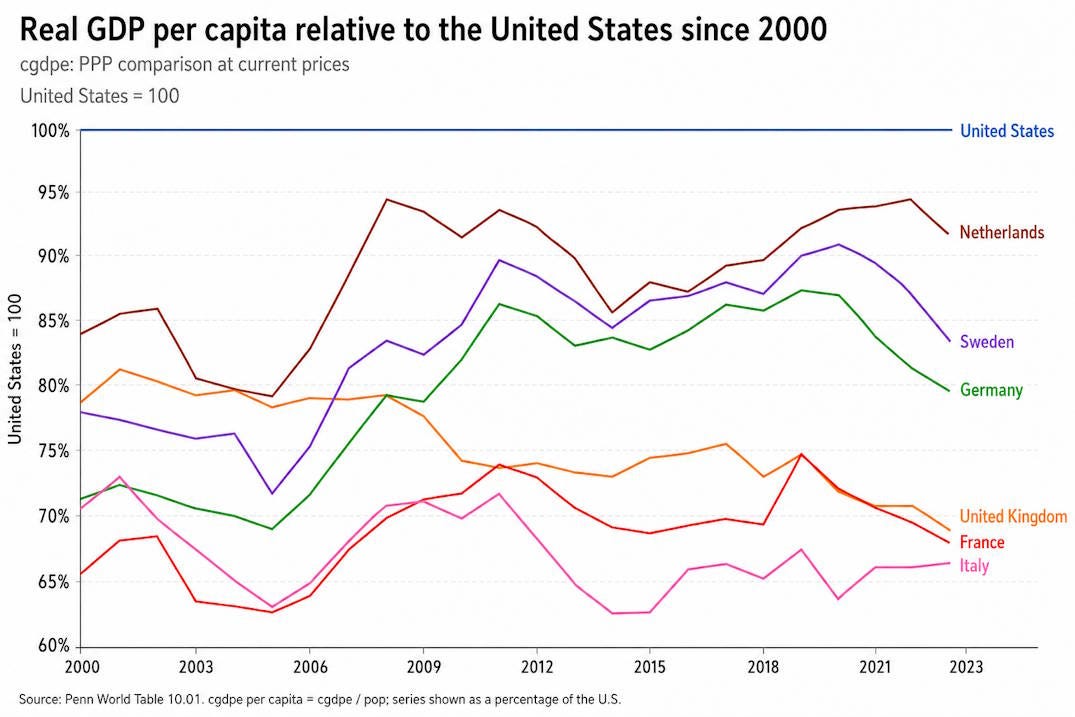
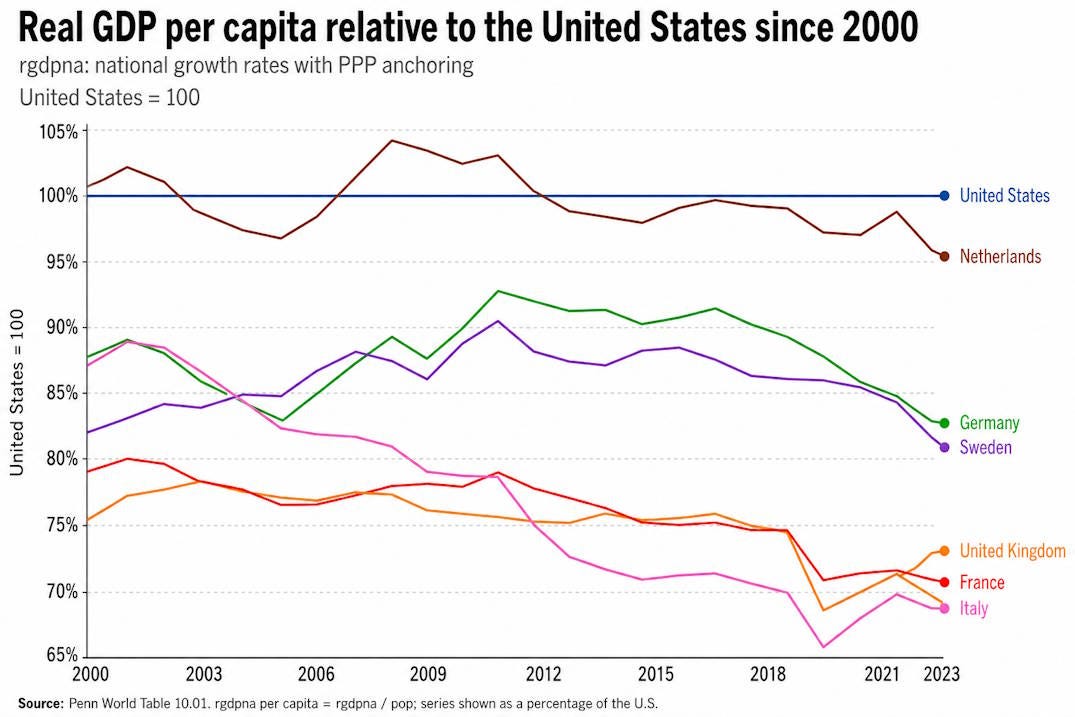
In general, the first method — which Krugman favors — shows a bigger gap between America and Europe, but also a more stable gap. The second method shows a somewhat smaller gap, but a little bit more European decline in the last decade.
Ultimately, I don’t think this makes a big difference to the basic story: America is significantly richer than Europe.
In fact, there’s a third way to do this comparison that’s a little more complicated, but which I think is probably better than either of the methods Krugman compares. The Penn World Tables constructs a price index that controls for both international price differences and changes in domestic prices in each country over time. Here is that measure of real GDP per capita, for the U.S. and the West European countries:
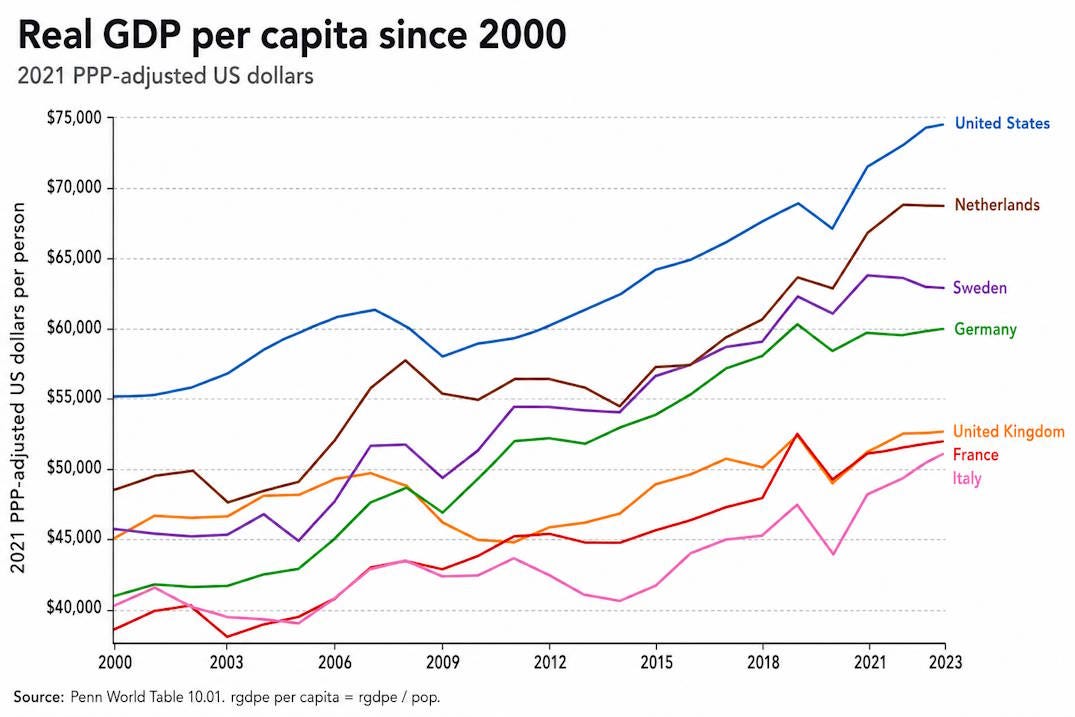
The U.S. comes out consistently ahead. Here are the same GDP numbers expressed as a percent of the U.S. level:
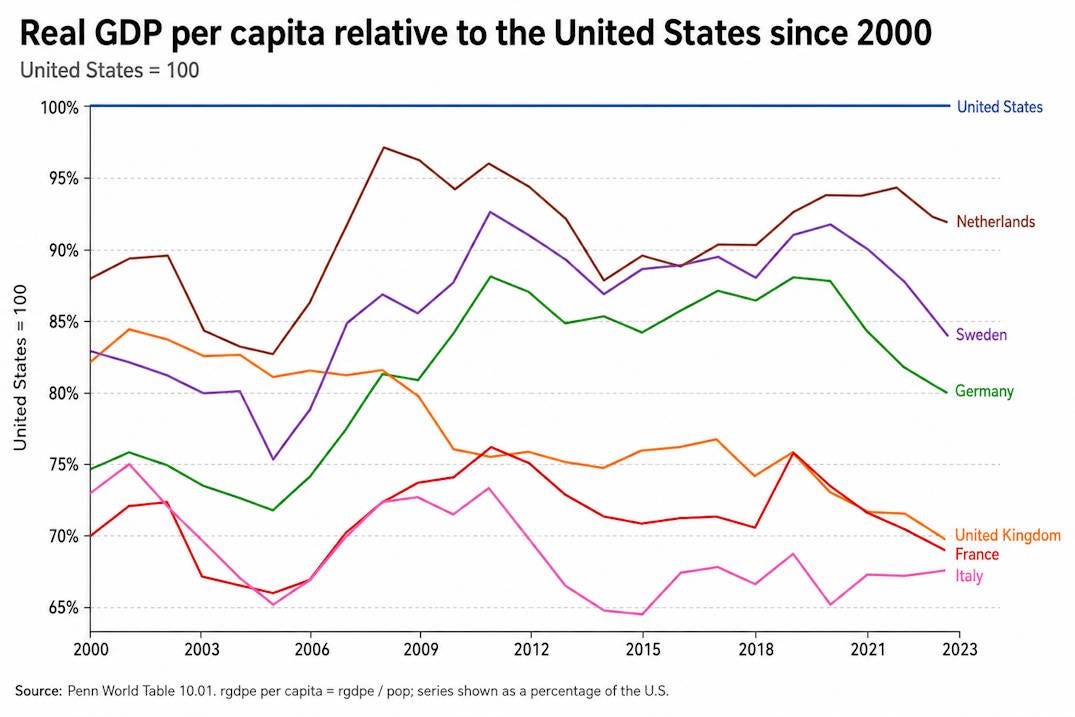
This ends up looking similar to Krugman’s preferred method, but it still says that Europe is significantly poorer than America. Most West European countries have kept pace with the U.S. since 2000, but they haven’t caught up either. The Netherlands is only a little bit behind, while France and Italy are far behind. The UK is the big exception here, and not in a good way — its GDP per person has steadily plummeted relative to the U.S. and relative to the other European countries since the turn of the century.
GDP isn’t the only measure of material living standards, but other measures all tell the same story. For example, you might think that because Europe has high taxes and lots of government services, GDP isn’t a good way to compare Americans’ real income to Europeans’. Also, GDP is an average, not a median. Fortunately, we have median equivalized disposable income — or, as Our World in Data calls it, “median income per year (after tax)”:
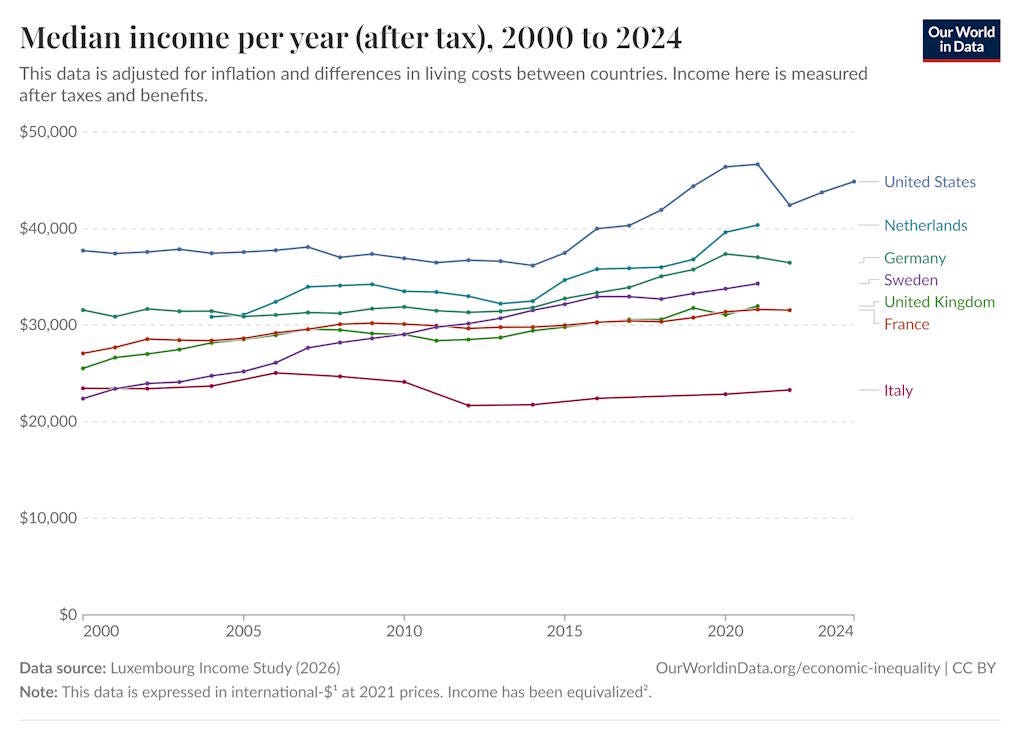
Yes, this includes European government health benefits!
These numbers tell the same story as GDP — the typical American is richer than the typical European, and the gap is roughly constant over time.
Americans don’t just make more than Europeans — they consume more
What about how much people in the two countries actually consume? The OECD has a measure called Actual Individual Consumption:
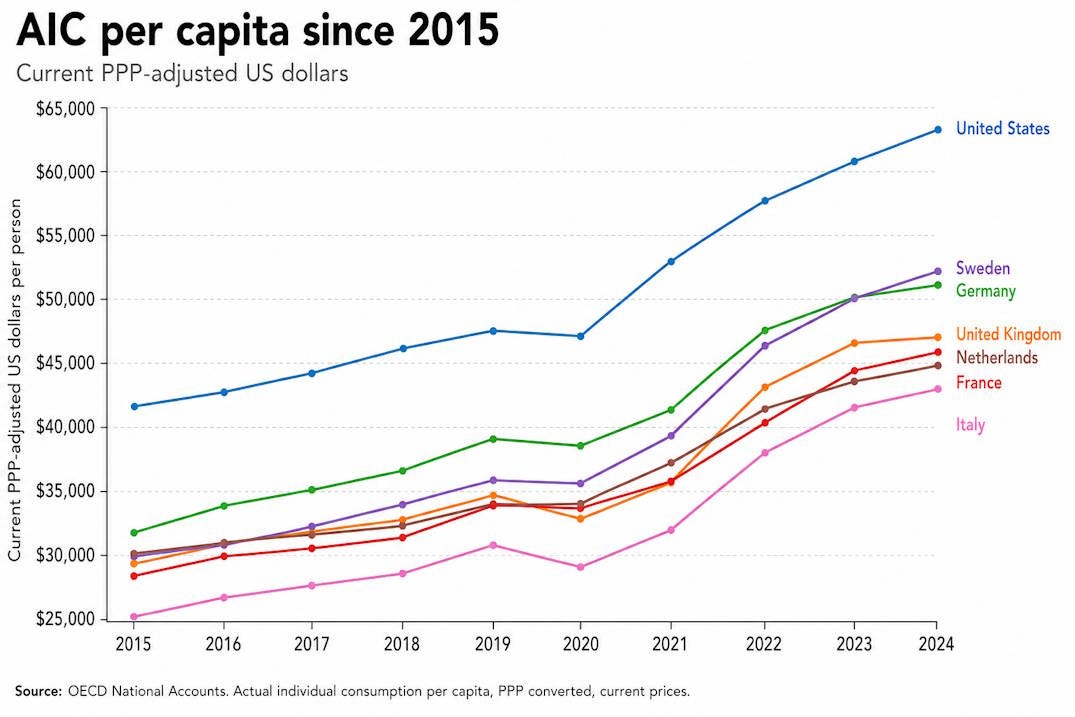
AIC is an average, not a median, but consumption is far less skewed by the super-rich than income itself, because super-rich people tend to save most of their money instead of consuming it (there are only so many yachts and private jets you can buy). Anyway, this measure tells the same story — Americans consume more than Europeans, and the gap is pretty constant over time.
What is all the stuff that Americans are consuming more of than Europeans? Housing is the biggest one. Americans have much bigger houses than Europeans:
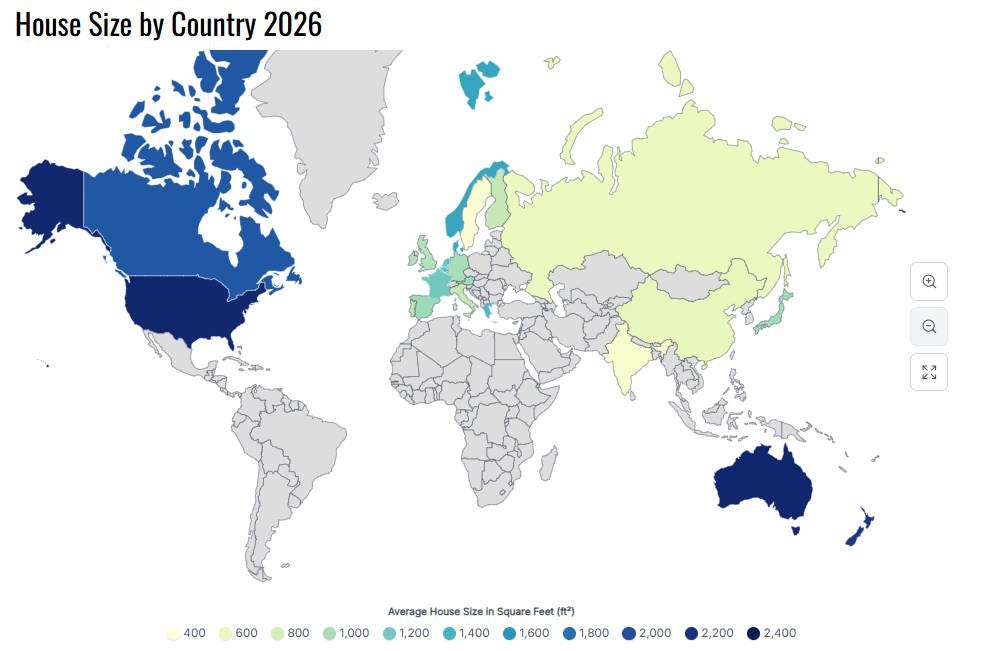
Other measures, like rooms per person, also put America well above Europe. In the U.S., inner cities are dilapidated and dirty, but if you drive out of the city center you’ll suddenly be among gorgeous well-appointed McMansions, big spreading lawns and well-tended gardens. In Europe, if you venture far outside the picturesque streets of the central cities, you quickly find yourself among far more modest suburbs filled with apartment buildings and smaller single-family homes.


This is not poverty, but it’s not the same kind of suburban wealth Americans enjoy.
Americans have much bigger houses than Europeans, and they fill these houses with furniture and appliances and entertainment devices and decorations and pets. The appliances tend to be better — Americans use air conditioning a lot more than Europeans, and their clothes dryers are much more effective. That’s a big part of the difference in material wealth between the U.S. and Europe.
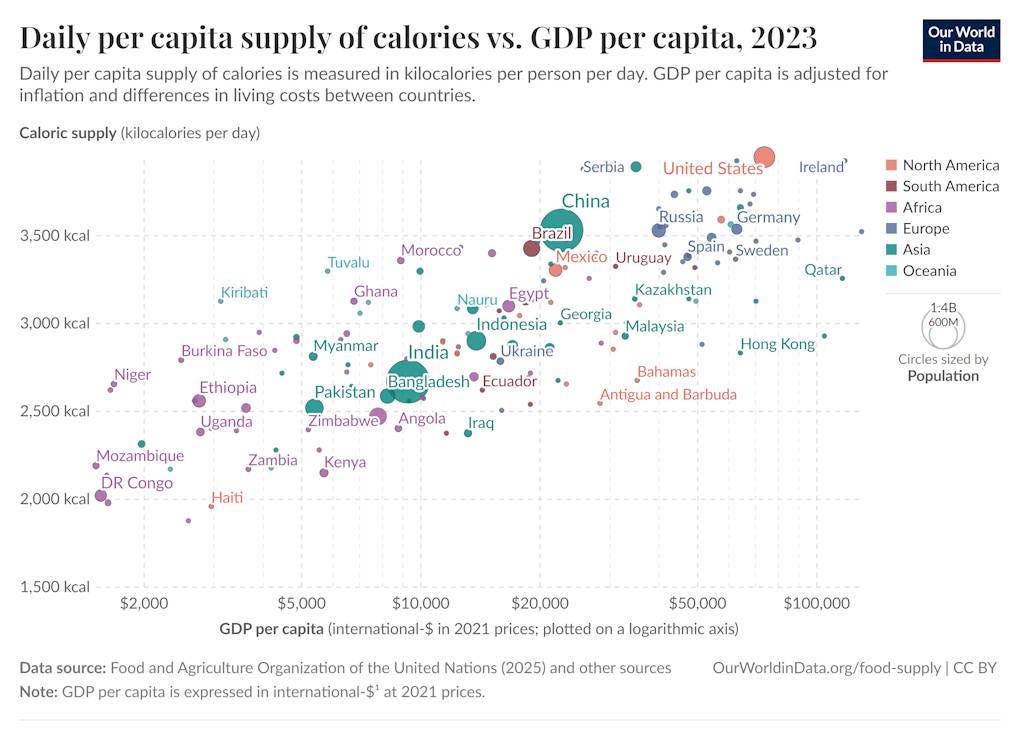
Food is another thing Americans consume more of. Calorie consumption per day is pretty strongly correlated with national income, and Americans consume more calories per day than anyone else:
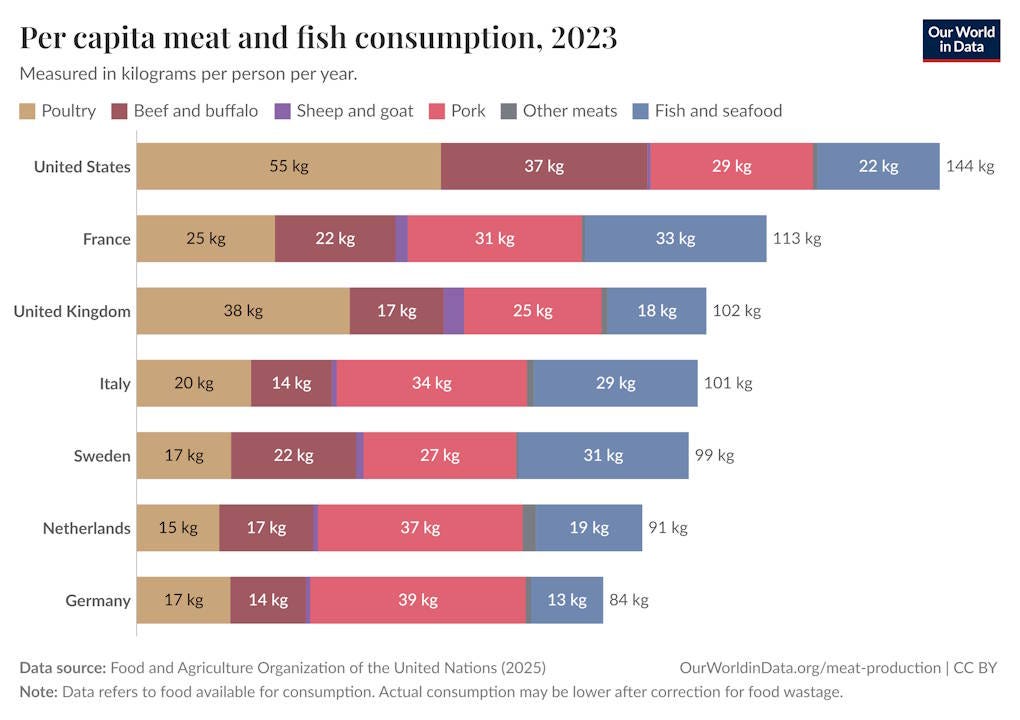
And Americans consume more meat than Europeans — traditionally something people consume more of as their countries get richer:
A third thing the U.S. consumes more of is cars. Vehicle ownership is much higher in the U.S. than in European countries.
This is by no means an exhaustive list. Americans go out to eat more, they get more food delivery, and they also consume more of most services (though about the same amount of health care, which they pay much higher prices for). One service Americans spend a lot more on is pet care, which makes sense because they keep a lot more pets than Europeans do.
Now for each of those types of consumption, you can tell a story about why it’s actually bad. Oh, you have a giant house? You must be lonely and isolated. Oh, you have a bunch of cars and drive a lot? Car-centric cities are isolating and ugly, and roads are dangerous. You eat more food? That’s why you’re obese. You have more dogs and cats? Your pets are just stand-ins for real human community, which of course you need because your country is just a bunch of strip-malls and sterile subdivisions, etc. etc.
All of these arguments boil down to the idea that the American lifestyle is inferior to the European lifestyle. And that’s certainly an argument you can make! But it’s not a story about material wealth. And as I’ve mentioned already, it’s a matter of taste — we urban liberal intellectuals can talk all we want about how awesome it is to live in an apartment in a hip city center and not own a car and take the train, but regular Americans are still moving out to the suburbs. (And in fact, as their incomes have grown, West Europeans have generally been moving out to the ‘burbs and buying more cars as well.)
Is America only richer because Americans work more?
There’s one final argument that Europe boosters make against the notion that Americans are richer. This is the notion that Americans only make more money because they work more hours. Here’s Krugman:
While Europe has lower GDP per capita than the U.S., its labor productivity is relatively close to that of the U.S. What explains this divergence?…The answer is that America is the “no-vacation nation.” Historically, Americans were more like Europeans, taking part of the gains from productivity growth in the form of shorter work hours. But that process stopped after around 1970. Europeans, however, do take vacations, and as a result work fewer hours per year. This means lower GDP, but with the offsetting benefit of more personal time.
It is true that leisure time is a valuable commodity that isn’t counted in GDP. And it’s true that Europeans work less than Americans do. And it’s also true that if you look at output per hour — i.e., labor productivity — Europe is closer to America than if you look at GDP or consumption.
But if you’re going to look at output per hour, you shouldn’t just look at the most recent snapshot — you should look at how it’s changed since 2000:
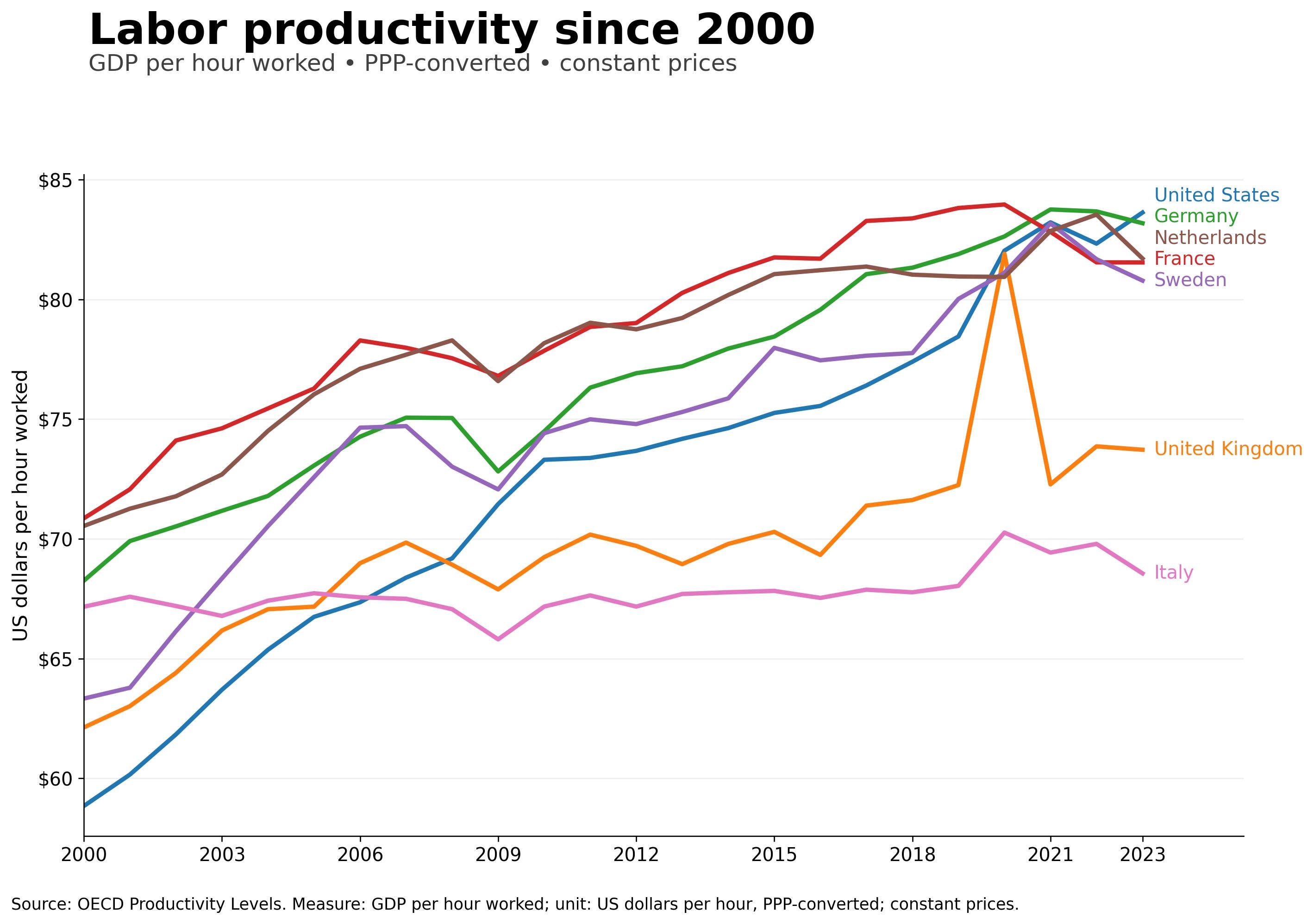
This is pretty amazing. In the year 2000, American output per hour worked was lower than that of the major West European economies. By 2024, it was higher than any of them.
How can the U.S. be maintaining only a steady lead in GDP, when its output per hour has been rocketing up the charts? The answer is that Americans work a lot fewer hours than they did a quarter century ago. Some of this is due to falling hours for employed Americans, but most of it is due to lower labor force participation — more housewives and househusbands, early retirements, young people in school, and so on.2
So if you want to claim that output per hour is the true appropriate measure of a country’s income, then you have to reckon with the uncomfortable fact that America’s output per hour has soared while West Europe’s has grown only slowly. It’s this slower growth in productivity that’s precisely why some European leaders and intellectuals are sounding the alarm over the region’s growth rate and policy regime.
So no matter which way you slice it, the economic comparison between Europe and the U.S. doesn’t come out looking great for Europe. Yes, in terms of nonmonetary factors — crime, road safety, drug use — Europe is a nicer place. But Americans are richer in material terms, and their productivity is growing much faster. That’s definitely a gap Europeans should be worried about. Being a “garden” — a leisurely, comfortable, senescent civilization — was a luxury Europe could afford in the peaceful decades of yore. But not anymore.
Update: A lot of people have pushed back on my claim that it’s “not that hard” for people to move between Europe and the U.S. This is fair; I was trying to be generous to the pro-European side here. To the extent that it’s actually hard to move between the two, the fact that >1% of the populations of many North and West European countries have still chosen to relocate to America despite the difficulty, while very few have done the reverse, is stronger evidence in favor of the idea that America is just a better place to live.
Also, Krugman’s arguments in favor of current-price PPP comparisons are odd. His model assumes that all goods are tradable, which is very weird because PPP is based on countries having different prices for nontradable goods. And he spends a lot of time arguing that the tech sector is driving America’s GDP outperformance, but this doesn’t make sense — instead of measuring GDP by industrial output, you can just measure it by expenditure. The broad basket of goods that Americans consume more of than Europeans is not dependent on the tech industry at all.
Also some discouraged workers, but Europe has a higher unemployment rate than America, so this probably isn’t the big story.
"It's not that hard to move between Europe and the U.S., but not that many people do it."
This statement is very incorrect. And since this is a very load-bearing part of your argument, that's a problem downstream of the point. But yours is a misconception so widely held by Americans that it's important to clarify it here for the readership, generally:
It's *extremely* difficult for Europeans to move to the Untied States and vice-versa, as I can well-attest from the POV of an American living in Europe long-term. Most people in rich countries absolutely cannot "vote with their feet" in either direction. EU/EEA residents can't even easily move to the UK, and vice-versa, *within* Europe, anymore! And that changes the terms of these types of arguments, fundamentally.
For Europeans who aren't married to an American, the narrow pathway to moving to the US to work and live is via: 1/ the tiny-and-closing pathway of the H1-B visa 2/ an L-1A/B intracompany transfer or 3/ an O-1 for "extraordinary ability."
You've talked about the H1-B here before, so you know that it's capped at 85,000 professionals per year, which is a minuscule amount relative to *global* (overwhelmingly Asian) candidates and the unmet domestic American demand for that talent.
As for the L-1, it's also such a small volume as to be meaningless: you're talking a scale of a few tens of thousands. I know a few fellow tech workers who were transferred to the US on that basis (e.g. at Amazon or other American multi-nationals) to pursue global leadership roles, but the process within your corporation is extremely stringent, given the costs and complexities involved to sponsor. You're going to need to clock several years and reach upper-middle-management at your company for them to even consider it. Or else, yeah, be one of the tiny pool of charmed talent "working 80 hours a week building the future of AI."
And as for the O-1, it should be self-explanatory that this is an infinitesimally small pool. I suppose you could now double this exclusive pool with Trump's new "Golden Visa" for plutocrats. But it's not material to your argument.
Out of a US workforce of 160 million people and a EU/EEA/UK workforce of 250 million, then, we're looking at maybe ~50,000 Europeans who even *could* transfer to the US per year.
So when Trump asks why Norwegians and Danes aren't moving to the US instead of people from "shithole countries," the boring answer is because they literally can't. Many more Nordic people would if there was a pathway for them to do so.
Just like all of us know several dozen Americans who would *love* to move to Denmark or Norway if they were actually able to. Because do you have any idea how impossible that is for Americans!? One doesn't simply move to Europe. You've got a parallel situation to the one that greets Europeans trying to move to the US: a very limited and very stringent allotment of work visas, EU Blue Cards, or Critical Skills Visas available for the choicest American workers. I was able to get the latter, but a tiny percentage of American workers would qualify. The overwhelming majority of the millions of Americans residing Europe are either stationed there for the US military or other government reasons, retired on Golden Visas, or married to a European. There's no clean total of Americans just working in Europe on work visas, but the number granted per year is roughly equivalent at ~50,000, given the difficulty.
As in the US, your real scale path in to Europe is via family ties: Millions of Americans have a Polish or Italian or Greek grandparent that would be their "ticket" to EU citizenship, often without their knowledge. Others marry-in. But even finding a European to marry for your pathway is arguably even more onerous than it is on the American side, with years-long administrative delay, sizable costs, formidable red-tape (which is very different by country), and practical challenges that can be insurmountable (like families literally having to remain separated for 12-18 months and maintaining households on two continents). I am married to a European but that would have been the hardest way for me to secure residency, ironically.
So saying that people in rich countries reveal their preferences by moving (or not) is incorrect.
Thanks for this Noah, a really good overview of what's going on here. For what it's worth, in this specific context, I agree more with Garicano's way of looking at real income than Krugman's, though I understand it is to a certain extent subjective and context-dependent. Over very long periods of time, and we're really talking decades here, you have to have something that accounts for how much our consumption has changed qualitatively. If, say, Americans buy more cars and phones relative to Europeans, who may spend more on eating out - a hypothetical, but plausible example - we have to take into account the fact that cars and phones are vastly better in 2026 than in 2000. Eating out isn't, however, unless we're talking about delivery services, which Americans definitely spend more on.
I think to properly look at this, both economically and sociologically/politically, it's important to separate two things: European economic performance, which is pretty heterogeneous, and cultural preferences for what to do with wealth, which aren't. For the first, zooming in on real output per hour worked is absolutely the correct thing to do. This is where the gap opens up in the aggregate, something Mario Draghi's report showed pretty conclusively. The underlying reason is also obvious: the gap started opening up in the late 1990s, when the US tech boom started. The same thing did not happen here in Europe to nearly the same extent.
That said, there are clear outperformers. The Netherlands, Sweden, and Switzerland have all done pretty well compared to the US and other European countries. Others, like Italy and the UK, are notable laggards. The two things that stand out about the outperformers are that (1) they have relatively deep capital markets by European standards and (2) they are small but open economies whose businesses orient themselves around selling goods and services into much bigger markets. They also tend to have more flexible labour market arrangements for formal and permanent employees than some big European countries, like France and Spain. That said, the UK also has deep capital markets and relatively flexible labour laws, and that clearly hasn't helped them very much.
Cultural preferences - how to spend it - are a totally different story. Visually, there is honestly not much to separate nice suburbs of London, Paris, Milan, Zurich, and Amsterdam, aside from the weather and some aesthetic architectural details. They all resemble each other a lot more than they do a nice American suburb. If you go to Switzerland, where labour productivity is pretty much dead-on American levels, they do not live in huge, air-conditioned houses, or drive cars that are the size of a light tank. The most noticeable differences between them and other European countries are how punctual the trains are, and how much Swiss people talk about going on holiday in the Maldives. In other words, they plough that extra wealth into very European things - better public transport, and nicer holidays.
The economic outliers also don't have vastly different social models to other European countries. Switzerland in particular does have lower government spending relative to its GDP. But that's not really true of the Netherlands or Sweden, and Switzerland still has a robust social insurance-based system. If you go to the doctor, become unemployed, or retire, it's still far more like it is elsewhere in Europe than in the US.