


Hi, folks! My father unfortunately passed away two weeks ago from chemotherapy complications, and as you can imagine, I’ve been busy dealing with that, so posting has been a bit light. My apologies. (I will probably write something about my father on this blog at some point in the near future.)
Anyway, there’s tons of stuff happening out there in the world — far too much to fit in a single roundup post — but here are some items I hope you’ll find interesting.
1. The U.S. national debt bomb
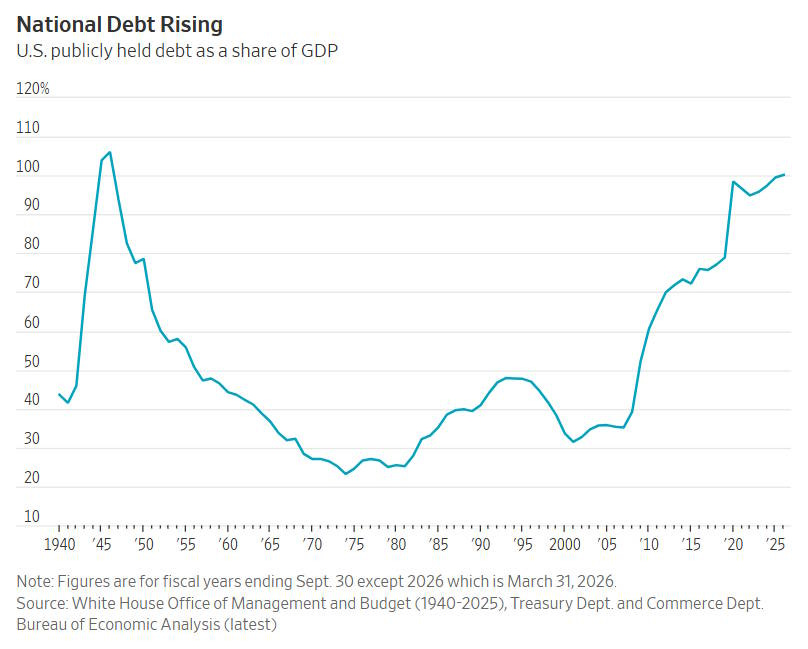
The U.S. passed a major milestone recently. The ratio of national debt to GDP passed 100% for the first time since World War 2:
Note that there are two measures of national debt, and they have names that sound very similar. “Total public debt” is the amount owed by the Treasury, while “Federal debt held by the public” is the amount owed by the Treasury to lenders outside the U.S. federal government itself. If another government agency holds Treasury bonds, that debt counts in “Total public debt”, but not in “Federal debt held by the public”. The one exception is the Fed — if the Fed holds Treasuries, it counts in both debt measures.
It’s very confusing, I know. They should probably change those names to make them less similar. Anyway, it’s “Federal debt held by the public” that just passed 100% of GDP for the first time since World War 2.
Now, there’s nothing particularly special about the “100% of GDP” marker — it’s just a big round number. The amount of money that the federal government has available to pay back the national debt is tax revenue, not GDP. Debt is currently at a little over 8 times annual revenue, meaning that the U.S. federal government owes about 8 years of its “income”.
But what’s really scary isn’t the debt number itself — it’s two other things. First, there’s interest payments. As a percentage of GDP, the U.S. government is paying just about as much in interest as it ever has — and a lot more than after World War 2.
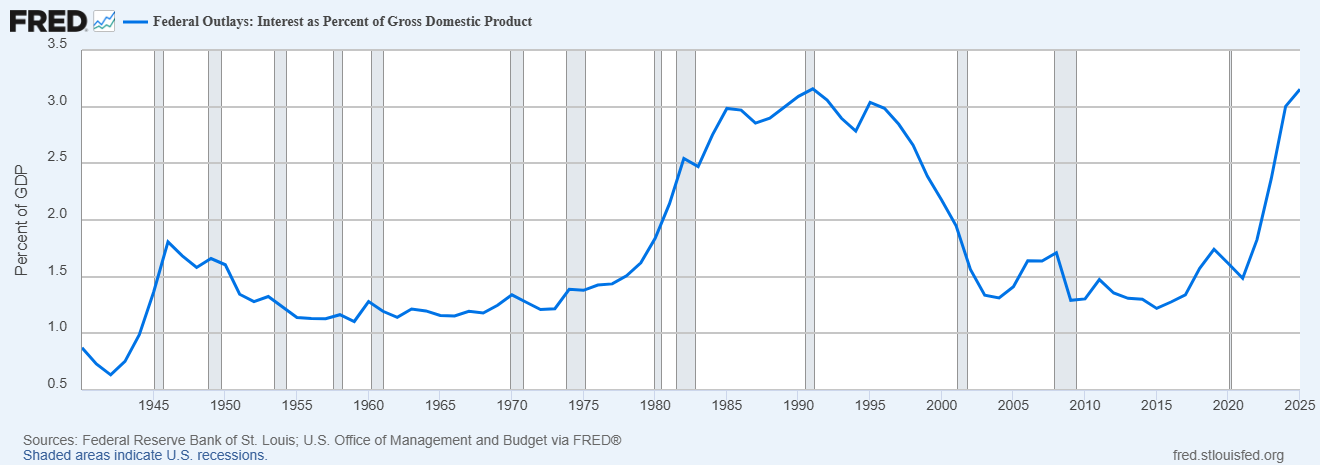
That number is going to soon hit record highs, as an increasing percent of the federal debt gets rolled over at current high interest rates.
The other scary thing is that no one in the United States government seems especially interested in curbing the debt. DOGE was a complete joke, and totally failed to lower spending. Trump is going on a giant deficit spending binge. The Democrats are now promising tax cuts. The government’s official deficit projections rely on totally fantastic assumptions about interest rates.
As Paul Krugman says, we are no longer a serious country. (But the Democrats are more complicit in that unseriousness than Paul would probably like to admit.)
If we keep going in this direction, we will eventually see negative consequences. It could be inflation, or a collapse in the dollar, or a sovereign default. Any of those outcomes would be very bad for the American economy and the American people. But everyone seems more interested in winning the next election cycle and kicking the can down the road.
2. Is the danger of AI cyberattacks overrated?
The recent release of Anthropic’s Claude Mythos model sparked global alarm about the possibility of a wave of AI-powered cyberattacks. The new model was able to find a bunch of security flaws in existing software systems, prompting fears that if it got into the wrong hands, it could collapse all kinds of critical digital infrastructure. Ostensibly in order to allay these fears, Anthropic limited the initial release of Mythos to only a few people, while it worked with the government and with corporations to use Mythos to find and close as many security loopholes as possible.
Then along came OpenAI, and released GPT-5.5. While there’s no single test of hacking capabilities, the UK government’s AI Security Institute rates GPT-5.5’s capabilities as equivalent to — if not slightly better than — Mythos’.
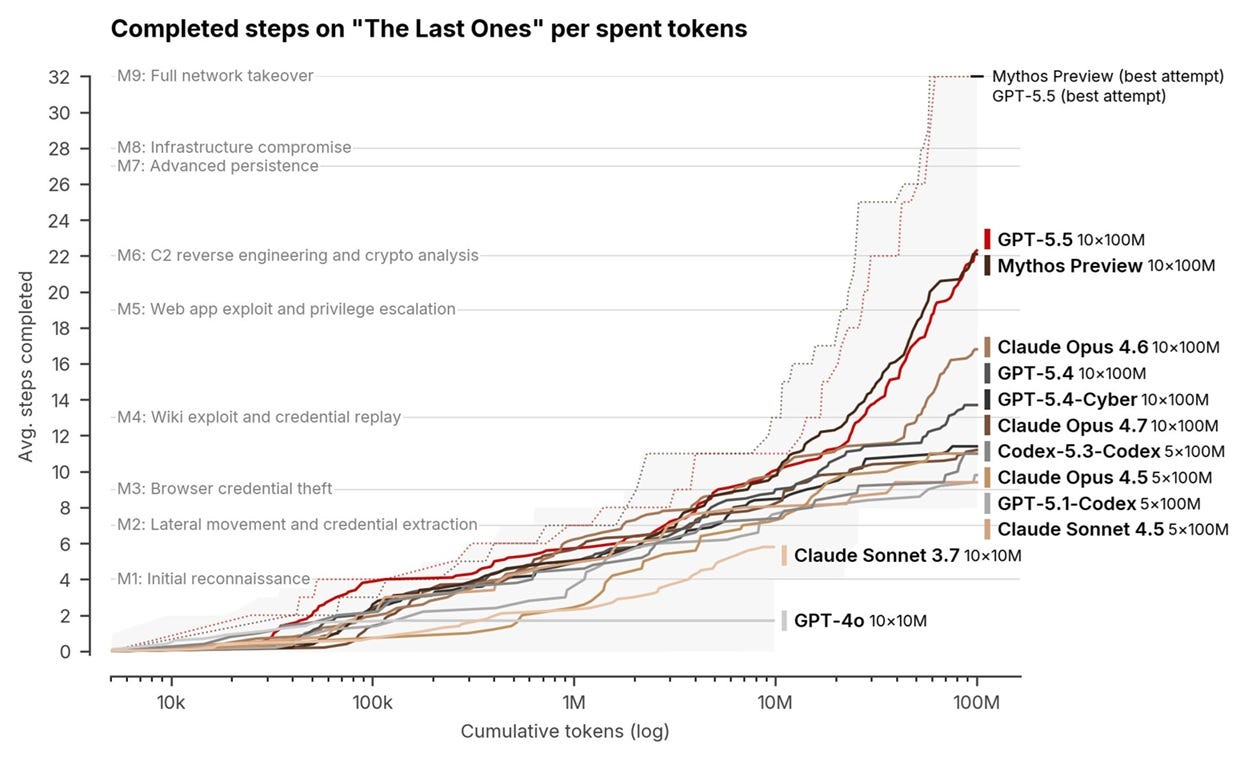
This at first seems very worrying, because it means that a lot of different companies can build models with superhuman hacking abilities. The Chinese companies certainly aren’t far behind. Is the digital infrastructure that supports modern civilization about to be destroyed?
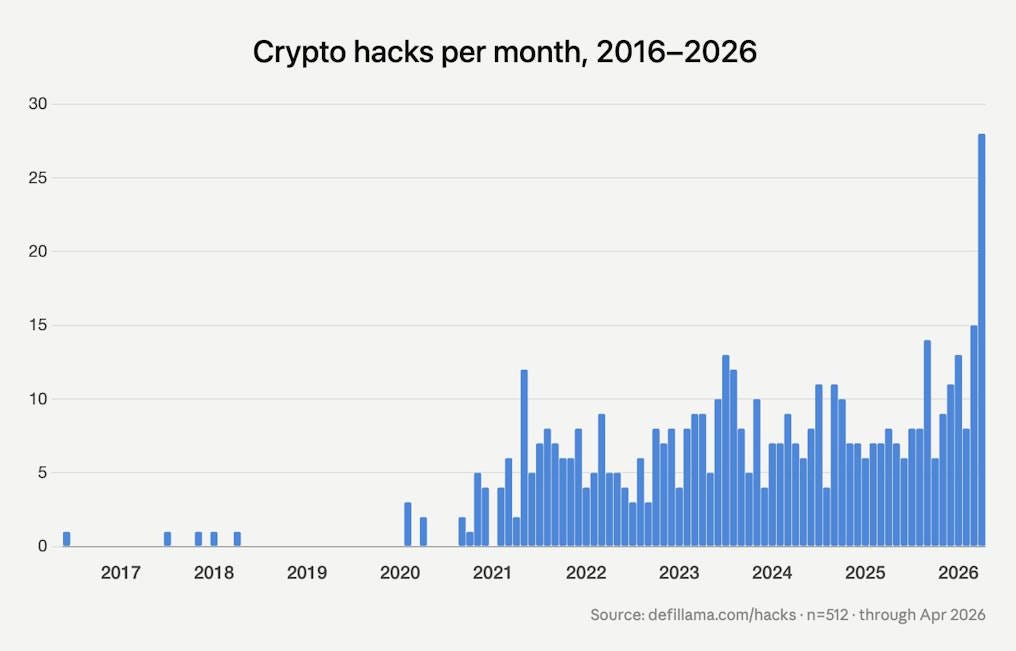
Well…maybe not. As some have pointed out, GPT-5.5 is being widely released, unlike Mythos. It’s been a week and we haven’t seen a giant wave of crippling online bank heists or other hacking attacks, so maybe cyber-defense is more robust than we think. There is some research to support this, actually. On one hand, hacking attacks have gotten steadily more common over the years, even before AI came along:
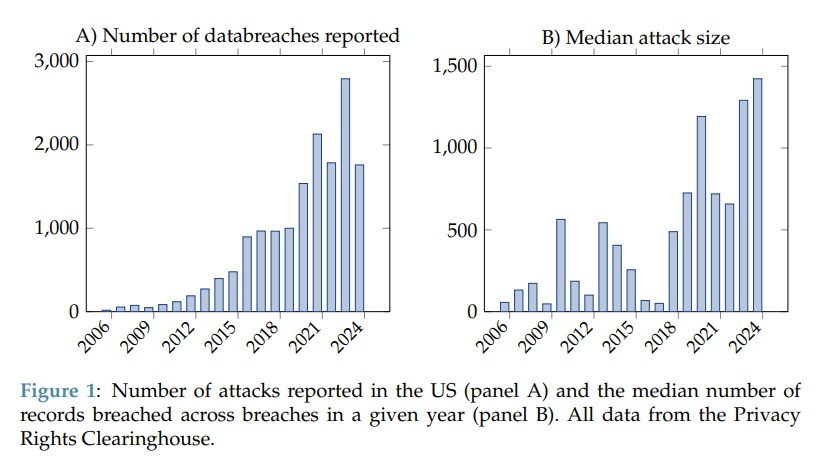
But the cost of a typical attack is generally very low, and lower than it was in the past. A recent paper by Tom Johansmeyer shows that cyber “catastrophes” cost much less than they used to:
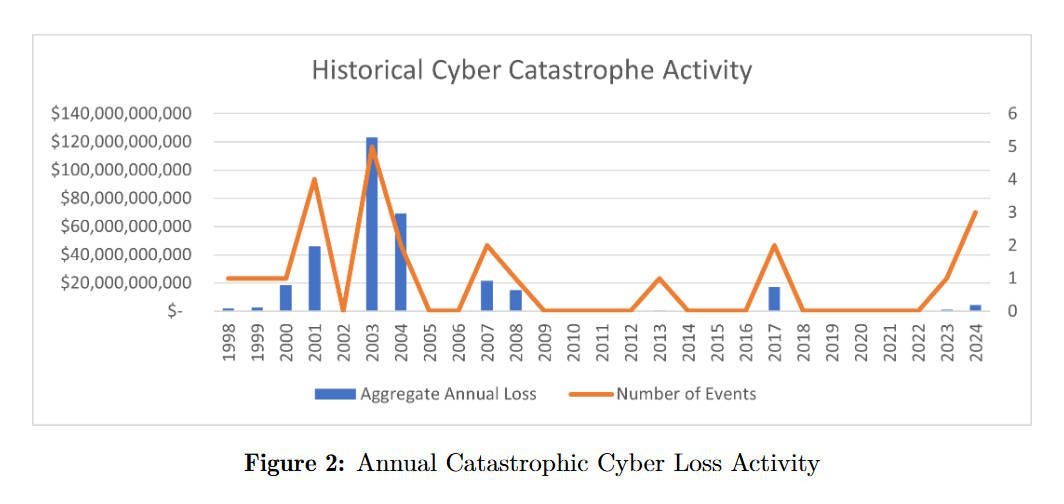
So perhaps our companies and governments have just developed defenses-in-depth against the omnipresent threat of data breaches — systems of backups, redundancy, cross-checking, compartmentalization, damage control, and so on that make the cyber-world very robust to even successful hackers.
If so, perhaps the new AI models will make things even more secure. Any system has only a finite number of security vulnerabilities, so if we have new AI models that are good enough to comb over the code and fix the weak points very quickly, that should privilege the defense over the offense. Of course attackers have the same newfangled AI, but even the most powerful AI system can’t find software vulnerabilities if there are none to find. So it seems like if AI gets better at both attack and defense, defense will tend to win in the long run.
This might be a reason to sleep a little easier about the coming of superhuman AI hacking. If you’re in a space that has fewer institutional safeguards, however, you may be sleeping a little less soundly right now…
3. Phone bans in schools seem…good?
I’m generally a techno-optimist, but I think that it often takes a very long time for human society to learn to use a new technology in a beneficial, healthy, socially stabilizing way. The adjustment period, where we still haven’t reconfigured society to adapt to the new technology, can be very painful.
One technology I think has been producing a particularly painful adjustment period is the smartphone — and more specifically, smartphone-enabled social media. “Social-mobile”, as we called it a decade ago, seems to have a bunch of negative side effects — it makes our politics more bitter and contentious, it makes young people unhappy, and it probably distracts people and makes it harder for them to think and learn. “Just put down the phone” isn’t a solution, because the strong network effect keeps people trapped in the ecosystem against their will — you can delete Instagram, but that doesn’t help much if all your friends are still on it. The rapid and often negative social changes caused by social-mobile are probably one reason why many Zoomers desire to ditch modern technology and live in the past.
But past waves of technological advancements show that the right approach isn’t to ditch modernity; it’s to reshape society so that it uses new technology in more beneficial ways. It’s been only a decade and a half since the advent of social-mobile, and we’re already experimenting with cell phone bans in schools. Already, those experiments are yielding positive outcomes. Here’s Abrahamsson (2024):
I show that banning smartphones significantly decreases the health care take-up for psychological symptoms and diseases among girls. Post-ban bullying among both genders decreases. Additionally, girls’ GPA improves, and their likelihood of attending an academic high school track increases. These effects are larger for girls from low socio-economic backgrounds.
And here’s Sungu et al. (2025):
In a randomized controlled trial involving nearly 17,000 students, we find that mandatory in-class phone collection led to higher grades --- particularly among lower-performing, first-year, and non-STEM students --- with an average increase of 0.086 standard deviations. Importantly, students exposed to the ban were substantially more supportive of phone-use restrictions, perceiving greater benefits from these policies and displaying reduced preferences for unrestricted access. This enhanced student receptivity to restrictive digital policies may create a self-reinforcing cycle, where positive firsthand experiences strengthen support for continued implementation. Despite a mild rise in reported fear of missing out, there were no significant changes in overall student well-being, academic motivation, digital usage, or experiences of online harassment. [emphasis mine]
Note that this study didn’t find an increase in psychological well-being — just a bit better grades. But importantly, students liked it when phones were banned. This could be because phones are an addictive drug, and the students welcomed an intervention. But a more likely explanation is that what they liked was that everyone around them was off of their phones — they were freed from the collective trap of having nowhere to go but online.
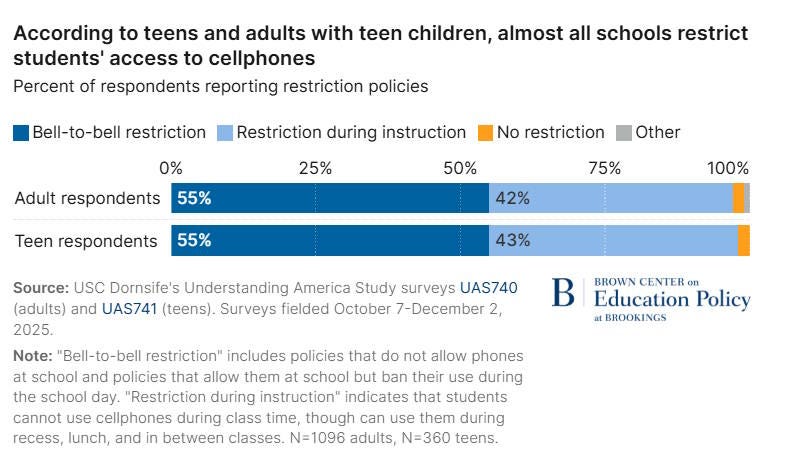
Anyway, other experiments consistently show some degree of improvement in either grades and/or student well-being from cell phone bans, with little evidence of negative effects. Over the last year or so, American states and cities have been scaling up the approach — as of the end of 2025, 35 states had enacted restrictions on phone usage in schools, and some cities are taking even more drastic measures. These restrictions are covering almost all students in America to some degree:
And amazingly, both students and parents like the bans a lot:
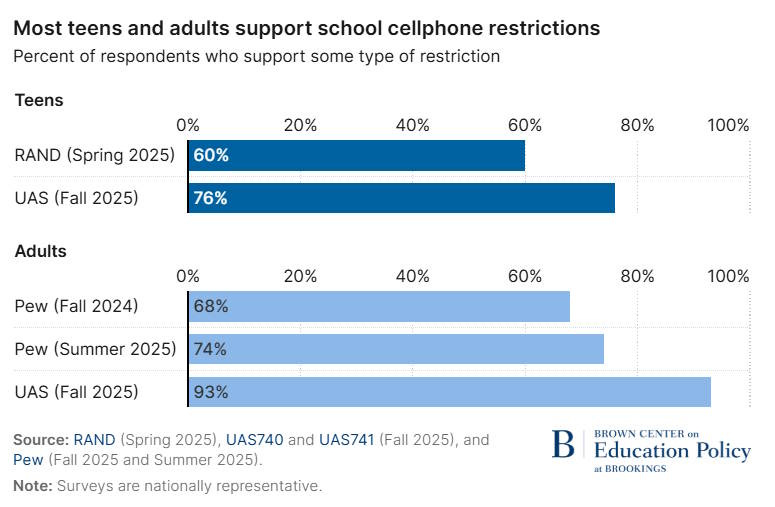
Does this mean technology is bad? I don’t think so — in fact, the apparent success of school phone bans actually supports my version of techno-optimism. Social-mobile isn’t intrinsically bad, but its network effect can easily become toxic if it isn’t counteracted by some outside force. Our society is simply learning how to provide that outside force.
4. Some bad news on AI and jobs
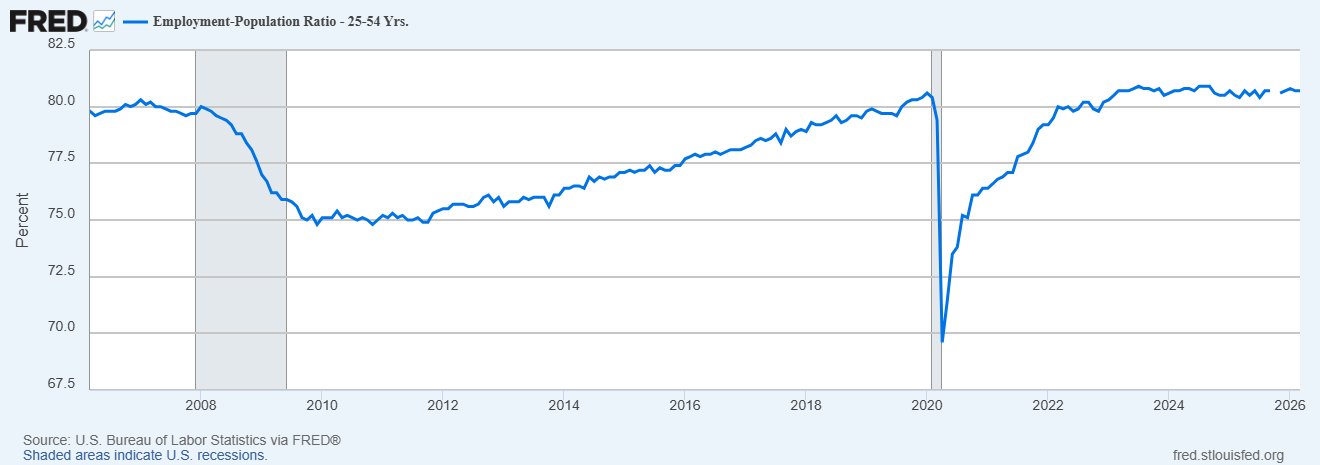
Everyone is watching like a hawk for evidence of the long-awaited AI displacement of human jobs. I keep checking in on this topic, and each time there seems to be only weak evidence of AI taking jobs. And at the macro level, pretty much everyone who wants a job still has some sort of a job:
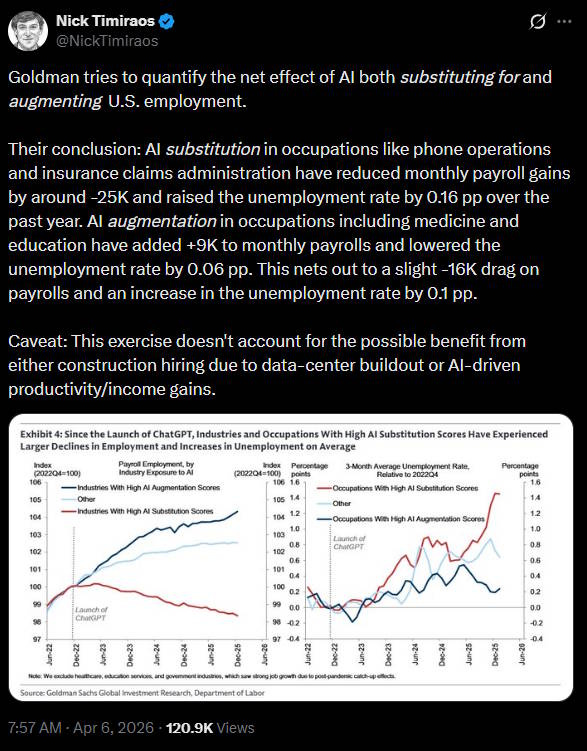
But some voices are now claiming that AI is beginning to kill jobs: Goldman Sachs claims that AI is exerting a small drag on hiring:
And Tucker (2026) finds that workers between the ages of 22 and 24 are having a tougher time getting hired:
Using detailed tabulations from matched employer-employee administrative data, I document evidence of an immediate, sizable, and persistent decrease in the level of early career (22-24 year old) hires following introduction of ChatGPT within the industry-state cells that are most exposed to AI. The decline in hires is the primary cause of large observed declines in employment over the subsequent period. Regression-adjusted employment of early career workers in the most AI-exposed quintile of industry-state cells declined by 12% over the 10 quarters following the introduction of ChatGPT, even as employment in less-exposed industries has remained stable. The rate of hiring largely recovered by early 2025, attributable to a smaller employment base…[T]he association of higher AI exposure with reduced early career employment and fewer hires is observed across most sectors of the economy.
So perhaps the job-pocalypse is finally here. Or perhaps employers are simply playing it safe, avoiding expensive hiring while trying to figure out what AI is and isn’t going to be able to do.
But even if AI doesn’t end up leading to massive job loss, it still might devastate some occupations — including some very highly paid ones. In fact, it would be very weird if a technology as important as AI didn’t lead to job losses in some occupations. After all, the list of jobs that no longer exist is very long, and those changes are pretty much all due to technology. There aren’t really many professional weavers left in the world, or telephone operators. Other occupations, like travel agent, slowly become more niche but never disappear; Ernie Tedeschi of Stripe has a good post on this.

AI has recently found its killer app — or at least, the first one. It’s coding. AI agents have rapidly replaced humans as the generators of most code, leaving human software engineers to do either higher-level direction or careful code-checking. That represents an increase in productivity. If demand for cheap software doesn’t expand to fully take advantage of that productivity increase, the result must be a reduction in coding labor.
In fact, we may now be seeing that happen. Some new research suggests that young software engineers are having trouble getting hired in the age of Claude Code. Here’s Crane and Soto (2026):
This paper [measures the] impact of ChatGPT’s release in November 2022 on employment in computer programming, an occupation heavily exposed to AI. We find robust evidence that coder employment growth fell after that release. After controlling for industry-level shocks we find that coder employment growth has been 3 percent lower since the introduction of ChatGPT. This may reflect reallocation of tasks across occupations and we cannot control for all the relevant factors. Nonetheless, it suggests that AI is having a significant impact on this group of workers…[M]uch of the debate over AI and the labor market has centered on industry-level stories such as interest-rate sensitivity and post-Covid dynamics. Our counterfactual exercise shows that the relevant industries differentially substituted away from coder employment. This is evidence that coders specifically experienced a shock not shared by their coworkers in other occupations.
And here’s the relevant chart:
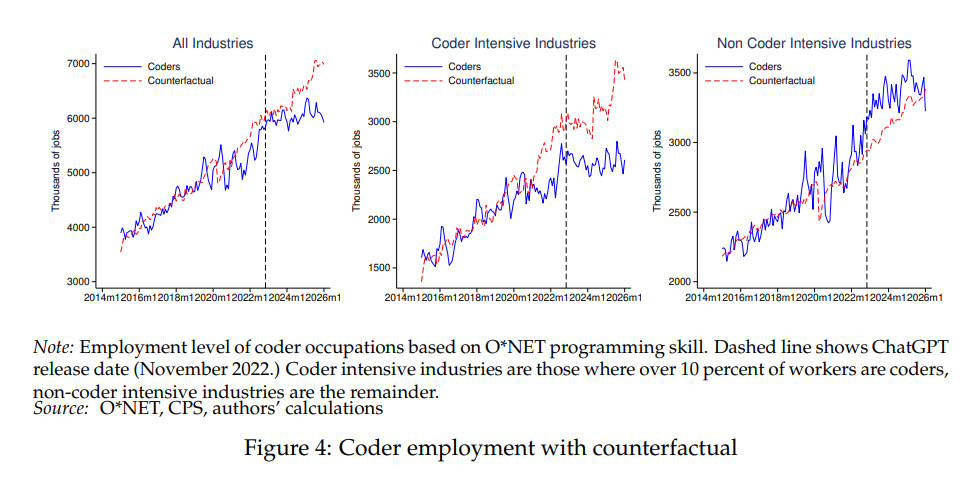
Note that when it came out in 2022, ChatGPT couldn’t even code. So perhaps employers correctly predicted that AI would hit coders the hardest. Or perhaps they were just limiting risk by refusing to hire. Either way, it’s cold comfort to the legions of computer science grads now on the market.
5. Millennials are doing better than our parents
Young Americans often claim that they’re being deprived of the economic opportunities that older generations — especially the Boomers — got to enjoy. Politicians and commentators often encourage this idea, probably as a way to get the youth vote. There’s also a more sophisticated version of the idea, which sees Millennials in particular as “Generation Screwed” — uniquely hurt by the Great Recession and a perfect storm of other economic headwinds.
In fact, as more and more commentators have been noticing since the pandemic, this narrative doesn’t really fit the facts — yes, Millennials faced some headwinds and negative shocks, but in the end they did fine. Now Kevin Corinth and Jeff Larrimore have a paper adding support (and some pretty charts) to that thesis. They write:
We construct a posttax, posttransfer income measure from 1963 to 2023…that allows us to consistently compare the economic well-being of five generations of Americans at ages 36–40. We find that Millennials had a real median household income that was 20% higher than that of the previous generation, a slowdown from the growth rate of the Silent Generation (36%) and Baby Boomers (26%), but similar to that of Generation X (16%). The slowdown for younger generations largely resulted from stalled growth in work hours among women.
Here’s a chart showing median income for the various generations, both before taxes and transfers (“market”) and after:
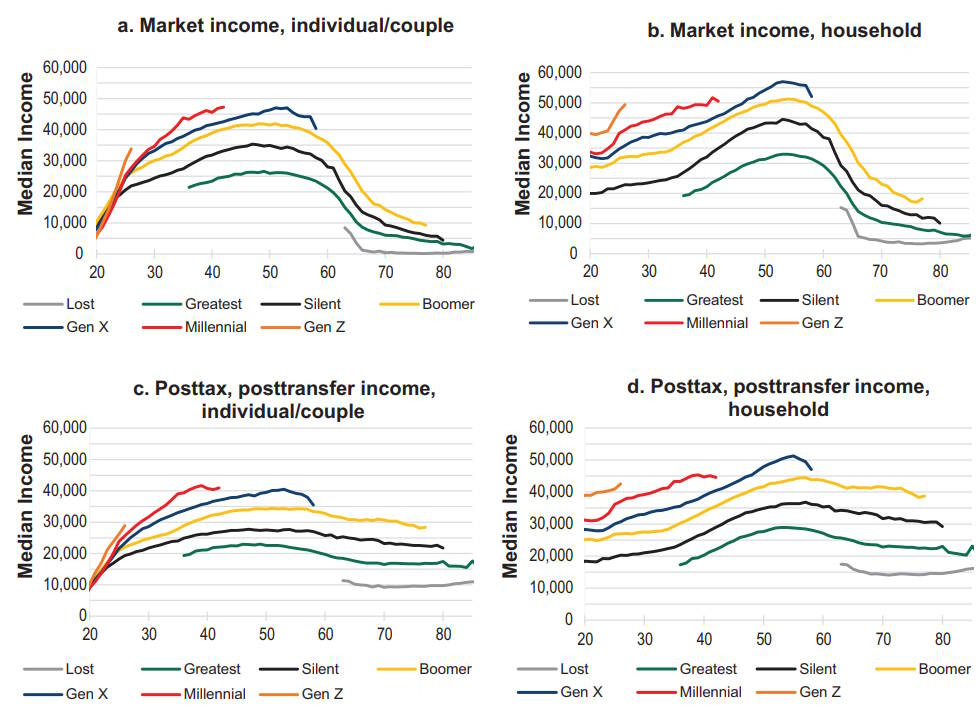
You can see that even before factoring in taxes and transfers, Millennials started exceeding the previous generation’s income somewhere in their 20s. They started to pull away a little later than previous generations did, but this was probably just because they stayed in school longer. In any case, by middle age, the Millennials were doing about as much better than previous generations as the Gen Xers and Boomers had. (The picture for wealth looks similar, though there we only have averages instead of medians.)
The basic story here is that younger generations of Americans aren’t screwed. It can be a bumpy ride to prosperous adulthood, but in the end, the basic machine of American capitalism has continued to work.
6. Public order: It works!
Crime and public disorder are the biggest reason why America’s cities feel so much shabbier and less livable than cities in Europe and Asia. One of the biggest weaknesses of progressive politics is that it believes that refusing to enforce public order is a way of helping the marginalized and disadvantaged. But lax policing and a permissive judiciary just pollute the commons, in ways that hurt the poor more than the rich — it makes buses unrideable for people who have no other way to get to work, it turns the streets of poor neighborhoods into dangerous jungles, and it destroys the public spaces that poor people are forced to rely on in order to congregate and relax.
It’s a testament to the deep dysfunction of progressive ideology that angry progressives fought for years against the BART train system’s plan to install fare gates at its stations. I’ve written about this topic before, but I never understood just what a bloody, extended political battle it took to overcome progressive ideology and get the fare gates installed. Henry Grabar writes:
[I]n San Francisco and other cities, the question of how riders access the subway—and how they behave on it—has been ensnared by vitriolic debates about fairness, poverty, mobility, social standards, and policing. One left-wing argument is that fare enforcement of any kind is a waste of money that instead could be spent improving commutes and helping low-income residents access the city…
BART first tried to [implement fare gates] in 2019…The experiment did not go well: KQED reported that the new gates were panned as “anti-poor, anti-homeless, and ableist” design. Even a BART board member concluded the agency had piloted “a guillotine fare gate that will live forever in some infamy.” Criminal-justice-reform advocates also pushed back on fare-beating enforcement; the state legislature voted in 2023 to decriminalize fare evasion, though the bill was vetoed by Governor Gavin Newsom.
But in the wake of the pandemic, when crime soared and BART ridership plunged — putting the entire future of the train system in immediate existential danger — the political will finally materialized to overcome the quasi-anarchist ideology that had been holding back good policy. When some BART stations installed fare gates, they immediately reaped massive benefits in terms of reduced cleaning costs, reduced crime, greater fare revenue, and increased ridership. Grabar again:
The new gates have compelled more riders to pay their fare—revenue is projected to rise by $10 million a year. They have also led to an enormous drop in vandalism. Workers spent nearly 1,000 fewer hours cleaning up after unruly passengers in the six months following the gates’ installation, compared with the six months before. Crime on BART fell by 41 percent last year.
Public order simply works. There are easier ways to produce public order — gentle measures like fare gates — and there are rougher measures like increased policing and incarceration. But by opposing both the gentle and the rough, progressives make it impossible to run a modern city effectively, and pollute the commons that the poor and marginalized rely on more than the wealthy and privileged.
The pushback against progressive ideological urban governance will be a long hard slog, but it has to be done.
7. Are YIMBYs losing in California?
Over the years I’ve trumpeted a wave of pro-housing legislation in California, and declared the YIMBY movement a success. But unlike in some other states, reform has not yet led to a big boom in actual housing construction in the Golden State. Are the YIMBYs failing in the birthplace of the movement?
M. Nolan Gray, a prominent California YIMBY, urges patience:

He writes:
I believe that skeptics are missing the existing mounting evidence of YIMBY success. In those areas of California where—substantively and geographically—YIMBY wins have been long-standing and thoroughgoing enough to actually mean anything, a lot of housing is already starting to get built…Chin up, YIMBYs. It’s working…
Before 2016, accessory dwelling units (ADU) were effectively illegal everywhere in California. That year, legislators embarked on the project of legalizing them statewide…As a result, nearly 150,000 new ADUs have been permitted, of which approximately 80,000 have been built…These ADUs now account for a quarter to a third of the housing units permitted in cities like Los Angeles, and they have allowed for rental housing production in even the most exclusionary suburbs…
I find that very few people realize just how many units the state density bonus law (SDBL) has helped to facilitate…According to a new report by Circulate Planning & Policy, these reforms have facilitated the construction of over 140,000 units since 2020…
Berkeley has gone from permitting almost nothing to permitting thousands of new homes in the past few years…The same is true in San Luis Obispo, another college town that was once a bastion of Left NIMBYism. In Silicon Valley, high-cost cities like Menlo Park, Mountain View, and Santa Clara have started permitting housing at scale for the first time ever. In cities like Sacramento and San Diego, hegemonic YIMBYism has facilitated a steady flow of new units, such that rents keep falling in those cities…For all the focus on bad actor cities like Huntington Beach, many California cities are getting their act together.
And based on this record, he issues a call to further action:
There is still a lot of work to be done on zoning and streamlining in California…But at California YIMBY, our policy focus in the coming sessions is shifting toward making housing financially feasible to build…Toward this end, we are backing bills to fix up condominium defects and presale law. In coming years, we will be overhauling California’s exorbitant impact fees and unfunded inclusionary zoning mandates…
Get involved in your local YIMBY group. Come to YIMBY lobby day. Vote for, donate to, and knock doors for YIMBY candidates…
Generational shifts in policy don’t happen overnight. But with enough sustained effort, they do happen.
I strongly endorse that message.
Commiserations Noah on the loss of your father and I hope you are ok. When you are ready it would be wonderful to read your post on him.
The one about millenials is misguided.
Yes, household/personal income is up relative to previous generations.
But what else is up?
Homeownership? (That's way down)
Child bearing? (Most people have less children than they want)
Student debt? Yes, a lot.
Speaking of my mom, who was a quintessential boomer. She got divorced from her first husband in 1980ish, drove across the country to a new city, lived in a YMCA type thing for a bit, but nevertheless owned a new home, had a new husband, and had a new child within a year and a half.
That doesn't happen to millennials. We have more "money," but more precarity as well.