

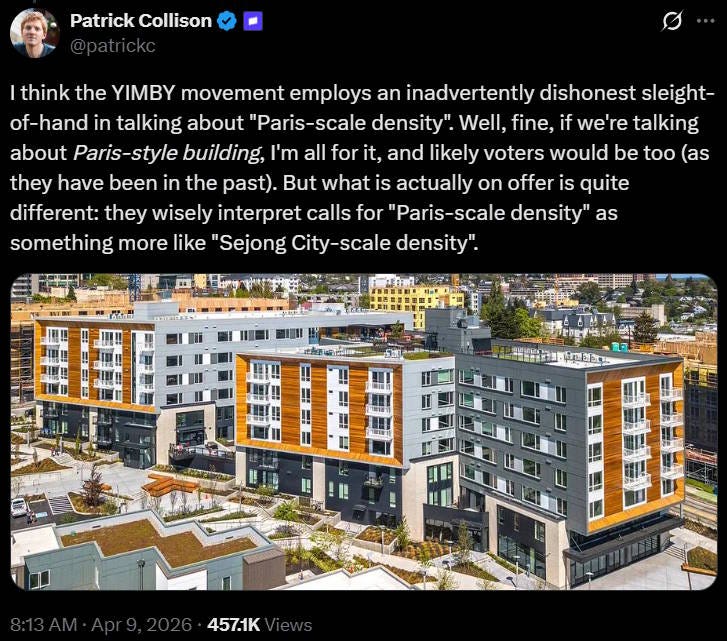
Patrick Collison’s YIMBY credentials are unimpeachable. He is a major backer of California YIMBY, the organization that has passed a stunning array of pro-housing bills in one of the most anti-development states in the nation. So it was interesting to see him claim that the movement has made a big mistake — or even been downright dishonest — by ignoring the aesthetics of apartment buildings:
For reference, here’s Sejong City in Korea, whose residential districts do indeed look rather bland and oppressive:


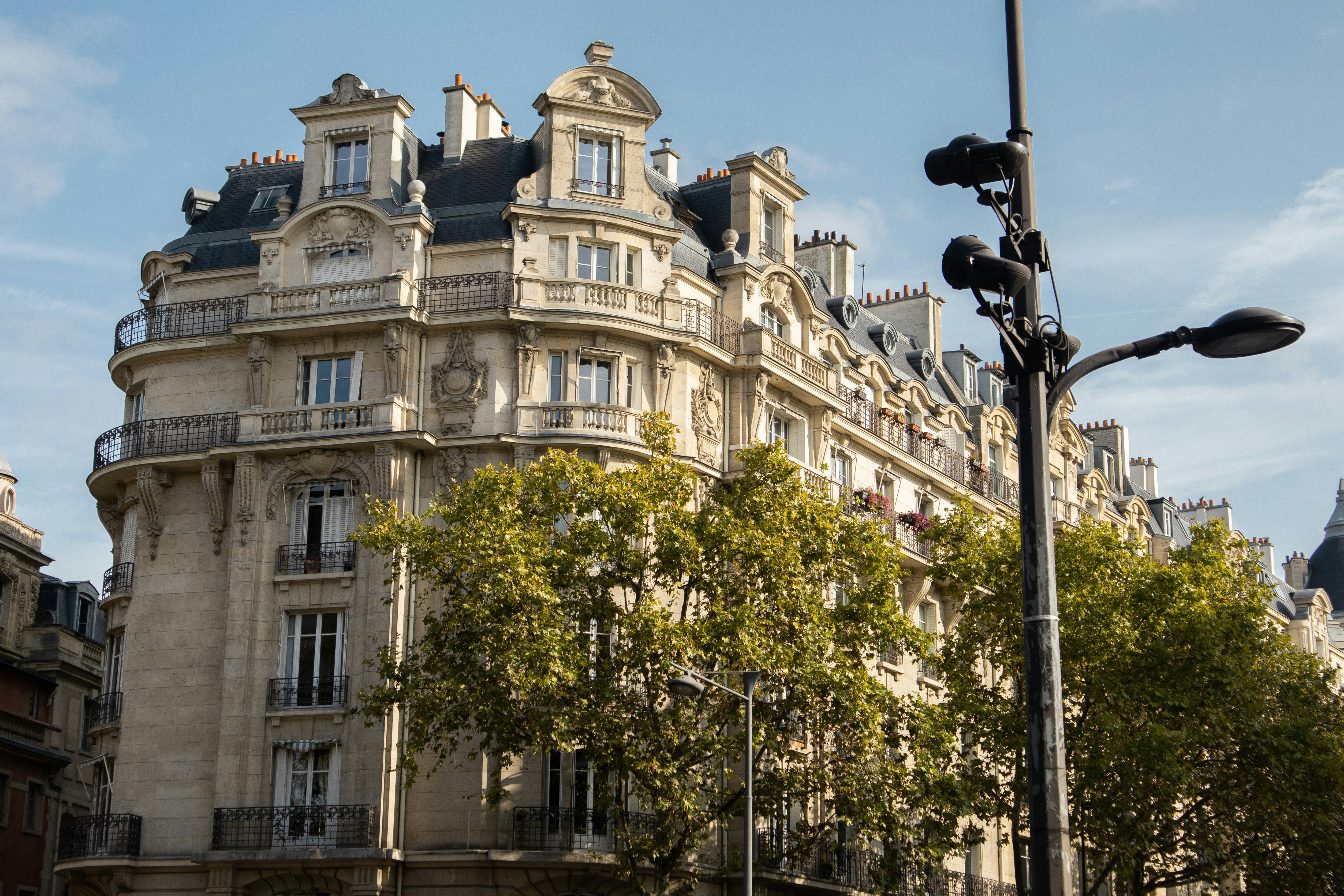
Some urbanists agreed, calling for regulatory reform that would allow American apartment buildings to look like the famous Haussmann buildings in Paris (depicted at the top of this post). So did some conservatives, which is unsurprising; intellectual conservatism has always called for a return to classical architecture and a rejection of modern styles. In fact, the idea that ugly building styles are a key reason that Americans disapprove of housing construction has been around quite a while, and it even has a name — “QIMBY”, meaning “quality in my back yard”.
Chris Elmendorf protested Patrick’s framing, arguing that YIMBYs have been active in pushing for reforms that would allow more beautiful buildings to be built in America:
YIMBYs have been pushing for single-stair reforms that would allow more "Paris-like" buildings…The municipal design standards & reviews that YIMBY laws allow developers to bypass did not improve designs. Per [Arthur] Stamps's studies (the only relevant empirical evidence of which I'm aware), they made things worse…[T]he problem of housing aesthetics deserves more attention -- and is receiving more attention -- but it's not like YIMBYs broke something that was working.
Elmendorf also pointed out that California YIMBY itself recently came out with a plan to encourage the building of more beautiful multifamily housing. The plan reads like exactly the kind of thing that Patrick might like:
[T]here’s a missing piece that housing policy still treats like an afterthought: how buildings look, function, and feel…Our current objective design standard paradigm…assumes you can “design away” ugliness by chopping a façade into smaller pieces…so the building feels “less big.” But contextual-design research shows why this keeps disappointing…When the underlying form and materials feel cheap or incoherent, extra façade break-ups read as fussiness, not beauty…
Many local Objective Design Standard codes demand heavy articulation and multiple cladding changes. The evidence suggests those moves have limited payoff compared to coherent style, material quality cues, greenery, and visible detail. (Stamps 2014; Nasar & Stamps 2008)…[We should u]pdate the California Department of Housing and Community Development’s model Objective Design Standards to [allow] projects [to] use a simpler envelope and meet a measurable threshold of real ornament (projections/recesses, columns/bands/cornices/fins, tile or relief work, murals), with minimum depth and material standards…
If California wants more European-feeling mid-rise development with courtyards, better daylight, shade, and balconies, it has to keep modernizing the [building] code…Too many building, electrical, and fire rules (in California and across the U.S.) [forbid] the buildings people actually like: bright cross-ventilated homes, true courtyard buildings, and mixed-use ground floors. All these requirements – egress, stairs, corridor, and elevator – often make projects bulkier and require much bigger lots, limiting where we can build new housing…[T]he web of building code regulations denies light, proportion, street connections, courtyards, greenspace – everything that makes buildings feel humane…Passing single-stair reforms and elevator reforms makes smaller mid-rise buildings possible, which fit on smaller lots, can be nestled into existing buildings, add variety to the streetscape, and reduce the pressure for larger, monotonous developments.
So at least one prominent YIMBY organization — the one that Patrick supports — is already answering the call to focus on building aesthetics. Others are likely to follow.
I think that’s a good thing. Eliminating onerous building codes and regulations will kill two birds with one stone, making it easier to build housing even as it also makes it possible to build more of the European-style ornamentation that commentators always call for. And allowing American developers to experiment with ornamentation and alternative styles will help break up the sameness of an urban landscape dominated by endless forests of boxy 5-over-1 buildings.
But that said, I highly doubt that this — or any stylistic change — would move the needle on public acceptance of new apartment buildings.
First of all, I’m skeptical that regular Americans actually like the kinds of building styles that intellectuals often yearn for. If you plunk down old-looking European-style buildings in the middle of Houston or Seattle, people tend to ridicule them as cheesy and inauthentic. The typical insult is “pastiche”, a derogatory term for a style that jumbles and mixes old European styles (even though, as Samuel Hughes points out, mixing and matching older ideas is exactly how classic European building styles were created in the first place).
Many local design standards explicitly discourage old-style buildings. For example, Los Angeles’ planning department, in its design guide for Echo Park, writes: “Do not imitate historic architectural styles; a modern interpretation may be appropriate if architectural features are borrowed and replicated to a simpler form.”
Nor is it just old European-looking buildings that leave many Americans cold. Pietrzak and Mendelberg (2025) find that although people tend to dislike tall buildings, traditional brick facades fail to move the needle on support for housing. Alex Armlovich points out that when New York City came out with new limestone skyscrapers, only three were permitted. And Brooklyn Tower, a recently built art deco style skyscraper in Brooklyn, has drawn tons of criticism for its style.
And Elmendorf cautions that no one has yet managed to find a specific architectural style that Americans like enough to move the needle on their support for new housing:
While the paper by [Broockman, Elmendorf, and Kalla (2026)] provides pretty good evidence that ordinary people’s aesthetic objections to bad, very unfit-to-context buildings affect their support for development (to the extent they care about anything development-related)…no one has shown that any specific set [of] design standards would materially improve public support for development, apart from pretty obvious stuff like "don't put up new buildings in low-density areas that are much taller than their neighbors").
All this suggests that while some American intellectuals may pine for the cornices and mascarons of Haussmannian Paris, most Americans just think that style — and any old style — looks cheesy when it’s transplanted to an American context. This may be because Americans consciously think of their culture as a young one, more suited to modern styles than traditional ones. Or it may be because America’s artistic culture has always focused on critique and fault-finding. But whatever it is, it suggests that allowing — or even forcing — cities to build ornamented buildings will not garner a wave of popular support for new development.
Conversely, the places that do build a lot of housing tend not to build it in old, ornate European styles. Texas, which is one of the best states when it comes to building new housing, mostly constructs single-family homes with lawns. When it does build apartment buildings, they tend to look like this:
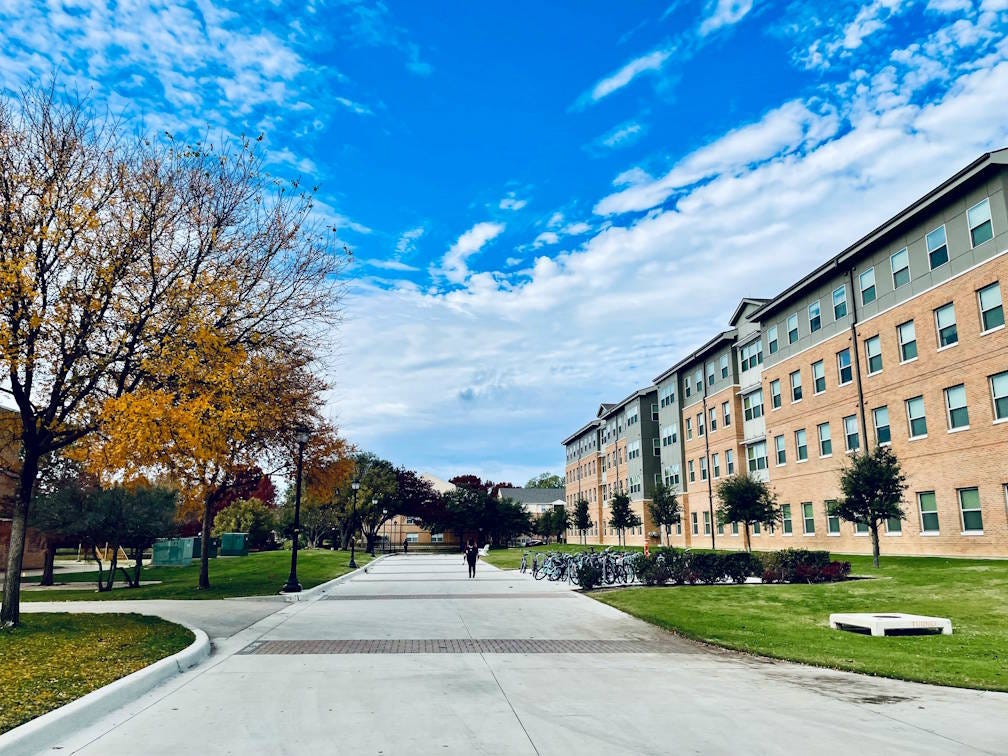
Texas builds them anyway, for much the same reason that the Koreans built Sejong City — they’re cheap and efficient, and the state needs them to support its rapid population growth.1 You do see a little experimentation with slightly more European-style apartments in a few places, but overall it’s just boxy and functional. The fundamental driver of housing abundance in Texas isn’t architectural beauty; it’s a culture and politics that values and seeks out economic growth.
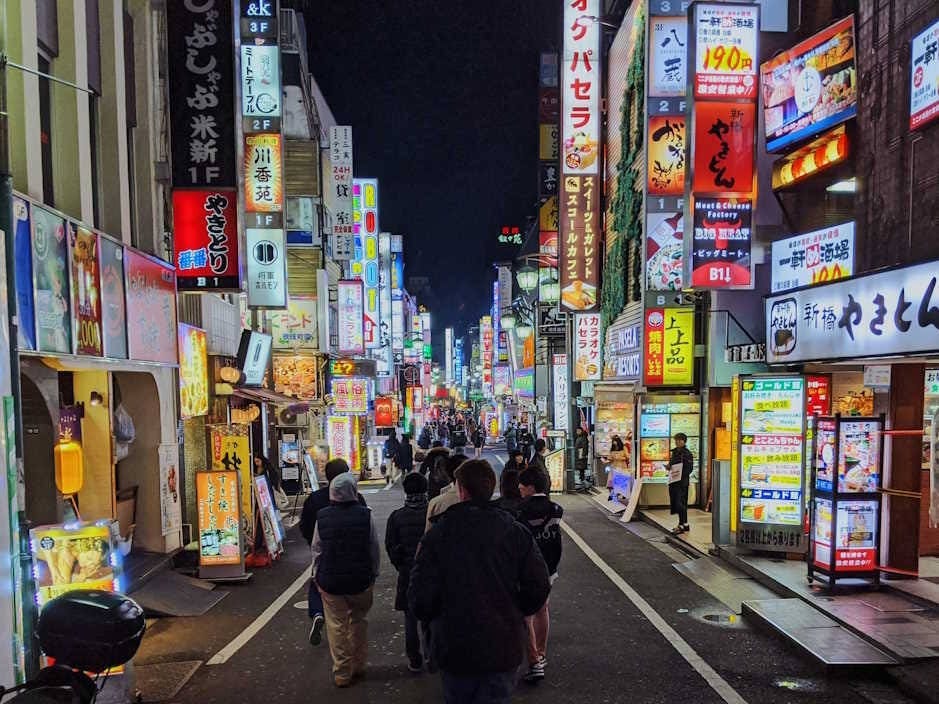
Nor is ornamental architecture necessarily what makes people love a city. Traditionalists may sigh over old European styles, and urbanists may salivate over the superilles of Barcelona, but the city that has captured the hearts of Americans in recent years is Tokyo. Downtown Tokyo is a forest of electric lights, strung up along the sides of stubby concrete mid-rises called zakkyo buildings. There’s nary a fancy cornice to be found; instead, the beauty comes from the bright cheery emblems of commerce:
Tokyo’s residential neighborhoods have even less ornamentation. They often feature flat brown or white or tan facades, hanging power lines, and bare asphalt streets with no setbacks or lawns or even trees:
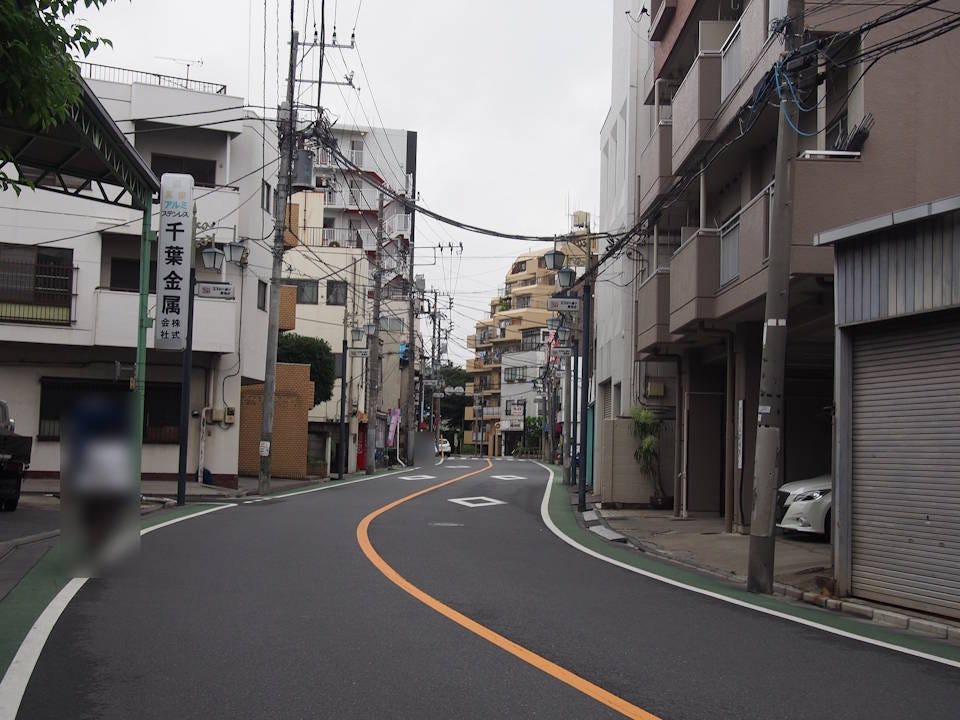

And yet these are absolutely enchanting places to live. Why? Not because of the architecture, but because of the design of the city itself. The small curving streets make perfect walking paths, undisturbed by zooming traffic. Mixed-use zoning gives the neighborhood a communal, lived-in feel. Plentiful public transit makes it easy and stress-free to get around, while Japan’s peerless public safety makes it fun to hang out on the street or in a park at any hour.
Americans who go to Japan have definitely noticed this:
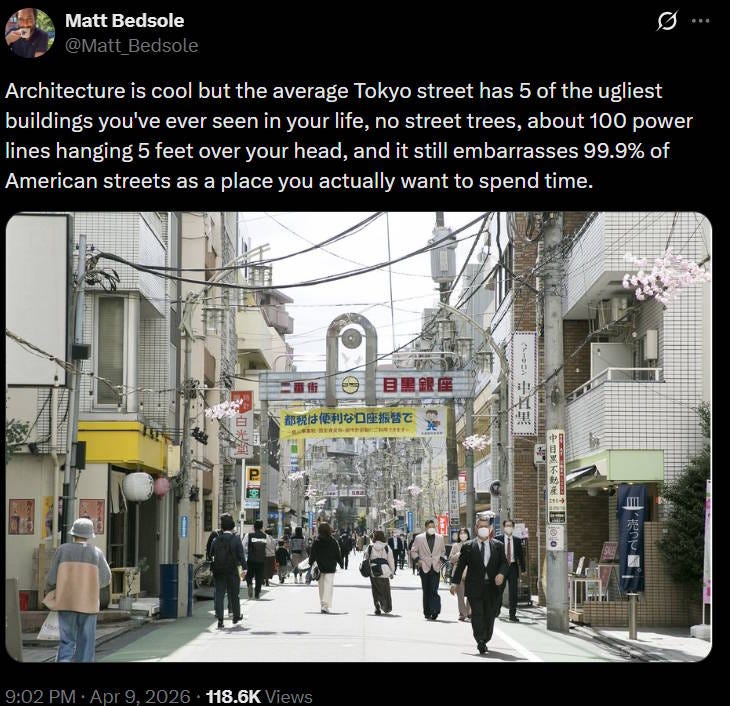
It’s no coincidence, I think, that Japan is one of the best countries when it comes to building plenty of housing. Yes, most of its apartment buildings look like crap when evaluated in isolation on their pure architectural merits. But the urban system made up by those buildings is a wonderful place to live, and so Japanese people have few qualms about building up that system. And Americans go there and love it.
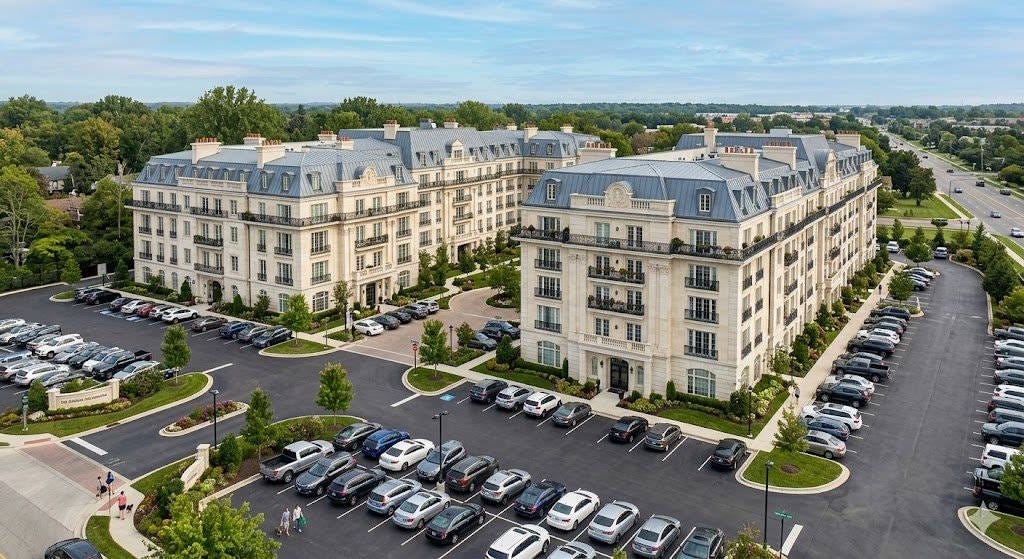
And if America built a bunch of Haussmann buildings instead of boxy 5-over-1s, it would probably only marginally improve the feel of the country’s cities. Imagine Haussmanns in place of 5-over-1s in a typical Texas apartment complex:
Or imagine Haussmanns along a giant American stroad instead of a cute walkable Paris street near a train station:
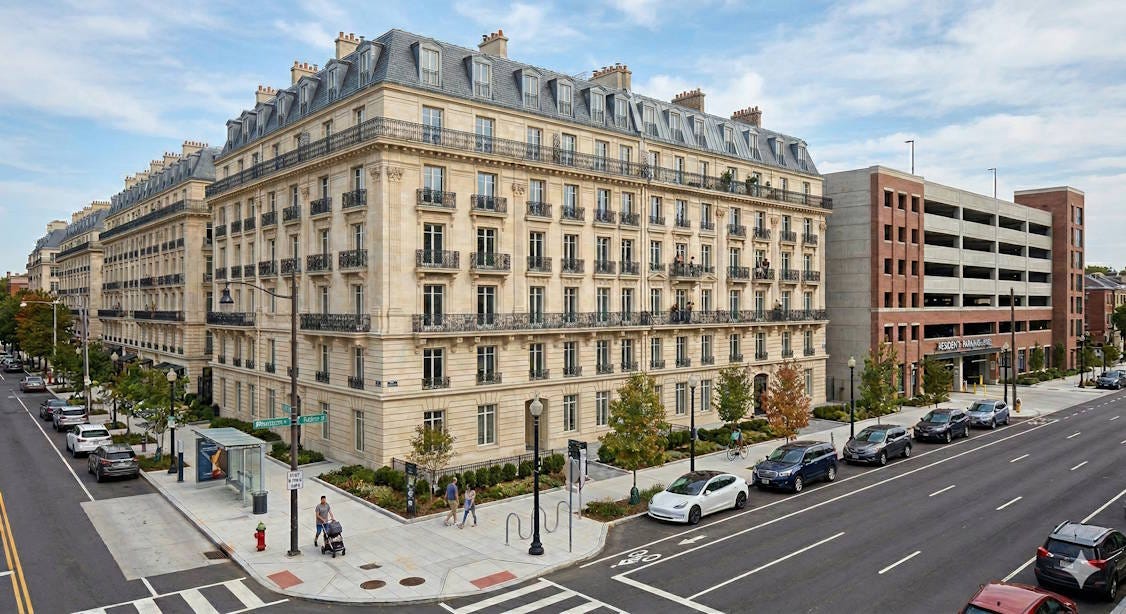
These renderings don’t look terrible; the buildings look fine. But they don’t make the city that much more appealing of a place to live, because it’s still built in the American way — there aren’t any shops, it’s all based around driving, and it doesn’t feel cozy or lived-in. At best it’s a marginal improvement.
If you want American cities to look and feel so nice that Americans are willing to build housing in them, I think you have to do a lot more than give the buildings fancy facades. You have to do the hard work of putting in train lines, making side streets safe for pedestrians, rezoning for mixed use, and — perhaps most important — policing cities in order to ensure robust public safety.
That’s a tall order, and I recognize that this total urban transformation isn’t going to happen soon — or happen all at once. Instead, I think America really has no choice but to build up its cities organically:
Implement hyperlocal control to allow neighborhoods that want to build more housing to do so as they see fit, thus circumventing the veto of city-level NIMBYs.
Build more fast commuter rails between inner-ring suburbs and city centers, and more subways and elevated trains in city centers.
Improve public safety through a combination of policing, community outreach efforts, better public services, and mandatory institutionalization for the dangerously ill.
Use state-level upzoning where possible to allow “missing middle” housing everywhere — duplexes, triplexes, townhouses, and small apartment buildings.
Simplify zoning at the state level along the Japanese model — have a few standardized zoning categories, and define them based on what kinds of nuisances they disallow, rather than what kind of buildings they explicitly allow. Make most zones mixed-use to some degree; most residential neighborhoods can benefit from neighborhood cafes and small stores.
Carry out sensible reforms like allowing single-stair buildings.
Over several decades, this gradual process will allow American cities to evolve into a better form. That will increase political support for denser housing. And when paired with sensible reforms like the one put forward by California YIMBY, it will allow American cities to develop their own local architectural styles over time. Ultimately, that will be cooler and more interesting than simply borrowing from old Europe.
Sejong City was a recently built administrative capital, so it had rapid population growth even in a country whose population was plateauing overall.
What I appreciate here is that you are pushing back on the idea that prettier buildings are some hidden master key that suddenly makes people love housing.
That always felt a little too easy.
The Tokyo comparison is especially useful because it breaks the lazy equation between ornamental architecture and lovable urban life. A city can be architecturally plain in isolation and still feel deeply human, walkable, lived-in, and worth inhabiting. That gets much closer to the real issue.
I do think aesthetics matter at the margin because ugly, cheap-feeling development can make people feel like something is being done to them rather than built with any care. But I think your bigger point is the right one: people experience systems, not facades. Streets, transit, safety, mixed use, and the overall texture of daily life do a lot more to shape how a place feels than cornices alone ever could.
Strong piece. The Haussmann-on-a-stroad thought experiment especially made the argument click.
Could not agree more with the point that layout and urban planning matters more than building design. This is revealing when you actually look at what is being built in the Paris region, which smokes most of the Anglosphere in terms of new starts.
The big new housing development on the other side of the park I live next to here in the southern Parisian suburbs isn’t a Haussmann pastiche at all. It’s fairly blocky modern development, like most Paris-region new builds. But it’s still clearly going to be an attractive place once it’s finished because it’s human-scale, centred around a nice tree-lined square, near a big park, tram, and suburban mass transit station, with mixed-use development including a new supermarket, pharmacy, bakery, and bike shop.
After having lived here for a while, I think the developments being mixed use is esp. important for local buy-in. The development isn’t just a bunch of new neighbours who will compete with me for services and resources. Instead, it’s providing me with new services I now have access to. It’s way easier now for me to get a snack or bottle of wine to take for a picnic to the picturesque southern side of the park. I also have an alternative pharmacy if I know something is unavailable in the one next to me.
These commercial businesses, or at least the anchors, like supermarkets and pharmacies, often open before the development is fully opened up too. This gives you a nice little preview of how it will improve your life.