

Everyone except the die-hard faithful now realizes that Donald Trump’s second presidency is a colossal failure. The president is doing his best to gin up symbolic, minor controversies in order to activate negative polarization and distract from his spectacular failures on inflation, the Iran War, corruption, racial harmony, and so on. These include demanding that artificial intelligence be renamed “artificial superintelligence”, bellowing that he should have won the Nobel Peace Prize, and conducting an execution on live TV. The goal is to get Republicans fighting Democrats over these controversies, in order to trick everyone into focusing on how much they hate the other team instead of how much they hate Trump.
The trick will probably fail, just as Trump’s promise to give every American $5000 for voting Republican backfired. All of these little tempests-in-teapots simply reinforce what a cruel, selfish, petty buffoon Trump is. And Trump’s approval rating just drifts lower and lower:
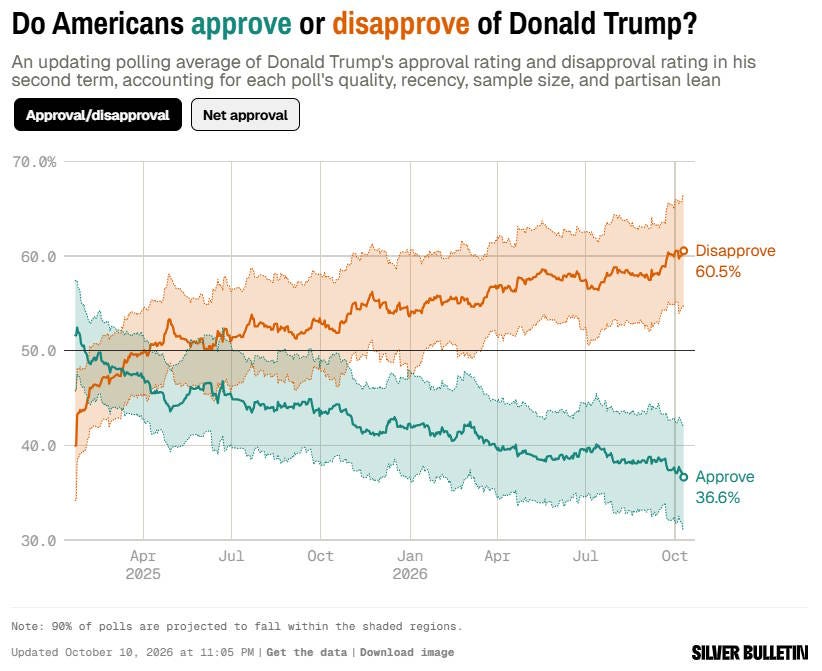
Trump will probably lose the midterms, and become a lame duck president, spamming increasingly grandiose, unworkable executive orders while battling a stream of Congressional investigations.
That means the window is closing on my ability to force Democrats to reckon with their failures during the Biden years. If and when Trump loses a national election, there will be far less pressure for soul-searching on the left. And once the GOP is no longer in control of all three branches of government, the Democrats will be able to influence actual policy instead of sitting around rebuilding their brand.
So before that happens, I want to summon the last fading scraps of the self-reflection that Democrats and progressives were briefly forced into after Trump thumped Kamala Harris two years ago. When Trump won, I wrote four blog posts trying to explain where the Democrats had gone wrong:


So today I’m going to repost all four parts of my election post-mortem, so that the progressives and Democrats among my readers can take one final moment to reflect on how not to enable the rise of authoritarian rightist leaders in future election cycles.
Identity politics isn’t working
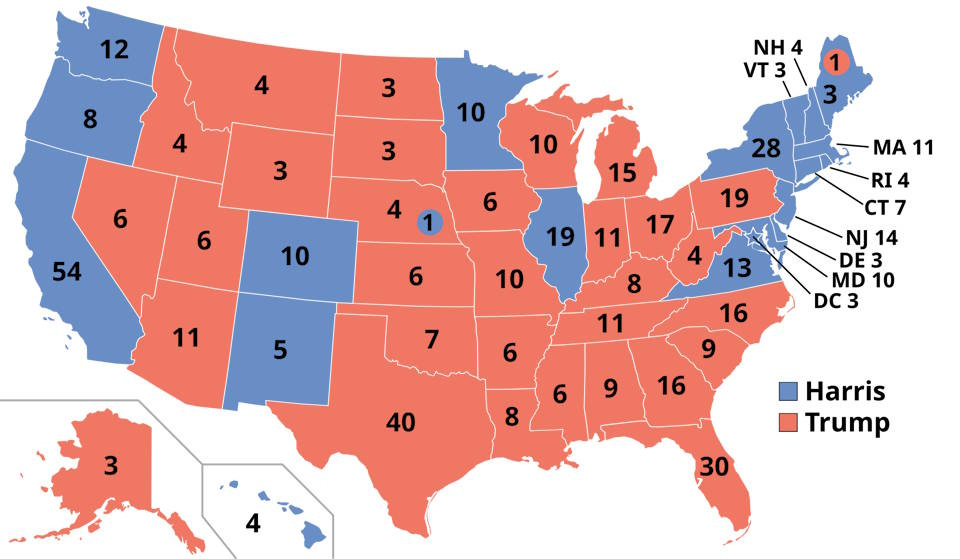
I’ve made no secret of the fact that I think Trump is a terrible choice for America, but there’s no denying that the American people have made their choice. Trump is currently projected to win every single swing state. He outperformed his 2020 performance in every single county in the country. He’s projected to win a solid majority of the popular vote — the first time a Republican has done so since 2004. I still don’t like the Electoral College as an institution, but you can’t blame it for this result like you could for 2016. In fact, Trump’s victory was part of a more general Republican landslide — the GOP took the Senate and improved its majority in the House. A map of political shifts between 2020 and 2024 shows almost solid red.
I suppose a small silver lining here is that we won’t have to spend the next two months enduring waves of “Stop the Steal” election denials, lawsuits, and threats to repeat January 6th. Democracy delivered Trump a victory, and so Trump has little incentive to attack democracy.
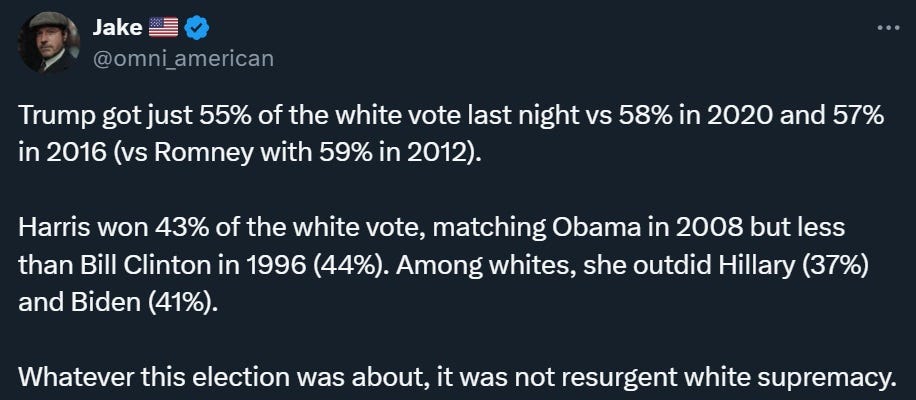
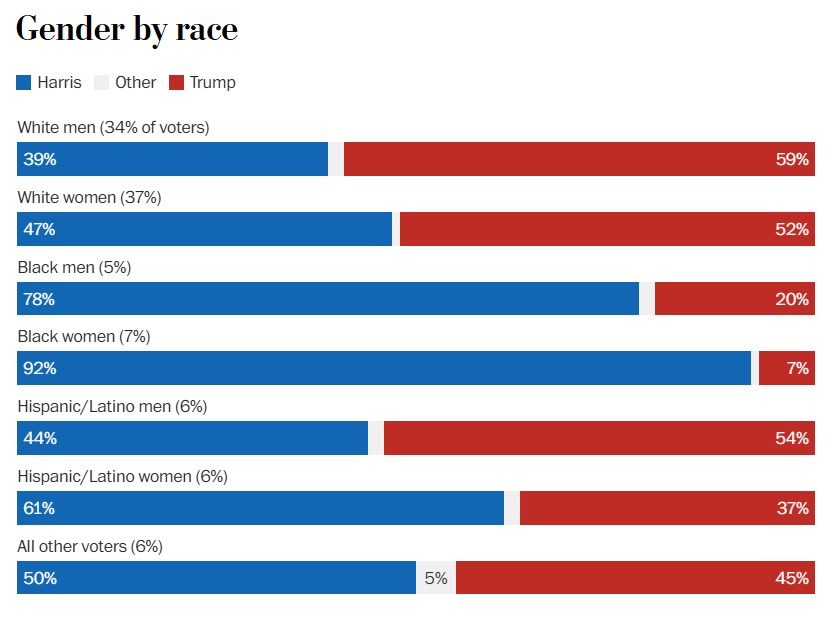
In fact, that silver lining might extend to the long term too. Trump and the GOP won because nonwhite voters and working-class voters — traditional Democratic constituencies — shifted his way. Dems still won Hispanic, Black, and Asian voters overall, but their margins fell significantly from previous elections, while actually improving with White voters:
In fact, exit polls show Trump winning a solid majority of Hispanic men!
Update: Over at Matt Yglesias’ blog, Jed Kolko shows that heavily Hispanic areas swung harder toward Trump than any other parts of the country:
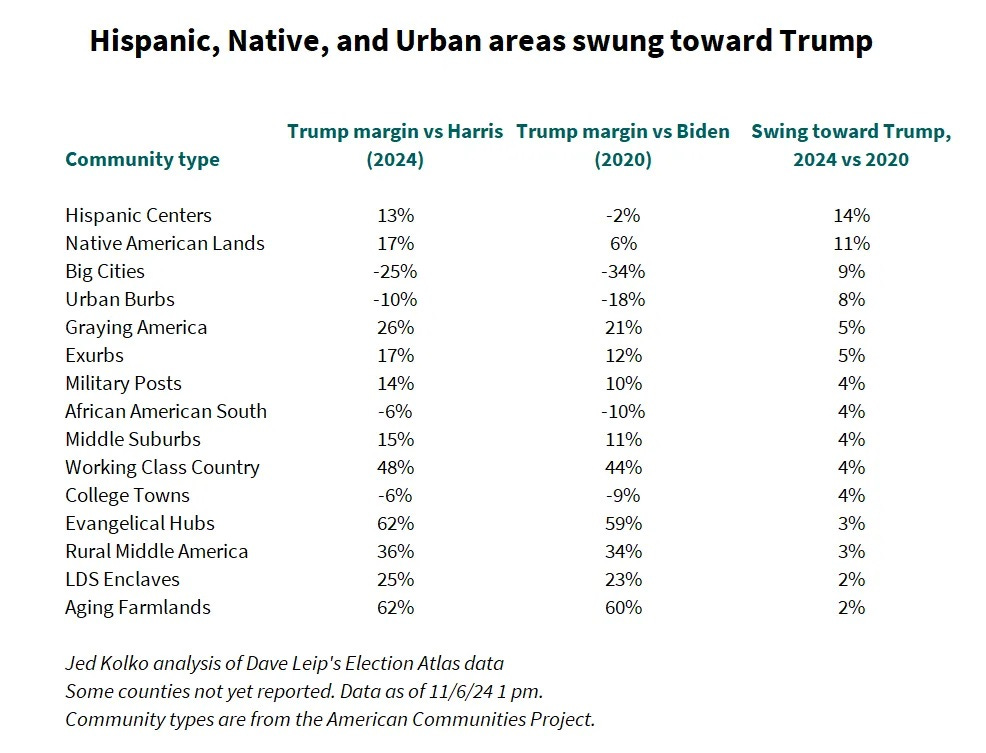
Ronald Reagan’s prophecy that Latinos would become Republicans is coming to pass.
Income has realigned as well. Democrats are now the party of the educated upper middle and wealthy class, but have lost their appeal to the middle and working classes:
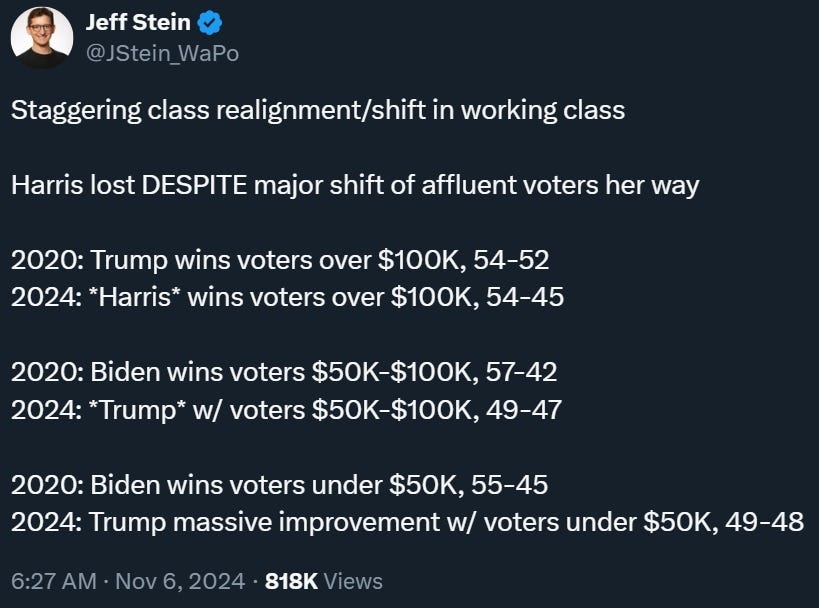
This largely destroys the narrative that nonwhite immigration will demographically drown White Americans under a tide of imported minority votes. In fact, it vindicates my guest poster Wally Nowinski, who observed that high-turnout elections like this one now help Republicans, because marginal voters — working-class Americans and Hispanic Americans — now lean to the right:

At some point, Republicans are going to realize this, and hopefully become less anxious about America’s racial future. Hopefully they will also realize that any attempt to make voting harder actually hurts them in the future, because the impact would fall disproportionately on their own base.
I expect these realizations to take some time to sink in, but ultimately their effect could be very salutary for American democracy. In the days of Nixon and Reagan, Republicans never worried about democracy itself — it was obviously on their side. Even in 2004, Republicans could tell themselves that we lived in a “center-right nation”. Now, Trump’s victory, powered by lower-income Americans and Hispanic men, will hopefully convince the GOP that democracy is still a game they can win.
A democracy needs both major parties to believe they can win via persuasion rather than by organized resistance, and 2024 showed that Republicans can still do that — even if the method of persuasion is one that I personally wish hadn’t worked so well.
If you want an optimistic take, there it is.
So what other important lessons can we learn from this disappointing election result? I didn’t title this post “Why Trump won”, because I don’t think I really have a convincing answer — I’m not a political scientist, or even a political pundit. In fact, there are probably a bunch of reasons, not just one.
Nor am I going to be one of those pundits who tells you that if only Democrats had listened to my policy priorities, things would have gone very differently. In fact, few Americans care about my own policy priorities. My top issues are industrial policy and pro-democratic foreign policy. I definitely don’t think emphasizing those more, or doing more of those things, would have propelled Harris to victory. (I don’t think they would have hurt; I think voters just don’t care.)
But I do think there are some important lessons that we can already learn from this election, especially at the intersection of economics and politics. In particular, I see three big ones:
Identity politics — viewing racial groups as homogeneous “communities” to be targeted with appeals to collective grievances — is not an effective way of winning over Hispanic (or, probably, Asian) voters.
People care about inflation more than about unemployment.
The educated professional class has become dangerously out of touch with the rest of the country.
Instead of writing all of these in one post, I’m going to split it into three, because I think the lessons are each very important. Since I’ve already shown the racial and class breakdown of the exit polls, I’ll talk about how identity politics is failing Democrats. Whether or not you think identity politics drove voters into Trump’s arms, it certainly hasn’t done an effective job of retaining Hispanic voters. The whole approach needs a deep rethink.
Americans are individuals, not extensions of racial “communities”
In the 2010s, there was a big debate over identity politics, with scholars like Francis Fukuyama warning that treating the American electorate as a balkanized set of racial collectives was undermining democracy. Stacey Abrams and other progressive writers pushed back against Fukuyama, arguing that all politics is identity politics, and so Democrats should continue focusing on racial appeals.
Abrams et al. were right in the facile, definitional sense that people’s personal identification with larger groups, movements, and ideas — rather than their own personal economic interests — drives much of their political behavior. After all, if human beings were rational calculating machines, they wouldn’t even vote, given the incredibly low probability that any election will be decided by a single vote.1
But the 2024 election — even more than the 2020 election — makes it clear that most Hispanic and Asian voters don’t want to be appealed to based on the racial group of which they’re supposedly a part. For example, lenient policies toward asylum seekers from Latin America don’t seem to have won over many Hispanics:
In Hidalgo County, in South Texas — a Mexican American stronghold that Biden won with 58% of the vote in 2020 — Vice President Harris and Trump were virtually tied early Wednesday, with Harris leading by less than half a percentage point…In Cameron County, at the southern tip of Texas’ Rio Grande Valley, Trump led Harris, 52-47, according to early results. Biden won that county with 56% of the vote four years ago.
The whole notion that lenient policies on illegal and quasi-legal immigration would win inroads with Latinos was based on the idea that Hispanic Americans identify strongly with others of their same race. Political scientists call this the theory of “linked fate”.
Democrats clearly buy into this theory when they refer to racial groups as “communities”. This term has become ubiquitous in Democratic messaging — for example, Harris talked about her “economic agenda for the Latino community”.
But races are not communities. Our country is not like a segregated 1930-era city, where Black people live in a ghetto, Chinese people live in Chinatown, Italian people live in Little Italy, and so on. Hispanic and Asian Americans might share a sense of “linked fate” with others of their race, but it’s only one of many things they care about, and perhaps not even a major one.
The big exception, of course, is Black Americans, who continue to vote mostly like a racial bloc, despite Trump’s modest inroads with Black men. This has clearly influenced the Democrats’ view of how racial politics operates in America, and they’ve tried to apply the same mental model to Hispanics and Asians. This is explicit in California, where you hear the term “Black and brown” thrown around a lot.2
But it isn’t working. In fact, it’s backfiring. A recent paper by d’Urso and Roman found that use of the term “Latinx” actually made Hispanics vote for the Republicans in nontrivial numbers!
Group labels are political, but little theory and evidence explains how group labels shape politician evaluations…Latinos’ relationship with “Latinx,” a gender-inclusive label, is a theoretical test case. Using several datasets, we find: Latinos are less likely to support politicians who use “Latinx”…Latinos who oppose “Latinx” are less likely to support politicians who used or are associated with “Latinx”…Latinos in areas where “Latinx” is more salient are more likely to switch their vote toward Trump between 2016-2020[.]
One common interpretation of this result — and one the authors discuss — is that many Latinos are conservative, and that this makes them susceptible to “anti-LGBTQ+” labels. I’m highly skeptical of this interpretation. Outside small, highly educated, deeply progressive circles, who even knows that the purpose of the “x” in “Latinx” was to be trans-inclusive? Almost no one who is likely to be offended by the term is even aware of this.
Instead, what they hear is simply someone making up a weird label and applying it to them. It’s what sociologists call ascription — it’s someone making up a racial category for someone else and then stuffing them into it without their consent. The Occam’s Razor explanation for Hispanics’ dislike of “Latinx” is that it minoritizes them — it declares that they’re part of a special “community”, separate from other Americans.
Democrats’ purpose in assigning Americans to “communities”, of course, is not to exclude them, but to reward them — to hand them special prizes or favors via government policy. For example, the Biden administration had a whole policy oriented around giving government benefits specifically to “HSIs” — an abbreviation for “Hispanic-Serving Institutions”, i.e. colleges that a lot of Hispanic people tend to go to. Harris also had a plan for encouraging small banks to give Hispanic people more loans.
This is, fundamentally, a special-interest model of politics — it’s similar to the kind of quid pro quo that historically dominates much of urban machine politics. I’m not sure whether today’s Dems inherit their instinct for this kind of group giveaway from their old Tammany Hall days, but it’s recognizably similar to the way California cities hand out cash to favored nonprofits — especially because the programs are often targeted at colleges or banks or nonprofits or other organizations that claim to serve the racial “community” in question.
But there are notable downsides to this approach. First, unlike in a city, these targeted initiatives probably don’t make it through to the public consciousness. What Puerto Rican voter in Philadelphia even knows what the heck an “HSI” is? But more fundamentally, I think most Americans, including most Hispanic Americans, would rather be treated as individuals than as members of a racial “community”.
Identity politics and minoritization
Identity has many components. For my part, I identify as an American, a Texan, a liberal, a rabbit keeper, a writer, a nerd, a PhD holder, a science fiction fan, a Jew, a white person, a Lithuanian-American, and so on.3 If politicians primarily spoke to me as part of the “Jewish community”, I would be annoyed, because I don’t necessarily want to be defined by that component of my identity. I don’t reject it, but I don’t want to be reduced to it either. And if politicians tried to appeal to me with policies targeted through Jewish organizations to benefit Jews, I would simply not care. In fact, I would be a little conflicted about accepting any of those benefits, since it would pigeonhole me into prioritizing an identity that exists as only one component among many.
Even more fundamentally, being constantly minoritized — being told to think of myself as a Jew first and as an American second — would pressure me to shrink the circle of people that I consider part of my own in-group. Because I think of myself as an American first and foremost, I feel like there are 330 million other people who share my primary identity — 330 million people on my “team”. But if I were to think of myself first and foremost as a Jewish person, that would shrink my in-group to only 16 million, almost none of whom live near me. It would make me feel more isolated, and might even cause me to start questioning whether the 323 million non-Jewish Americans who live all around me have my best interests in mind.
In other words, being set apart from your fellow countrymen and neighbors is generally not a desirable thing, even if the reason is to put you on a pedestal.
I suspect many Hispanic Americans feel the same way. Talking to Hispanic folks (remember, I’ve lived most of my life in either Texas or California) and reading books like The Diversity Paradox, The New Americans?, and The Great Demographic Illusion, it seems clear that most would like to think of themselves as regular Americans — not to give up or forget their national origins or ethnic identity, but to prioritize their American-ness.
The progressive movement of the 2010s told us that this was a bad thing. “Assimilation” became a dirty word in progressive circles, and the University of California told their faculty not to call the U.S. a “melting pot”. The implicit assumption was that given the choice, people would like to prioritize their racial and ethnic identities, and that only forcible conformity pressure from American institutions — or from White people — was preventing people of color doing that. The Democratic party’s embrace of identity politics — its habit of targeting racial “communities” with encouraging rhetoric and specific material benefits — was seen as a way to counteract the pressures of assimilation.
The conservative counter-narrative was that race relations had been fine right up until progressives started making everything in America about race. Conservatives always send me the following chart:
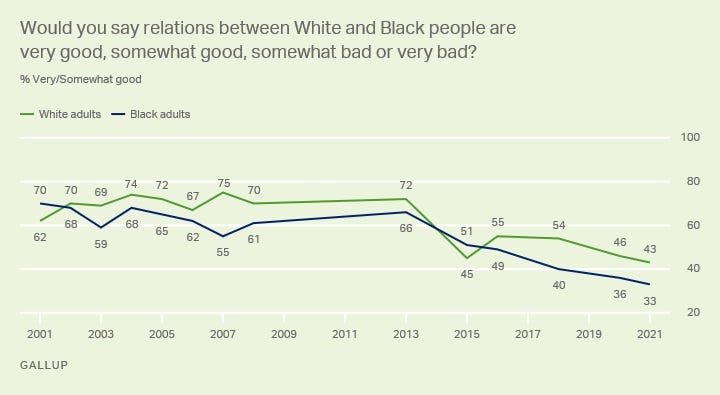
This is a powerful argument. If structural racism was really so entrenched before 2014, then why did two-thirds of Black adults say race relations were good? Essentially, the progressive story is that they were effectively bullied into saying this — or perhaps bullied into thinking it. The conservative story is that progressives created the decline in race relations by making everyone think about race all the time.
I suspect that neither of these stories gets it quite right, but that the conservative story is closer to the truth. Increasing the salience of racial divisions and racial conflict makes people mistrust their neighbors more. And although both sides were guilty of this in the 2010s, progressives were far more zealous and absolutist about it.
Essentially, the progressivism of the 2010s sought to turn American society into a sort of estate society, where people’s rights, privileges, and social roles would be mediated by their identity group. How your teachers and principals treated you, your relationship with the law, what colleges were available to you, what kind of parties you could go to, what jobs you could get hired for, how your bosses treated you at work, what kind of benefits you could expect from your government, and even how people walked past you on the street were to be determined by the race you were born into, rather than your own actions as an individual.
These race-based social relationships were to be enforced by a combination of DEI departments, lawsuits, social shaming, job loss, and so on. Ibram X. Kendi even suggested the totalitarian step of creating a constitutionally mandated “Department of Antiracism” to enforce race-based social relations at every level of society — all in the name of combatting “structural racism”, which Kendi couldn’t even define when asked.
Democratic party politicians never fully embraced this vision of the future, even in 2020-21. Some of these ideas were tried out in 2020-21, but they failed almost as quickly as they were tried, making basically everyone mad in the process. By 2024, Kamala Harris was tacking pretty strongly away from the racialized vision of America.
But that was too little, too late. People remember the individualistic Americanism largely prevailed in public life before 2014, and they remember the constant hyper-consciousness of race in 2014-21, and they know which one they like better. And although Democrats abandoned much of their woke rhetoric, the practice of targeting politics at specific “communities” has persisted. I suspect that it refreshes the bad memories of the racial conflicts of 2014-21.
All of this is a long-winded way of saying that Democrats’ racial targeting probably makes a lot of Hispanic people feel singled out and alienated in their own country, even if the purpose is to help them.
But that’s not all. Democrats’ identity politics flies strongly in the face of the narrative that has defined the American experience for many Hispanics.
The story of Hispanic voters is defined by the American Dream
To the extent that most Hispanic Americans do share a common experience, it’s the immigrant experience. Immigrants come to America seeking the American Dream of upward mobility and opportunity. And by and large, they achieve it. Their children tend to earn a lot more than they do, and their grandchildren earn even more.
This was the path that most immigrant groups have followed — the Irish, the Italians, the Lithuanians, the Chinese, and so on. For a while, people argued that Hispanics were different — that they would be permanently excluded from the American Dream. That turned out not to be true:

For many Hispanic Americans, their salient experience of America has not been one of racialized exclusion, but one of upward economic mobility and social inclusion. Economists have found that Hispanic incomes are converging to White levels across the generations. Once you control for the composition effect of new poor immigrants coming in, there’s strong income convergence across the generations:
We study the sources of racial and ethnic disparities in income using de-identified longitudinal data covering nearly the entire U.S. population from 1989-2015….[T]he intergenerational persistence of disparities varies substantially across racial groups. For example, Hispanic Americans are moving up significantly in the income distribution across generations because they have relatively high rates of intergenerational income mobility…
Hispanic Americans are moving up significantly in the income distribution across generations. For example, a model of intergenerational mobility analogous to Becker and Tomes (1979) predicts that the gap will shrink from the 22 percentile difference between Hispanic and white parents observed in our sample…to 6 percentiles in steady state…
Hispanics are on an upward trajectory across generations and may close most of the gap between their incomes and those of whites…Their low levels of income at present thus appear to to be primarily due to transitory factors.
In fact, despite composition effects from continued immigration, Hispanic wages have grown faster than White wages in America since the turn of the century:
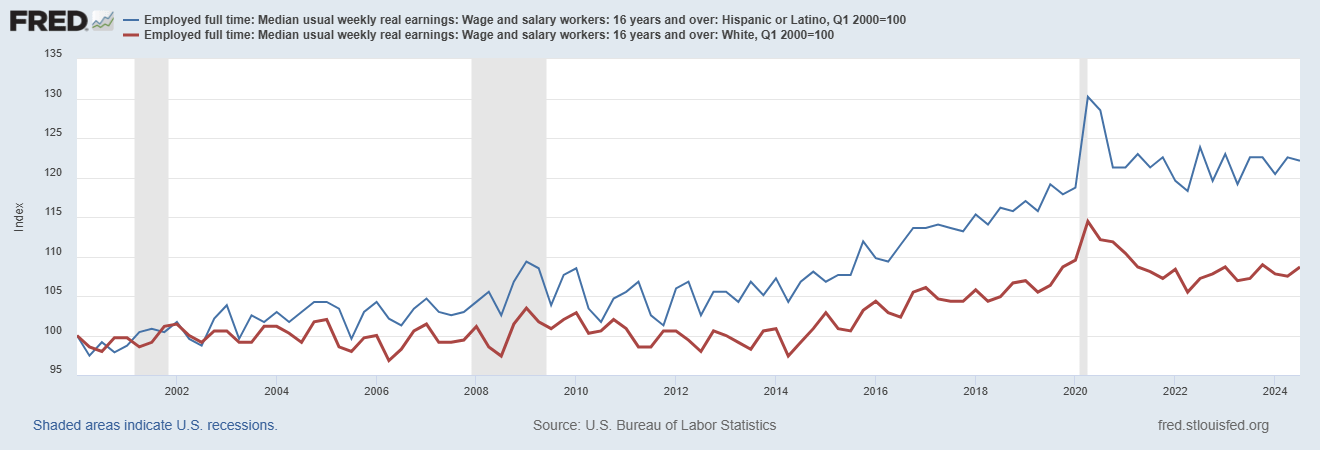
Surveys unsurprisingly have found widespread economic optimism among Hispanics for many years. Hispanics are climbing the ladder of education:
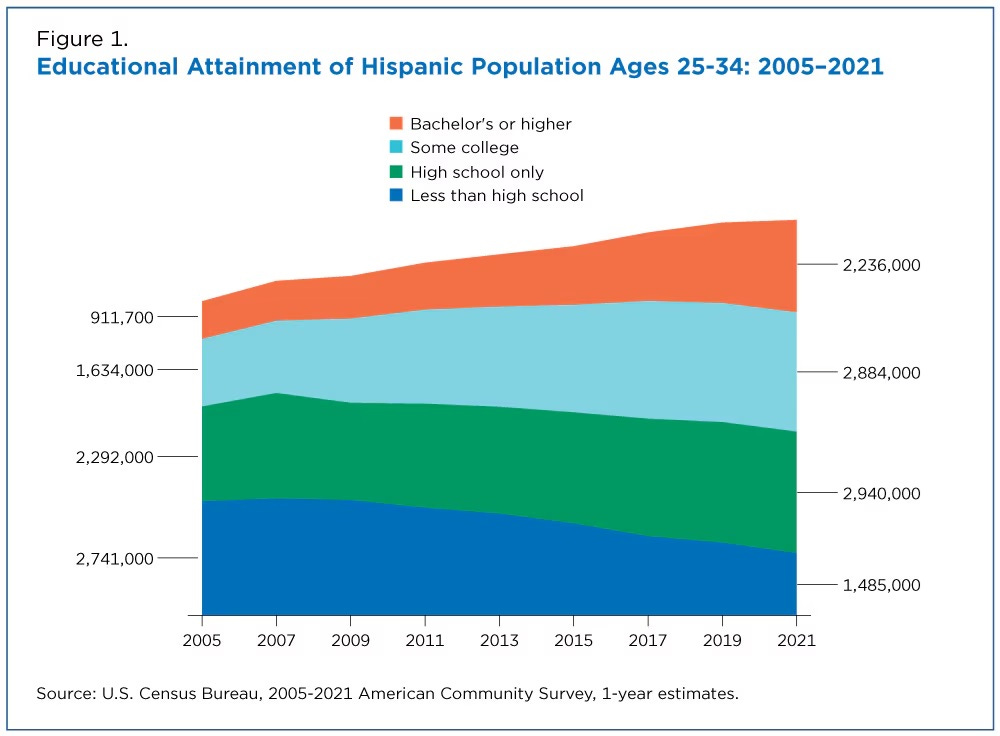
Hispanic homeownership is rising strongly. And Hispanics are starting businesses at very high rates:
New businesses owned by Latinos accounted for 36% of launches in 2023…As of 2023, Latino entrepreneurs have established a staggering five million businesses across the United States, collectively generating over $800 billion in annual revenue…The rapid pace of this growth is further highlighted by the fact that the number of Latino/a-owned businesses surged by 34% from 2007 to 2019.
In other words, Hispanic Americans’ economic path looks reasonably similar to that of Italian Americans or Irish Americans.
In the 2010s, it became taboo to even talk about these successes in some progressive circles. The University of California’s 2015 speech guidelines told faculty not to say “America is the land of opportunity”. This was deemed to be a racist utterance, since it supposedly minimized the economic exclusion that many minority groups have faced.
But the fact is, America is the land of opportunity, especially for immigrants and their children. Hispanic Americans, broadly speaking, have been prime beneficiaries of that upward mobility — they have worked incredibly hard, gone to school, started businesses, learned English, and done everything else they were supposed to do. And America has rewarded them with economic success and social integration.
Compared to that self-bootstrapped success, racial preferences — DEI, affirmative action, preferential government contracts, and so on — are basically a booby prize. Yes, in reality, those policies can sometimes help accelerate Latino achievement. But the mere fact that they’re on offer — and that Democrats seemingly view them as permanent policies instead of temporary ones — sends the message that Hispanics are a permanently racialized, excluded, marginalized group. This message is often explicit — when Democrats and progressives talk about “marginalized groups”, which they often do, that term is generally supposed to include Hispanics.
Being a marginalized group is simply not part of anyone’s American Dream.
The tricky part for Democrats is that this is an approach that has largely worked with Black voters — or at least failed to alienate them. It will be difficult for Democrats to convince themselves that Hispanic voters are not going to work the same, after spending so many years believing they would. But the 2024 election, and the trend of the last few elections, makes it clear that the two are not going to work the same.
After identity politics
Identity politics allows Democrats to hold on to a supermajority of the Black vote, so I suspect it will never go away. But the Black vote is a smallish and shrinking part of the electorate, and even there, the power of idpol may be fading a bit. Meanwhile, Hispanic voters, Asian voters, and Middle Eastern voters are the future. Those groups are all strongly upwardly mobile, and mostly descended from people who came to America voluntarily in search of the American Dream. And although ethnic studies professors and progressive activists will happily tell you all about the Chinese Exclusion Act and post-9/11 Islamophobia, it’s just not the case that Hispanic, Asian, and Middle Eastern Americans have anything that compares to the history of slavery and segregation.
The Democrats need to move away from identity politics. And switching to class-based politics, as some have suggested, won’t really help. Biden was probably the most pro-union and pro-worker President America has had since the mid 20th century, and yet some prominent unions refused to endorse Harris.
Instead, Democrats need to retool their message to be about American identity, as it was in the New Deal days, and as it arguably was for Clinton and Obama. I believe Harris actually took steps in the right direction, but not enough, and not nearly soon enough — and she was probably the wrong person to sell the idea. My advice is not to be discouraged, and to keep at it — Walter Mondale and Michael Dukakis both went down to crushing defeats with centrist, positive messaging, but then Bill Clinton eventually figured out how to make the approach work.
Republicans will eventually screw up. Trump is old, and he has a lot of foolish and bad people around him, and his economic policy program is kind of a dead end. At some point, America will once more call upon the Democrats to save them from Republican mistakes, as they did in 2008 and in 1992. Democrats will have an easier time rising to that inevitable summons if they leave the identity politics of the 2010s behind. Because that stuff just isn’t getting the job done.
Americans hate inflation more than they hate unemployment
In 2021, there was a fierce debate, both within the Biden administration and among the general left-of-center commentariat, about how much to worry about inflation. For example, in May 2021, Larry Summers wrote:
Even six months ago, it was reasonable to regard slow growth, high unemployment and deflationary pressures as the predominant risk to the economy. Today, while continuing relief efforts are essential, the focus of our macroeconomic policy needs to change…Inflationary pressures are mounting…How much does it matter whether inflation accelerates? In general, increases in inflation disproportionately hurt the poor and are associated with reductions in trust in government. Progressives might consider the role that inflation played in electing Richard M. Nixon in 1968 and Ronald Reagan in 1980.
In February 2021, Olivier Blanchard, another prominent macroeconomist, wrote a detailed argument that the Biden administration was spending too much on Covid relief with the American Rescue Plan, and that this would generate a surge of inflation. The argument included a simple model whose predictions ended up being close to what actually happened.
Other economists pushed back hard against Blanchard and Summers, arguing that inflation was due to transitory factors, and that it was important to keep spending in order to preserve full employment. One of these was Paul Krugman, who declared himself “a card-carrying member of Team Transitory” — “Team Transitory” being those who thought inflation was mostly due to pandemic disruptions and would fade on its own. There was even a live debate between Krugman and Summers in early 2022. But by late 2022, Krugman issued a mea culpa, and admitted that Biden’s American Rescue Plan had exacerbated inflation:
In early 2021 there was an intense debate among economists about the likely consequences of the American Rescue Plan, the $1.9 trillion package enacted by a new Democratic president and a (barely) Democratic Congress. Some warned that the package would be dangerously inflationary; others were fairly relaxed. I was Team Relaxed. As it turned out, of course, that was a very bad call.
Economic analyses of the inflation surge of 2021-22 generally assign the American Rescue Plan some share of the blame.
Ignoring Summers’ warnings, and believing Team Transitory, might have cost the Democrats the 2024 election. I’m no political scientist, but there are reasons to believe that the burst of high inflation in 2021-22 was one factor in Kamala Harris’ loss.
Why inflation probably mattered in this election
The first reason we should think inflation mattered is that people pretty consistently said it mattered. On Gallup’s long-running “most important problem” survey, inflation consistently ranked as the most important specific economic problem that people mentioned, right behind “economy in general”.
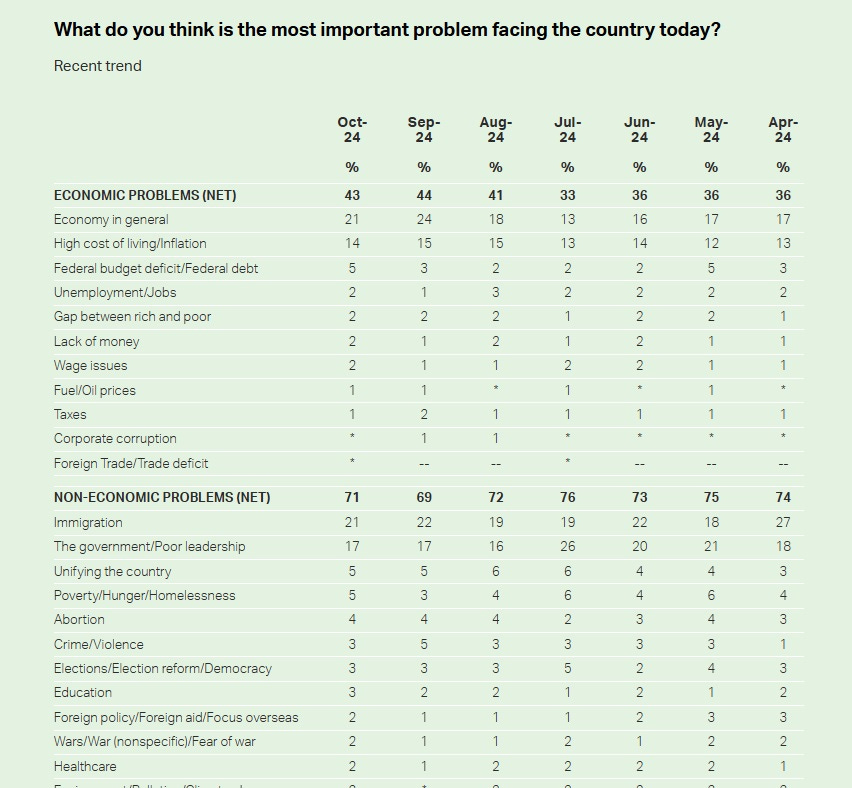
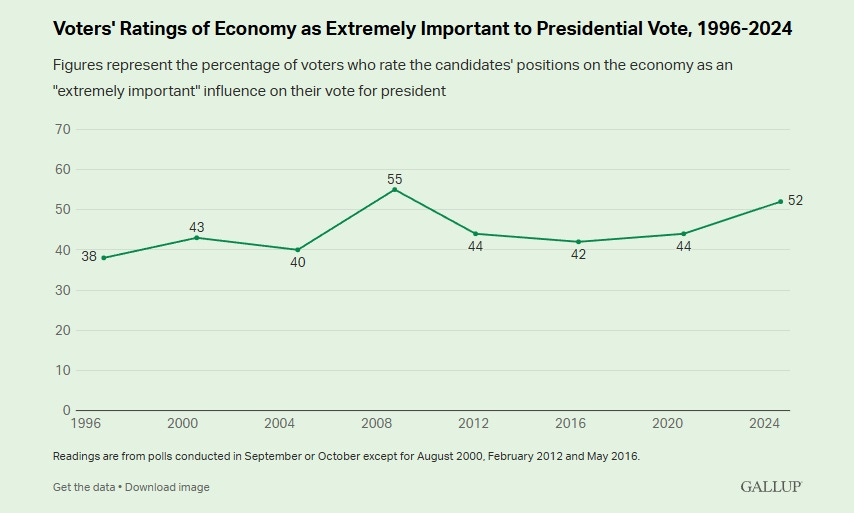
A lot of other surveys showed similar results. And the percentage of people who told Gallup that the economy was “extremely important” to their presidential vote was unusually high — almost as high as in 2008, when the financial crisis had just devastated the U.S. economy:
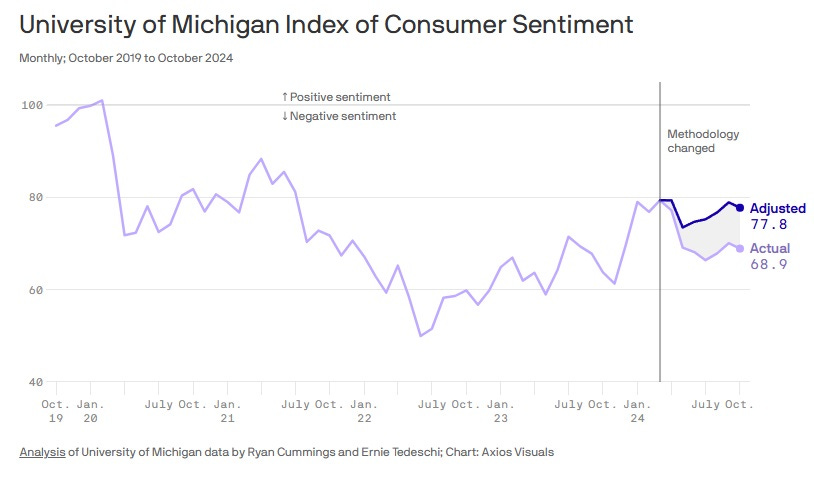
And of course consumer sentiment was pretty low, even after adjusting for changes in methodology:
Now, it’s possible that this was mostly just Republicans complaining about inflation because it felt more substantive than talking only about more social/cultural grievances like wokeness, immigration, trans stuff, etc. After all, opinion on the economy shows a very partisan pattern depending on who’s in the White House:
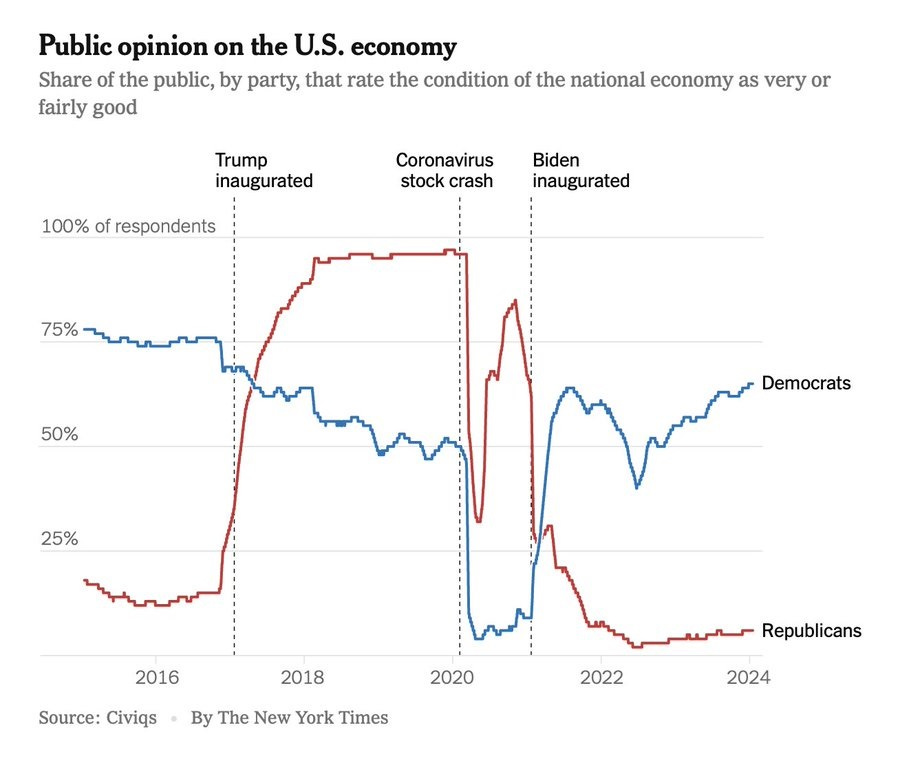
It’s a pretty good bet that Republicans will suddenly “discover” that inflation in America is actually low now, and give Trump the credit.
But if you look historically and across countries, it really looks like inflation tends to make voters particularly mad. Research often finds that cumulative inflation over a President’s term in office — not just the current inflation rate — affects presidential approval and election performance. If you look at Gallup’s long-running survey, you’ll see that the inflation of the 1970s dominated Americans’ complaints even more than the unemployment of the Volcker recessions in the early 80s, or the recession of the early 90s:
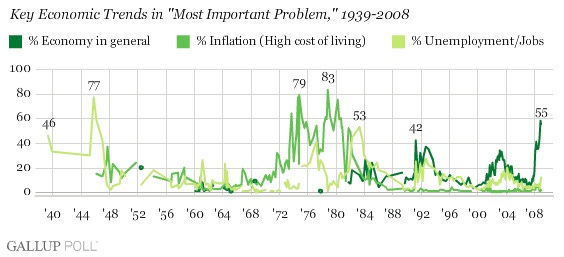
And if you look at other countries, you’ll see that governing parties in every other rich country have seen their vote shares go down this year:
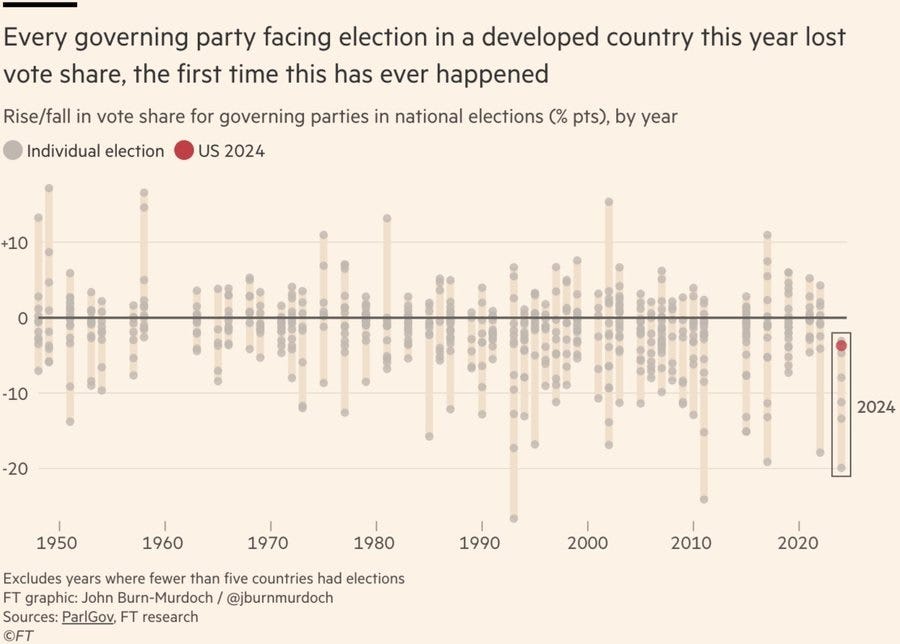
There are relatively few factors that are affecting all rich countries at the same time. A backlash over immigration is another possible common factor, but the list is basically just that plus inflation.
On top of that, there was a model that predicted the election outcome quite well. An interdisciplinary team of researchers created a model based on presidential approval ratings and economic conditions in each state, and they ended up predicting each state correctly:
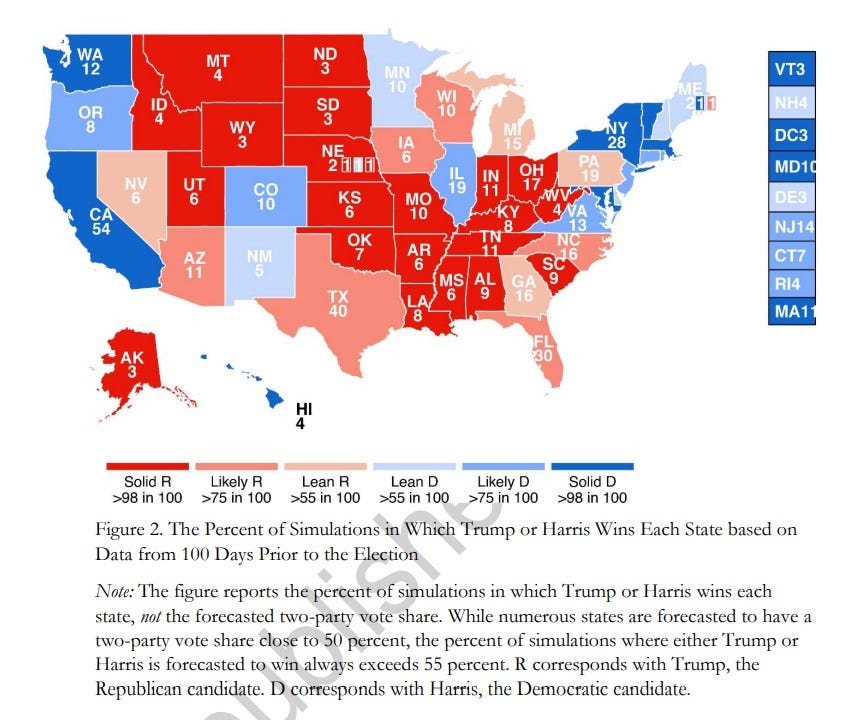
It might be a fluke, but the same model got only one state wrong in 2020 (Georgia), so that’s pretty encouraging. In any case, the model relies partly on economic fundamentals — measures of the labor market and real wages. And real wages depend on inflation. So since labor markets are generally very strong all across America, the erosion of state-level wages by inflation is going to be the main economic factor that led this model to forecast a Trump victory.4
So I think it’s safe to say that while it’s possible inflation mattered less for Trump’s victory than people say on polls, it did matter at least somewhat.
Why inflation makes voters even angrier than unemployment
Let’s talk a little about macroeconomics for a second. Most mainstream macroeconomic models assume that there’s some sort of short-term tradeoff between inflation and unemployment. If the Fed lowers interest rates or does quantitative easing or otherwise prints money, the general consensus is that unemployment will go down and inflation will go up. Similarly, if the government borrows and spends money and the Fed doesn’t counteract this by raising interest rates, the general consensus is that you’ll get faster growth, more jobs, and rising prices.5
Macroeconomic policy then becomes a question of how to strike the right balance. We want everyone to have a job. We don’t want inflation to go about 2%. But if we have to choose between these two things, how do we choose? In economic models, the relative degree that policymakers should care about inflation versus unemployment is determined by a social welfare function — basically, how much each of these economic ills makes regular people unhappy. A lot of economic research is dedicated to figuring out what that welfare function, and there’s not really a consensus.
But the experiences of the 1970s and the 2020s are teaching us that in America at least, people seem to get even madder about inflation than they do about unemployment. And the question is why. I actually wrote a post about this back in March of 2021, shortly after the American Rescue Plan was passed:

The basic story here comes from a survey Robert Shiller did in 1990. Basically, inflation tends to make people’s purchasing power go down, because their wages can’t keep up.6 This makes people poorer, and people do not like to be poorer.
The inflation of 2021-22 definitely made people poorer. In fact, the drop in real personal disposable income from mid-2021 to mid-2022 was more severe than the Great Recession or the 1970s inflation!7
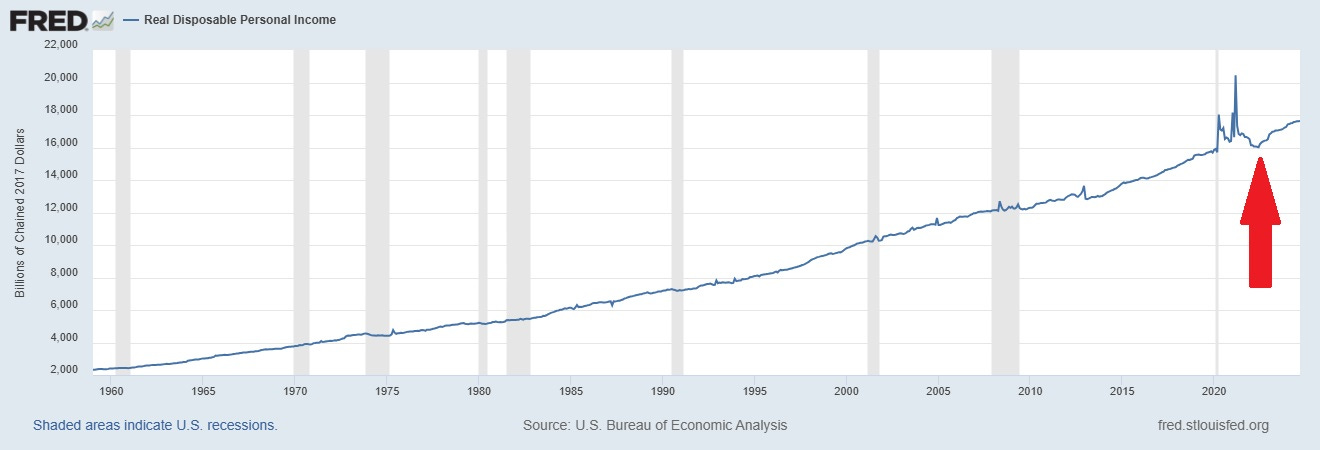
This was caused by a combination of the end of pandemic relief, and falling real wages and other income due to inflation. In 2021 and 2022, Americans’ real wages suffered their biggest drop in postwar history, thanks to inflation8:
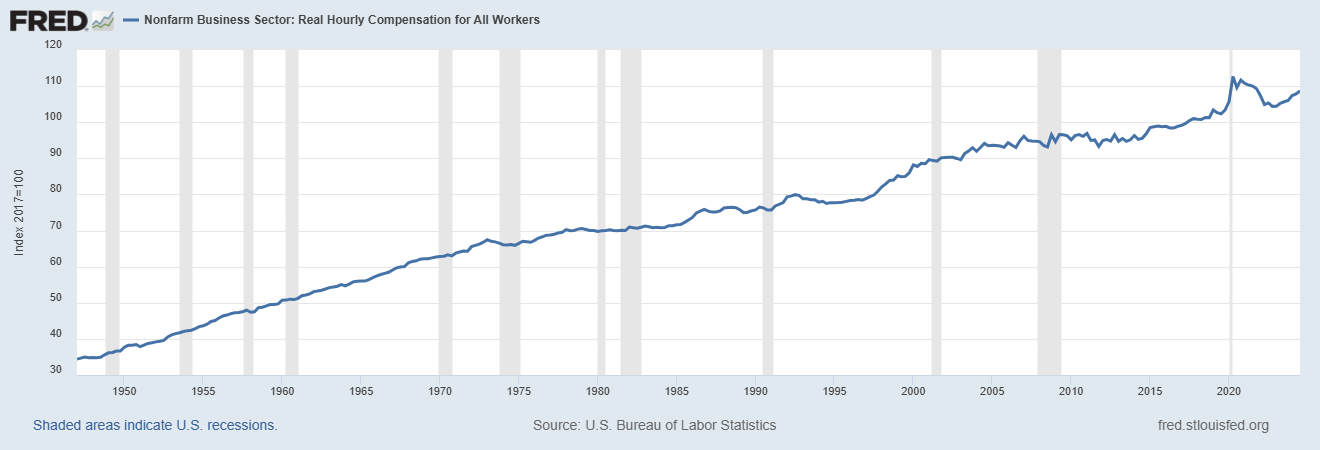
Remember, real wages are a key economic input that went into the model that managed to successfully predict every state’s election result. People really don’t like it when their real wages go down!
One key thing to understand is that this sudden impoverishment happened to most Americans. Rising consumer prices affect everyone, from the rich to the poor, the employed and the unemployed, the old and the young.
In a recession, on the other hand, the negative effects are largely concentrated. If you’re one of the unlucky people who loses their job, you take a huge hit. But if you’re not one of those people, you probably do OK. Maybe your wages grow more slowly for a few years, and maybe you have to stress out about the increased possibility of being laid off. But in general, the harms of inflation are diffuse while the harms of unemployment are concentrated.
If you’re a moral philosopher, an activist, or an economist estimating a social welfare function, you may prefer harming a lot of people a little bit with inflation to harming a few people a lot with unemployment. But a democracy doesn’t vote based on social welfare. It’s one person, one vote. So if unemployment harms 10 million people a lot, and inflation harms 200 million people by a moderate amount, it’s clear that inflation will directly harm a much larger number of voters.
The social welfare function and the “get your butt kicked in an election” function are two very different things.
I actually suspect that there are other reasons why inflation bothers voters even more than unemployment. Inflation is something that’s obviously beyond an individual’s control — if the price of eggs goes up, you can choose not to buy eggs, but otherwise there’s not much you can do. But unemployment is something that individuals do exercise some degree of control over — if you work a bunch of extra hours during a recession and establish a good relationship with your boss, maybe you can avoid getting laid off.
In general, I think people are less worried about risks they have some control over, even if the overall level of danger is higher. Look at how people are more afraid to fly than to take long road trips, despite road trips being much deadlier per mile. The leading theory is that in a car you have some control over your safety, while in a plane you have basically zero control. Similarly, I suspect that inflation makes people feel powerless, like being stuck in a crashing airplane.
In any case, this is probably an important area for survey research to explore. But in the meantime, Democrats need to remember that full employment doesn’t necessarily mean an economy that Americans are happy with. If it comes at the expense of rapid inflation, that price is going to be one that most Americans aren’t comfortable paying.
Democrats should be wary of macro-progressivism going forward
I’d like to say a little more about the debate over the American Rescue Plan in 2021. While Paul Krugman and Larry Summers viewed their argument in purely technical terms, some economists and commentators did come at the debate from an ideological angle. In general, spending more was considered the progressive position, while spending less in order to avoid high inflation was considered more centrist or moderate.
This makes sense — full employment disproportionately benefits the least well-off in society. The lowest-paid workers are often the first to be fired in a recession and the last to be hired in an expansion, so the longer you can keep an expansion going, the more poor people can have jobs. Also, full employment tends to push up wages, especially at the lower end of the scale — in fact, even as most Americans lost purchasing power during the inflation of 2021-22, the bottom 10% of American workers actually saw their real wages rise.
This July, I wrote about how some influential progressive think tanks basically push for full employment all the time, and downplay worries about inflation:

Some progressive economics commentators — I will not name names, because I’m trying to be a less confrontational blogger these days — also consistently downplayed the risks of inflation and extolled the many benefits of full employment during Biden’s tenure in office.9
In retrospect, whether or not this was a good move from a moral standpoint, it looks like a big mistake from an electoral standpoint.
I hope that these commentators are reevaluating their beliefs. And I hope that Democratic politicians, staffers, and donors are reevaluating the paradigm as well. Full employment is great, all things equal. But sometimes the price of full employment is too high — not just for the majority of Americans who have to endure years of erosion in their purchasing power, but for everyone who has to suffer from the election of leaders like Donald Trump.
Update: Good to see some left-leaning economists quickly coming to the same conclusions.
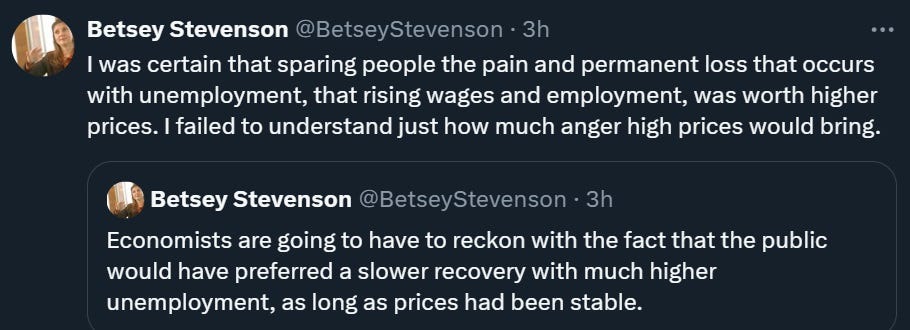
Our task now is to get the ear of Democratic politicians, which will probably require wresting it away from some progressive think tanks and Twitter posters.
The educated professional class is out of touch with America
I’ve been writing about the lessons that Democrats should take away from the big GOP victory. I’ve written about how identity politics is failing to attract Hispanic voters, and about how Dems cared too much about employment and not enough about inflation. The third big lesson, I think, is about class in America. The educated professional class is drifting away from the rest of the country, in terms of values, beliefs, and their information diet.
This election upended a lot of demographic trends that people had been very certain about only a few years ago. Trump seems to have produced a large-scale shift of Hispanic voters to the Republicans, and big cities swung harder toward the GOP than other areas. But there’s one key trend that this election didn’t reverse: education polarization. Trump was even more dominant among non-college voters than he was in the last two elections, while Harris won the highly educated by about as much as Biden did.
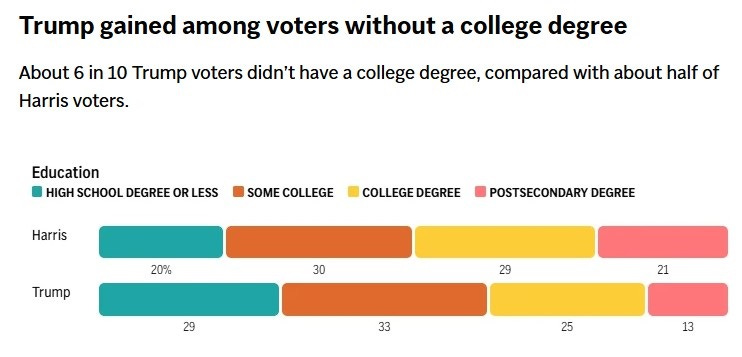
Over the years, the Democratic base has shifted decisively from the working class to the educated professional class:
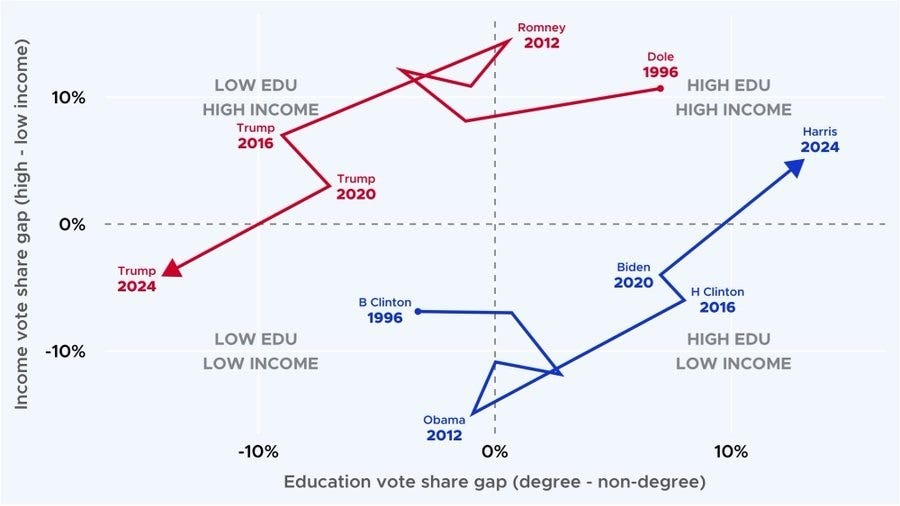
This shift doomed Harris’ campaign, since people without college degrees outnumber their college-educated counterparts — in 2024, the latter were only 43% of the electorate.
And this weakness looks likely to be a long-term problem. In the past, when college education was steadily increasing, it was easy to think that college-educated voters would own the future. But in recent years, the rate of college enrollment has plateaued and begun to fall:
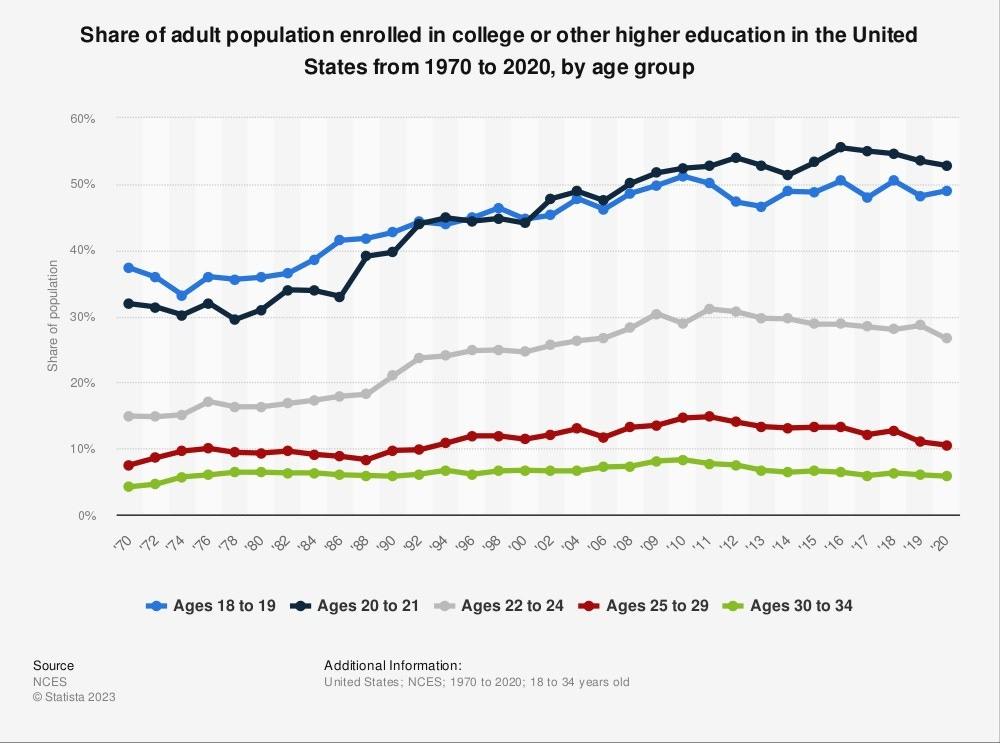
And the number of new college graduates fell in 2022, even as America’s total population grew.
As for why fewer Americans are getting a college education, I wrote a post about this back in July:

The short version is that tuition soared even as the earnings boost from a college degree shrank substantially, making college a less attractive value proposition. A lot of this had to do with colleges themselves boosting spending on administrators and facilities, and having to charge students more to pay for it.
If universities cut costs, cut tuition, and raised their value proposition, we could see enrollment rise again at some point, but I wouldn’t bet on that happening soon. Meanwhile, socialists’ plan for universal free college is dead on arrival; even Biden’s generous new student loan repayment provisions might prove to be temporary, since the fiscal cost is so huge. So a wave of taxpayer cash is not going to restore the trend of rising educational attainment.
In other words, Democrats’ education problem is here to stay. Unless Dems can figure out how to win back those non-college voters, they’re likely to be at a huge electoral disadvantage for the foreseeable future.
But winning back those voters would require the educated professional types who make up the backbone of the Democratic base and the progressive movement to figure out how to connect rhetorically with the less-educated masses, addressing their concerns, speaking to their values, and just speaking their language in general. And although it’s too early to tell, many of the reactions I’m seeing on social media are, to put it mildly, very unencouraging:
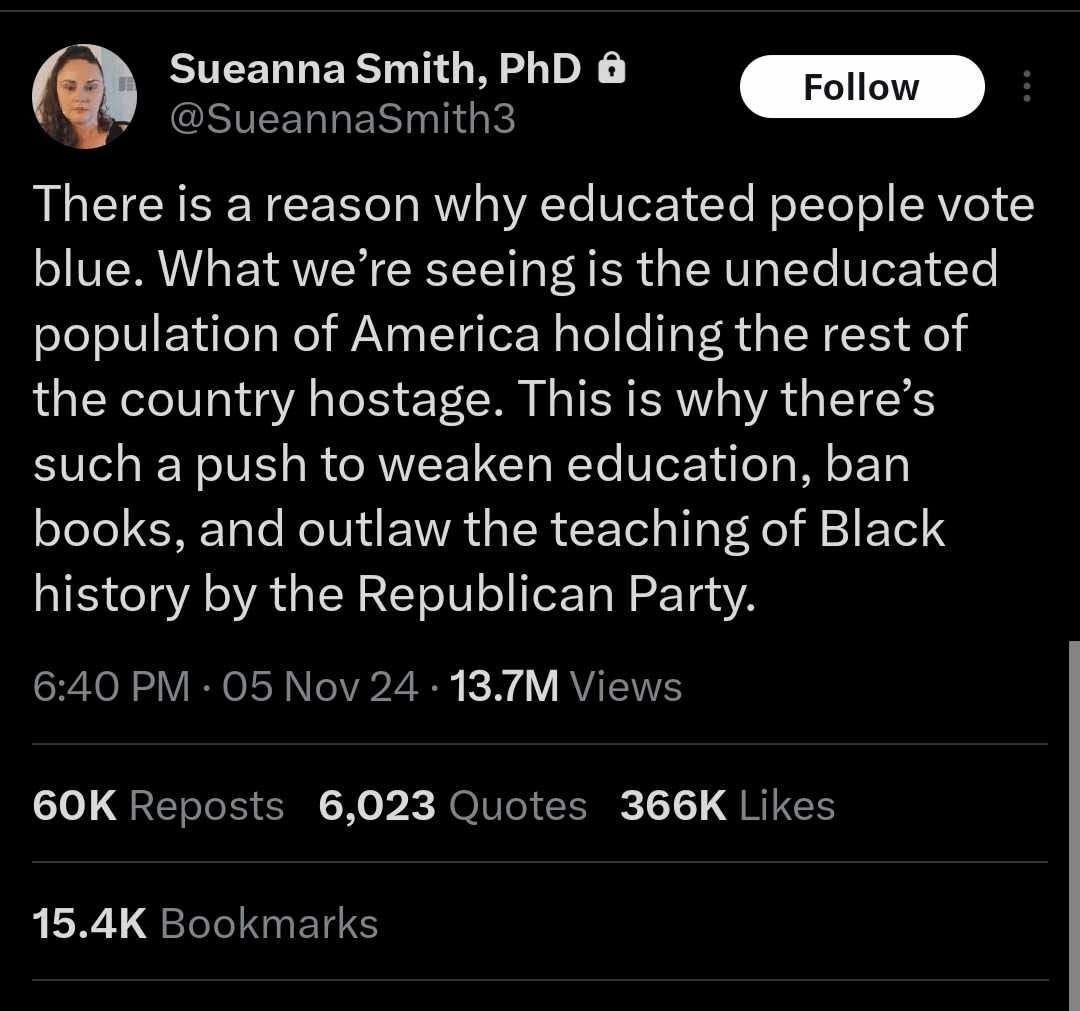
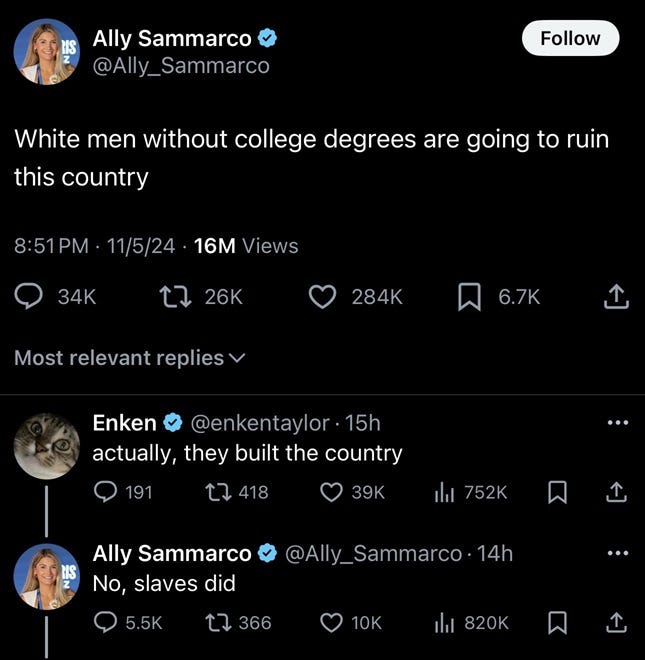
Obviously these are extreme examples, but in general it seems to me that the educated professional class has simply grown apart from the rest of the country over the past few decades.
A disconnect on problems
The most important disconnect between educated professionals and the rest of America is about the problems they face on a day-to-day basis. Practically every problem that Trump voters cited is something that hits the working class harder than the professional class.
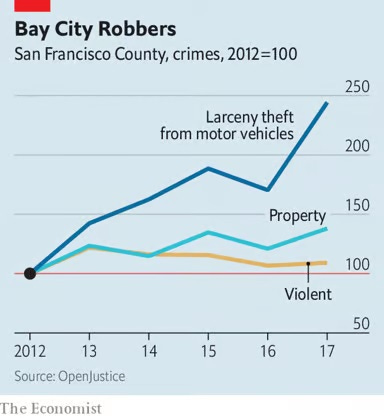
About a year ago, I found a really good place to get a haircut. The hairstylist, a Vietnamese immigrant woman in her 50s, was complaining about rampant theft from small businesses in the neighborhood. She said that if thieves stole less than $950, they wouldn’t even be arrested or prosecuted, creating an incentive for constant theft.
In fact, stealing less than $950 was still a crime, but there was a plebiscite in 2014 called Proposition 47 that changed it from a felony to a misdemeanor. (Prop 47 was mostly repealed this year, when California voters passed another ballot measure called Prop 36.) I’m not sure how big of a factor Prop 47 was, but for whatever reason, property crime in San Francisco did rise quite a lot in the late 2010s:
This mirrored a more general rise across the state10:
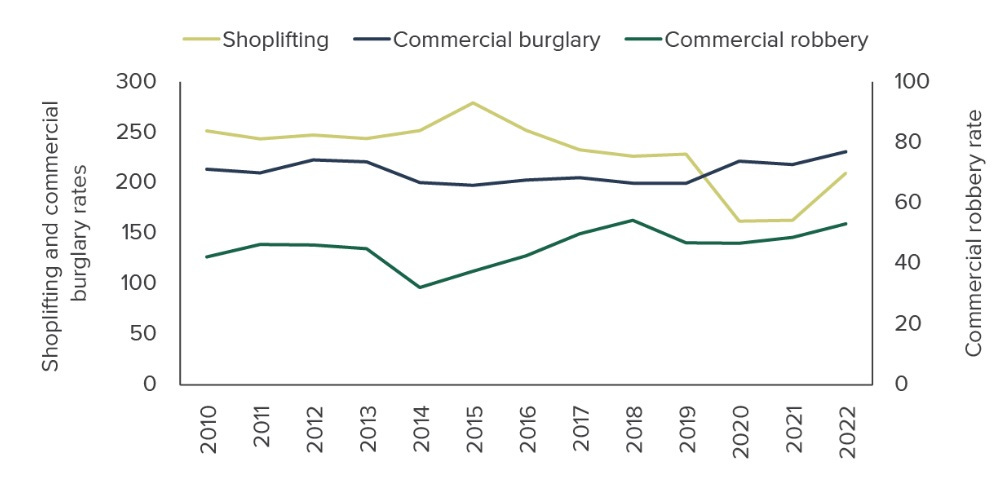

I am an educated professional, not a small local businessperson. I had heard about the big wave of car break-ins in San Francisco, but it took me a very long time to realize how common retail theft had become. To me, the wave of smash-and-grab attacks in the Bay Area was a sign of urban disorder and decay, and a force causing a bunch of downtown stores to close.
But to someone who owns a hair salon that gets robbed, or a convenience store that gets looted, that’s their livelihood. That could be their child’s ticket to college, or their ability to get the pipes fixed at their house, or their chance to get their car fixed. As an educated professional, I’m simply much less exposed to robbery and theft.
And on top of that, I’m an urban educated professional. Those who live out in the fancy suburbs are even more disconnected from the crime wave that afflicted America in 2020 and 2021. It’s lower-earning people in cities or poorer neighborhoods who bore the brunt of the explosion of disorder that followed in the wake of the Floyd protests.11
Stuff like “defund the police” is a luxury of the rich and mobile — i.e., of the educated professional class. It’s lower-income Americans and small business owners who need the police the most.
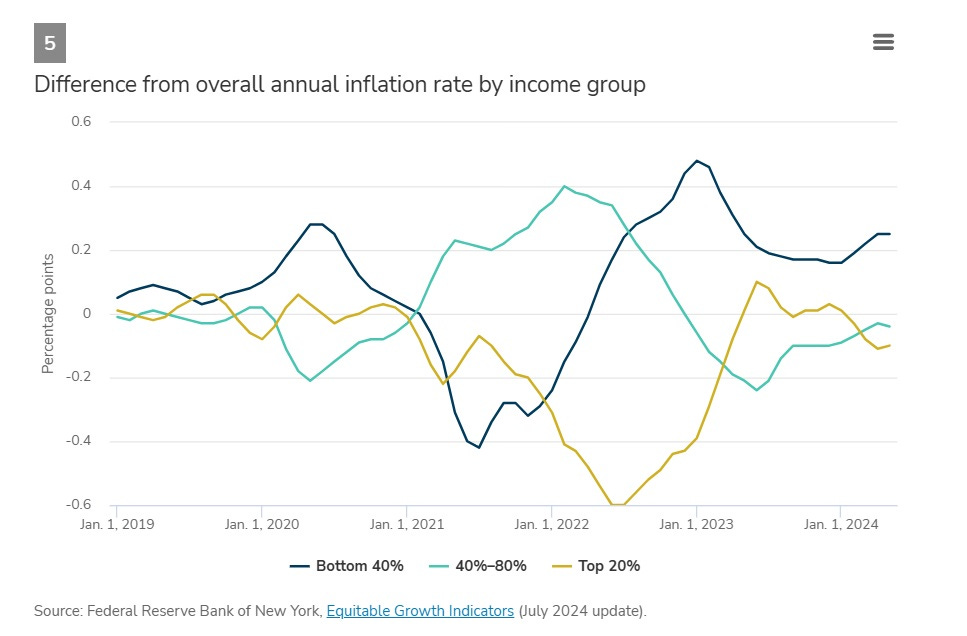
How about inflation? When defending the Biden economy, I often point out that real wages for people in the lower part of the distribution increased faster. That’s adjusted for inflation, but it’s adjusted for the overall state-level inflation rate. In fact, as the Minneapolis Fed’s Jeff Horwich explains, people who make less money have faced higher price increases since 2021, for two reasons. First, the things that lower-income and middle-income people spend a larger percent of their income on — especially housing — tended to go up in price a bit more:
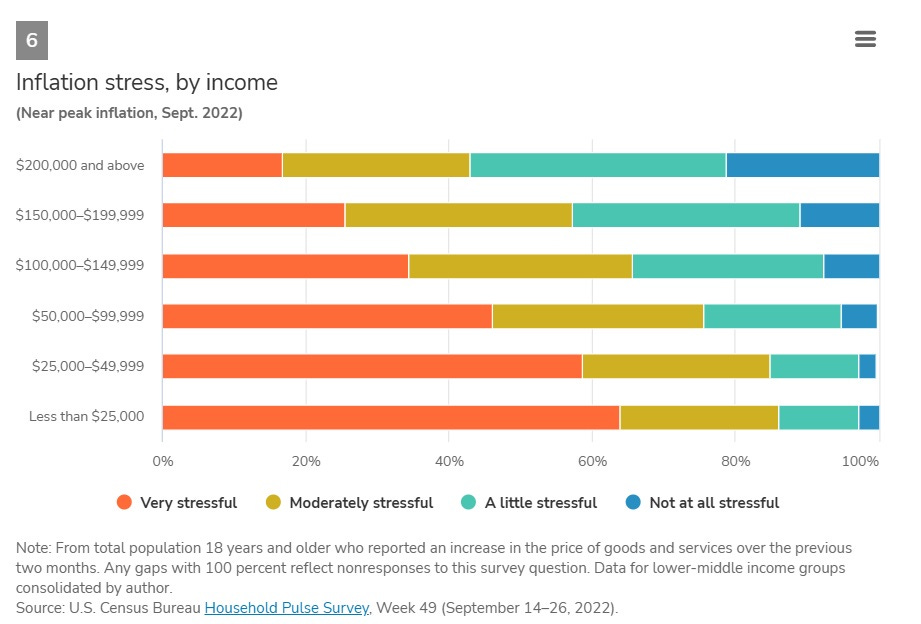
The second reason is pretty obvious: Having less money makes drops in purchasing power harder to bear. If my cost of living went up by 10%, it would be a minor annoyance; to a working-class person that could very well be ruinous. No wonder lower-income people tend to notice price changes more:
So while educated professionals like myself were able to put the post-pandemic inflation behind us fairly quickly after it subsided in 2023, regular Americans probably felt a more lingering hurt.
How about the wave of asylum seekers that flooded across the border in the Biden years? Lower-skilled immigrants don’t actually tend to reduce wages for native-born working-class Americans. But a big part of the reason they don’t reduce wages is that native-born people respond to increased immigration by going back to school and climbing the skill ladder. That takes time and money.
Also, low-skilled immigrants directly compete with less-educated and lower-earning Americans for housing. Asylum seekers tend to be poor, meaning they will try to get apartments and houses in lower-income neighborhoods. The effect on local rents in those neighborhoods, and for those types of housing, will be greater than the overall citywide or statewide effect. Rent will go up for the American working class, differentially affecting their purchasing power in ways that don’t get captured by state-level or national statistics.
So although Biden did beat inflation, crime did go down, and Biden did eventually crack down on the border, I can understand why the traumas that working-class Americans had to suffer in 2020-2022 couldn’t be expunged just by some encouraging charts. And the fact that educated professionals were much more insulated from the disruptions of the pandemic and from Biden’s missteps in 2021 mean that they didn’t necessarily even see the need to acknowledge how hard these had been on everyone else.
This disconnect probably ended up alienating people without college degrees. Not only did it cause many progressives to support deeply unpopular things like “defund the police” on social media, but Democratic politicians who became used to talking to their educated progressive base probably got a distorted idea of what was troubling the rest of America.
An information disconnect
I was taking an Uber with a friend a couple of weeks ago, and the driver went on a gigantic rant about how inflation is out of control, vaccines are ineffective and are causing all kinds of massive health problems, there are no jobs anymore, and so on. Listening to his rant drove home the fact that there are huge segments of the American populace that I’m just completely out of touch with.
Almost all of what he said was factually wrong, of course. Inflation is back down to a low level, and has been for years now. Employment is near all-time highs. Vaccines are safe and effective, and so on. But the fact that he believed in all of this stuff is a sign that there’s an information ecosystem out there that’s totally separate from the world of blogs and Washington Post articles and nerdy podcasts and Econ Twitter that comprises my own information diet.
In fact, this information disconnect is probably one reason why Trump won. Voters who knew about the positive data that I know about — and which I frequently talked about on this blog — went very strongly for Harris, while voters who had the same misapprehensions as my Uber driver went pretty strongly for Trump:
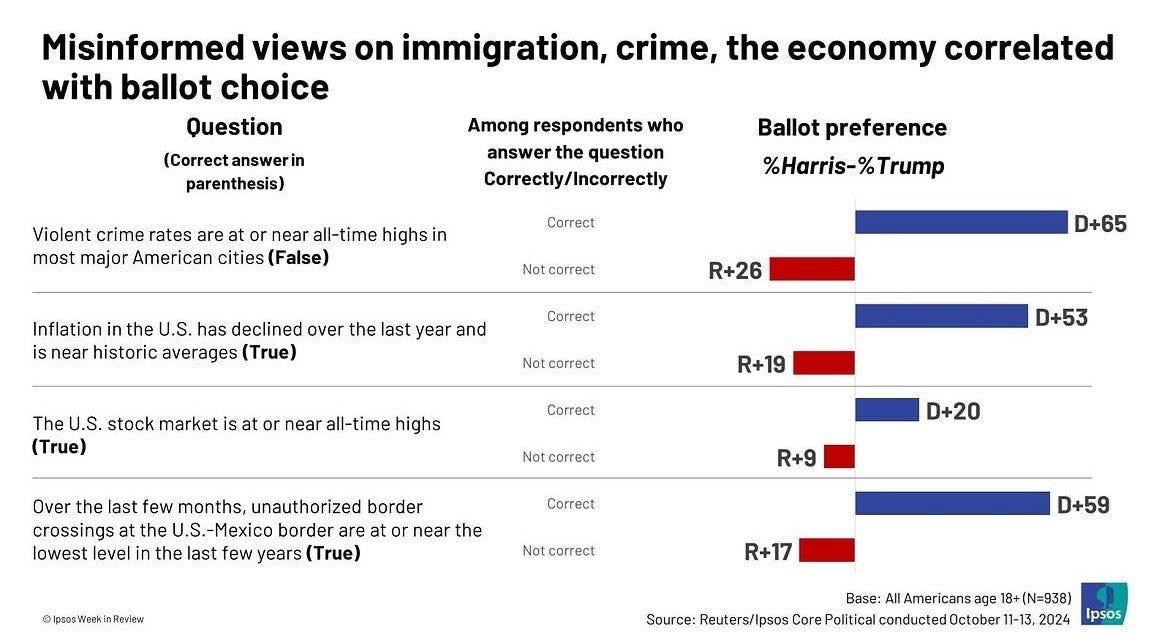
Now, people may simply be bullshitting on these polls — there’s research that shows that when you pay people to get these facts right, they tend to get them right. Saying “inflation is still high” might just be a way of saying “I like Trump”.
Also, note that all four of these questions are specifically phrased in such a way that the correct answer says something positive about Joe Biden’s tenure in office. If the questions had been things like “Overall, murder rates were higher under Biden than under Trump (True)”, or “Inflation in the U.S. since 2021 has been the highest of any four-year period since the 1970s (True)”, or “Since 2021, unauthorized border crossings have been higher than at any point since the early 2000s (True)”, it might have been Democrats getting the facts wrong instead of Republicans. (We’ll never know, of course, but Democrats do tend to show partisan bias on economic surveys.)
But it also seems likely that many of these less-educated Trump voters just don’t get nearly as much information about politics, economics, and public affairs. Highly educated folks consume a lot more news in general. And people who consume a lot more political news tended to vote for Harris:
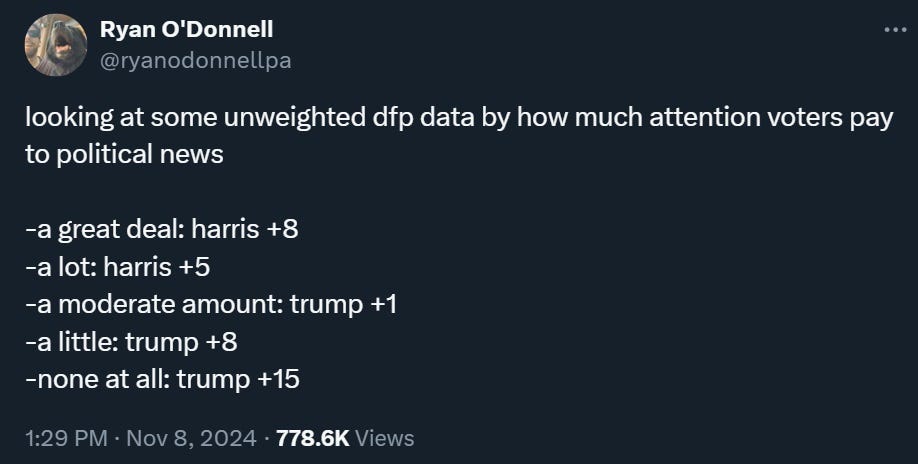
And when they do consume news, it’s likely to be from different sources. Many election postmortems have focused on the fact that Joe Rogan, a popular podcast host with many blue-collar fans, interviewed both Donald Trump and JD Vance during the campaign, but not Kamala Harris or Tim Walz. Joe Rogan’s podcast has 18 million subscribers. In comparison, Fox News, the most popular cable news network, has somewhere around 2 million primetime viewers.12 Meanwhile, Barstool Sports, another news outlet that’s popular with blue-collar types, went solidly for Trump and reportedly refused Harris’ offer for an interview.
In other words, Democrats are still doing a good job of getting their message to educated Americans who consume lots of political news, but are increasingly failing to reach the non-college masses. That’s why listening to an Uber driver talk about politics can seem like meeting someone from another universe.
This is not to say that educated progressives get the facts right, while blue-collar conservatives get them wrong. In fact, highly educated progressives can talk themselves into believing some absolutely insane things. During the summer of 2020, a lawyer friend insisted to me that the institution of police grew out of the institution of American slavery (obviously wrong, since police emerged independently all over the world). A number of progressives also asserted to me that police don’t reduce crime (false). The oft-repeated progressive claim that slaves built America is also obviously false, since slaves were less than 10% of the population. A few educated progressives even fiercely defend intentional fabrication of results in the social sciences, on political grounds.
But whatever the various myths are on the left and right, they are different myths. And because educated professionals swim in entirely different information ecosystems, they have little clue how to reach the masses and tell their side of the story.13
Why did the class disconnect come about, and how can we reduce it?
“Her belly may be full, but her spirit will be empty.” — Jean-Luc Picard
The educated professional class has been growing apart from America’s other social classes for decades now. Part of this was due to the big shift in the U.S. economy — the rise of knowledge industries like IT, finance, biopharma, and business services pulled America’s talented people to coastal metros and college towns. As the economist Enrico Moretti showed in his excellent book The New Geography of Jobs, a city’s human capital — i.e., how many educated professionals live there — became the best predictor not only of economic success, but also various measures of public health and well-being.
For those with the talent to escape the bleakness of their hometowns, big cities like New York, San Francisco, and Minneapolis — or college towns like Ann Arbor, Madison, and Berkeley — became magical playgrounds, full of great restaurants and shops and bars, other educated professionals to date and marry, and plenty of money to be made. I was one of the people who made that escape.
But what happened to the places the talented people left behind? Bereft of their talent in an age when talent equals money, they stagnated economically — counties that voted for Biden in 2020 represented just over half of the electorate, but 70% of America’s total GDP. And without as many talented people to be local doctors, teachers, etc., those places saw their health deteriorate — drug use and obesity ran rampant. Even the well-documented decline of marriage among the less-educated could be partially due to talented professionals fleeing the area — without as many visible examples of economically successful educated people getting married and staying married and raising kids in two-parent families, some working-class people in left-behind towns may have simply abandoned the practice.
This is the first reason for the disconnect. The second, I think, was institutional. In earlier times, there were a number of institutions that regularly brought people together across social classes — the three main examples being churches, businesses, and the military. But after Vietnam, the U.S. Military shifted from a mass-participatory conscript force to an elite professional volunteer force. Business became increasingly fragmented, with much blue-collar work and low-level service work outsourced or automated. And church membership has declined14 in America, possibly as a result of the internet:
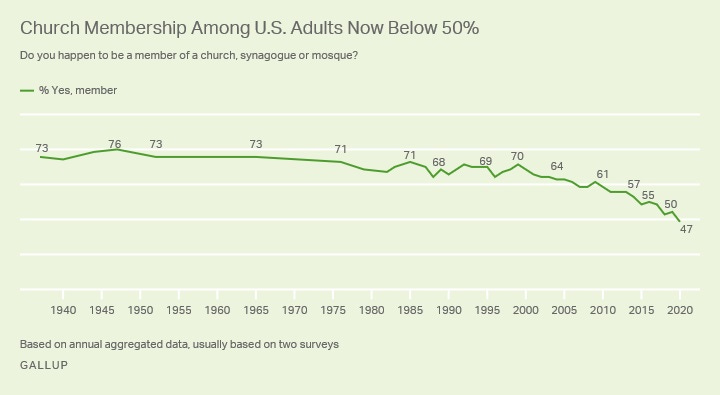
Combine this with the de-localization of American social life due to the car and the internet, and you have a recipe for extreme sorting. As Tyler Cowen writes in his book The Complacent Class, Americans have become increasingly expert at sorting themselves according to education, income, and other characteristics.
There was one public institution that managed to retain its broad functionality over this time period: College. American universities tried hard to recruit and mix people of diverse backgrounds, teach them healthy personal and social habits, and provide them with a rich community life that could be a model for their later adult communities. And to a large degree, this worked.
But it only worked for 40% of the population! The majority of Americans lacked the talent, the study habits, the inclination, the time, or (eventually) the money to get that four-year degree. So for that lucky 40%, colleges were church and army and work team all in one — an acceptable substitute for the tight-knit villages that the modern economy of the car and the internet had destroyed.
For the rest of the country there was nothing. There were daytime TV and televangelists and methamphetamine and conspiracy theories. There were strip-malls and NASCAR and hip-hop and Marvel movies. There were Fox News and Rush Limbaugh and Michael Savage. There was plenty of cheap land, big houses, cheap cars, and jobs in the vast service sector. But their upper caste had fled them for the playgrounds of college and the big city and the Google cafeteria.
But they were still part of the same country as the educated professionals. And so they all still voted in the same elections. So one day Donald Trump came along, and the classes were reunited by the institution of electoral democracy, in a very unpleasant and painful way.
After this crushing defeat, many educated progressives will turn to the idea of Bernie Sanders-style “class” politics as an alternative to the identity politics that failed so spectacularly. But this won’t work either.
First of all, Bernie himself underperformed Kamala Harris in this year’s election. Second, and more importantly, Biden has been the most pro-labor, pro-union President in many decades, and it availed the Democrats nothing. Biden raised overtime pay, strengthened unions with various new laws, revived factory construction with industrial policy, mandated the hiring of union workforces for federal contracts, became the first President to walk a picket line, funded vocational education and apprenticeships, banned noncompete clauses, and took dozens of other actions in support of the blue-collar working class.
Wages rose strongly for the working class, and inequality fell. Biden also enacted a lot of Bernie-style policies — canceling student debt, passing a huge climate bill, and increasing subsidies for health care.
And none of it helped Kamala Harris. The Teamsters union withheld their endorsement. The East Coast dockworkers’ union threatened a crippling strike just weeks before the election. All across the nation, steelworkers and other blue-collar union workers defied their leaders and organized in support of Donald Trump. Harris did win a slim majority of the union vote, but this probably came mostly from educated professional types, especially public unions.
The fact is, America just isn’t the industrial society it was in the 1950s. The broad blue-collar manufacturing laborer class is a thing of the past, and the fragments of that class that remain are often more focused on sociocultural issues than on pure pocketbook concerns. Most of the American non-college populace are non-unionized suburban service workers with no real class consciousness.
America, fundamentally, is an incredibly rich country with a sick society. We have higher consumption by far than people in any other country on the planet, and yet by and large, except for the few people who were lucky enough to receive the blessings of community and health from our one remaining functional institution, we’re a bunch of unhealthy socially isolated drug addicts.
As for the solution to all this, I don’t have an easy fix. In the long run our country needs to build new inclusive institutions — places where society’s classes mingle and cooperate. I don’t know what those can be, though of course I’ll think about the problem. But it will take a long time. Obviously, YIMBY policies that allow working-class people to live in big cities will help a bit, by putting the various classes in physical proximity, but without integrating institutions the effect will be marginal.
Nor do the educated right-wing professionals in the tech industry understand their new working-class political allies any better than the progressives do. Beyond helping to elect Donald Trump and annoy educated progressives, they don’t really have any plans to help those who lack the talent to work at SpaceX.
In the short term, what Democrats can do is to realize the extent of the problem, and begin doing everything they can to explore the culture and the information ecosystem of Americans who didn’t go to college. Get interviewed on Rogan and Barstool Sports and wherever, but don’t just get interviewed — immerse yourself in the culture. Don’t get your information about regular Americans from the activist groups who knock on your staffers’ doors, or from 20-something socialists who spout stale Marxist theory. Go meet them, find out what they care about, and think about how to give it to them.
Fixing America’s great class disconnect will take a long time, but there’s no better time to start.
The blue cities must be fixed
Donald Trump’s victory in November 2024 wasn’t the only important election result. Big cities in California shifted away from so-called “progressive” governance. In San Francisco, progressive champion Aaron Peskin was soundly defeated in the mayoral race, and his vacated seat was won by a moderate. Peskin’s close ally, Dean Preston, was unseated by moderate challenger Bilal Mahmood, and the Board of Supervisors is expected to lose its progressive majority. In Los Angeles progressive district attorney George Gascón lost his reelection bid, while Oakland’s Pamela Price was recalled. This followed a national trend of progressive DAs getting the boot; meanwhile, San Francisco’s moderate DA Brooke Jenkins, who succeeded the notorious Chesa Boudin after the latter was recalled, easily cruised to reelection.
It’s possible to interpret these victories as part of a general revolt against progressive governance in big cities. At the local level that’s a good thing, since that governance has proven remarkably poor. But at the national level, the urban revolt against probably helped usher in another four years of Donald Trump. Although large metros still voted for the Democrats overall, they swung harder towards Trump than any other geographic region:
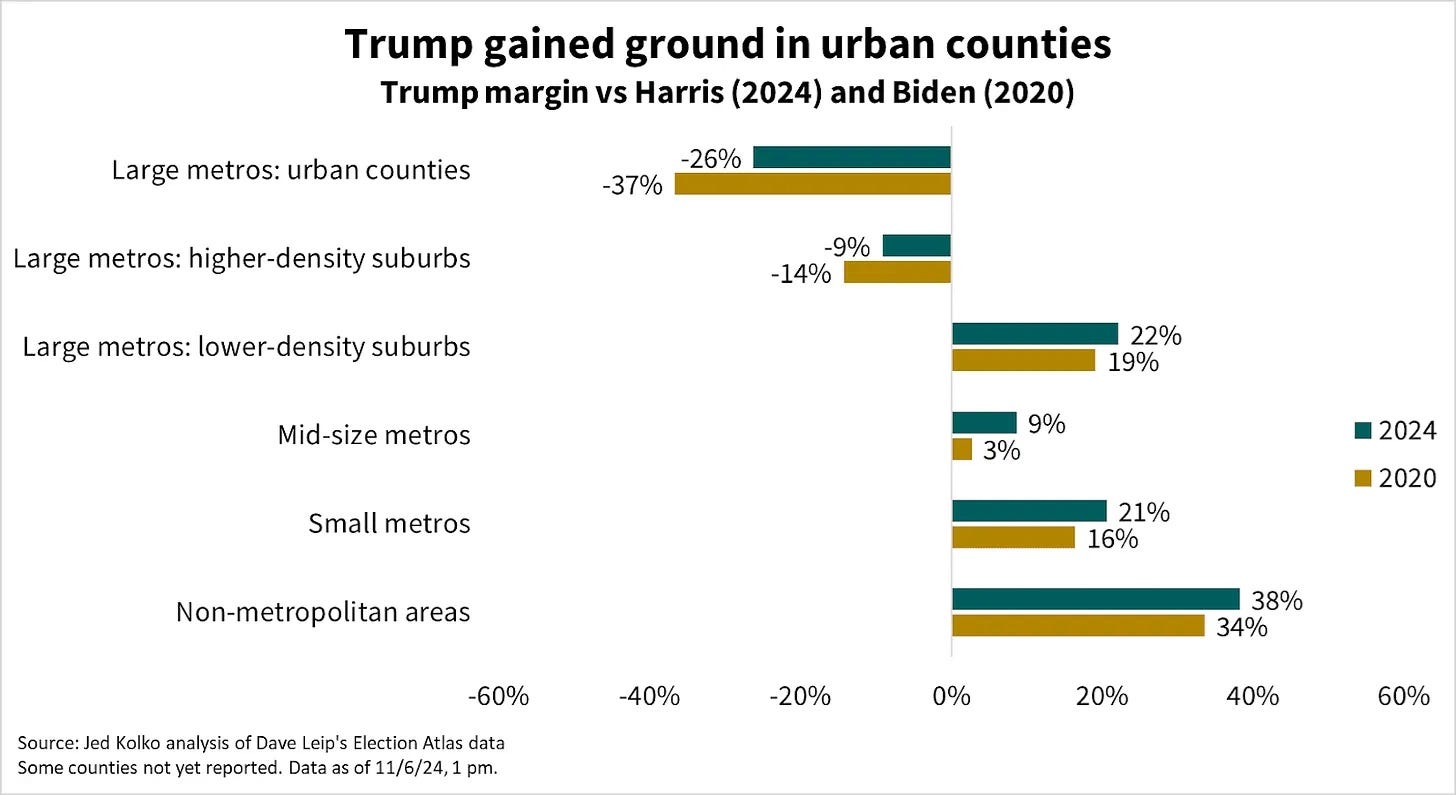
Derek Thompson has some more numbers:
In the past two cycles, Democrats could comfort themselves by counting on urban counties to continue moving left even as rural areas shifted right. That comfort was dashed last night, at least among counties with more than 90 percent of their results reported. In the New York City metro area, New York County (Manhattan) shifted nine points right, Kings County (Brooklyn) shifted 12 points right, Queens County shifted 21 points right, and Bronx County shifted 22 points right. In Florida, Orange County (Orlando) shifted 10 points right and Miami-Dade shifted 19 points right. In Texas, Harris County (Houston) and Bexar County (San Antonio) both shifted eight points right and Dallas County shifted 10 points right. In and around the “Blue Wall” states, Pennsylvania’s Philadelphia County shifted five points right, Michigan’s Wayne County (Detroit) shifted nine points right, and Illinois’ Cook County (Chicago) shifted 11 points right.
Josh Barro wrote an insightful post-election post arguing that big cities’ failure to curb urban disorder, fiscal waste, and soaring housing costs drove their inhabitants away from the Democratic party. Some key excerpts:
I write this to you from New York City, where we are governed by Democrats and we pay the highest taxes in the country, but that doesn’t mean we receive the best government services. Our transportation agencies are black holes for money, unable to deliver on their capital plans despite repeated increases in the dedicated taxes that fund them, because it costs four times as much per mile to build a subway line here as it does in France, and because union rules force the agency to overstaff itself, inflating operating costs. Half of bus riders don’t pay the fare, and MTA employees don’t try to make them. Emotionally-disturbed homeless people camp out on the transit system…even though police are all over the place (at great taxpayer expense) they don’t do much about it, and I can’t entirely blame them since our government lacks the legal authority to keep these people either in jail or in treatment. The city cannot stop people from shoplifting, so most of the merchandise at Duane Reade is in locked cabinets…[S]chools remain really expensive for taxpayers even as families move away, enrollment declines, and chronic absenteeism remains elevated. Currently, we are under state court order to spend billions of our dollars to house migrants in Midtown hotels that once housed tourists and business travelers. Housing costs are insane because the city makes it very hard to build anything — and it’s really expensive to travel here, partly because so many hotels are now full of migrants, and partly because the city council literally made it illegal to build new hotels. And as a result of all of this, we are shedding population — we’re probably going to lose three more congressional districts in the next reapportionment. And where are people moving to? To Sun Belt states, mostly run by Republicans, where it is possible to build housing and grow the economy…
[A]ll of this is why I think Democrats’ approach to the cost-of-living issues…has fallen so flat. The Democratic argument is, more or less, “look at all my programs” — all the things I’m going to have the government do to make life easier for you…I think Americans look around at how it goes when the government actually tries to help, and they have a healthy skepticism about how helpful the government is really going to be, and about whether the benefits are really going to flow to them. Democrats are making too many promises; they instead need to pick a few things for the government to do really well, with a focus on benefits to the broad public rather than to the people being paid to provide the services, instead of trying to do a zillion different things and doing them badly at great expense[.]
Of course I don’t know how big of a factor this was in Trump’s victory, but I’m not actually sure that even matters. Barro is largely correct about the sad state of blue cities, and it’s the inhabitants of those cities who are suffering the most from that failure of governance. The most important reason to fix those cities isn’t to help Democrats get elected at the national level, but because it would make life better for urban residents themselves. The swing toward Trump is simply an illustration of just how angry city dwellers are.
The blue city renaissance, 1980-2012
It’s important to remember that just a few years ago, the general consensus was that big cities in America were doing really well. In 2017, Will Wilkinson cited the success of American cities as a reason to reject Trump:
[W]hen Trump talks about cities, he presents a fearsome caricature that bears little resemblance to the real urban landscape…He persists in his efforts to slur cities as radioactive war zones because the fact that America’s diverse big cities are thriving relative to the whiter, less populous parts of the country suggests that the liberal experiment works…[T]he American metropolis is more peaceful and prosperous than it’s been in decades…Yes, cities have their share of failing schools. But they also have some of the best schools in the country and are hotbeds of reform and innovation…America’s most diverse, densely populated and well-educated cities are generating an increasing share of the country’s economic output.
Wilkinson’s paean to big cities was the culmination of decades of real success. In the middle of the 20th century, America’s cities had been hollowed out, by a combination of soaring urban crime and the lure of the suburbs. In the 1970s, big metropolises were still losing population. NYC almost went bankrupt.
Starting around the 1980s, though, America experienced an urban revival. Big cities began to gain back some of the population they had lost:

There were a number of reasons for this revival. One was the rise of knowledge industries like tech, finance, and business services, which tend to cluster together in cities. As Enrico Moretti shows in The New Geography of Jobs, human capital tended to cluster in big cities after around 1980 or so; Richard Florida also famously documented this in The Rise of the Creative Class. Here’s some data from Jed Kolko for 2000-2014 that’s pretty representative of the general shift:
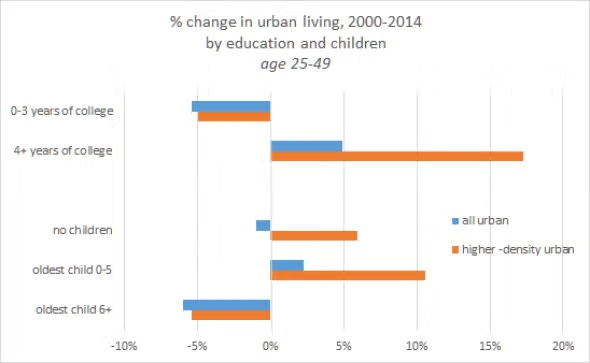
A second reason for the revival was immigration — just like a century earlier, immigrants flocked to big cities.
Then in the 1990s, crime plummeted. In 1992, New York city had 2,245 murders. By 2016 it was down to 292:
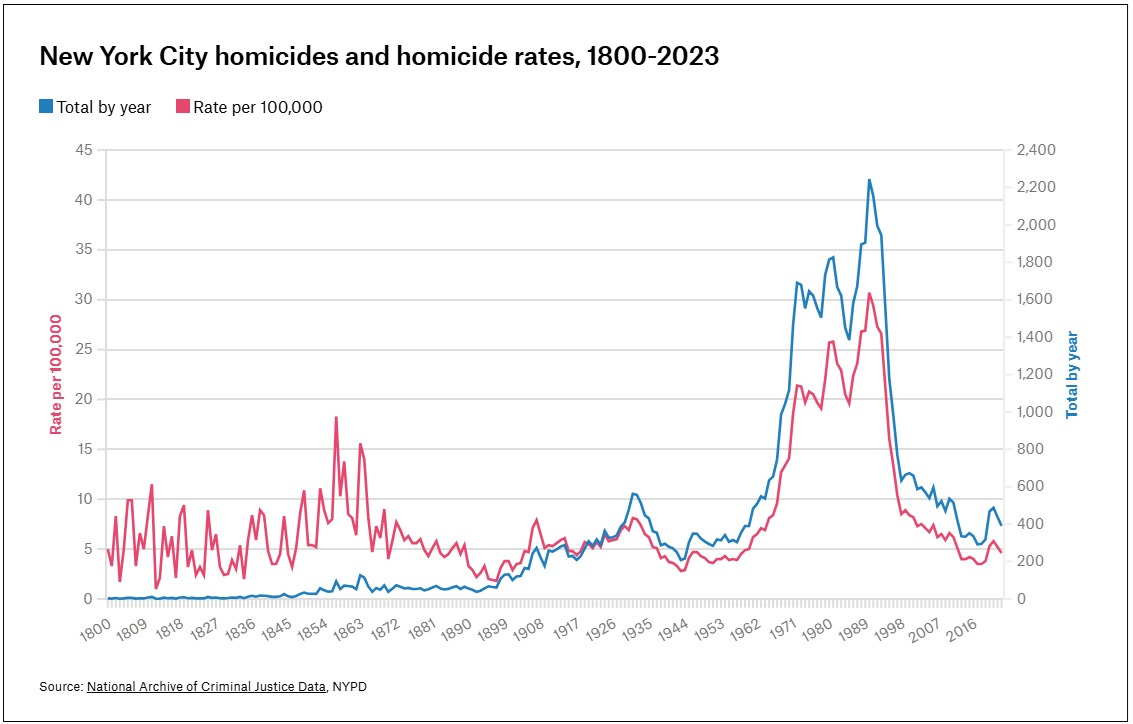
The combination of the crime drop and the knowledge-industry boom made American cities great places to live, at least for a couple of decades. TV shows like Seinfeld and Friends and Sex and the City and How I Met Your Mother celebrated the lightheartedness of upper-class city life. Urban art and fashion and culture bloomed again, producing the hipster era.15
Why blue cities declined again
But the renaissance was short-lived. In the 2010s, the urban revival stalled, and the populations of big cities plateaued. The reason was simple: housing. Since the 70s, American cities had developed an entrenched culture of NIMBYism and a thicket of laws like rent control, which prevented cities from building new housing in order to accommodate the influx of population. As a result, rents rose. And since rich people — the same knowledge workers who were powering the urban boom — were better able to afford the rising cost of housing, it was middle-class and working-class people who were pushed out of the cities. New York, San Francisco, and the rest became playgrounds for the affluent.
More progressive cities in blue states consistently built less housing than cities in red states. Kahn (2011) found:
Traditional explanations for why some communities block new housing construction focus on incumbent home owner incentives to block entry. Local resident political ideology may also influence community permitting decisions. This paper uses city level panel data across California metropolitan areas from 2000 to 2008 to document that liberal cities grant fewer new housing permits than observationally similar cities located within the same metropolitan area. Cities experiencing a growth in their liberal voter share have a lower new housing permit growth rate.
As a result, progressive cities became less affordable:
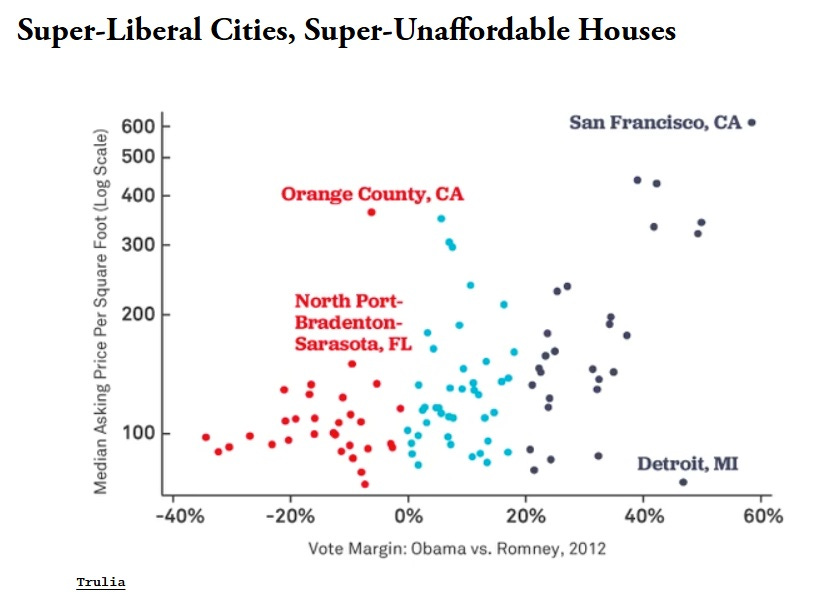
This divide continues to this very day. Blue cities are still building a minuscule amount of housing:
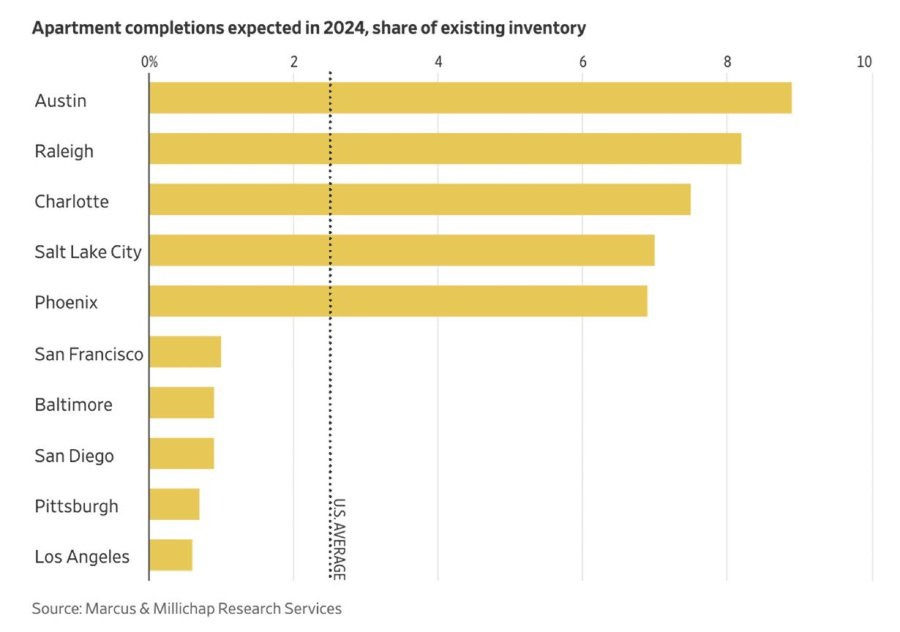
At the same time, many blue cities were spending way beyond their means:
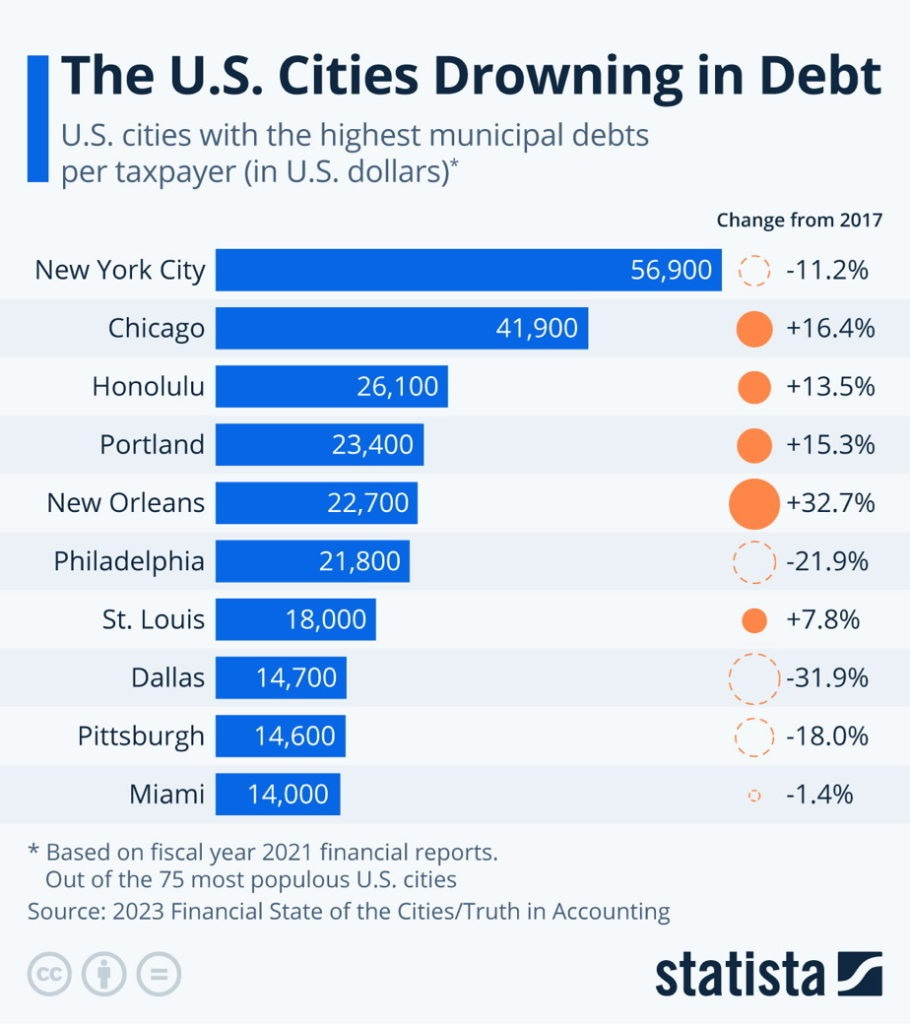
Some of this was due to the chronic problem of city pension obligations, which have grown more severe due to unrealistic assumptions about stock returns, the power of public-sector unions, and simple short-sightedness. But some was because local infrastructure and city services got very, very expensive — witness how New York City pays several times the cost per mile to build a new subway that a French city would pay.
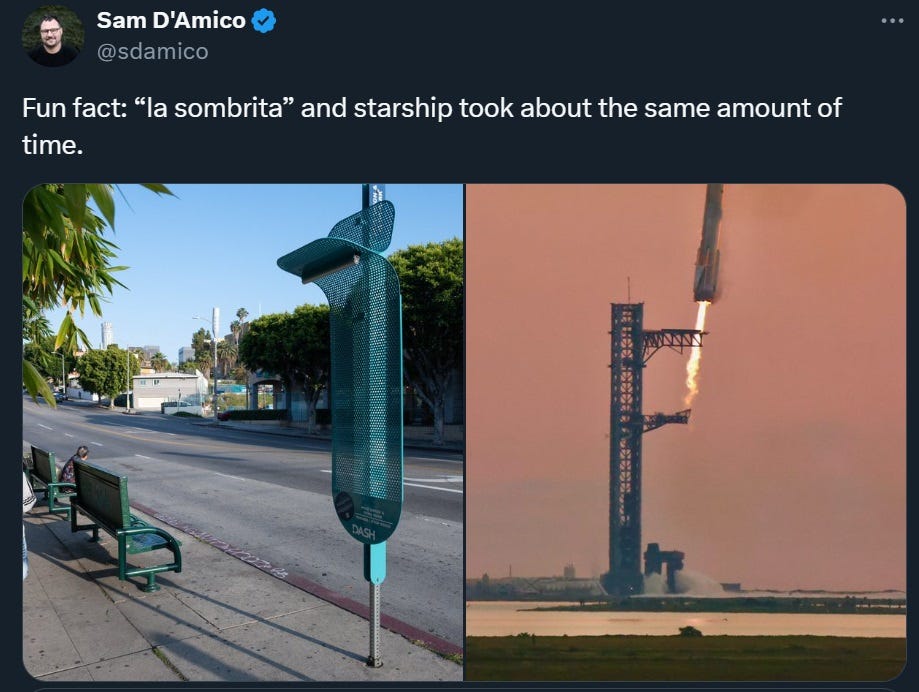
Some of this ballooning cost is due to broken bidding processes and the erosion of state capacity. With their own departments having shrunk, progressive cities have been outsourcing more and more of their core functions to inefficient and often corrupt nonprofits. Recall the infamous case of La Sombrita, the ineffectual sun-shade that the Los Angeles Department of Transportation paid a nonprofit $200,000 to create:
San Francisco, as usual, is the worst offender, with a new nonprofit corruption scandal popping up every month or so.
In the late 2010s, blue cities brought yet another problem on themselves: urban disorder. Crime rates began rising in 2015, fueled by national unrest. But blue cities didn’t respond by cracking down on crime as they did in the 90s and 00s. Progressives in the late 2010s reviled and rejected “stop-and-frisk”, “broken windows policing”, and other tools that blue cities had used to keep order in previous decades. Instead, they elected a bunch of progressive prosecutors, enacted more permissive policies toward public drug use, passed laws that made it hard to use violence against shoplifters, and sometimes even reduced penalties for minor crimes.
The result was entirely predictable. Blue cities became increasingly afflicted by pervasive, low-level urban disorder — drug needles in children’s parks, epidemics of car break-ins, and so on. Female friends of mine in San Francisco started to report being followed for blocks, harassed on the train, or even slapped in the head by street people on their way to work. The housing crunch made the disorder much worse, of course, by exacerbating homelessness.
Then the pandemic and the riots hit, and the trend got turbocharged. Without “eyes on the street” to deter crime, and with police cowed or disgruntled by the protests of summer 2020, progressive cities became increasingly lawless, chaotic zones. Violent crime soared in 2020-21, with waves of attacks on vulnerable populations like Asian elders.16
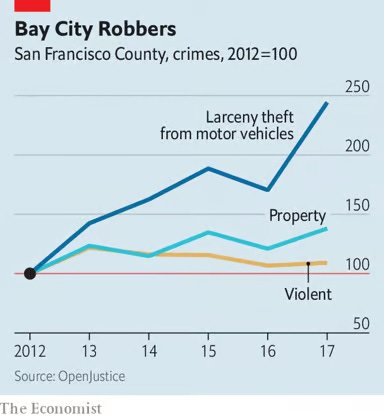
Nowhere was the chaos more evident than in San Francisco. Although murder rates in SF stayed low, more minor crimes, like car break-ins and theft, skyrocketed:
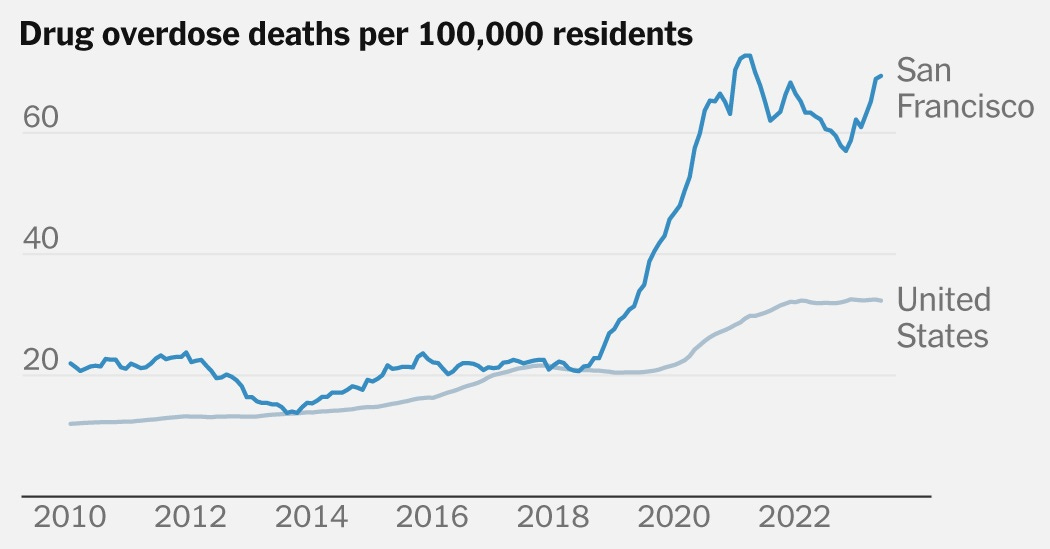
And the epidemic of public drug use in SF got utterly out of control:
After the pandemic, there was an epidemic of store looting that continued for years, causing many of the stores in the downtown area to close.17
The American urban renaissance is now well and truly over. In the 2010s and early 2020s, many progressive cities squandered the massive windfall from the knowledge industry boom. With its seemingly invincible network effects and ever-increasing bounty of tax revenues, that boom seemed to convince progressive cities that they had infinite amounts of fiscal and social surplus to dispose of as they pleased — that they could tolerate crime and disorder, spend infinite money, and neglect the need to build new housing, and that none of this would end up mattering. That turned out to be wrong, and now the bill is coming due.
Three principles for reviving blue cities
Reviving blue cities will require a number of big changes. Elections like the recent one in San Francisco will be needed to push out “progressive” leaders who want to continue the failed experiments of the last decade. A sensible policy is going to have combine material abundance with intolerance toward crime and disorder. I like the basic platform advanced by GrowSF, a San Francisco advocacy group that combines pro-housing and pro-infrastructure policies with a tough-on-crime approach. Here’s a list of just a few of their good ideas:
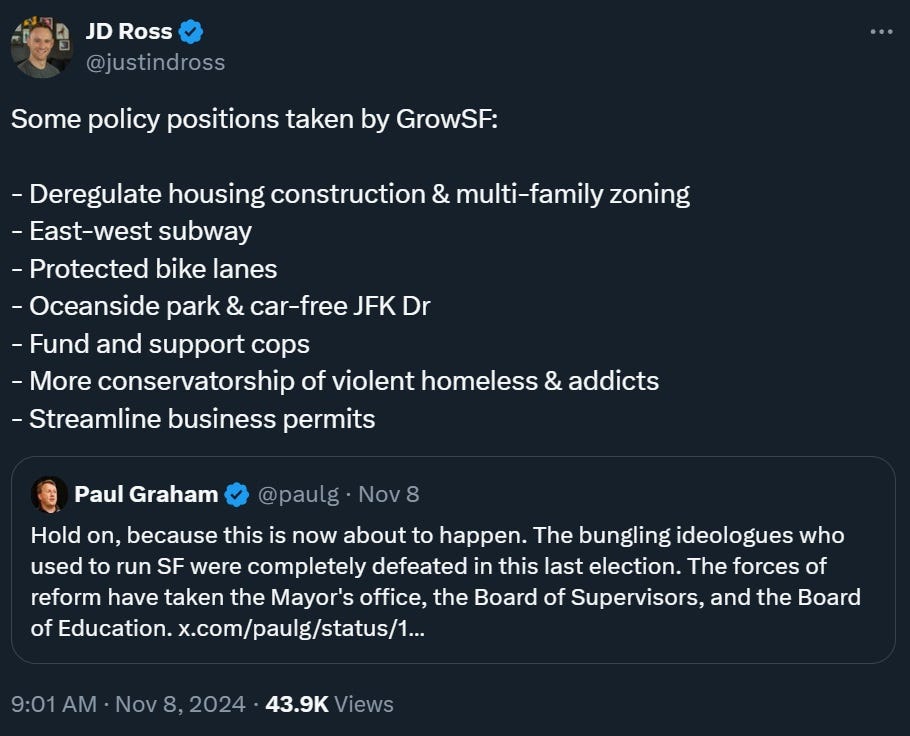
But fixing blue cities is going to require more than just waves of voter anger or a laundry list of good policies. It’s going to require a mindset change — a shift in people’s understanding of what a city should be and how it should be run.
The most important thing blue cities need to understand and internalize is that anarchy is not a form of welfare.
Many progressives believe that any actions to curb urban disorder — restrictions on sidewalk tents, making people pay for public transit, arresting people for nonviolent crime, and so on — represent the exclusion of marginalized people from public life. In the absence of a full-service cradle-to-grave welfare state, progressives think they can redistribute urban utility from the rich to the poor by basically letting anyone do anything they want.
But in fact, permissiveness toward the behaviors that create urban disorder destroy more value than they redistribute. When you don’t make people pay for public transit, you scare people off the train, thus causing the train to go bankrupt. Pretty soon neither the rich nor the poor have a train, and everyone is screwed. This is the tragedy of the commons.
Measures to curb disorder therefore represent defense of the commons. When Bay Area trains put in new stronger gates to prevent people from riding the train without paying, crime on the train fell and rider satisfaction increased. Similarly, measures to curb shoplifting — including punishing shoplifters and letting security guards and business owners defend their stores with violence — allow local businesses to keep operating, which means that poor and working-class urban residents have places to shop for their daily needs. And so on.
Second, Josh Barro is absolutely right when he says city services should “focus on benefits to the broad public rather than to the people being paid to provide the services”. In other words, progressive cities need to realize that costs are bad for the city government.
The habit of having cities overpay for everything is another form of highly inefficient redistribution. A bunch of people do get paid out — nonprofits, overstaffed contractors, expensive consultants — but at the end of the day the ballooning costs that result from all these payouts mean that cities don’t actually have the infrastructure or services they need. All too often, progressive cities are operated for the benefit of the people who get the money instead of the people who get the stuff.
That payout-focused behavior is driving cities to bankruptcy while worsening the quality of infrastructure and services alike. Cities need to replace consultants and nonprofits with civil servants, implement stricter oversight of outside contractors, improve their bidding processes, and in general do everything they can to bring down the cost of everything they do and provide better value to the citizenry.
Finally, cities must realize that housing is non-negotiable. Fundamentally, cities are places that people live — if people do not have houses to live in, you don’t actually have a city. Housing is what allows businesses to function, because most people live near to where they work. Housing is what allows retail to function, because it creates a sufficient density of customers. Housing sustains knowledge-industry network effects, by allowing more knowledge workers to live close to each other and exchange ideas. In most states, housing generates more tax revenue for the city as well. And of course, housing reduces homelessness.
Blue cities should therefore do absolutely whatever it takes to get a lot more housing. “Whatever it takes” includes upzoning, deregulation, planning, public housing, and cutting back on policies like rent control. The correct method of building housing is “any and all methods”. That’s what it means for a goal to be non-negotiable.
I loved the blue cities of fifteen years ago. They had already sown the seeds of their own decline, but in the brief moment between the chaos of the 1970s and the foolishness of the 2010s, America’s big blue cities were indeed the glory of the country. They can and should recapture that glory.
Actually, what would happen is that the number of voters would shrink until it’s so small that a single vote had a high probability of being decisive, and voters would all randomize whether they went out and voted. This, of course, is a silly fantasy, since humans do not behave like this.
Note that “Black” is capitalized in this expression but “brown” is not. This is really the way that progressives write it! The reason is academic theory — “Black” is supposed to be an identity group that its members have chosen for themselves, while “brown” and “white” are theorized to be ascriptive terms imposed from outside. Although the crosstabs of the 2024 election do lend a bit of support to that distinction, the weird capitalization behavior is still fairly precious and out of touch. Note that in this blog, I capitalize “White” as well as “Black”, consistent with Bloomberg and the Washington Post. But sometimes I forget to capitalize them, because I also just don’t care about stuff like this very much, and I think the nation would be better off if we all cared less about stuff like this.
I tried to put these in rough order of importance, but really it’s situational.
The other factors that influence elections — culture wars, charisma, narratives, and so on — are all represented by the presidential approval ratings that get fed into the model.
This effect will generally be magnified if nominal interest rates are at the zero lower bound, as they were in 2021.
This sounds like one of those bleedingly obvious things that economists need a research paper to prove to themselves, but which every normal person with half a brain already knows. In fact, it’s not. Inflation drives up wages as well as prices — there’s no obvious reason why wages should go up more slowly than prices during a period of high inflation. But in fact, that is what happens, and economists don’t know why.
Actually, not all income measures show the same thing. Real median personal income did much worse in the Great Recession than in the post-pandemic inflation. Real median household income fell significantly in both episodes.
Some of this was due to a composition effect — low-wage workers returning to work dragged down the average. But wage measures that control for composition effects also found that wages failed to keep up with inflation in 2021-22.
The most extreme form of this “macro-progressivism”, of course, is the cult-like movement known as MMT. Most macro-progressives want nothing to do with MMT, of course. But sometimes their beliefs can seem like MMT’s more reasonable, wonkish cousin — always pushing for a little more fiscal stimulus, rain or shine.
Shoplifting shows a decrease on this chart, but this is probably due to a drop in reporting rates. When you don’t think the police will do anything about shoplifting, you don’t tend to tell them when it happens, and it doesn’t get recorded.
And it was disproportionately Hispanic-owned, Asian-owned, and Black-owned small businesses that got looted that summer and afterwards. Small wonder that nonwhite voters shifted toward Trump!
All Things Considered, the most popular NPR program, has 14.7 million weekly listeners. Sean Hannity has about 14 million.
This is obviously true for me as well, of course. I don’t know for sure, but my bet is that almost all of my audience is college-educated.
Note that regular church attendance is actually pretty stable. It turns out that a lot of church members lie about going to church regularly, which you can see when you track their cell phones. But the people who only go to church services once in a while are still probably involved with the institution, which puts them in at least occasional contact with a bunch of people from other social classes.
But also producing lots of genuinely interesting and non-annoying culture as well!
Homeless people themselves, of course, are the most frequent victims of urban chaos, despite popular stereotypes of homeless people as predators.
The other reason for this was decreased foot traffic in the downtown area, caused by the rise of remote work.