

There’s a large market for “Trump is bad” posts. I wrote one of them back in May:

It’s easy to tune these posts out, for at least two reasons. One is partisanship — as a reader, I’m sure you know how hard it is to separate “Trump is bad” from “Trump made me mad”. The second is fatigue — you’ve heard the familiar litany of all of Trump’s outrages, and reading it one more time is both redundant and depressing.
Today I’m going to do something a little different, which is to ask: Why, exactly, has the second Trump presidency been such a failure?
Trump is a failure in the eyes of the nation
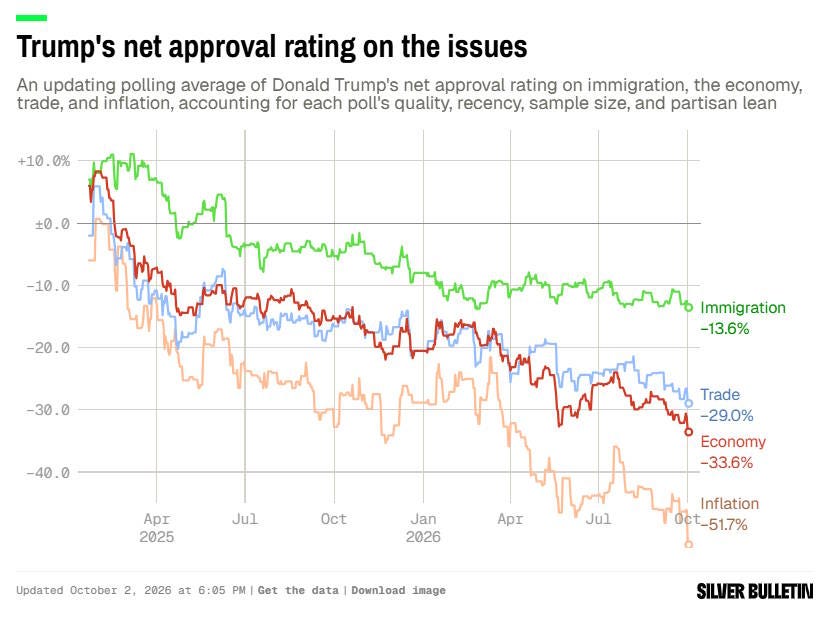
Before I do that, we should establish that in the eyes of the nation, Trump’s second presidency has been a failure, at least so far. His approval rating, going into the midterm election, is at historic lows:


America was mildly disapproving of Trump in his first term; now, only his base is staying loyal. And even that base is eroding. On the cost of living — one of the key issues in 2024, and likely to be a key issue in the midterms — Republicans now disapprove of Trump:

Hilariously, a modest but growing number of people who voted for Trump in 2024 now say they never voted for him.
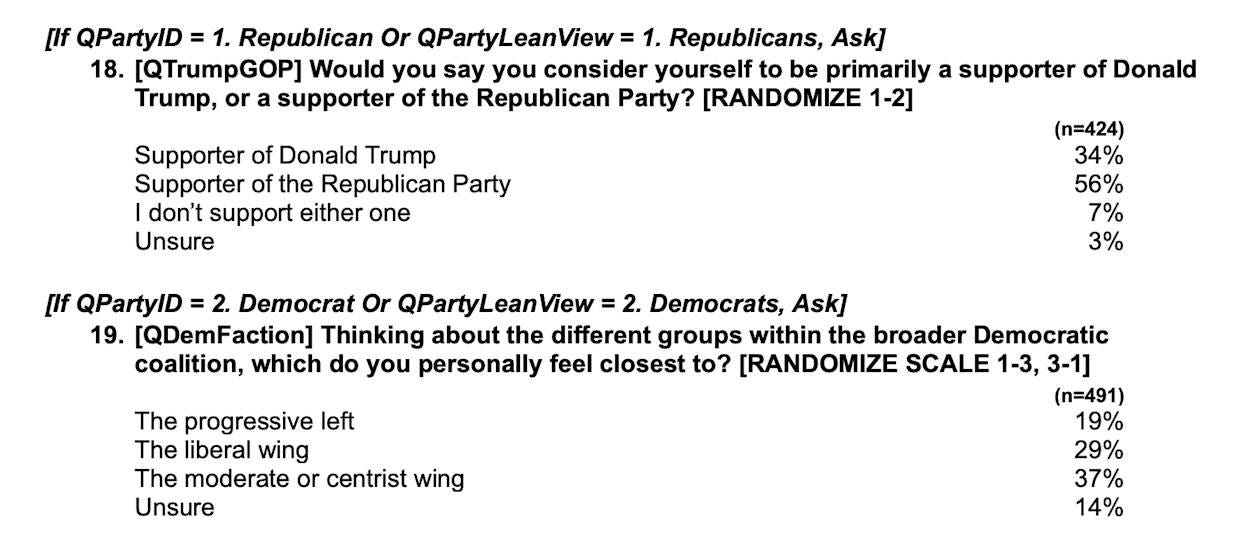
And despite the widespread belief that Trump’s cult of personality dominates the GOP, Republicans now tend to say they support the party rather than the president himself:
But nevertheless, the GOP is going to suffer from Trump’s unpopularity in the midterms. Prediction markets are increasingly sure that Dems will take the House, and they now also give Dems a better-than-even chance of winning the Senate, despite a very difficult map:
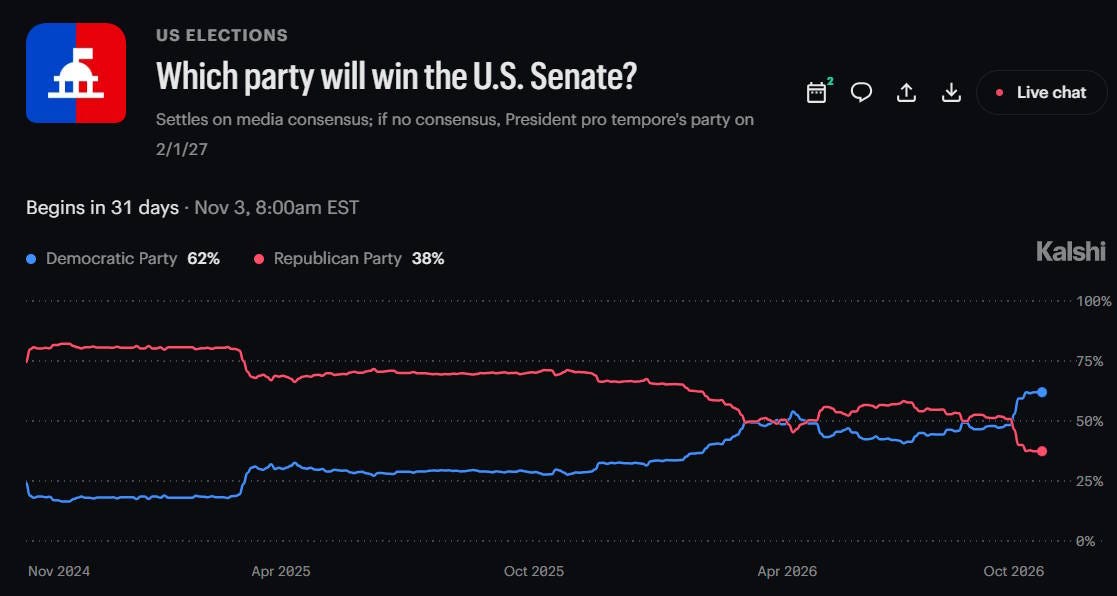
Polls showing Senate races moving toward the Dems might be overstating things, but polls have ended up understating Democratic support in special elections since Trump returned to power. Trump has resorted to desperately promising $5000 checks to every U.S. citizen if Republicans win the midterms. But so far, these wild bribe attempts are falling decidedly flat — in fact, they’re actively driving voters away.
All this is all the more remarkable because Democrats themselves are in disarray. The party has torn itself apart over Israel/Palestine, and the public is still deeply skeptical of Dems’ “woke” progressive ideology. But whereas Americans still trusted Republicans more on many issues in 2025, now they tend to trust Democrats on issues like the economy and immigration:
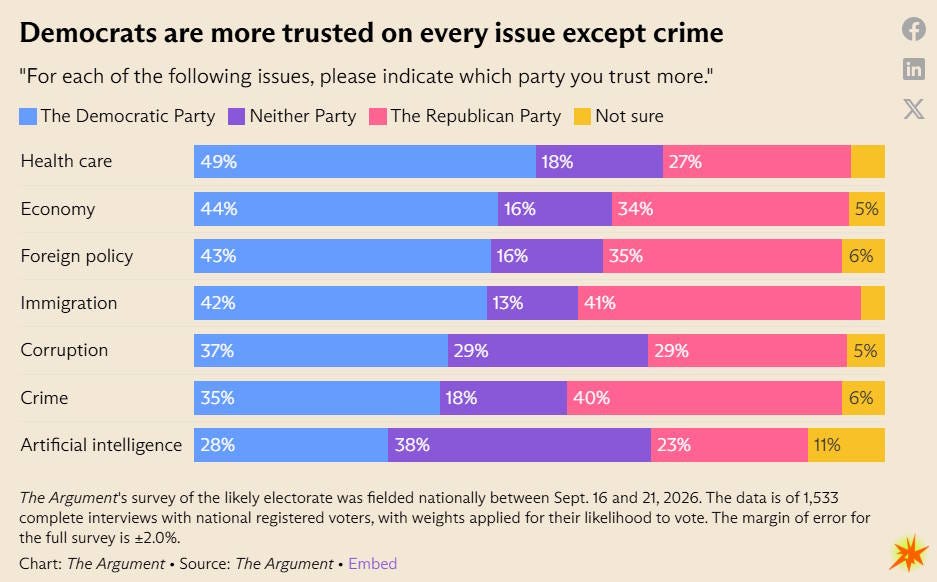
The GOP was more popular than the Dems as of one year ago; now that has reversed.
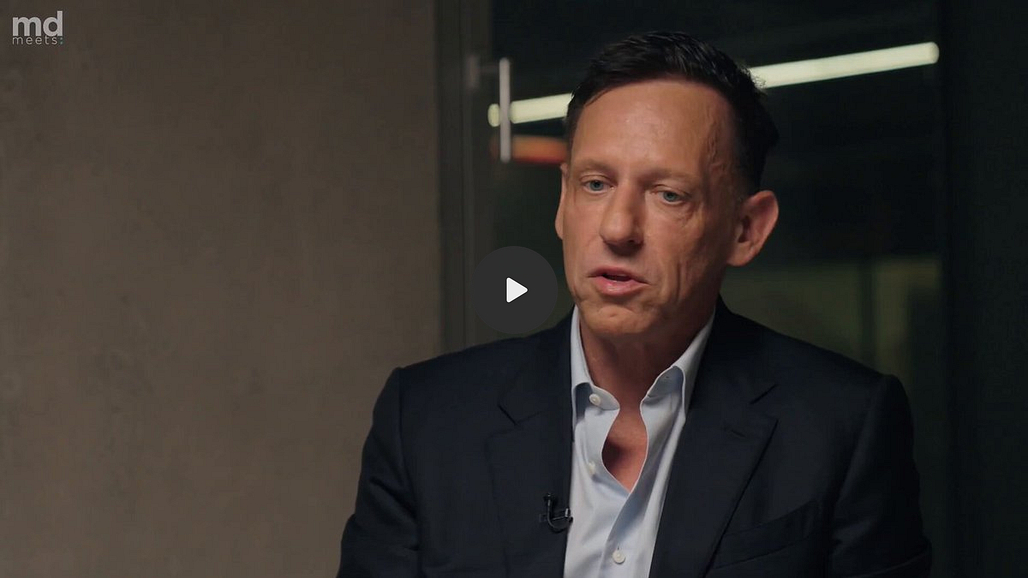
Even some of Trump’s most prominent allies are now distancing themselves from the president. Here’s Peter Thiel, one of the godfathers of the Tech Right:

I can’t rule out the possibility that someday we’ll all look back on Trump’s second presidency as a success. Perhaps winning the AI race will prove to be so much more important than everything else that Trump’s decision to stall AI regulation ends up swamping everything else he ever does.
But I don’t find it very useful to indulge in this kind of “too early to tell” speculation. The blunt fact is that Trump’s second term has already failed in the court of public opinion. This is an incredible, world-historic failure. And it didn’t have to be that way — Trump simply made a bunch of avoidable errors, for a mix of ideological and personal reasons.
Trump didn’t have to fail
Liberals and progressives — who constitute the majority of my own social circles and friend group — hate Trump with a passion, and always have. But when I analyze his performance in office, I try to be as nonpartisan as I can. When Donald Trump returned to the presidency, I noted that his first term actually hadn’t gone that badly:

Trump’s first term was marked by a lot of shouting and social division, but yielded surprisingly benign results. The economy grew very solidly, though Trump (predictably) passed up the chance to cut the budget deficit. America’s economic response to the Covid shock was among the best in the world, though it ended up fueling inflation later. Trump’s administration showed surprising competence in developing a vaccine for Covid. And although Trump did nothing to reshore U.S. manufacturing, his election and his protectionist policies did produce a needed shift toward seeing international economics through a geopolitical lens.
Trump came back to office in 2025 with a modest but real mandate, having won the popular vote for the first time. He could have essentially run the same playbook from his first presidency — done a lot of shouting and blustering, purged the government of wokeness, halted the flood of asylum-seekers (i.e. “secured the border”), put some more tariffs on China, supported tougher policing in American cities, and called it a day. This is basically what America elected Trump to do, and it’s what I think most of his supporters probably envisioned for his second term, given how the first had gone.
Progressives would have hated it, of course, and high Democratic turnout might still have produced a modest blue wave. But I think that if Trump had stuck to this plan, the nation would have rewarded him with popularity and a grudgingly positive place in the history books. Only because he deviated so radically from this basic playbook is his presidency failing.
And although I don’t like it, I am forced to admit that many of the things that piss me off about Trump don’t seem like big factors in his low popularity. For example, I’m horrified by the administration’s anti-vaccine turn under RFK Jr. But despite the resurgence of measles in America, RFK’s crusade against Western medicine seems like only a minor electoral liability.
Nor does America seem particularly enraged about Trump withdrawing support for Ukraine, distancing America from NATO, or cozying up to Vladimir Putin. His bullying of Ukraine and his threats to invade Greenland are deeply unpopular, but don’t seem to have caused significant downward movements in his approval rating.
Other outrages seem to have had even less of an impact. Trump’s dismantling of USAID was unpopular, but the blame has mostly fallen on Elon Musk, who acted as a sort of ablative shield for Trump by removing himself from the political sphere. His purges of generals, his abuse of presidential power to attack law firms and media outlets, and his pardons for the perpetrators of the coup attempt of 1/6/2021 all seem to have flown below the radar of anyone who doesn’t follow politics closely or already hate Trump.
It’s possible, of course, that all of these things have contributed to a sort of general background distrust of Trump that has slowly eroded his approval rating over time. But Trump’s big second-term failures — the things that Americans say they dislike about his presidency — are basically just inflation and the Iran War.
Trump showed that he didn’t care about inflation
It’s barely exaggerating to say that Trump was elected in 2024 to address two things: inflation, and immigration. Those two issues dominated the polls in advance of the election, and of the two, inflation loomed larger. Trump was generally given better ratings on his ability to handle the economy — which, to most voters, meant the rising cost of living. Voters who emphasized economic issues broke hard for Trump.
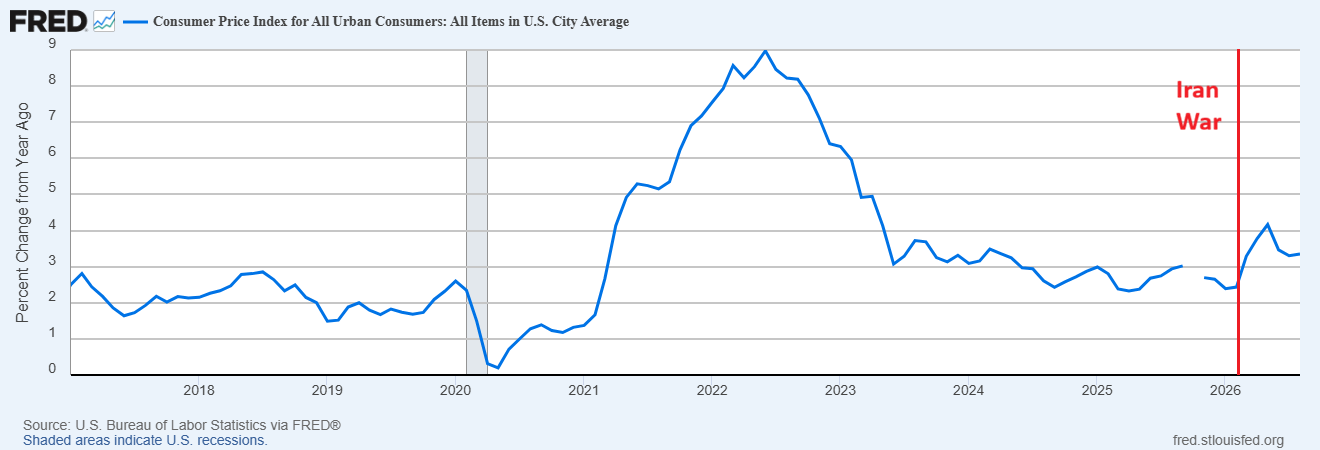
But Trump failed to fix the economy. Inflation under Trump hasn’t been as bad as it was in 2021-22, but it has remained at around 3%, compared to 2% in Trump’s first term. And since the Iran War started, inflation has accelerated:
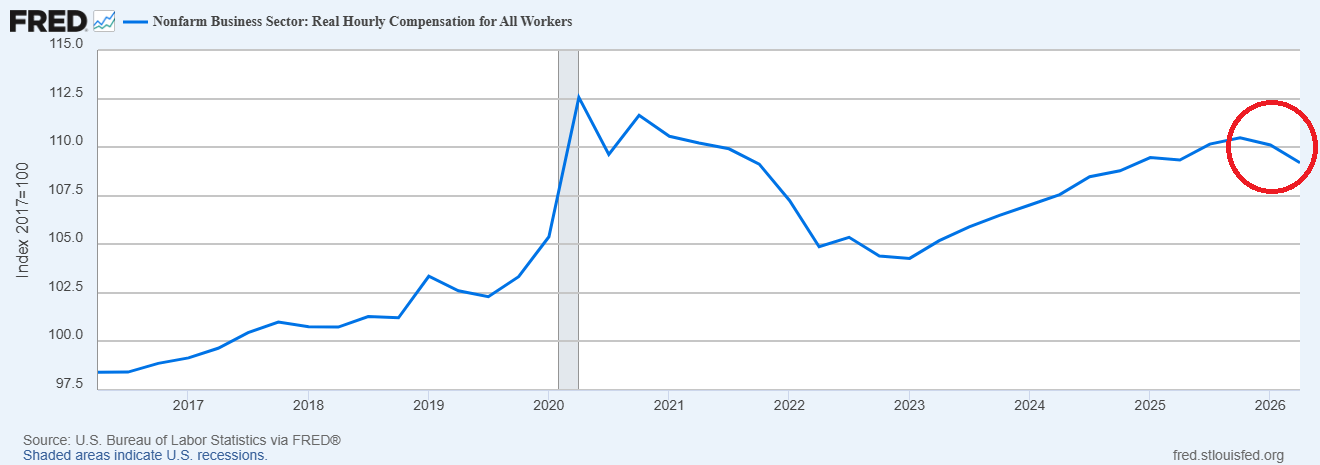
The surprise inflation has sent real wages back into decline for the first time since 2022, meaning that American workers are now getting poorer again:
Inflation has many causes, of course, and some of these are beyond Trump’s control — in particular, the massive AI investment boom that’s driving up prices for materials, electricity, and so on. But from the very start, Trump showed very clearly that he didn’t really care about bringing inflation down.
First, there were the tariffs. Everyone knows that tariffs raise prices for American consumers. Trump knows this too — when the price of beef rose earlier this year, Trump temporarily lowered tariffs in order to bring prices down.
Tariffs have defined Trump’s approach to economic policy during his second term. Although walkbacks, “deals”, court rulings, and plenty of exceptions have blunted the negative impact of tariffs, they’ve still raised prices somewhat:
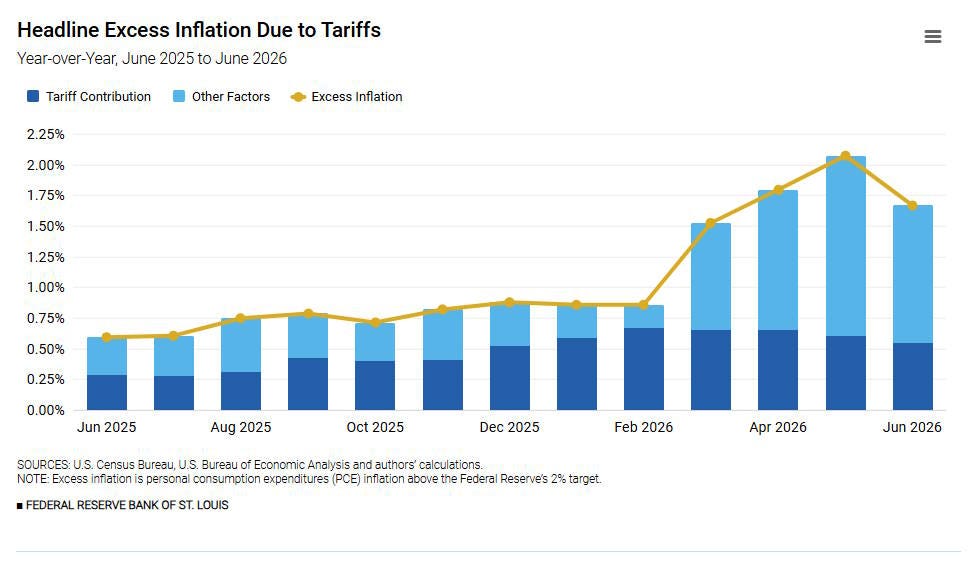
A 0.5% increase in inflation is not huge or catastrophic. But it sends a very clear signal that inflation isn’t Trump’s top priority.
Nor was it the only such signal. Trump let deficits rip, boosting spending even as he cut taxes. Americans may not instinctively think of deficits as inflationary (as many economics models do), but they understand exactly what it means when Trump says that higher inflation is helpful for paying off the debt:
[I]n a recent interview with Time…Trump also said something that will prick the ears of economists: "You know, inflation, certain levels of inflation, will also pay off that debt very rapidly. Very rapidly." [emphasis mine]
Intentionally running up debt and then using inflation to “pay off” the debt — which is actually a soft default rather than “paying” anything back — is the classic way that governments set off hyperinflationary spirals. So when Trump runs up the debt and then talks about inflating it away “very rapidly”, people know what that means. Even if an actual hyperinflation never happens, the fact that Trump was willing to prioritize handing out fiscal goodies over bringing down the cost of living probably makes an impression on at least some voters.
But of course Trump’s most inflationary move was the Iran War. In Trump’s first term, gas was $2.50 a gallon. When he took office it was around $3, but after Trump recklessly went to war with Iran, it shot up to over $4:
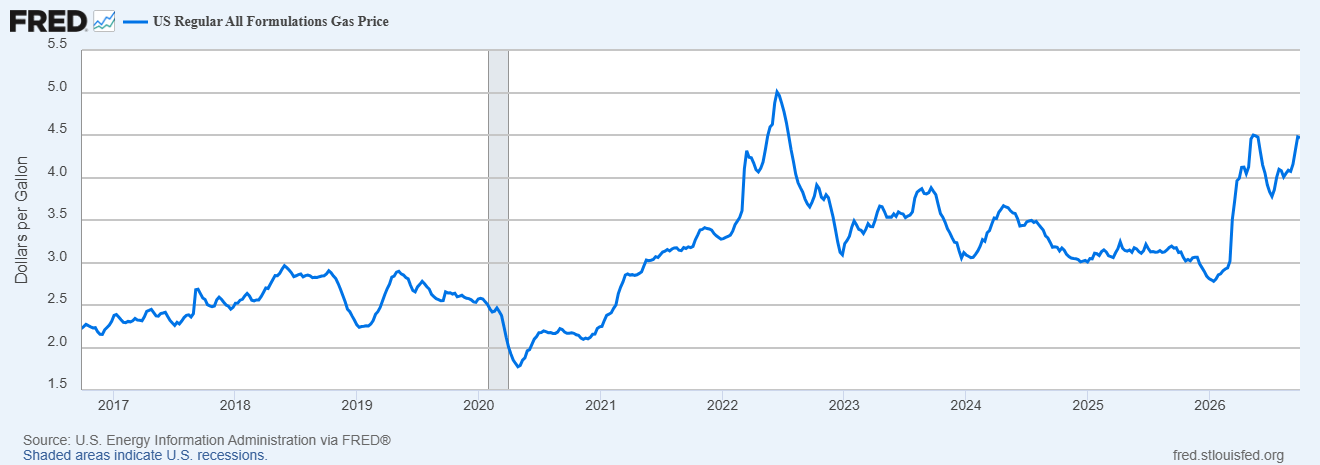
Expensive gasoline feeds through to the rest of the economy in plenty of ways, since gasoline is so important for transporting people and goods. So expensive gas is definitely feeding into the higher inflation we’ve seen in 2026. But there’s also evidence that Americans care about gas prices even more than they care about inflation in general. This is probably a big part of why the Iran War is the most unpopular war since Vietnam.
So time and again, Trump has shown that inflation is low on his list of priorities. He was elected to bring down inflation, and instead he willfully made it worse, through a combination of protectionism, fiscal profligacy, and military adventurism. No wonder inflation is the issue where Americans give Trump the lowest marks:
As they’ve realized that Trump has no intention to actually attack inflation, even Republicans’ economic mood has begun to sour:


Alternative measures of economic sentiment, which had held up much better than the standard University of Michigan numbers, have now also gone into steep decline.
America is tired of leaders who stoke racial division
The #2 issue that Americans wanted Trump to address was immigration — specifically, the flow of quasi-legal asylum seekers across the southern border. This has, in fact, been accomplished, with border encounters going from a quarter million per month to approximately zero almost the instant Trump took office:
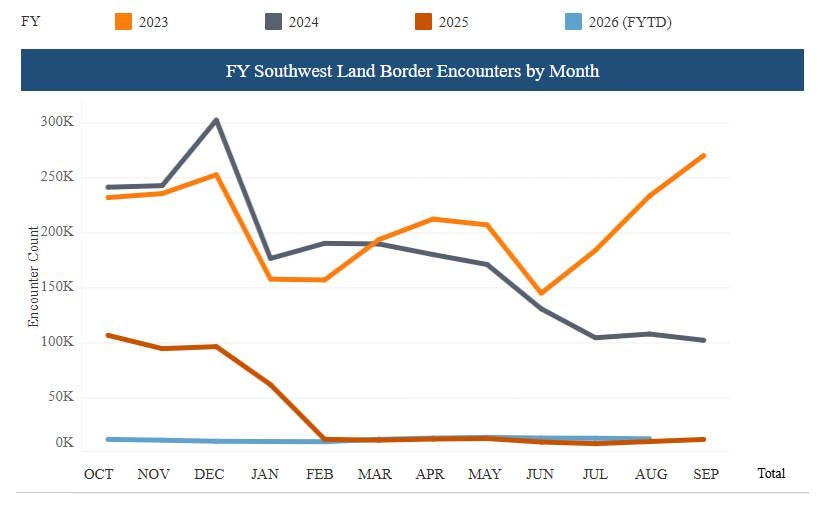
Trump could have taken this victory and called it a day. Instead, he decided to engage in a program of mass deportations. And instead of focusing on deporting illegal immigrants who committed crimes — as Barack Obama had done — he sent ICE to round up anyone they could find who might be in the country illegally.
Naturally, this involved a large element of racial profiling. ICE just ended up grabbing any Hispanic-looking person and demanding to see their papers. This has made many Hispanic voters realize that immigration enforcement isn’t just coming for the immigrants. Polls show that ICE’s overreach is a big reason that Hispanic voters are shifting back toward the Democrats this cycle, after trending Republican for years. Stories about Hispanics who regret having voted for Trump have become commonplace.
This is an enormous electoral own goal for the Trump movement. In 2024 it looked as if the GOP were succeeding in converting Hispanics to their cause, thus neutralizing the threat of the “emerging Democratic majority” that so many had feared. Without Hispanics on board, MAGA’s path to victory looks a lot more difficult:


But Trump’s missteps on immigration have gone far beyond what ICE is doing in the streets. It has become abundantly clear that MAGA sees immigration policy through a fundamentally racial lens. Trump has promised to stop all immigration from “third world” countries, even as he hurries to roll out the welcome mat for white South African refugees. JD Vance has spoken about his desire to cut off legal immigration. And the Trump administration has put gigantic fees on H-1B visas, making these much harder to obtain.
Trump’s crusade against H-1Bs, despite strong Republican support for higher levels of skilled immigration, is especially telling. These visas have become identified with Indian immigration, and the GOP base has rapidly become more openly racist against Indians specifically:


Scholars from the Manhattan Institute — hardly the most racially oriented of the conservative think tanks — are now releasing podcast episodes on “The Indian Question”:
The American public doesn’t like this sort of thing. After Texas Railroad Commissioner candidate Bo French denounced the presence of Indian American fans at a UT Austin football game, polls showed a strong negative reaction among regular Texans:
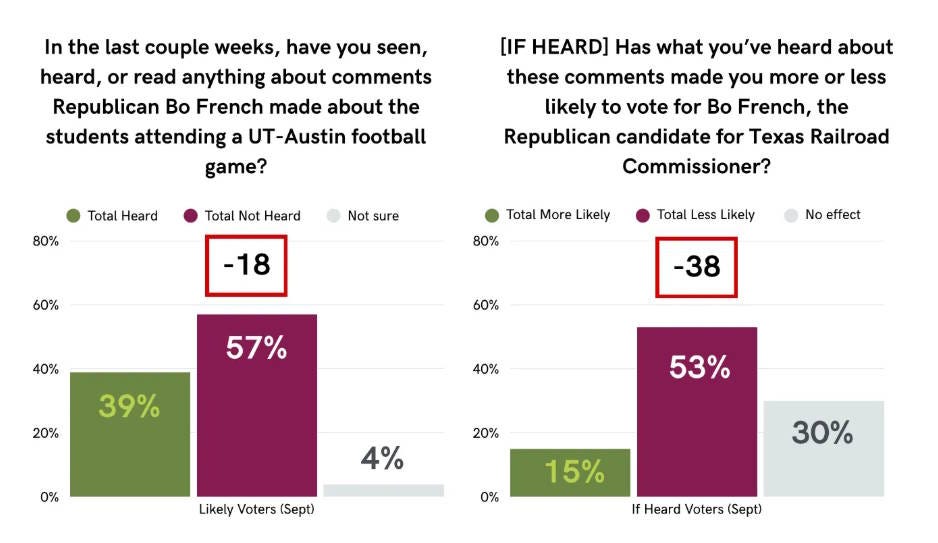
The combination of rampant racial profiling of Hispanics and pure animus toward Indians leaves no doubt about what Trump’s anti-immigration campaign is all about. It is a campaign to racially re-engineer the American populace. Karl Rove, hardly anyone’s idea of a screechy woke progressive, now says the GOP is being taken over by “Nazis”.
It’s hard to say how much the GOP’s turn toward race war has hurt its electoral chances. But it’s notable that in Trump’s first term, his decline in popularity set in after the Unite the Right rally. A decade ago, Americans really disliked racism and were inclined to punish it in the polls.
Between then and now, progressives massively overreached on race. They embraced explicit racial discrimination in hiring, promotion, and every other walk of life, in defiance of the Civil Rights Act of 1964, and often of the 14th Amendment. Endless discussions of race, with guilt and “privilege” assigned collectively instead of to individuals, became standard in progressive circles.
Americans punished the Democrats in 2024 for their extreme views on race. That gave an opening to elements of the Right who wanted to prosecute their own race wars on the stage of American politics. But Americans didn’t simply oppose the leftist version of racial struggle — they oppose all such divisive efforts, and want to be treated as individuals. They don’t want to simply trade one set of race warriors for a different set — but they’re quickly waking up to the reality that this is exactly what they did in 2024.
Corruption is starting to break through to the public consciousness
In general, anger at inflation and the Iran War is the most important reason Trump’s presidency is being rejected, and souring on his approach to immigration is probably #2. His rightist foreign policy, anti-vaccine policies, and general authoritarian overreach are probably smaller factors, but contribute to the general impression of a failed presidency.
But there’s one more issue that I haven’t seen much polling on, that I suspect might be contributing to Trump’s loss of popularity: corruption.
By any reasonable reckoning, Donald Trump is by far the most corrupt president in U.S. history. Here’s a good summary of all the main ways that Trump has used the office of the presidency to increase his personal fortune — rampant insider trading, misuse of personal property for government functions, giving government contracts to his relatives, giving his own companies lucrative foreign deals, and so on. But all you really have to do is look at a chart of Trump’s personal wealth, which has increased by $5 billion since he returned to the presidency:
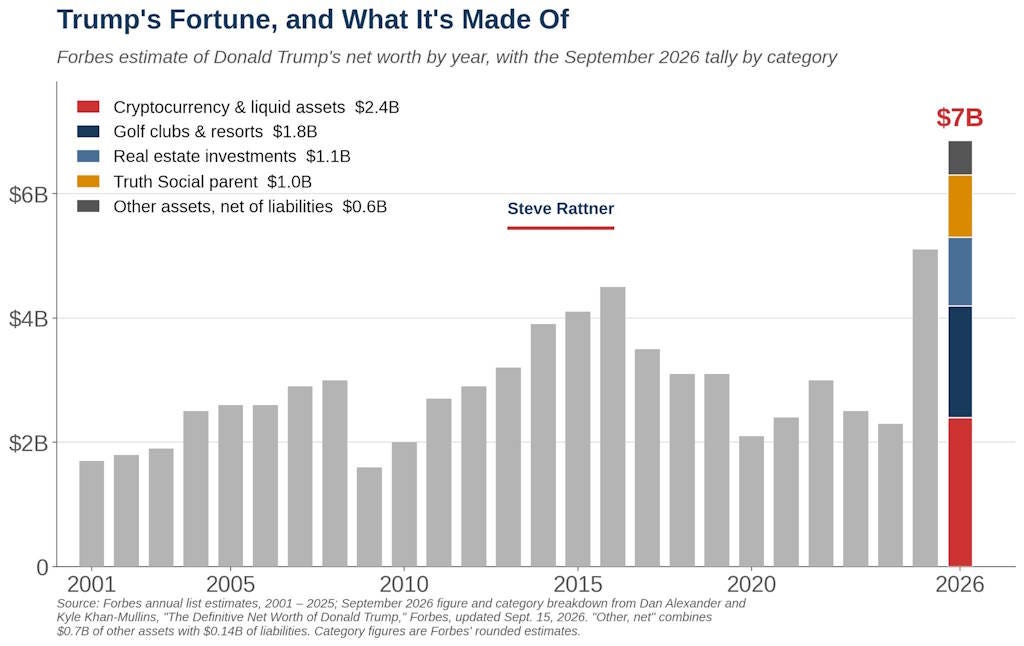
Note the giant red “cryptocurrency and liquid assets” bar at the bottom of that huge pile of ill-gotten gains. As I warned last year, crypto has become the perfect vehicle for corruption — people can essentially bribe Trump by buying his memecoins.


And Trump can also use the crypto system as an unregulated, unmonitored shadow financial system to hide all sorts of shady goings-on:

I had been pretty pessimistic about all of this breaking through to the public consciousness. Americans are constantly being bombarded with allegations of corruption — Hillary and Bill Clinton were both prime targets, as was Nancy Pelosi. My default assumption was that this had made the populace so numb — so used to either believing all of those allegations or tuning them out entirely — that they would ignore real, massive corruption when it came along.
But perhaps I was wrong. Perhaps Americans are starting to wake up:
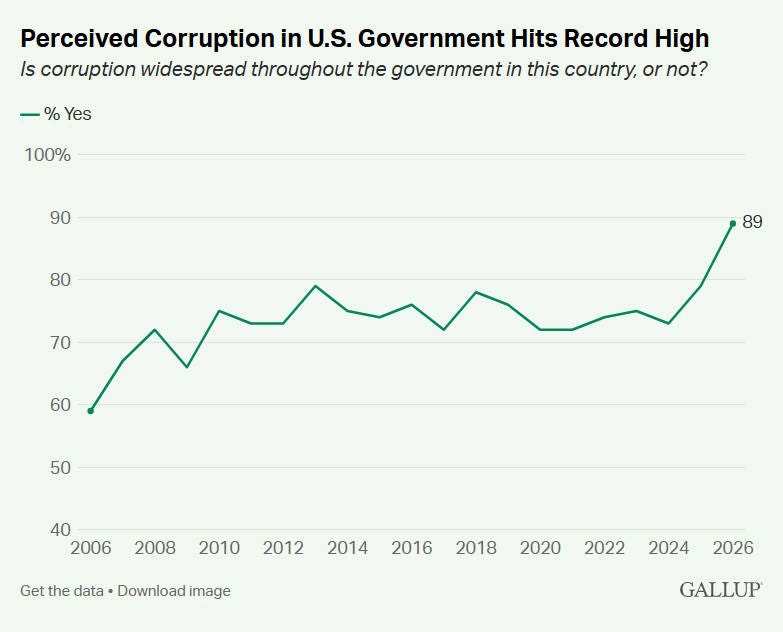
It’s not inconceivable that this is another reason America is turning away from MAGA and the GOP.
Of course, seen in this light, calling Trump’s presidency a “failure” might be a bit of a misnomer. He’s failed the country and failed his party. But perhaps he was never very interested in doing right by either one. If Trump’s purpose was always just to make himself rich and powerful, his presidency has been a spectacular success. Maybe that’s all it was ever about.
Most of us on these pages are not Trump supporters. Anyone who considered voting for Harris had to ask whether continuing the Biden Administration for another four years would be good for them.
A slim majority of voters chose not to have the Biden Presidency continue. Many who voted for Trump were thinking they were going to get Trump’s first term. Whatever historians end up saying about Trump’s second term, I think we can say it has been nothing like his first term.
Trump’s kakistocracy seems more about enriching themselves, either metaphorically, as Pete Hegseth puffs himself up with push-ups, or literally, as Howard Lutnick’s wealth has risen. Remember, Lutnick’s kids and Trump’s kids have their names all over their crypto company.
Americans do not believe Canada is a threat to America. They are not as giddy about Trump’s renovations as his are and likely see it for what it is: a vanity project.
I agree with everything Noah has stated; as a conservative, I am a politically homeless voter. I often get stuck with awful choices, so I have to make a decision. Do I stick with my current Representative, a Republican, or vote for the lefty progressive Democrat with really dumb ideas?
Who is more dangerous, more damaging? This is not easy. My compliant Republican is not standing up for Conservative principles. He has no clue what Chesterton’s Fence is, and if he is he does nothing about it. If he is a conservative but is too worried about a Primary challenge to speak out, he is a political coward and not worthy of the position.
I want MAGA to enter the dustbin of history. It is dangerous, damaging, and deeply harmful to America and Americans. There is no making America white again. That boat sailed; Noah is spot on regarding Hispanics. They were a lifeline for the GOP, and Trump, with Stephen Miller, has pushed them away from the GOP for a very long time.
Trump and MAGA are more dangerous to the nation than any woke or socialist stupidity. If I end up voting for the lefty progressive despite her positions, I might have a stroke as I pull the lever.
One thing Trump still has going for him is the political ignorance of the majority of American voters. In our Substack bubble we know all the points made here but so so many folks have no interest in a diverse information stream. ( look at how many Texans had not heard of the remarks about the UT crowd) How many folks understand the crypto schemes, the deficit, etc? It is kind of fortunate for the long term stability of the nation that gas is high - most folks see that.