

With the end of the post-WW2 global order, every great power is now effectively a rogue state. Russia is trying (and failing) to reestablish its old empire. China is menacing its neighbors and funding aggressive proxies around the globe. But for sheer wackiness and chaos, it’s hard to beat the United States under Donald Trump. First it was tariffs and threats to invade Greenland. Now the Iran War is causing a global energy crisis.
Militarily, the U.S. has pretty much had its way with Iran, destroying their missile launchers, killing their leadership, and achieving air supremacy with extremely few losses. But Iran has done the one thing that everyone — except, apparently, Donald Trump and his leadership team — had always expected them to do in a major war with the U.S. They have closed the Strait of Hormuz, through which about 20-25% of all global oil and liquefied natural gas flows. Iranian forces have attacked and damaged a large number of ships, causing ships to avoid the strait.
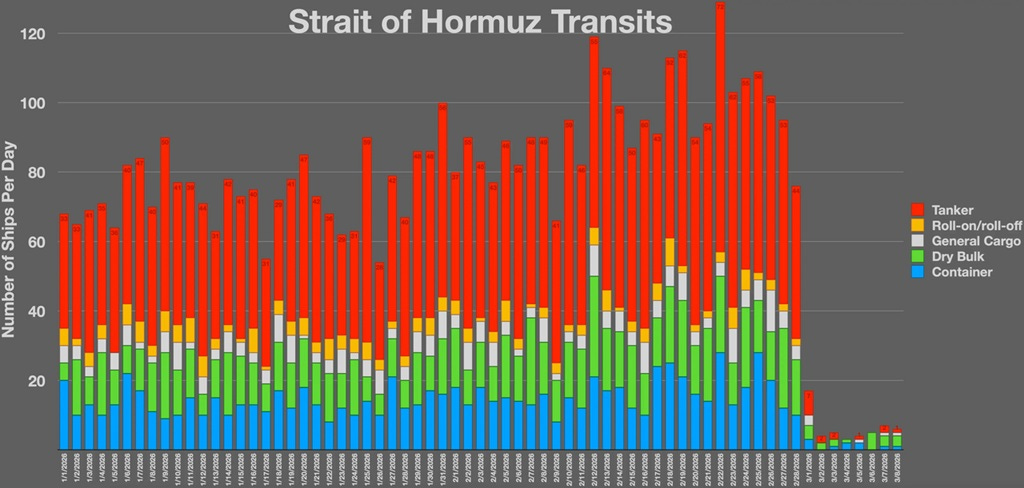

Demand for oil and LNG is inelastic. That means when you cut off some of the supply, price shoots way up. Here are oil prices:
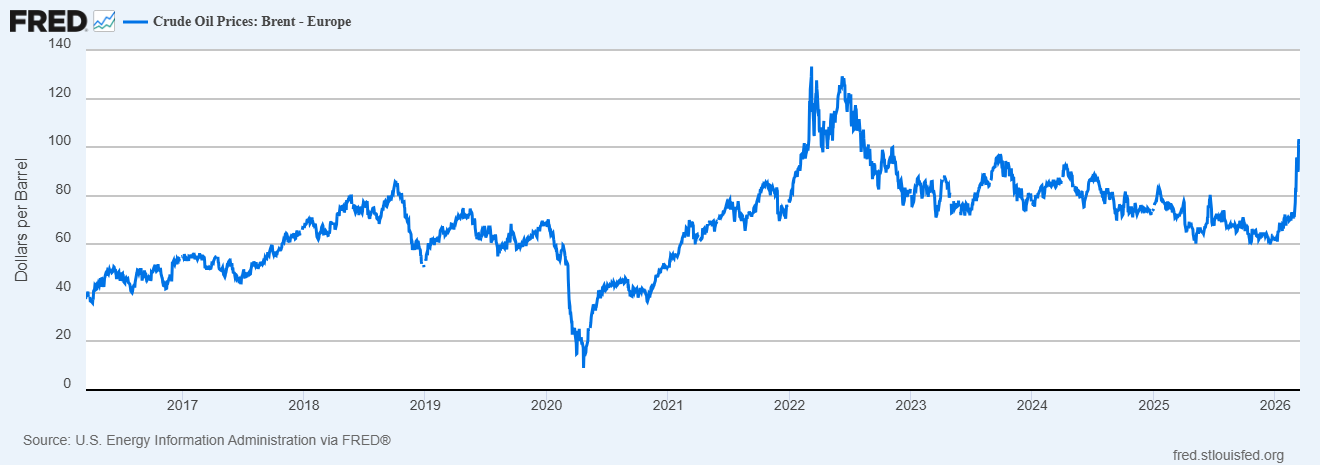
It’s not clear whether this is actually the biggest oil disruption in history, but it’s up there. And unless Trump chickens out and calls off the war very soon, the disruption is likely to continue for some time.
Natural gas prices in Asia (which imports much of its gas as LNG) have also gone way up, due to the strait closure, and to Iran’s attacks on Qatar’s LNG infrastructure.
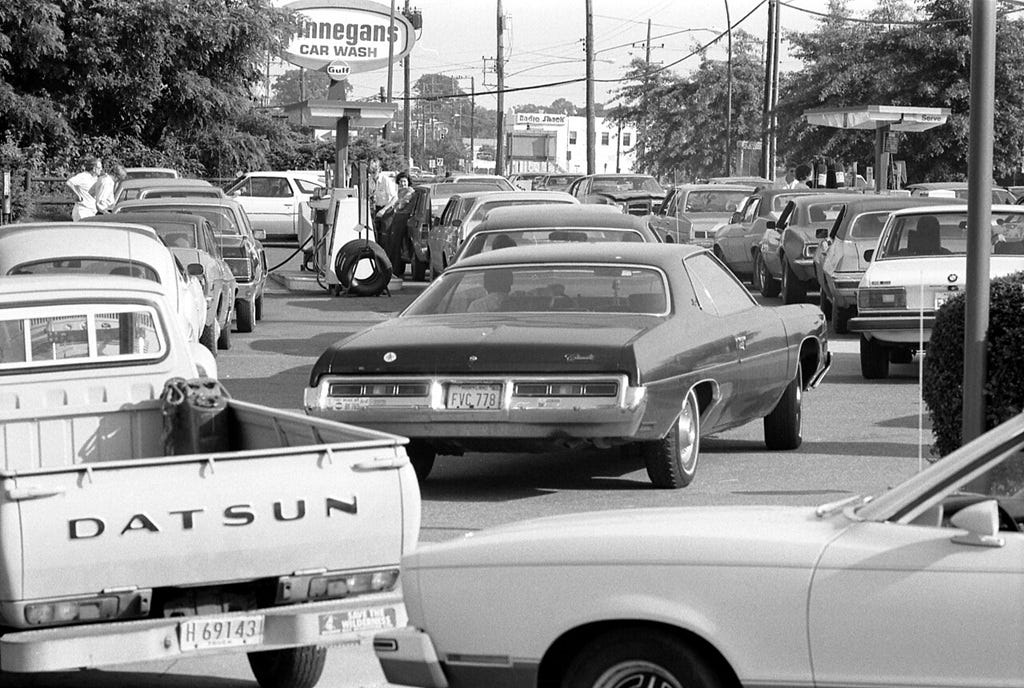
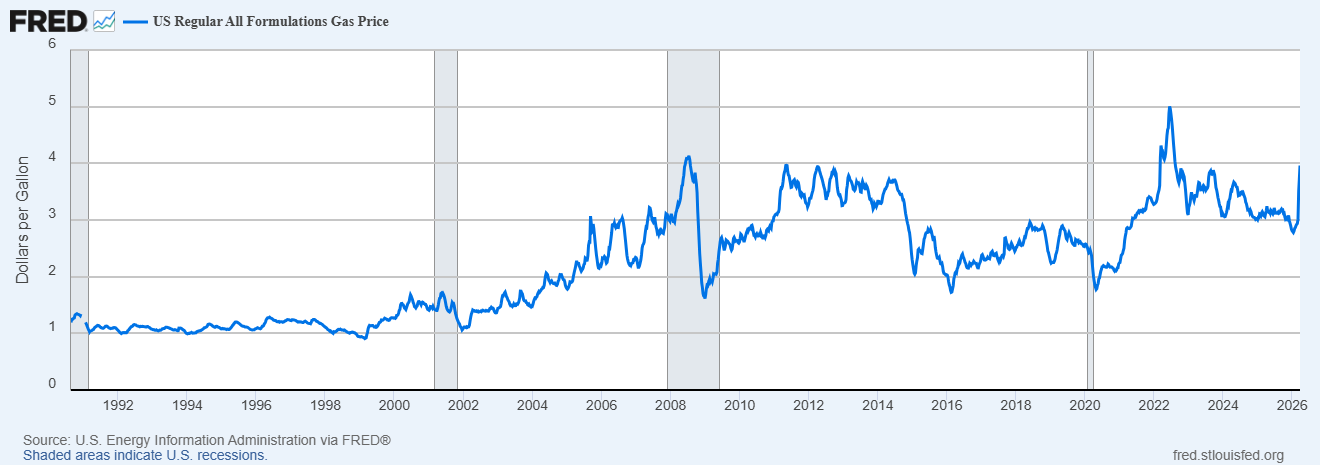
When oil prices go up, gasoline prices go up too. Gas in the U.S. (meaning gasoline, not natural gas) is now back to $4 a gallon, about as high as it’s ever been1 other than right after the start of the Ukraine war:
But Americans actually have it easy compared to much of the world, where fuel shortages are escalating. Asia, which gets most of the oil and gas that pass through the Strait of Hormuz, is being hardest hit:
Arguably, nowhere has felt it more than Asia: nearly 90% of the oil and gas passing through the strait is bound for Asian countries…Governments have ordered employees to work from home, cut the working week, declared national holidays and closed universities early in order to conserve their supplies…Even China - which is thought to have reserves equivalent to three months of imports - is making adjustments, limiting a fuel price hike as citizens are faced with a 20% jump in price.
In India, people are panicking over fuel shortages, and long fuel lines are springing up across the country. The Philippines has declared a national emergency, and is considering grounding flights. Australia is considering rationing fuel throughout the country.
On the geopolitical front, this seems unlikely to lead to much international goodwill toward the United States. Iran was not a friendly or peaceful regime by any means, but America attacked and decapitated it without immediate provocation, seemingly with no good long-term plan or exit strategy — and now other countries around the world are bearing the brunt of Trump’s mercurial violence. This all makes America seem like a dangerous loose cannon — a powerful country flailing around, applying its power whimsically and indiscriminately and leaving others to suffer the consequences.
But what will be the economic ramifications? Despite the drama, the damage is likely to be modest rather than catastrophic.
Economists have been studying the impact of energy shocks for a long time. As you can imagine, this was a big topic in the 1970s, when there were two big oil shocks — one related to the Yom Kippur War and the OPEC oil embargo in 1973, and the second after the Iranian revolution in 1979. Those shocks are often blamed for the 1970s “stagflation” — low growth, high unemployment, and high inflation.
In fact, after the recent post-pandemic inflation, Larry Summers posted a chart predicting a resurgence of inflation, based on little more than pattern-matching:
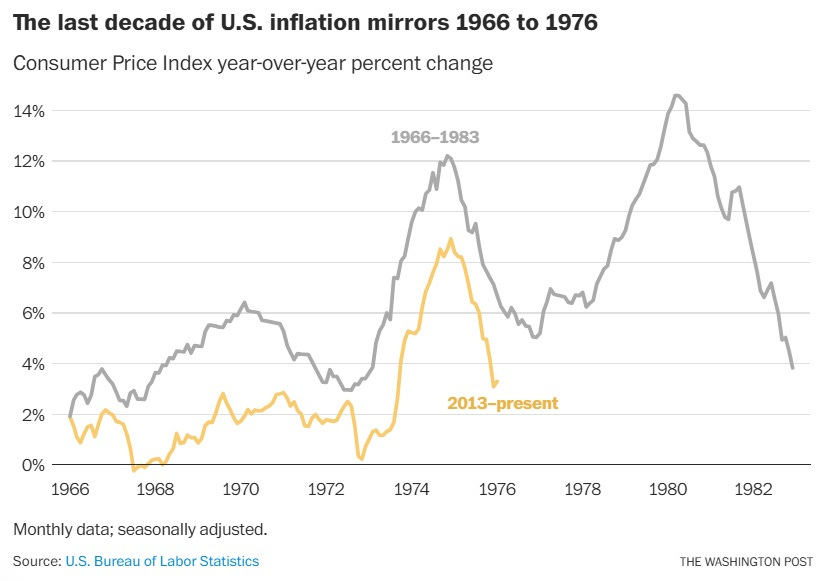
A lot of people laughed at this chart when it came out, but it would be darkly ironic if history actually ended up repeating itself due to another oil disruption from Iran.
I have my doubts that anything like this will happen, though. For one thing, some economists, like my econometrics teacher Lutz Killian, vigorously dispute this narrative, and claim that the 70s inflation wasn’t caused by oil at all. But regardless of who’s right about the 1970s, it looks like modern economies are just more resilient to disruptions in oil supplies.
Blanchard and Gali (2007) looked at economic responses to changes in oil prices in the U.S.,2 and concluded that the economy of the 2000s was only about a third to half as sensitive to the price of oil as the economy of the 1970s had been. Their reasoning is that modern economies are more flexible in general, that they have better monetary policy (i.e. we don’t try to print a ton of money in response to a supply shock), and that we depend on oil less.
By their estimates, a 10% increase in the price of oil now (or at least, if “the 2000s” means “now”) leads to only a 0.25 percentage point increase in the CPI and a 0.3 percentage point reduction in GDP over the course of a year or so. Since oil just spiked by 50%, then if that’s sustained, we might expect to see inflation go up by 1.25 percentage points, and GDP go down by 1.5 percentage points over the next year. That would mean inflation would go to around 4% and GDP growth might go down to 1.5% — frustrating and annoying, but not catastrophic.
Other estimates seem similarly modest. For example, in a recent roundup, I flagged a paper by Känzig and Raghavan (2025) that looked at the closure of key shipping chokepoints. Here was their chart showing the predicted response to a 10% increase in shipping costs caused by the closure of a key waterway:
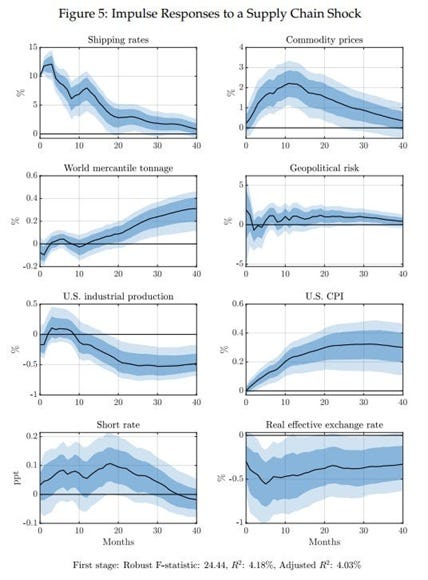
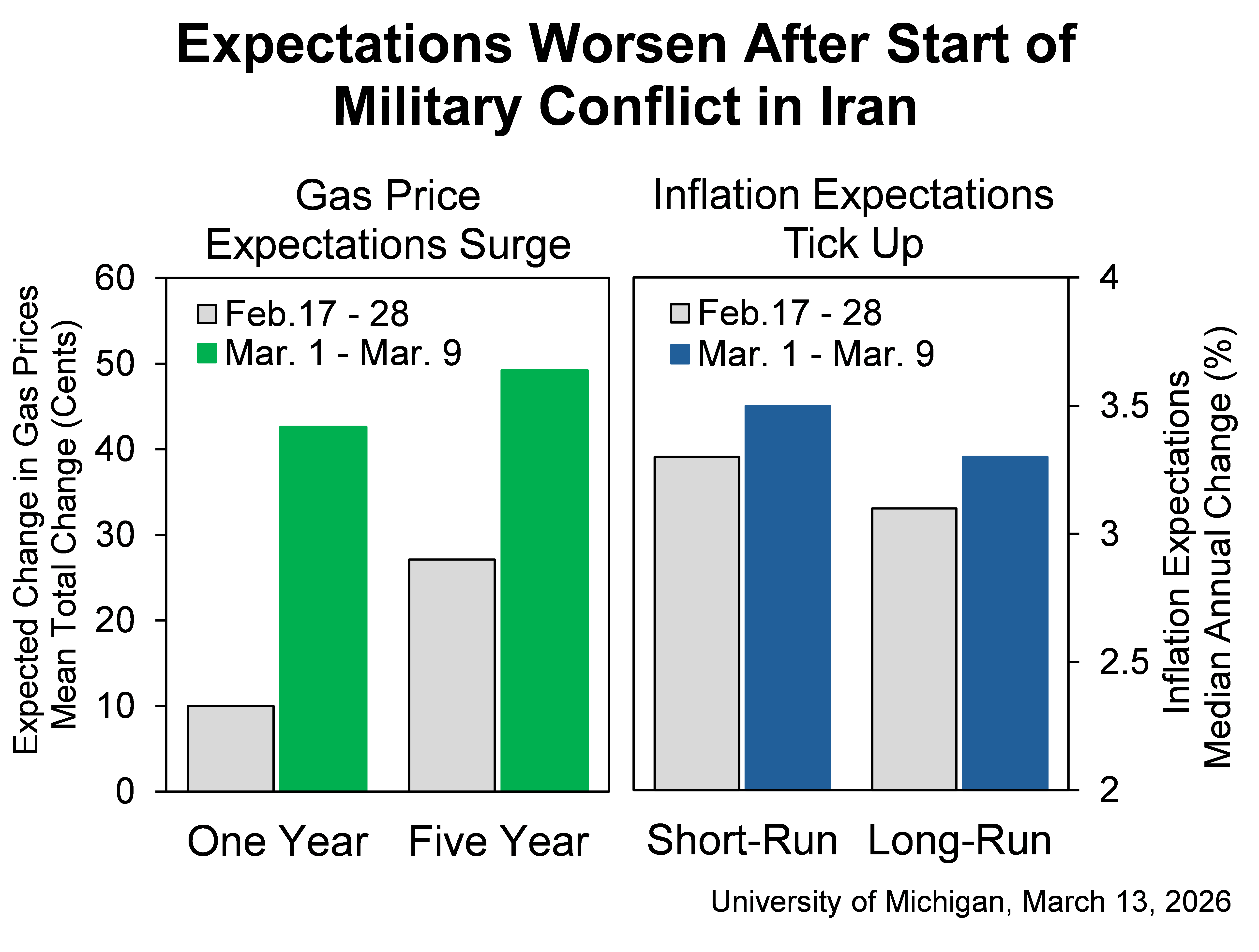
Now note that shipping costs haven’t even increased since the start of the Iran war. That implies relatively little shock from shipping disruption. Inflation expectations have risen only a tiny bit in survey measures, and market measures so far show no expected increase in inflation over the next one or two years.
So if you were worried that the Iran war was going to collapse the economy, I think you can relax. 4% inflation and growth cut in half for a year are no fun, but they’re not a calamity either.
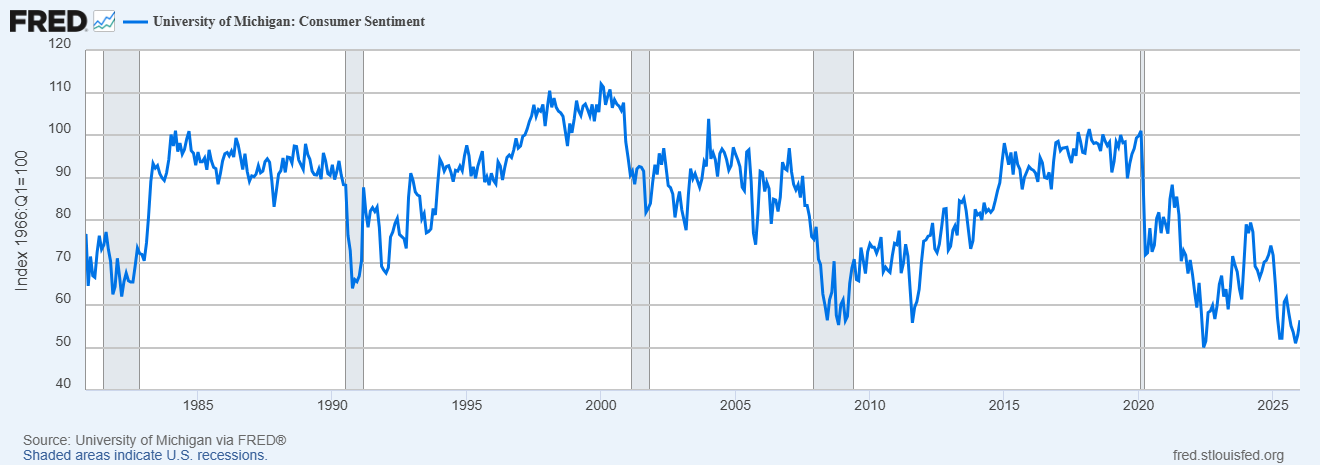
That said, there are several reasons to worry a bit. First of all, 4% inflation and growth cut in half feel like a self-inflicted wound — another self-inflicted wound, after the madness of tariffs. Americans are already in an incredibly bad mood about the economy. Consumer sentiment is absolutely in the dumps:
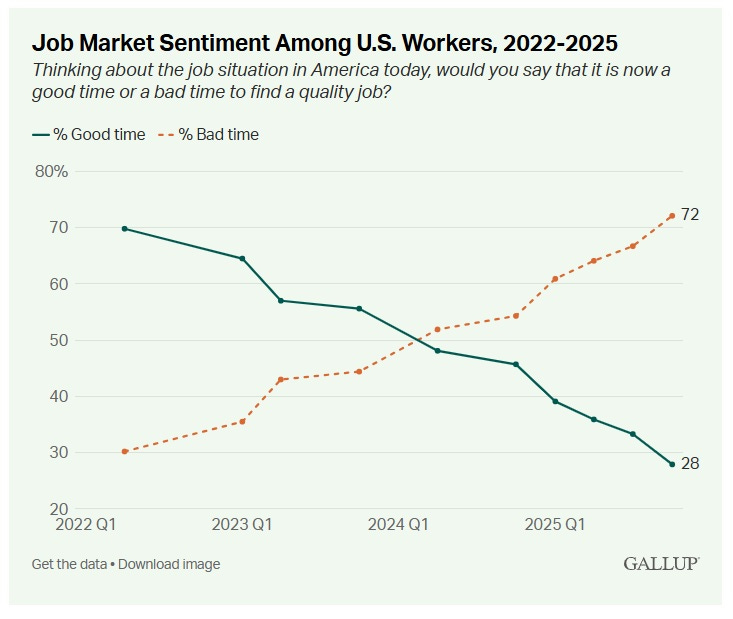
And people say it’s a bad time to find a job:
The negative trend began in the Biden years, and voters definitely blamed Biden at the time. But now they’re blaming Trump, and it’s clear that the Iran war made approval of Trump’s economic policy fall off a cliff:
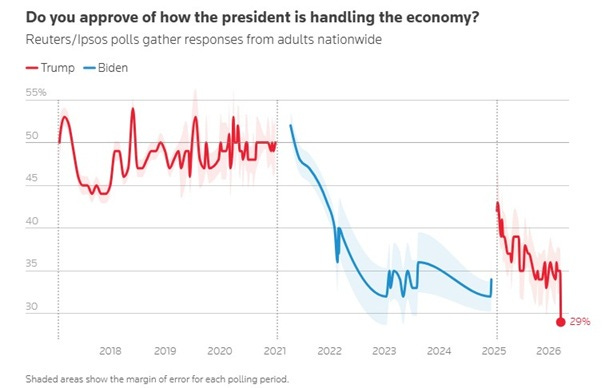
Even if some of this is AI-related, it seems clear that voters don’t like Trump piling self-inflicted wounds on top of all the underlying risks.
Americans also expect gasoline prices to stay high over the next few years. Political scientists have found that the American public tends to be especially sensitive to gasoline prices, even above and beyond general inflation. So more expensive gas could absolutely cause a further souring of the mood in this country.
(Note, by the way, that “Trump’s approval rating goes down” is not bad in and of itself — in fact, I’m glad more people are finally waking up to what a horrible leader Trump is. But I do not want Americans to feel sad and angry and afraid about their economy. It’s not worth wishing for bad things to happen just so there will be a backlash against politicians I don’t like.)
Also, it’s worth remembering that the U.S. isn’t the only country that matters. Kilian and Zhou (2023) find that Europe and the UK tend to experience much more of a bump in inflation from oil price shocks than the U.S. or Japan. And there are plenty of papers that find a strong link between global energy prices and local food prices in poor countries like Pakistan, Uganda, and others.
In other words, even if the U.S. escapes relatively unscathed from its ill-planned war of choice in Iran, its allies, and vulnerable poor people around the world, may feel a lot more pain. Not that the Trump administration has shown much inclination to care about allies or the global poor, of course.
That will simply reinforce the notion of America as a force for chaos — a bully who jumps in, smashes things up, and leaves others to deal with the consequences. It will be very hard to shake that reputation, even after Trump is out of office. Meanwhile, Americans themselves are getting angrier and angrier, even if the actual harms they’re suffering are more mild.
So the Iran war will not be a catastrophe, but it’s still bad news for the economy. And that pain is unlikely to come with any geostrategic gains, either — Trump is probably not going to be able to destroy Iran’s nuclear program with airstrikes, and the Iranian regime doesn’t seem in danger of collapsing. So it’s worth asking why we’re doing this war at all. The answers won’t be flattering for Trump, and they won’t be pleasant for his fans to hear.
If we measure gasoline prices relative to incomes, it won’t be as high as in the early 2010s, because incomes have gone up since then. But it’s still a big spike!
This requires the assumption that oil prices move due to supply-related factors — rather than to changes in economic conditions, which would give rise to reverse causality.
It would be deeply ironic if Trump's Iran war moves up the worldwide time table to full electrification by 2-3 years. Someone should look at the amount of electric vehicles sold in March vs. February.
Politicians always try to sell us the story that America is just the world's reluctant peacekeeper, only fighting when we absolutely have to. But if you look at our actual track record—from Vietnam to Iraq—it’s pretty obvious that's a lie. Leaders in Washington are just really good at making power grabs sound like noble fights for human rights, all while our wars end up killing hundreds of thousands of innocent, everyday people in the name of "freedom." The mendacity occurs regardless of which administration we have, imperial ambitions never die, only the people we purport to save. Poorer countries will suffer from our actions and for what, an illusion. There are no nukes in Iran there were no WMDs in Iraq and there was no domino that fell after Vietnam. When you stop and look at the sheer amount of death left behind, you realize our foreign policy isn't really about being the good guys; it's mostly just a giant machine that inflicts a massive amount of suffering to get what it wants.