



This roundup is in honor of Chris Sims, the extremely influential macroeconomist, who has just passed away. Item #4 even features some evidence for the Fiscal Theory of the Price Level, which he helped develop.
But first, podcasts. I went on the Members of Technical Staff Podcast with Jayden Clark to talk about the politics of the tech industry, and we ended up talking about a ton of fun stuff:
Anyway, on to the roundup. Before we get to the macro stuff, let’s talk about one of America’s worst public intellectuals…and a little about AI.
1. Paul Ehrlich was bad
Paul Ehrlich, the author of The Population Bomb and a relentless advocate for population control, has died. One general rule of punditry is supposed to be that you don’t speak ill of the dead. But on the other hand, what if the dead had some really, really bad ideas?
We all know the story of why Ehrlich was wrong. He predicted that the world would run out of food, producing catastrophic famines in the 1970s. Based on those predictions, he called for things like cutting off emergency food aid to India, reasoning that if people were saved from starvation today, it would just mean more people to die of starvation later on. But new farming techniques known as the Green Revolution created enough calories to feed the whole world with plenty to spare. The Population Bomb came out in 1968; by then, famines were essentially already a thing of the past:
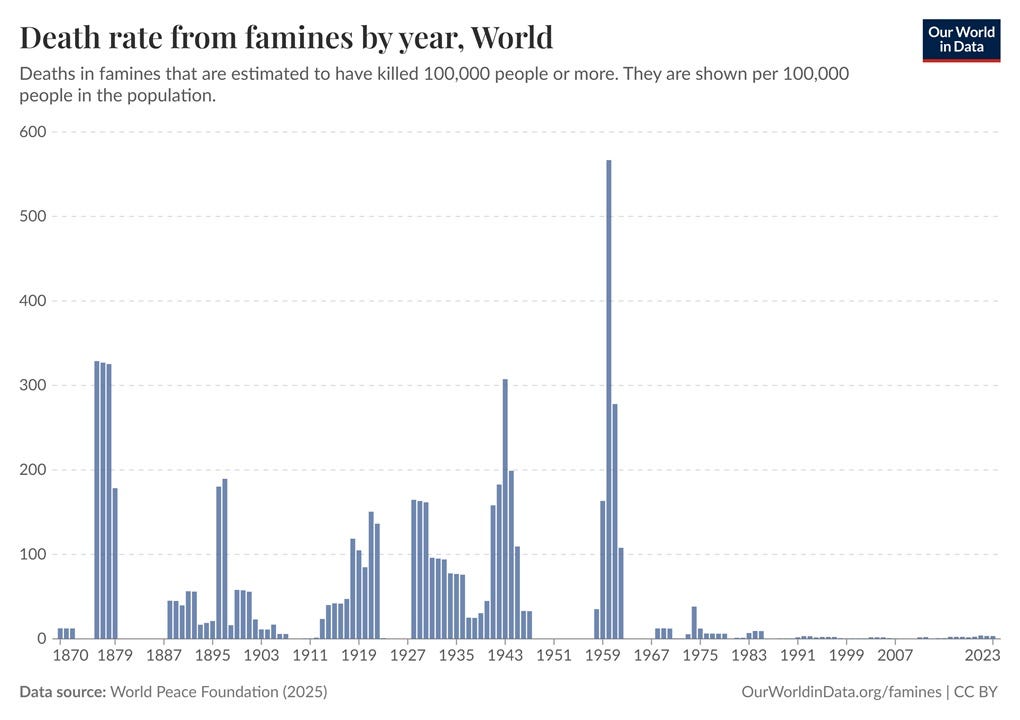
And fertility rates fell without the kind of draconian, dystopian population controls that Ehrlich constantly called for. The main country that listened to Ehrlich was China, and their One-Child Policy turned out to be quite unnecessary for reducing fertility rates — as well as being totalitarian, cruel, and dystopian.
What people don’t know about Ehrlich is how relentlessly he kept promoting his ideas and haughtily dismissing his critics, even after it had become clear that he had been completely wrong. A man who had endorsed nightmare policies in service to a broken theory simply never reckoned with this monumental failure, and continued to self-aggrandize and to evangelize for his old mistakes.
And in fact, Ehrlich’s bad ideas have survived and even thrived, in the form of the “degrowth” movement that’s popular in the UK and parts of Europe. Today’s degrowthers call for immiserating the developed-world middle class instead of starving India to death and throwing people in prison for having too many kids, which I suppose is an improvement. Still, the idea is fundamentally based on the same old fallacies that Ehrlich never stopped pushing — that humanity has overstepped its bounds and must be forcibly diminished.
2. A Grossman-Stiglitz Paradox for AI
One of the most interesting results in theoretical economics is the Grossman-Stiglitz Paradox.
Have you ever heard of the Efficient Market Hypothesis — the idea that financial market prices already incorporate all available information about the value of the underlying assets? Well, in 1980, Sanford Grossman and Joseph Stiglitz showed why the EMH can’t be quite right. The idea is pretty simple: It takes effort to find information. Who is going to go out and spend the effort to find out information about what stocks or bonds or houses are really worth, if they can’t make money trading on that information? And if no one spends the effort to find the information, how can it ever be incorporated into the price in the first place? Grossman and Stiglitz concluded that financial markets must be at least somewhat inefficient.
Now, Daron Acemoglu, Dingwen Kong and Asuman Ozdaglar have posited a similar problem for AI. I’m usually not a fan of Acemoglu’s papers on AI, but I think this one gets to an important and fundamental insight.
Acemoglu et al. write that if generative AI put all the information of the world at people’s fingertips, then people will have no incentive to go out and learn new things, which will then prevent them from accidentally finding new knowledge to add to the world’s total knowledge base:
We study how generative AI, and in particular agentic AI, shapes human learning incentives and the long-run evolution of society’s information ecosystem…Learning exhibits economies of scope: costly human effort jointly produces a private signal about their own context and a “thin” public signal that accumulates into the community’s stock of general knowledge, generating a learning externality. Agentic AI delivers…recommendations that substitute for human effort…[W]hile agentic AI can improve contemporaneous decision quality, it can also erode learning incentives that sustain long-run collective knowledge…[T]he economy can tip into a knowledge-collapse steady state in which general knowledge vanishes ultimately, despite high-quality personalized advice.
Basically, Acemoglu et al. posit that humanity as a whole learns new things when individual humans try to reinvent the wheel — to discover things on their own instead of just looking them up. This wastes a lot of effort, but it also adds to the overall knowledge base.
The idea here is that AI makes everyone really lazy — instead of trying to write a piece of code from scratch, or prove a math theorem from scratch, or figure out some piece of knowledge for yourself, you just ask AI to do it all for you. So everyone ends up getting the right answers to questions whose answers are already known, so they don’t end up adding anything new. It’s the Grossman-Stiglitz Paradox, but for everything.
In fact, you can sort of see hints of this happening already. Website traffic is collapsing, as people read AI instead of websites. Tech publications, for example, are rapidly losing their readership:
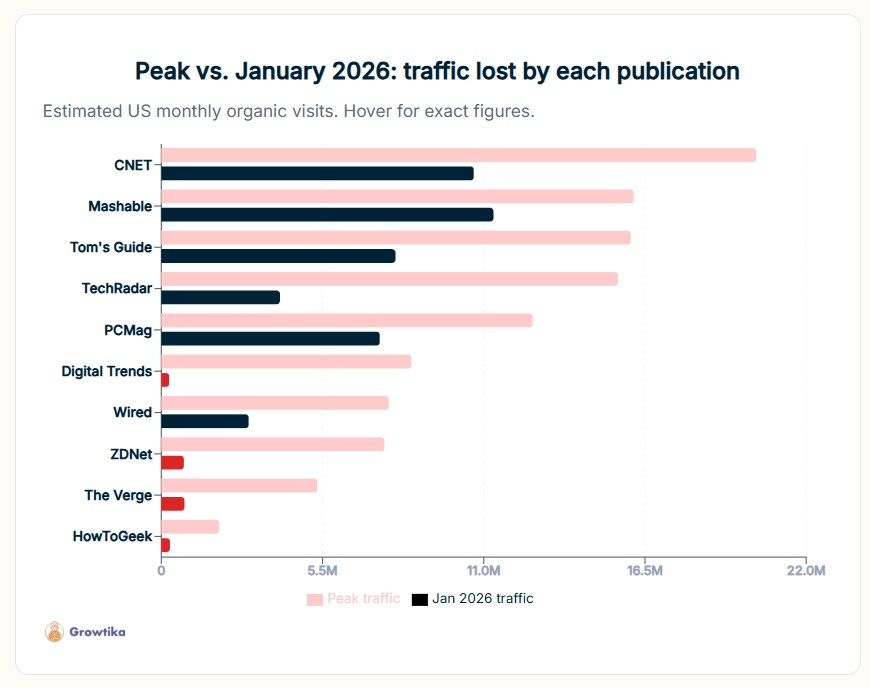
And using AI to code causes programmers’ skills to atrophy.
My first observation here is that this also applies not just to AI, but to the internet itself. Yes, people can ask an LLM to teach them about math or write some code for them. But they could also ask Math Exchange and Stack Exchange, even before LLMs existed. And the same problem arises — if all of the world’s knowledge is there at your fingertips, there’s no reason to waste your time reinventing the wheel. But as Neal Stephenson wrote as far back as 2011, this can lead to a lack of novelty, as everyone just copies what’s been done before.
And this leads me to my second thought: What if AI can also produce new knowledge? AI, after all, is prone to hallucination — i.e., random errors. If agents are out there randomly trying the wrong thing, occasionally they’ll discover something new. If there’s a way for those accidental discoveries to get incorporated into the general body of AI knowledge, then perhaps AI can grow the total knowledge stock instead of shrinking it. All that’s needed is to stop forcing humans to be the sole long-term repository of knowledge. How to do that, of course, I don’t know.
3. What will result from the Strait of Hormuz being closed?
The Iran War is making everyone afraid to go through the Strait of Hormuz — the key maritime choke point that a significant part of the world’s oil must pass through in order to reach the world market. Iranian strikes and mines have effectively closed the strait, and European countries are refusing to help America reopen it (which is perhaps only natural, given Trump’s threats to seize Greenland from Europe, and his withdrawal of aid from the Ukraine war). As a result, oil prices have skyrocketed:
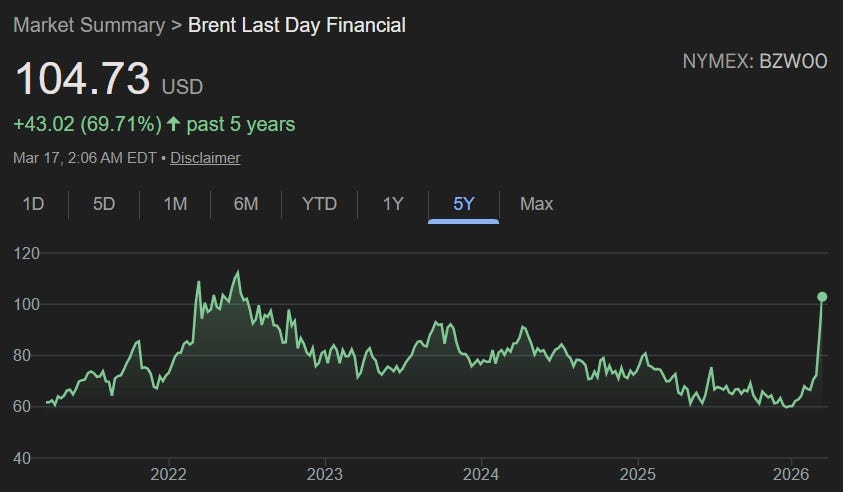
What will be the economic result? Fortunately, this is one of the rare areas where macroeconomists are actually able to make some predictions. Closure of key shipping routes is a thing that occasionally happens, and when it happens we can look at the short-term results and get a pretty clean picture of the effect.
That’s what Diego Känzig and Ramya Raghavan did last year in a paper entitled “The Macroeconomic Effects of Supply Chain Shocks: Evidence from Global Shipping Disruptions”. Basically, they look at similar incidents in the past, and try to quantify the economy’s average response. Here’s the picture they come up with:
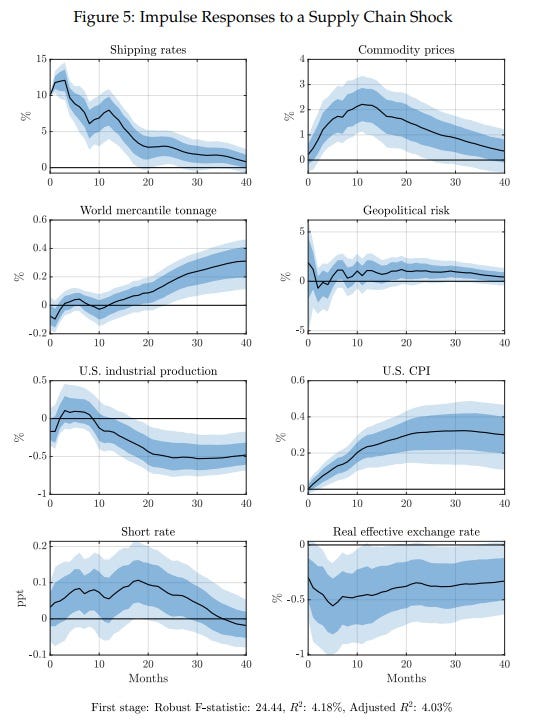
Basically, commodity prices (e.g. oil) go up, inflation goes up as a result, and U.S. industrial production suffers.
Can we expect the same thing to happen this time? Maybe. One big change from the past is that thanks to the shale oil boom, the U.S. is now a net oil exporter, rather than a net importer:
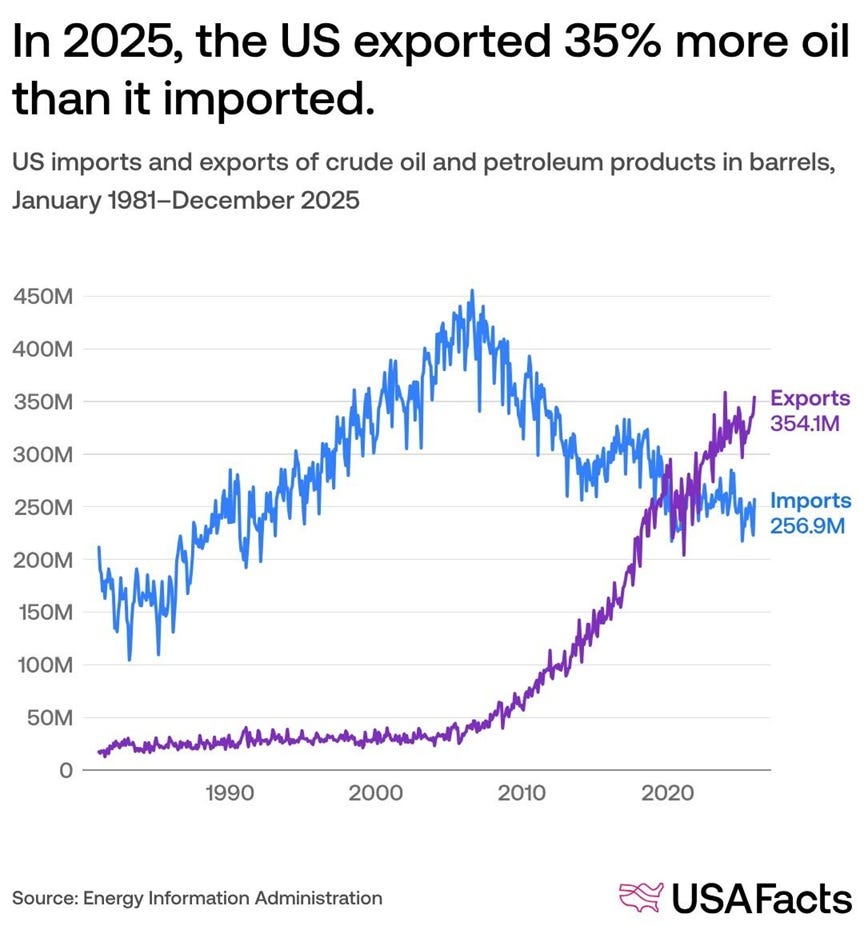
That means that U.S. oil companies will see a big windfall from the war. But the inflation bump resulting from higher input prices will probably still happen, and oil-consuming industries — chemicals, transportation, etc. — will still probably suffer.
4. Government debt probably does make inflation worse
Governments all over the world are running up enormous levels of debt, so it’s important to know what the risks of that are. You can always get your central bank to lower interest rates to make government debt easier to refinance, or even have it print money to buy government debt directly. The problem is that this can cause inflation to rise. A macroeconomic theory called the Fiscal Theory of the Price Level — which drew heavily on Chris Sims’ ideas — predicts a tight relationship between the two.
Progressive macroeconomics types typically pooh-pooh this danger, pointing to cases like the Great Recession, or Japan in the 1990s and 2000s, where soaring levels of government debt didn’t lead to inflation. But Covid may be a counterexample to this complacency. A number of macroeconomics papers have come out recently that establish what looks like a link between Covid borrowing and subsequent post-pandemic inflation.
For example, Barro and Bianchi (2024) find that government spending “has substantial explanatory power for recent inflation rates across 20 non-Euro-zone countries and an aggregate of 17 Euro-zone countries”. And Reis (2026) finds that “the unexpected worsening of fiscal surplus during the period during and after the pandemic is strongly correlated with the unexpected increases in inflation.”
Reis blames America’s borrowing binge — primarily Trump’s CARES Act and its follow-up bill, but also Biden’s American Rescue Plan — for America’s higher rate of inflation after the pandemic:
How much did public deficits contribute to the inflation surge of 2021-24?…A popular argument notes that inflation rose in the US by almost as much as in other OECD countries. Yet, the US had a large fiscal stimulus in 2021 that most other countries did not. Therefore, the US fiscal stimulus did not contribute to the inflation surge. Is that right? No, it is not.
To inspect this claim, you can use expectations data…[Here’s a] plot [that] compares the unexpected high deficits with the unexpected high inflation terms for OECD countries, using the common units of their impact on the public debt…For countries that ran higher unexpected fiscal deficits, inflation was also unexpectedly higher.
And here’s his chart:
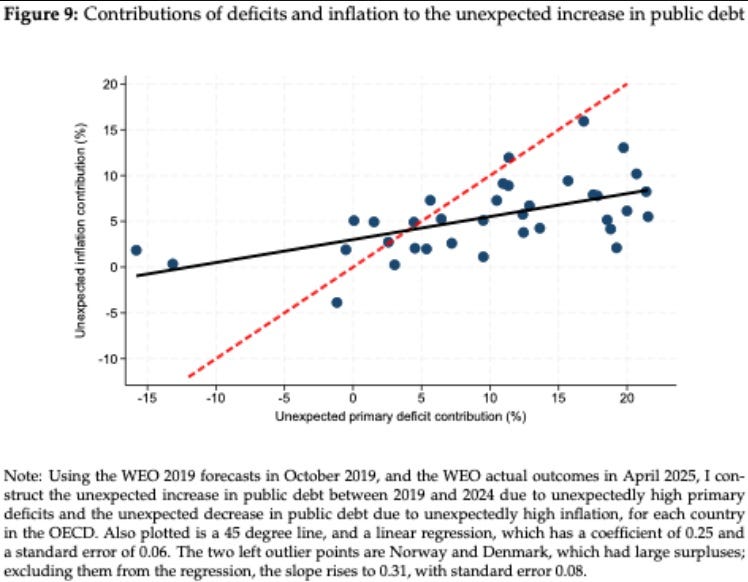
That’s not the tightest relationship I’ve ever seen, or the steepest slope. But it’s not nothing, either. And it’s worth remembering that Olivier Blanchard managed to predict the surge in inflation in advance, just by looking at how much the U.S. government was borrowing back in 2021.
Progressive pundits and Democratic think-tankers who like to hand-wave away the dangers of deficits need to think again. America is up in arms about the cost of living, and if Democrats get in power and just borrow more and more and more, it could make the problem worse.
5. Japan, still the land of robots
I wrote a book about the promise of foreign investment in Japan. When I was on the book tour last year, a bunch of people, both Japanese and otherwise, asked me: “What industries should foreigners invest in in Japan?” My first answer was always the same: Robotics.
In a world where software is increasingly ruled by AI, robotics is the next frontier. But it’s a lot trickier — you have to combine AI techniques with a lot of hardware know-how. A lot of people think that this know-how resides primarily in China, because they look at charts of robot adoption. China has a lot of factories, and it has a lot of cheap bank loans that factories can use to buy robots, and so China buys a lot of robots. It’s also becoming more self-sufficient in the industry — making more of the robots it installs.
But this doesn’t mean China has caught up in the robot industry, or dominated it the way it has dominated the electric vehicle industry. In fact, most of China’s robots are still low-end, mass-market stuff; to produce high-end robots takes many years of careful practice and accumulated tacit know-how.
Japan has this know-how. And so as AI increasingly pushes into robotics, Japan will be an increasingly important partner for the U.S. James Riney of Coral Capital has an excellent post in which he explains why Japan’s robotics expertise is the perfect complement to America’s strength in AI:
If the US wants real, functional robots that can survive a 10,000-hour duty cycle in a factory rather than a 5-minute demo on X/Twitter, Japan is here to the rescue…
The body of a humanoid robot is an engineering nightmare of competing constraints. Strong but lightweight. Blinding speed but sub-millimeter precision. Massive heat dissipation without cooking its own battery. And it needs to do this millions of times without fatigue…This is where Japan excels…
The single biggest misconception in the humanoid hype cycle is the difference between a demo and a deployment…A robot that looks impressive dancing in a pre-programmed video is operating under “Short-Duration Peak Performance.” It pushes its motors and gears to the limit for a few minutes. But industrial customers don’t buy demos….A robot on [a production] line needs a Mean Time Between Failures of 5,000 to 10,000 hours…This is the Reliability Cliff. Most entrants from the software-first ecosystem, and many low-cost Chinese clones, fall off this cliff at around the 1,000-hour mark. Their gears develop backlash, their lubricants break down, and their positional accuracy drifts…
Japanese companies like Harmonic Drive Systems and Nabtesco have spent fifty years solving these problems. They have mastered the black art of tribology, metallurgy, and heat treatment…If you peel back the skin of almost any high-end robot today, whether it is building cars in Germany or sorting packages in an Amazon warehouse, you will find Japanese logos inside…According to Japan’s Ministry of Economy, Trade and Industry (METI), Japanese manufacturers hold an impressive 70% of the global market share for industrial robots…
The battle for robotics dominance is not a story of the US vs China. China would likely win that battle. It is a story of the US & Japan (and allies) vs China…For now, and for the foreseeable future, if you want a robot that works, you need to knock on Japan’s door.
Wise words. American startups, AI companies, and government agencies need to listen to James.
6. Democrats don’t want to tax the (moderately) rich
There has been a big political realignment in the U.S. — and in many other countries — in recent years. Center-left parties, like the Democrats in the U.S. and Labour in the UK, used to primarily be the parties of the working class. But in recent years, their voter bases have shifted — they have become the parties of educated high-earning professionals, while working-class voters have drifted to the right. Here’s Rogé Karma:
In 2008, the top fifth of earners favored Democrats by just a few percentage points; by 2020, they were the group most likely to vote for Democrats and did so by a nearly 15-point margin. (Democrats won the poorest fifth of voters by a similarly large margin.) Democrats now represent 24 of the 25 highest-income congressional districts and 43 of the top 50 counties by economic output. A similarly stark shift has occurred if you look at college education rather than income. Perhaps most dramatic of all has been the change among wealthy white people. Among white voters, in every presidential election from 1948 until 2012, the richest 5 percent were the group most likely to vote Republican, according to analysis by the political scientist Thomas Wood. In 2016 and 2020, this dynamic reversed itself: The top 5 percent became the group most likely to vote Democratic.
And here’s a chart:
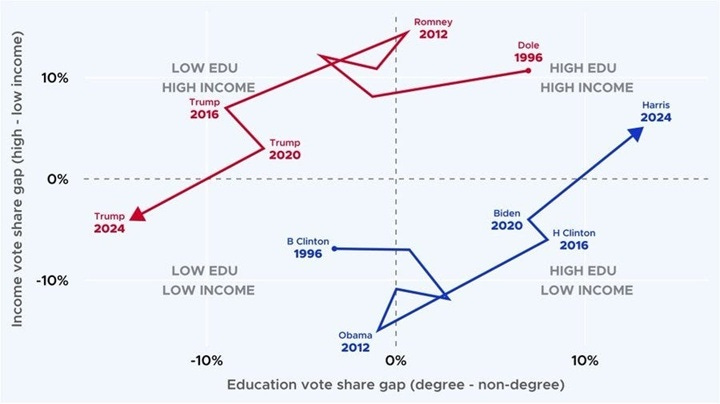
For the most part, Democrats have kept their pro-working-class politics, even as they represent the working class less and less. They’ve supported unions even as unions have abandoned them at the polls. They’ve pushed for more welfare and health spending, even as the benefits have flowed more to red states than to blue ones. This is commendable.
However, this class altruism doesn’t extend to all types of policy. Progressives have fought hard for student debt cancellation, even though people who go to college are pretty obviously the main beneficiaries of that. And on taxes, Democrats have shifted from their old strategy of taxing the rich to a new strategy of taxing only the hyper-rich while cutting taxes for the merely-rich. Matt Yglesias reports:
Chris Van Hollen and Cory Booker both recently introduced proposals to raise taxes on the very rich in order to finance broad-based tax cuts for the rest of the country…[T]he existing progressive structure of the income tax code means that any broad-based income tax cut is going to be regressive. Check out this Yale Budget Lab estimate of Van Hollen’s plan — he makes sure to soak the rich, but he does more with the money for the comfortable than for the struggling. Booker’s plan is even worse in this regard…
[L]ooking at the distributional tables for the 1993 budget…that Bill Clinton signed…it’s almost shocking how broadly he raised taxes…[B]y Obama’s time, willingness to enact broad-based tax increases was waning…Obama vowed not to raise taxes on anyone earning less than $250,000 (roughly $360,000 in today’s dollars), which meant in practice being willing to extend a majority of the Bush tax cuts…Except vulnerable senate Democrats lost their nerve and pushed to extend tax cuts up to $450,000 — or nearly $650,000 adjusted for inflation today.
Basically, as Democrats have become the party of the somewhat-rich, they have begun to embrace tax cuts for the somewhat-rich.
But without broad-based taxes, America will never be able to rein in its deficit or increase the welfare state further. Billionaires have a ton of money individually, but collectively there just aren’t enough of them to support the fiscal needs of a country like the United States. If we want broadly shared benefits, we will need broadly shared sacrifice.
The Democrats, comfortable in their newfound identity of the party of millionaires-against-billionaires, are no longer calling for broadly shared sacrifice. Instead, the best populism they can seem to muster is an attack on one group of elites by another group of elites.
7. Get off your phone
“Blow up your TV/ Throw away your paper/ Go to the country/ Build you a home/ Plant a little garden/ Eat a lot of peaches/ Try and find Jesus/ On your own” — John Prine
I’m generally a techno-optimist, but I make an exception for at least one technology: smartphone-enabled social media. In the long run, I expect us to be able to adapt in order to use this technology to our net benefit. But in the short run, I think it has devastated our politics, destroyed many of our social bonds, and made us less happy in general.
A research project called the Global Mind Project has tried to assess mental health across the globe, using a huge survey with millions of respondents. Their latest report zeroes in on the deleterious effects that smartphone usage has had on the well-being of Gen Z. Here’s Jonathan Haidt’s summary:
Young adults used to generally have good mental health, compared to older generations. But now, in ALL countries examined, they are doing badly compared to older generations in that country…The decline of young people's mental health is "most pronounced in the wealthier and more developed countries." They note that it is in such countries that smartphones are given earliest, junk food is most heavily consumed, spirituality is most diminished, and family ties are looser and often weaker…"A younger age of first smartphone ownership is associated with increased suicidal thoughts, aggression, and other problems in adulthood."
And this is from the report itself:
GenZ is the first generation to grow up with a smartphone. Among this group, the younger they acquired their first smartphone in childhood, the more likely they are to have struggles as adults. These struggles extend beyond sadness and anxiety to less discussed symptoms, such as a sense of being detached from reality, suicidal thoughts, and aggression towards others…Excessive time spent on smartphones also diminishes the development of social cognition that requires learned interpretation of facial expressions, body language, and group dynamics. The negative impacts are particularly sharp below age 13.
Fortunately, some young people seem to be realizing that the phones are bad for them. Here’s a recent story from CNBC:
Going chronically offline is the latest trend to grip young people, and ironically it's going viral on social media…I received nearly 100 responses from Gen Z and millennials sharing stories about social media detoxes and digital burnout…They talked about ditching their smartphones for flip phones, visiting record stores to buy vinyl, taking up analog hobbies like knitting, and most importantly, connecting with their friends in person.
A 2025 Deloitte consumer trends survey of more than 4,000 Brits found that nearly a quarter of all consumers had deleted a social media app in the previous 12 months, rising to nearly a third for Gen Zers…Meanwhile, social media use has steadily declined since time spent on the platforms peaked in 2022, according to an analysis of the online habits of 250,000 adults in more than 50 countries by the Financial Times and digital audience insights firm GWI…Globally, adults 16 and over spent an average of two hours and 20 minutes per day on social platforms by the end of 2024, down almost 10% since 2022, the report found. The decline was particularly pronounced among teens and 20-somethings…
Young people who are deleting their social media platforms cite the increasing pressures of being online as well as damage to their mental health as causes…Deloitte’s consumer survey showed that almost a quarter of respondents who deleted social apps reported these apps had negatively impacted their mental health and consumed too much of their time.
This is actually the kind of thing that makes me such a techno-optimist. In the short-run, the drawbacks of a new technology can do more harm than good. But in the long run, humans learn and adapt to the new technology. And in the case of smartphones, the right adaptation may simply be to get off social media.
Certainly, AI may come up with novel ideas, but will AI be able to recognize them as novel or as worthwhile? Humans have accidentally stumbled on useful innovations, but they were smart enough to recognize that their oopsies were beneficial. Penicillin was discovered when an attempt to grow bacteria was disrupted the accidental introduction of a mold. Rubber became useful when Charles Goodyear dropped a rubber/sulfur mixture on a Hot stove and learned this way how to harden it.
“if Democrats get in power and just borrow more and more and more, it could make the problem worse.” Are not the Republicans the party of spend these days? Not tax and spend as they don’t like taxes, just spend and add to the deficit.