

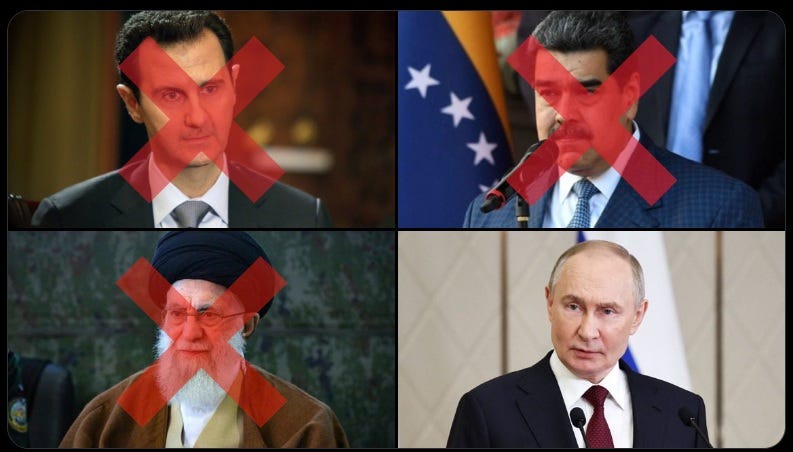
I was all set to publish another post about AI, but then the U.S. and Israel attacked Iran, so now I guess I’ll write about that.
Last June, Israel launched a bunch of attacks on Iran, and didn’t encounter much resistance. Trump briefly joined the fray by launching a couple of airstrikes at Iranian nuclear sites. Afterward, the White House put out a statement bellowing that “Iran’s Nuclear Facilities Have Been Obliterated — and Suggestions Otherwise are Fake News”. This was obviously false, and so here we are, eight months later, with Trump ordering more attacks on Iran, ostensibly in order to take out their very non-obliterated nuclear facilities.
I chose not to write a post about the Iran attacks last June, simply because they didn’t seem that important. Trump’s strikes were perfunctory and seemed a bit performative. China and Russia didn’t come to Iran’s aid, which showed that Iran isn’t really a core member of their alliance. Israel seemed to have their way with Iran’s air defense system; this was interesting from a military standpoint, but the wider implications are unclear. Other than that, there didn’t seem much reason for me to analyze the conflict.
The current attacks are more significant, so I’ll write about them. The most important reason is that Israeli strikes killed Iran’s Supreme Leader, Ayatollah Ali Khamenei (along with various other top Iranian leaders). That seems like the crossing of a Rubicon; you can’t really take out a country’s head of state and expect a quick return to the status quo. And it means that Trump, accidentally or on purpose, has taken a serious geopolitical action instead of making a bunch of noise and then backing down. This could have long-term consequences.
Anyway, I don’t have a single big thesis about the new Iran war, so I’ll just offer up a series of thoughts. Basically, my takes are:
Pax Americana actually restrained American power, and the people who wanted a multipolar world may come to regret that wish.
While Trump’s ability to launch a war of choice without Congressional authorization is bad for American democracy, it’s also true that Iran’s leaders are absolutely evil and had it coming.
Western leftists’ full-throated support for Iran demonstrates how badly they have lost the plot.
The New Axis of China, Russia, and Iran has been materially weakened by this conflict, but we shouldn’t write it off.
Welcome to the multipolar world
My basic geopolitical thesis over the past few years has been that Pax Americana — the rules-based international order backed up by American power — is gone. America was simply no longer industrially strong enough to support the kind of world-policing role it carried out during and after the Cold War; China, the main revisionist power, had gotten too strong for America to remain the hegemon. On top of that, the U.S. has been consumed by internal conflicts, and has far less energy to look outward. This domestic social conflict is ultimately behind Trump’s isolationism and his alienation of many traditional U.S. allies.
A lot of people — leftists and rightists in the West, and America’s rivals and detractors abroad — welcomed this development, but for different reasons.
Leftists and foreign rivals celebrated the end of Pax Americana as a diminution of American power. They eagerly heralded the rise of a multipolar world, in which other nations would have the power to check America’s designs. This has, in fact, come to pass. And Trump’s rejection of his erstwhile European allies has weakened American power even further, beyond what America’s enemies might have dared to hope.
But what they all failed to realize is that Pax Americana bound and restrained the United States. In order to uphold the rules-based order it created, America accepted many limitations on its hegemony. It restrained its use of military force in many cases, eschewed territorial conquest, and treated smaller and poorer countries as its equals in many international bodies.
That’s all gone now. Without rules and norms to bind him, Trump is free to threaten conquest of Greenland, take out Russia’s allies, and generally throw America’s still-considerable weight around much more freely and aggressively than during his first term.
Rightists, meanwhile, relish America’s newfound freedom from the pesky constraints of international norms. But their hope that the U.S. would abandon global power, in order to focus inward on domestic cultural and social conflicts, seems to have been dashed, at least for now. Trump remains far more inclined toward foreign adventurism than any Democrat, and is more eager to participate in Israel’s wars.
In other words, this is a “be careful what you wish for” moment for all of the advocates of a multipolar world.
