



Birthright citizenship is the law of the land. The Supreme Court has once again ruled that the 14th Amendment gives automatic citizenship to anyone born in the U.S.1 This includes the children of illegal immigrants and temporary visa holders, both of which the Trump administration had sought to exclude from birthright citizenship.
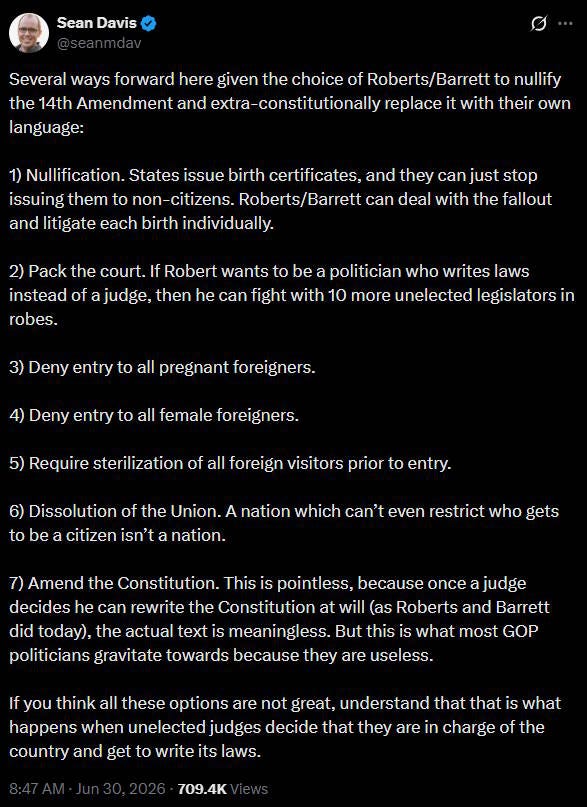
Rightists immediately began howling about the ruling, and saying some very intemperate things. Sean Davis of The Federalist suggested dissolving the Union and/or sterilizing foreign visitors to the United States:
Right-wing political commentator Matt Walsh shrieked that the America he grew up in — which also had birthright citizenship and significant amounts of illegal immigration — has somehow been destroyed as a result of the SCOTUS ruling:
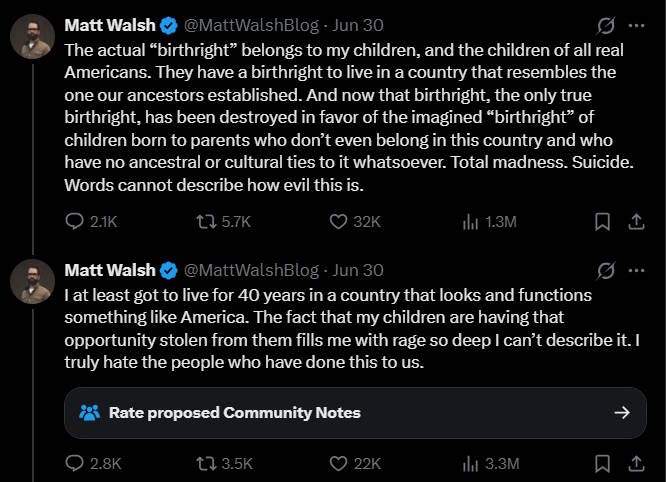
These histrionics — sadly typical of online reactions to major news events in the social media age — demonstrate how central the anti-immigration cause has become to the political right in the United States. The notion that immigration is an invasion bent on destroying the country by replacing its founding population has become a bedrock belief on the Right; it is a singular, all-consuming passion similar to what anti-racism was for 2010s progressives and Palestine has become to leftists in the 2020s. Nor is it just an object of passion; nativism has become a self-contained, hermetically sealed worldview not subject to reasoned argumentation, logic, or data.
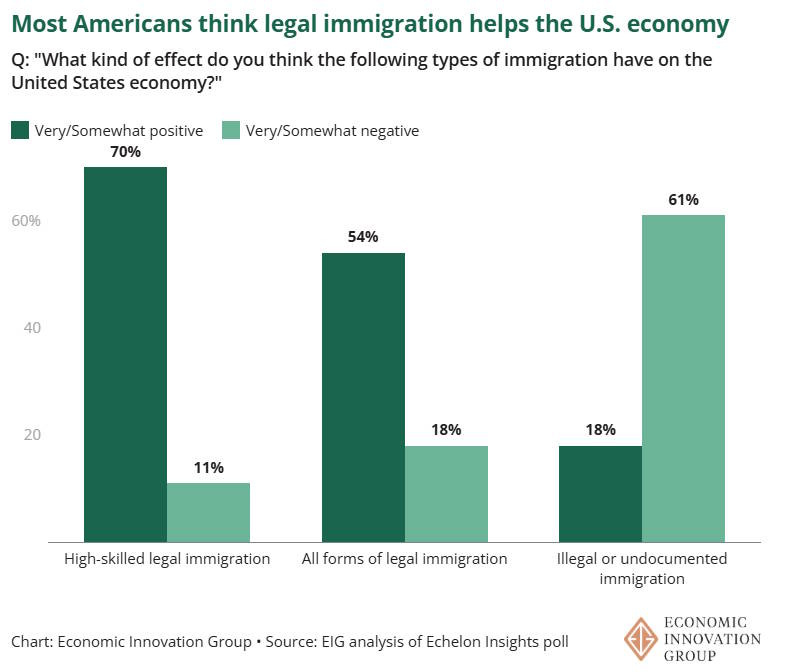
It is a distinctly minority worldview. The overwhelming majority of Americans continue to say that immigration, on the whole, is good for this country:
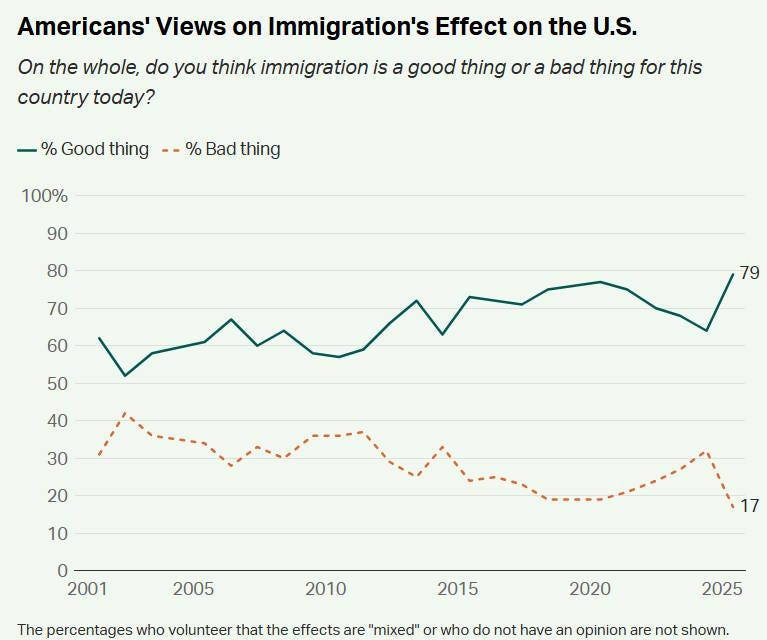
This does not mean that Americans want open borders, or that they think all kinds of immigration are good. Sentiment against illegal immigration, and in favor of increasing border security, remains strong. A backlash against the disorderly flood of quasi-legal immigration under Biden helped get Trump elected in 2024. But even illegal immigration is not seen as an invasion by most Americans — support for a pathway to citizenship remains strong, even among many Republicans not affiliated with the MAGA movement.
The rightist view of immigration as the death knell of America is simply a small minority viewpoint. Guys like Sean Davis and Matt Walsh are a screechy online fringe. They seem to think that if they screech loud enough and make dramatic enough threats (“Dissolve the Union!”, “Sterilize tourists!”, and so on), they can bully the supermajority into giving them their way. They basically expect veto power over this one issue, based purely on the strength of their emotion.
And on the narrow question of birthright citizenship, poll after poll shows that Americans want to keep the practice. Here’s an example from The Hill:
Nearly 70 percent of respondents in a Quinnipiac University poll think the Supreme Court should keep birthright citizenship in place. The results come ahead of the high court’s ruling on the legality of President Trump’s executive order seeking to end the policy…The survey, conducted between June 18 and 22, found that 69 percent of 1,165 self-identified registered voters believe the Supreme Court should keep in place its 1898 ruling affirming that the 14th Amendment guarantees citizenship to those born in the U.S…Less than 3 in 10 respondents (27 percent) said the high court should reverse its decision[.]
That doesn’t mean the public entirely disagrees with the Trump administration. About half of Americans think that birthright citizenship ought to be denied to the children of illegal immigrants:
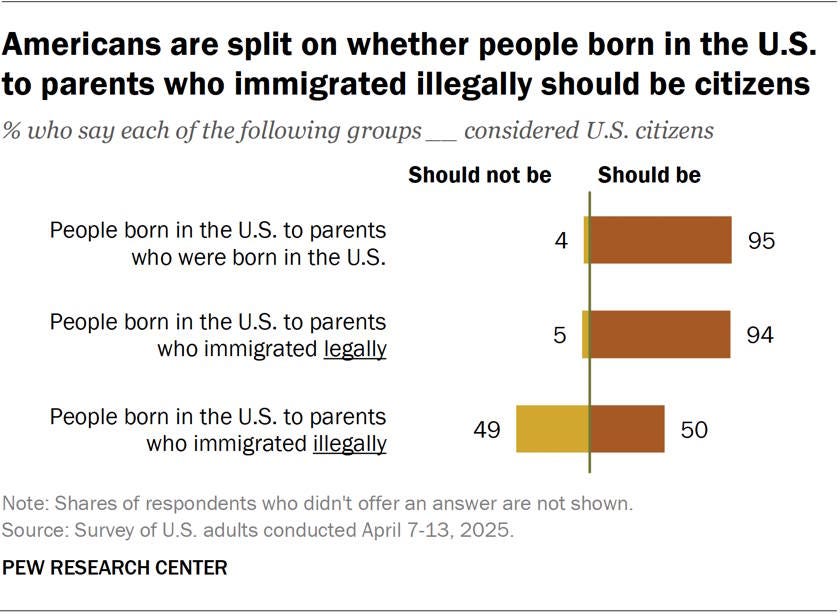
(It’s not clear what Americans think about the children of temporary visa holders; this question is typically not broken out in polls, and it’s not clear whether Americans generally understand the difference between permanent residents and legal visa holders.)
So if the MAGA movement were pragmatic — if they really wanted to succeed in restricting immigration in a way that Americans would support, instead of just screeching louder and louder about immigration in general in an attempt to cow the majority into giving them their way — there might be room for them to change the law. They don’t currently have enough support for a Constitutional amendment specifically revoking birthright citizenship for the children of illegal immigrants, but they might be able to get over that line with a concerted campaign.
But that’s a bit of a moot point, because the right is probably not going to execute that sort of pragmatic, majoritarian strategy. Immigration has become a culture war. Taking a maximalist position on the issue is a way for people to signal their allegiance to the MAGA movement; supporting substantive compromises that win real policy victories broadcasts that you’re not a core part of the movement.
As for Democrats, they seem to still be almost entirely reacting against MAGA. On the positive side, this means that even hardcore leftists like Hasan Piker responded to the SCOTUS ruling by temporarily dropping their “America is evil” shtick and showing some national pride:


On the minus side, it makes it even harder to get coherent immigration policy. Trump & co. want to make immigration harder, so Dems will simply make it easier in response. This is probably why Biden was so lax on border enforcement during the first three years of his term — a disastrous decision that probably cost the country four more years of Donald Trump.
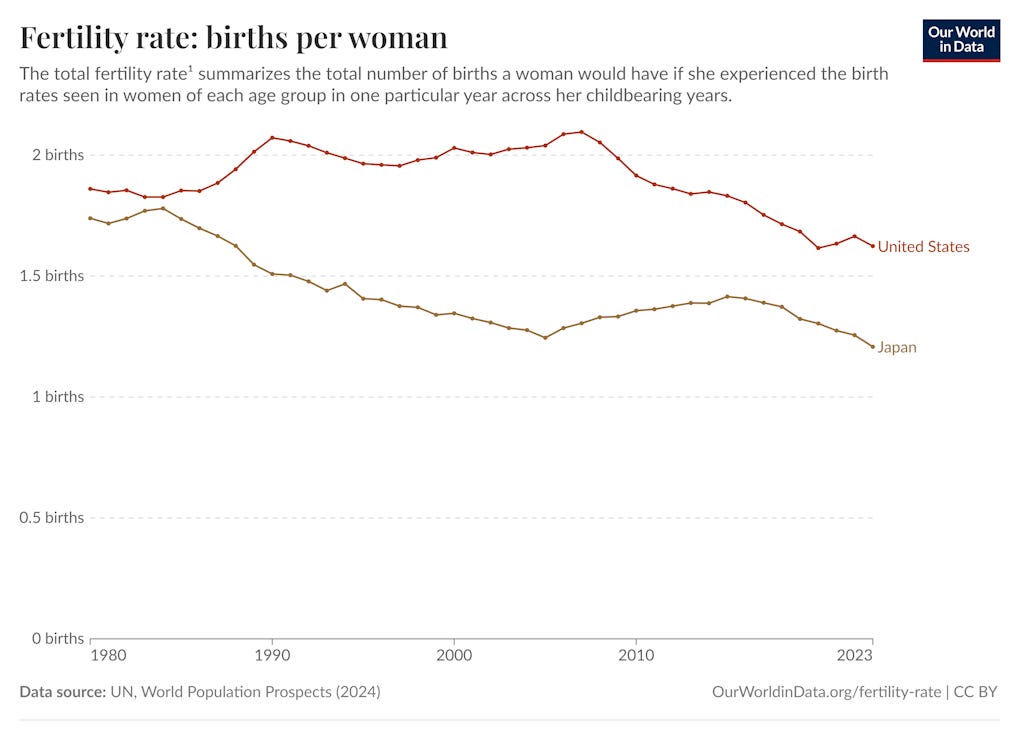
This is a shame, because smart immigration policy is needed now more than ever. The U.S. is suffering a fertility crisis, similar to the rest of the world. Two decades ago, America was having enough kids to keep the population stable over time. Now, fertility in America has declined to below the level of Japan in the 1980s:
Most of us grew up thinking of Japan as a place with an aging, shrinking population. America is now headed for exactly that same fate, unless we take in immigrants. But Trump’s restrictive policies — not just deportations, but dramatic reductions in legal immigration — have almost entirely cut off the inflow:
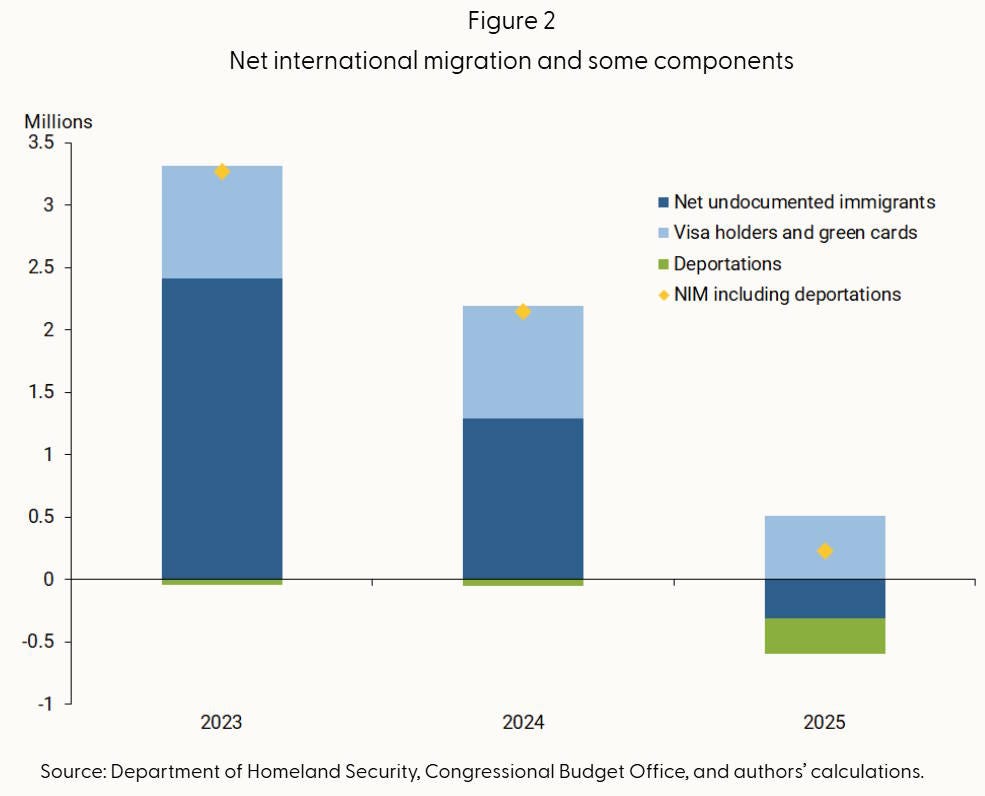
Other estimates show Trump actually reducing the number of immigrants in America in 2025 (and probably 2026), which would mean MAGA’s anti-immigration crusade is now actively reducing the country’s population.
This is bad news for the country. For one thing, it means far fewer workers to support each retiree. With zero immigration, the number of American working-age people per retiree will fall from 3 to 2 over the next quarter century:

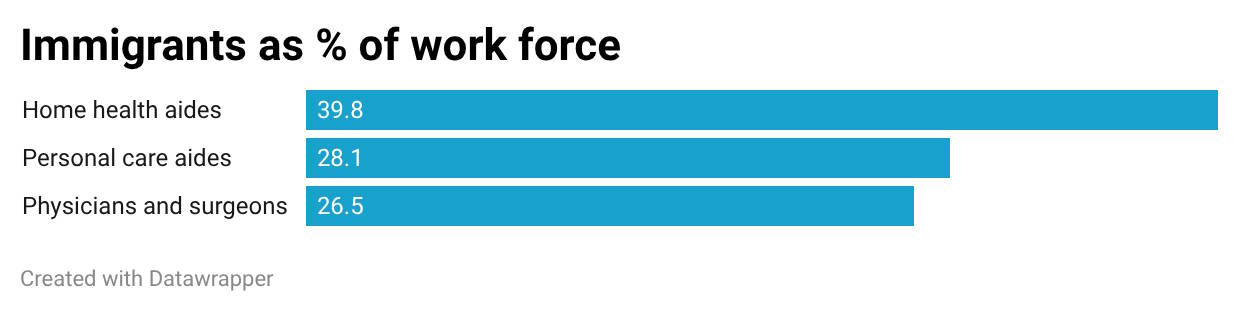
For some, that will mean paying higher taxes to support old people’s health care and eldercare. For others, it will mean directly doing the work of taking care of their aging parents. Either way, it means more toil and drudgery for the young and the middle-aged, and less freedom and consumption and fun. As Paul Krugman points out, immigrants are disproportionately likely to work in jobs that take care of old people:
The burden of supporting the elderly will also probably reduce fertility even further — it’s hard supporting kids and your retired parents at the same time! — which will compound the problem in the long term. And small towns and rural areas will be especially hard-hit.
Immigration can’t hold off population aging forever in a world of low fertility — immigrants get old too, and so you need to keep increasing the immigration rate just to maintain the age structure. And as the whole world begins to shrink, the supply of immigrants will dry up. But America’s wealth, and our (rapidly diminishing) reputation as a “city on a hill”, gives us the ability to stave off population aging for a while, and perhaps buy time to find a more permanent solution to the riddle of low fertility.
At the same time, we’ll get a lot more benefit if we’re careful about which kind of immigrants we let in. Immigrants with higher education levels add to the national fiscal coffers, since they make a lot of money. But immigrants with low education levels create a net fiscal drain, since they make less money and absorb more government benefits (as do their children).
If you just look at immigrants themselves, you find that college-educated immigrants tend to decrease the national debt, while immigrants without college degrees tend to add to the debt:
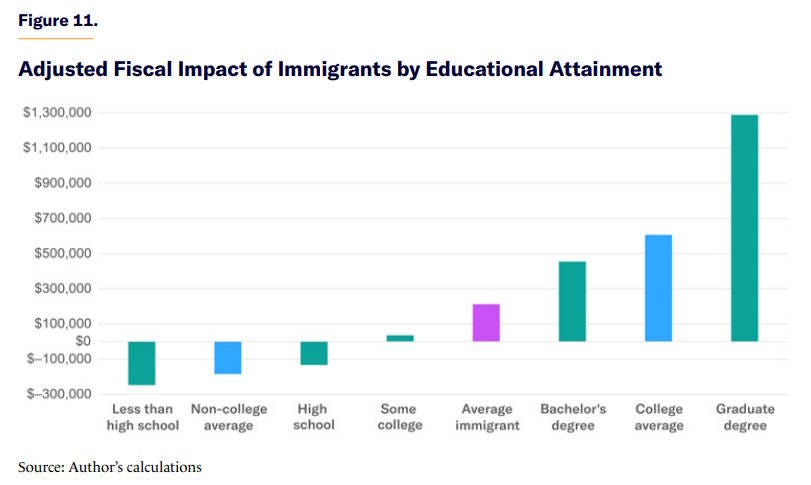
If you include later generations — who tend to show strong upward mobility in the U.S. — then the long-term fiscal impact is more positive, but you still see a very strong difference by education level:
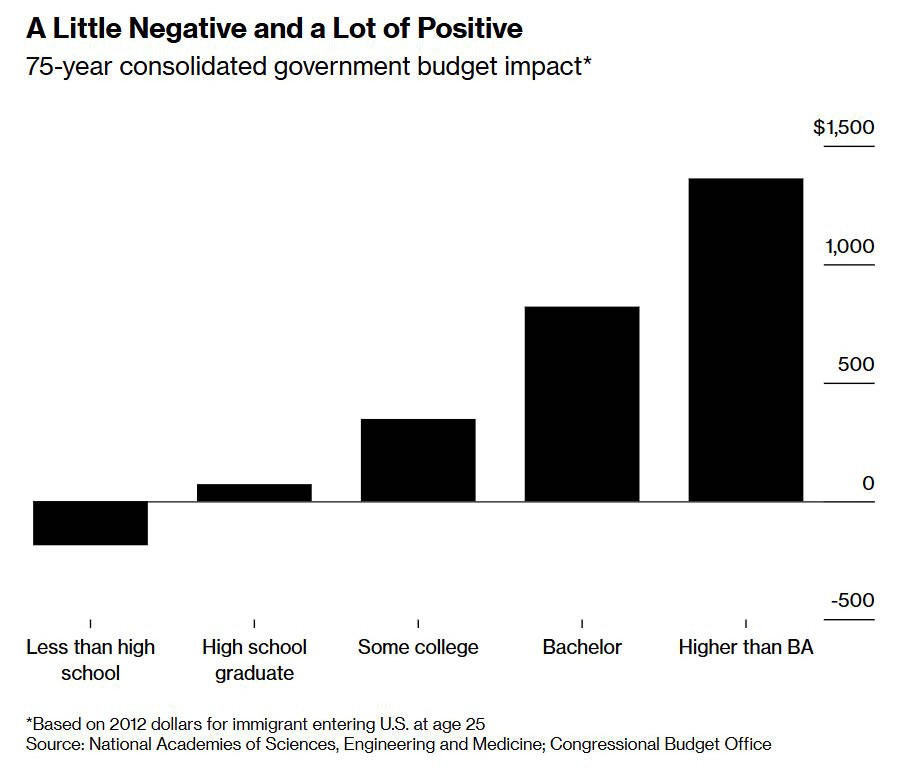
So if we want to use immigration as a tool to strengthen our nation’s economy, we should focus on letting in immigrants with college degrees. That means more legal skilled immigration, more border security, and less quasi-legal asylum grants — in other words, exactly the set of policies that the American people say they want.
Now, MAGA people will certainly respond that immigration is about more than dollars and cents — it’s about culture. Immigrants assimilate to American culture, but they also do change that culture somewhat; assimilation is a two-way street. It’s impossible to live in the same country you grew up in — technology is still the biggest cause of cultural change — but if you want to preserve as much of the country of your youth as humanly possible, then it makes sense to restrict immigration. More broadly, if you believe that nation-states are legitimate entities, then you must admit that countries have an inherent right to preserve their cultures in amber by shutting themselves off to immigration, if they want to.
But MAGA has already lost that battle. America is not North Korea; we’re not even Japan or Sweden. 79% of Americans say that immigration is good for the country overall; they say this even knowing that immigration will cause some long-term cultural changes. The cultural preservation argument against immigration is a lost cause, no matter how desperately its proponents shriek and bluster and threaten.
At the same time, Democrats must be extremely wary of embracing open borders simply out of pure reaction to MAGA nativism. Americans don’t want to let just anyone in; they want people to come legally, and they want to admit people who earn enough money to contribute positively to the economy. If Democrats simply respond to each electoral victory by throwing open the borders and turning a blind eye to illegal immigration, the American people will continue to respond by intermittently electing xenophobes.
In the age of low fertility, America desperately needs to be smart about its immigration strategy. We can’t let a fringe of culture-warriors dictate our national policy.
With a few exceptions.
I agree with this essay with one quibble: considering that caring for the elderly is a growing need and if many of the people doing so are immigrants who likely do not have a college degree (because they are from countries that have a low college degree penetration), then I think we need to have immigration from a wide range of educational backgrounds.
The answer to the question "Who's gonna change your momma's bedpan at the nursing home?" is not "an immigrant with a master's degree."