


This week’s roundup has a lot of AI in it. Fortunately or unfortunately, it seems like a lot of the news is going to revolve around AI for the rest of our lives. That was true of industrial technology in 1870-1970; people basically got used to the idea that railroads and factories and oil and industrialized warfare and such matters were central to the way the world was run and to the collective future of humanity. AI is going to be like that going forward, and we’re just going to have to get used to that. So let’s make it as fun and interesting as we can!
1. Americans are getting scared about AI risk
AI risk has exploded onto the national scene. AI companies and AI researchers generally believe that the technology they’re building has the capacity to do great harm — perhaps even to end the human race — if it’s not developed more slowly and deliberately. There are five main groups of people opposing the slowdown:
The Trump administration, which is worried that an AI slowdown might also slow down economic growth
Investors who think a slowdown might hurt their bottom line
Libertarians and techno-optimists who think regulating technological progress is bad on principle
China hawks who worry that a slowdown would let China take the lead in the AI race
Progressives who spent the last few years telling themselves that AI doesn’t work, that AI is a huge economic bubble, and so on, and who now can’t bring themselves to admit that yes, the techbros actually built something that works.
This is a strange alliance indeed. The last of these — the progressives who simply couldn’t admit that billionaire-funded private industry could build something powerful enough to endanger humanity — were the strangest of all, since their refusal to acknowledge the effectiveness of AI basically put them in an alliance with libertarians, hawks, and Trump. In fact, in recent days there has been a tremendous civil war within the progressive movement between the “AI is dangerous” and “AI is fake” camps, with Bernie Sanders supporting the former and his former comms director David Sirota supporting the latter.
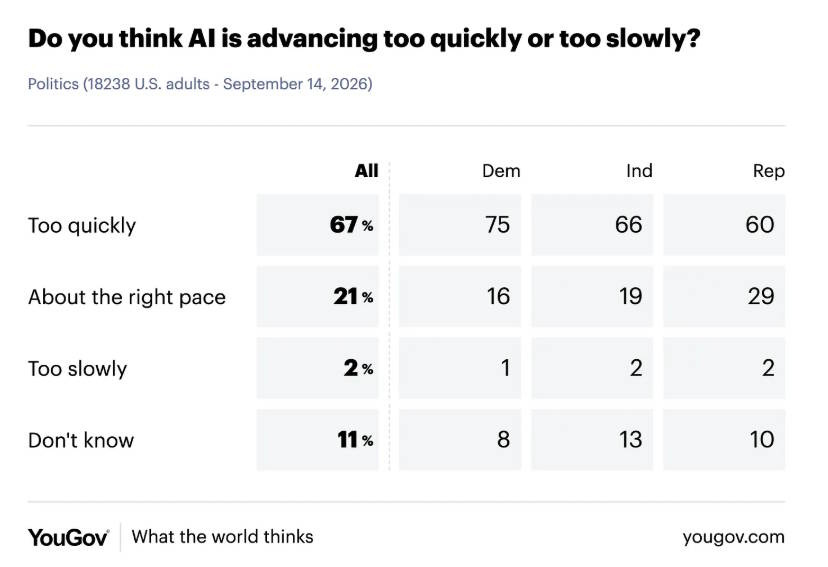
But although it has the support of the president (for now), the anti-slowdown coalition is losing in the court of public opinion. Nate Silver has a post rounding up the evidence:

A bipartisan majority is now worried about existential risk from AI:
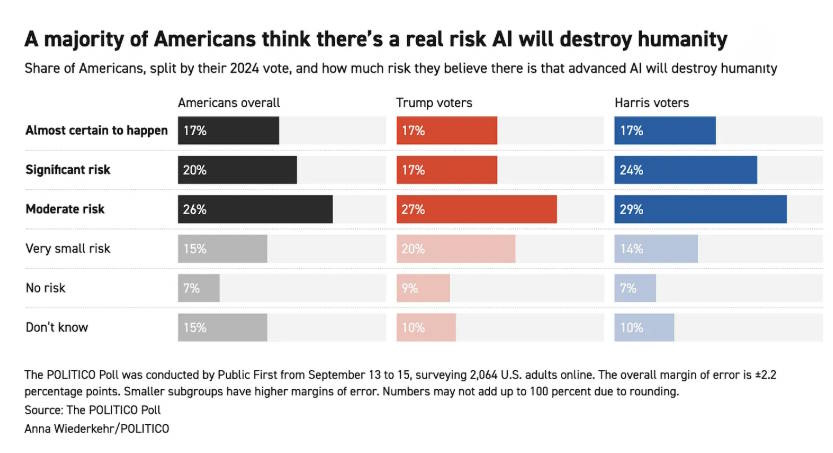
And a bipartisan majority thinks AI is moving too fast:
Barack Obama, probably the most successful American politician of this century so far, is telling Democrats to make AI safety one of their tentpole issues.
This is remarkable. I don’t think I’ve ever seen such bipartisan national unity on any issue in my adult lifetime. Trump is standing firm against the tide of public opinion here — as he has on the Iran War, tariffs, and other issues. But it’s not clear how long he’ll be able to hold out.
2. A very cool debate about AI and growth
Quite apart from the question of whether AI will kill us is the question of whether AI will deliver explosive economic growth. There’s a pretty epic public bet on this:


The people on the “fast growth” side are mostly AI researchers, while the people on the “slow growth” side are mostly (but not entirely) economists. This is an exaggerated version of a broader disconnect — AI researchers are generally more optimistic about AI’s impact on economic growth than economists are:
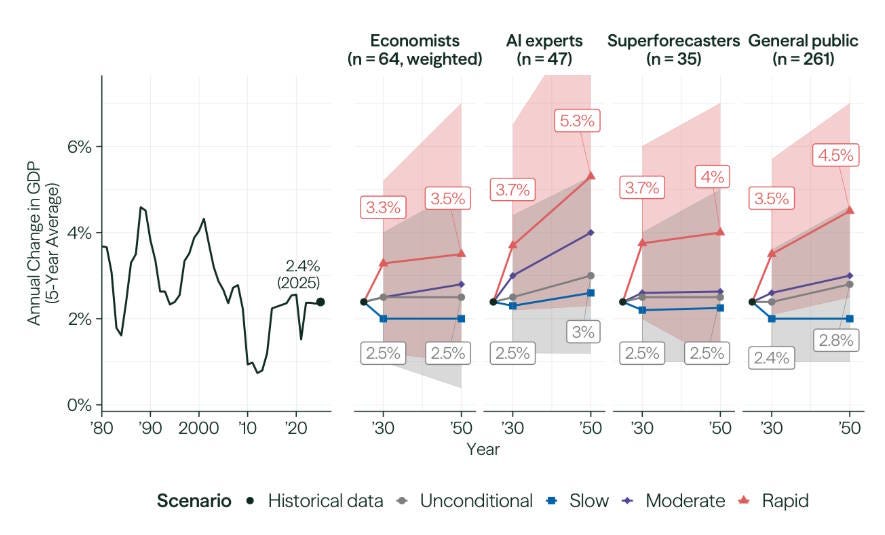
But the people publicly betting on fast growth are making an even more extreme forecast — they’re forecasting 15% growth, which is much higher than the 5.3% that AI experts forecasted as their most optimistic scenario. That’s an absolutely stupendous growth rate — China has hit it only in one year (1984) since it began its rapid growth, and that was when it was a very poor country. And yet, a number of people in the AI industry think it’s going to happen to us very soon.
Economists — even those who work on the economics of superintelligent AI, like Alex Imas — are skeptical. In a recent blog post, Imas and Ben Moll explain their thinking:

Basically, they foresee a bunch of factors combining to limit AI’s contribution to economic progress in the short term:
Slow diffusion of AI technology throughout the economy,
The “J-curve” effect where productivity tends to fall right after a big innovation comes out (because companies need to spend resources adopting the new technology rather than on their existing businesses)
The difficulty of automating the physical world with robots
Political barriers to adoption
The difficulty of reorganizing production processes around AI
The persistence of activities that consumers want to keep having humans do (the “relational sector”)
Bottlenecked inputs to the AI industry (e.g. chips)
Baumol’s cost disease
AI disasters that slow adoption
That’s a lot of reasons! It makes sense that at least some of these will end up having an effect. Whether AI’s rapid improvement is enough to overcome all of these, and propel us to 15% growth, is something I guess we’ll have to see for ourselves. Personally, I lean toward the economists’ more measured expectation, but I’m prepared to be surprised on the upside.
3. AI keeps stubbornly refusing to kill SaaS
One of the most entertaining storylines about AI is how it keeps refusing to destroy all the things people say it’s about to destroy. On Labor Day, I noted that AI keeps stubbornly refusing to kill jobs. A month ago, I noted that AI keeps stubbornly refusing to kill Indian back-office outsourcing companies.
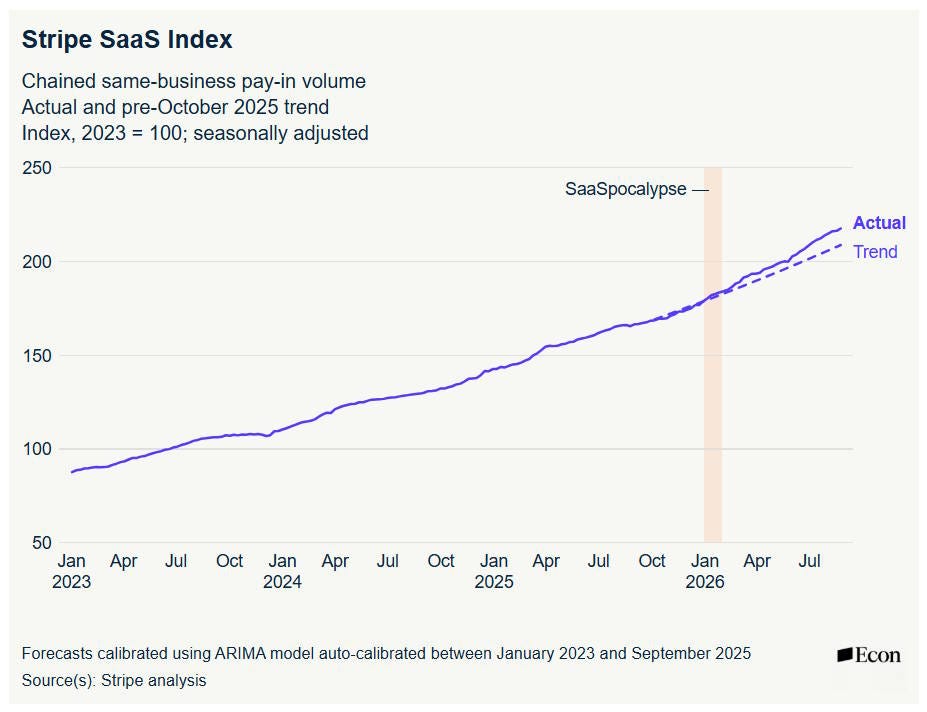
Now Ernie Tedeschi and the excellent folks over at Stripe Economics have a post about how AI is stubbornly refusing to kill the Software as a Service industry:

Earlier this year, when coding agents came out, there was a bloodbath in software stocks. Why would anyone pay Salesforce or other companies big bucks to make and maintain software for them when Claude Code could just do it all for a lot cheaper?
That logic made some intuitive sense, except things didn’t turn out that way — at least, not yet. In fact, SaaS companies started making more money in the age of AI! Tedeschi and the Stripe team tracked an index of publicly traded SaaS companies and found that their revenue has grown faster since coding agents came out:
And SaaS stocks have made up all of the ground they lost:
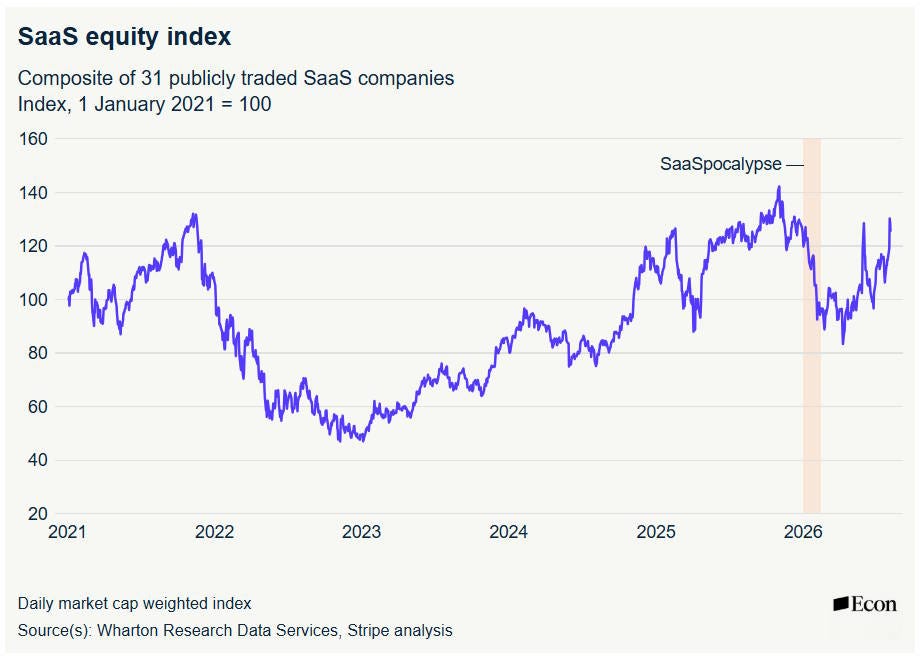
Ernie’s post has many more fun charts.
What’s going on here? Well, for whatever reason, companies are still willing to pay for software instead of trying to roll their own with Claude Code. And SaaS companies are probably improving their own productivity by using AI. As in so many other areas of the economy, AI is proving to be a complement when people thought it was going to be a substitute.
That could all change, of course, if and when AI gets good enough, or when new AI-centric business models disrupt older ones. But for now, the simple story of AI replacing everyone and everything just isn’t happening.
4. America’s quiet, boring rich people
Owen Zidar is one of my favorite economists. His meticulous empirical research with Eric Zwick on inequality in America has fundamentally changed how I think about the issue. Now that research has become a book, entitled The Everywhere Millionaire: Who Is Really Rich in America and How They Got There. I haven’t read it yet, but I’ve read some of the underlying papers, so I know it’s going to be good.
Anyway, Zidar and Zwick have an article out in The Atlantic explaining their findings. Here are some excerpts:
When Americans picture the ultrarich, they typically think of tech billionaires such as Elon Musk and Mark Zuckerberg, whose wealth lies predominantly in shares of publicly traded companies. They might also think of Wall Street financiers and celebrities such as Taylor Swift. But far more typical are…owners of successful privately held businesses…By our calculations, about 1.7 million Americans have each built a net worth of at least $10 million by owning a private business. For every CEO of a public company, there are more than 1,000 private-business owners with a net worth of more than $25 million…
What we found changed how we think about inequality…Today, when Senators Elizabeth Warren and Bernie Sanders propose making the rich pay their fair share, they aim at Wall Street and Silicon Valley. But far more relevant to the story of inequality in America are the everywhere millionaires who quietly press their elected representatives for favorable treatment. The tax code bears their imprint far more than it does Musk’s…
A loophole that lets private-business owners avoid Medicare taxes has similarly been justified as a break for the little guy. Preserving the family farm has been a pretext for passing ever larger exemptions to the estate tax, to the point that a married couple can now pass on $30 million to heirs tax-free. Hiding behind small business, in short, has proved a devastatingly effective strategy for the rich…[T]he everywhere millionaires have one thing in common: They own what have become known as pass-through businesses…[L]awmakers have carved out multiple loopholes, so a dollar earned from owning a business is routinely taxed much less than a dollar earned in wages. [emphasis mine]
In fact, though I haven’t yet joined the ranks of Zidar and Zwick’s “everywhere millionaires”, I probably will do so — Noahpinion is a pass-through business (an S-corporation), and although I haven’t yet managed to get Congress to create tax loopholes for Substack writers, the generally favorable tax treatment these businesses receive has certainly lowered my tax bill.
So perhaps it’s not in my financial interest to promote Zidar and Zwick, but I will do so anyway. Expect to see more about their work on this blog in the months to come!
5. Christians vs. Nazis
Christians and Nazis should be natural enemies. The original Nazis in Germany persecuted the Catholic Church, and attempted to create a new state religion that co-opted some elements of Christianity while rejecting the Old Testament. Christianity is, at its core, a universalist faith, open to human beings of all races, while Nazis are…not that.
In the U.S., neo-Nazis have been weak enough where they haven’t tried to usurp leadership of the Right from conservative Christianity. But as Christianity wanes and online rightism rises, the two may now be coming more into direct conflict. Erick Erickson, a Christian conservative pundit, recently wrote a post exposing one network of neo-Nazi influence on the Right:

Some excerpts:
Charles Haywood made his fortune selling shampoo…[H]e has spent the years since writing out, at length and under his own name, what he would like to do with your country.Rod Dreher, who is no man of the left, read Haywood’s online ramblings and described Haywood as pouring out vile from “deep in his Midwestern Führerbunker”…
In a document he calls the Foundationalist Manifesto, Haywood explained that his preferred government “will not be democratic.” The state “will have unlimited means,” because “properly viewed, the state is not constrained externally.”…The state will seize the assets of “any citizen who views himself as a global citizen.”…Those are his words, from the manifesto that earned him a friendly sit-down with Tucker Carlson in September 2022…Elsewhere he has speculated about serving as a “warlord” at the head of an “armed patronage network,”…
Haywood’s personal foundation has given the Claremont Institute $390,500 since 2022…Haywood sits on the publication committee of Claremont’s American Mind, one of four men who do. Claremont let Haywood’s fraternal order get itself incorporated under Claremont’s own nonprofit status. That order is the Society for American Civic Renewal…[T]he president of Claremont, the chief executive of New Founding, and the chief marketing officer of the Blaze are all members…
Haywood himself…has argued that the Allies, not the Nazis, were the genuinely barbaric power in World War II, has insisted the war was not much motivated by the horrors of Nazi aggression, and gushed that Tucker Carlson and Darryl Cooper “boil down all my political plans.” Cooper argues that Churchill, not Hitler, was the villain of World War II…In a 2023 debate…Haywood raised the hypothetical of a real white nationalist with real political power, and answered that you should cooperate with that person in order to destroy the power of the left.
There’s a lot more in Erickson’s post, but you get the point. Erickson notes that the Haywood/Claremont nexus is separate from the “groyper” network organized around Nick Fuentes, which has received a lot more attention; the two parallel rightist networks share similar ideas, but the Haywood/Claremont group is an intellectual movement aimed at elite influence, while Fuentes is an entertainer in search of an audience of disaffected overly-online young men. Erickson also notes that both the Haywood/Claremont people and the groypers have ties to JD Vance, who has emerged as the paramount leader of the New Right.
Anyway, this should go without saying, but I’m rooting for Erickson, Dreher, and the Christians in this fight, and I think they deserve help exposing the neo-Nazi moneymen and elite influence channels. There’s a tendency among progressives — and especially among leftists — to view everyone on the Right as essentially part of one solid undifferentiated bloc, but this has never been true. I have many differences with conservative Christianity, but it was never Nazism, and it has never been ambiguous which one was worse.
6. Japan is not a “Confucian” society
One thing that has always annoyed me is when people call Japan a “Confucian” society. Confucianism certainly had a historical influence in Japan — it was an important school of political thought in Japan from around 1300 to the late 1800s, especially during the latter half of that period. It did have some influence on the development of Japan’s education system (though not nearly as much as in China and Korea). But it was never nearly as dominant as it was in China and Korea, and it never morphed into a quasi-religion the way it did in those other countries. Japanese people will regularly tell you about how Koreans are much more Confucianist than they are.
Anyway, I’m not the only one who gets annoyed by the “Confucian” label. Here’s Richard Hanania:


Hanania’s entire post about differences between Japan and other East Asian nations is worth reading, but his invocation of the Inglehart-Welzel World Cultural Map is especially powerful. The World Values Survey, which goes around asking people from various countries about their values, puts out this map periodically. Here’s the more recent version:
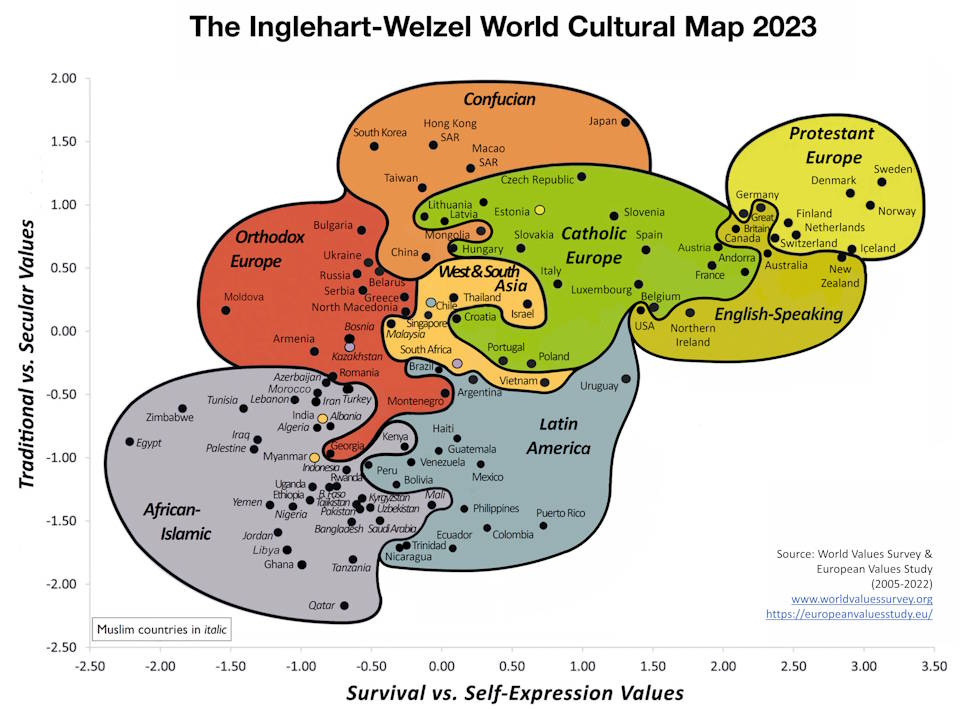
You can see a little movement from Hanania’s earlier version — Hong Kong and South Korea have become a bit more secular — but Japan is still the clear outlier in the “Confucian” category. Its values are far more in the direction of “self-expression” — very close to the U.S., in fact (though North Europe and the Anglosphere still reign supreme in this regard).
To anyone who has lived in Japan, this is hardly a surprise. The country is highly individualistic, creative, and socially nonconformist, despite a penchant for following rules and procedures. Japanese parenting is also far more laissez-faire and far less education-obsessed than Chinese parenting. If you want to read more, I recommend the book New Japan: Debunking Seven Cultural Stereotypes, by David Matsumoto; it’s two decades old at this point, but still perfectly relevant.
In other words, “Confucian” is lazily applied to Japan as a racial category, rather than any kind of a useful description of the culture and society.
7. State capacity: It works.
One unpopular position I’ve stuck to over the years is that a strong bureaucracy is good. I don’t mean “bureaucracy” as in red tape and regulation; I mean a competent, empowered civil service that can perform crucial government functions efficiently and well using in-house expertise. This is also called state capacity. Over the past half century, conservatives and progressives made a devil’s bargain to slash state capacity — conservatives got to cut the size of government, while progressives got to outsource core government functions to progressive nonprofits.
The problem was that this often ended up costing the government much more money to do things like build trains and roads, because the government ended up getting ripped off by expensive consultants, ineffective and sometimes corrupt nonprofits, opportunistic unions, etc. — as well as suffering constant delays that increased costs even more and sometimes prevented anything from being completed at all. A decade ago, the New York Times published a story called “The Most Expensive Mile of Subway Track on Earth”, detailing how lack of state capacity had made NYC’s famous train system increasingly dysfunctional and unaffordable.
So I was very happy to see a story (by Tahra Hoops) about how NYC’s Metropolitan Transportation Authority has actually invested in state capacity, and how this investment is yielding results:

Some excerpts:
Last week, the MTA…finished a major infrastructure project 60 months ahead of schedule and $195 million under budget…Since October 2023, crews replaced 196 bridge structures and more than 12,600 feet of railroad along the Park Avenue Viaduct…And to top it all off, they did it over 28 weekends without delaying a single train…
The project was done effectively through prefabrication, sequencing, and a project team empowered to actually manage the work…Phase 1 wrapped 21 months ahead of schedule in October 2025. Phase 2 finished the weekend of July 25, five full years early, with the final cost coming in $195 million under the initial $960 million budget…
Before 2019, capital projects at the MTA were run separately by each operating agency…In 2019, the MTA consolidated all of it into a single delivery organization, MTA Construction & Development, bringing nearly 2,000 employees from those scattered capital divisions under one roof. One agency, one accountable executive, one set of lessons learned that actually compound from project to project…In 2023, C&D awarded more than $8 billion in new contracts at prices 6.2 percent below the engineer’s estimate, saving nearly $300 million, and in 2025 it reported another $1.2 billion in savings while completing 41 elevator replacements, double its previous single-year record, each finished about two months faster on average…
C&D shifted to design-build contracts, which put design and construction under one contract so the builder owns the gap between the drawings and the dirt, and bundled similar projects into single procurements rather than bidding out ten station upgrades ten separate times. It also started pulling work back in-house instead of defaulting to consultants[.]
This is great progress, and shows the value of the state capacity approach to infrastructure. Whether other states and cities will pay attention is another question. Hoops notes that L.A.’s D Line extension is mired in the typical endless series of delays and cost overruns. Five decades of going in the wrong direction is hard to reverse overnight.
Still, the MTA’s success shows that in most cases, all you really need in order to get infrastructure built cheaply is the political will to do so.
8. Will self-driving cars make cities more dense or less dense?
A lot of people just assume that self-driving cars will make cities less dense. After all, simple logic dictates that if a car trip is less burdensome — if you’re able to get work done or watch TV or scroll social media during your commute instead of being forced to keep your eyes on the road — then people will be willing to live farther away from their places of work. That suggests that like the car itself, self-driving cars will lead to urban sprawl — which is why many urbanists don’t like the notion of self-driving cars, despite the obvious safety benefits.
But in fact, the economics of self-driving cars and city size are a lot more complex and subtle. Ed Glaeser, one of the greatest living urban economists, has a new paper exploring the topic. After explaining the relevant economic theory, he argues that Waymos and other autonomous vehicles will make people want to live in dense urban areas more, rather than less.
Glaeser notes that people who live in dense cities actually spend more time commuting than people who live in the suburbs (something I wrote a post about a couple of months ago). That means urbanites stand to benefit more from self-driving car trips than suburbanites, who generally already have shorter (and probably less stressful) commutes. Thus, he argues, self-driving cars will complement urban life more than suburban life, and make people want to live in denser cities. He expects the effect to be modest, but it’s still in the exact opposite direction from what people’s intuitions suggest.
Fundamentally, this is because people typically misunderstand the nature of American suburbia. They imagine bedroom communities where people commute to and from a central business district. Some suburbs definitely do behave like that, but most are like little cities themselves, with office parks where people work and strip-malls where people shop. Suburbanites trade the variety and financial opportunity of the big city for the convenience and safety of the suburbs. But self-driving cars make big cities more convenient.
Urbanists who throw a lot of hate at self-driving cars should stop to consider that perhaps their anger is misplaced.
Glaeser is probably one of the best / most prominent living urban economists, but who are the best dead ones?