


So, Germany’s far-right party, the AfD, just won a huge landslide election victory in the eastern state of Saxony-Anhalt. This doesn’t mean AfD is taking over Germany — the far right is much more popular in the post-communist east than in the more populated western regions. Germany is also a parliamentary democracy, and almost everyone else hates and fears the AfD. But the statewide victory is a warning shot, and everyone in Germany — and in Europe — is taking it seriously.
AfD’s surge means two things. First, it means that the rise of far-right parties was not simply a reaction to the pandemic. Back in 2024-25, a number of pundits I respect argued that voters in the U.S. and Europe were backing rightist leaders out of anger at incumbents over Covid. That thesis now looks dead.
Second, it means that something is making many German voters so angry that they’re finally willing to overlook all of the AfD’s catastrophic flaws — its obvious ties to Vladimir Putin, the fact that the party is filled with crooks, its extreme rhetoric, its lack of governing experience, and so on.
What is that “something”? A number of socialist types have tried to claim that AfD’s new voters are responding to economic despair, and can be won back with more socialism. But more sober voices agree that the “something” is immigration. Adam Tooze, who strongly leans to the left, tries to be gentle as he explains that there’s no getting around the immigration issue:
If you ask AfD voters what they worry about, along with their xenophobic concerns about “too many foreigners”, they will mention the cost of living and their concerns for their standard of living. They also mention climate change and the threat of external war…But if you ask them what they think about the AfD and why they voted for it, economic issues are barely mentioned. What comes first is security, foreigners, woke politics, remoteness etc…
If you are hard up and working-class it would after all be nothing short of bizarre to vote for the AfD in the hope of improved social protection…Voting for the AfD in the current landscape, whatever your economic issues, in short, is not a vote to have your economic issues addressed by social democracy, or welfare or government intervention. It is a vote to crackdown on foreigners[.] [emphasis mine]
Robin Brooks is more blunt:
There’s lots going on in Germany at the moment, but - when it comes to the surge in AfD popularity - you don’t need to overthink it. The AfD is relentlessly campaigning on immigration, which tells you that this is what resonates most with voters…A key driver of the recent surge in AfD popularity is that the CDU - SPD grand coalition is proving itself incapable of confronting immigration with the urgency many voters want.
In fact, anger over immigration is probably the main reason that the right is surging everywhere in Europe. Here are Konstantinou and Roumanias (2024) with some data:
We use regional data spanning over 4500 electoral outcomes…between 2000 and 2017 to assess the impact of immigration on Western European Far-Right voting. To deal with potential reverse causation, we use immigration in neighboring countries as an instrument for domestic immigration. The estimated effects of immigration are positive, significant and larger compared to those obtained by simple OLS and fixed effects regressions. Depending on the measure of immigration used, we find that a 1% increase in immigration stocks leads to a between 1.78% and 2.97% in Far-Right voting…Our estimated effects explain a large part of the observed rise in Far-Right in Western European countries that experienced high levels of immigration during the span of our sample.
2026 is hardly the beginning of the trend. Here’s Brookings in 2024:
In the European Union (EU), one election after another has demonstrated the centrality of irregular migration and border security in public discussions and forced mainstream parties to take more restrictive approaches…The results of the European Parliament election, France’s snap election, three German state elections, and the Austrian election all showed a strong rightward drift and signaled voters’ distrust in their national governments, confirming the notable shift in tone on migration in Europe toward a more securitized, hardline approach, even among mainstream parties.
Trump’s election in 2024 was also partially about immigration. Trump voters rated it as one of their top issues, along with inflation. It was the issue where Trump had the strongest lead over Kamala Harris in polls. American voters clearly soured on immigration in 2023-24.
Progressives in America and socialists in Europe still desperately claim that what angry working-class voters really want is more economic support. They keep offering more and more lavish promises of welfare supports and price controls, while staunchly opposing restrictions on immigration. The approach keeps failing, and the far right keeps rising.
Center-right and center-left politicians, on the other hand, realize the source of their voters’ anger very clearly, and are taking steps to reduce immigration. Germany’s center-right CDU has already stanched the flow with restrictive policies:
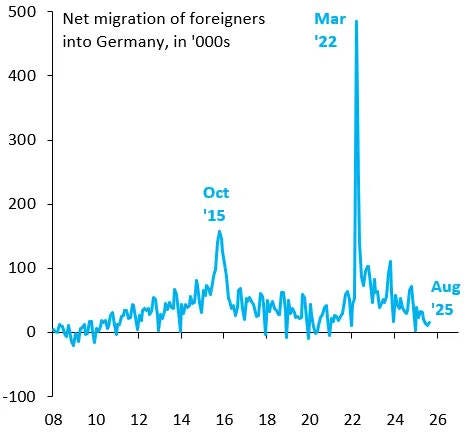
And Chancellor Friedrich Merz is responding to AfD’s gains by making it harder to get citizenship. Meanwhile, France and Italy are tightening border controls. France is making it harder to become a citizen. The EU is toughening up its asylum rules. Sweden is offering migrants large sums of money to leave the country. European countries are streamlining their infrastructure for kicking out large numbers of failed asylum-seekers. Japan is tightening its own immigration policies after a period of liberalization.
Even Canada, one of the most immigration-friendly and progressive countries on Earth, has scrambled to reduce immigration, cutting targets for permanent residents, reducing student visas, and slashing the number of temporary workers. Immigration levels are still high, but are falling quickly — all under the center-left government of Mark Carney.
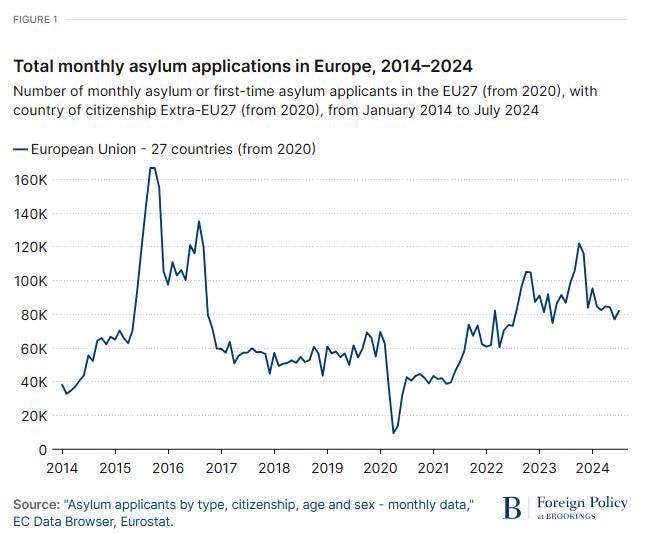
And yet I’m worried that voters around the world will see these measures as superficial — tactical pauses to let populist anger simmer down before resuming the same permissive immigration policies that made voters mad in the first place. This certainly seemed to be the case in Europe, where the government stopped admitting asylum seekers from the Middle East in the late 2010s after a popular outcry, only to resume taking them in en masse in the 2020s:
And it also seems to be true in the U.S.; Biden mostly closed the border to asylum-seekers in 2024 after he saw how mad it was making Americans, but many Democrats are now calling for the abolition of ICE. This is a somewhat popular position right now, thanks to the agency’s abuses under Trump. But if Democrats actually try to abolish federal immigration enforcement instead of just reshuffling and renaming the agencies, I predict it will take just a couple of years for Americans to realize that the difference between “open borders” and “immigration laws with no one to enforce them” is largely semantic.
What’s needed, I believe, is not just a tactical, temporary retreat. We need to stop and think why a maximal pro-immigration policy is something that we need to retreat from in the first place. We need a new concept of what a sustainable liberal immigration policy looks like.
Since I started writing, I’ve been an advocate of more immigration to the United States. This does not mean I ever favored unrestrained immigration or open borders. I’ve consistently argued that favoring skilled immigration will bring more economic benefits to native-born Americans, and be more politically palatable as well. And while I don’t hate illegal immigrants for trying to better their lot in life, I favor strong border controls, because nations have the right to decide, democratically, who gets in and out. It’s understandable when people get mad at seeing their decisions flouted.
On top of that, I’ve always remained agnostic on immigration to other countries; although I find much to admire in Canada’s points-based system, for example, I don’t think that qualifies me to decide whether more immigration is good for Canada overall. If the people of a country decide that immigration is diluting their local culture unacceptably, for instance, I think they have every right to cut it off. That’s just Westphalian sovereignty — not a perfect system, but the best system we’ve ever found for organizing humanity into geographic units. As an American, I don’t view it as my place to tell Japan, or the UK, or any other country that immigration is the right choice for them.
Despite those reservations, I’ve always thought that immigration to the U.S. is a basically good thing, and should be expanded. The economic benefits are pretty undeniable — higher tax revenue to shore up our dangerously depleted government finances, dominance in high-tech industries and innovation, and so on. And while some of the economic costs are real — local housing shortages and strains on local government finances being the two biggest ones — many of the fears are overblown. In particular, the bulk of the evidence concludes that immigrants don’t reduce wages or job opportunities for native-born Americans.
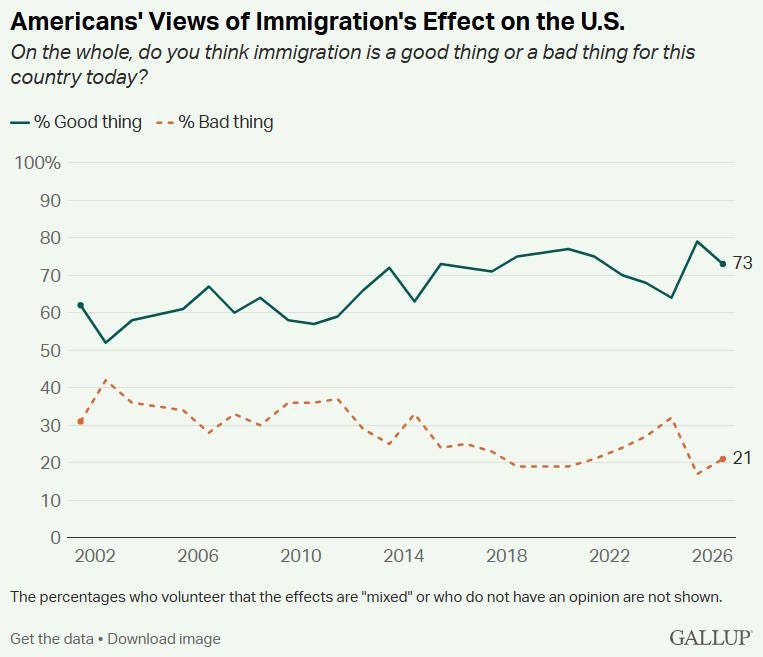
And importantly, lots of Americans share my overall positive view of immigration. If you ask Americans whether they think immigration is good or bad, most will say “good”:
And if you ask Americans whether the annual rate of immigration should be increased, decreased, or kept the same, you get a pretty even split:

So I’ve never really felt like I was going out on a limb or advocating an unpopular position when it came to this issue. Sure, rightists will direct online vitriol toward anyone who supports any immigration at all, but their energy and savagery shouldn’t be mistaken for majority support.
And yet there will always be some amount of immigration — and some types of immigration — that will arouse even the most open and welcoming people to ire and make them think about shutting the doors. We saw this in the U.S. in 2023-24, when anti-immigration sentiment spiked in response to Biden’s permissive asylum policies. Yes, that sentiment crashed again when Trump took power and started committing abuses. But if liberals don’t change how we approach immigration, the sentiment will simply rise again and again, as it has so many times throughout our history. And the Donald Trump and Stephen Miller types will be right back in power — and our country will be worse off for it.
Liberals need an immigration approach that can be sustained for long periods of time — i.e., one that doesn’t enrage the public every time it manages to get in power. What would that look like?
The first thing liberals (and progressives, and Democrats, and European lefties, etc.) need to admit is that migration is not a human right. We live in a world of sovereign nation-states, and unless we find some better way of dividing up and administering the world, we will continue to live in a world of sovereign nation-states. And nations are, necessarily, exclusive clubs; they have the right to restrict immigration for any reason whatsoever.
Liberals must therefore not view borders and citizenship as annoying obstacles to be tactically circumvented or overcome; instead, we must view them as fundamental parts of the social compact that allows nations, including liberal nations, to exist in the first place. Nation-states and their laws and their police and their courts and their armies are the fundamental guarantors of the human rights that define liberalism. And for better or for worse, the ability to decide who gets in and who has to keep out is a necessary precondition for nation-states to exist.
That means we need to recognize that immigration law is legitimate and needs to be upheld. Some progressives have tried to advance the notion that being undocumented is a marginalized identity that needs to be protected and supported by the state. But this is absurd; it’s like if progressives decided that people who drive over the speed limit are a minority group.
Illegal immigrants chose to break U.S. law when they came to this country. Our democratically elected leaders made those laws, and they should be honored. We should treat illegal immigrants humanely, of course, and we should not tear local communities apart just to hunt down a few people. But there has to be some way of enforcing the law, because a law without enforcement is no law at all.
A third principle that liberals should embrace is that the purpose of immigration is to benefit the people who already live in the country that is receiving the immigrants. Immigration to America must be for the benefit of Americans. We must flatly reject any concept of immigration that sees it as a necessary sacrifice on the part of American citizens.
For example, the book This Land is Our Land, by Suketu Mehta, argues that immigration is a form of reparations for colonialism — a sacrifice that Western nations owe to other nations, even at their own expense. This idea has found some purchase in progressive circles, but liberals must reject it as wholly illegitimate.
Instead, liberals need to promote immigration because of the benefits it brings to the American citizenry. This includes economic benefits — the tax revenue, the investment, the eldercare, the innovation, the entrepreneurship, the expanded market size. But it also includes cultural benefits — the constant reinvigoration of this nation of immigrants by new waves of people with the gumption and bravery to pick up and move across the world in search of opportunity and freedom.
America has always been the country of the frontier; in order to maintain that ethos in the modern age, we need people for whom America itself is the frontier. And our founding ideals — which are very liberal ideals, of liberty and opportunity and the rights of the individual — are strengthened by people who make the conscious choice to move to a country that represents those ideals.
These are the kinds of arguments liberals made in the past. We can — we should — make them again.
And if this requires us to be selective about which immigrants we bring in, then so be it. Skilled immigrants bring far more economic benefits per capita than others — so by all means, let us tilt our system toward them, as American voters of both parties want. Immigrants who don’t love and embrace American culture will probably invigorate our nation less — so by all means, let us bar immigrants who have been part of groups that see America as evil, using the law with which we once banned immigration by members of communist parties.
These are the kinds of decisions that nation-states, including liberal nation-states, are inherently entitled to make. And we should expect Europe to make different decisions than America makes. That’s perfectly OK. Because immigration is fundamentally the decision of each sovereign nation-state, it’s inevitable that we’ll make different decisions. JD Vance wants us to think that France’s immigration policy, or Germany’s, is inextricably tied to America’s. But it’s not, and we shouldn’t let him get away with conflating the two.
A liberal immigration program based on these three principles could defuse the anti-immigration sentiment now sweeping the developed world — not just now, but permanently. But it will only do so if liberal leaders explicitly articulate and avow these principles. That’s what’s required in order to convince the electorate that liberals are trustworthy on immigration — that embracing the kind of immigration policies Americans demand represents a principled stand rather than a tactical retreat from a hidden agenda of open borders.
For America, the kind of immigration agenda I’ve sketched out — which all the polls show Americans favor by substantial margins — would not be a “far right” policy, even though some progressives and leftists will inevitably try to label it as such. In fact, it would allow in far more immigration than the policies of Franklin D. Roosevelt or Harry Truman. It won’t satisfy progressives who dream of a borderless world, or leftists who salivate over the chance to make the West pay for colonialism. But I believe it will preserve America as the kind of liberal nation-state that we knew it as in the days before Trump.
As for the rest of the world, countries like Germany and Canada and Japan have to make their own decisions. I can’t tell them what kind of nation to build; I can only try to promise that as an American, I’ll respect their decision. If they want to shut their doors in order to slow the pace of cultural change, it’s not my job to lecture them otherwise. All I can say is that I hope they do what they need to do in order to avoid getting taken over by parties that take their marching orders from the Kremlin.
But speaking only for my own country, I believe that if America gives up immigration, it will lose one of the key things that has made it great. With the GOP in the hands of a xenophobic rightist movement that sees immigration as an invasion, it’s up to the Democrats to craft a system that can be preserved for the long term.
Would you consider adding "assimilation" to this discussion?
For a simple example: I feel there has been a lot of Left pushback against wanting immigrants to learn English. But opinion polls show most Americans would even go so far as making English our official language. The common view is as simple as "if you want to become and American, BECOME an American." In the 20th century, most immigrants I knew actually felt this way too! Oh, they might keep some traditions and foods from the old country, but they raised their kids as Americans.
Basically I think the economic argument will only go so far, and people really want assurances that new arrivals will not change the CULTURE of their country.
The problem is not skilled migration in Europe. All European countries have strict criteria to get work visa if you are coming from outside Europe. The problem is illegal migration and asylum seekers.
You write that ''migration is not a human right'' but that is exactly the issue: European countries signed up to the European Convention on Human Rights (ECHR) which states that everyone can apply for asylum in a European country. Therefore politicians can promise all kind of changes to national laws but as ECHR overrules national laws their hands are tied. And this frustrates voters as they see that politicians are powerless. Basically there is only one solution of you want to stop the continues flow of asylum seekers and that is to leave the ECHR and maybe you would even need to leave the EU as the EU laws on asylum also overrule national laws. The other problem is that if asylum is denied you are expected to leave the country but obviously that hardlly happens or they keep moving around Europe trying their luck somewhere else.
Since this summer a new EU migration pact came into force that addresses some of the problems, but the core problem remains the same: anyone from anywhere in the world can apply for asylum in Europe according to the ECHR and EU laws. Therefore they will keep coming.