


Soft power is notoriously hard to quantify, but it’s difficult to argue that global soft power has been shifting steadily toward East Asia in recent decades. A few years ago I wrote a post about how South Korea became a cultural superpower on purpose, while Japan became one by accident:

The big question then was: When does China get its turn? China is a lot bigger than either Japan or Korea, so you might assume that if the world loves East Asian stuff, we might eventually get a Chinese Wave. So far, it’s been slow to arrive. In my post about the Chinese Century last year, I argued that China’s closed political system meant that its cultural influence would lag its technological and geopolitical might:
In the cultural realm, I expect China to be more isolated and less influential than America was…China is a deeply repressive nation, with universal surveillance, fine-grained media and speech control, and ubiquitous censorship. That’s the kind of society where only anodyne, cautious artistry can flourish, except in tiny subcultural pockets too small for the government to worry about…China’s leaders will also...continue to use the Great Firewall to “protect” Chinese people from the memes and ideas produced by the rest of the world. So artistic and cultural ferment will arrive in China only weakly, and with a lag. It will be orphaned from the global discussion…So while I expect China to produce some hit video games and big-budget movies, I don’t think it will do much to push the boundaries of culture, despite the individual creativity of its people.
In a follow-up post on Sinofuturism, I reiterated this prediction:

But as I noted in that post, the past year has seen the rise of breathless “I went to China” videos by American social media influencers. Although so far the videos are pretty shallow stuff — mostly just breathless videos and photos of China’s grandiose infrastructure — there’s a possibility it could be the start of the long-awaited Chinese Wave of soft power.
The “Chinamaxxing” trend feels a bit fake
Fast forward a year, and some people are claiming the wave has begun. There has been a “Chinamaxxing” trend on English-language social media:
[T]he phenomenon of “Chinamaxxing” has swept feeds with videos of people sipping hot water, shuffling around the house in slippers and donning a viral Adidas jacket resembling historic Chinese fashion…These things, content creators joke, will help you “become Chinese” – reflecting a growing Western fascination with Chinese culture and aesthetics…“Morning routine as a new Chinese baddie,” one TikTok creator captioned a video in which he does a series of traditional Chinese exercises. Another video, viewed more than 2.4 million times as of late February, shows the creator boiling apples to make fruit tea – a supposedly old-school Chinese elixir for gut health.
And here’s Fortune:
On TikTok, a growing wave of Gen Z creators—American first, then European, then global—are declaring themselves to be in their “Chinese era.” They’re drinking hot water. They’re eating hotpot. They’re wearing slippers indoors and marveling at the electric buzz of Chinese city life. They’re calling it “Chinamaxxing.”…
Spend five minutes in the Chinamaxxing corner of TikTok, and a clear aesthetic emerges. The videos cluster into a few recognizable genres. There’s “wellness and longevity mode” — warm water with fruit, herbal teas, gua sha, early bedtimes, gentle morning exercises, all framed as ancient secrets to soft living. There’s “uncle core,” in which creators affectionately mimic Chinese retirees: tracksuits, sidewalk squatting, communal street-side beers, a whole visual argument against American hustle culture.
But despite all the stories about this trend (here’s Slate, NPR, the AP, and the BBC if you want some others), it doesn’t feel like the kind of soft power wave we’ve seen from Korea and other countries. There are few actual Chinese products or creations involved here. Western youngsters are not, in general, watching Chinese dramas or microdramas, listening to Chinese music, or playing Chinese video games. Adidas, with its viral Chinese-style jacket, is a German company.
The most trumpeted Chinese cultural products still don’t seem to be finding much purchase outside China. Ne Zha 2, often trumpeted as the highest-grossing animated film of all time, earned over 99% of its revenue in mainland China. Black Myth: Wukong, the most famous Chinese video game, got over three quarters of its Steam sales from China.1 Other than the rapper Skai Isyourgod, who has had several songs go viral on TikTok, there are not many Chinese musicians known in the West.
Instead, the “Chinamaxxing” trend seems to consist mostly of Western youngsters doing stuff they think of as stereotypically Chinese — drinking tea, doing exercises, etc. This is the kind of thing that might have gotten dinged as “cultural appropriation” eight or ten years ago. Today it’s more reasonably viewed as an expression of fascination and respect — but it’s fascination and respect from a great distance.
Then there are those videos of Chinese cities. I covered these in my post last year, but the trend is still going. There are also now a bunch of influencers who relentlessly post about how Chinese cities are the greatest. For example, there’s Jostein Hauge, an assistant professor at Cambridge who relentlessly posts about how China is ahead of the West in every regard. The alleged supremacy of China’s cities is a regular talking point:
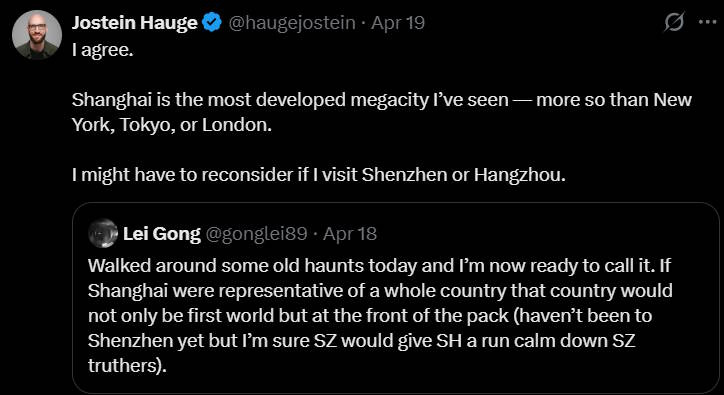
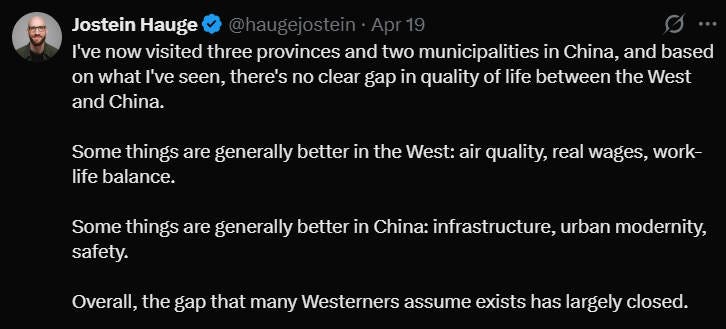
Cynics have noted that these accounts are pretty one-note; it seems more like a deliberate publicity campaign, abetted by a few amateur enthusiasts, than an organic outpouring of enthusiasm for Chinese urbanism. The same is true of the continuing parade of breathless videos from Westerners traveling in Chinese cities — they tend to feature shots of the exact same grandiose train stations and architectural landmarks, or the insides of factories or restaurants or other buildings, rather than videos or photos of life at ground level.
That’s telling, because it stands in stark contrast to the videos and photos you tend to see from Tokyo, Paris, Hong Kong, or other popular older cities. And there’s a reason for that — as I wrote in my Sinofuturism post, Chinese cities were built incredibly quickly instead of growing organically over time. This means that they’re dominated by sterile gated tower blocks (called xiaoqu, or microdistricts), large surface streets, and huge shopping malls. There are relatively few walkable mixed-use streets lined with shops near to people’s homes. External shots of China’s newly built city centers tend to show vast concrete plazas and soaring towers — impressive, but fairly sterile.
In fact, there’s hard data to support the notion that the appeal of China’s megacities is still shallow. As of 2024, tourism to China was still way down from the years before the pandemic, and the number of Americans studying in China had collapsed even further:
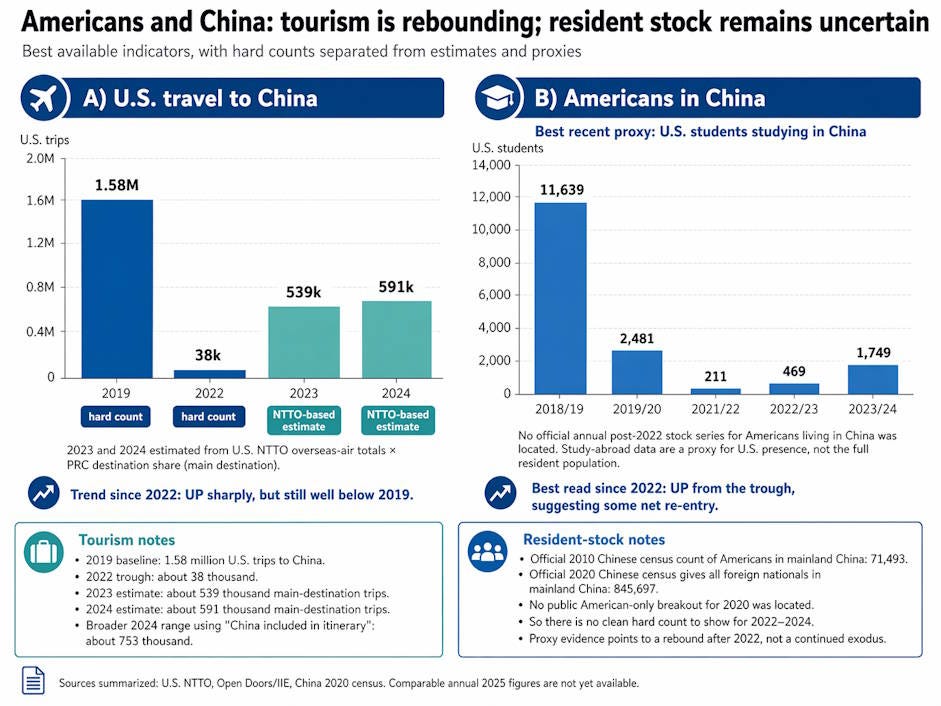
Contrast this with Japan and Korea, which both get many more tourists from the U.S. than China does (despite being far smaller), and which have both seen a more complete rebound since the pandemic:
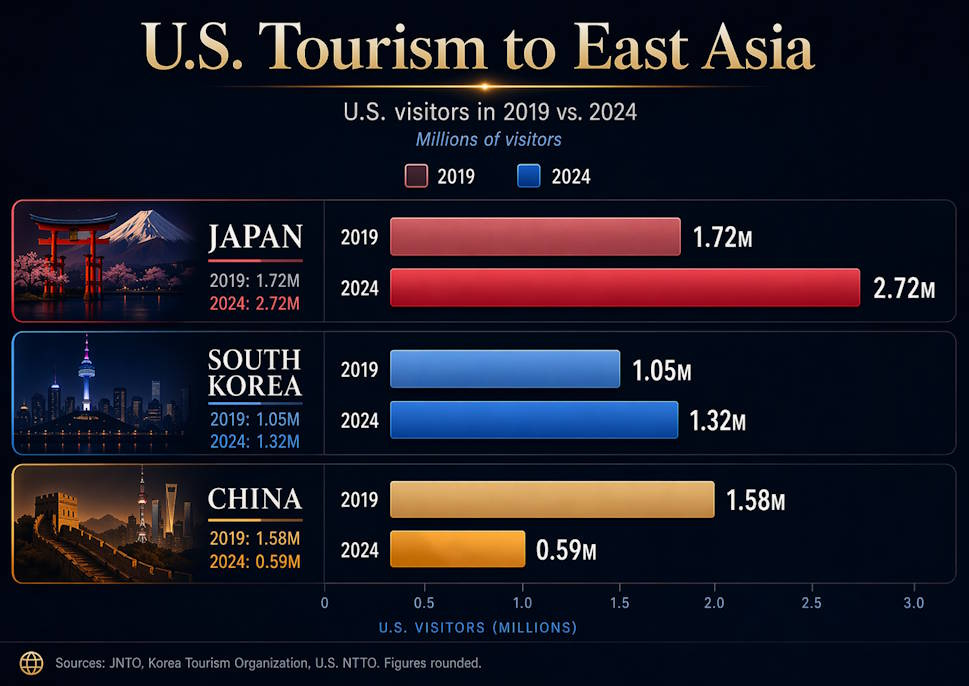
2025 numbers are harder to come by. Tourism to China is still recovering — up about 10% from 2024 — and American travelers are presumably part of this trend. But it’s still nothing compared to the tourism booms to Japan and South Korea, which are well above their pre-pandemic levels.
For all the breathless YouTube videos and glowing testimonials, Americans are still not going to China in large numbers, either to visit or to live.
So overall, the “Chinamaxxing” trend feels a bit fake and forced — the combination of a deliberate marketing campaign and social media influencers looking for a new niche. But there’s something else going on here as well — a statement about the declining appeal of America and the West.
Chinamaxxing is really about the decline of America
I think Fortune really puts its finger on something here:
The subtext of every “very Chinese era” video isn’t really about China. It’s about what young Americans feel they’ve been denied. Chinamaxxing romanticizes things that feel structurally out of reach at home — compact, affordable-looking apartments; public transit that works; streets safe to walk at night; multigenerational households as an antidote to loneliness; communal meals as an antidote to atomization. The comparison is implicit but unmissable: they have this, and we don’t…
Slate‘s Nitish Pahwa captured the emotional logic cleanly: “You told us we couldn’t have a high-speed railroad and universal health care, and it turns out they have it across the street! I’m going to live at their house now!”…Shaoyu Yuan, a scholar who studies Chinese soft power, told NPR the trend operates on two tracks at once: one that “weakens American narrative authority by highlighting content that highlights U.S. dysfunction,” and another that “makes China look more attractive.”…
The American century was built on the world’s desire to be American…The question the turbulent 2020s is forcing is a simpler and more unsettling one: what happens when the generation that was supposed to inherit the American promise looks around at their student loans, their rent, their medical bills, and their crumbling train stations — and decides they’d rather be something else?
And CNN gets it too:
[E]xperts say the [Chinamaxxing] trend reveals deeper undercurrents like dissatisfaction among many Americans with life at home – from political turmoil, gun violence, immigration crackdowns and persistent racial tensions. All this has dulled the veneer of the US, driving curiosity for American youths to see what life is like on the other side…[I]t’s no coincidence the trend comes amid a broader decline in the US’ global image…
[V]ideos showing vertiginous skylines from Chinese metropolises…have gone viral for depicting a futuristic vision of urban life, replete with seemingly clean streets and low levels of violent crime.
In other words, American youngsters idealizing China — without actually engaging with China or knowing much about it — is really about expressing their dissatisfaction with America.
Chinamaxxing is mostly just Americaminning.
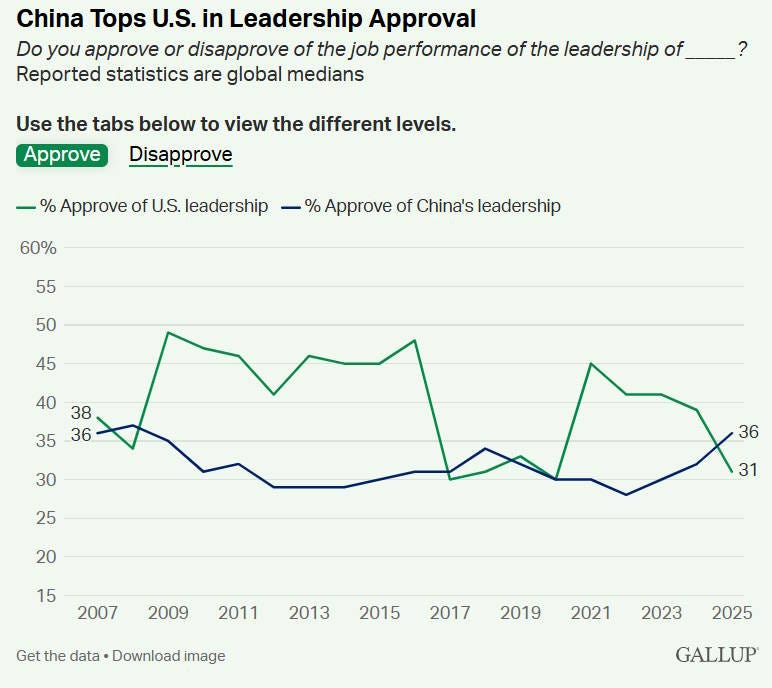
That mirrors a larger global reaction. Donald Trump’s tariffs, threats against allies, and reckless wars have turned most of the world against America. Traditionally, confidence in U.S. leadership was higher than in Chinese leadership, but this has reversed since Trump’s election:
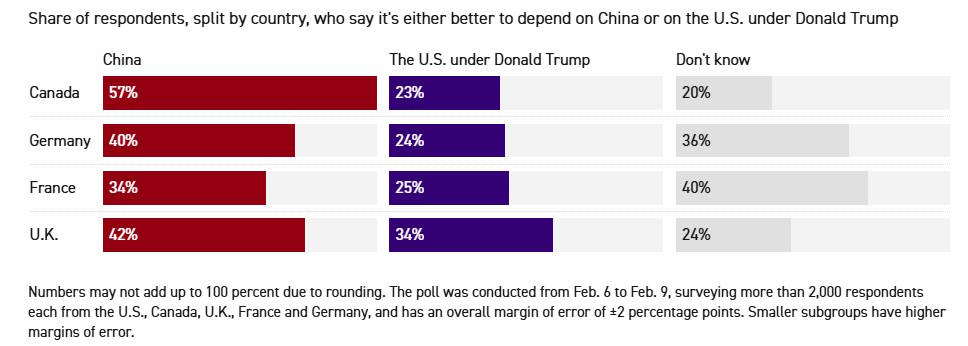
China isn’t especially popular itself, but in the age of Trump, it looks to some people like the only natural alternative:
In America, Trump’s extreme unpopularity among the youth is probably helping to drive the Chinamaxxing trend.
But it’s not just Trump and the GOP. Stories about Chinamaxxing consistently mention the safety, cleanliness, and low crime rates of Chinese cities as part of the country’s appeal. And pro-China influencers repeatedly trumpet this advantage, often showing pictures of China’s immaculate new developments with pictures of homeless encampments in America.
This is no Potemkin comparison. America really does have much worse crime and public order than other countries, including China:

There are a number of reasons for this, but progressive ideology takes much more responsibility than MAGA insanity. Blue cities’ tolerance of public homelessness and drug use, the “progressive prosecutor” movement’s permissive approach toward crime, and the consistent failure of progressive local governments to allow housing construction all contribute to the breakdown in public order that has left America’s flagship cities feeling dirty and unsafe.
It bears saying that despite the safer cities, the superiority of life in China over life in America is more myth than reality. Jacobin, the socialist magazine, recently published a good article by Daniel Cheng debunking the idea that China is a youth paradise:
Most people in China suffer from similar social and economic crises that afflict Americans today. The United States’ extreme income inequality is well-known, but China’s is comparable. After accounting for taxes and redistribution, China becomes even more unequal because it falls under the US’s (very low) standards for redistribution. While Chinese inequality has gradually shrunk over recent years, this is mostly due to compression between the top and middle of the income distribution. Those in the bottom 30 percent have been left in the lurch…
[W]hile American higher education is exorbitantly expensive, the education affordability crisis in China is even more severe. Parents have to pay for high school, and tutoring is a de facto necessity to keep up with demanding curriculums…The bottom quintile of Chinese families spend a massive 57 percent of household earnings on their children’s education…
[H]omelessness and extreme poverty are also major problems in China. Chinamaxxing influencers are simply blind to them because the government has successfully criminalized homelessness and driven the “low-end population” out of sight…Age discrimination in hiring is legal in China…D]ismissal rates rise dramatically after workers turn thirty-five…[A]n unexpected layoff can permanently condemn someone to underemployment in the gig economy.
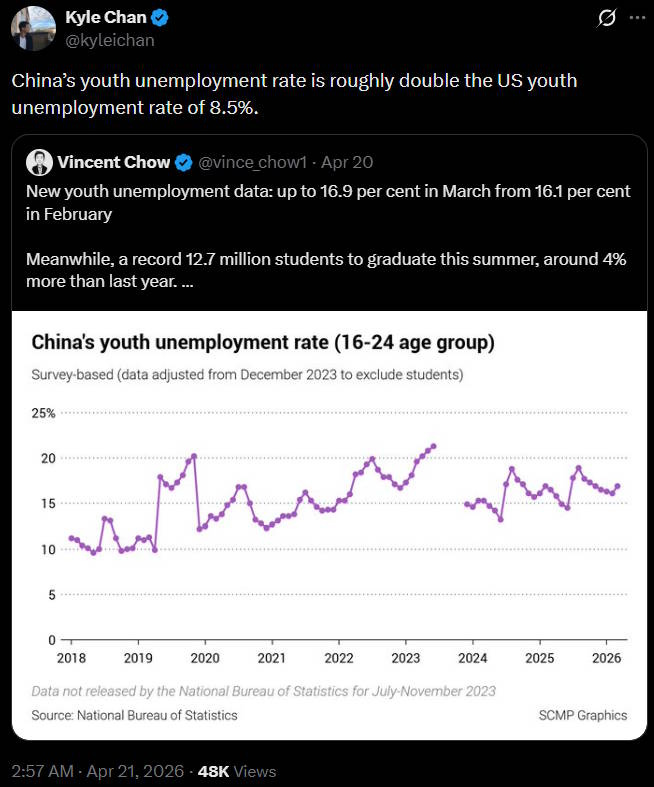
And youth unemployment is far worse in China than in America, even after the government redefined the numbers a couple of years ago to make it look smaller:
This is probably why we don’t see a lot of American “Chinamaxxers” put their money where their mouth is. It’s a lot easier to put on a bathrobe and eat some dumplings and pretend to be a Chinese uncle on TikTok than it is to actually move to China and make a living there.
In fact, China’s leaders probably don’t care. They’re not especially interested in getting American Zoomers to move to Shenzhen or Shanghai. Their own publicity campaigns, including all the gloating over the parlous state of American cities and the constant parade of photos of fabulous new infrastructure, are probably aimed at Chinese scientists and engineers living abroad. And in fact, this campaign is succeeding to some degree, helped along by Trump’s anti-immigration jihad and progressives’ mismanagement of big cities:
For decades…Many of China’s best and brightest saw the U.S. as a land of boundless opportunity underpinned by robust rule of law…Today, America’s allure is fading. More elite Chinese youths, businesspeople and scientists are gravitating back home. Some who have returned say they are turned off not only by the U.S.’s hardening immigration enforcement, but also by its faulty infrastructure, gun violence and living costs. Back in China, many cities have grown cleaner and more livable in recent years, linked together by efficient subways and high-speed trains…
In 2021, more than 1,400 U.S.-trained Chinese scientists left American jobs for roles in China, a 22% jump from the previous year, according to a survey published by Asian American Scholar Forum, an advocacy group. Most China-born Ph.D. graduates are still choosing to stay in the U.S., with close to 80% saying they intended to remain in 2024, according to the most recent available survey data from the National Science Foundation. But high-profile departures have continued steadily…
Frequent changes in immigration rules, combined with homelessness and perceptions of high crime rates in some of the coastal cities where Chinese immigrants tend to live, are also leading people to reconsider the appeal of the American dream, according to Chinese people who have spent time in both countries.
American leaders should be a lot more worried about losing Chinese talent than about Gen Z “becoming Chinese”.
Some real green shoots of Chinese soft power
All that having been said, I do see a few glimmers of real, organic Chinese cultural appeal. One is the rise of the Chinese micro-drama or duanju. These are serial shows with scripted 1-2 minute episodes, shown in a vertical scrolling feed. It’s a truly new art form, perfect for the age of TikTok and AI. The Economist explainer posits that these dramas have flourished precisely because the flood of content is too large for China’s censors to monitor and eviscerate:
Artsy film critics are unlikely to be impressed by China’s micro-dramas. Even so, the roughly two-minute episodes, which cram soap-opera plots into a short-video format, are wildly popular. Watched almost exclusively on mobile devices, viewers can scroll mindlessly through episodes as they would clips on TikTok. Revenue in China from micro-dramas is projected to nearly double this year…Chen Ou, the founder of Jumei Film Base, a leading micro-drama studio in Zhengzhou, says his company is starting to monetise its star power with live-streaming sales…[N]early all large tech companies in China are snapping up rights to micro-dramas…Many local governments are investing in micro-drama studios…
[F]or micro-dramas, which are chock-full of the kinds of taboo topics and comedic violence that usually irk censors, industry insiders say the sheer volume of content has resulted in looser or fewer checks.
This reminds me of how manga and anime developed in Japan — it flew under the radar of the conservative oligopolies that dominated movies and TV in the postwar period, making it a haven for political radicals,2 sexual deviants, and artistic auteurs.
It’s still early days, but Chinese microdramas are starting to catch on in America. This is from Wikipedia:
ReelShort and DramaBox, the two largest Chinese short-drama platforms operating overseas, entered the U.S. market in 2022 and 2023, respectively. By August 2025, DramaBox had surpassed 100 million downloads on Google Play alone, while maintaining an average of 44 million monthly active users. Meanwhile, ReelShort surpassed 370 million downloads and raked in $700 million in revenue. By 2025, the U.S. had become the single largest revenue market outside China for vertical drama, generating approximately $58 million in monthly in-app revenue and an estimated $1.3 billion for the full year. As of 2025, ReelShort and DramaBox are the top two duanju platforms in terms of downloads and active users.
Retail is a second strong point. As China’s economy diversifies and consumption rises, some Chinese shops are also starting to make inroads into cities in America and around the world. Chagee, Heytea, Mixue, and Luckin Coffee are high-quality drink shops that seem to have real and immediate appeal (Chagee is my personal favorite).3 The stores Miniso and Popmart are appearing all over global malls, selling toys, collectibles, and various other knicknacks. Chinese fashion is starting to make inroads overseas as well.
Food and design are inherently apolitical, so it’s a lot easier for Chinese creativity to reach the world through these items than through movies, TV, or music.
A third bright spot is the city of Chongqing. Unlike the sterile, formulaic videos of Shenzhen, the videos of Chongqing’s urban canyons and cyberpunk streets feel authentic and exciting:
Even the videos complaining about the difficulty of commuting to work showcase an urban landscape so unique that it has captivated much of the world:
In fact, tourists are actually flocking to Chongqing, to see the “cyberpunk city”. One reason for Chongqing’s appeal is that unlike Shenzhen or other “Tier 1” cities, Chongqing has more “old streets” adjacent to the newly-built downtown areas, giving it some of the kind of mixed-use walkable density that cities like Hong Kong and Tokyo have. Personally, I’d love to spend some time in Chongqing, while Shenzhen looks like somewhere I’d only go in order to tour some factories and see some robots.
So in fact, I do see some real signs of China’s soft power growing organically — finding ways to flow around the walls of censorship and official marketing campaigns, exposing outsiders to a more real, raw, authentic China. It would be astonishing if a newly developed country of 1.4 billion people didn’t have plenty of natural, organic appeal. Now, despite the best efforts of the country’s masters, that appeal is starting to show itself.
Marvel Rivals is made by a Chinese studio, but the IP is just Marvel superheroes.
The most famous right-wing anime creator is probably Nishizaki Yoshinobu of Space Battleship Yamato, while the most famous left-wing creators is almost certainly Miyazaki Hayao (of Ghibli fame). There are many other examples.
It’s kind of crazy that Taiwanese boba chains never expanded and became famous overseas.
I understand dreaming of places you've never been or things you don't have. But I'm genuinely surprised by the amount of Chinamaxxing I've seen too. China does an incredible job curating an image of utopia. But grass isn't always greener on the other side, folks.
I actually feel like Texas is having more of a soft power moment than China. Maybe it’s my X feed bias or something but I see so much content related to Buccees, and that giant grocery store chain they have and how Austin is a cool place. Even Netflix has more content down to things like “Watch these Korean guys wander around Texas and show you how great it is.” Korea and Texas the real soft power couple!