

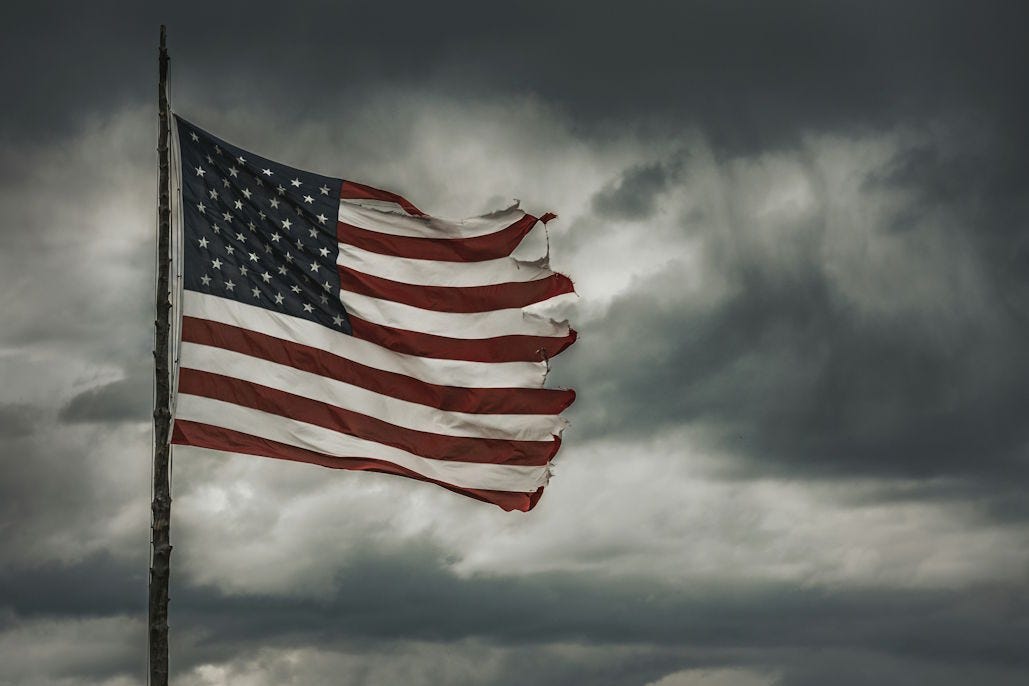
I remember a moment during the 2012 presidential campaign, when a woman sobbed on camera and cried “I want my America back!”. It bewildered me at the time; as far as I could tell, the America of 2012 was the same America I grew up in — unruly, anti-intellectual, independent to a fault, but kind to their neighbors, hard-working, fiercely protective of their freedoms, and generally accepting of those who were different. Like many others, I shrugged and concluded that the woman who was sobbing on camera was simply upset about the fact that the President was Black.
Thirteen years later, I’m still not sure exactly what that woman was upset about. But I definitely feel that the shoe is on the other foot. Today I look out at my own country and I feel like an intense sense of loss and longing for something that may no longer exist. The shared values that I felt permeated and undergirded my culture haven’t vanished completely, but it feels like among a large segment of the populace, they’ve been replaced with politicized anger.
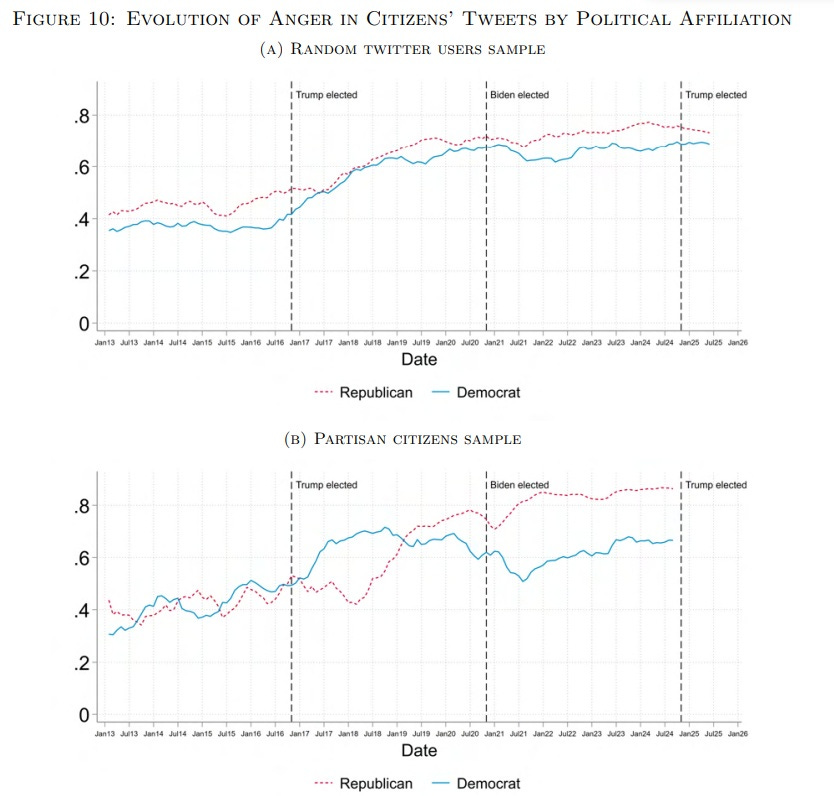
There is data to support this feeling. Algan et al. (2025) use AI to analyze the sentiment of tweets — both a random sample of tweets, and the tweets of a few hundred of the most prominent political shouters in America (whom they label “partisan citizens”). They find that from around 2016-2019, Americans of both political stripes became much angrier online:
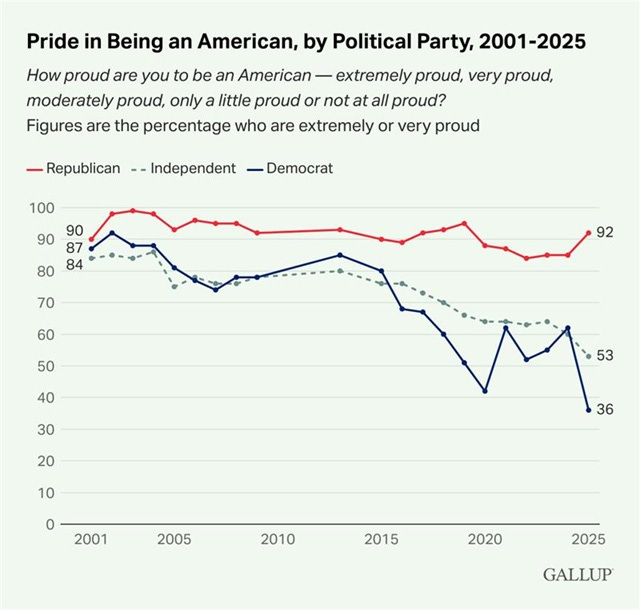
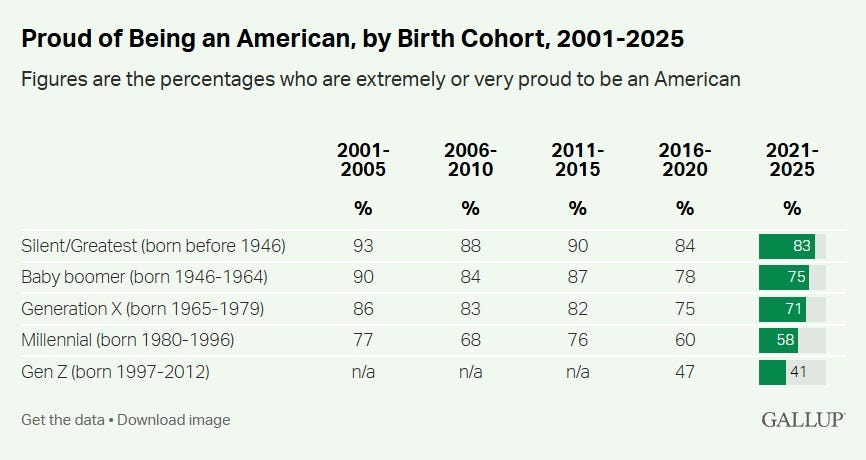
Around that same time, Democrats and political Independents became much less proud to be American:
And a well-publicized poll in 2023 found that Americans prioritize community involvement and tolerance less, and money more, than they did in earlier years:
Some 38% of respondents said patriotism was very important to them, and 39% said religion was very important. That was down sharply from when the Journal first asked the question in 1998, when 70% deemed patriotism to be very important, and 62% said so of religion…The share of Americans who say that having children, involvement in their community and hard work are very important values has also fallen. Tolerance for others, deemed very important by 80% of Americans as recently as four years ago, has fallen to 58% since then.
I’m not the only one who feels this way, either. Right now I’m in Japan promoting my book, and on the 4th of July I gave a talk at a university. A Japanese woman who had lived in America in the 1990s told me that she found American society to be generous, kind, tolerant, and helpful. But when she goes back now, she said, she sees a lot of anger and the culture feels a lot colder.
It’s tempting to look at these data points and anecdotes and conclude that the old America has been swept away by the tide of history, like the Roman Empire or the Qing Dynasty, replaced with something unrecognizable and baleful that just happens to exist on the same plot of land. But I think there’s also evidence that the America I grew up in has not been entirely replaced — that it still exists, battered and a bit shrunken, obscured by the constant flood of social media hate.
For example, when the 2023 poll came out, for instance, Erin Norman wrote a skeptical post, arguing that the shift in values was overstated:
If you don’t make faulty comparisons to previous surveys, the data in the new WSJ/NORC poll is encouraging. Self-fulfillment…is important to 91 percent of Americans. Hard work…tops the list, with 94 percent saying it is important to them…Seventy percent value marriage and 65 percent value having children…90 percent of Americans believe “tolerance for others” is important, and over half qualify it as “very” important…
Perhaps the anonymity of online communication has shown us we aren’t exactly who we thought we were and that there is more diversity of thought in America than stereotypes would suggest. But the WSJ/NORC poll shows that the big-tent, melting pot version of America is very much alive and well.
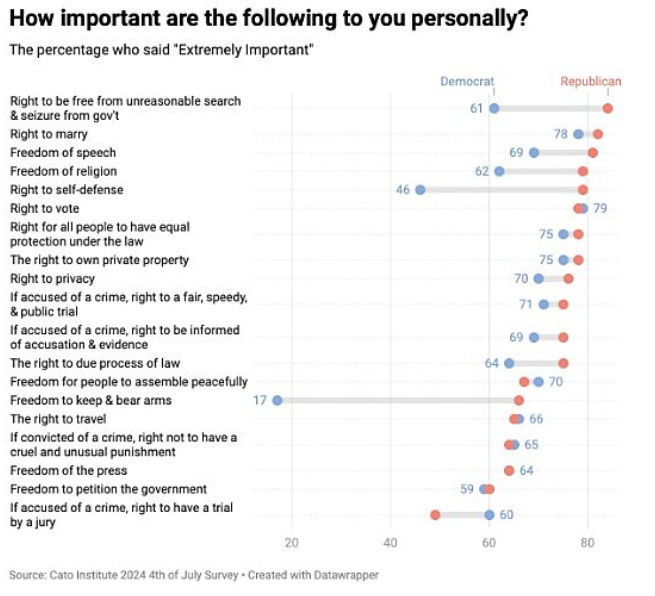
And a 2024 survey by the Cato Institute found that most Americans of both parties still say they value basic American freedoms:
And at times, the America I grew up in pops up to remind me that it still exists. A few weeks ago I attended one of the largest protests in American history, and everyone was waving American flags and talking about freedom:

And while social media is filled with shouting and hate, mass media still generally portrays the same country I remember from my youth — or even an improved version. The best example of this is the TV show Cobra Kai, which just concluded a 6-season run. Cobra Kai is a follow-up to the Karate Kid movies of the 1980s, focusing on the character of Johnny Lawrence, one of the antagonists from the original 1984 film. Now an aging adult, Johnny belatedly learns to temper the violent, toxic masculinity of his youth with adult values of personal responsibility, community, family, and so on, without ever losing his inherent toughness.
The show is one of the most heartwarming things I’ve ever seen on a screen, and I strongly recommend it. It doesn’t portray a return to the America of the 1980s, but rather an alternate future for that America — a projection of how the country could have kept getting better in the ways it seemed to be getting better back then. The cast is diverse, but racial politics never dominates the story.1 Social media exists, but merely as an adjunct for real life instead of a fantasy-land that absorbs young people’s every waking minute. Real-life community and healthy relationships end up winning out over everything else.
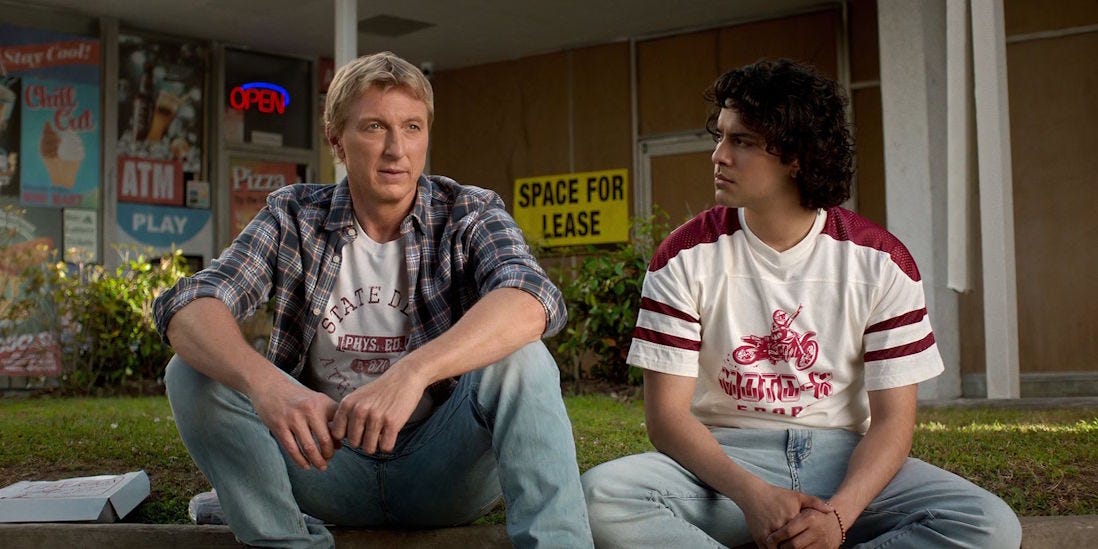
This isn’t a vision of what America is actually like in the 2020s. We can’t simply put down our phones and “touch grass” and go live in the world of Cobra Kai, because that country doesn’t exist. In the real America, young people are glued to TikTok all day, and romantic relationships in high school are now rare, and an Ecuadorian family like that of the protagonist Miguel Diaz would probably worry about the immigration system in some regard. There’s no Trump in Cobra Kai, and no ICE raids. Covid seems never to have happened, and there’s no mention of the BLM protests or the racial tensions of the late 2010s.
Instead, I think fantasies like Cobra Kai show us visions of an America we could have, if we could overcome the forces that filled us with rage and made us so many of us despise our nation. And being the technological determinist that I am, I think we should regard our enemies first and foremost as technological. Our country’s most potent and terrible enemy is in our own pockets.
And having located that enemy, I believe that we can pretty quickly see how to strike it where it lives, and take our country back.
America was conquered by the technologies we invented
People who think a lot about the risks of artificial intelligence like to talk about “shoggoths”. A shoggoth is an amoeba-like monster from the dark fantasy stories of H.P. Lovecraft. Created as a mindless servitor class by an ancient alien race, shoggoths eventually developed minds of their own and rebelled against their creators, driving them into the deep oceans.
Obviously, people think large language models could become humanity’s shoggoths if we’re not careful. But I think that social media has, in essence, already become America’s own shoggoth.
The U.S. invented most of the key technologies of social media — the computer, the internet, mobile phones, Facebook, and Twitter. (Japan contributed 3G wireless networking, and China gave us 4G and TikTok.) But in a post a few weeks ago, I argued that America had been uniquely hurt by the changes that social media unleashed:

In a nutshell, my argument was that diversity was always America’s strength, but only because we were able to use geographic diversity to temper the stresses and strains created by our ideological diversity. When Americans started arguing about politics and society over Twitter and Facebook and TikTok, it immediately stopped mattering as much who their physical neighbors were; in a short space of time, we were thrown into a small room with their countrymen who disagreed with them about everything. This created instant anger and friction throughout society.
At the same time, America had to deal with a version of the same problem that social media has created in all countries — the elevation of toxic personalities to positions of influence and popularity:

In the old days, American political discourse was gatekept by a class of well-educated, decently-well-paid professionals who had a deep stake in the continuity of the country’s social and political system — the anchors of CBS and NBC and ABC, the editors at the New York Times and the Washington Post. Yes, these people tended to be moderate liberals, which annoyed conservatives. Yes, they tended to be conformist centrists who went along with bad ideas like the Iraq War. But overall they were a force for stability.
Social media cracked that cozy oligopoly, which made a lot of people happy, because their views now had the chance to be heard. I was happy about it, because I felt that my own economic commentary was a bit better-informed and more reasonable than the output of many of the country’s most prominent business and economics columnists. In general, liberalism is supposed to thrive on free speech and the marketplace of ideas.
But what we discovered to our dismay, during the 2010s, is that the people who tend to win the scramble for social media influence and attention are toxic rabble-rousers who opportunistically press their grubby fingers into the cracks of every social division they can find in order to raise their own profile and clout. Bor and Petersen (2021) find:
Across eight studies, leveraging cross-national surveys and behavioral experiments (total N=8,434), we [find that] hostile political discussions are the result of status-driven individuals who are drawn to politics and are equally hostile both online and offline. Finally, we offer initial evidence that online discussions feel more hostile, in part, because the behavior of such individuals is more visible than offline. [emphasis mine]
The old mass media gave us the pious liberalism of Dan Rather, the idiosyncratic Boomer silliness of Maureen Dowd, and the vagaries of Thomas Friedman. Those were our opinion leaders in 2010. Social media, on the other hand, gave us extremists like Nick Fuentes, Jack Posobiec, Saira Rao, Jake Shields, Shaun King, Laura Loomer, and so on. In 2010 these people’s names would have been confined to niche activist circles, if they were even known at all; in 2025 they are all minor celebrities, occasionally with the ear of powerful politicians. This is thanks entirely to Twitter and TikTok.
These are only two of the ways in which social media tears at the fabric of the country we grew up with. There are others. For example, social media makes the U.S. more susceptible to foreign extremism. We all talk about the malign influence of foreign government propaganda, and yes this is certainly a problem. But because English is the world’s global language, plenty of regular citizens of countries around the world meddle in American political conflict as a hobby.
A prime example is the right-wing influencer Ian Miles Cheong. Cheong is a Malaysian who has never lived in the U.S., and visited it only a few times. And yet he has strong opinions about American politics, which he has advanced as a Reddit moderator and by shouting on Twitter/X. Cheong’s views of American politics were formed not by growing up in America; he does not have strong personal ties to American society. Yet thanks to social media, Cheong’s opinions about U.S. gender relations, race relations, and foreign policy are all influential in the U.S. in a way they never would have been in 2010.
People like Cheong are just the tip of the iceberg. American social media has become a playground for British and Australian fascists, Latin American communists, Pakistani Islamists, and every other kind of foreign extremist under the sun. Often, the hapless and vulnerable Americans have no idea whether the content they’re consuming on Twitter/X was made by foreigners, so they just assume it came from their countrymen; this makes them think their countrymen are far more extremist than they truly are, stirring division within American society and sowing distrust of neighbor against neighbor.
Foreigners who love America are likely to move here; those who hate America are likely to get involved in English-language social media discourse from afar. And so thanks to social media, young generations of Americans — having grown up on the internet and being more used to taking social cues from strangers online — are especially vulnerable to the tide of anti-American sentiment they encounter online. This is probably a big reason why the young generation is so much less patriotic:
Another big effect of social media is that pseudonymity levels age hierarchies. The old joke is that “on the internet, nobody knows you’re a dog”; the reality is that on the internet, nobody knows you’re a bored teenager. For teenagers, social media provides an opportunity for social status far greater than anything you could ever hope to get at school or in any real-name community. And because outrage spreads more easily on social media than positivity does, the easiest way to become a minor celebrity as a bored teenager is to scream about politics.
Many of us have a romantic notion of what society would look like if the children led us and the wicked old adults had to take a back seat. But in fact, the traditional importance and power of youth movements comes precisely from the fact that there’s such a high natural barrier to young people speaking out and making a difference. For young Americans to protest the war in Vietnam took bravery, effort, and sacrifice; for young Americans to sit around slinging communist or fascist memes from their bedrooms behind a sheltering screen of pseudonymity takes no bravery, effort, or sacrifice. It’s all upside for the young trolls, and downside for the United States of America.
Anyone who has seen the opening to Three Body knows about the negative results that can occur when young people are empowered to overturn age hierarchies and denounce their teachers, parents, and other elders. But on a more mundane level, young people are simply less experienced in life, and thus are more likely to embrace extremist theories. Pseudonymous social media has thus removed much of the tempering effect of wisdom on American society.
Social media also naturally encourages mob mentality. In addition to creating social incentives for people to spread outrage, social media lowers the barriers to people joining in on that outrage. It’s the matter of a simple button press to like or retweet a denunciation or condemnation of a popular figure, and there are no practical consequences to joining the mob. The natural defense against the proliferation of online mobs, of course, is to get a mob of your own that can fight any attacks that come your way. Social media thus leads to balkanization and tribalization of our national discourse.
Finally, social media is an amplifier for misinformation. Studies show that false information tends to spread faster than the truth on Twitter, and the same is probably true on TikTok. The reason isn’t hard to guess. The truth tends to be moderate and nuanced most of the time, while misinformation and conspiracy theories tend to be dramatic and eye-catching.
The natural ease of spreading misinformation on viral platforms without gatekeepers means that political extremists looking to rally Americans to their causes, or malignant troublemakers looking to widen the fissures in American society, have it easy in the social media age. Fact-checkers, debunkers, moderates, and reasonable people in general face an uphill battle; the social media age requires them to mortgage much of their lifetime to the thankless, unpaid, eternal uphill battle of rebutting misinformation. As the old saying goes, a lie can travel halfway around the world while the truth is still putting on its boots.
There is a growing body of careful research establishing causal links between social media and political polarization and extremism. But simply looking at the trend lines is enough to realize how much American society broke in the 2010s when everyone got a smartphone, Twitter, and Facebook. The 2010s are when perceptions of race relations in America fell off a cliff; when people began to perceive much more discrimination against themselves, despite declining discrimination in offline society; when progressives in particular became depressed en masse and started to experience mental health issues on an astonishing scale; and when young Americans started losing trust in their institutions at a rapid rate.
In the short term, the American public is getting exhausted with politics in general. The constant extremism of social media has produced a bone-deep weariness among the general populace. People are tuning political news out, and losing interest in activist causes. The “Great Awokening” is basically over, and recent anti-Trump protests, huge as they were, have been almost entirely peaceful and patriotic. Lots of young people now say they dislike the internet in general, and would even pay to be rid of social media; slowly, they’re filtering away from Twitter/X to private discussion groups and Discord channels. (TikTok will be more resilient, since short-form video is replacing basically every other form of content.)
All this, along with rapidly falling crime, paints a picture of a nation that’s calming down at the grassroots — just as I’ve long predicted.
But the danger to American society doesn’t come from the general populace — it comes from the small fraction of the populace who is deeply engaged and active on political and social issues. Some writers, like Martin Gurri, call this engaged fraction “the public”. It includes the political staffers who write legislation and do communications for our geriatric elected officials; street activists; the journalists and online pundits who write news stories and op-eds; the members of school boards and city councils; administrators at universities; and, of course, our national politicians themselves.
This “public” continues to embrace extremist ideas and to be deeply enveloped in political social media like Twitter/X and TikTok. The people in charge of the GOP are increasingly obsessed with the “Great Replacement” narrative of immigration as an invasion of the West, to the point where top Republicans are willing to mortgage basically every other facet of American policy to feed their battle against immigration:
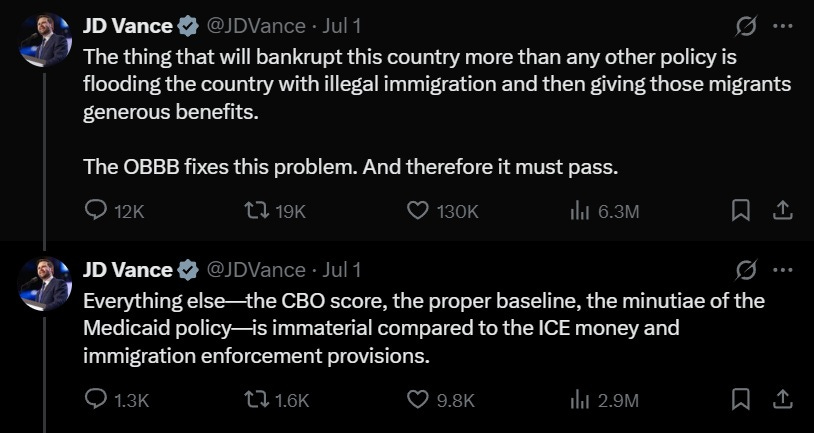
This is why ICE’s budget now exceeds that of most countries’ militaries, even as masked, unidentified ICE agents tear up American communities and the Trump administration celebrates the building of an immigrant detention facility called Alligator Alcatraz.
The Democrats, of course, have not been nearly so radicalized. But the Biden administration governed in a way that was far more radically progressive than Biden’s centrist campaign would have indicated, and a man who defended the phrase “globalize the intifada” is the overwhelming favorite to become the mayor of NYC. Moderate forces within the Democrats are losing power much more slowly than they did in the GOP, but they’re losing ground nonetheless.
America is therefore a country of normal people being ruled over by would-be revolutionaries whose information space is dominated by X and TikTok — by extremist theories, by trolls and grifters, by busybody foreigners, by viral misinformation, and by bored anonymous teenagers. If we want our country back, we need to retake the information space that is radicalizing our hyper-engaged elites.
Attack and defeat America’s true enemy where he lives
Normal Americans, who love their country and who believe in freedom and tolerance and community instead of Great Replacements and intifadas, have been driven off of mass social media, much like the aliens in the H.P. Lovecraft stories who were driven under the sea by the revolt of their shoggoth servitors. And so it is from this watery redoubt that we must launch the counteroffensive against the amorphous usurpers. Social media platforms are our true enemy, and so we must use the real world as a platform for our counterattack.
The first and most obvious policy is to ban phones in schools. All over the country, such bans are gaining bipartisan popularity and momentum. The main reason, of course, is not to de-radicalize our society — it’s to stop students from cheating and being distracted during school hours, and possibly to make them less depressed. But these bans will yield a double dividend — they will reduce bored teenagers’ own influence over online discourse and status, while also reducing their exposure to extremist ideas.
School phone bans should be emulated by every other organization where kids spend significant amountsf of time — extracurricular clubs, community programs, etc. And parents need to be encouraged to severely limit their kids’ use of phones at home. Young people can’t be entirely exiled from social media, of course, nor should they. But the point here is to turn the internet back into an adjunct to real life, rather than a replacement for it.
The second thing to do is to change the character of social media itself, by restricting the spread of extremist content. America obviously shouldn’t emulate China, banning foreigners from our social media spaces and policing them with armies of state-sponsored moderators. But the people who run social media platforms — Elon Musk, Mark Zuckerberg, etc. — can implement algorithmic tweaks that will direct people toward more moderate, reasonable content and away from extremist, incendiary content.
This will be possible because of two innovations. First, most people now access social media through algorithmically curated feeds. Second, LLMs give platforms the ability to cheaply and quickly filter content according to sentiment. Simply having an LLM downrank angry content and uprank positive content would lean against the natural tendencies of social media technology. Call it Digital Walter Cronkite.
Of course, this will require forcing ByteDance, the Chinese company, to sell TikTok. While I don’t think direct CCP control of TikTok videos matters that much for American public opinion (yet), China’s leaders are unlikely to be very interested in tweaking their algorithms to stop pressing at the fissures in American society. Thus, it must be sold, so that its new owners can implement Digital Walter Cronkite.
The devastation of the America I grew up in is reversible; the spread of social media technology is not. The key is to use technological solutions to solve the technological problem that we’ve inadvertently created — to yoke the shoggoths and make them work for us once more, instead of against us.
There is enough of the old America left to regenerate it, I think. But time grows short; in another decade or two, whole generations may have forgotten the goodness of the old world. We must act quickly.
In fact, the original Karate Kid movie was substantially more “woke”. Mr. Miyagi talks about how his wife died in an American internment camp even as he fought for the U.S. army, and the villain is a Vietnam War vet with a chip on his shoulder and a dojo full of Aryan supermen. The show Cobra Kai, on the other hand, feels like an America in which those past wounds have simply healed over time.
I love this post and agree with the diagnosis and prescriptions for the most part but I think it's somewhat missing what's happening with the olds. There's plenty of rage incubating in elder gen X and younger boomers that seems to be spurred on somewhat by the internet, but much more by cable news, talk radio/podcasts, or just the watercooler. I was just discussing this with my local middle millennial friends and we came to the conclusion that pretty much all of the political extemism in our families comes from the 45-70 crowd. That's probably because we live in a more rural state, no critical mass of young antifas or groypers here, but I don't think that means this facet of the problem can be dismissed, given how the fractious fault lines of rural blue collar vs urban elite seems to suffuse, and, indeed, drive a large part of our political conflicts. I don't know how to fix that hard problem, short of firebombing Fox, MSNBC and CNN headquarters, lol. Even then, these folks have had their minds poisoned by this stuff for 30 years, I don't know if there's a way of unringing that bell.
Musk likes Twitter the way it is and he is primarily responsible for turning it into the toxic hellhole that it is. Just take the oxygen out of the room. It’s a bad drug, get off of it and use the extra hours of your life to do something productive.