


The other day I saw a Harvard Harris poll on the favorability of various political figures in the U.S. Only RFK Jr. (sigh), Marco Rubio, and Mark Carney had net positive approval ratings:

While I understand that these polls all have methodological issues, I was struck by how three figures — Abdul El-Sayed, Zohran Mamdani, and Benjamin Netanyahu — had net approval ratings below almost any American politician. While Mamdani’s low rating might be partially due to his leftist policies and his association with the DSA, it struck me that all three of these unpopular figures had one thing in common — they are associated with the intrusion of Middle Eastern politics into American politics. And I thought: Maybe Americans just want to have nothing to do with the Middle East.
Today1 is September 11, the anniversary of the terror attacks 25 years ago. Though I don’t agree with the leftist line that those attacks were blowback from American involvement in the Middle East, it’s unquestionable that 9/11 inaugurated an era of heavy U.S. involvement in that area of the world — the Iraq War, the follow-up war against ISIS, the War on Terror, greater support for Israel, an increased military presence in the region, and finally the war against Iran.
I don’t believe that all of that involvement was a bad idea — in particular, as I’ll argue, the War on Terror, including the fight against ISIS, was generally successful and necessary. But overall, the era of heavy U.S. involvement in the Middle East has been a disaster for U.S. power and prestige, and it’s time for that era to end.
This is not a recent conversion on my part; I’ve been in favor of general disengagement from the Middle East for a very long time. Five years ago, in the early days of the Noahpinion Substack, I wrote a post called “How to fix U.S. foreign policy”:

In that post, I wrote:
[D]espite modest progress, we still remain too tied up in Middle Eastern conflicts…The U.S. will never be able to ignore the Middle East entirely, but we can remove ourselves much more than we’ve done…[W]e need to draw down engagement in the Middle East, and increase engagement in Asia.
Since then, things have gone from bad to worse, making my message far more urgent than it was at the time. Most obviously, there’s Trump’s disastrous war in Iran, which continues to waste U.S. military resources and make the U.S. look weak while failing to accomplish any significant objective. Recent polls show that a very strong majority of Americans think that the Iran War is not worth fighting.
There’s also Israel’s intensified campaign against the Palestinians. This has become the rallying cry of the American left, which has prompted a backlash and crackdown by the Trump administration. As a result of that conflict, Middle Eastern politics is increasingly becoming the focus of American domestic politics.
The controversy around Michigan Democratic Senate candidate Abdul El-Sayed, for example, has nothing to do with his policy stances, or even American culture wars — it’s entirely about his stance on Israel/Palestine and his ally Hasan Piker’s comments making excuses for 9/11 and Islamic terrorism. El-Sayed recently apologized for tying a synagogue shooting to Israeli warfare in the Middle East.
Many analysts believe that Zohran Mamdani, meanwhile, won the NYC mayorship primarily because of his outspoken stances on Israel/Palestine. And more is on the way. Organizations like CAIR Action that are linked to the Muslim Brotherhood — a sort of international equivalent of the Christian Coalition, but for Islam — are now supporting political candidates throughout the U.S., using the Palestine issue to recruit candidates and win votes. Muslim Brotherhood figures are cheering this effort on from overseas. AIPAC and other Israel-supporting groups, meanwhile, are pouring money into races in order to stop those candidates.
Our media, too, is increasingly filling up with the Middle East’s cultural and religious conflicts. Leftist shouters like Hasan Piker, Mehdi Hasan, and Cenk Uygur constantly urge progressives to base their politics around Palestine. Every day, Americans are bombarded with rhetoric like this:

This is simply bad for America. We have so many pressing issues to worry about — Trump’s corruption and authoritarianism, inflation, AI, etc. We should not be nominating Democratic politicians based on whether they support Israel or Palestine; we should be nominating them based on their stances on issues of direct relevance to Americans, and on their ability to oppose Donald Trump. Furthermore, mobilizing Muslim and Jewish voters to vote based on Israel/Palestine, rather than on issues of importance to Americans in general, provides fuel for rightist attacks on both groups.
What the United States needs, now more than ever, is general disengagement from the Middle East — an end to military adventures, a dialing back of support for Middle Eastern “allies” (including Israel), and a forceful rejection of Middle Eastern issues in American domestic politics.
Fortunately, conditions in the world have shifted. The kind of disengagement I’m calling for is a lot more feasible than it was twenty or even ten years ago. The Iran War has shown that Middle Eastern oil is a lot less important for the global economy than it used to be. And the success of the War on Terror and the general decline of Islamism reduce the necessity for further interventions.
The U.S. doesn’t need to protect Middle Eastern oil supplies anymore
For many decades, the main justification for U.S. intervention in the Middle East has been to keep oil prices low and stable. The Middle East is one of the world’s largest oil producers, and its low extraction costs mean it functions as the world’s “swing producer”. Supply disruptions from the region can cause global price spikes, endangering industrialized economies that depend on petroleum. Oil was a big reason the U.S. intervened to stop Saddam Hussein’s invasion of Kuwait in the early 90s, for example.
Obviously, oil is still a very important commodity. But it’s a lot less important to the U.S. than it used to be. Here’s what I wrote when the Iran War began:
Blanchard and Gali (2007) looked at economic responses to changes in oil prices in the U.S., and concluded that the economy of the 2000s was only about a third to half as sensitive to the price of oil as the economy of the 1970s had been. Their reasoning is that modern economies are more flexible in general, that they have better monetary policy (i.e. we don’t try to print a ton of money in response to a supply shock), and that we depend on oil less.
By their estimates, a 10% increase in the price of oil now (or at least, if “the 2000s” means “now”) leads to only a 0.25 percentage point increase in the CPI and a 0.3 percentage point reduction in GDP over the course of a year or so. Since oil just spiked by 50%, then if that’s sustained, we might expect to see inflation go up by 1.25 percentage points, and GDP go down by 1.5 percentage points over the next year. That would mean inflation would go to around 4% and GDP growth might go down to 1.5% — frustrating and annoying, but not catastrophic…Other estimates seem similarly modest. For example, in a recent roundup, I flagged a paper by Känzig and Raghavan (2025) that looked at the closure of key shipping chokepoints.
In addition to having a more flexible economy, better energy efficiency, and more reasonable monetary policy, the U.S. is now a net oil exporter. That means when oil prices go up, the benefit to the energy sector cancels out at least part of the harm to other sectors of the economy.
But on top of all that, the fact is that the Iran War simply hasn’t raised oil prices that much! Despite Iran’s closure of the Strait of Hormuz, and Trump’s retaliatory blockade of Iranian oil shipments, oil prices haven’t even reattained their highs from the early 2010s:

And in real terms, the spike is even less impressive. If we divide oil prices by average hourly earnings for production and nonsupervisory workers — basically, how many hours an average American worker would have to work in order to afford a barrel of oil — we see that prices really aren’t that high at all:

No wonder the U.S. economy is still doing fine, and inflation has only risen a little bit (and some of that may be due to demand from the data center boom).
Nor does the U.S. have to worry about oil cutoffs in the long term, if it disengages from the Middle East. Yes, in the 1970s, OPEC injured the global economy with its embargo. But the cartel’s power was broken in the 1980s and never recovered. In a world of globalized oil supply, Middle Eastern countries simply need to keep selling their oil to survive. And if Iran cuts off the Strait of Hormuz in the long term and raises global oil prices, it will arouse the ire of China, its main patron and customer.
Actually, China gives us one more reason to be less concerned about Middle Eastern oil supplies over the long term. China is racing to become less dependent on oil by adopting electric vehicles en masse, which is causing its petroleum usage to plummet:
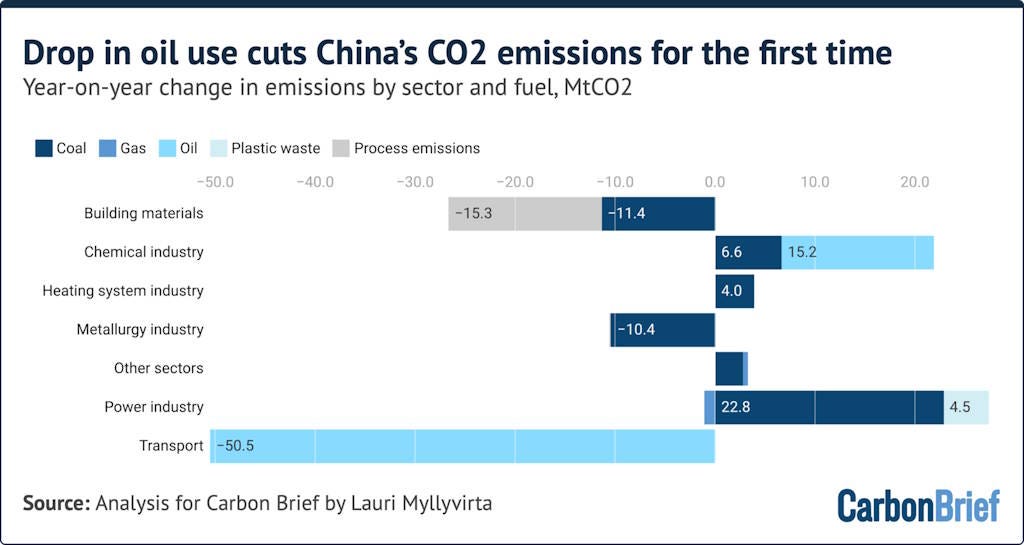
In fact, falling Chinese demand is a big reason global oil prices haven’t risen more in response to the Iran War. China’s drive to reduce oil use isn’t going to change, which will put downward pressure on oil prices for everyone else as well. And China’s exports of electric vehicles will cut petroleum use all over the world.
Thus, economically, the Middle East is already not nearly as relevant as it used to be, and it’s going to become a lot less relevant in the years to come. The 1970s taught America that we needed to maintain a robust presence in the region in order to keep the oil flowing; half a century later, that’s simply no longer the case.
The War on Terror was successful (and now we can go home)
When the War on Terror started after 9/11, a lot of people assumed it would be a losing proposition — that the more America went after jihadists abroad, the more they would multiply. Calling it a “forever war” was very common. And yet when we look at the results a quarter century later, it’s very hard to avoid the conclusion that the U.S. won the War on Terror, and that radical Islamism is on the wane.
The clearest fact is that the two main organizations that prosecuted the War on Terror from the Islamist side — Al Qaeda and the Islamic State — have been effectively defeated. Al Qaeda’s leadership, including everyone involved in the planning and execution of the 9/11 attacks, has all been captured or killed. The Islamic State was defeated on the battlefield, and its territory wiped off the map.
Both organizations survive only as brands — names that a few hundred random local jihadists can claim to be affiliated with in lawless backwaters like the Sahel. The U.S. and its allies will continue to hunt these down, but much like the smattering of communist guerrilla movements that persisted around the world after the end of the Cold War, they lack the ability to do any real damage.
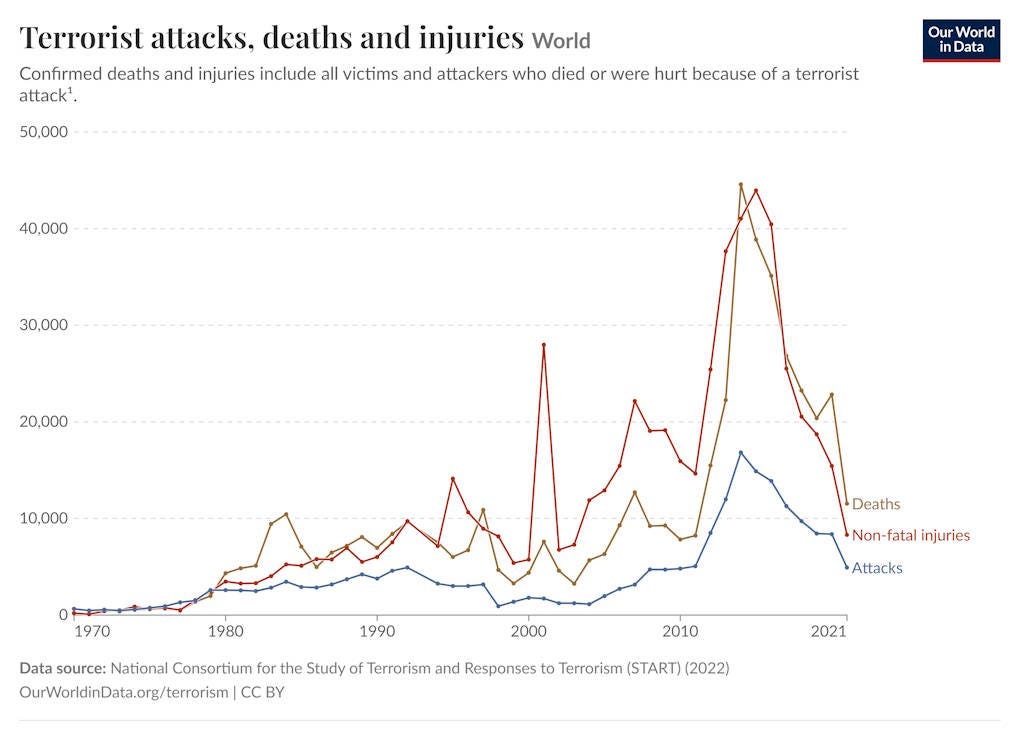
Perhaps the clearest way to see the victory in the War on Terror is to look at the plunging number of terrorist plots and attacks around the world. Here’s an estimate, which makes it clear that the battle against the Islamic State was actually the peak of the conflict:
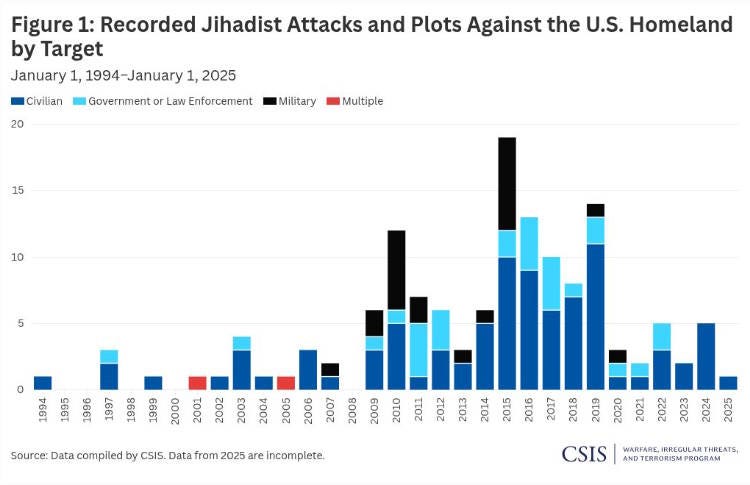
And here’s a dataset from CSIS that includes plots and threats as well as attacks:
I’ve been talking about this victory as if it were America’s alone, but I really shouldn’t. Most of the fighting was actually done by people in the Middle East, South and Southeast Asia, Africa, and so on — regular, normal folks who adhere to the Muslim faith but wanted no part of what the Islamists were selling, and were willing to put their lives on the line. Here’s what I wrote in 2021:
Remember how in the wake of 9/11, commentators used to always demand that moderate Muslims condemn jihadists? Well, folks, they did one better — they shot the jihadists.
In the U.S., too, sympathy for Islamic radicalism is dying. Charles Kurzman of UNC Chapel Hill has kept tabs on reports of Muslim American involvement with extremism. There was a wave of verbal support for Islamism after 9/11, and a wave of violent attacks in the mid-2010s, though neither wave was very large at all. Then the waves died down, and jihadist activity in America basically vanished:

Europe is seeing the same pattern — the big deadly attacks were all in the mid-2010s, at the same time as the conflict with the Islamic State. There remains a smattering of low-level, low-casualty attacks — perhaps about a dozen a year throughout the EU, with annual deaths in the single digits.
Many European societies are currently experiencing anxiety about their ability to absorb large numbers of Muslim immigrants, but that’s very different from the kind of threat posed by Islamic State and Al Qaeda. In particular, it doesn’t require any sort of involvement in the Middle East — in fact, the people experiencing the anxiety over Muslim immigration would probably also want to have less to do with that region of the world.
In other words, there’s little reason for the U.S. to maintain a high level of involvement in the Middle East in order to thwart Islamism. The war has been won, and what remains is low-level monitoring and clean-up. That can be accomplished with low-key coordination between intelligence services, rather than with military bases, invasions, and so on.
America’s “alliance” with Israel has outlived its usefulness
Beyond oil and Islamism, the other reason often given for continued American involvement in the Middle East is to help our ally, Israel. Israel is not a treaty ally of the United States, like Turkey or Japan; we are not obligated to come to its defense, or vice versa. The U.S. has unilaterally designated Israel to be a “Major Non-NATO Ally”, but that’s simply an indicator of our attitude toward the country, not any kind of a pact or treaty. Israel is an “ally” only because we choose to regard it as such.
But is this attitudinal alliance still worth what we’re paying for it? I have my doubts. First of all, there’s the matter of Israel’s obvious human rights abuses. Americans used to consistently sympathize much more with Israel than with the Palestinians, but this has recently reversed:
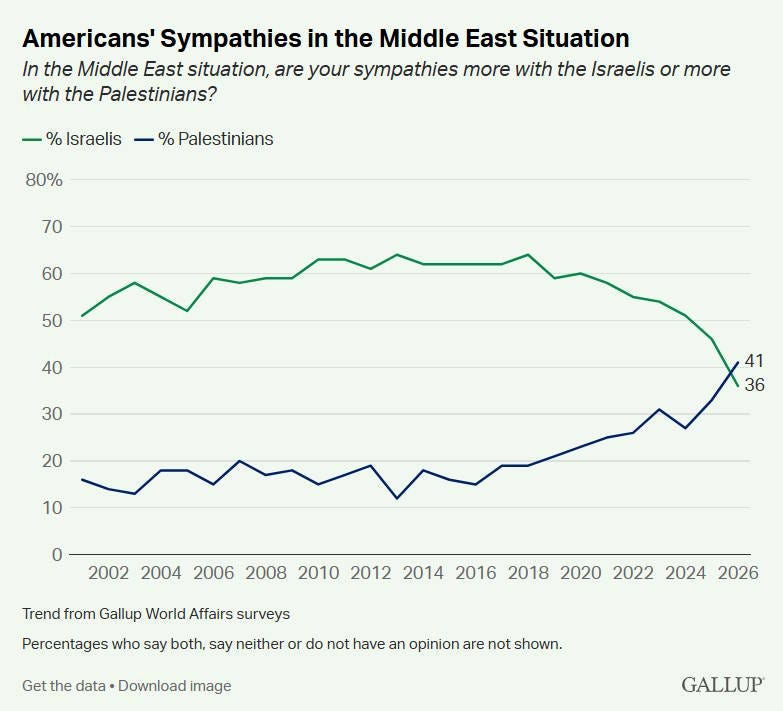
Some part of this is undoubtedly due to the leftist movement, and their relentless — and often dishonest — campaign of anti-Israel agitation. America’s progressive media is clearly biased against Israel to some degree. But Israel isn’t just losing the war of public opinion because their opponents are better at lying. Americans simply can’t ignore the country’s human rights abuses any longer.
Forget about the war in Gaza for a moment, and consider the situation in the West Bank. Israel keeps large numbers of the Palestinians in the West Bank stateless; these people are citizens of nowhere. The Palestinian Authority administers much of the day-to-day business of governance in the Palestinian parts of the West Bank, but Israel actually rules; all real power in the territory is held by the Israeli military.
That by itself should be considered a crime, but it gets worse. The West Bank Palestinians are denied freedom of movement — kept penned into their villages and cities, often unable to move around to other parts of the West Bank. Much of the territory is held by Israeli settlers — Israeli citizens who have the (sometimes explicit, sometimes tacit) support of the Israeli military occupation. These settlers commit frequent, sporadic acts of violence and theft against the stateless Palestinians in the territory — basically, pogroms — and often receive protection from any retaliation by the Israeli military.
This state of affairs has been likened to apartheid, and honestly the metaphor is apt. It’s a slow campaign of conquest, land theft, and racialized and religious violence against a people who have been forcibly denied a place in the community of nations. It’s not quite as brutal as what Russia is doing in the occupied territories of Ukraine, but it’s in the same general vein.
Why would the United States of America want to associate itself with that sort of villainy? Why would we give almost $7 billion a year — more than we give to any other country, more even than we give to Ukraine — to a nation that carries out campaigns of mass dispossession and conquest like the one Israel is executing in the West Bank? I realize that America is no longer a champion of human rights under Donald Trump, but the American people can still tell when they’re being asked to support crimes against humanity. (And note that I didn’t even deal with Gaza at all; I don’t have to even mention it in order to make my point.)
In addition to Israel’s human rights abuses, there’s the question of what, exactly, the U.S. is getting out of this alliance. Granted, Israel’s failure to offer aid in Afghanistan or Iraq wasn’t its fault — the U.S. asked it not to get involved, so as to avoid adding a religious aspect to those conflicts. But the only reason Israel refused to help Ukraine was out of fear of alienating Vladimir Putin, with whom Israel’s Prime Minister Benjamin Netanyahu has been friendly for many years. Nor has Israel helped the U.S. prepare for a Chinese onslaught in Asia.
In the Middle East, it’s now mostly America who does the helping. Netanyahu reportedly helped persuade Trump to attack Iran — a course of action that has been distinctly to America’s detriment. Leftists have been accusing America of conducting wars in the Middle East at Israel’s behest for decades, but this time, it looks like it might sort of be true. Trump undoubtedly had his own reasons for wanting to attack Iran, but the fact that Israel’s leader seemingly goaded him into taking the plunge should make the U.S. much more skeptical of its relationship with that country.
Essentially the only thing Israel might have to offer the U.S. — other than some defense technologies that we can almost certainly replicate ourselves — is the promise of cooperation to prevent Iran from acquiring nuclear weapons. Prior to the current war, that argument held some water. But months of joint action by Israel and the U.S. have failed to cripple Iran’s nuclear program. So it’s unclear how much help Israel is even capable of offering in this regard. If the U.S. is going to prevent Iran from getting nukes, it isn’t going to do it via joint Israel-U.S. bombing campaigns.
An ally that refuses to help you with your biggest challenges, but which goads you into engaging in risky, ill-advised conflicts on its behalf, all while committing large-scale human rights abuses with impunity, is simply not a very good ally. So it seems like it’s time for the U.S. to pause or dial back its close relationship with Israel.
What does that mean? Most obviously, it means cancellation of foreign aid to Israel — money that is invariably used to maintain the intolerable situation in the West Bank. It also means removing Israel’s designation as a “major non-NATO ally.” The aid and ally status can be restored if Israel ever stops its campaign of dispossession and violence in the West Bank and agrees to support U.S. interests in Europe and Asia.
That does not mean I think the U.S. should reorganize its foreign policy around opposition to Israel, as the leftists would have us do. Israel’s enemies — Hamas, Hezbollah, and Iran — are even more savage than Israel is. Hamas would absolutely commit genocide on the Israelis, given the chance. Leftists like Hasan Piker and Mehdi Hasan who urge us to think of Hamas as the lesser of two evils simply want us to switch our support for one brutal Middle Eastern regime to an even more brutal one.
Instead, what we need to do is to reduce American involvement in Israel’s conflicts with its neighbors. If there aren’t pressing national interests that can be served by throwing our support to one side or another, and if supporting either side requires endorsing human rights abuses, then the right answer is just to be less involved.
The Middle East will be fine without us, and vice versa
All of this might make it seem like I dislike the Middle East, or view it with disgust. On the contrary, I think the Middle East has a bright future ahead:

What I think is that the Middle East had some problems that caused it to lag behind some other regions in terms of political and economic development. Over-reliance on oil inhibited industrialization, while Islam was slow to recognize the importance of the separation of church and state.
But I believe the region is in the process of starting to overcome those initial conditions. The constant series of quasi-religious wars that has engulfed the region over the last few decades is reminiscent of Europe’s Wars of Religion and Thirty Years’ War in the 16th and 17th centuries. Eventually, Europeans tired of fighting over God, and Middle Easterners will as well.
In fact, it’s already happening in some places. After over a decade of horrifically destructive sectarian civil war, Syria is slowly rebuilding itself under a moderate government (despite the occasional Israeli airstrike). Middle Easterners are, for the most part, not religious fanatics who want nothing more than to die for Allah; they are regular people who want to buy bread at the store and have a roof over their heads and go to work and raise their children in peace.
Meanwhile, the region’s economic future is more promising than people realize. Solar power will allow it to remain an energy powerhouse even as the world shifts away from oil. Permissive land-use policies will allow it to build data centers when other countries block them. Falling fertility has primed most Middle Eastern countries for a demographic dividend that will boost growth, even as Europe and Asia age rapidly.
The best thing the U.S. can do to further this process along is not to interfere with it. The Middle Easterners — Israel, Iran, Saudi Arabia, Turkey, Egypt, UAE, and all the rest — have to simply realize that eternal war isn’t doing them any good, and then work out a regional architecture for security and economic cooperation among themselves. Military interventions by distant powers will only delay that maturation process.
Meanwhile, U.S. politics will be healthier if we can ignore the activists and demagogues who constantly harangue us about the Middle East. Right now, with Trump executing his doomed misadventure in Iran, and American aid supporting Israel’s campaign of conquest in the West Bank, it’s very hard for anyone in American politics to avoid constant debates and discussions about the Middle East. Making it easier to avoid those debates and discussions should be a conscious goal of our politics and our policy. It’s time for America’s Middle Eastern era to end.
Actually yesterday, since the publication of this post was delayed a day due to me having to take my rabbit to the vet all day.
This post makes too much sense Noah... Which means you'll probably get flamed on Twitter for it 😂
For Israel, I don't think we should remove all support, they would still be a key ally in the region that largely shares Western Values, but I like the idea of a hard pull back on support and intense pressure to do the right thing in the West Bank.
Netanyahu's actions in the West Bank are a shame and a blight on Israel. Gaza is complicated, a lot of gray - not black and white - and Hamas is truly the greater of the two evils by a lot. The West Banks is simple, Israel is acting badly.