

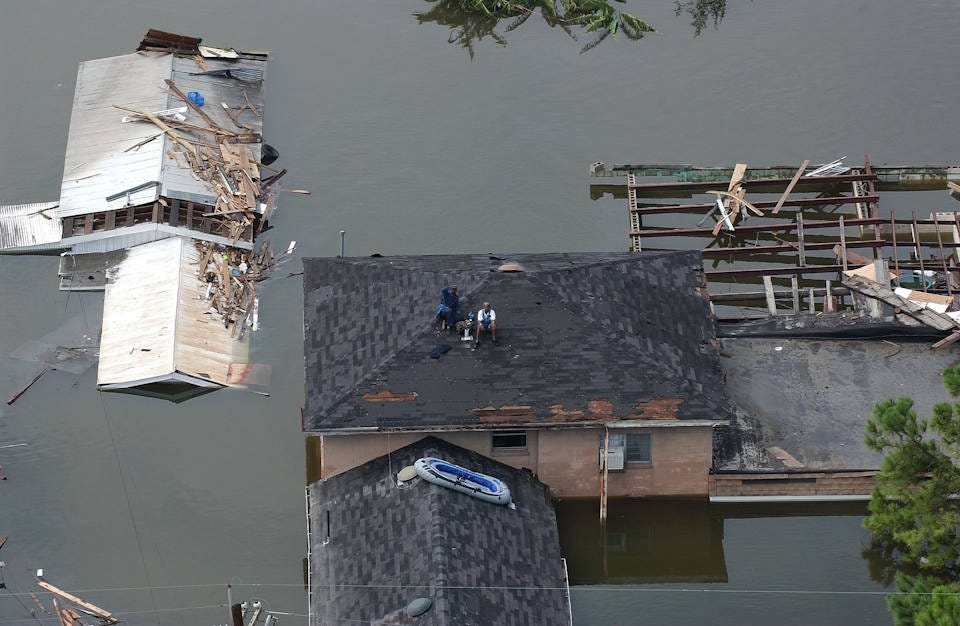
Young people won’t remember this, but there was a distinct point at which George W. Bush started to lose the country. In August 2005, a giant hurricane swamped New Orleans, killing over a thousand people and washing away whole parts of the city. Bush displayed startling incompetence and tone-deafness during the cleanup, which began a process of general disillusionment with his presidency that intensified with the financial crisis of 2008 and the long slog in Iraq.
I don’t know whether Trump’s debacle in Iran will be a similar moment for his presidency. For one thing, unlike Bush, Trump’s approval ratings were already very low before Iran:
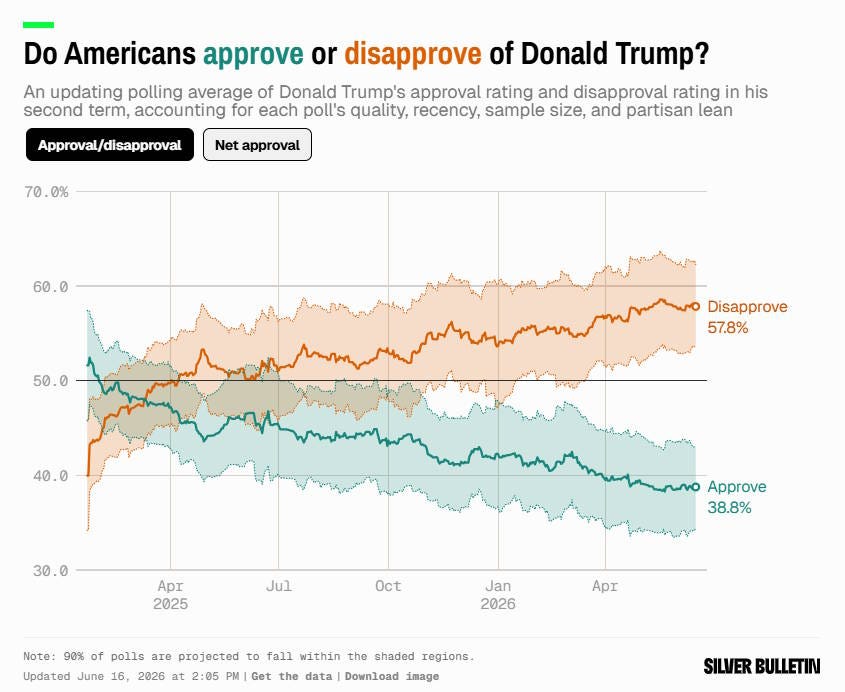
Compared to the other stuff people hate about Trump — the blasé attitude towards inflation, the tariffs, the unprecedented corruption, the ICE raids, the various abuses of power — the Iran War may end up being a minor footnote. But there is one similarity with Katrina: This is the point at which even many of Trump’s defenders will be forced to admit, in private if not in public, that the man and his administration are grossly, pathetically incompetent.
The details of the deal that Trump is trying to make in order to withdraw from the war he started are still murky and unclear — probably because as soon as those details are released, people will realize that the U.S. has effectively been defeated by Iran. Here’s what the deal is rumored to contain:

(Update: Bloomberg has the confirmed details of the draft memorandum, and and the initial reports look to have been completely accurate.)
Plenty of people, looking at these details and observing the conduct of the war, are ready to speak the plain truth that the U.S. lost the war to Iran. Tom Nichols, a former professor at the U.S. Naval War College, had this to say:
Trump and his team, in record time, just lost a war to a militarily mediocre—but nonetheless extremely dangerous—adversary…[E]ven before we have the details, it is clear that Trump has failed to achieve every one of the goals he put forward for this war of choice, and now he is determined to sign, seal, and deliver America’s capitulation as quickly as possible.
The New York Times editorial board concurs, with the headline: “Trump Lost the War He Started in Iran”. The WSJ Editorial Board is slightly nicer, writing “Trump Stages an Iran Retreat”.
As regular readers of this blog know, I’m very skeptical of claims that America has “lost” this or that war:

For example, we clearly won the Iraq War, despite a generation of pundits who got used to repeating that we “lost”. We defeated all enemies — Saddam, various militias, and ISIS — and established a friendly, pliant government that allows U.S. oil companies unfettered access to the country. Bush’s war was a strategic mistake — in my opinion, the geopolitical benefits weren’t worth the costs — but by any reasonable historical standard, it was a victory.
The same is not true, however, of Trump’s war in Iran. This one really is a clear defeat for the U.S. The reason is not just that the U.S. failed to achieve its strategic goals. It’s how Iran forced the U.S. to give up those goals.
How Iran won the war
Iran used military force to defeat the U.S. First, it successfully dispersed and hardened its key forces — missiles and drones. This is from the Washington Post on May 7th:
A confidential CIA analysis delivered to administration policymakers this week…found that Tehran retains significant ballistic missile capabilities despite weeks of intense U.S. and Israeli bombardment…Iran retains about 75 percent of its prewar inventories of mobile launchers and about 70 percent of its prewar stockpiles of missiles, a U.S. official said. The official said there is evidence that the regime has been able to recover and reopen almost all of its underground storage facilities, repair some damaged missiles and even assemble some new missiles that were nearly complete when the war began.
And this is from CNN on May 21st:
Iran has already restarted some of its drone production during the six-week ceasefire that began in early April, one sign it is rapidly rebuilding certain military capabilities degraded by US-Israeli strikes, according to two sources familiar with US intelligence assessments…Iran’s military is reconstituting much faster than initially estimated…[S]ome US intelligence estimates indicate Iran could fully reconstitute its drone attack capability in as soon as six months…Iran has been able to rebuild much faster than expected due to a combination of factors, ranging from support it is receiving from Russia and China to the fact that the US and Israel did not inflict as much damage as the two countries had hoped, one of the sources told CNN…
Thousands of Iranian drones still exist — roughly 50% of the country’s drone capabilities[.]
Iran dispersed and buried both its weaponry and its defense industrial base, and the U.S. was unable to destroy it.
Next, Iran used its surviving weapons to execute an effective naval blockade of the U.S., and its key allies.
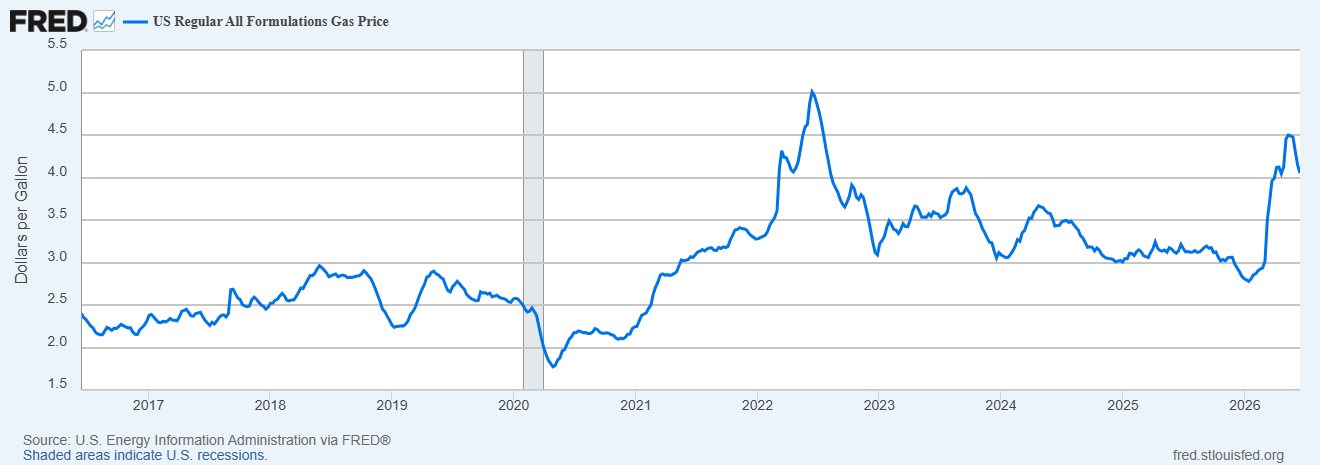
The naval blockade was Iran’s closure of the Strait of Hormuz. This vital waterway, which delivers much of the world’s oil, is right next to Iran, so Iran had the geographic advantage. It used drone boats, naval mines, aerial drones, and missiles to prevent ships from transiting the strait. This did two things. First, it raised the global price of oil, which raised gasoline prices in America:
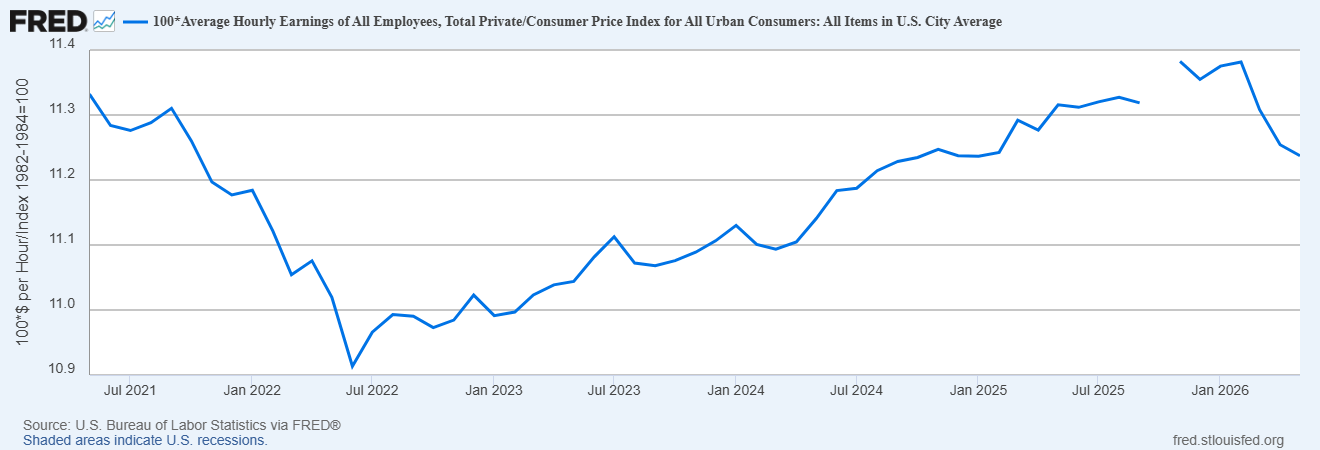
It also sent U.S. inflation back to around 4%, which caused Americans’ real wages to start falling:
Meanwhile, the U.S.’ allies — the Gulf states and Saudi Arabia — were severely impacted by Iran’s blockade of Hormuz, since much of their oil couldn’t be sold. These allies put pressure on Trump to end the war.
The U.S. tried many things to open the Strait of Hormuz, but nothing worked. American strikes were incapable of destroying Iran’s weaponry or forcing Iran’s regime to submit. So in the end, it had to submit. The deal Trump is reportedly cutting makes huge concessions to Iran, leaving Iran in a much stronger position both economically and militarily than it was before the war:
The U.S. will withdraw its forces from the conflict zone within 30 days.
All U.S. sanctions on Iran are reportedly being lifted. Before the war, sanctions had crippled Iran’s economy since 2012, leaving it stagnant and sclerotic. With those sanctions gone, Iran will be able to sell oil and grow much more prosperous.
Iran will reportedly start charging fees on transit through the Strait of Hormuz. This is a toll on international shipping — something forbidden by the UN Convention on the Law of the Sea. This will be a huge source of income for Iran — something that didn’t exist before the war.
The U.S. and/or its Middle Eastern allies will reportedly pay Iran a $300 billion reconstruction fund, as well as unfreezing Iranian assets. This is equal to one entire year of Iran’s GDP, and would effectively constitute war reparations. JD Vance has said that the reconstruction fund is not yet confirmed.
Iran thus compelled the U.S. to withdraw its military, end the sanctions that were in place before the war, and potentially pay Iran reparations. In exchange, Iran will allow the Strait of Hormuz to open (with tolls) and will publicly declare that it’s not pursuing nuclear weapons (which it has always publicly declared in the past).
In addition, Iran will gain an important new source of geopolitical power and economic revenue: control of the Strait of Hormuz.

Before the war, Iran didn’t control the strait, simply because it didn’t realize it could. Drone technology had advanced to the point where Iran was able to shut down Hormuz, but Iran didn’t know that until the U.S. attack forced it to try the risky and desperate move of actually shutting down the strait. The gambit paid off spectacularly, and now Iran knows that modern drone weaponry gives it an advantage it didn’t have in previous decades. So it controls Hormuz.
It’s kind of wild to step back and consider how good of a position Iran’s leaders are in now, compared to the situation before the war. Iran had lost most of its proxy armies in the Middle East — Hezbollah, Assad, most of Hamas. The regime had been rocked by massive nationwide protests, which it only managed to quell by murdering tens of thousands of innocent Iranian citizens. The country’s economy was slowly dying. Now the leaders are firmly entrenched in power, their economy will be revived, and they find themselves the masters of Hormuz for the first time.
Anyway, I don’t see any sense in which this is not a classic military defeat for Donald Trump and the United States. Consider the contrast with Iraq. None of America’s opponents in the war were in power after the war; in Iran, despite the assassination of a few leaders, the regime is even more firmly in power now than before the war. In Iraq, the U.S. suffered some economic damage, but was willing to see the conflict through until all opposition was defeated and all U.S. war aims were achieved (except for the destruction of WMDs, which never existed in the first place and so could not be destroyed). In Iran, economic pressure forced America to make major concessions relative to the pre-war status quo.

