

Anthropic recently filed for IPO. At an estimated $1.5 to $2 trillion, it will be one of the biggest IPOs of all time, rivaling SpaceX, and possibly the biggest. For reference, Facebook’s valuation when it had its blockbuster IPO in 2012 was $104 billion, and Google’s valuation in 2004 was $23 billion. Anthropic will instantly become one of the world’s most valuable companies — Google itself is now worth $3.4 trillion, and Nvidia and Apple are both worth around $5 trillion.
This naturally has a lot of people asking: What’s the upside to buying Anthropic? Even if it grew to be as valuable as Apple or Nvidia — in other words, if it became one of the most valuable companies on planet Earth — that would only be a multiple of 2 to 2.5. But if Anthropic stumbles, that lofty valuation could come tumbling down.
There are certainly lots of reasons Anthropic could stumble. Demand for AI could take longer to materialize than people think, perhaps because companies have trouble integrating AI into their existing business models. The U.S. government could decide that Claude’s hacking capabilities represent a national security threat — especially after the recent wave of AI-assisted cyberattacks — and decide to regulate, appropriate, or otherwise restrain the company (the spat with the Department of War might represent the beginnings of that conflict). One company (SpaceX?) might end up monopolizing all of the compute, squeezing Anthropic’s profits. Competition from OpenAI and Google, or Chinese models, might result in a competitive race to the bottom that forces down Anthropic’s margins. And so on.
In order to balance all that uncertainty and risk on the downside, Anthropic needs to have huge upside. It needs a way that it could be worth a lot more than $2 trillion in the years to come. For comparison, if you bought Google when it IPO’d, your investment would have gone up by over 130 times by today. To equal that performance, Anthropic would have to be worth $200 to $260 trillion by the late 2040s. That’s almost half of the total wealth that exists in the entire world today. For Facebook, the number is around 16x, meaning Anthropic would have to be worth $32 trillion by the early 2040s — still an impressive performance, considering that that’s more than six times the value of the most valuable company in 2026.
How could Anthropic manage that kind of growth? One possibility is that the world economy itself will grow at a very rapid pace, thanks to AI. Some AI researchers think that growth could soon accelerate to fantastically high levels. But most economists bet against that, and even most AI industry insiders expect the growth speedup to be much more modest. Even 7% nominal growth — 4% real growth plus 3% inflation — would only make the economy about 2.75x larger by 2041, and 4.43x larger by 2048.
So in order to have the upside of a Facebook-like outcome — let alone a Google-like outcome — Anthropic probably can’t just ride a wave of economic growth.1 It’ll need to capture a greater fraction of the value that our economy produces.
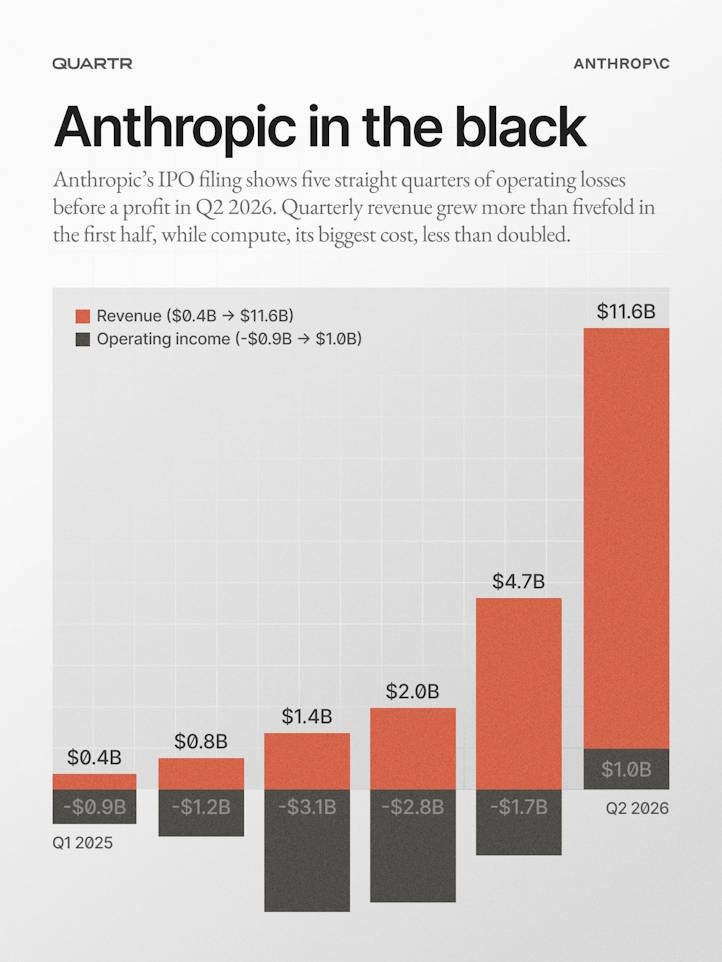
So far, the company has been doing exactly that — and at an extremely rapid rate. Its revenue has grown faster than any company of similar size in all of history. And despite this explosive growth, the company is now making an operating profit:
Businesses usually have to spend more money to make more money at the outset, but Anthropic’s Claude Code is a product that sells itself — relative to just one year ago, the company is making more than 3 times as many dollars of revenue for each dollar that it spends on compute:
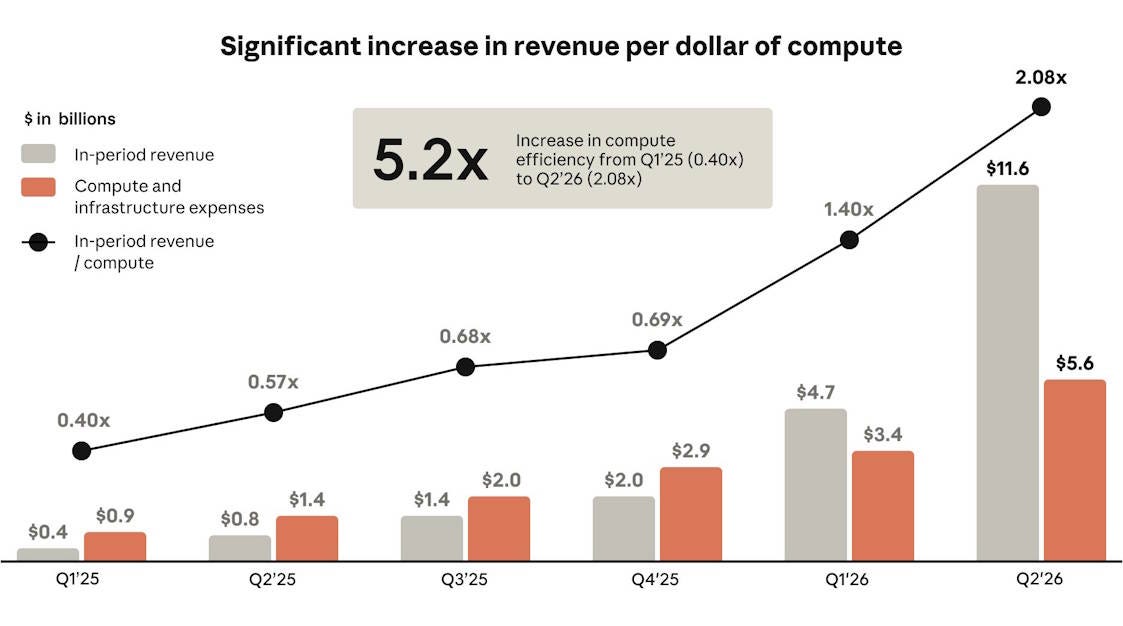
As SemiAnalysis writes, this is “the most efficient scaling of a business in the history of capitalism”. Jeffrey Bussgang has a good breakdown of Anthropic’s recent IPO filing, and it’s full of amazing details — incredible user retention, a broadening base of customers, and so on.
And Anthropic is selling a product whose adoption rate is still very low. As Aaron Levie points out, most big companies are still spending only a pittance on AI, and could afford to spend a lot more:


And yet for this growth to continue, Anthropic must do more than simply make great products. It will need to stave off the competition for decades on end. It will, in Wall Street jargon, need a “moat”.
Why Anthropic needs a moat
When I was teaching business economics to MBAs at Stony Brook, I spent lots of time on the question of why companies make profit. This might sound like a stupid question, especially if you’ve been conditioned to think that there’s some kind of magic force called “capitalism” that companies can use to extract money from people and hand it to their shareholders. But in a world of perfect competition, companies should keep trying to undersell each other until their profit goes to zero — or at least, until it goes to a level where companies are just able to pay for their investments. Even if one company has a huge share of the market, the simple threat that new companies might be able to enter the market and compete with them should force them to keep their prices low in order to maintain their market share.
And in fact, lots of industries do work like this. Agriculture, in the absence of farm subsidies or other significant government support, is the most famous example. Solar power is another — energy provides huge value to the world, but solar is so undifferentiated a product that solar producers never end up making big margins.2 Airlines are a third example. Consumers (and workers) benefit from these industries, but shareholders don’t end up making huge returns.
In order to make profits (or “excess profits” above and beyond the cost of investment), companies generally need some sort of a “moat” — a barrier to entry that reduces the threat of competition. This could be a government-sponsored monopoly — cronyism, or intellectual property. It could be a network effect — the natural tendency of everyone to be on the same social network or use the same electric power grid. It could be something as simple as brand loyalty — maybe everyone thinks Louis Vuitton bags are worth paying money for because of the name, or maybe everyone is just very used to using Microsoft Excel and doesn’t want to switch.
These are all reasons why some companies make high profit margins. There are probably more. Investors will tell you that if you want to assess how valuable you think a company is going to be, you should try to evaluate the strength of its moat — in fact, the term “moat” as slang for barriers to entry was coined by Warren Buffett.
Ever since AI companies like Anthropic and OpenAI burst on the scene, I’ve been hearing smart people argue that they have no moat. After all, unlike famously profitable software companies like Facebook or Google, it’s not clear that AI has a network effect — whether I should use Claude Code or Codex doesn’t really depend on whether you use Claude Code or Codex. And brand loyalty to AI is probably pretty low, since coding with Claude Code and coding with Codex is probably a pretty similar experience, and since AI isn’t a prestige good like an iPhone or a Rolex. And logistically speaking, it’s very easy to switch from one company’s AI products to another’s.
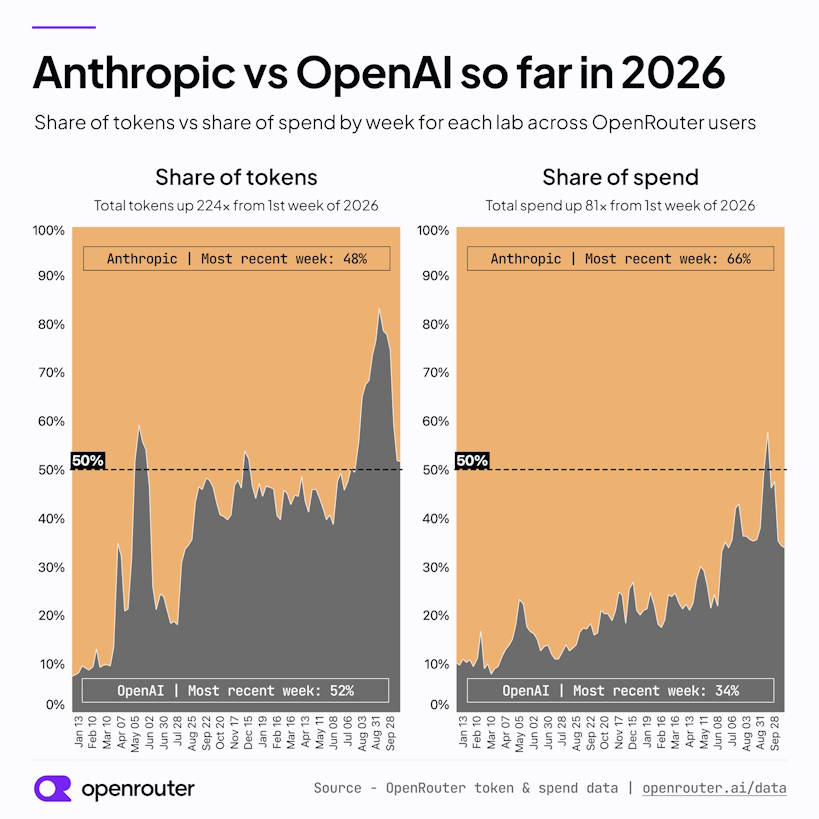
What’s more, catch-up in AI models is typically very fast — OpenAI and Google are typically only a little bit behind Anthropic in terms of model capability. In fact, by some measures, Google’s new Gemini 4 Carbon model just took the lead over Anthropic. Obviously this will reverse when Anthropic releases the next blockbuster model it currently has under wraps, but it shows that the other major players are still very much in the race. In terms of market share, OpenAI has been nipping at Anthropic’s heels:
I’ve written previously about the possibility that AI will end up like solar power, or airlines — a cheap utility that lots of companies use to create enormous economic value, but whose producers don’t manage to capture much of that value:

But I think we need to talk more about the opposite scenario — the possibility that AI intrinsically does have a huge moat. I see a distinct possibility that intelligence itself — the ability to outsmart competitors in the arena of business — is a tremendous source of competitive advantage for a company. And in fact, I suspect that this is exactly what Anthropic itself is (quietly) betting on.
