


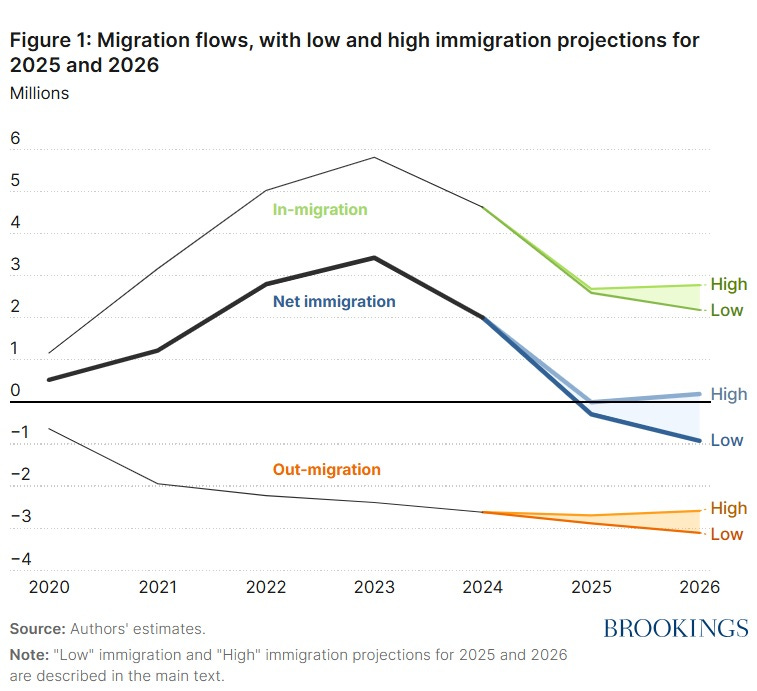
The immigration issue in America isn’t going away. Thanks to Trump’s crackdown, immigration to the U.S. went into reverse in 2025, with more people leaving (voluntarily or involuntarily) than entering the country:
But just like a century ago, shutting the gates isn’t the end of the discussion. The argument has shifted from who gets in to America to who belongs here in the first place.
To much of the MAGA right, the answer appears to be that only people of European heritage can become true Americans. For example, here is how right-wing commentator Matt Walsh responded to news about some crimes by some Texan teens:

Anyone who thinks these aren’t Texan names isn’t very familiar with the history of Texas; the Tejanos (Mexican Texans) were there from the beginning, and were a core part of the Texas Revolution. Most Mexican Texans today aren’t descended from the original Tejanos, but from more recent immigrants. But the fact that the Tejanos were there from the start is probably why Hispanics, and Mexicans in particular, have always been deeply integrated into Texan culture. It was at the behest of Texan businessmen that America didn’t put any cap on Mexican immigration in 1924, when it passed a law effectively barring immigration from most other countries.
Matt Walsh is unaware of most of that; to him, anyone without an Anglo-sounding name is presumptively non-American. This leaves little doubt as to what Walsh views as the marker of true American-ness. It’s likely that many others in the MAGA movement feel similarly, even if many would feel uncomfortable stating it out loud in simple terms. Anti-Indian sentiment has also risen to prominence on the right.
And many in the MAGA movement view Muslim immigration as an invasion, bent on imposing Sharia law on Westerners. They believe this “invasion” has already overtaken Europe, which explains their antipathy toward the EU and NATO. A “Sharia Free Caucus” is growing in popularity in Congress, and Ron DeSantis has signed anti-Sharia legislation in Florida. Various Republican politicians have explicitly stated that Muslims don’t belong in America.
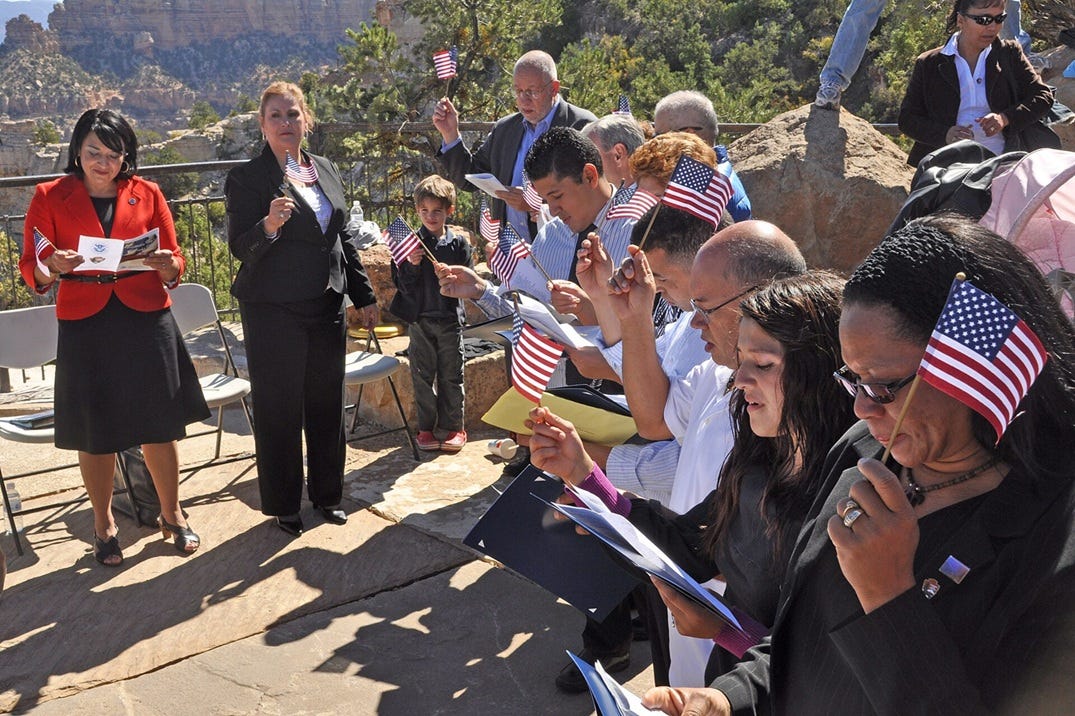
If you’re Hispanic, Muslim, or Indian, there’s just not much you can do about this. In the past, showing that you were a good American — waving the flag, joining the army, speaking perfect English, and so on — was good enough to reassure most conservatives that you weren’t an invader bent on overthrowing America’s culture and replacing it with something alien. Nowadays, that’s not enough.
So perhaps it’s unsurprising that some nonwhite Americans are choosing to simply throw in the towel and reject the whole notion of assimilation. This is the essence of Shadi Hamid’s article in the Washington Post yesterday. He writes:
The assimilation defense — look how well we’ve integrated — is satisfying to make. But it concedes a premise I no longer accept: that a minority community’s right to be in the United States depends on its willingness to converge with the cultural mainstream. It shouldn’t depend on that. It shouldn’t depend on anything.
Whereas in the past, Hamid saw assimilation as synonymous with patriotism, now he sees it as a requirement to give up the religion of Islam itself:
The country is becoming less religious. Muslims, by and large, are not…This is a community that has increasingly integrated into American civic life, but it has done so while holding on to its religious commitments in a way that most other groups haven’t. Whether you think that's admirable or worrying probably says more about you than it does about them. The question I keep returning to is: Why do Muslims need to be like everyone else?…[A]ssimilation tends to mean secularization.
Whether Hamid is right that “assimilation tends to mean secularization” is an open question. Assimilation certainly didn’t require Catholic or Jewish Americans to give up their religion when they immigrated en masse in the 19th and early 20th centuries. Religious liberty is a fundamental part of the Constitution and of American tradition. On the other hand, even some immigration advocates do use conversion away from Islam as a measure of assimilation, and a growing number of Republicans — heavily influenced by their view of events in Europe — sees the religion as incompatible with American-ness.
Hamid is no blue-haired progressive — in fact, he’s explicitly anti-woke and fairly conservative. But his call to reject assimilation will be music to the ears of progressives, who have loudly and vehemently rejected assimilation for many years. A recent example of this is Bianca Mabute-Louie, whose new book Unassimilable: An Asian Diasporic Manifesto for the Twenty-First Century is a call for Asian Americans to resist assimilation by building communities and culture apart from White Americans. In a recent interview, NPR’s Alisa Chang gently pushed back on Mabute-Louie’s idea:
I want to understand what does orienting ourselves towards each other mean? Like, who is the each other? Like, my lingering thought, Bianca, is I still do want to belong here in America. And to me, belonging in America is not only shaped by whiteness, but it's also shaped by colliding and mixing with all the cultures that make America, not just white cultures. And I have trouble picturing being both Asian and American outside of that collision and mixing, you know?
Mabute-Louie’s response is interesting:
[T]he book isn't an argument to be isolationist…[O]ne example of how I'm trying to pursue that…in the South…is joining political community, joining mutual aid organizations with people who are most impacted. And I'm not really thinking about if they're Asian or not Asian. I'm just thinking about who's impacted when the hurricane comes. Who am I going to call? I always make the joke - who's going to be on my compound when the apocalypse comes because that's who I'm building community with, and that's what it means for me to be unassimilable.
Mabute-Louie’s idea of anti-assimilationism is not a call to interact only with Asian people — it’s to form political alliances with other people that she sees as being threatened in America at the current moment. It’s a vision of a country fracturing along racial, ethnic, and religious lines; Mabute-Louie is mentally preparing to fight a racial conflict, and she sees the “American” side, defined as hegemonic White culture, as her enemy.
This is different than classic progressive multiculturalism — though it clearly grew out of that idea. This is racial balkanization. The fact that anti-woke writers like Shadi Hamid are now leaning into the anti-assimilation line suggests that it’s now mostly a defensive response against Trumpism and the heavily racialized anti-immigration purge. Whereas ten or twenty years ago, “assimilation” meant waving a flag and speaking English and so on, to many it now means accepting that America is a fundamentally European nation and that nonwhite Americans are permanent guests in that nation.
In fact, this is pretty much what many children of recent immigrants did in the early 20th century, after the anti-immigrant backlash. German Americans were pressured into changing their names, giving up their ancestral traditions, and listening to long, patronizing lectures from volunteer citizens’ groups. Japanese Americans were interned en masse in World War 2. FDR reportedly once told his Jewish and Catholic advisers that "You know this is a Protestant country, and the Catholics and Jews are here under sufferance." For decades, Americans who didn’t come from the old North European Protestant stock felt they had to walk on eggshells.
That’s not going to happen again. Whatever Bianca Mabute-Louie might think, White American culture is not a monolith — in fact, it’s deeply politically and culturally fractured. MAGA will have neither the cultural power nor the enduring political power required to make European heritage the defining characteristic of American-ness. The country will break apart before it accedes to the likes of Matt Walsh or Tucker Carlson as the arbiters of true American-ness.
It’s probably a good thing that forced assimilation, of the type used in the early 20th century, is off the table. I say “probably” because 20th century America is arguably the most spectacularly successful story of integration and multiculturalism in modern history; some will inevitably claim that the cruel, bullying tactics that the old Protestant majority used on German, Japanese, Italian, Jewish, Polish, and other immigrants were necessary to that success. I reject that idea; I think that those bullying tactics were overkill, and probably led to lingering resentments.
But even though early-20th-century-style forced assimilation is off the menu, America still needs some sort of assimilation. A multicultural nation can’t survive as a “salad bowl”, where each group of people maintains its distinctiveness over time. (Canadians, who are fond of the salad bowl metaphor, are probably in for a rough time.) There is no “separate but equal” when it comes to cultures within a nation; if they remain forever separate, they will inevitably be unequal. More pragmatically, nations without cultural unity have difficulty providing public goods; politics tends to break down into an ethnic spoils system instead of being run for the benefit of the masses.
What America thus needs is a melting pot — or if you’d prefer a less metallurgical metaphor, a stew. Immigrants and their children should not be required to forsake every symbol of the old world, abandon their religion, or forget their heritage. But over time, the boundaries between America’s initially distinct cultures should blur. Intermarriage, interethnic business partnerships, and interethnic friendships should gradually erode the physical borders of the old blocs, while modern American culture — Netflix shows, pop musicians, and so on — should provide shared experiences and touchstones to bring Americans together without regard to ancestry.
This gentler assimilation has been happening my entire life. In a post last September, I wrote about what it looks like on the ground:
[M]any also value American culture as a marker of shared nationhood.
When I was growing up in Texas, one of my best friends was born in Shanghai, and didn’t become a U.S. citizen until the age of 18. Culturally, he was a little different than me and the rest of my friends — his mom made dumplings instead of sandwiches, he taught me how to use chopsticks, he didn’t believe in God.
But in all the cultural ways that mattered to us, we were the same. We watched the same TV shows, played the same video games, and listened to the same music. We used the same slang, had the same attitudes toward school, and wanted pretty much the same things for our future. And yes, we believed in the Constitution, and American freedoms, and all of that stuff.
During the 2010s, during our nation’s great…collective freakout over race, I wrote to my friend and asked him if he had ever felt discrimination growing up, or if he had ever felt excluded from the majority. He responded that while once in a great while he faced a little racism from a few jerks, it didn’t dominate his experience. In terms of identity, he told me he just felt very American.
This kind of real, on-the-ground cultural affinity is something too nebulous for YouGov pollsters to ask about, and yet I suspect it’s deeper and more important than most of the more quantifiable markers of American-ness. America is a propositional nation to some extent, but we’re also a cultural nation, bound together by shared habits and attitudes and lifestyles and beliefs. What matters the most isn’t our family’s history in the country, but our own personal history. Shared life experience beats shared heritage in terms of building the bonds of nationhood.
This is what Tomas Jimenez writes about in The Other Side of Assimilation, in which he argues that immigrant cultures will gently add their distinctiveness to mainstream American culture instead of being erased. And it’s what Richard Alba writes about in The Great Demographic Illusion, in which he predicts the gradual melding of America’s disparate groups into a unified “mainstream”. Before the Trump years, it looked like this was working well.
And I believe it was working well. I do not believe that this form of assimilation was too gentle and tolerant. I do not believe that concentration camps and forced name-changes and ethnic slurs and “100 percent American” movements sending volunteers into immigrants’ living rooms would have averted the coming of the MAGA movement. I believe that the MAGA movement is simply one of America’s periodic nativist backlashes, like the Know-Nothings in the 1850s or the restrictionists of the 1910s. It would have come anyway; it always comes back, and we just have to deal with it again.
What we must not do, I believe, is react to the MAGA movement by throwing out the notion of a unified and unifying American culture. We must not retreat to enclaves, online or physical, and view large swathes of the country as our enemies. Instead, we have to recommit to commonality.
This will be hard, but it won’t be impossible. Studies consistently show that Americans are less polarized on the issues than the media tells us we are. As recently as the 2000s, red and blue America were essentially culturally unified as well; though this might be changing, a lot of commonality remains. The online realm pushes us to hate and fear the outgroup, and to identify more with our distant co-ethnics than our real, physical neighbors. But the pull of the real world is still strong, and we’re starting to spend less time on social media.
Assimilation — which is really just another way of saying integration — won’t always be the picture of tolerance. Building a shared culture requires changes from everyone. Yes, some Muslim Americans will need to make sacrifices — they may have to look at cartoons of the Prophet Muhammad, or eat at school cafeterias where pork is on the menu, or hear bigots defame their religion. America is not Europe; freedom of speech, and the separation of church and state, are part of our core values as a nation, and these should not change.
But at the same time, non-Muslim Americans have to get used to seeing mosques on their streets without thinking they’re being invaded. They’ve got to get used to the idea that Islam is just one more religion in America’s mosaic of faiths and practices, and that Muslim Americans are every bit as American as Baptists. Some people will inevitably convert away from Islam, but others will convert to Islam, and this is fine; this is how freedom of religion works in a free society.
And yes, assimilation will involve the eventual loss of old cultural traditions as the generations go on. People will start eating more American food. Some will become secularized. Essentially all will forget how to speak their ancestral language. These processes are happening even faster with recent waves of immigration than they happened a hundred years ago. It’s a normal healthy process, and everyone should accept it; it’s part of the deal when you move to America.
Most of all, we all need to get over the idea that America is on the precipice of a race war or a religious war. Online activists might dream of that, but they’re small in number — and a lot of them aren’t even Americans, but foreign trolls for whom American politics is a fun outlet for their hatred and boredom. Most actual Americans just want to get along with our neighbors and live our lives together.
Ultimately, that’s all assimilation is — living our lives together until we become one people. It happened before, and if we want it, it can happen again.
As a first step, assimilation may mean not being on social media. The awfulness, at least on some platforms. I posted the other day about the rhetoric of "flower power"(for those who remember), which was, at the very least. all about love, not hate. And long hair and no washing. And doves and that peace symbol.
I will continue to maintain that multi-generational lack of assimilation is a largely fictional problem. Assimilation is a generational given. A Mexican-born laborer may never seem fully American, but his kids born in the US will. Second-generation immigrants are often invisible to people having this debate because they don’t stand out. They largely do not have accents, nor look or dress distinctively, and are fluent in American culture.