


When I tell people I’m becoming a China bear, they’re often surprised. “Weren’t you already a China bear?” they ask me.
Well, no. I’ve always been a China bull — I’ve always believed that China’s economic growth would be robust, that they would master advanced technologies, and that their geopolitical influence would grow. This is exactly why I was also always a China hawk1 — I recognized the very real possibility that China would become a global hegemon, and I didn’t especially want to live in a world ruled from Beijing. It’s why I advocated so strongly for friend-shoring, for export controls, and for military alliances to balance out China’s awesome and growing power.
This was true even as China began to show visible signs of weakness in the late 2010s and early 2020s. Xi Jinping proved himself less competent than his predecessors, and the country’s real-estate-heavy growth model hit the skids. But despite those stumbling blocks, I still predicted that this would be the Chinese Century. The country had what seemed like unassailable advantages in human capital, market size, and state capacity, even as all of its possible rivals were convulsed by internal division. And the one thing that most people cite as China’s big weakness — demographic decline — never struck me as much of a threat to the country’s power.
Now, however, for the first time I can remember, I’ve found myself becoming actually bearish on China. I still think it will be an immensely powerful country — perhaps the most powerful single country on the planet. I still think it will be at or near the forefront of technology, and that it will generally be a safe, moderately prosperous, and tolerable place for its people to live. But more and more, I’m starting to think that global hegemony of the type the U.S. enjoyed throughout most of the 20th century will be out of reach. I’m also starting to think that China’s bid for technological dominance is weaker than I had believed.
And just as my previous bullishness made me a hawk, my increasing bearishness makes me more of a China dove.2 I still think friend-shoring is important, export controls are good, and we need robust military alliances to make very sure China doesn’t try to conquer Asia. But I no longer feel the same sense of desperate urgency about these prudent measures — they feel more like an insurance policy now.
There are basically three reasons I’m revising my China expectations downward. The biggest reason is AI. China’s system is incredibly optimized for an era of technology and economic production that is very quickly coming to an end. AI will change everything, and modern China is not the kind of country that adapts well when everything changes.
The other reasons are less important but still worth mentioning. China’s new economic model — the government-supported push to capture all of global high-tech manufacturing — is not likely to succeed. And third, the country’s political situation appears to be deteriorating. Just as the Deng/Jiang/Hu era illustrated the strengths of authoritarian political systems, Xi Jinping is giving us a much-needed lesson on the weaknesses of those systems. His spiraling paranoia is turning the country inward, just as his economic policies are running out of steam.
Anyway, let’s start with those economic policies. This is an economics blog, after all.
China’s manufacturing push is hitting its limits
In a nutshell, Xi Jinping’s economic strategy is to dominate manufacturing — to have China be, in the words of Damien Ma, the “make-everything country”. I’m increasingly convinced that this approach is already beginning to backfire.
Going all-in on manufacturing is a strategy you see a lot of developing countries use during their periods of rapid catch-up industrialization. And there are some good reasons for that. When you’re poor, what your people need most aren’t video games or dog-walking services, but houses and cars and refrigerators. Manufactured products are also easy to export, and poor countries don’t have big domestic markets to rely on. It might also be easier to reach the technological frontier in manufacturing, since you can reverse-engineer physical products more easily than services.3
Usually, as countries get rich and their needs evolve from the physical to the ephemeral, they move out of manufacturing and into services to some degree. But Xi Jinping decided that this was a mistake. He reasoned that if China continued to behave like a developing country forever, and promoted manufacturing at the expense of everything else, China could dominate the globe.
This was an interesting hypothesis, and it might have worked — indeed, there’s still some chance it might work. Militaries, after all, depend on manufacturing above all else, so in a big protracted WW2-style war, being the master of manufacturing might give you an automatic win.
And dominating key nodes in global supply chains lets you use export controls to bully other countries without actually bombing them. In fact, China is doing this more and more, using export controls on everything from tunnel-boring machines to rare earths to drones to medicines as bludgeons to force other nations to do its bidding.
In order to make China dominate global manufacturing, Xi unleashed a wave of industrial policy bigger than any the world had ever seen, spending about 4% of GDP per year on subsidizing manufacturing industries — usually through cheap bank loans, but sometimes just by sending cash directly.
For a while, this seemed to be working spectacularly. A 2024 paper by UNIDO got a lot of attention for predicting that China’s share of global manufacturing would be 45% by 2030 — equal to the United States right after World War 2. But cooler heads pointed out that China’s manufacturing share growth had already slowed; more reasonable predictions put its 2030 share at maybe 35-36% — still enormous, but more like America in the 1960s or the early 1920s.
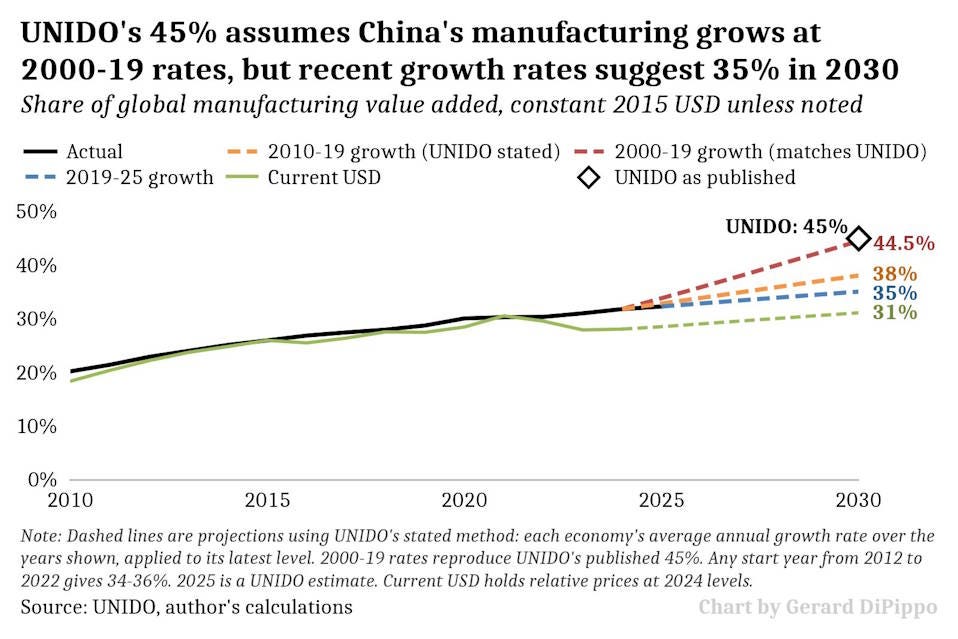
And in U.S. dollar terms, China’s share peaked during the pandemic and has been drifting down since then:
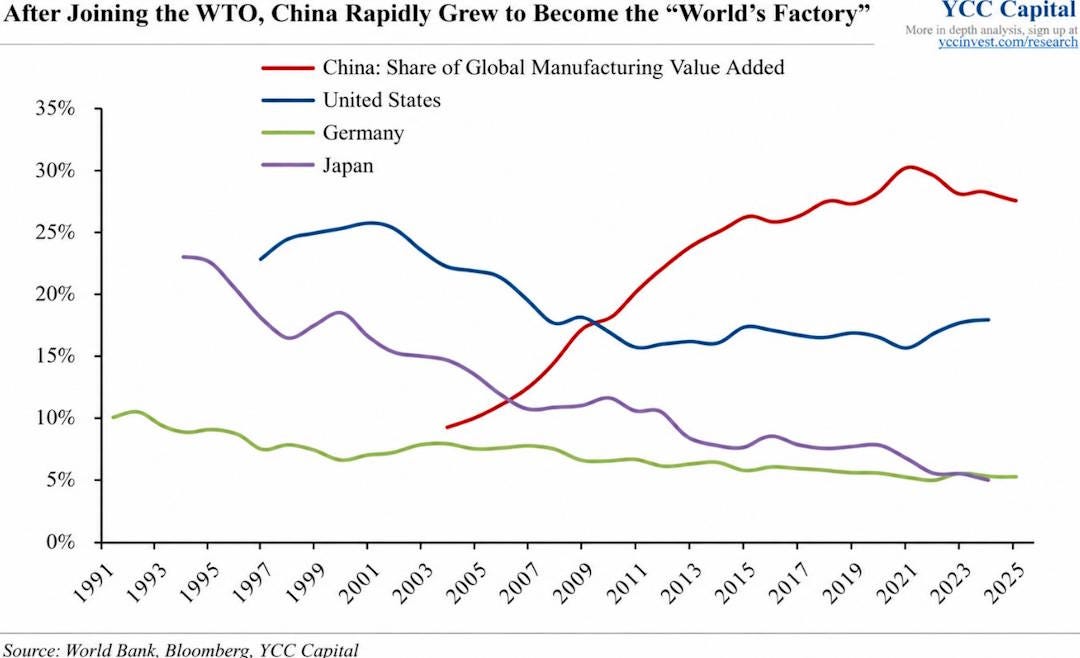
In fact, despite Xi’s push, manufacturing is a shrinking share of China’s economy. China is now less industrial than South Korea, despite being less than half as rich:
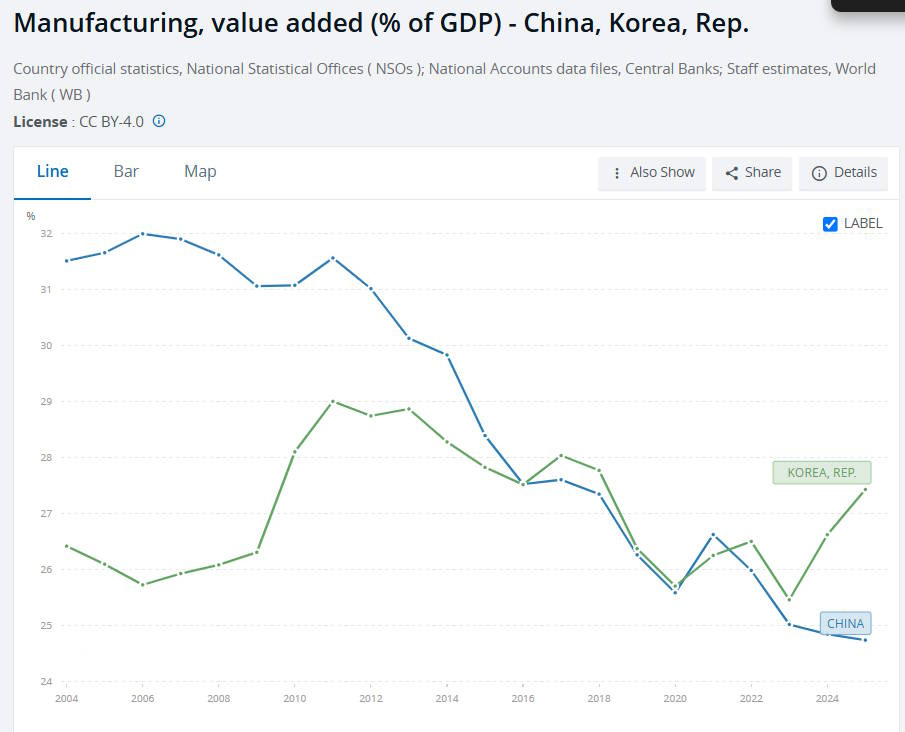
The reason is simple, and it’s something I’ve written about many times before. Unlike South Korea, China is a very large country. That means most of China’s manufacturing production is going to have to go to the domestic market. Even if other countries don’t slap big tariffs on your products, export markets will simply saturate. One of the most reliable empirical laws in all of economics is the gravity model of trade, which says that trade volumes drop off rapidly with distance.
Of course, some countries will put tariffs on China. The EU recently forced China to make a deal to limit auto imports, and if that doesn’t work, stronger measures are likely. That will only accelerate the natural saturation of China’s export markets.
And despite everything you’ve read about the “Second China Shock” and the big export boom, China is still far less export-intensive than Korea, and that’s not going to change:
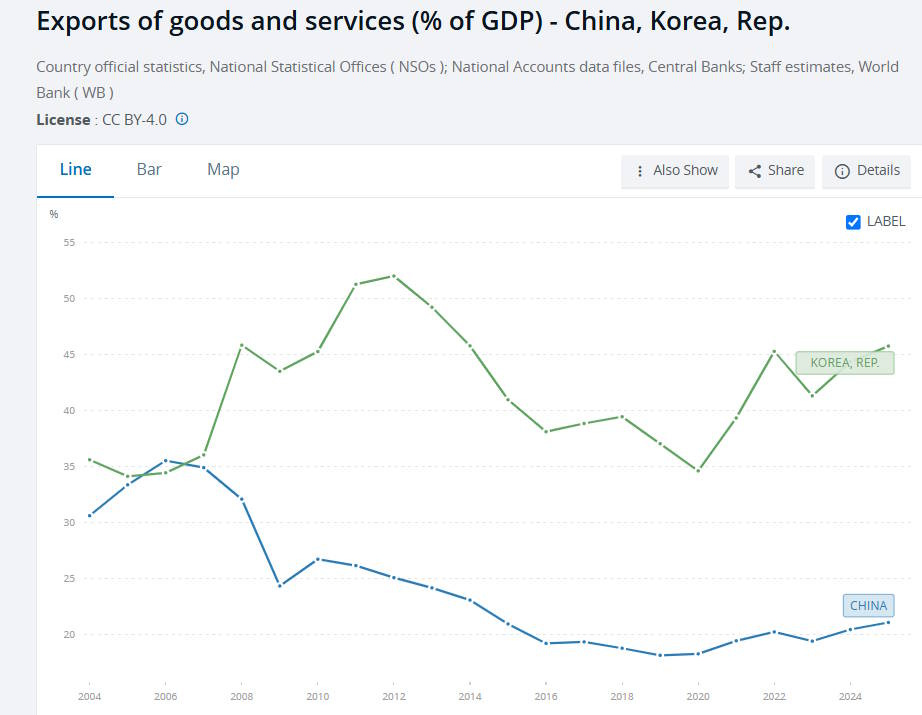
China simply can’t be Giant Korea; it’s so big that its manufacturers need to rely on its domestic market. But that domestic market is becoming saturated even faster than the global market. Profits in the auto sector, the steel sector, the solar sector, and many other manufacturing industries are all collapsing. Weak domestic demand from China’s real estate bust has encountered massive oversupply from government subsidies, and the result is that few companies in China are making much money. That will force lots of businesses to close and consolidate, and it will starve dynamic private-sector companies of R&D budgets, forcing them to rely more on research handed down by the distant, unresponsive, and unaccountable government.
Government subsidies can keep the party going a lot longer than it ought to, but already the limits have probably been reached. Chinese manufacturing indicators are faltering, and manufacturing investment seems to have topped out as well.
In fact, this isn’t even the only example of Xi Jinping taking a developing-country strategy and pushing it far beyond its limits. Infrastructure is another. For many years, China invested huge amounts into building more roads and bridges and high-speed trains than they knew what to do with. But there was a limit to that process, and China has now hit the limit. The Economist reports that China’s infrastructure investment has leveled off:
China’s years-long splurge on bridges, tunnels, expressways, high-speed rail and airports is beginning to tail off…In July this year a senior transport official said China’s main transport network was “91% complete”, and the country would pivot from expanding to upgrading existing infrastructure.
But it isn’t so easy weaning yourself off of infrastructure overinvestment. China built so much infrastructure that it will have to spend a lot of money just to upkeep all those roads, trains, and bridges. That’s the iron logic of depreciation. And since much of China’s infrastructure isn’t really carrying many passengers or much cargo, that means China is stuck spending a significant fraction of its GDP upkeeping stuff that people don’t really need — unless, of course, it chooses to let some of that infrastructure decay into ruin.
All of this means growth will slow. And of course, it’s all happening against the backdrop of weak demand from the continuing, protracted fallout from China’s real estate bust. There are signs that the real economic damage in that sector is only getting started:
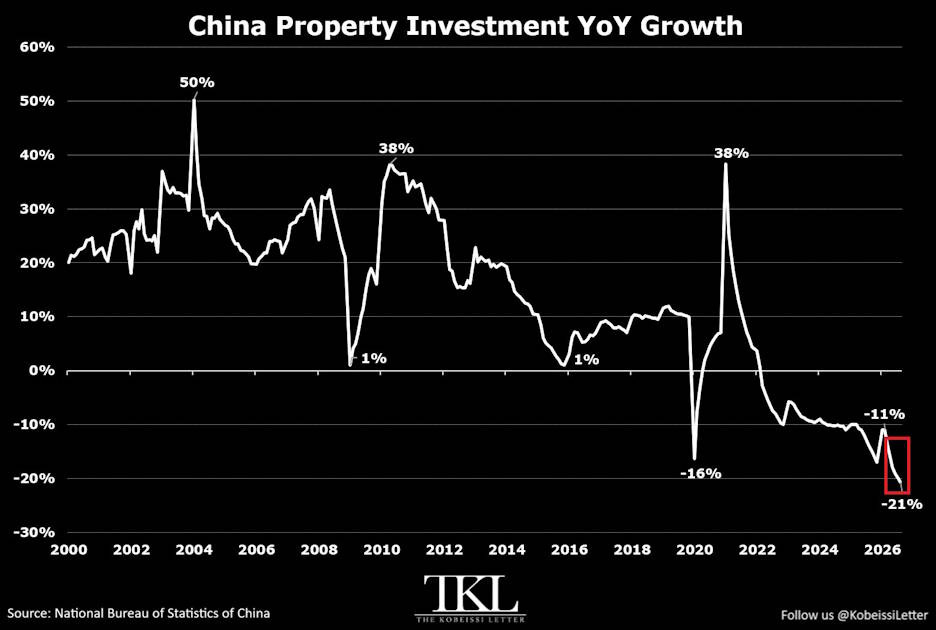
Weak domestic demand won’t just be a drag on China’s headline growth — it will also make it harder for China’s manufacturing sector to maintain its 30% global market share, much less expand it to 35% or more. Xi seems to think that China can just sort of pull resources off of real estate development and put them into manufacturing, one for one, like a corporate manager reassigning engineers to a different project. But it doesn’t work like that; demand matters, and China’s manufacturing triumphs in past decades depended heavily on the tailwind that the long property boom had been delivering.
Chinese economists realize this, but Xi seems to have stopped listening to economists, and to have purged his government of anyone who was inclined to listen.
(And of course as the years go by, China’s accelerating population decline will reduce its domestic market size by more and more, compounding the pressure on manufacturing. I don’t expect this to be a big factor until at least 2040 or so, but it’s worth mentioning.)
In other words, Xi’s “make-everything country” strategy is likely to see only modest short-term success. It will not let China conquer the world. And the failure of this strategy will come just as a massive new technological revolution upends the global economy — a revolution that China, despite all reports, is not well-prepared to take advantage of.

