

I’ve been wanting to write this post for a while, actually. What triggered it was seeing this tweet:
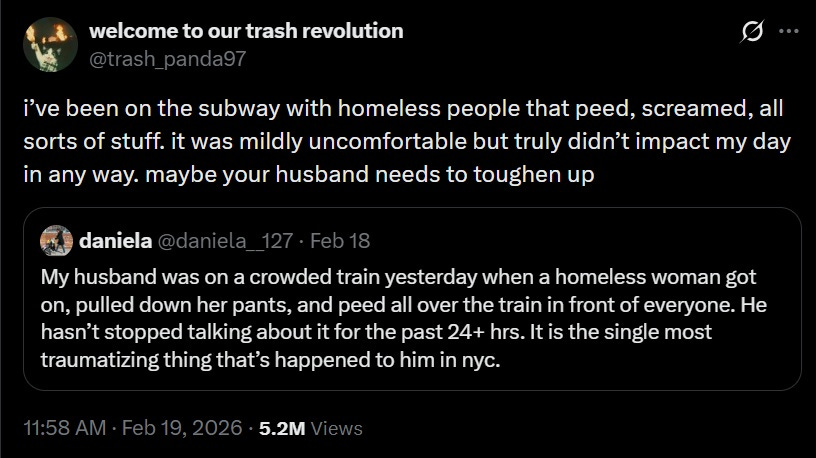
Extreme tolerance of public disorder, and downplaying the importance of crime, is a hallmark of modern progressive American culture. There are plenty of Democrats who care about crime — Joe Biden recently tried to increase the number of police in America by a substantial amount — but there is constant pressure from the left against such measures. On social media, calls for greater public order are instantly met with accusations of racism and classism:


(And this was far from the most radical post on the topic.)
Nor is this attitude confined to anonymous radicals on social media. When Biden announced his Safer America Plan, the ACLU warned that putting more cops on the streets and punishing drug dealers would exacerbate racial disparities:
[I]n this moment of fear and concern, the president must not repeat yesterday’s mistakes today. He calls for hiring 100,000 additional state and local police officers – the same increase in officers as the 1994 crime bill. This failed strategy did not make America safer, instead it resulted in massive over-policing and rampant rights violations in our communities…And while it is important that the president’s plan commits to fixing the racist sentencing disparity between crack and powder cocaine, it regrettably also perpetuates the war on drugs by calling for harsh new penalties for fentanyl offenses.
“While we are pleased with the president’s commitment to investing in communities, we strongly urge him not to repeat the grave errors of the 1990s — policies that exacerbated racial disparities, contributed to widespread police abuses, and created our current crisis of mass incarceration.
The ACLU is very wrong about policing and crime — there’s very solid evidence that having more cops around reduces the amount of crime, both by deterring criminals and by getting them off the streets.
In fact, the idea that tough-on-crime policies are racist is a pillar of progressive thought. It’s the thesis of Michelle Alexander’s influential 2012 book The New Jim Crow: Mass Incarceration in the Age of Colorblindness, which argues that mass incarceration is a form of racial segregation. Ta-Nehisi Coates, perhaps the most important progressive thinker of the 2010s, relentlessly attacked the “carceral state”.
A major progressive policy initiative, meanwhile, has been the election or appointment of district attorneys who take a more tolerant approach toward criminals. These “progressive prosecutors” really do prosecute crime less, although evidence of their impact on actual crime rates is mixed.
I am not going to claim that progressive attitudes are the reason America’s crime rate is much higher than crime rates in other countries. The U.S. has probably been more violent than countries in Asia and Europe throughout most of its history, and the divergence certainly long predates the rise of progressive ideology. It’s possible that the progressive prosecutor movement, the decarceration movement, and the depolicing movement exacerbated America’s crime problem a bit, but they didn’t create it.
What those progressive attitudes do do, I think, is to prevent us from talking about how important the crime problem is for the United States, and from coming up with serious efforts to solve it.
Why crime is more uniquely American than other problems
The thesis of this post is that when you compare America to other countries, what stands out as America’s most unique weakness is its very high crime rate — not just violent crime, but also public chaos and disorder. That statement might come as a shock to people who are used to hearing about very different American weaknesses.
For example, it’s common to hear people say that Europeans and Asians “have health care”, and that Americans don’t. That’s just fantasy. Around 92% of Americans, and 95% of American children, have health insurance, and those numbers keep going up.
Yes, U.S. health care is too expensive — we spend half again or double the fraction of GDP on health as many other countries, while achieving similarly good outcomes. That’s a real problem, and we should try to bring costs down. But this is tempered by the fact that Americans spend a lower percent of their health care costs out-of-pocket compared to people in most other rich countries:
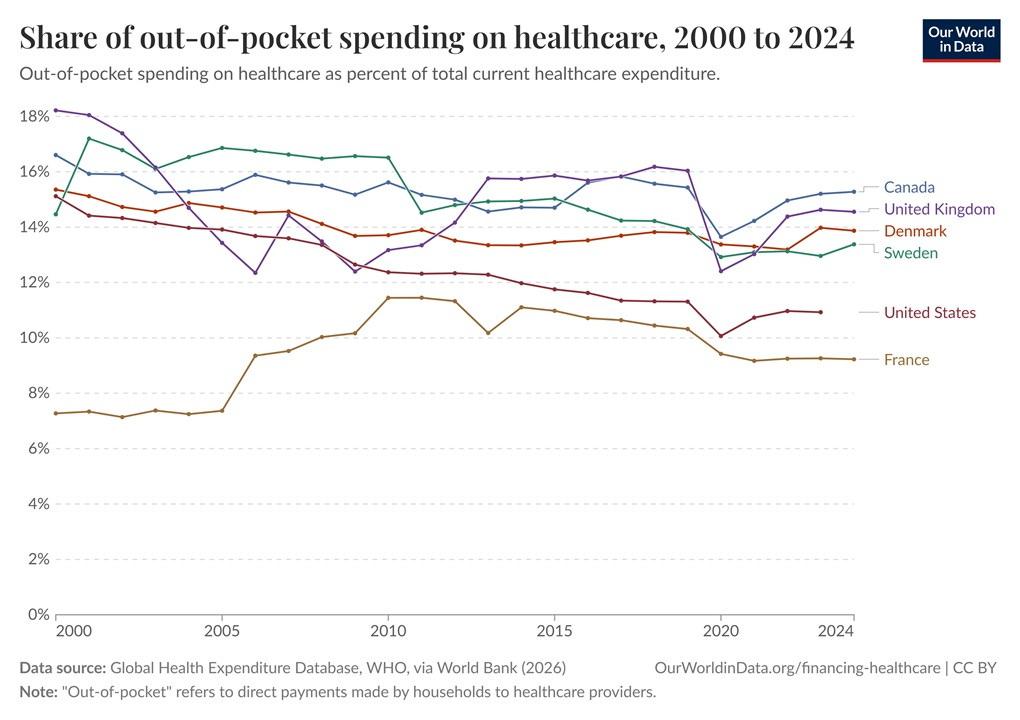
And if you took health spending entirely out of the equation, Americans would still be richer than people in almost any other country. So our high health costs are more of a nuisance than a big difference in quality of life.
If not health care, what about health itself? America’s life expectancy has started to rise again, but it’s still 2 to 4 years less than other rich countries. The size of this gap tends to be overhyped — Germany’s life expectancy advantage over America is smaller than Japan’s advantage over Germany. And the difference is mostly due to America’s greater rates of obesity and drug/alcohol overdose — diseases of wealth and irresponsibility, rather than failures of policy.1 This stuff usually doesn’t affect quality of life unless you let it — if you don’t overeat, drink too much, do fentanyl, or kill yourself, your life expectancy in America is going to be similar to, or better than, people in other rich countries.
What about inequality and poverty? It’s true that America is more unequal than most other rich countries. About a quarter of Americans earn less than 60% of the median income, compared to around one-sixth or one-fifth in most other rich nations. But this is not because America is a uniquely stingy country where conservatives have managed to block government redistribution. In fact, the U.S. fiscal system — taxes and spending — is more progressive (i.e., more redistributionary) than that of most other rich countries, and we spend about as much of our GDP on social welfare as Canada, the Netherlands, or Australia. In fact, America’s system has become continuously more progressive over time.
How about housing? You may have read the “Housing Theory of Everything”, which blames housing shortages for a variety of social and economic problems. It’s true that housing is very important, and that America doesn’t build enough of it. It’s also true that housing is a bit more expensive in America than elsewhere — according to the OECD, house prices relative to incomes are about 12% higher than in the average rich country. But U.S. houses are also much bigger than houses in most other countries, so it’s natural that they’d cost a little bit more. And America has actually been above average in terms of housing production in recent years, after lagging in the 2010s:
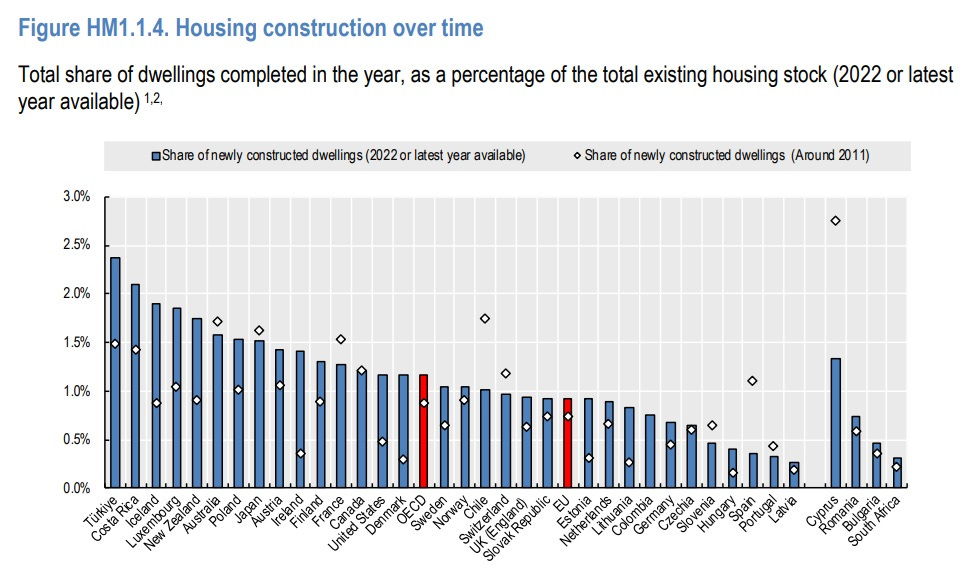
So it’s more accurate to say that housing is a big problem, but it’s a big problem all over the globe, not something that’s special to America.
How about transit and urbanism? Here, America is certainly an exception. The U.S. has the least developed train system in the developed world, and worse than many poor countries as well. America is famous for its far-flung car-centric suburbs, with their punishing commutes and paucity of walkable mixed-use areas. Only a few rich countries are more suburbanized than America, and those countries tend to have very good commuter rail service.
This is a real difference, though whether it’s good or bad depends on your point of view. Lots of people in America and elsewhere love suburbs and love cars. But I’m going to argue that to the extent that America’s urban development pattern is more suburbanized and more car-centric than people would like, it’s mainly due to crime.
So in almost all cases, the difference between America’s problems and other rich countries’ problems is minor. But when it comes to crime, the difference between the U.S. and other countries is like night and day.
The best way to compare crime rates across countries is to look at murder rates. Other crimes are a lot harder to compare, because A) reporting rates are very different, and B) definitions of crimes can differ across countries. But essentially every murder gets reported, and the definition is pretty universal and unambiguous. And although murder isn’t a perfect proxy for crime in general — you could have a country with a lot of theft but very few murders — it’s probably the crime that people are most afraid of.
So when we look at the murder rate, we see that among rich countries,2 the United States stands out pretty starkly:
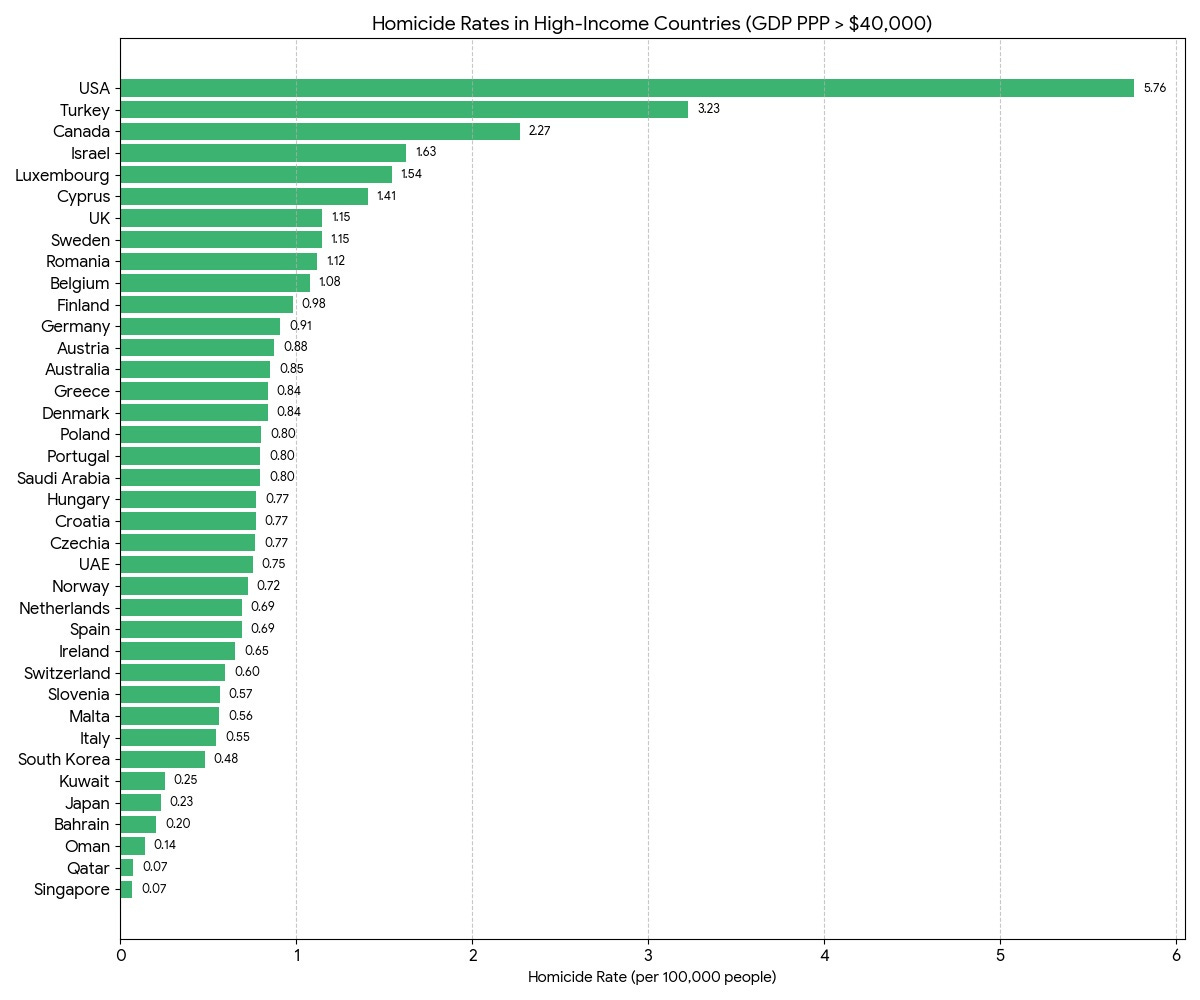
This is an astonishingly huge difference. America’s murder rate is between five and ten times as high as that of most rich countries.
Many progressives will protest that violent crime has gone down in America since 2022. And in fact, murder really has gone down a lot.3 Here’s the CDC’s count of homicides:
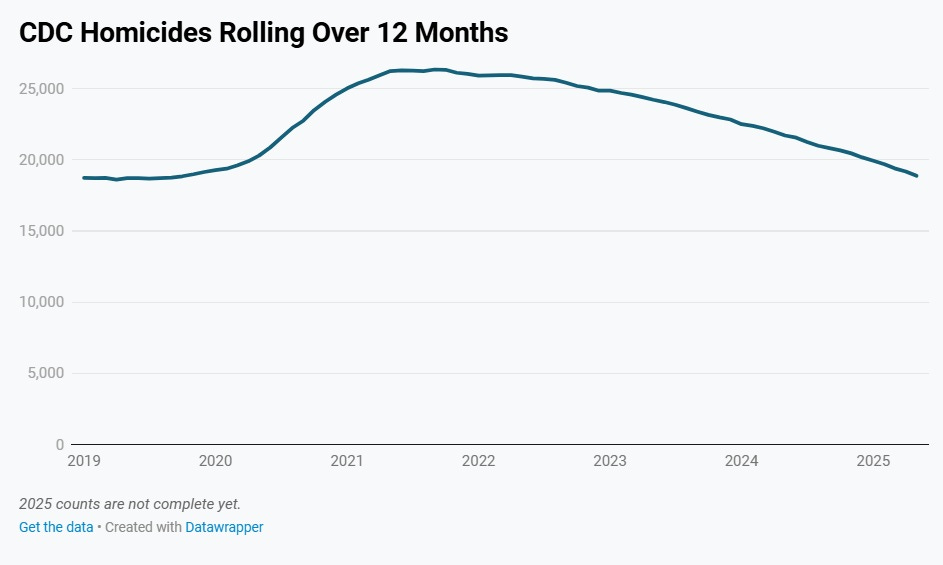
But even after this decline, the U.S. homicide rate is still five to ten times higher than other rich countries! The recent improvement is welcome, but it hasn’t yet changed the basic situation.
Anyway, while murder is the most important crime, public order also makes a big difference. Here were some replies to the tweet about tolerating destructive behavior on American trains:


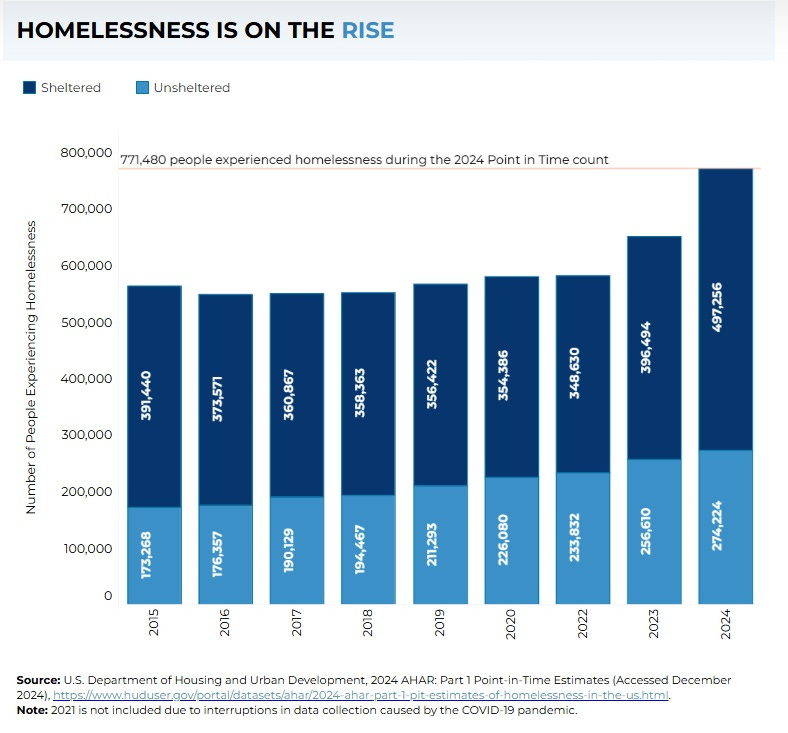
The tragic and disturbing scenes of mentally compromised people shouting, peeing, pooping, defacing property, and acting menacing in public — so familiar to residents of cities like San Francisco — are not entirely unique to America. I have been to a place in Vancouver that has similar scenes, and twenty years ago I even walked through a dirty and dangerous-seeming homeless camp in Japan. But overall, the differences between the countries are like night and day, and other countries seem to have made a concerted effort to bring order to their streets in recent years. The U.S., on the other hand, has seen a huge rise in the number of unsheltered homeless people in recent years:

And although America’s overall homelessness rate doesn’t stand out, it has a much higher unsheltered (“living rough”) population:
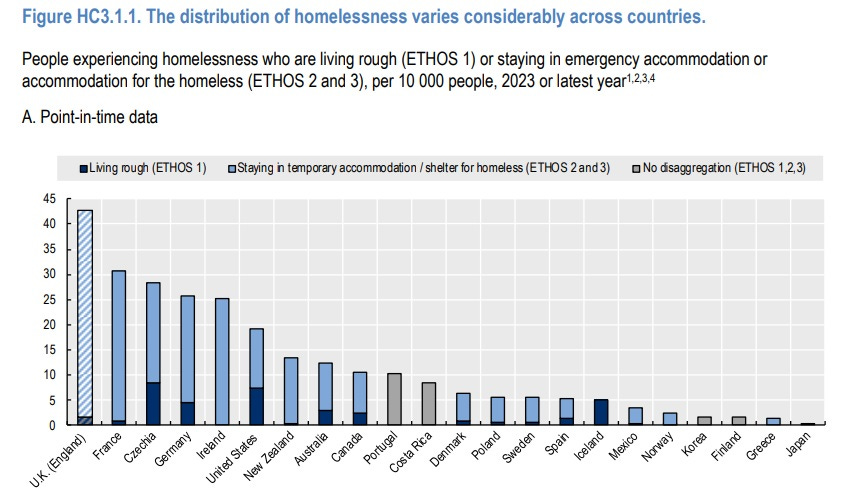
Obviously, unsheltered homelessness and public disorder aren’t the same thing — you can have lots of violent or threatening people on the streets who do have homes, and most homeless people are harmless. But homeless people do commit violent crime at much higher rates than other people, so when people walk down the street and see a bunch of seemingly homeless people, they’re not wrong to be scared.4
The ever-present threat of crime in U.S. cities has devastated American urbanism. In the mid 20th century, there was a huge exodus of population from the inner cities to the suburbs; this is often characterized as “white flight”, but middle-class black people fled the cities as well. Cullen and Levitt (1999) look at the effects of changes in the criminal justice system, and find that crime has been a big factor in Americans’ preference for suburban living:
Across a wide range of specifications and data sets, each reported city crime is associated with approximately a one-person decline in city residents. Almost all of the impact of crime on falling city population is due to increased out-migration…Households with high levels of education or with children present are most responsive to changes in crime rates…Instrumenting using measures of criminal justice system severity yields larger estimates than OLS, which suggests that rising city crime rates are causally linked to city depopulation.
It’s no surprise that America’s short-lived and minor urban revival in the late 1990s and 2000s followed a big decline in crime. But crime rates are still very high in the U.S., and Americans are still trying to move from the cities out to the suburbs and the far-flung exurbs.
Meanwhile, crime damages American urbanism in other ways. NIMBYs use the threat of crime to block affordable housing projects; this reduces housing supply, driving up prices everywhere, and making it difficult to build the multifamily apartment buildings that enable the kind of dense, mixed-use urbanism that prevails in Europe and Asia. The “housing theory of everything” is partially a story about crime.
Crime also makes it a lot harder to build good transit systems. Trains are a public space, and when there are violent, destructive, or menacing people on the train, it deters people from wanting to ride the train. There’s research showing this, but I also thought that a recent post by the blogger Cartoons Hate Her was especially vivid in explaining how the fear of disorder keeps women and parents away from transit:
When my daughter was a little over a year old, we were walking down the street in broad daylight (she was strapped to my chest and facing outward) when we heard a man about twenty feet away shout “I’M GOING TO FUCKING KILL YOU!”…[A]t least we had an easy safe option to escape…But if we had been on a subway, we would have had no easy choice. We could have waited for the train to stop and then switched cars—but what if he saw us leave and took that as a message, prompting the threat to move from “vaguely directed at my delusions” to “at the next person who triggers me?” What if we couldn’t get to the door in time? What if he followed us? What if he escalated before the train stopped?…
I’ve been told many times that people who are uncomfortable with this type of behavior need to just stay put, don’t make noise, and “avoid eye contact.” After all, asking someone to turn down their music could get you stabbed. You just need to keep your head down and you’ll be fine. That’s apparently all it takes, right? Except for Iryna Zarutska, who quietly sat down in front of a visibly deranged, pacing man on the bus, only to be stabbed to death shortly after. Or the young woman in the Chicago subway who was randomly lit on fire by a severely mentally ill subway rider? Or Michelle Go, the woman who was pushed in front of a subway to her death in New York City by a total stranger?…
Since 2009, assaults on public transit in New York City have tripled…Subway assaults also often involve strangers. When the attack is sexual, the victim is almost always a woman—and New York City alone accounts for around 4,000 sex crimes on public transit every year. These cases are likely underreported and limited to more severe crimes. Many women experience flashing, sexual harassment, groping, and public masturbation, and then never report it, assuming nothing would come of the report. (And honestly? They’re correct.)
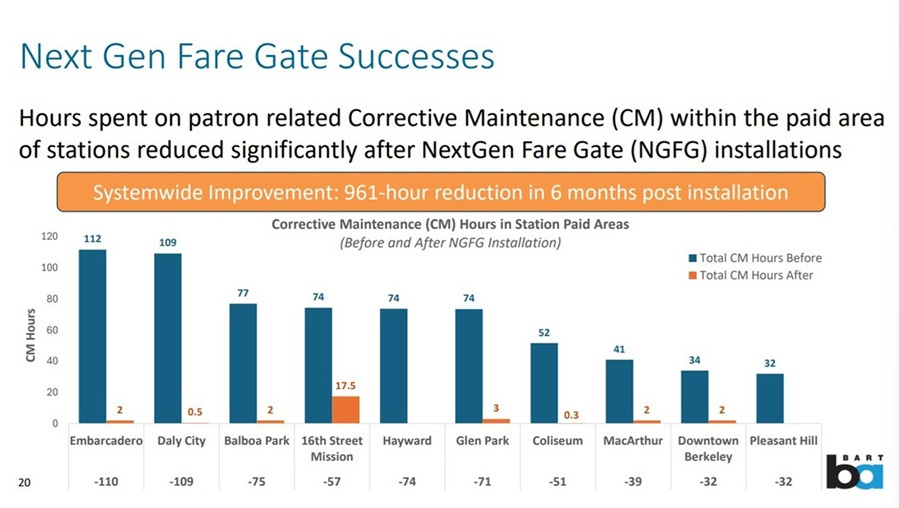
In fact, we have evidence that this fear is very rational. When BART installed ticket gates at their train stations that prevented people from riding for free — over the loud objections of progressives — crime on the train went down by 54%, and the amount of disorder and bad behavior on the train absolutely collapsed:
Fear of crime — often rational fear — also stops people from allowing train stations and bus stops in their neighborhood in the first place. There are a number of studies linking train stations and bus stops to increased crime, both in the immediate area and at areas linked to the same transit line. Criminals ride the bus and the train, so in a high-crime country like America, people don’t want trains and buses in their neighborhood. This is probably a big reason why almost no U.S. city has a good train system.
In other words, while car-centric suburbanization is partially about people wanting lots of cheap land and big houses and peace and quiet, part of it is a defense-in-depth against America’s persistently high crime rates.
As an American, when you go to a European city or an Asian city — or even to Mexico City — and you see pretty buildings and peaceful clean streets and there are nice trains and buses everywhere, what you are seeing is a lack of crime. The lack of crime is why people in those countries ride the train, and encourage train stations to be built in their neighborhoods instead of blocking them. The lack of crime is why people in those countries embrace dense living arrangements, which in turn enables the walkable mixed-use urbanism that you can enjoy only on vacation.
In other words, this tweet is right:

Of course, urbanism is not the only thing that benefits from low crime rates — health costs are lower, families are more stable, and of course fewer people die. But the big differences that Americans notice between the quality of life in their own cities and the seemingly better quality of life in other countries that are less rich on paper are primarily due to the fact that those other countries have gotten crime largely under control, while the U.S. has not.
As for the root causes of American crime, and what policies might bring it down to a more civilized level, that’s the subject for another post. The point of today’s post is simply to say that we can’t ignore our country’s sky-high crime rates just because we’ve lived with them our whole lives. Nor should we comfort ourselves with the fact that crime is down from the recent highs of 2021. We are still living in a country that has been devastated by violence and public disorder, and which has never really recovered from that. Someday soon we should think about getting around to fixing it.
Update: As if on cue, here’s a paper by Bencsik and Giles showing that electing a Republican prosecutor reduces crime and mortality rates:
This paper investigates the causal relationship between approaches taken by local criminal prosecutors—also called district attorneys—and community-level mortality rates. We leverage plausibly exogenous variation in prosecutorial approaches generated by closely contested partisan prosecutor elections, a context in which Republican prosecutorial candidates are commonly characterized as “tougher on crime.” Using data from hundreds of closely contested partisan elections from 2010 to 2019…we find that narrow election of a Republican prosecutor reduces all-cause mortality rates among young men ages 20 to 29 by 6.6%. This decline is driven predominantly by reductions in firearm-related deaths, including a large reduction in firearm homicide among Black men and a smaller reduction in firearm suicides and accidents primarily among White men. Mechanism analyses indicate that increased prison-based incapacitation explains about one third of the effect among Black men and none of the effect among White men. Instead, the primary channel appears to be substantial increases in criminal conviction rates across racial groups and crime types, which then reduce firearm access through legal restrictions on gun ownership for the convicted.
On one hand, progressives have to reckon with the fact that their prosecutors’ soft-on-crime approach is getting a bunch of Black men needlessly killed. On the other hand, conservatives need to reckon with the fact that the most important mechanism seems to be preventing people from owning guns. More about both of those things in the follow-up post.
The remaining difference is almost entirely due to traffic accidents, suicide, and violent crime.
I excluded a few small Caribbean nations like Trinidad and Tobago, Bahamas, and Guyana.
At this point, someone in the comments will ask me about Dobson (2002), who claimed that medical advances that prevent gunshot victims from dying have masked a big increase in attempted homicides. But we have tons of recent survey data on rates of violent crime victimization, and there was definitely a huge decline in assaults, gun violence, and so on in the 1990s. As for the difference between today and the 1930s, a more likely explanation is that many attempted murders went unreported or unprosecuted back then.
Note that progressives tend to staunchly oppose getting homeless people off the streets. When Zohran Mamdani reinstated homeless sweeps after realizing that pausing them would lead homeless people to die en masse from exposure to the elements, progressive activists were outraged.
As a Czech (a country with highly developed public transport), I quite often get into public transport-related discussions on Reddit, Hacker News etc.
I can confirm that the only people who ever tried to morally lecture me about the presence of screaming, threatening or stinking people on public transport are the American leftists. For them, this is a racist (because the homeless can't be white?), bigoted prejudice against the "less fortunate" and "less privileged", who are entitled to do anything they want and your only moral reaction ought to be "shut up".
This is just a bizarre ideology based on worship of anti-social behavior. Because if the system is bad, people disrupting it must be good, right?
The fact that tolerance of such behavior destroys a fairly expensive commons that is disproportionally used by lower-income people just does not register to them.
In the rest of the world, even lower-income countries manage to keep their public transport nice and safe. You could eat from the floor in the metro stations in Kyiv (GDP per capita about one tenth that of the worst US state), even today, after four years of active war.
Yeah, just bizarre, but it seems to be downstream from that dysfunction-worshipping worldview.
Thank you for saying what almost nobody else will: the American status quo for crime and disorder in urban spaces is, and has long been, disgraceful. All our urbanist dreams are for naught as long as our crime and disorder problem persists. Until we fix it, we will remain a car oriented suburban/exurban county.