


Explaining stock market movements is always a little bit of a fool’s errand; no one really understands why stocks boom or crash on a given day or in a given week. Over the long run, the stock market displays lots of “excess volatility” — prices move up and down much more than is warranted by changes in earnings or other measures of fundamental value. There are plenty of theories about why those swings happen, but it’s very hard to know which of those — if any — is in operation at any given time. And so although every big stock market movement is followed by lots of articles claiming to know why, you should take them all — including this one — with several grains of salt.
Anyway, having said all that…
The Korean stock market has been crashing for weeks now. Around March, Korean stocks went on an epic tear; the KOSPI index rose from around 5,000 to over 9,000. Then, just over a month ago, it all went into reverse, with the index falling back to around 5,500:
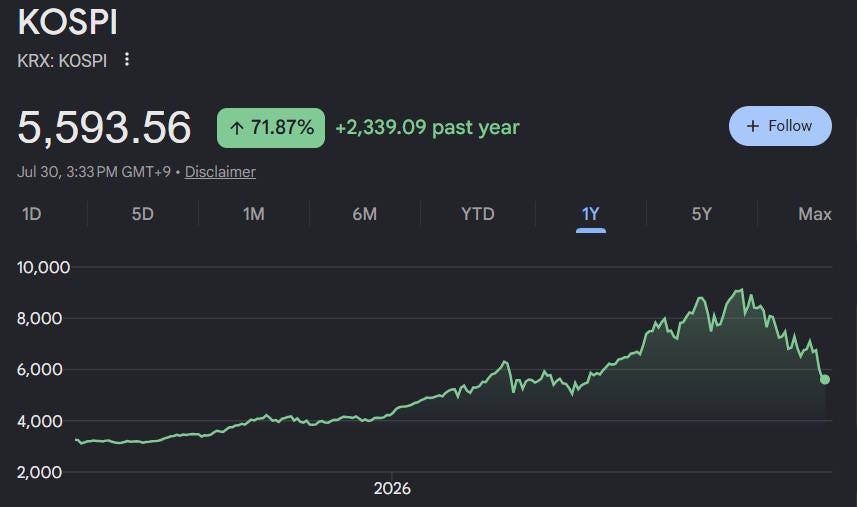
There are probably two stories regarding why this happened — one about fundamentals, and another about finance. In fact, this is typical for bubbles and crashes, not just in stocks but in every asset class. There’s almost always some kind of connection to fundamentals — some story about how we’re in a new economy, followed by doubts about whether that story is really true, and so on. But the big market movements are almost always accelerated by purely financial factors — “noise traders” armed with piles of excess cash, opportunistic speculators looking to ride the wave of sentiment, and so on.1
For Korea, the fundamental story was about memory stocks. Korean companies like SK Hynix and Samsung make a lot of the world’s computer memory. Under normal circumstances, computer memory isn’t a great business to be in — the technology is fairly commoditized, the industry is brutally competitive, it takes a LOT of capital to build the factories, and it’s very risky to make long-term bets on the evolution of memory technology.
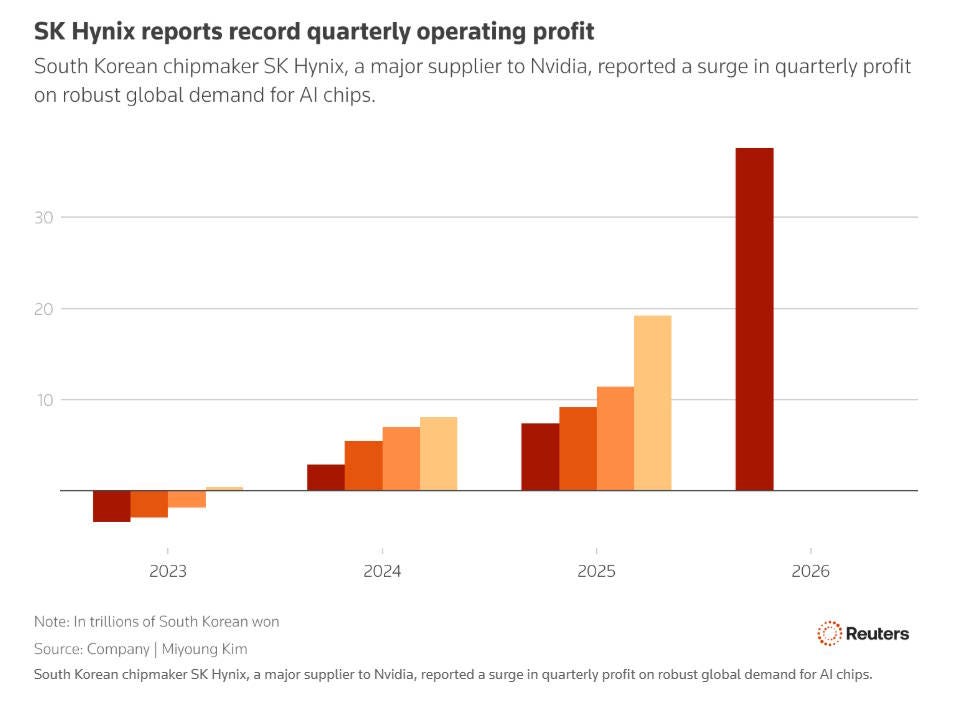
But computer memory is really important for AI data centers. And so the AI boom kicked off the mother of all memory booms. Only a few companies had the scale to meet a large amount of this demand explosion, and the two biggest of these were in South Korea. SK Hynix’s operating profit went from under $10 billion in the first quarter of 2025 to over $35 billion in the first quarter of 2026:
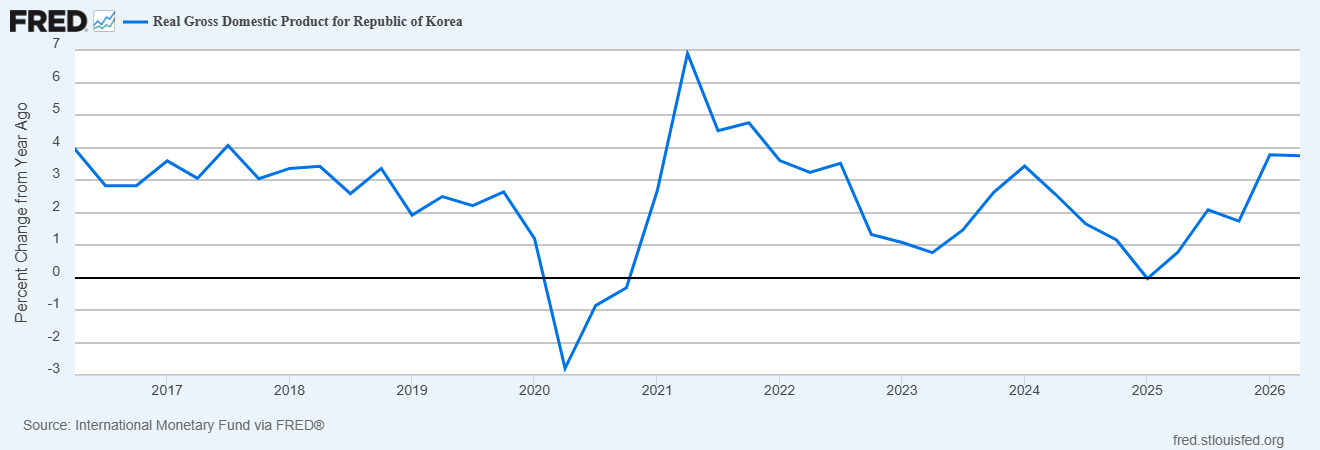
Hynix, which specializes in memory, briefly had a higher market capitalization than Samsung, simply because the memory boom is so huge. Korea’s exports rose over 70% in just one year; in fact, the country’s whole national GDP growth rate increased by a noticeable amount over the past two quarters, just because of this one product:
That’s a pretty strong fundamental story about why South Korean stocks should be worth a lot more. So it’s no surprise that the Korean stock market boomed as soon as people realized in early 2026 that AI technology is going to be extremely valuable. Here’s a thread about just how epic the runup in these companies’ stock prices was:


This is where the financial story rears its head, though. A bunch of traders saw this enormous price rise and decided to buy into it. You’d think a lot of these would be foreign, but international investors mostly avoided the boom (except for a few who bet big on Korean memory stocks). The most frenzied buyers were regular Korean people — the proverbial taxi drivers and teenagers.
These investors probably didn’t understand the fundamental story about AI and data centers and so on. Instead, they probably had extrapolative expectations — they see the price go up and up, and they figure stocks are just a “goer upper”. As more and more buy in and the stock goes up more and more, the perception of a structural upward trend is only reinforced, causing yet more people to buy in. This isn’t the only explanation for coordinated “noise trader” buying frenzies, but it’s probably the most likely.
Normal people don’t have a lot of cash sitting around. But earlier this year, regular Korean people got the opportunity to effectively borrow lots of money to invest it in stocks, via the introduction of leveraged single-stock ETFs. When you buy a share in a leveraged single-stock ETF in SK Hynix, it’s like borrowing money to buy SK Hynix stock.
A whole lot of Koreans used leveraged ETFs and other borrowing methods to borrow huge amounts of money and buy lots and lots of Korean stocks — especially the memory company stocks that were driving everything.
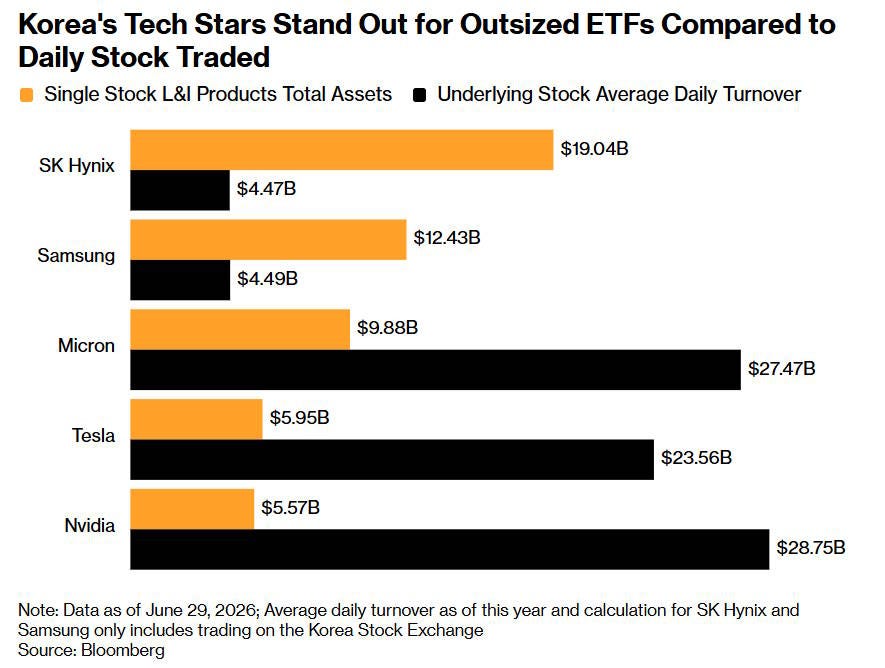
There were some people selling — notably, foreign investors “taking profits” and getting out. But the noise traders overwhelmed all the selling pressure, and sent stock prices soaring.
Then something happened last month — either something fundamental or something financial. Hynix and Samsung are doing fine in terms of earnings growth, but it’s possible that something suddenly gave traders reason to doubt the overall story about the AI boom sending these companies’ profits to the moon. The other possibility is that Korea simply ran out of hotheaded day traders willing to borrow more and more in order to bet on stocks, and the influx of cash naturally came to a halt.
Whichever it was, at that point the price faltered and began to fall. All that borrowed money accelerated the fall on the way down. When prices fall, leveraged ETFs have to sell some of what they hold.2 When a bunch of leveraged ETFs do this at the same time, it pushes prices down, forcing others to sell. In the meantime, people who had borrowed money to buy stock faced margin calls (or bankruptcy), forcing them to sell stock to raise cash. All of this created extra selling pressure, and so increased the rate at which Korean stock prices fell since late June.
Anyway, that’s the financial story. It’s a very old story — financial leverage plus unsophisticated new buyers plus a strong fundamental story often produces a bubble and crash, or exacerbates one that was already in progress. No wonder Korea is now moving — a little belatedly — to restrict leveraged ETFs.
But while financial factors affected the timing and the size of the stock price boom and bust, the fundamental story is more interesting. Fears of an AI bubble are quietly creeping back.
In 2025, as consumer chatbots struggled to find a market big enough to justify the kind of investments being made, there was a lot of talk about an AI bubble. One possibility was that AI revenues wouldn’t grow fast enough to justify the amount being invested in data centers. Another possibility was that AI companies wouldn’t have enough of a “moat” to make them consistently profitable.
In 2026, Claude Code exploded onto the scene, and everyone realized that AI had finally found “product-market fit”. We now know at least one thing that AI is incredibly useful for — writing computer code. Suddenly, an AI bubble seemed much less likely. Spending on AI was skyrocketing, and Anthropic — the new market leader — was successfully capturing much of the profits. Cybersecurity and other zero-sum applications — where having the absolute best model can matter a lot — started to seem like the “moat” that AI had previously lacked. Suddenly, the giant data center construction boom seemed a lot more reasonable.
But slowly, doubts have begun to creep back in. AI is amazing at writing software, but writing software is different from selling it. So far, huge increases in coding productivity are translating into only minor increases in the amount of software being shipped:
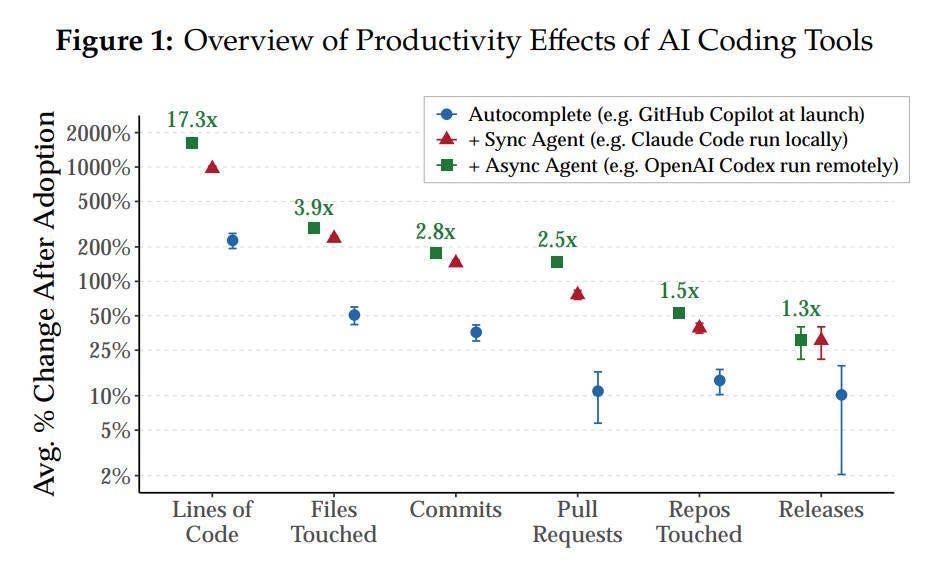
It’s possible that a significant fraction of the explosion in the use of coding agents is just “tokenmaxxing” — companies trying to use as much AI as they can, either to learn to use the tools, or perhaps just to look like they’re doing something. If so, we can expect a retrenchment and a temporary slowdown of AI spending growth.
It’s also possible that even the revenue growth we’ve seen isn’t enough to offset the enormous costs of the data center boom. Here’s a recent report from The Economist:
A back-of-the-envelope calculation finds that covering AI capex through identifiable AI income requires revenue on the order of $2.5trn per year, more than tech’s entire combined revenue today…Anthropic pulls in perhaps $75bn, annualised; OpenAI makes tens of billions; Google, via its AI model Gemini, and Microsoft probably get a bit less. SpaceX may have a few billion dollars’ worth of revenue from enterprise AI this year. Meta also makes a few bucks from AI. Add this up and you land at roughly $150bn a year. [emphasis mine]
AI revenue is growing very fast, but if these calculations are right, it’ll have to grow by 17x from where it is now in order to justify the capital being spent. In other words, even Claude Code isn’t enough; AI revenue has to accelerate even further, and while it’s perfectly plausible that it could do that, it’s a big question mark.
There’s also the possibility that the moat of companies like Anthropic is less invincible than it looked just a couple of months ago. A Chinese company called Moonshot AI has released a model called Kimi K3 that nearly equals the best available American models. American companies are using cheap Chinese AI models more and more for daily tasks. If Anthropic and OpenAI lose the overall b2b market to cheap Chinese competition — which is undoubtedly supported, of course, by China’s usual blizzard of subsidies and government supports — there’s not much chance that they’ll be able to pay for the data center boom.
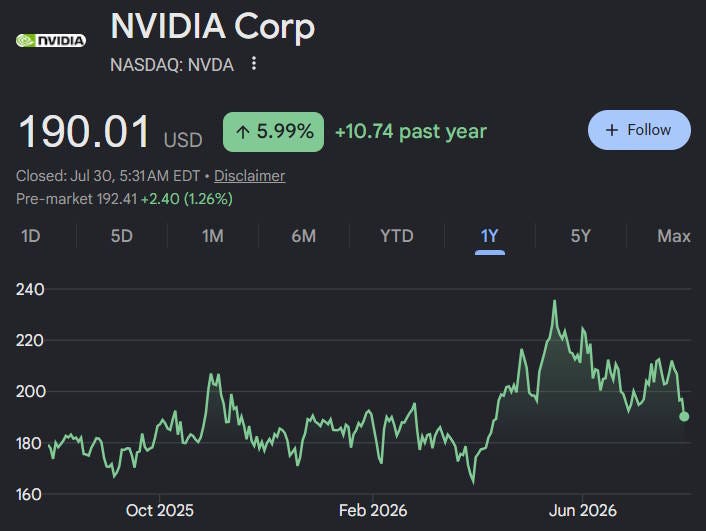
And at that point, there could be a big, big bust — similar to when railroads went under in 1873. Investors are probably already beginning to worry about this. It isn’t just Korean AI-related stocks that have taken a hit recently. Here’s Nvidia, which designs and furnishes the chips that run data centers:
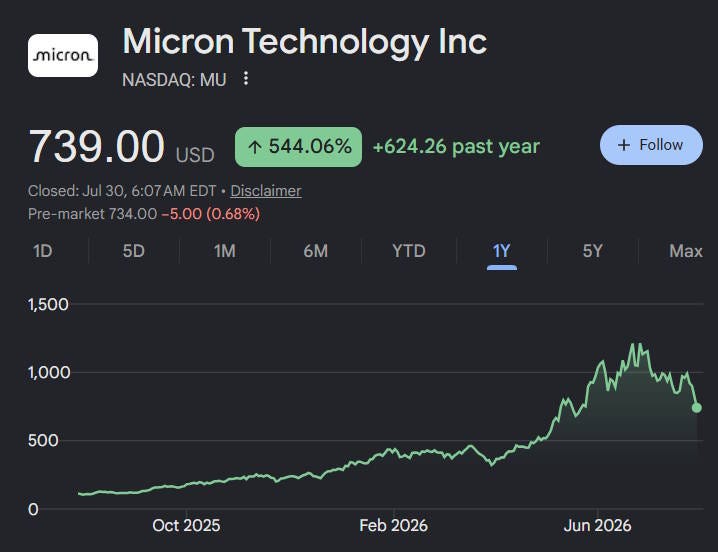
And here’s Micron, America’s top memory chip maker:
And here’s Microsoft, a big part of whose business is installing AI data centers:
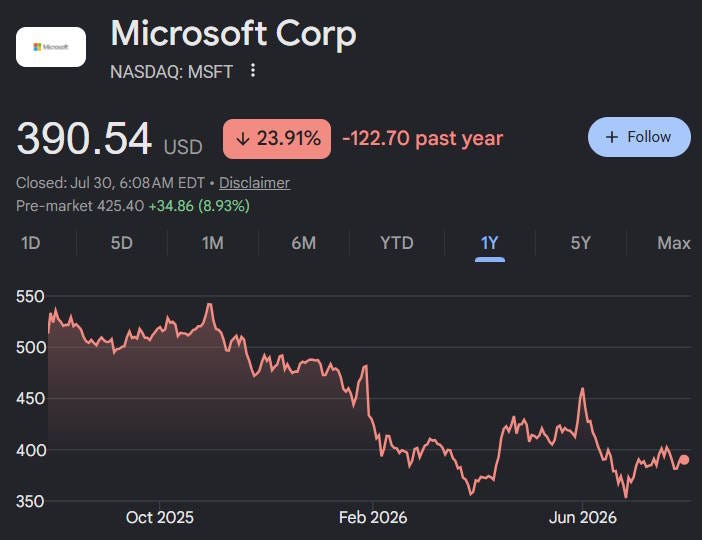
There are similar (if less dramatic) stories at Google and Amazon, who also run a ton of data centers.
Here’s Bloomberg’s story about the decline of the so-called “Magnificent 7” tech stocks:
Wall Street is growing increasingly concerned about the hundreds of billions of dollars Big Tech is spending on artificial intelligence…“The real problem is the amount of spend that’s going on,” said Ken Mahoney, chief executive officer of Mahoney Asset Management. “No one knows what the return on investment is.”…The selloff is coming as investors grow increasingly cautious about the massive sums that Big Tech firms are spending to build out their AI infrastructure. The Mag 7 index is now down 11% from a record reached in late May, erasing $2 trillion in market value.
So although South Korea’s epic stock crash was probably related to Korea-specific financial factors, it could also herald the return of the “AI bubble” story. AI is far and away the most important thing going on in the American economy right now, so any hint of a bubble is worrying.
Update: One possibility I should have mentioned is that the Korean stock crash is the start of a general crash in AI stocks — the long-awaited “AI bubble pop”. So far the carnage hasn’t been too extensive, but it’s notable that some people who bet big on the smooth, uninterrupted exponential growth of AI are now seeing those bets blow up:


Citadel — a big traditional mainstream finance firm — is now stepping in to buy many of the stocks owned by Situational Awareness.
And as Derek Thompson noted a couple of weeks ago, Korean retail investors aren’t the only ones borrowing money to buy stocks:


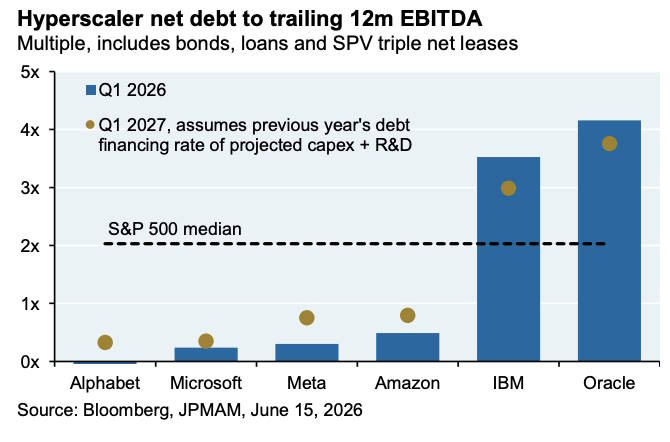
Derek flags the rise of margin buying and leveraged ETFs in America, but I also noticed that some pretty big companies are leveraging themselves to the teeth here:
For the best simple explanation of how financial markets can go haywire, I recommend the famous paper by DeLong et al. (1990). If you don’t feel like reading through a mathematical model, just ask AI to explain it to you in simple terms.
Usually, futures or options or some other derivatives tied to the value of the underlying stock.
Most mature heavy industries have a commodity layer and a premium layer. Cars for example. Traditionally, small hutchbacks had margins so tight that large auto conglomerates would make no money from them directly. But they would share parts with pricier models.
AI seems on its way to be a largely commoditized heavy industry. This may be good news for the economy as a whole. There would be smaller markets for specialized premium models. If you think you need THAT model, then you have to truly and fully pay up.
If you're fine with the commodity layer, then you have many options heavily competing on price. The sheer scale and efficiency of AWS, Google or Microsoft will enable them to sell compute cheaper than the average company could do in-house.
Interestingly, the only two companies with a defensible moat in all this are Samsung and SK Hynix. You cannot have AI without memory, be it an open-source or a frontier model, cloud or in-house. And from 2028 on those two will offer HBM5 (Micron a year or two later), which will give them the technological lead that produces those moats. And possibly around the same time they will offer the next innovation: cHBM.
These moves were inspired by a succession of stories: Samsung and SK Hynix have extremely low forward earnings compared to US semi stocks, even Sandisk - up. Memory is cyclical and the additional capacity coming online in 2028 is gigantic - down. The next story to come will be about next generation memory. The stock market is not governed by true fundamentals, never has been.
One small thing re: your footnote: the way that Korean leveraged ETFs are constructed they end up actually having to sell shares, not just futures. For those who want a deep dive into the financial mechanics, I write about it here: https://liquidcontext.substack.com/p/twice-the-risk-twice-the-excitement