

These days it seems like the only things to write about are politics and AI. I wrote about AI last time, so today I’ll write about politics.
Here is my basic theory of American politics in the 2020s: The United States is a nation of moderates ruled by a fringe of extremists. The extremists rule because they are more engaged than the moderates — they spend more time thinking about politics and doing political activism. In Martin Gurri’s terms, the extremists are the “public” and the moderates are the “populace”.
There are several reasons why American politics is dominated by extremists. The well-known one is the closed-primary party system. Republicans win primaries not by aligning with the median voter, but by aligning with the median Republican voter — usually in an area that’s already right-leaning to begin with. The same is true of Democrats.
But that has been true for a while. The fundamental reason why American politics is more extremist-dominated than in the past is technological. Modern social media bypasses traditional hierarchies and institutions and gathers together communities of like-minded extremists who then create challenges to traditional institutions; it also provides these extremists a platform in which their emotionally charged messages are more likely to go viral than messages of positivity and reason.
The moderate majority increasingly avoids the politically charged, extremist-dominated online spaces. That gives lots of Americans more peace of mind, but it also means that online spaces become more and more extremist as moderates leave.1 This is the conclusion of Törnberg (2025):
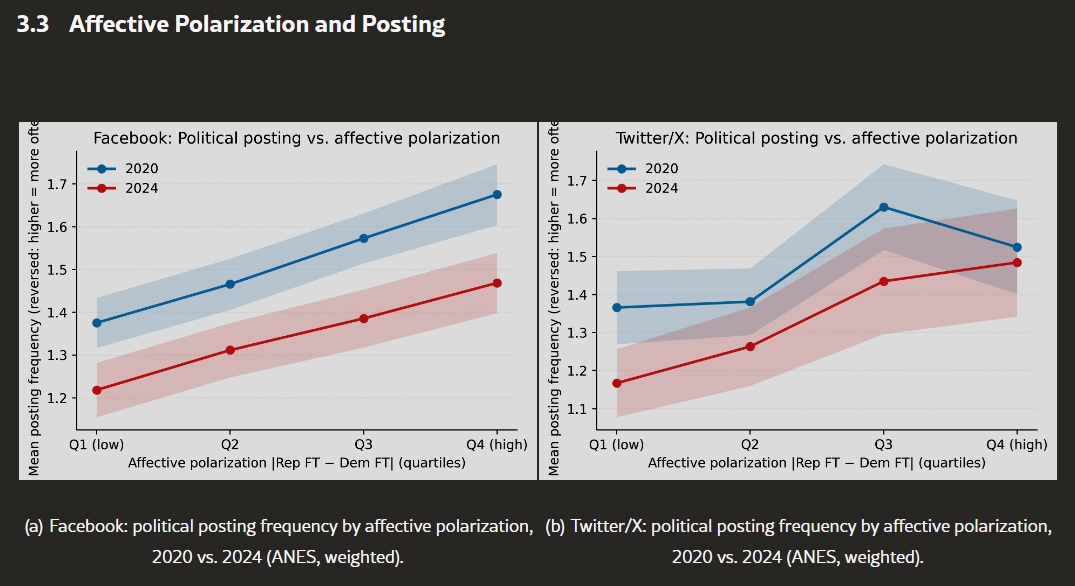
Using nationally representative data from the 2020 and 2024 American National Election Studies (ANES), this paper traces how the U.S. social media landscape has shifted…Overall platform use has declined, with the youngest and oldest Americans increasingly abstaining from social media altogether. Facebook, YouTube, and Twitter/X have lost ground, while TikTok and Reddit have grown modestly, reflecting a more fragmented digital public sphere….Across platforms, political posting remains tightly linked to affective polarization, as the most partisan users are also the most active. As casual users disengage and polarized partisans remain vocal, the online public sphere grows smaller, sharper, and more ideologically extreme. [emphasis mine]
In case you like charts, here’s one from the paper showing that extremists post more than moderates:
If extremists remained online, shouting at each other or shouting into the void, this would be a good and healthy process for a nation weary of culture wars. But the people who dominate real-world politics are increasingly drawn from this pool of online extremists. I am talking not about elected politicians themselves, but about the activists who create and promulgate political ideologies, the think tankers who translate those ideologies into policy ideas, the lobbyists who promote those policy ideas to politicians, and the staffers politicians hire to decide which ideas to embrace, and how.
Let’s talk about those staffers for a moment. Staffers write legislation, advise elected officials on policy, and handle lots of public communications. While politicians are out fundraising, pressing the flesh, or giving speeches to increasingly outdated TV news networks, their staffers are busy with the business of running the country. These staffers are much younger than the politicians they ostensibly serve — the typical Congressional staffer is in their late 20s, while the typical Congressperson is in their late 50s.
This means staffers are more online, and thus spend their days lost in the extremist maelstrom of social media, mainlining rightist conspiracy theories on X and leftist tropes on TikTok. Staffers are also unelected, which means they don’t have to cater to regular voters; they are free to pursue radical ideologies, support radical movements, and put out extremist messaging unless their bosses explicitly act to rein them in.2 There are plenty of anecdotes about how staffers in both the Democratic Party and the Republican Party are more extremist than the politicians they serve — to say nothing of the country as a whole.
For a concrete example of this, take the recent contretemps over one of Donald Trump’s racist social media posts. Trump’s Truth Social account posted a video depicting Barack and Michelle Obama as apes:
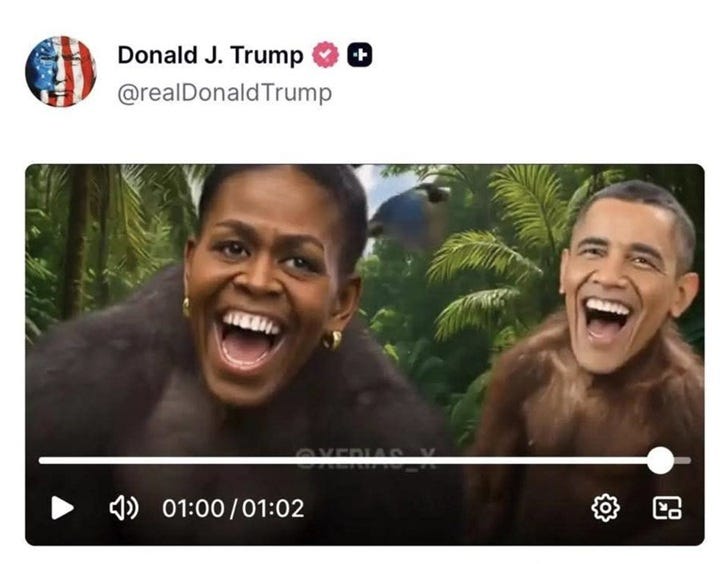
After a general outcry, the racist video was taken down. A White House official stated — and Trump later confirmed — that the video was posted not by Trump himself, but by a staffer. Trump refused to apologize for the video, demonstrating how extremist staffers can essentially force the politicians who employ them to take more radical positions.
These 28-year-old extremely online radicals — along with the larger network of think tankers, lobbyists, and activists with whom they are deeply enmeshed — are a key part of America’s ruling class, invisible and unaccountable and unelected and more powerful than almost anyone realizes.
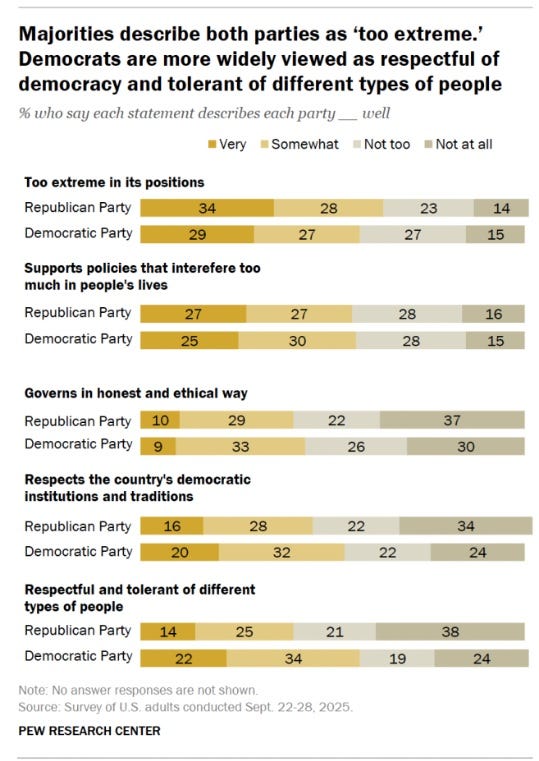
Anyway, regular Americans sense this and are distinctly unhappy with it. Majorities say both parties are too extreme:
And voters are voting with their feet, leaving both parties and registering as Independents in record numbers:
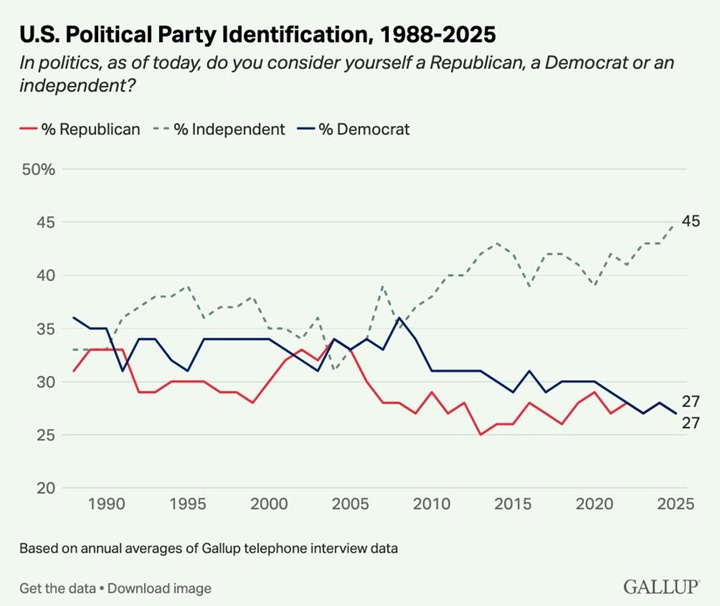
But although this is a very natural way to express disapproval with the two parties, it ends up exacerbating extremism, just like when moderates abandon social media. Independents can’t vote in closed primaries, so the people who remain registered as Democrats and Republicans are going to end up nominating even more extremist candidates, forcing regular Americans to choose between two even more polarized extremes — and simply increasing their frustration and disaffection.
This is all very bad for America, and I don’t have a way to fix it, other than A) transitioning to open primaries and B) bringing back the Fairness Doctrine and applying it to social media — two things that nobody is going to do. But watching the behavior of America’s two extremist movements, I don’t think either of them is going to be durable and successful.
I think this is true for many reasons. American voters are unlikely to keep either party in power for long at the national level, and instead will more likely ping-pong back and forth between them as they grow disgusted with the performance of each. Social media activism and memes will push both parties toward unworkably extreme policies — stupid tariffs, unchecked government borrowing, and so on. Online spaces will make it ever harder for real leaders to emerge on either side, as reasonable moderates are quickly “cancelled” by mobs hunting for the smallest peccadillo.
But on top of that, I see some core tendencies that are particular to the American right and left — the MAGA movement and the progressive movement — that strike me as maladaptive and seem to portend long-term weakness.
On the right, a big problem is that the MAGA movement is relentlessly focused on shrinking its coalition. Winning coalitions in politics are built by gathering together various groups and aligning them toward shared goals. Trump did a good job of that in 2024, assembling a startlingly diverse, broad-based electoral majority. But MAGA insists on attacking every group it could bring into its tent.
As an example, just look at that video Trump’s staffer just posted — and which Trump defended, even though some Republicans condemned it. One way that Trump enlarged his coalition in 2024 was to persuade some Black voters to switch sides:
In 2024, Trump won 15 percent of Black voters — according to Pew Research’s widely cited validated voter survey — an increase from the 8 percent he won four years earlier. A pre-election Pew poll found that the economy and health care were the most important issues for the voting bloc[.]
15 percent doesn’t sound like much, but an 8 percentage point shift is big, and every vote counts. Does Trump think posting videos showing prominent Black people as apes will help him solidify that small Black conservative contingent as part of an enduring GOP coalition? It doesn’t seem like he cares.
Nor is this an isolated incident. James Fishback, a Republican primary candidate for governor of Florida, recently referenced “goy slop” — an antisemitic conspiracy theory that says that Jews are forcing gentiles to consume low-quality goods. This is just one example of a rising tide of antisemitism in the GOP, which party leaders like Ted Cruz have acknowledged. That will probably prevent a major exodus of Jewish voters from an increasingly anti-Israel Democratic Party.
Meanwhile, ICE’s racial profiling and raids on Hispanic-owned businesses are starting to drive away Hispanics who were a crucial part of Trump’s winning coalition in 2024. MAGA has not explicitly demonized Hispanics as a group, and many who voted for Trump believed that he would distinguish between citizens, legal residents, and illegal immigrants. But like every other big U.S. deportation effort since 1930, Trump’s current crackdown involves a significant degree of enforcers simply grabbing people who look Mexican and holding them on suspicion of being illegal.
And MAGA is attacking Indian immigration as well. A wave of anti-Indian sentiment among online Trump supporters has spilled over into the real world. Texas’ Governor Greg Abbott has stopped public universities and the state government from hiring H-1B workers (most of whom are Indian). This will hurt the state economy, which depends on Indian doctors and other professionals for essential services. Whether it will hurt the GOP with Indian-American voters remains to be seen, but I doubt it will help.
There are also signs that MAGA is starting to turn against East Asians. A couple of years ago, affirmative action in college admissions was struck down by SCOTUS after a MAGA-aligned group sued Harvard for discriminating against Asians. That raised the possibility that MAGA’s ostensible defense of meritocracy might win over some Asian voters to the GOP. But then right-wing commentator Helen Andrews went on a multi-day tirade against Asian immigrant culture, alleging that Asians threaten the American way of life by working too hard in school and succeeding too much, while also claiming (rather farcically) that Asians benefit from workplace DEI programs:
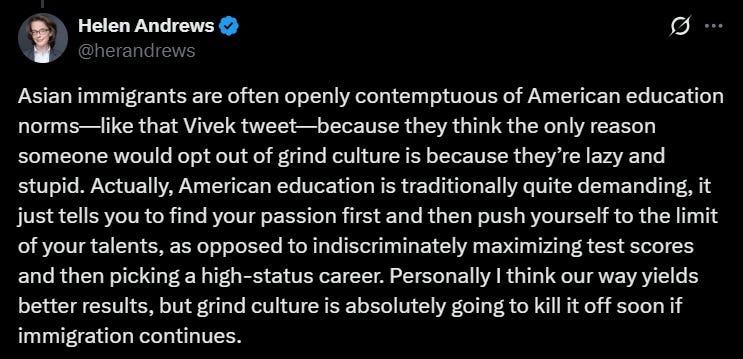
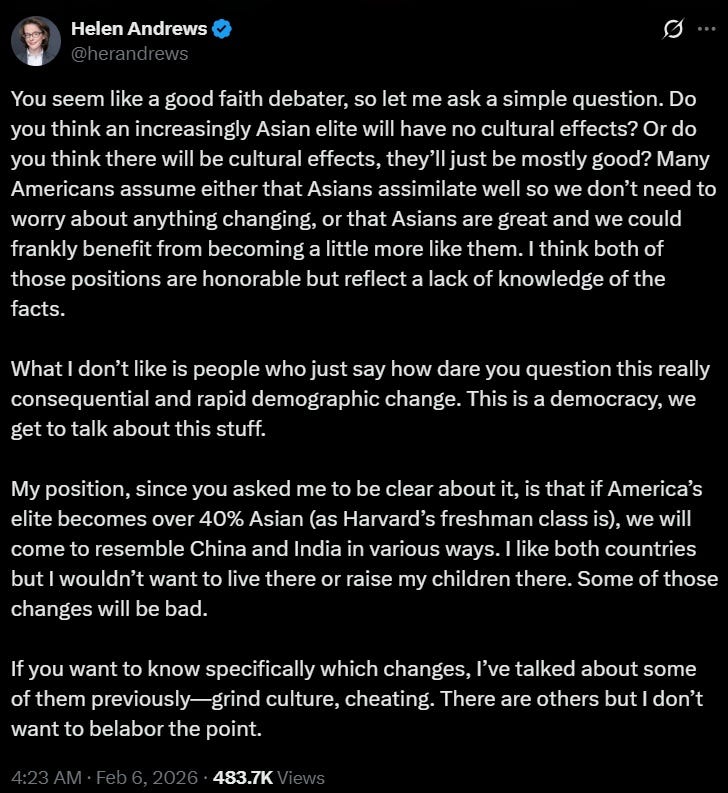
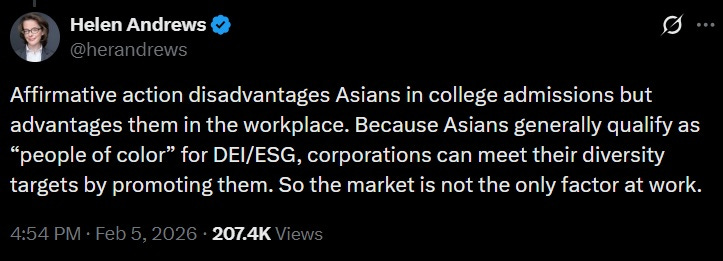
The idea that Asians are going to destroy American culture by working too hard is ridiculous — an obviously ad-hoc fabricated excuse to attack a minority group that succeeds financially, comes in legally, and tends to commit very little crime. It also happens to be wrong (Asian “grind culture” is simply another case of immigrant striver culture, which tends to fade by later generations). And if the rest of MAGA takes up this line, it seems likely to alienate the Asian voters who shifted toward the GOP in 2024, many of whom were alarmed at Democrats’ attacks on educational meritocracy.
It’s hard to think of a group of Americans — other than White Protestants — that the MAGA movement has not turned its outrage machine on. Indeed, the whole movement has come to resemble a roving Eye of Sauron that constantly looks around for a new racial enemy to attack, switching targets every year or so.
This is not a way to build an electoral coalition. There are far too few White Protestants to form an electoral majority in America, no matter how many people ICE deports or how many visa-seekers and refugees Trump turns away. Instead, Trump’s movement will simply drive away one ally or potential ally after another, shrinking the tent as they go.
My sense is that this is structural. MAGA leaders — politicians, pundits, and so on — energize their base by stirring up fear of racial “others”, but then back off when they receive sufficient pushback and accusations of racism. So they have to keep cycling through targets, so they can keep stirring up their core voters’ anxieties without having any one particular minority become the focus for liberals’ defensive efforts.
As a result, they just end up alienating everyone, one by one. At its core, MAGA is a xenophobic movement that gains a lot of its power from the fear of racial enemies; this is a poor long-term strategy in a diverse democracy.
As for progressive extremism, I think this will also fail, but for a very different reason.
Progressivism lost at the polls in 2024, but still dominates in many big cities and some states, and has had a chance to prove itself as a governing ideology over the last 10 to 15 years. It has failed. I highly recommend this article about the decay and decline of Portland, revered as a progressive mecca in the previous decade. Some key excerpts:
Last fall, after the city acquired a reputation for crime, homelessness, and dysfunction, Oregon politicians rushed to media outlets to assure the nation that the city was not literally on fire…[But] Portland is constantly on fire. In the year following July 2024, Portland had 6,268 fire-related incidents – and 40% of the fires in the city are a direct result of Portland’s out-of-control vagrancy…
[Jeff] Eager says one key reason why the city’s massive crime problem goes unaddressed is that it’s largely self-inflicted and driven by ideology. “Hard core progressivism has destroyed what old school Oregon liberals built – farmers markets, parks, walkable communities, transit, and all the good kind of Portlandia-era liberal lifestyle stuff,” said Eager. “This brand of progressivism is just so against the rule of law, it’s ruined all those institutions that made Portland a cool, trendy, quirky place. It's not really quirky anymore. It's dangerous.”
Portland now has the second-highest crime rate of any city in America, behind Memphis. About one out of every 16 people in the city is the victim of a crime every year…The lack of law enforcement became obvious to everyone during the summer of 2020…As part of the Defund the Police movement that year, Portland’s leftist city council cut $15 million from the city’s law enforcement budget, eliminating 84 jobs in the police department – with predictable results. By November 2021, [the mayor] acknowledged “many Portlanders no longer feel safe,” and the city council began the process of restoring some funding to the department – though the police are at loggerheads with local politicians and the department remains chronically understaffed. [emphasis mine]
Portland’s plight is especially notable because it contrasts with a pretty epic nationwide decline in crime. It’s obvious that progressive extremist ideas about tolerant approaches toward crime have prevented Portland from fully participating in that happy trend — murders fell in 2025, but property crime remained sky-high.
Another likely example of this is the epidemic of copper theft in Los Angeles, that is literally turning lights off across the city.3 The main impetus for the theft wave, of course, is the rising price of copper, which makes it more valuable to steal. But California has a pandemic-era law saying that theft of under $950 worth of goods is a misdemeanor, not a felony. That law has now been watered down, and some exceptions added, but it still makes it hard to prosecute petty thieves.
When a swarm of petty thieves is crawling all over your city stripping out the wires, prosecuting and penalizing petty crime is exactly what you need to do. But a progressive criminal-justice “reform” back in 2014 made that harder.
The frequent failure of progressive cities to crack down on crime — and the progressive movement to make America more tolerant of criminals in general — undermine the entire left. This can be added to a litany of other progressive local and state government failures — not building enough housing, bankrupting cities through excessive spending, outsourcing government functions to NGOs, spending way too much on transit projects, and so on.
In all of these cases, what progressivism is doing is parasitizing the liberal institutions that allowed progressivism to exist in the first place. Liberals built the public libraries; progressives are destroying them by turning them into ad-hoc homeless shelters. Liberals built trains, but now people don’t want to ride the train because of crime and disorder, requiring big bailouts from the state of California. Progressive tolerance of bad behavior by the few — open drug use and sales, theft, street harassment — has turned parks, streets, and other types of urban commons into no-go zones for the bulk of the citizenry.
The pattern repeats itself: Liberals build, progressives come in and demand more and more from the system liberals built, until the system collapses. As yet, liberalism seems to have evolved no defense against this; for at least a decade, nobody seems to be able to say no to progressive demands.
This is why I believe that both the American right and the American left will fail — and indeed, are already failing wherever they gain power. Extremist ideas are generally bad at actually governing, but good at winning hearts and minds in online chat groups. Of course, this provides cold comfort for those of us who will suffer from America’s two flavors of bad governance. A country with two broken ideological programs is a deeply dysfunctional country.
Eliezer Yudkowsky calls this “evaporative cooling of group beliefs”. I quite like the analogy.
I did find one paper claiming that staffers are more moderate than politicians in general, but I don’t trust this measure of moderation.
It should be noted that L.A.’s problems with homeless people starting fires are even bigger than Portland’s by some measures.
The first thing to note is that the progressive failure you describe (breaking things, creating chaos) creates strong support for right wing extremism.
And right wing extremism, at least as ineptly practiced by Trump's administration, creates similar support for left wing extremism.
And in each case, moderates pretty much have to follow their extremists. Those anti-ICE protesters might be standing for vastly more extreme positions than I would ever support, but hey, fuck masked government agents shooting protesters and ignoring all manner of the law.
For me, it is a little unclear what your piece is implying. That both extremes are failing, so moderates will inherit the earth? Or that both extremes are failing, so America is pretty much screwed?
At the moment, I lean very much towards the latter. I am quite sure that the majority of Americans actually prefer moderation, but contrary to myth, majority doesn't rule.
In large part, it's the technological shift in mass communications. It's not just that social media "provides these extremists a platform in which their emotionally charged messages are more likely to go viral than messages of positivity and reason." It's that almost everyone is more drawn to the sensational, the outrageous, the enraging. Which is why The Washington Post did fine under Bezos during Trump I but fell apart during Biden -- extreme, attention-grabbing crap is the lifeblood of media and politics in this era.
But yeah, at this point, power positions like congressional staffers and legacy media writers and influencers are filled with people committed to various forms of extremism. Once the print era got into high gear, illiterate people simply didn't matter much, regardless of fine words about all being created equal. Now it's a different era and a different set of people do (and do not) matter. And it's hard for print people to wrap their heads around, because they (we) analyze in terms of policies and majorities and rationality and so on.
Another big disappointment from Noah. In his quest for both-siderism, he conflates left, liberal, and progressive once again. For example, he says "Liberals built the public libraries", but that is just wrong: the push for libraries was progressive, and I don't know how he would explain Andrew Carnegie (for example) as a liberal. Nor is there a counterpart to the billionaire-supported, coordinated, organized, right-wing movement that created Reaganism, the Tea Party, and MAGA.
A better way to write articles would be to focus on problems of one thing at a time, conservative, liberal, left or progressive, rather than this sort of messy, combined pseudo-analysis.
In that respect, Noah's analysis of self-destructiveness in the MAGA coalition is much better, though I think he misses two big ideas. The first is that the core of MAGA is white supremacist and Christian Dominionist. Blacks, Asians, Hispanics, Jews, gays, etc. can delude themselves that they can join in if they are in the middle or upper classes, but they are really being exploited for their support by a core that despises them. The second is that this is a strategy by the ultra wealthy to keep the lower classes divided and controllable by giving them reasons to despise each other for race, religion, culture, class, and other excuses. It is simply appeal to a natural desire to feel superior to others in some way. The way poor white trash can say "at least I'm not a n-word". And now all those minority groups are in the FAFO stage with MAGA.