

“And the only way to fight the bastards off in the end is through intelligence.” — Enoch Root
“In human life it's also true/ The strong will try to conquer you/ And that is what you must expect/ Unless you use your intellect” — Merlin
Five years ago, I wrote a post about the wave of authoritarianism sweeping the world:


That unhappy trend has continued. Freedom House’s 2026 report is subtitled “The Growing Shadow of Autocracy”, and finds that freedom continues to decline across the globe:
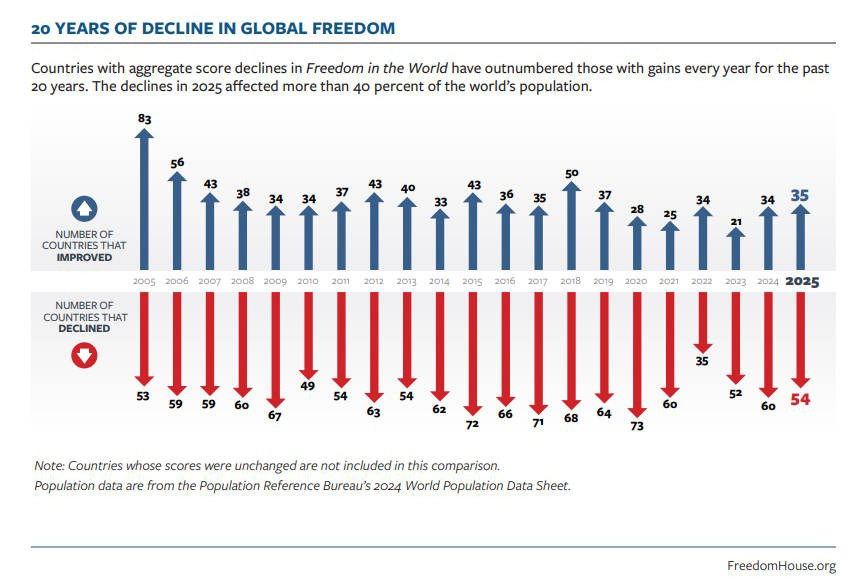
V-DEM’s 2026 report, subtitled “Unraveling the Democratic Era?”, delivers the same message:
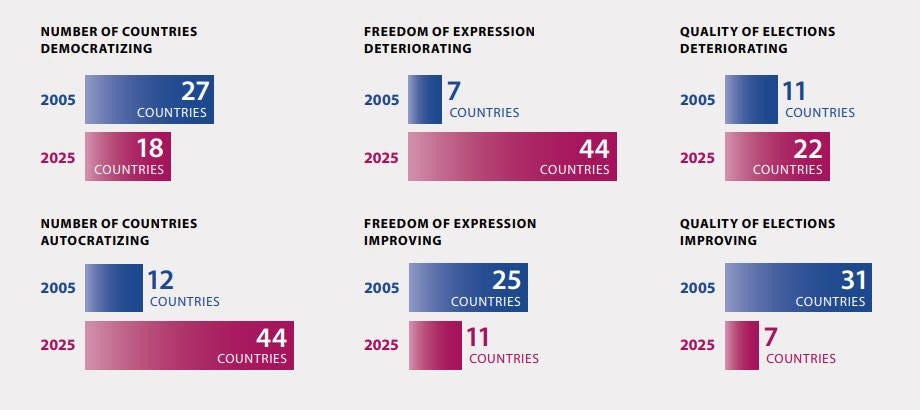
Both organizations note the rapid deterioration in freedom under Donald Trump’s second administration, including attacks on free and fair elections, persecution of critics in the press, and the rise of a violent and unaccountable security state. In the 20th century, the U.S. was the Arsenal of Democracy — as the world’s most powerful country, and one of its most free, it often used its industrial might to support liberal democracy around the world. In the 21st century, America is increasingly incapable and unwilling to play this role.
Instead, the industrial powerhouse of this century is China. In addition to its own rapidly growing military power and technological supremacy, it supports various autocratic satellite powers to keep potential rivals off-balance — Russia, Iran, North Korea, and so on. This geopolitical grouping has been given various names — I called it the “New Axis”, and others have called it things like the “Axis of Autocracy”. But Trump has shown that Cold War 2 will not be a clean contest of liberal democracy versus totalitarianism; instead, it’ll be a hodgepodge of amoral competing power blocs, more reminiscent of the time before World War 1.
Liberal democracy hasn’t been defeated, but it’s definitely the underdog again. The hope that regular folks would rise up and overthrow the one-party states, petty tyrants, and populist strongmen is fading; the Hong Kong protests of 2019, the Belarus protests of 2020, and various waves of Iran protests all failed to make headway against autocratic regimes, while America’s protests in 2020 did little to halt the country’s slide into strongman rule.
That’s all very sad and disturbing. But we’re starting to see another trend quietly emerge — tyrants are losing wars.
The first example of this was the Syrian Civil War. After brutally crushing various rebel factions for over a decade with the help of Russia, Iran, and Hezbollah, the Assad regime suddenly collapsed in late 2024. Despite a lot of hand-wringing over whether Syria’s HTS militants would bring jihadist rule to Syria, the country’s new leaders seem reasonable, pragmatic, and a lot more tolerant than any of the alternatives.
The second example was the collapse of Iran’s shadow empire of proxies in the Middle East. In addition to Assad, they lost Hezbollah, whose catastrophic defeat by Israel in 2024 belied its fearsome reputation, and mostly lost Hamas. The Israelis are not exactly liberal democrats at this point, but they’re certainly less illiberal than Iran and its proxies.
But the most important loss for the Axis of Autocracy, or whatever you want to call it, is shaping up in Ukraine. It’s still early days, but there are clear signs that the tide has turned against Russia. Ukraine’s drone industry has really hit its stride, producing several million drones a year and innovating all kinds of new and deadly weapons.
This has enabled the Ukrainians to fight a successful defensive war while taking fewer and fewer casualties. Some sources estimate that Ukraine is now killing 5 Russians for every Ukrainian lost. Even if that’s an overestimate, the ratio certainly seems to have tilted significantly in Ukraine’s favor. The Russians are taking horrendous losses — over 30,000 each month in recent months, probably more than the Russians can currently recruit. Russia’s total estimated losses in the war were over 350,000 killed and 1.4 million at the end of last year; by now the numbers are significantly higher.
Russia’s territorial gains, meanwhile, have slowed or even reversed, despite all the bodies Putin is throwing into the meat grinder. Here’s The Economist:
Not only has Russia’s expected spring offensive been a flop, but in April Russian forces suffered a net loss of territory for the first time since August 2024…By our calculations…Russia has lost control of 113 square kilometres over the past 30 days.
Meanwhile, Ukraine’s long-range drones are inflicting more and more pain on Russia. Ukraine is destroying Russian oil infrastructure and closing Moscow’s airports. Russia’s air defenses can’t even protect the capital; Putin was so afraid of Ukrainian drones that he had to scale down his recent annual “Victory Day” parade, removing military vehicles from the procession, appearing only briefly in public, and asking Donald Trump to persuade the Ukrainians to declare a temporary ceasefire to allow the parade to happen:
Ukraine’s long-range drones are so powerful that they could soon even be able to cut off Crimea from Russian resupply.
None of this means that Russia or its military is about to collapse. But even if Putin declares a full mobilization and throws millions more Russians into the Ukrainian drones, it’s not clear what that’ll win him except further depopulation of his country. This is probably why Putin has recently declared that the war is “coming to an end”:
Russian President Vladimir Putin said on Saturday that he thought the Ukraine war was coming to an end…"I think that the matter is coming to an end," Putin told reporters of the Russia-Ukraine war, Europe's deadliest conflict since World War Two. He also said he would be willing to negotiate new security arrangements for Europe, and that his preferred negotiating partner would be Germany's former Chancellor Gerhard Schroeder.
This is still wildly over-optimistic on Putin’s part — he seems to think he can just end the war on favorable terms any time he wants, choose Russian patsies as negotiating partners, and dictate the future of European security. Most of that is highly unlikely to happen; barring an unforeseen Ukrainian collapse, the Ukrainians will simply keep hammering away at Russia’s troops and infrastructure with their drones. But Putin’s sudden willingness to talk is very significant — it means he knows he’s starting to lose the war, and wants to beat some kind of face-saving retreat.
Ukraine is the clearest and most important example of how 21st century autocrats, having triumphed in the streets and on social media, are losing on the actual battlefield. Trump’s losing war in Iran is part of the trend too — although the Trump regime isn’t technically part of the Chinese-led Axis, he’s definitely cut from the same cloth as the other populist, illiberal strongmen who have proliferated around the globe in recent decades.
What’s going on? Why are tyrants suddenly getting their butts kicked? I see several reasons.
First, the defender usually has the advantage. The strategic advantages are well-known. Almost by definition, the attacker’s forces are far from home and have to be resupplied, which incurs cost and risk. Conquering and subduing a whole country is also just an inherently more complex and difficult task than halting an invading army’s advance.
But I’m talking about something deeper — the moral advantage that you get from defending your homes and families against an invader.
Ukraine never threatened Russia at all. The whole Russian cause in this war is based on the notion that Ukraine’s potential accession to NATO and the EU was threatening Russia’s “sphere of influence.” But the idea of “spheres of influence”, while sometimes a good factual description of how powerful countries operate, is not a good moral principle. The idea that countries deserve “spheres of influence” is just the claim that powerful countries ought to dominate their weaker neighbors. In other words, it’s just imperialism.
Morality doesn’t field divisions, of course…or does it? Putin can pay desperately poor people to fight in his wars, or empty his prisons of criminals, or buy mercenaries, but can he persuade regular middle-class Russians in Moscow and St. Petersburg to die for the glory of the New Russian Empire? Not really, no — which is why as soon as casualties get too high to replace without general mobilization, he starts to think about ending the war.
Ukraine, meanwhile, was defending itself against conquest — a conquest that would have stripped away its national identity, brutalized its population, and kept it in poverty. That threat provided a powerful motivation for regular Ukrainians to sign up and risk their lives on the battlefield. Ukraine became a nation in arms, while Russia was still trying to fight a “special military operation”, because Ukraine had a compelling cause and Russia had an unconvincing one.
This lesson is useful in explaining why Trump’s war on Iran has failed. When Iran was the attacker — trying to control the Middle East through a network of armed proxies — its aggression provoked a backlash from people in Syria, Lebanon, Israel, and elsewhere who didn’t want to be ruled by foreign powers. But when Trump attacked Iran without direct provocation, Iran’s cause suddenly shifted to the defense, and its fortunes improved.
The people of Iran have no love for their regime — it recently mowed down tens of thousands of protesters in the streets, and the country’s economy is in a state of protracted collapse. But even so, they refused to rise against their rulers when Trump’s bombs started falling. Meanwhile, most Americans disapprove of the Iran war, and have no desire to endure the economic hardship of high gas prices just to topple someone else’s dictator.
This provides us with an important lesson. Reality is not Star Wars — dividing warring sides into “good guys and bad guys” is never really accurate. But “invaders vs. defenders” is a lot less ambiguous. If America ditches Trumpism and goes back to the principle of upholding territorial integrity, we’ll see our military fortunes improve, because we’ll associate ourselves with causes that people want to fight for.
The second reason tyrants are losing wars is because democracies tend to cooperate more than strongman regimes. The liberal democratic ideal is of a peaceful, positive-sum world, where people are free to get rich and express themselves. But for dictators like Putin and Xi, or populist strongmen like Trump, the goal is to dominate everyone else — including the other autocrats.
This was vividly illustrated in World War 2. Hitler started off the war by making a pact with Stalin to divide up Poland. But he ended up betraying his erstwhile ally, because he couldn’t suffer the idea of another dictator more powerful than himself. The Nazis cooperated only very loosely with Imperial Japan, if at all, and probably would have fought them in the end had the USSR fallen. Meanwhile, Roosevelt and Churchill were highly pragmatic and would cooperate with any power they thought would help stabilize the world — even the USSR.
It’s not a universal principle that democracies cooperate more than autocracies — in fact, democracies are often reluctant to come to each other’s aid directly in wartime. But personalist systems — the type that Trump, Putin, and increasingly Xi all favor — are less likely to cooperate than other types of regimes. Someone has always got to be the Big Man.
So although Trump may be drawn to the ideologies and the absolute power of Xi and Putin, and though he might entertain the notion of carving up the world with them, his ego will get in the way. So you see Trump currying favor with Putin, but then taking out Russia’s ally in Venezuela and seizing Russian oil tankers. And you see him going to war against a Chinese proxy and Russian ally in the Middle East.
Meanwhile, Ukraine has survived thanks to staunch support from European countries, who recognize that if Ukraine falls, they’re next on the menu for the empire next door. But while Russia has gotten some help from its ostensible Chinese ally, China has been extremely circumspect with this aid — not providing direct military assistance, gouging Russia to the bone on oil purchases, and halting cooperation as soon as U.S. sanctions loom.
Under Trump, the U.S. has put itself in a very perilous position by throwing its alliances overboard and going it alone. The U.S. alone has little chance to achieve the scale of production needed to match China. And when Trump alienated his European allies by throwing up huge ridiculous tariffs and threatening to conquer Greenland, he lost any chance for assistance with the Strait of Hormuz.
Meanwhile, there are signs that defenders — even some autocratic ones — are starting to band together against big empires. Ukraine is selling anti-drone technology to the Gulf states, and informal quiet connections are growing between Ukraine and Taiwan. An unofficial global anti-imperialist alliance would not be a bad thing.
The third reason tyrants are losing wars is that the civilizations they’re attacking are usually technologically superior. Hezbollah lost to Israel when Israel blew up their pagers and killed their leaders with pinpoint decapitation strikes. Russia is starting to lose to Ukraine because the Ukrainians are more inventive — with their world-beating drone industry, they’ve created an entirely new form of warfare just to defeat the Russians. Russia tries hard to keep up, but so far it hasn’t succeeded.
Much has been made, especially in rightist circles, of Russia’s supposed warrior culture. Their ads emphasize macho masculinity and show soldiers working out in the gym:
Ludicrously, the Trump administration has tried to copy the Russian example instead of the Ukrainian one. Hegseth constantly emphasizes warrior ethos and masculine toughness:
But big muscles don’t do much against exploding drones, nor do they help plan the complicated logistics that modern militaries depend on, nor do they produce innovative new technologies. Hegseth may be able to do a bunch of pushups, but the whole country is now recognizing that he’s dangerously incompetent.
Now, it’s not universally true that autocratic countries value innovation and technology less than democratic ones. China is arguably now the world’s leading technological nation — or at least on par with the U.S. In a war over Taiwan, China’s advanced drone and electronics capabilities would be a powerful asset.
But the autocratic regimes that have been the aggressors in the 21st century tend to value a warrior ethos, or religious fervor, over innovation and cleverness. In Neal Stephenson’s terminology, they worship Ares instead of Athena.
I hope people don’t interpret this post as a claim that liberal democracies are inherently stronger than autocracies. Trump is a fool, but the New Axis might yet rally, backed by the awesome technological and industrial might of China. Or even if autocracies continue to fail in their foreign military adventures, the natural disruptiveness of social media might simply bring down every liberal democracy from within, leaving the world to be fought over by incompetent tyrants.
But if current events have convinced you that tyranny is on the march and freedom is forever in retreat, you should probably look at the actual battlefield, and feel a little encouraged. If the wave of illiberalism that began in the mid-2000s is going to break and roll back, battlefield losses will probably have a lot to do with it — just as they did in previous eras.
Watching Ukraines resistance is one of the most heroic events of my lifetime. I am still proud that under Biden we were able to help them survive long enough to now essentially stand up on their own. It’s one of the most encouraging reversals in contemporary history.
One of the aspects of the Iran war that is interesting to me is how much it lays bare that Trump is fundamentally a coward. He likes to seem to be a strongman without being much of one in substance. Not to say he isn’t corrosive to democracy. He is. It’s just that in Iran he didn’t take Putins tactic of “throw everyone in the meat grinder until I get what I want.” When the going got tough…he quit. Now he’s just begging to be allowed to say he won and run away.
And then, of course, there's General Patton, ""No bastard ever won a war by dying for his country. He won it by making the other poor dumb bastard die for his country"