

“Imagination/ That’s the way that it seems/ A man can only live in his dreams” — The Flaming Lips
“No future/ No future/ No future for you” — The Sex Pistols
If you have kids — or if you’re planning to have kids in the future — I want you to think about a question: How will you make sure your kids have a successful life?
Obviously, this isn’t a question that anyone can ever answer with certainty. But ten years ago, in 2016, you could have given a pretty good answer. You’d work hard and save money and invest wisely, so you would have enough family wealth to cushion against unexpected shocks. You’d teach your kid good values, make sure they went to a good school, and send them to a good college. You might even encourage them to enter a promising elite professional field, like software engineering, medicine, or law. If you did all of this, you could be reasonably confident that your child would grow up to be at least economically secure, and probably upwardly mobile as well.
What answer would you give now, in 2026? Do you have any confidence that colleges — even top colleges — will actually teach your kid the skills they need to make it in a job market defined by AI? What field of study could you recommend to your child, knowing that there’s a possibility it will be automated by the time they finish studying it? Will even family wealth be enough to protect your descendants, in a world where land and energy are being gobbled up for data centers?
The sudden rise of artificial intelligence has cast a great fog over our future. It may bring wonders beyond our comprehension — the end of aging and disease, material hyperabundance, digital worlds to suit our every desire, expansion into outer space. Or it might bring chaos and destruction, as rogue agents wreak havoc with bioweapons and drones. Or it might become a superintelligence that turns us all into house pets.
Your kids might be chronically unemployed, as the CEO of ServiceNow recently predicted. Or AI tools might turn them into highly paid super-workers, as the founder of Uber recently predicted. The truth is that they don’t know, and I don’t know, and you don’t know either. Financial markets don’t know either. The people actually building AI certainly don’t know. The future is a blank wall of fog, rushing toward us at top speed, and nobody knows what to do.
Plenty of people have predicted this. It’s called a Technological Singularity — a period of accelerated technological change so rapid that it’s impossible to predict what life or society will look like afterwards. You can argue that the Industrial Revolution was a kind of Singularity, moving humanity in today’s developed countries from the edge of starvation to material abundance. Who could have predicted, in 1890, what life in 1990 would look like? And the AI revolution is happening much faster, promising to compress a century’s worth of change into a couple of decades.
AI may be the biggest thing casting a fog of uncertainty over our future, but it’s not the only thing. The political chaos of the last decade, and especially the governing style of the second Trump administration, has swept away much of what we thought we knew about American society. The rise of China has raised the possibility that global power will now reside with totalitarian countries instead of democratic ones. The possibility of another world war looms.
Now here’s the crucial point — even back in 2016, this period of rapid change was on the way. Most people just didn’t see it coming. Everyone who thought their kids would be safe if they just followed the standard 2016 playbook — a good college, a professional career — was wrong. They just didn’t know they were wrong yet.
But because they didn’t see what was coming, they were optimistic. Back in 2016, 69% of Americans expected a good life in the future — a number that’s now down to only 59%:

Even during Covid and the Great Recession, American optimism about the future didn’t waver. We “knew” — or at least we thought we knew — that we would recover from those shocks, and be able to live a good life. We might have been wrong, but we thought we could see the future — and it was those extrapolations that comforted us, even as we endured one shock after another.
It occurs to me that this can also explain why Americans are so nostalgic for the 1990s and the early 2000s.
Back in 2022, a few weeks before the release of ChatGPT, a writer named Michael Young tweeted an iconic tweet:
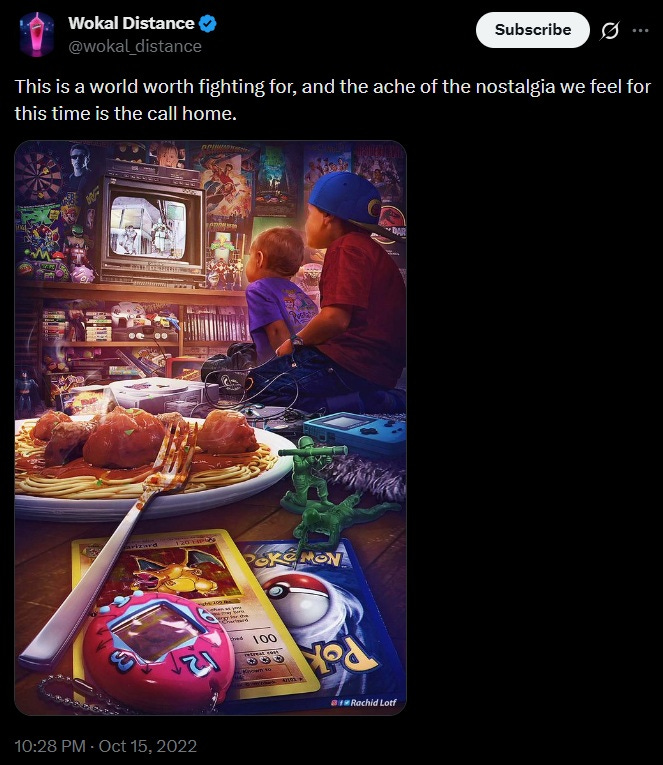
The tweet became a meme. Young was widely mocked for being nostalgic about middle-class consumer products from the late 1990s and early 2000s — video games, spaghetti and meatballs, CRT TVs, and so on. Everyone tends to be nostalgic for the decade when they were young; by evoking images from Millennials’ youth, Young was just tugging at the heartstrings of a population bulge.
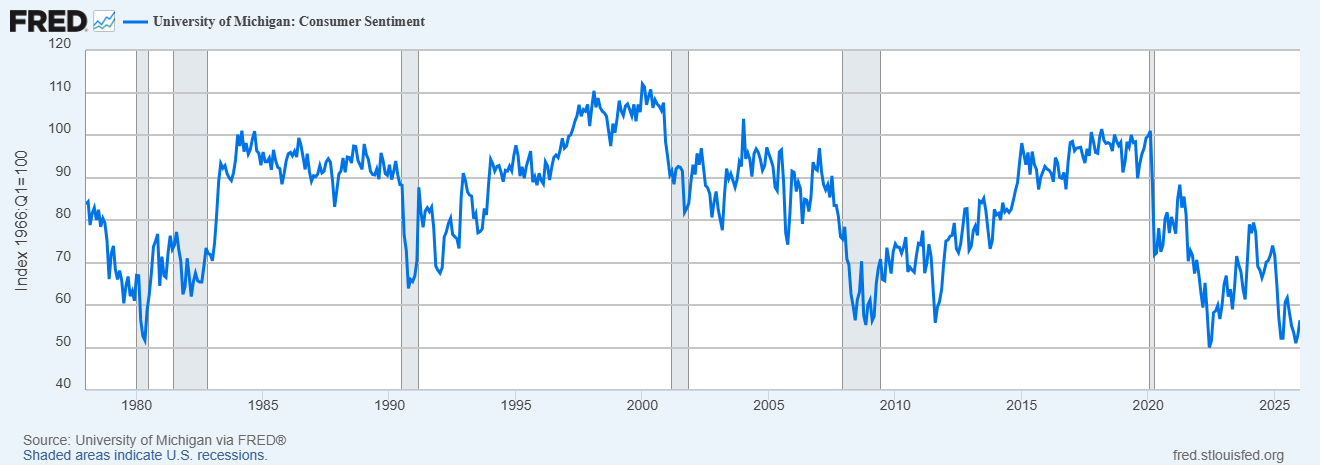
And yet Americans actually were more optimistic in those days. We’ve never recorded higher consumer sentiment than we did in the 90s:
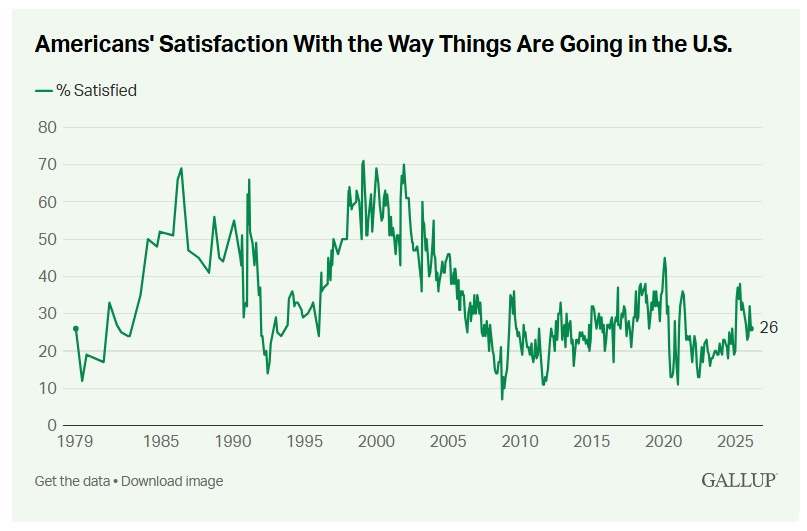
And the 90s were a peak in Americans’ assessment of the direction their country was headed:
Why were Americans so optimistic in the 90s? It was probably because the country had just experienced an extraordinary run of success, along a wide variety of different measures. Incomes were rising quickly. Housing and stock prices were way up, causing a surge in household wealth. Productivity accelerated after decades of stagnation, as the tech boom swept across the country. Crime plummeted. America won the Cold War, removing the imminent threat of nuclear destruction. And democracy and liberty spread rapidly around the globe.
When you have a run of good luck, you can easily start to believe that it’s bound to continue. This is probably an important principle in finance.
I spent several years thinking about the cause of financial bubbles. A lot of economic theorists wrote down a lot of ideas about why bubbles can happen — over-optimism, herd behavior, pure speculation, Bayesian updating, and so on. But one explanation really rang true to me: extrapolative expectations.
Barberis et al. (2018) theorized that when an asset — stocks, or housing, or Bitcoin, or whatever — has a run of good luck for a while, people decide that there must be some structural trend break that will make it keep going up. They buy the asset because they think it’s just a Goer-Upper, and their buying pushes up the price more. That just convinces more people that the early buyers were right about the new price trend, so some new people buy in too — and the cycle continues. It keeps going up until the market runs out of new people who are susceptible to extrapolative expectations. Then the price levels off or even starts to fall, and everyone realizes “Oh no, it’s not a Goer-Upper anymore!”. They start to sell, and then everyone decides it’s actually a Goer-Downer, so they all sell too — and the bubble turns into a crash. I predict that once we gain the ability to measure expectations more directly, we’ll see that this is the core mechanism that causes bubbles.1
My guess is that Americans’ optimism in the 1990s — and to some extent, the 2000s — functioned on a similar principle. Instead of just a stock bubble or a housing bubble, it was an everything bubble — an extrapolation of a short run of good luck into the infinite future. We had no idea that 9/11, the War on Terror, the housing crash, the financial crisis, the Great Recession, or the Trump Era was just around the corner. We thought that things were going to just keep going our way.
You could see this in the aesthetics of the time period. The 1990s and early 2000s painted sparkling, beautiful visions of what the future was supposed to look like:
That, I think, is what people are really nostalgic for, when they think about the 1990s. Would we actually want to go back and live in an era where life expectancy was lower, broadband didn’t even exist, cancer was much more deadly, violent crime was higher, gay marriage was illegal, median incomes were lower, and so on? Probably not, because if we went back and lived in that slightly less advanced society, we wouldn’t have the same sort of extrapolative optimism that people had back then — we’d know that all the bad stuff was coming, and so the lower living standards would rankle even more.
When most of us express nostalgia, I think, what we yearn for is not the past. It’s the brightly colored, chrome-plated future we thought was coming. We want our extrapolative expectations back.
Two decades ago, my PhD advisor Miles Kimball, along with his coauthor Bob Willis, came up with a theory of happiness. They theorized that a big component of happiness was driven by “news about lifetime utility” — in other words, changes in how much you think you’re going to get what you want in the future. If the outlook for your future success suddenly brightens, you become happy; if it suddenly darkens, you become unhappy.
Now combine that idea with extrapolative expectations. If you’re extrapolating recent trends out to the far future, small changes in current conditions can cause big swings in happiness, because they affect the direction you project the entire rest of your life to go.
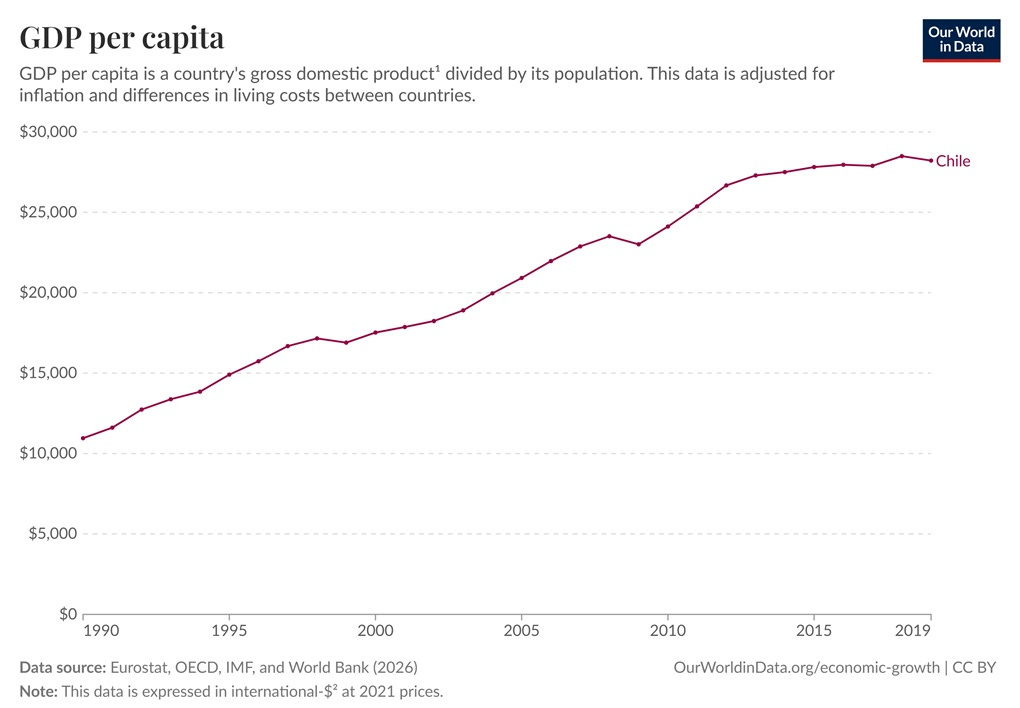
This is the idea behind the concept of the “revolution of rising expectations”. Political scientists have observed that people often rebel not when conditions are bad, but when improvement slows down after a strong run. An example might be Chile, which rioted in 2019, even though the country was much richer than in the past. One theory is that a slowdown in growth in the 2010s dashed young Chileans’ expectations that the growth rates of the 1990s and 2000s would be sustained:
If a worsening of expectations can cause riots and social chaos, what happens when the future disappears entirely? What happens when radical new technology — along with social and geopolitical shifts — makes it impossible to form extrapolative expectations about the future? Will people be pacified and docile, because they have no expectations to dash? Or will they be terrified and enraged by the sudden destruction of their ability to convince themselves that tomorrow will be better than today? Or will they be resolute and determined to conquer the uncertainty — to master the new technology and the new politics, in order to restore at least the illusion of predictability?
I suppose we’ll find out.
Of course, our ability to measure expectations directly might allow people to trade against the bubbles more easily, which would stop the bubbles from forming in the first place. Financial markets are funny like that.
I remember that cover on Wired magazine in 1997 with the big Smiley and the title 'The Long Boom' that was the ultimate optimist projection. I read it on a sunny beach in Jamaica.
Here is their retrospective two years later. https://www.wired.com/1999/09/boom-2/
As a child of the Cold War, I grew up with TWO opposed futures. One was the moon landing and the Jetsons and flying cars. The other was 'The Day After' and 'A boy and his dog'... post-apocalypse nuclear wasteland.
Which future would I get? Flip a coin, kid.
When the Cold war ended, we still didn't have talking robots or flying cars. But we did have the internet and early cells phones. We did have a tech boom promising the sun and the moon and the stars (even if it took 20-30 years to deliver).
And suddenly, we went from DOOM to BOOM. That was a huge reset of expectations.
No wonder the Matrix is set in late 1990s Chicago.
It wouldn't hurt a bit for us to promote optimism, whenever we can and however we can and as often as we can. It looks pretty bleak right now, but I think there were many, many times in our history when things probably looked to those who were faced with some new calamity, a lot whole lot bleaker. We can create an absolute mess of things for sure. But we wouldn't be where we are today without our ancestors having persevered all these centuries.
Nice thought, eh? I just hope I'm up to the task at age 67 to help. I only have about 18 years to live, so I have to make all of them count. I'll probably be checking out at around 85, if my family history is a guide, hence my email address: tjennings2044@gmail.com. Probably won't need it after that year.
All I really know to do is treat people decently, do the right thing when the choice is presented, hold to your integrity, and love. Probably would be a good idea to stock up on toothpaste and toilet paper too.