
The "corporate feudalism" thing won't work
Warrenite progressives are not going to catch populist fire by bashing corporations.



Nothing unites feuding factions like losing. For years, the Bernie leftists and the Warren progressives were at each other’s throats, competing viciously for the mantle of standard-bearer for a generational wave of popular unrest. Despite the fact that Warren’s 2020 campaign crashed and burned and Bernie caught much more fire with the youth, Warren actually won that battle — her ideas and her allies had an incredible amount of intellectual, ideological, and backroom institutional influence in the Biden administration. The Biden administration was, in some ways, a Warren administration.
Now progressivism in general is on the outs. And both the Warren and Bernie wings of the left have united to attack a new foe — the Abundance Agenda, championed by center-left types like Ezra Klein, Derek Thompson, and Matt Yglesias. The Bernie people mostly either just hurl sarcastic insults, or mischaracterize the abundance faction as being “neoliberals” who just want to deregulate. (They didn’t read the book, and it shows.)
The Warrenites, however, are a more intellectual lot, and they have coalesced around a coherent critique of the abundance idea. In their view, it ignores corporate power. Abundance liberals want more housing, more energy, more transit, more health care, more everything, and they’re pretty agnostic about how we get there. Derek Thompson summed up his point of view in a recent interview:
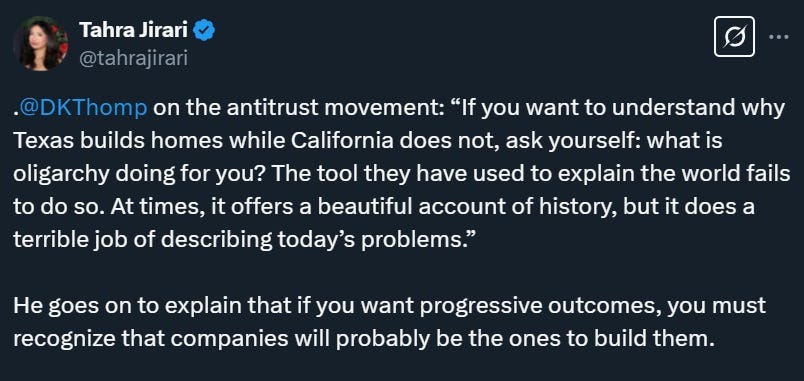
But Warrenites care very much about how we get to abundance. If building more housing, energy, transit and health care enhances the power and/or boosts the profits of large corporations, then Warrenites think it’s not worth it.
Zephyr Teachout, a Fordham law professor, sums up this attitude in her review of Abundance:
If we just…took on the real bureaucratic behemoths of today—the private equity cartels and the monstrous platform monopolies like Google and Meta—we would unlock far more innovation and creativity and vitality…My view then, and now, is that to transform a bloated corporate feudal system into a dynamic one, we need to break up feudal power[.]
This notion of corporate feudalism as America’s biggest problem animated many of the policies of the Biden administration. Elizabeth Warren blamed corporate power (“greedflation”) for the post-pandemic inflation, and called for price controls as a solution — a call that both Biden and Kamala Harris echoed at least to some degree. Biden FTC chair Lina Khan’s approach to antitrust, which focused on corporate power instead of on consumer welfare, was squarely in this tradition. Biden’s DOJ and FTC both aggressively targeted big tech companies like Meta, Google, Amazon, and Apple.
It didn’t help. Neither the Biden administration nor the Harris campaign ever really sparked populist fire among the American public. All the rhetorical and policy assaults on big corporations failed to prevent significant numbers of working-class Americans (especially working-class Hispanic and Black Americans) from defecting to the GOP. The Warrenite anti-corporate approach was populism without popularity — an elite intellectual project that was mostly wrong on the actual economics while also failing to spark enthusiasm among voters.
I can’t think of a worse combination than populism without popularity. It’s abundantly (heh) clear at this point that banging on about the evils of big companies is not going to rouse the American public. And this is particularly ironic because at a time when Trump’s tariffs are smashing the American economy, inflation is raising the cost of living, and Elon Musk’s DOGE is preventing crucial government functions from functioning, there is plenty of economic stuff that regular people are actually mad about.
The fact that a bunch of progressive lawyer types are still laser-focused on Meta and Google at a time like this simply illustrates how completely out-of-touch they are with what’s really ailing the American masses.
Antitrust is just not going to rouse the masses
Throughout the 2010s, I supported stronger antitrust, as did many other people in the general econ world. Although the evidence wasn’t definitive, there was a lot of circumstantial support for the idea that excessive corporate concentration was holding down wages and possibly holding back growth and innovation as well. Antitrust, in the form of closer scrutiny of M&A and the occasional prosecution of a monopolist, seemed like the natural remedy.
But the “Neo-Brandeisians” like Lina Khan, who dominated antitrust thinking in the Warren movement and the Biden administration, had a different idea. My reasons for supporting stronger antitrust were economic in nature — I was worried about prices, wages, and growth. The legal scholars who made up the Neo-Brandeisian movement worried that if companies got too rich and powerful, they’d take over the country. In other words, econ types like me were worried that economic power would lead to negative economic outcomes; the Neo-Brandeisians worried that economic power would translate into political power.
This is why Lina Khan’s FTC and Biden’s Justice Department went relentlessly after big tech companies instead of focusing more on boring, pedestrian industries like meat packing. No one thinks Tyson Foods is going to take over the U.S. government. But a lot of Warrenites and antitrust people convinced themselves that Meta, Google, and other big internet companies really were going to wield significant political power unless they were broken up.
Ironically, three companies the Biden administration didn’t sue were Tesla, SpaceX, and Twitter/X, the three biggest companies owned by Elon Musk. And yet Elon was the only tech billionaire who has ended up grabbing significant amounts of political power. This is a pretty vivid demonstration that the Neo-Brandeisian theory has a big hole in it — the government is actually pretty bad at telling which tech titans have the potential to become oligarchs.
That’s not the only hole in the idea, though. So far, the U.S. government has only won one of its cases against Big Tech — the one against Google — but it did lose a lot of cases. Essentially, there’s no U.S. law that says a big company should be broken up so that it can’t wield excessive political power. You have to prove that the company is actually restraining competition in some way. I suppose Democrats could try to rewrite antitrust law, but that would be a tall order.
Meanwhile, Biden’s aggressive actions toward Big Tech never seemed to win it any credibility with the American public. This makes sense if you look at the polls. Although big business in general polls poorly, big tech companies actually poll better than the presidency, Congress, newspapers, or TV news:
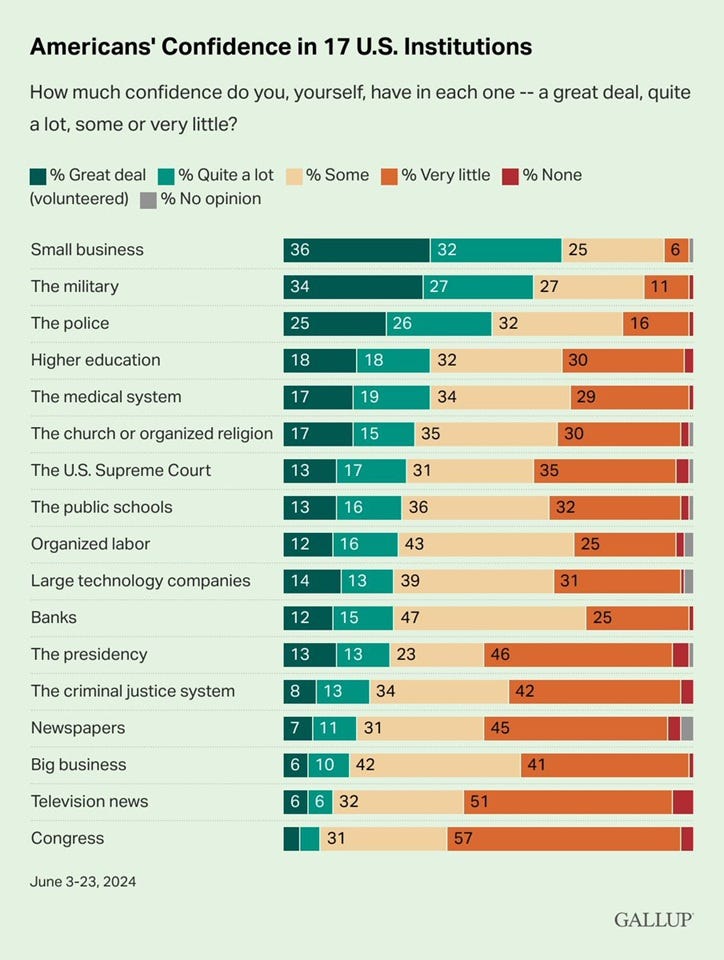
And when people are annoyed at big tech platforms, it’s usually because they’re worried about censorship, not because they’re worried about anticompetitive practice.
Think for a second about the degree to which Americans’ pocketbooks are actually affected on a day-to-day basis by Big Tech’s market power. Most of these web services are completely free to use.1 How many Americans are sitting there wishing that Instagram and Facebook were owned by different companies? How many are sitting there wishing that Google’s sidebar ads were cheaper?
Probably not a lot. When David Shor polled a bunch of Americans to see which issues mattered to them, corporate concentration just didn’t make the list of issues. And in Gallup’s long-running survey about America’s “most important problem”, there’s not even a line item for corporate power or “corporate feudalism” or anything of the sort — probably because essentially no one mentions these things on open-ended surveys.
I’m not arguing that the American people side with Google on the question of whether its search ad businesses uses anticompetitive tactics. It’s just that they just don’t care. Antitrust is an elite game, played by lawyers and judges and occasionally economists. As Richard Hofstadter noted in the 1960s in his essay “What Happened to the Antitrust Movement?”, Americans became basically complacent about corporate power after World War 2, and began to view big business as somewhat distasteful but basically benign.
The Warrenites and the Neo-Brandeisians were unable to reverse that long trend. Antitrust remained a hyper-elite technocratic niche issue. The critics of the Neo-Brandeisians dubbed it “hipster antitrust”, and that honestly wasn’t too far off the mark. Whether or not antitrust is good, it’s just not inspiring or interesting to the masses.
Anti-corporatism supports bad policies (price controls)
Antitrust doesn’t stir the passions of the masses, but it probably wouldn’t hurt the economy if Google had to make ads cheaper or if Meta had to sell off Instagram. But in fact, the Warrenite anti-corporate movement pushed a very economically dangerous policy during Biden’s term: price controls.
During the big inflation of 2021-22, many progressives blamed rising prices on corporations’ market power, alleging that they used supply constraints as an excuse or cover to raise prices and reap fat profits. This idea came to be known as “greedflation”.2 The problem was that according to all the evidence, this probably wasn’t even happening.
Alvarez et al. (2025) found that markups — i.e., the amount that companies charge for things above and beyond what those things cost to produce — stayed constant during the post-pandemic inflation, meaning that companies weren’t actually able to use the inflation to gouge consumers:
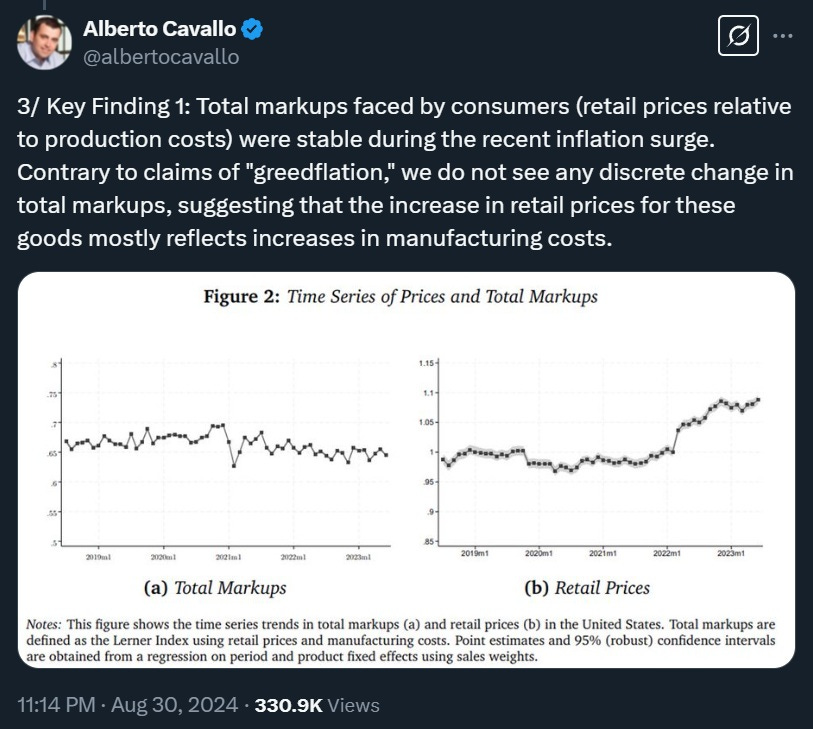
Leduc et al. (2024) and Bouras et al. (2023) found the same. And Jose Azar found that industries with higher markups — implying more market power — actually passed on less of their costs to consumers during the post-pandemic inflation.
Greedflation, in other words, is not a real thing. But that didn’t stop Elizabeth Warren and other progressives from shouting it from the rooftops, and calling for price controls as the solution. Harris echoed the call for price controls during her campaign.
This was a very bad idea. Price controls sometimes have little effect on prices, or on the general economy. But when they do have an effect, it’s bad. Store shelves go empty — instead of foods and basic necessities becoming more expensive, they become difficult or impossible to find at all. And paradoxically this can raise inflation, since it gives people an incentive to hoard, which causes an additional supply shock that drives up prices. Something like this may have happened in Venezuela.3
Price controls are basically the progressive equivalent of Trump’s tariffs — a bad policy that has been ineffectual at best and disastrous at worst when tried in the past, but which ideologues keep on calling for as the solution to various economic problems. If progressives ever succeed in implementing a price control regime, it will probably go very badly, just like the tariffs. There’s only a certain degree to which you can willfully violate the laws of basic economics before your people start suffering.
The anti-corporatist fantasy extended universe
One annoying thing about populist movements is that they tend to become like fantasy extended universes, generating a whole alternative reality in which every bad thing that happens is caused by the globalists, or the counterrevolutionaries, or immigrants, or whatever. This is also true of faux-populist elite movements like the Warrenite anti-corporatist movement. Corporate power certainly has its harms, but overall it’s just not nearly as all-consuming or overwhelming as Warrenite progressives believe.
For example, both Elizabeth Warren and Kamala Harris blamed food price increases on grocery stores, alleging that they used their market power to gouge consumers in their time of need. This was totally false. Grocery stores don’t even have market power — they make miniscule profit margins compared to other companies. And grocery stores’ profit margins didn’t even go up during the recent inflation.
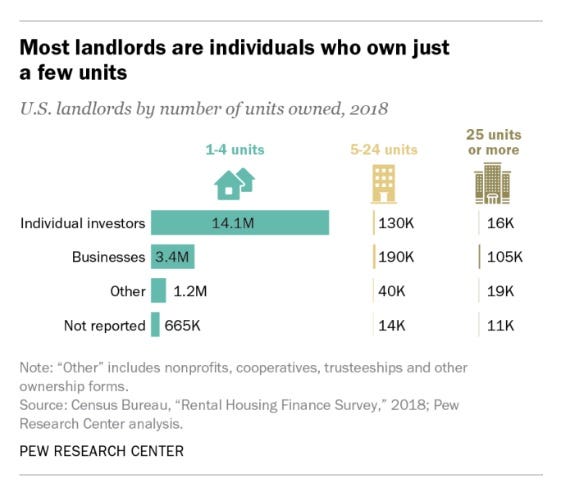
Another example is progressives blaming corporate landlords for America’s high rents. While this might become a problem in the future, and while it might be a problem in a few small areas, it’s just not anywhere close to being the main reason for rent increases. Corporate landlords just don’t own most of America’s housing stock:
As for the critics of abundance liberalism, many of them simply assert that corporate power is the thing holding back abundance, when most of the time it’s not. Derek Thompson said it well:
“Oligarchy” at the national level isn’t a one-stop explanation for why Austin builds so much more housing than Boston. Antitrust law doesn’t capture why Georgia is adding so much more battery capacity than many states with more progressive climate change goals . In SF, some very rich tech people are NIMBY and many are YIMBY; so how is a theory of oligarchy the best explanation for S.F. permitting?
Matt Yglesias also said it well:
[I]t’s a bit puzzling that so much of the overt pushback to abundance thinking has come from people associated with the neo-Brandeisian antitrust movement…
Sandeep Vaheesan, for example, is the legal director at Open Markets, which is nominally a competition policy organization. But he opined on X this week that, “Under the shareholder wealth maximization ideology and norms, U.S. corporations prioritize dividends and especially stock buybacks. It is a governance philosophy antithetical to investment and thereby abundance.” I don’t think that’s true, and his follow-up is definitely not true — the claim that these corporate governance issues rather than land use policy are the key driver of how much housing gets built…
Why is Tennessee adding housing at nearly double the rate of Massachusetts? Is it because they have different corporate governance there? Because dividends are illegal?…
We can either acknowledge that some significant economic issues are not solvable by complaining about “corporate power,” or else we can spin our wheels aimlessly.
In some cases, corporate power is very real. In some cases, it’s bad. But it’s just not the omnipresent supervillain that Warrenite progressives would have you believe it is.
Anti-corporatism alienates valuable potential Democratic allies
The frustrating thing about the Warrenite progressives’ anti-corporate crusade is that we have a real villain in the room with us right now. Corporate greed probably isn’t raising prices for regular Americans, but Trump’s tariffs sure will. Corporate greed won’t balloon the national debt, but Trump’s planned tax cuts sure will. The profits of Meta and Google aren’t actually a threat to democracy, but Trump sure is.
Warrenite progressives could be leading the charge against all of these threats. Instead of Big Tech profits they could be decrying tariffs. But instead they’ve chosen to remain focused on their traditional bogeyman — Meta, Facebook, etc.
I don’t generally like to psychologize people I disagree with, but I’ll be damned if this doesn’t smell like class resentment. Hatred for the “tech bro” class is ubiquitous in elite progressive circles. It’s easy to imagine that law professors might have a bit of resentment toward the vast fortunes accumulated by some of the men they went to college with. After all, those men went to the same schools and came from the same class background as the law professors, but went on to make hundreds of times more money. Wanting to destroy the sources of their profits — after you convince yourself that their profits are the cause of everything bad in the world, of course — is a natural instinct.
But right now, that’s a resentment the Democrats can ill afford. Many billionaires are not Trump fans, and their vast fortunes could help bankroll a successful resistance movement. Sure, Jeff Bezos is demanding that the Washington Post support “free markets”, but what if that’s just a dig at Trump’s tariffs? Rich tech people tend to have most of their money in the stock market, which Trump is willfully smashing.
Progressives don’t have to like the economic system that gave rise to billionaires, but they put themselves at a severe disadvantage if they refuse to even try to ally with the billionaires our system has already given us. And tariffs don’t just hurt regular people’s jobs and purchasing power — they hurt corporate profits as well. There is an anti-Trump alliance to be made between big business and regular American workers, if Democrats can just stop following the Warren playbook for five minutes.
But regardless of whether or not that alliance happens, any attempt to reorient American politics so that people stop caring about whatever they care about (abundance, stopping Trump, etc.), and start caring about corporate profits instead, seems highly unlikely to succeed.
Maybe some companies pay a bit more to advertise on Google or Meta than if the market were less concentrated. But they’re unlikely to rise up en masse. And in general, h
Isabella Weber tried and failed to popularize the alternative term “sellers’ inflation”.
Isabella Weber, to her credit, recognizes this.
Why should the government crack down on a free browser like Chrome when the real pain is felt in food, fuel, housing, and healthcare? It feels like a huge waste of government time and resources to go after free stuff that barely impacts consumers (significantly less than GDPR I might add...), when instead they could be bringing down costs of life-saving care by breaking up the healthcare cartels and conglomerates propped up by private equity.
At this point, I think it’s hard not to psychologize people. When I was younger, I feel like the pseudo-religious, quasi-scientific people who yelled their pet theories from the rooftops that it really was all the bourgeoise, corporate power, the government, or the aliens that controlled everything were rare.
Living in the San Francisco Bay Area, it feels like they’re everywhere now.