

One source of constant frustration for me is that Americans, by and large, seem to be missing the importance of the battery revolution. Batteries represent a truly revolutionary shift in our ability to store energy and move it around at will in arbitrarily large or small pieces. The country continues to install batteries at a decent clip, and there is some dawning realization in the Trump administration that batteries are actually important (thanks to their usefulness in data centers). But many American technologists don’t seem very excited about batteries, opinion leaders aren’t paying much attention, and politicians have politicized the issue to the point where Trump and Republicans actively attack the EV industry.
I try to remind people about the importance of batteries every chance I get. So when Alex Shoer, an energy VC and founder, offered to write me a guest post about why he thinks sodium-ion batteries will create a revolution in the space, I was happy to oblige. Sodium-ion is a technology that China has really poured a lot of resources into, but America has largely slept on, so we need to catch up.
Alex Shoer is currently a managing partner at GridVest, a company that delivers end-to-end battery storage procurement, financing, and commissioning for commercial and industrial and utility-scale projects. You can learn more about Alex at his website and his X account.
A decade ago, if you’d told a room of battery engineers that lithium iron phosphate (LFP) would take over the market, most of them would have laughed. LFP held noticeably less energy per kilogram than the nickel-rich chemistries that most used, and as recently as 2020 it supplied under a fifth of the world’s EV batteries.
Then something surprising happened: LFP got cheap, stayed safe, and turned out to be good enough. By 2023 it powered about 80% of new grid storage, and by 2025 it supplied more than 55% of EV batteries worldwide, with cells now around $84 per kilowatt-hour. I watched that shift up close from Shanghai, and I think we’re about to see the same thing again. This time with a battery made from one of the most common elements on Earth: sodium.
I want to make the case for why sodium-ion batteries will win, but I also want to be clear about what “win” means, because that’s where most of the hype, and most of the skepticism, goes wrong. Sodium-ion is not cheaper or more power dense than LFP today, but economists will recognize this pattern, because it’s one of the oldest in industrial history: the product that wins isn’t always the best one. It’s the cheapest one that’s good enough, made from inputs nobody can corner.
A market growing faster than anyone could have imagined
Start with demand. Global battery demand passed 1 terawatt-hour in 2024, according to the IEA. To put that in perspective, a single average week of battery demand in 2024 exceeded the entire year’s demand from a decade earlier. Most of that went into cars. But the fastest-growing slice, and the one I spend my days on, is stationary storage: the big refrigerator and shipping-container-sized systems that store cheap solar energy during the day and release it in the evening, stabilize grids, and increasingly keep data centers and microgrids running.
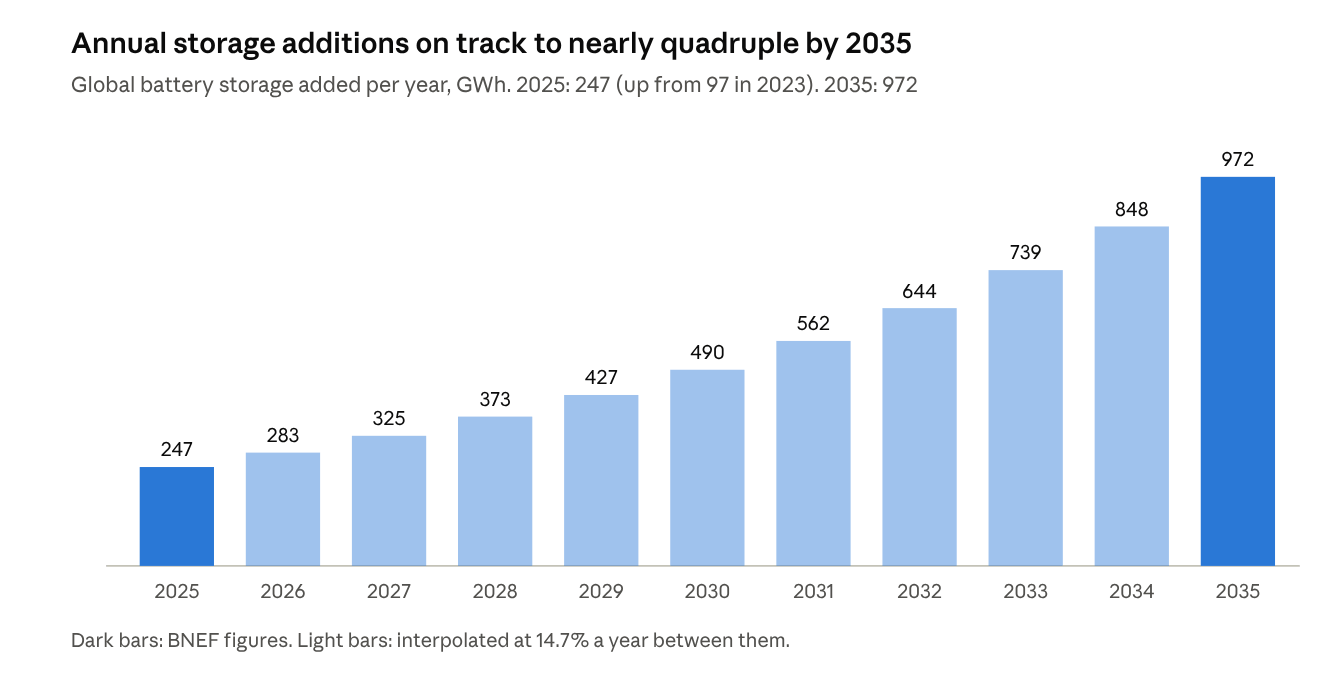
Stationary storage used to be a rounding error next to EVs. That’s changing because the economics changed and the demand for more on and off-grid capacity has changed. When I started in renewables in 2011, a battery on the grid was a science project. Today, in places like California, Texas and New York, solar-plus-storage is the cheapest way to add reliable evening capacity. And now AI data centers, which need enormous amounts of firm power fast (and to smooth the spiky power draw of AI chips), are turning storage from a nice-to-have to a requirement.
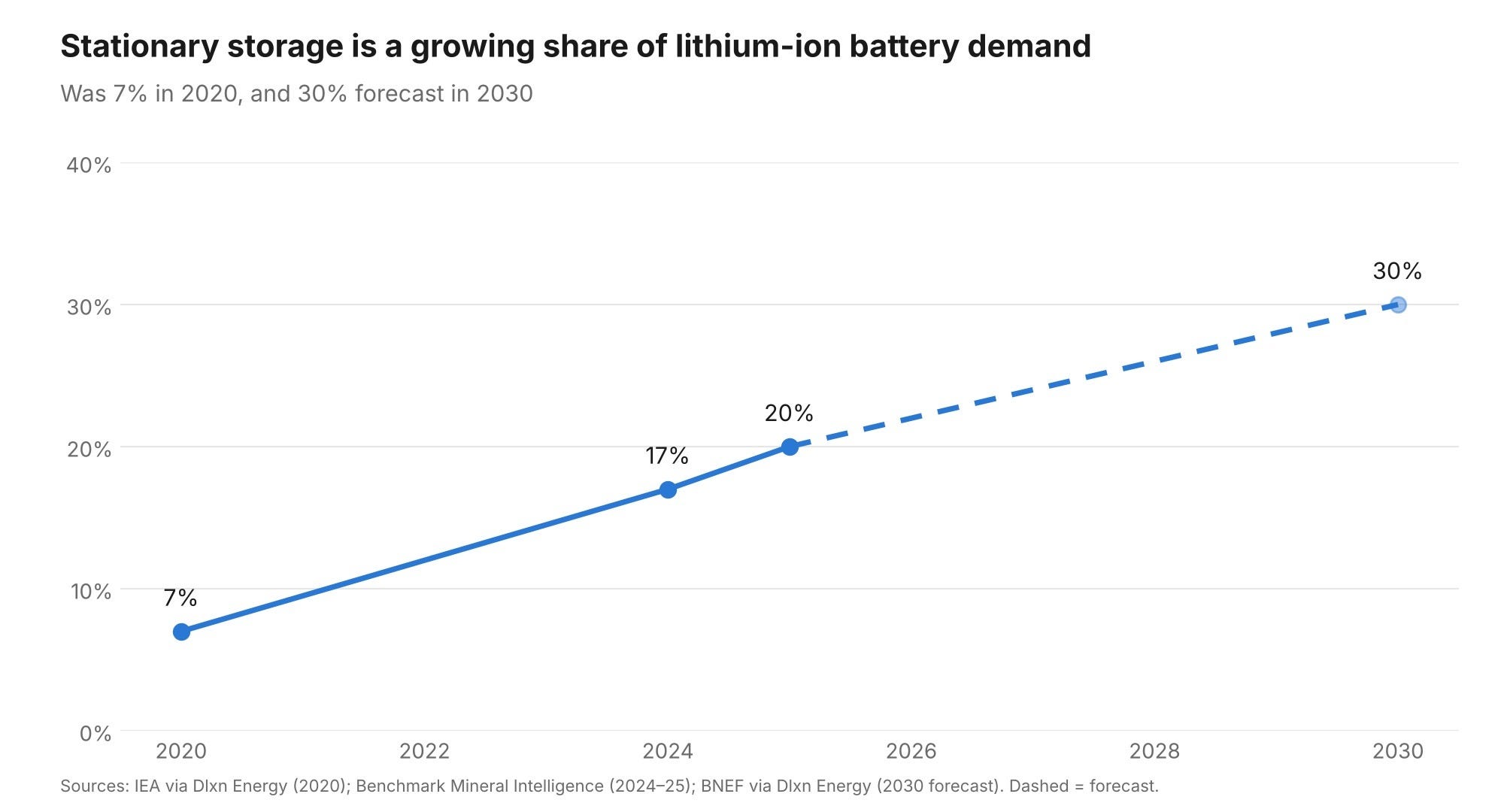
Here’s the key point: stationary storage doesn’t really care much about weight. A car battery has to be light, because every kilogram costs range. A stationary/grid battery sits on a concrete pad and never moves after it’s installed. What storage buyers care about is cost per kilowatt-hour over its lifetime, safety, how many times it can cycle, and whether supply is reliable. That list describes exactly what sodium-ion is good at.
Where sodium-ion is today
Sodium-ion today is tiny. LFP manufacturing is measured in terawatt-hours of capacity; sodium is measured in tens of gigawatt-hours. CRU, a commodities research firm, forecasts sodium-ion demand of 135 GWh in 2030 and 346 GWh in 2035. At the other end, Morgan Stanley expects 830 GWh by 2030 and 2.4 TWh by 2035, which would be roughly a fifth of the battery market by 2030 and over a third by 2035. That’s a six- to sevenfold gap between forecasts, and that difference is the story. Almost nobody disputes that sodium works. The argument is about how fast it gets cheap.
The world’s largest battery makers are no longer treating sodium as a side project. CATL launched a sodium-ion platform called Naxtra in 2025 and signed large sodium supply deals for grid storage. BYD has invested in dedicated sodium-ion lines. Hithium, one of China’s biggest stationary storage-cell makers, just launched a 785 amp-hour sodium cell for grid systems. And the first grid-scale projects are running: a 50 MW / 100 MWh sodium-ion station in Hubei, built with HiNa Battery cells, came online in 2024, with expansion planned.
GetFocus, tracks how fast technologies improve rather than how big they are. By its measure, sodium-ion is improving at about 57% a year since 2010, the fastest of the 30 storage technologies it analyzed. That’s the kind of early-warning signal LFP showed against nickel chemistries a decade before it took over. Size tells you who’s winning now. Slope tells you who’s winning next.
What’s actually inside a sodium-ion battery
Most people’s understanding of sodium-ion stops at “it uses salt instead of lithium.” That’s generally correct, but the more interesting story is in what else changes.
A battery has four main parts: a cathode, an anode, an electrolyte that lets ions shuttle between them, and thin metal foils, called current collectors, that carry electricity in and out.
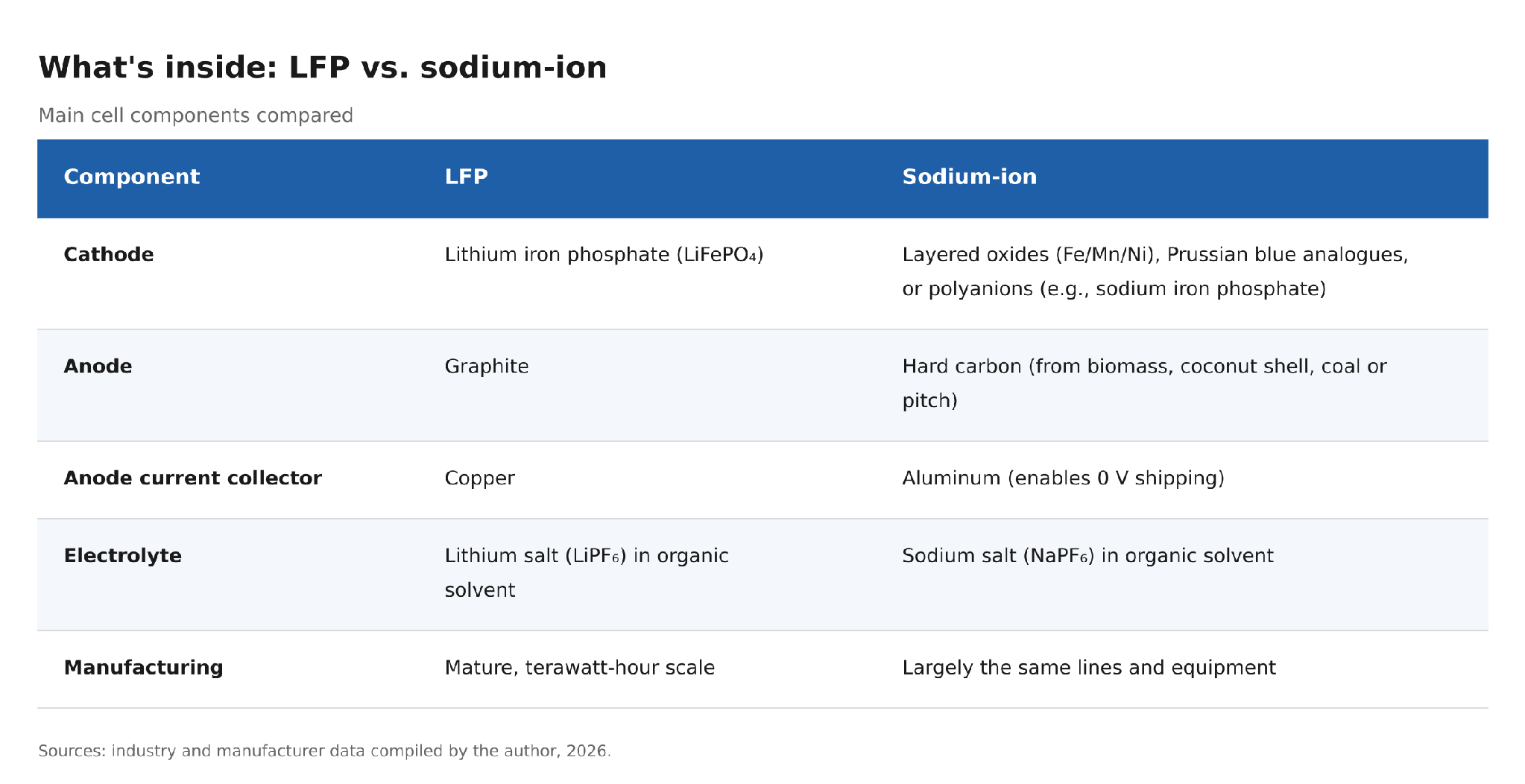
Three things jump out.
The cathode options are cheap and diverse. Prussian blue is literally a chemistry related to a centuries-old paint pigment.
Second, sodium cells use hard carbon (an organic component) instead of graphite. That turns out to be the current bottleneck: hard carbon supply chains are young and expensive (but eventually hard carbon could become a benefit as it could be derived from waste products).
Sodium cells can use aluminum foil on both sides instead of copper. This is one of my favorite details as aluminum is cheaper and lighter, and it means sodium batteries can be shipped fully discharged, at zero volts, without damage. Lithium-ion batteries can’t do that safely (the copper will degrade). If you’ve ever dealt with the paperwork and insurance of shipping hazardous lithium cargo across the Pacific, you understand why it would make logistics so much easier and in some cases could allow for fewer dangerous goods provisions.
Are the inputs cheaper?
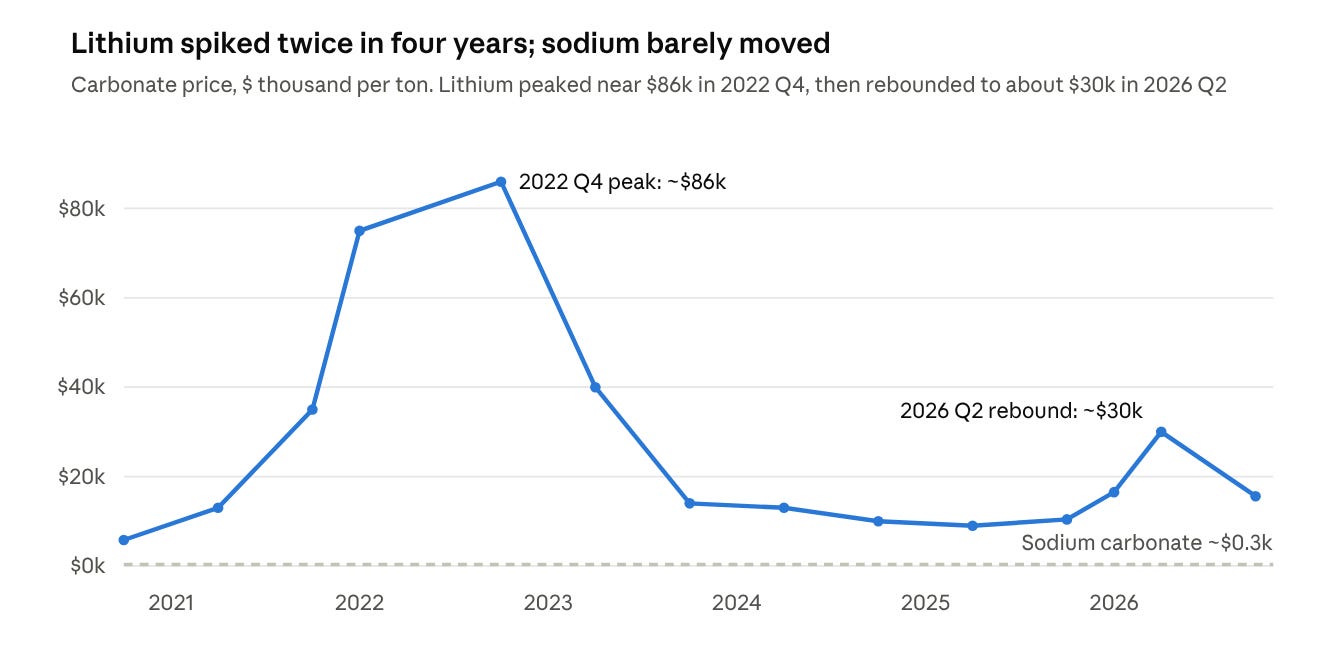
On paper, yes. Sodium carbonate, the raw material, costs roughly $100 to $500 per ton. Lithium carbonate in LFP has swung between about $6,000 and $86,000 per ton since 2020, and this spring it jumped about 70% in a few months. Sodium is extracted from seawater and vast mineral deposits on every continent. Lithium is concentrated in a handful of countries and refined mostly in one (and it’s a messy process).
When will sodium-ion cells be cheaper than LFP?
HiNa’s general manager estimates sodium cells at 0.5 to 0.7 yuan per watt-hour, against 0.3 to 0.5 for lithium cells. Independent trackers put the premium at roughly 13% to 25%. Why? Three reasons:
LFP has a decade of manufacturing learning and enormous scale.
Hard carbon is still pricey.
Sodium cells store less energy per kilogram, about 175 Wh/kg for the best commercial cells versus up to 205 for LFP, so you need more of everything else per kilowatt-hour (including higher shipping costs per Wh).
The IEA estimates sodium-ion could cost up to 20% less than today’s batteries once it reaches scale, and some analysts put the gap at 30%. Putting the crossover around 2028 to 2029. Notably, that date keeps slipping, because LFP keeps getting cheaper: cells fell from about $115 to $84 per kWh between early 2023 and early 2026.
Sodium as a backstop technology
William Nordhaus coined the term “backstop technology” in the 1970s: a substitute available at a fixed cost, which caps how expensive a scarce resource can get. Sodium-ion is shaping up to be lithium’s backstop.
Between late 2020 and late 2022, lithium prices rose more than tenfold, battery prices rose for the first time in years, and storage projects I was working on got repriced mid-negotiation. With a mature sodium-ion industry, every storage buyer would have had a lithium-free alternative, and the spike in price would have been far less if sodium was a real alternative.
So even before sodium wins much market share, it turns lithium into an ordinary commodity with a substitute. That’s a win for everyone building the grid, whether or not they ever buy a sodium cell.
Where sodium beats LFP outright
Cost is the headline, but performance is where sodium already has real advantages.
Cold weather. Lithium batteries lose much of their capacity in deep cold and need heating systems to operate safely. Sodium-ion handles cold far better. BYD rates its sodium storage cell from −30°C to 55°C. For projects in Minnesota, Alberta, or northern China, that means less energy spent heating the battery and better winter performance.
Safety. Sodium cells are generally less prone to thermal runaway, and the zero-volt shipping capability (as mentioned earlier) makes logistics and storage simpler. Fire risk is the single biggest source of local opposition to storage projects in the US. A chemistry that eases that fear is worth a lot more than its spec sheet suggests.
Shelf life and logistics. The same zero-volt trick may matter even more for how batteries move and are stored. For stationary projects stuck a year or more in interconnection queues, that could mean equipment that sits on site without aging, spare cells that don’t degrade (or need to be cycled). So far manufacturers they can hold more cell inventory and build more in advance. For distributors and developers they can order equipment earlier. The multi-year storage data of sodium-ion batteries doesn’t exist yet. But if it holds up, it changes the economics of an industry where so much hardware spends so long waiting and being shipped as Hazardous Materials (”HazMat”).
Cycle life, with caveats. Some manufacturers are making huge claims: Hithium rates its new sodium cell for 20,000 cycles and a 30-year calendar life, and HiNa’s storage cells are rated for 8,000 cycles. These aren’t field results but if credible warranties back them up they are pretty meaningful numbers compared to LFP which is more in the 6,000 cycle range. In my work, we’ve learned to trust a spec sheet only as far as the warranty behind it. Most stationary storage projects average 1-2 cycles per day and the more they can be cycled typically the better their return on investment is and the lower the Levelized Cost of Storage (LCOS) is.
Power output / C rating: Sodium-ion batteries can often sustain higher continuous and peak discharge rates (C-rates, typically 3C to 5C) without significant damage compared to many standard lithium-ion chemistries like LFP which tend to be .5C to 1C. This is a huge benefit to microgrids and datacenters in particular that want Universal Power Supply (UPS) quick response backup or are supporting large loads.
Environmental footprint. A sodium-ion pack produces about 56.8 kg of CO₂ per kWh, roughly 25% less than LFP’s 75.5. Most of the gain comes from replacing lithium and from lower-temperature cathode processing. Not every study agrees, and hard carbon production is the main hotspot, but the direction is encouraging. Sodium-ion also avoids lithium mining, cobalt and copper.
The on-ramp: sodium-lithium hybrids
The switch to sodium probably won’t be a clean break. The more likely path runs through hybrids that put sodium and lithium cells in the same system and let software give each the job it does best. China Southern Power Grid switched on the first large-scale example in May 2025: a 200 MW / 400 MWh station in Yunnan pairing HiNa’s sodium cells with lithium-ion. Hithium is now marketing a lithium-sodium hybrid for AI data centers. The logic is a portfolio one. Lithium carries the bulk of the energy and the density, while sodium takes the fast bursts, the cold snaps and the heavy cycling, which is exactly where it’s strongest. For buyers, a hybrid is a way to put sodium to work at modest volumes, build a track record, and shift the mix as sodium gets cheaper, without betting a whole project on a young chemistry.
Hybrids aren’t risk-free, though. Two chemistries with different voltage curves and aging rates make the control software harder, and a mistake in that software becomes a safety problem as well as a performance one. Each chemistry needs its own fire testing and certification, warranties have to cover how the two interact, and lenders have even less field data on hybrids than on pure sodium. And if lithium stays cheap, the hybrid’s cost edge narrows. I think of hybrids as a bridge rather than a destination: their value is that they let the market learn while the cost curves cross.
Will sodium ever go into mainstream EVs?
This is the question I get most, and my answer is: partly, and from the bottom up.
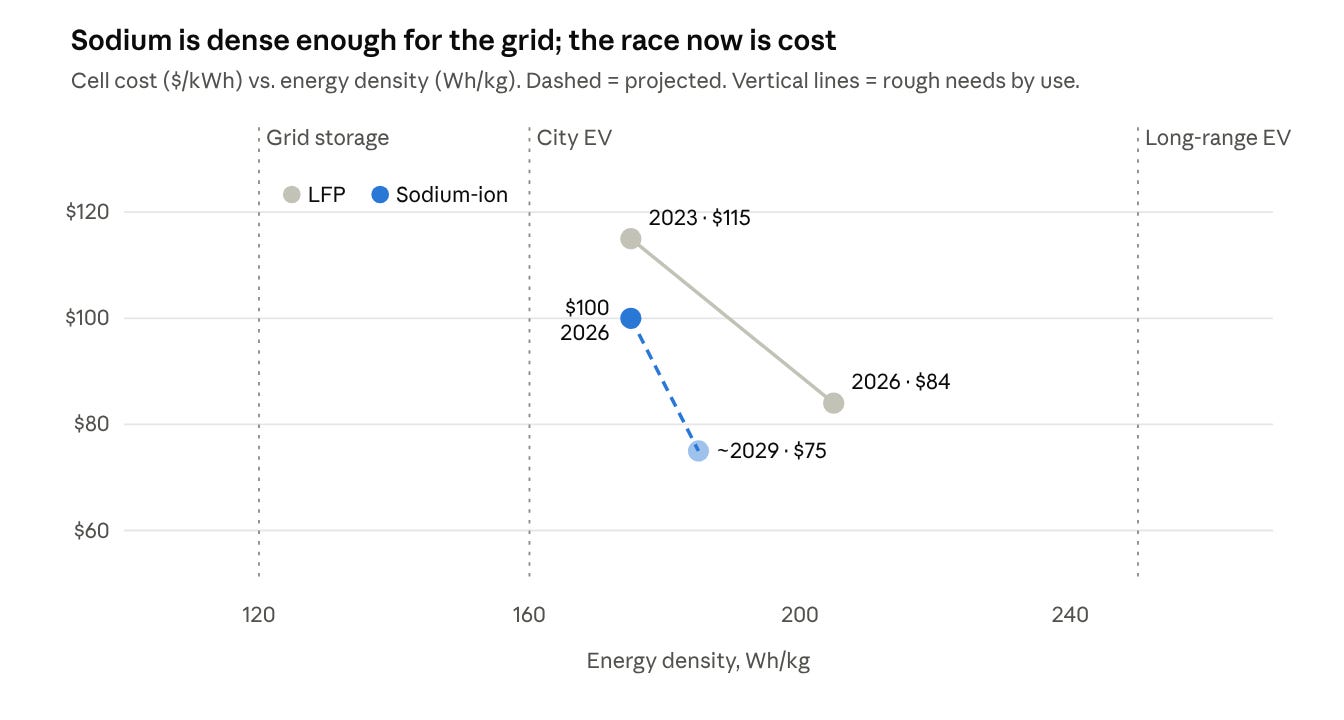
The constraint is energy density. At about 175 Wh/kg, the best sodium cells today are roughly where LFP was several years ago, and that was good enough for standard-range cars. So the plausible path is cheap city cars, scooters and three-wheelers first, which already matter enormously in China, India and Southeast Asia, and then hybrid packs that pair sodium with lithium cells to improve cold-weather performance. Long-range SUVs and trucks will likely stay with lithium chemistries for the foreseeable future.
But notice that sodium doesn’t need EVs to win. Stationary storage alone is on track to become one of the largest battery markets in the world. Sodium can be a niche in cars and a giant on the grid.
Can the US dominate sodium-ion?
Now the uncomfortable part for Americans. Sodium-ion is often pitched as a way to escape Chinese lithium supply chains. The chemistry does escape lithium. But it doesn’t escape China.
Sodium-ion is made on largely the same equipment, with largely the same processes, as LFP. Hithium says its new sodium cell runs on its existing 1,000 amp-hour lithium-ion manufacturing platform. CATL’s sodium storage product uses the same enclosures, lines and supply chains as its lithium products. Spencer Gore, founder of the now-shuttered US startup Bedrock Materials that was attempting to manufacture sodium-ion in the US, put it bluntly: “If you lost it for lithium-ion, you’ve already lost it for sodium. It’s the same thing, same equipment, same process.” When asked what he would have done differently, “I would have gone to China the very first day that I founded the company.”
The companies that know how to build gigawatt-scale factories, and that control the hard-carbon supply chain, are mostly Chinese. Also companies like CATL can afford to lose money on sodium for years, treating it as a hedge on its LFP business.
So far in the US Natron Energy went under and Bedrock shut down. The bright spot is Peak Energy, which shipped its first grid systems in 2025 and signed a 5 GWh deal with Jupiter Power.
But, I think America’s bigger bet belongs somewhere else as it’s already way behind. Solid-state batteries are a different kind of race. Much of the underlying science was pioneered in the US, and companies like QuantumScape, Solid Power and Factorial Energy are trying to skip past China’s lithium-ion manufacturers, with cells claiming roughly 300 to 390 Wh/kg, well beyond today’s EV batteries and the batteries that will be used for electric aviation. That’s a contest where research expertise, venture capital and automaker partnerships have a huge factor.
Of course Japan and South Korea are also close to mass production and Chinese giants are working on solid-state too. But if I were setting US battery strategy, I’d deploy sodium-ion storage wherever it pencils out today, build the anode supply chain at home, encourage foreign investments in factories in the US, push for US integration of Chinese battery cells in the meantime and put the big policy bets on the next chemistry rather than trying to compete on the current ones. That argument deserves its own post but I touch on it in the Cleaning Up PodCast.
What could prove me wrong
Lithium stays cheap (and gets cheaper) for a decade. If new supply keeps prices low, the urgency to switch fades and sodium remains a niche.
LFP keeps outrunning sodium on cost. LFP’s learning curve has repeatedly surprised everyone. If it hits $50/kWh at scale before sodium does, the crossover may be tough to arrive.
Cycle-life claims don’t hold up in the field. If real-world degradation looks more like the skeptical tests than the spec sheets, storage buyers will walk away.
Hard carbon doesn’t scale. If the anode supply chain stays tight and expensive, sodium’s materials advantage stays theoretical.
The bottom line
The history of energy is not a history of the best technology winning. It’s a history of good-enough technologies made from abundant materials getting cheap at scale.
Sodium-ion probably won’t win everywhere. But it will likely win the grid, the cold environments, and on LCOS, and by simply existing at scale it will cap the price of lithium for everyone else. That might be the most interesting kind of victory: the one that makes the whole market work better, even for the people who never buy the product.

Useful and especially the welcome reminder "is not a history of the best technology winning. It’s a history of good-enough technologies made from abundant materials getting cheap at scale." - would be useful also to have invited comment on the other emerging chemistries (in stationary).
Wish we had used the IRA to fund next gen battery tech research and materials science programs rather than paying people to assemble Chinese Lithium battery components in the US