

“Buy a big house and live in the suburbs” — Tracy Chapman
“Outside suburbia’s sprawling everywhere/ I don’t want to go, baby” — Kim Wilde
I grew up in the suburbs, and when I got the chance, I moved to a big city and never looked back.1 I love living in dense, built-up urban areas, with great train systems and tons of restaurants and shops. Japanese cities are the best in the world, and I’ve written plenty of posts about what makes them so great. But you don’t have to be Japan in order to create amazing metropolises — New York City, Paris, Istanbul, Seoul, London, etc. are all excellent places to live.
I’m far from the only person who feels this way. Rents in New York City are absolutely insane — $5300 a month to live in Manhattan, $4350 to live in Brooklyn. That’s partly because there are a lot of good jobs in NYC — it’s a cluster for industries like finance and media. But more and more, Americans move to cities because they like living there.
As early as 2000, economists were starting to find that “amenities” were driving America’s urban revival even more than job opportunities were. Couture and Handbury (2020) find that wanting to be close to restaurants and nightlife explains about 40% of the trend of young, high-earning, college-educated people2 moving to cities in recent decades. Furthermore, the stereotype of dense cities as crime-ridden and unsafe is just wrong — NYC has one of the lowest violent crime rates among big cities in America.
I’ve been a relentless advocate of building more dense, walkable cities in America. Not only would this raise GDP (because of improved clustering effects), but it would let Americans live where they want. The demand for life in cities like NYC exceeds America’s willingness to supply these environments; this raises rents in places like NYC, which pushes a lot of people into the suburbs who don’t want to be there. Forcing those city types into the ‘burbs raises rents for people who like suburbia. Basically, everyone would be happy if America had a few more Manhattans and a lot more Brooklyns.
Yet among my fellow urbanists and YIMBYs, I often encounter disdain or outright hostility toward the suburbs that define most of America’s present urban landscape. This isn’t just an urbanist thing, of course — my own parents had a lot of negative things to say about suburbia, and ranting against its sterility and boredom is a staple of pop culture. But the criticisms are just way overdone; the suburbs are not the isolating, lonely hell that they’re often made out to be.
And I think that the constant ranting against the suburbs complicates the quest for denser cities. It creates the suspicion that urbanists and YIMBYs want to make the whole nation into Manhattan. Nothing like that could ever happen, of course; even Japan is mostly suburbanized. But painting the quest for denser metropolises as an attack on suburbia makes everything needlessly confrontational, polarized, and zero-sum.
So I think it’s helpful to go through some reasons why the suburbs aren’t actually as bad as they say.
The suburbs don’t force you to have a long commute
One of the most persistent myths about suburbia is that it forces you to commute a long way to work:

It’s possible, of course, for something like this to be true. If cities refuse to build housing (which they do), and if jobs are concentrated in the city center (thanks to clustering effects or agglomeration or whatever), then people will be forced to live far out on the periphery and endure punishing commutes to get to work.
The thing is, it’s not true. Despite greater sprawl, Americans have some of the shortest commutes in the developed world. This is from the OECD:
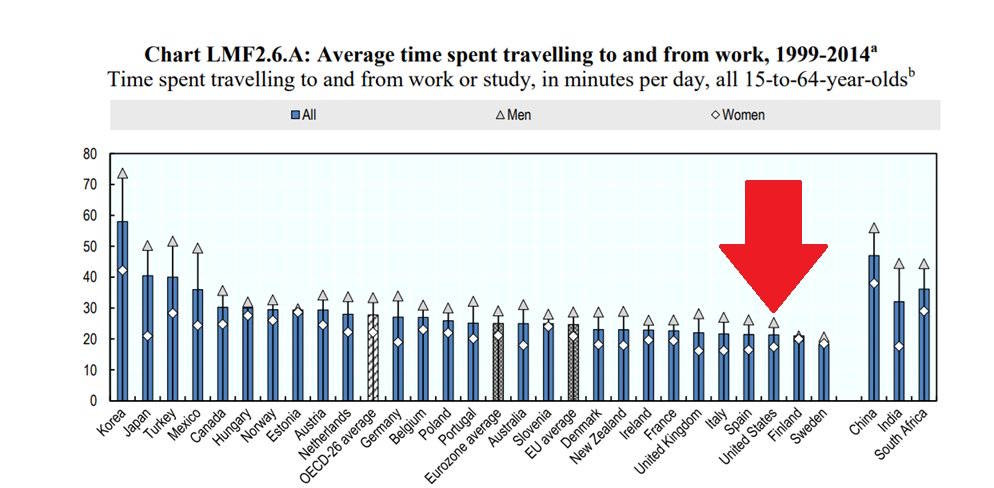
Why do Americans take less time to commute to work? One reason is that it’s not just our homes that are scattered and dispersed; our workplaces are too. America’s urban agglomerations are polycentric; they’re not just one central business district surrounded by concentric rings of houses. Suburbanites tend to live near where they work.
Another reason Americans have shorter commutes is that cars are almost always faster than public transit at getting you from point A to point B. This isn’t just true in places like America and Canada that are built with cars in mind. It’s true in places like Stockholm and Amsterdam that were built to be transit-friendly — even when you take parking time into account. In fact, it’s not even close. This is from “Disparities in travel times between car and transit: Spatiotemporal patterns in cities”, by Liao et al. (2020):
We use real-world data to make realistic estimates of travel time by car and by PT [Public Transit] and compare their performance by time of day and by travel distance across cities. Our results suggest that using PT takes on average 1.4–2.6 times longer than driving a car. The share of area where travel time favours PT over car use is very small: 0.62% (0.65%), 0.44% (0.48%), 1.10% (1.22%) and 1.16% (1.19%) for the daily average (and during peak hours) for São Paulo, Sydney, Stockholm, and Amsterdam, respectively…A systematic comparison between these two modes shows that the average travel time disparity is surprisingly similar across cities…for travel distances less than 3 km, then increases rapidly but quickly stabilises at around 2. [emphasis mine]
And here’s a chart, showing that public transit takes more time whether you’re measuring in terms of the length of the trip or the percent of the population reached:
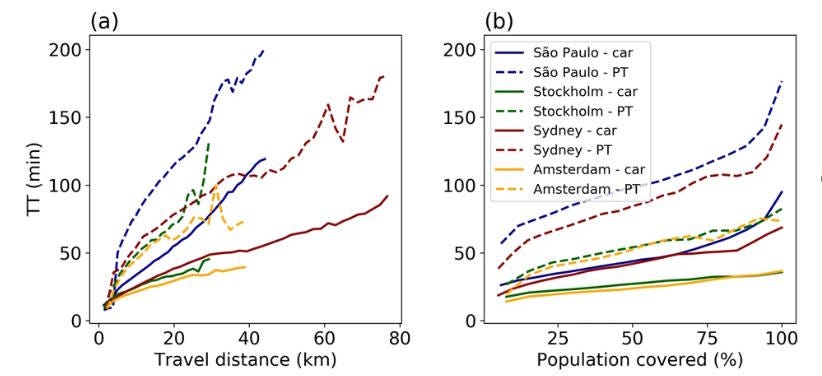
That doesn’t mean cars are better than public transit. Cars cost more, and they require a lot more land to move the same number of people. But because they take you directly from point to point, instead of making a circuit and stopping periodically, they get you there faster.
Of course, commuting by car and commuting by train or bus aren’t the same experience. Driving gives you more privacy, but it forces you to pay attention to the road instead of reading or playing games. Traffic can be frustrating, but so can jostling and bumping strangers for a space on the train. You’re a lot less likely to be sexually harassed in your car, but you’re more likely to die in an accident than to be murdered on the bus. And so on.3
But the point is, cars are not a cost forced upon suburbanites in exchange for their large houses, as some urbanists believe. They are a thing people want in and of themselves, and are willing to pay a lot of money for, all over the world. The convenience, sense of freedom, and privacy cars offer is a benefit of suburbia to many people, in addition to the large house and cheap land. Car ownership is a form of wealth.
The suburbs are not lonely and isolating
Again and again, I hear urbanists declare that the suburbs are lonely and isolating. It certainly sounds logical. In a city, you’re walking past other people constantly — on the street, on the train, in cafes and restaurants. In suburbia, you’re shut at home inside your giant house or alone in the metal shell of your car. How could suburbia not be more lonely than the big city?
But in survey after survey, we don’t find this to be the case. Here’s Abshire et al. (2022):
Data were obtained from 616 adults (278 from small rural, 100 from large rural, 98 from suburban, and 140 from urban areas) from June 2018 through October 2019…Mean unadjusted loneliness scores were lower in suburban compared to urban areas…The prevalence of loneliness was 50.7%, 59.0%, 40.8%, and 54.3% in small rural, large rural, suburban, and urban areas, respectively. Suburban living was associated with lower odds for being lonely compared to urban living…but this association was not statistically significant in the adjusted model[.] [emphasis mine]
And here’s Hammond et al. (2021):
Data from 756 participants who completed 16,602 assessments between April 2018 and March 2020 were used in order to investigate associations between momentary feeling of loneliness, the social environment (i.e. overcrowding, social inclusivity, population density) and the built environment (i.e. contact with nature)…Increased overcrowding and population density were associated with higher levels of loneliness; in contrast, social inclusivity and contact with nature were associated with lower levels of loneliness. These associations remained significant after adjusting for age, gender, ethnicity, education and occupation. [emphasis mine]
And here’s Morris and Pfeiffer (2016):
Based on data from the 2003 to 2013 American Time Use Surveys, this research…assess[es] whether suburban living is associated with less socializing than city living in mid-to-large American metropolitan areas. After controlling for personal characteristics, we find no meaningful difference in suburbanites’ and city dwellers’ time spent socializing across a wide range of social activities. [emphasis mine]
Bower et al. (2022) review 57 different studies and find no systematic association between loneliness and any measurable feature of the built environment.
Why doesn’t the simple intuition work here? Probably because people aren’t just like particles bouncing around in a chemistry experiment — they don’t simply form human connections and bonds just because they happen to walk past each other. A few relationships form from random urban conversations, but most form through work, or friends-of-friends, or shared hobbies, etc.
And while meeting a ton of new people is fun, what really gets rid of loneliness is repeated interaction with people you know and care about. Imagine going to ten parties filled with strangers versus having two close friends over for dinner. Which of those is more likely to leave you feeling lonely? What about 100 Hinge dates versus having a relationship? Remember that Japan has the world’s best cities, but struggles with widespread loneliness.
In fact, suburbs have some features that make it easier to interact with the people you really care about. Those big houses aren’t just for walking around all alone and going “Wow my house is so huge”. They’re for entertaining guests. It’s harder to have a dinner party or a TV night or a game night at a tiny little Manhattan apartment than at a big suburban McMansion. Cars help too; those short travel times make it easier to just pop over and hang.
This doesn’t mean cities are socially inferior to suburbs. Constantly meeting new people is exciting. There’s more fun stuff to go out and do with your friends in a city — restaurants, parties, and so on. It’s just a different lifestyle.
There’s a reason people are moving to the ‘burbs
The urban revival of the 1990s through the 2010s was a modest thing. It was largely driven by young people, high earners, and educated people. Here are some charts from Jed Kolko a decade ago:
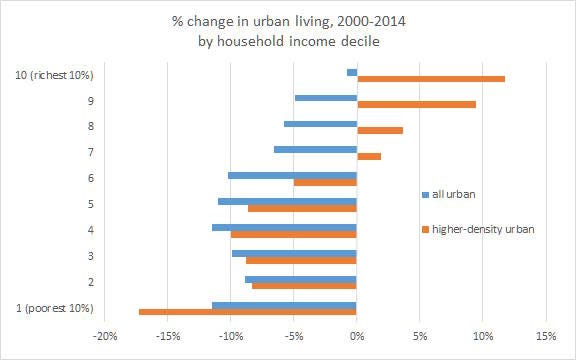
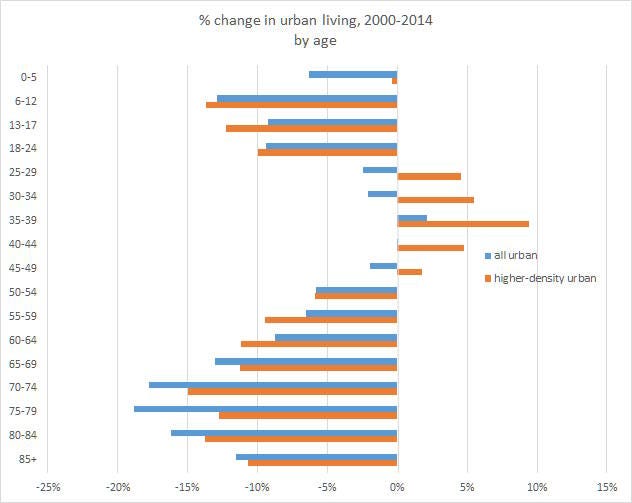
During most of that urban boom, it was actually the suburbs that were growing much faster. And in recent years, the trend toward suburbanization has only accelerated. Here’s a much more recent chart:
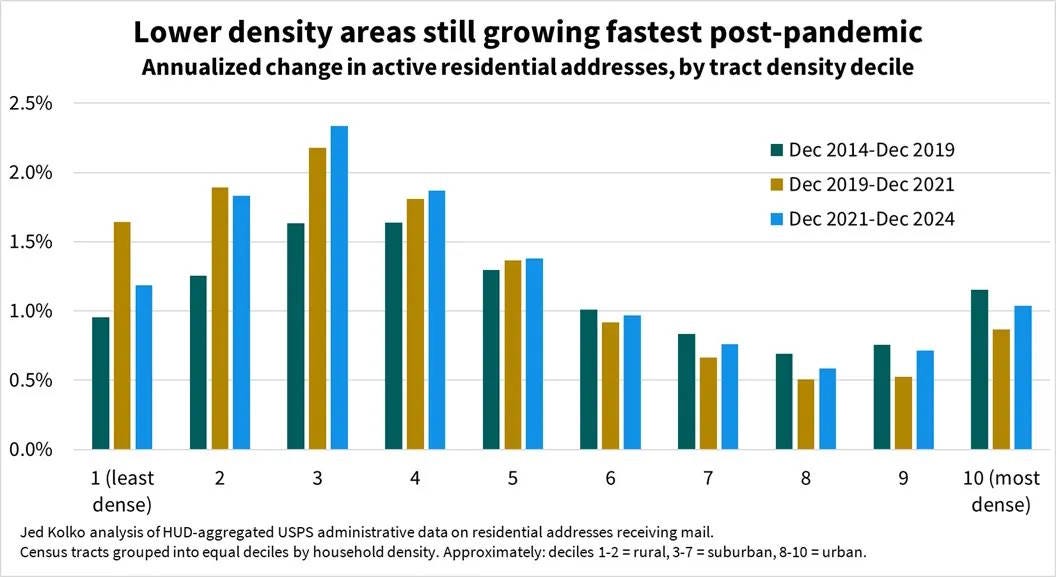
Kolko shows that although the densest city centers are rebounding from the pandemic, more than 100% of this is driven by immigration — domestic migration is still strongly away from city centers.
In fact, the new suburbanization trend is being led by Millennials. This is from the Joint Center for Housing Studies:
[W]e found that throughout the past decade millennials were moving to suburbs that were farther out from the city center. There are many ways to define suburbs, and in this paper we rely on a framework that considers rates of homeownership, single-family housing, and car commuting, in addition to proximity to a metro’s urban core. While there is extensive research and discussion about millennial preferences for walkable urban areas, we found that the places with the largest increases of early millennials were both suburban and on the periphery of metropolitan areas. [emphasis mine]
Why are Millennials moving out? Part of it — the part that urbanists and YIMBYs will emphasize — is that they’re being pushed out by higher rents, which are a result of cities failing to build more housing. But that’s not the whole story. Millennials are also being pulled to the suburbs, because suburbs are generally better for raising kids.
Albouy and Faberman (2025) find that the kind of high-skilled workers who drove the urban boomlet of the 1990s through the 2010s tend to move out — and value urban amenities less — once they get a little older:
We show that high-skill workers disproportionately sort into high-amenity areas, but do so relatively early in life. Workers of all skill levels tend to move towards lower-amenity areas during their thirties and forties. Consequently, individuals’ time use and expenditures on activities related to local amenities are U-shaped over the life cycle…We present evidence that the move towards lower-amenity (and lower-cost) metropolitan areas is driven by changes in the number of household children over the life cycle: individuals, particularly the college educated, tend to move towards lower-amenity areas after having their first child. [emphasis mine]
Kolko shows something similar — people with a kid over 6 tended to move out of cities during the urban boomlet, even as childless people and people with young children were moving in:
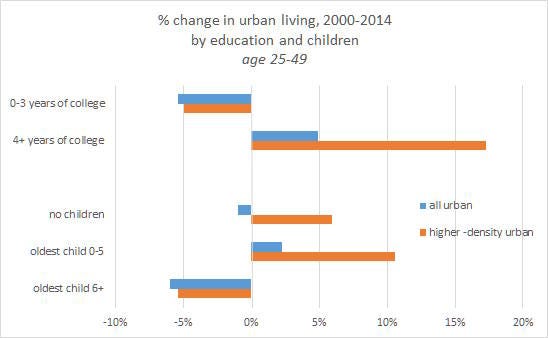
Anyone with kids can easily rattle off the reasons why suburbs make it easier to raise kids. A big house means more room for kids to have their own bedrooms, space to play, and a back yard to run around in safety. A car makes it a lot easier to ferry kids around to school, or soccer practice, or wherever. Cars also make it much easier to do large grocery shopping trips — try taking a week’s worth of food for a family of four home from the store on foot or on a bike and you’ll quickly understand.
It’s almost a cliche that people move to the city when they’re young — to jump-start their career, to party, to meet friends, to explore the world, to date around, and to find their spouse — and then move out to the ‘burbs once they settle down and have kids. The cliche is rooted in reality.
Instead of attacking suburbia, just make room for everybody
Instead of treating the suburbs as some sort of hellish place that Americans’ car culture has exiled them to, urbanists should recognize that suburbs have real advantages that dense urban cores can’t easily replicate. Yes, too many Americans are pushed out to the ‘burbs by unaffordable housing. But a lot move there of their own free will, because they want a nice place to raise kids, enjoy a short quiet drive to work, and hang out with their friends in a big comfy house. It’s not the lifestyle for everyone, but it’s the lifestyle that a lot of people love and aspire to.
Which doesn’t mean we should ignore the real disadvantages of suburbia, either. Low-density sprawl is very expensive to maintain. It tends to make people less healthy, because they walk less. It reduces variety among restaurants and brick-and-mortar retail outlets, because it’s harder to cater to niche tastes when you don’t have a critical mass of people nearby. Those tradeoffs shouldn’t be ignored.
Nor should we accept that the current suburban form is the optimal one. A lot of American urbanism has focused not on Manhattanizing urban cores, but on giving suburbs a few more of the benefits of cities — creating “gentle density” with rowhouses and duplexes and small apartment buildings, allowing retail in residential areas, adding bike lanes and commuter rail, and so on. This should all continue.
But it’s simply a mistake to frame the question of urban form as “Which is better, cities or suburbs?”. The answer is that they’re good for different things, and they appeal to different sets of people. Instead of fighting flame wars over whether the whole country should look like Manhattan or the Inland Empire, we should aim for a country that has room for everyone. We should build great city centers for the same reason we should build great suburbs — because Americans deserve to have great places to live, no matter what kind of place they want to live in.
Well ok, not quite. My PhD years and my first year at Stony Brook involved more stints of suburban living.
“Yuppies”, in the parlance of our times.
Whether your car or the bus smells better probably depends on a lot of things.
One pet peeve of mine related to anti-suburb sentiment is the enormous pile of media portrayals from when I was younger like Weeds, Desperate Housewives, American Beauty, and Serial Mom thinking they're edgy and clever for saying "the suburbs aren't wholesome as you THINK!" when they were just recycling a trope that was already stale by then.
If you have kids and value privacy, space, quiet,good public schools and uncrowded green spaces, then the burbs are the way to go
Wasting money on restaurants or door dash 3-5x a week is a yuppie thing, not a family thing,
If you are rich, have “help”, can pay for private school and one partner can manage the helicopter parenting and “enrichment” activities for kids, then sure, Cities can be great (and that describes the life of some “urban experts”), but not in NYC. I’d recommend London where you can be 30 minutes from the City and have a garden and birdsong (not just pigeons).