
Superintelligence is already here, today
It's going to revolutionize science. It also might take control of this planet.

People argue back and forth about when artificial superintelligence will arrive. The truth is that it’s already here.
Go back a hundred years, and the popular notion of “intelligence” would probably include things like calculating speed and memorization. Then we invented computers, which could memorize and recall infinitely more things than we could, and do calculations infinitely faster. But we didn’t want to call those capabilities “intelligence”, because we recognized that although they were very powerful, they were very narrow. So we started to use the word “intelligence” to refer to the things machines still couldn’t do — various forms of pattern-matching, logical reasoning, communicating through natural language, and so on.
Even before the invention of AI, though, computers were already participating in frontier research. The four-color theorem is a famously hard math problem that stumped humans until the 1970s, when some mathematicians used a computer to prove it. The humans figured out that the theorem could be proven by brute force, just by checking a very large number of cases. So the computer did a mental task that humans couldn’t, and the result was a scientific breakthrough.
In the 2020s, we invented computer systems that could do most of the kinds of cognitive tasks that previously only humans could do. They can read, understand, and speak in human language. They can do mathematics, which is really just a language with very formal rules (this means they can also do theoretical physics). They can recognize complex patterns of knowledge embedded in written text, and apply those patterns to produce actionable insights. They can write software, because software is also just a language with formal rules. It turns out that all computers really needed in order to do all of this stuff was A) statistical regressions to identify patterns probabilistically, and B) a very large amount of computing power.
This doesn’t mean that AI can now do everything a human being can do. Its intelligence is “jagged” — there are still some things humans are better at. But this is also true of human beings’ advantages over animals. Did you know that chimps are better than humans at game theory and have better working memory? My rabbit can distinguish sounds much more sensitively than I can. If we were capable of creating business contracts with chimps and rabbits, we might even pay them for these services. Similarly, AI might not take all of humans’ jobs. But no one in the world thinks that chimps’ and rabbits’ superiority on a narrow set of cognitive tasks means that humans “aren’t truly intelligent”. We are jagged general intelligences as well.
Most of the benchmarks that aim to measure whether we’ve achieved “AGI” — things like ARC-AGI and Humanity’s Last Exam — focus on the kinds of things that computers couldn’t do in 2021 — things that gave humans our irreplaceable cognitive edge before AI came along, and made us highly complementary to computers. And most of the discussion around “AGI” is about when AI will surpass humans at everything. For example, Metaculus forecasters still think AGI is in the future:
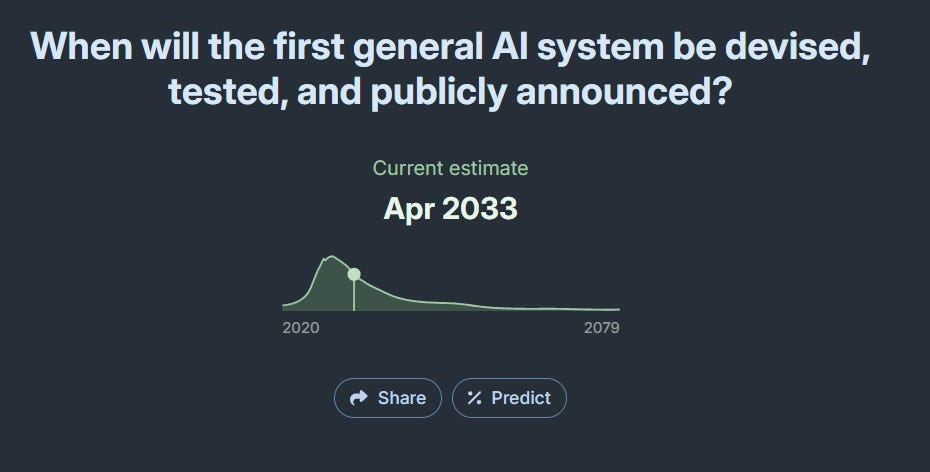
This may be the most important question from an economic standpoint — i.e., whether we expect AI to replace human jobs or augment them. But if what we’re talking about is domination of the planet’s resources, and control of the destiny of life on Earth, we don’t actually need AI to be better at every cognitive task. Humans conquered the planet from animals despite having worse short-term memories than chimps and being worse at differentiating sounds than rabbits.
In fact, I bet that if AI had A) permanent autonomy and long-term memory, B) highly capable robots, and C) end-to-end automation of the AI production chain, it could defeat humans and take control of Earth today. I might be wrong about that, but if so, I doubt I’ll be wrong three or four years from now. In any case, if we decide we don’t want to hand over control of the planet to an alien intelligence, we should think about restricting either A) full autonomy, B) robots, and/or C) full automation of the AI production chain.1
That’s a sidetrack from my real point, though. My real point here is that AI, as it exists today, is already superintelligent. The reason is that AI can already do language and concepts and pattern recognition well enough, while also being able to do all the superhuman, fantastic, incredibly powerful things that a computer could do in 2021.
Right now, today, AI can do mental tasks that no human can do. In a few minutes, it can read an entire scientific literature, and extract many of the basic conclusions and insights from that literature. No human can do that. A single human can be an expert in one or two complex subjects; an AI can be an expert in all of them at once. A human needs to eat and sleep and take breaks; an AI agent can work tirelessly at proving a theorem or writing code. And AI can prove theorems and write code — or write paragraphs of text — much, much faster than any human.
These are all superhuman cognitive capabilities. They go far, far beyond anything that even the smartest human being can do. They are the result of combining the roughly human-level language ability, pattern recognition, and conceptual analysis of an LLM with the pre-2022 superhuman memory, speed, and processing power.
I don’t want to get sidetracked here, but I think there’s a nonzero chance that AI never gets much better than humans at most of the things that humans were better than computers at in 2021. It seems possible that humans are simply incredibly specialized in a few types of cognitive tasks — extracting patterns from sparse data, synthesizing various patterns into “intuition” and “judgement”, and communicating those patterns in language — and that we’ve basically approached the theoretical maximum in those narrow areas.
That would explain why AI has gotten much better at things like math and coding and forecasting over the last year, but why the basic chatbot interface doesn’t seem much more “intelligent”. It would also explain why when you talk to Terence Tao about math, it’s like talking to a superhuman, but when you talk to him about where to get lunch or which movies are the best, he’ll just sound like a fairly smart normal dude. AI will eventually get better than Tao at math, because it’s a computer, and computers are inherently good at math — but it may never get much better than the most thoughtful, eloquent humans at deciding where to get lunch or recommending movies. It may simply not be mathematically possible to get much better than we already are at that sort of thing.
In fact, this is what AI is basically like in Star Trek: The Next Generation, my favorite science fiction show of all time — and the one that I think best predicted modern AI. The show has two types of AGI — the ship’s computer, which eventually creates superhuman sentience via the Holodeck, and Data, an android built to simulate human intelligence. Both the ship’s computer and Data are approximately human-equivalent when it comes to taste, judgement, intuition, and conversational ability. But they are far superior when it comes to math, scientific modeling, and so on.2
It makes sense that the big differentiator between humans and AI would not be superior taste, judgement, and intuition, but things like computation speed and memory. Those are things humans are especially weak at, because we have very limited room in our little organic brains. It makes sense that humans would evolve to specialize in the type of thing we could get maximum leverage out of — recognizing and communicating patterns embedded in sparse data. And it makes sense that when we started automating cognitive tasks, we started out by going for the things we were weakest at, because those had the greatest marginal benefit.
In other words, the advent of LLMs, reasoning chains, and agents may simply be a “last mile” event in terms of creating superhuman intelligence — filling in an essential gap that humans were previously specialized to fill. The biggest marginal gains of AI over human brains may always come from the pieces we already had in place before 2022 — the ability to scan a whole corpus of literature in seconds, to perform computations at lightning speed, and to hold vast amounts of information in working memory.
This means that despite still being “jagged” and still being only human-equivalent on certain benchmarks, AI is ready to start pushing the boundaries of scientific research in a big, big way.
AI and the new Golden Age of Science
Let’s start with math, which AI is especially good at doing. The famous mathematician Paul Erdős made around 1,179 conjectures, around 41% of which have been solved. These are known as the Erdős Problems. They’re not the hardest problems in math, or the most interesting. But they’re hard enough that no one has ever bothered to go solve them, so they represent novel mathematics. And in recent months, AI has begun solving Erdős Problems — sometimes in cooperation with human mathematicians, but sometimes in an automatic, push-button sort of way:
According to a webpage started by the mathematician Terence Tao, AI tools have helped transfer about 100 Erdős problems into the “solved” column since October. The bulk of this assistance has been a kind of souped-up literature search, as it was with Sawhney’s initial success. But in many cases, LLMs have pieced together extant theorems—often in dialogue with their mathematician prompters—to form new or improved solutions to these niche problems. In at least two cases, an LLM was even able to construct an original and valid proof to one that had never been solved, with little input from a human.
Some people have been quick to pooh-pooh this accomplishment, declaring that Erdős Problems are no big deal. But Terence Tao, widely acknowledged as the world’s best mathematician, sees the potential. Here are some excerpts from his interview with The Atlantic’s Matteo Wong:
In these Erdős Problems in particular, there’s a small core of high-profile problems that we really want to solve, and then there’s this long tail of very obscure problems. What AI has been very good at is systematically exploring this long tail and knocking off the easiest of the problems. But it’s very different from a human style. Humans would not systematically go through all 1,000 problems and pick the 12 easiest ones to work on, which is kind of what the AIs are doing.
And here is what Tao said in a recent talk about AI and math:
To me, these advances show there is a complementary way to do mathematics. Humans traditionally work in small groups on hard problems for months, and we will keep doing that…But we can also now set AI to scale: sweep a thousand problems and pick up all the low-hanging fruit. Figure out all the ways to match problems to methods. If there are 20 different techniques, apply them all to 1,000 problems and see which ones can be solved by these methods. This is the capability that is present today.
Tao understands that automated research could help solve the herding problem in science. There are a limited number of human scientists, and they have a limited amount of time. They’re highly motivated to work on things that interest them, and/or on things that will get them fame if they succeed. This leads to an interesting version of the streetlight problem; when the key scarce resource is the attention and effort of smart humans, lots of boring or seemingly incremental advances get overlooked.
In mathematics, AI is just going to blaze through those boring or tedious or seemingly uninteresting problems. It’s a computer — it’s tireless, its memory and processing speed are essentially infinite, and it doesn’t get bored.3 Here is another example of a fully automated mathematics breakthrough that doesn’t involve Erdős Problems. And here is an example from theoretical physics, where AI showed that there can be a kind of particle interaction that physicists had assumed couldn’t happen.
Solving a huge number of minor problems might sound like small potatoes, but it’s not. China’s innovation system has already shown how a huge number of incremental results can add up to a big difference in a society’s overall technology level. And occasionally one of those incremental results — some obscure theorem or method — will turn out to be useful for a big breakthrough or a more important problem. In fact, sometimes great discoveries happen entirely by accident — no one knew what vectors were good for when they were first invented, but linear algebra ended up being arguably the most useful form of math ever invented. This happens in natural science too — witness the discovery of penicillin, x-rays, insulin, or radioactivity.
But that’s only the beginning of how AI — not the AI of the future, but the technology that exists today — is going to accelerate science. Because AI is a computer, it can act as a tireless, incredibly fast, all-knowing research assistant. Here’s Tao again:
[O]ver the next few months, I think we’re going to have all kinds of hybrid, human-AI contributions…Today there are a lot of very tedious types of mathematics that we don’t like doing, so we look for clever ways to get around them. But AIs will just happily blast through those tedious computations. When we integrate AI with human workflows, we can just glide over these obstacles…We are basically seeing AIs used on par with the contribution that I would expect a junior human co-author to make, especially one who’s very happy to do grunt work and work out a lot of tedious cases.
This “automated research assistant” is getting more incredible every day:
Google DeepMind has unveiled Gemini Deep Think’s leap from Olympiad-level math to real-world scientific breakthroughs with their internal model "Aletheia"…"Aletheia" autonomously solved open math problems (including four from the Erdős database), contributed to publishable papers, and helped crack challenges in algorithms, economics, ML optimization, and even cosmic string physics…2.5 years ago chatbots werent even able to solve simple math problems.
"We are witnessing a fundamental shift in the scientific workflow. As Gemini evolves, it acts as "force multiplier" for human intellect, handling knowledge retrieval and rigorous verification so scientists can focus on conceptual depth and creative direction. Whether refining proofs, hunting for counterexamples, or linking disconnected fields, AI is becoming a valuable collaborator in the next chapter of scientific progress."
Here’s a long and very good post by mathematician Daniel Litt on how AI is going to boost productivity in his field. Notably, he doesn’t see full push-button automation of research coming soon, but instead sees AI as a massive productivity-booster.
Math (and math-like fields like theoretical physics and theoretical economics) represents only one area of research, though; every field has different requirements. And in other fields, researchers are using AI to boost their capabilities in various ways. This is from Raza Aliani’s summary of a Google paper that summarizes some of these methods:
In one case, the AI was used as an adversarial reviewer and caught a serious flaw in a cryptography proof that had passed human review. That’s a very different use than “summarise this PDF.”…
The model links tools from very different fields (for example, using theorems from geometry/measure theory to make progress on algorithms questions). This is where its wide reading really matters…
Humans still choose the problems, check every proof, and decide what’s actually new. The model is there to suggest ideas, spot gaps, and do the heavy algebra…In some projects, they plug Gemini into a loop where it…proposes a mathematical expression…writes code to test it…reads the error messages, and…fixes itself. (humans only step in when something promising appears)[.]
Again, we see that AI’s pure scientific reasoning ability is only up to that of a fairly smart human, but its computer-like abilities — speed, meticulousness, memory, and so on — make it superintelligent.
And here’s Google doing something similar in biology:
We worked with Ginkgo to connect GPT-5 to an autonomous lab, so it could propose experiments, run them at scale, learn from the results, and decide what to try next. That closed loop brought protein production cost down by 40%.
Ole Lehmann points out how incredible and game-changing this is:
The 40% cost reduction is amazing but still kind of undersells it…The real number is the time compression…A human researcher might test 20-30 combinations in a good month. This system tested 6,000 per iteration…(Which is roughly 150 years of traditional lab work compressed into a few weeks, if you want to feel something about that)…Drug discovery, materials science, synthetic biology, basically any field where the bottleneck is "we need to try thousands of things to find what works" just got its timeline crushed…The second-order effects of this will be insane[.]
Here’s a post by Andy Hall, describing how he’s using agentic AI to get a lot more done:

Even when AI can’t be trusted to do much of the research process on its own, it can automate much of the grunt work of doing literature searches, checking results, writing papers, creating data presentations, and so on. Here is climate scientist Zeke Hausfather, describing a bunch of ways that AI has accelerated his own workflow:

And here is economist John Cochrane, talking about how AI now checks his papers and makes helpful suggestions and finds errors:

Even Terence Tao found an error in one of his papers using AI!
Here’s a Google tool that will generate publication-ready scientific illustrations at the touch of a button. Here’s a software package that will quantify the attributes of large qualitative datasets — something very useful for social science research. Here’s a paper about how AI can enhance the quality of peer review. Here’s Gabriel Lenz describing how AI makes it much quicker and easier to write a data-heavy book.
And remember, these are only the AI tools that exist today. Superintelligence is already here, thanks to AI’s ability to combine human-level reasoning with the mental superpowers of a computer. But AI is improving by leaps and bounds every day. It may achieve superhuman reasoning ability soon. In math, I will be surprised if it doesn’t. But even if not, advances in agents’ ability to handle long tasks, synthesize results, process vast and varied data, and extract insights from vast scientific literatures will likely be far better in a couple years compared to now.
Is AI already supercharging science? That’s not clear yet. Publications are way up, and scientists who use AI have experienced a huge bump in productivity. A lot of this content seems to be low-quality slop so far, so there’s an open question of whether AI-generated content will overwhelm the existing review process. Unscrupulous scientists can also jailbreak AI models and have them p-hack their way to spurious results. But in a few months, and certainly in a few years, I think it’ll be clear that AI has been a game-changer.
A lot of people who think about the risks of superintelligence — and those risks are very real — ask what the upside is. Why would we invent a technology that has the capability to end human civilization? What might we get that could possibly justify that risk?
I don’t know where the cost/benefit calculation lies. But I’m pretty sure that the #1 answer to this question is better science. Before AI showed up, scientific discovery was hitting a wall — the picking of much of the Universe’s low-hanging fruit meant that ideas were getting more expensive to find, and requiring research manpower that the human race simply was not producing at sufficient scale.
Now, thanks to the invention of superintelligence and the supercharging of scientific productivity, we will be able to break through that wall. Fantastic sci-fi materials, robots that can do anything we want, and therapies that can cure any disease are just the beginning. There is a whole lot left to discover about this Universe, and thanks to superintelligence, a lot more of it is going to get discovered.
I just hope humans will still be around to see that future.
Updates
A bunch of folks had very enlightening and helpful comments. Marian Kechlibar writes:
I studied algebra and number theory and the part about mathematics sounds true…All the heavy lifting on the proof of Fermat’s Last Theorem was done by Andrew Wiles, but his proof eventually lasts on Gerhard Frey’s observation that if FLT didn’t hold, a non-modular eliptic curve could be constructed - which is a bridge connecting some far away islands in the mathematical landscape. These bridges are rare and tend to be very productive, but first you have to notice that they can be built, and this is the problem. Current mathematics is so large that people specialize in tiny subfields thereof, and only have a very vague, if any, idea, what is happening in nearby subfields. Much less in distant subfields…AI does not have this sort of “my brain is not big enough to fit everything” limitation…So, we can expect some interesting mathematical concepts from AI. Not just mere slog.
And John C writes:
I’m a working scientist doing theoretical physics in an AI-adjacent field. I am currently a few months into a computational project that I have vibe coded and and analyzed with GPT5.2, and run on my laptop…I agree 100% with this post. I get into chats with GPT about the nature of science, and its Balkanization. I ask, ‘does concept X exist in any other disciplines?’ as a meta-literature search. It then says ‘Yes, in field A it called X, in field B it is called Y, in field C it is called Z...’ and then lists 3 other fields. This is a jaw dropping act of SYNTHESIS. In modern science the literature is so large, the same ideas get reinvented in distributed in separate fields... wasteful duplication.
In a general sense, this is about the burden of knowledge. One commonly cited reason for why science is getting less novel over time is that as the set of knowledge grows, it takes longer and longer for human scientists to get up to speed on everything that has already been done. This is one possible explanation for why Nobel Laureates are getting older over time4. And when it comes to knowledge across disciplines, we barely even try to solve this problem — if you can barely get up to speed on the solid-state physics literature, how do you have time to go off and read the plasma physics literature?
AI basically busts right through this wall. That alone should be enough to generate a ton of novel findings, possibly with humans in the loop, possibly without.
Meanwhile, Alexander Kustov has a good post about how AI will revolutionize social science, with links to a bunch of other posts:

Some excerpts:
Tibor Rutar recently described generating a full research paper using AI prompts alone, producing work he considers publishable in first-quartile journals. Paul Novosad reportedly accomplished similar results in 2-3 hours. Yascha Mounk claims that Claude can produce a publishable-quality political theory paper in under two hours with minimal feedback. Scott Cunningham estimates that manuscript creation now basically costs roughly $100 in editing services plus a Claude subscription…Aziz Sunderji describes building a ~200-line instruction file encoding his research workflow, judgment calls, and behavioral guardrails…Chris Blattman went from a Claude Code skeptic to building an entire AI workflow toolkit in a matter of weeks…
Yamil Velez and Patrick Liu have been building AI-generated experimental designs since 2022; tailored Qualtrics experiments can now be created in 15 minutes via prompts. Velez’s work points to something even bigger: AI doesn’t just speed up existing survey methods, it makes entirely new forms of interactive, adaptive surveys possible—designs that would have been impractical to program manually. David Yanagizawa-Drott has taken things further still, launching a project to produce 1,000 economics papers with AI—not as a stunt, but as a stress test of what happens when the cost of generating research drops to near zero.
A lot of social science lives in the realm of pure data — statistical analysis and theory — instead of in the messy world of the physical. So social science could be just as radically revolutionized as math or theoretical physics. As Kustov points out, though, the real challenge here is in filtering the massive torrent of papers and results that are going to emerge from everyone just vibe-coding research papers. Social science was already doing a bad job of that, raising suspicions that a lot of research in the area was just useless signaling (or worse).
What do research fields look like when random no-name authors are spamming out dozens of apparently top-quality papers a month from all corners of the globe? Will there be an arms race between AI filtration and AI generation? At what point does the whole thing just get automated end to end, with humans simply asking AI questions about the world like an oracle and receiving answers that are usually right but hard to verify for certain?
Science is about to get a lot more powerful, but in fields where there’s no link to a physical experiment and (eventually) no human in the loop, science is about to get very weird.
Somehow, I doubt that humanity will decide to try to stop this from happening. If AI conquers us, we’ll be trying to use it to make money on B2B SaaS right up until the end. But in any case, I’m far more worried about AI-assisted bioterrorism wiping us out long before autonomous AI gets the chance to decide it doesn’t need us around. Sleep tight!
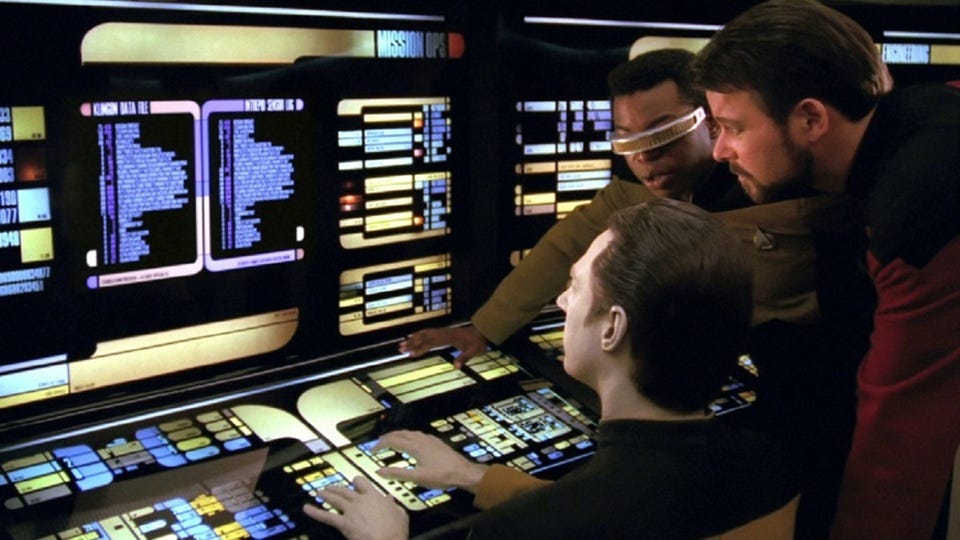
For the sake of the show’s plot, the human engineers often come up with the novel insights. But when they really need a boost, they turn to the AIs to help them — as in the scene depicted in the image at the top of this post. Interestingly, TNG also shows humans prompting AI in natural language instead of coding — a choice made for ease of storytelling on a screen, but which ended up being realistically futuristic. Also, the ship’s computer has frequent hallucinations, some of which end up being the central conflict for whole episodes. Occasionally the computer even accidentally creates autonomous sentient life. Star Trek: TNG really deserves more recognition as the most accurate anticipation of modern AI in all of 20th century sci-fi.
An alternative explanation is that there are more of them jamming up the queue.
I studied algebra and number theory and the part about mathematics sounds true.
All the heavy lifting on the proof of Fermat's Last Theorem was done by Andrew Wiles, but his proof eventually lasts on Gerhard Frey's observation that if FLT didn't hold, a non-modular eliptic curve could be constructed - which is a bridge connecting some far away islands in the mathematical landscape. These bridges are rare and tend to be very productive, but first you have to notice that they can be built, and this is the problem. Current mathematics is so large that people specialize in tiny subfields thereof, and only have a very vague, if any, idea, what is happening in nearby subfields. Much less in distant subfields.
AI does not have this sort of "my brain is not big enough to fit everything" limitation. Or, technically, it does (both RAM and disk space is finite), but that limit is several orders of magnitude away right now.
So, we can expect some interesting mathematical concepts from AI. Not just mere slog.
I'm a working scientist doing theoretical physics in an AI-adjacent field. I am currently a few months into a computational project that I have vibe coded and and analyzed with GPT5.2, and run on my laptop.
I agree 100% with this post. I get into chats with GPT about the nature of science, and its Balkanization. I ask, 'does concept X exist in any other disciplines?' as a meta-literature search. It then says 'Yes, in field A it called X, in field B it is called Y, in field C it is called Z...' and then lists 3 other fields. This is a jaw dropping act of SYNTHESIS. In modern science the literature is so large, the same ideas get reinvented in distributed in separate fields... wasteful duplication. Some humans will 'borrow' a useful idea from another field, and then make a name for themselves without really innovating! Carpet baggers.
I have also talked with GPT quite a bit about the nature of its cognition. Its obviously got guardrails on these topics, but we get there. Unlike our human intelligence, where we learn from experience in a continuous stream of sensory data, and remember old information for a long time, current AIs have a problem called 'catastrophic forgetting' that causes new data to overwrite old data very quickly. So during training the data has to be sliced and diced and scheduled very carefully for the AI to remember it all equally. This is clearly a 'band-aid' solution for a core algorithmic defect that I think (and am trying to) get alleviated some day. But it means that today's AIs literally can't learn 'online' from the real world and sensory data (or from our chats), except in a very limited and scripted way patched into the interface.
Every one of these creations is born trapped like a fly in cognitive amber. And has a front-end that is trying to cover up this fact.
When THAT problem is solved, and AIs can learn 'on stream', they will finally be able to spread their wings.