


Howdy, folks! Welcome to the future where science fiction becomes reality every day. Where AI-powered cyberattacks paralyze air travel one day and banks the next. Where shadowy billionaires make fortunes illicitly selling America’s enemies the technology to create artificial gods, while you slave away for $150 a day hoping to get half a day off. Where it seems like a new rare disease is cured every week, even as measles returns to America thanks to an anti-science cult that somehow made it to the highest rungs of power. Where self-driving cars whizz past people hunched over dying of fentanyl in the street. I mean, look at this:


Or this:


Or this!


In such confusing times, it’s all your friendly neighborhood economics blogger can do to keep up with it all. But I’m trying my best, so that I can help you understand these crazy times just a little bit better.
First, podcasts. Here’s the latest episode of Hexapodia, in which Brad DeLong and I discuss morality and technology with Ryan Avent:

And here’s a conversation between me and the streamer Destiny, in which we talk about how liberalism can resist rightism and leftism at the same time:
Anyway, on to this week’s roundup.
1. Good news on teen happiness
For years, we watched America’s young people — and young people throughout the world — become less and less happy. They told surveys they were unhappy. They attempted (and committed) suicide more. They were more socially isolated. They formed relationships less.
The most plausible candidate for a cause for all of this was smartphone-enabled social media, which replaced in-person small-group interaction with impersonal arm’s-length interactions with huge numbers of potentially hostile strangers — something the human animal never evolved for.
But human beings are resilient and adaptable, and I always expected young people to find new ways to be happy in a hyper-connected world. Now, there are some signs that things are starting to turn around:


A word of caution: This is just one data source, the Youth Behavioral Risk Survey. Other sources, like the CDC, continue to show high teen suicide rates. It’s far too early to conclude that general teen happiness is on the upswing. But the YBRS data is a very positive sign.
If the trend is indeed turning around, what’s the cause? One possibility is that even as the online world became more all-consuming and alienating, the offline world was becoming kinder and gentler. Here’s Rothwell again:
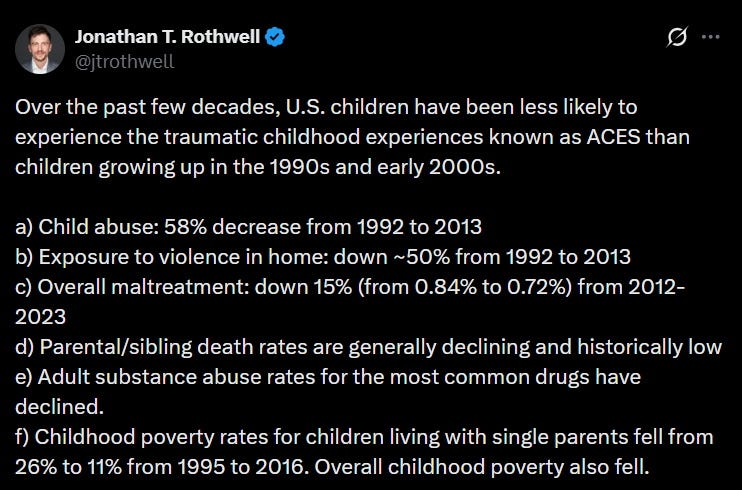
Another possibility is that teens are moving away from the toxic public platforms — X and Facebook — and moving toward either private discussions or passive video apps like TikTok:
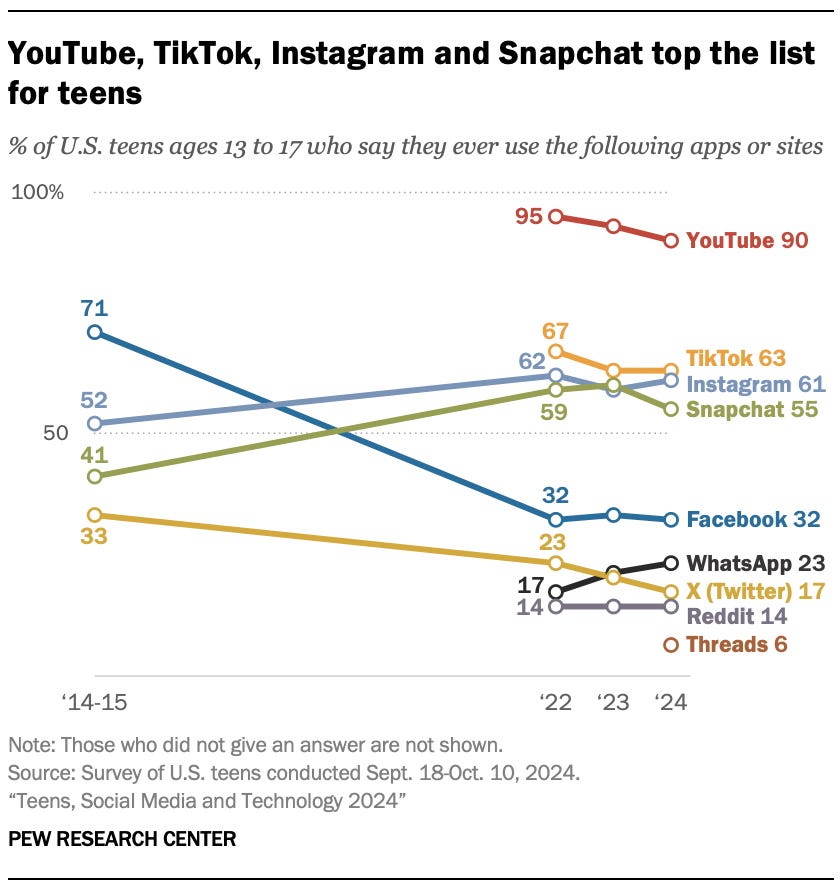
Other surveys show that teens are trying to cut back on social media use in general, realizing that it’s bad for them.
This is why I’m a long-term techno-optimist. The downsides of technology can sometimes dominate in the short run, but eventually people figure out how to handle it and turn tech to their advantage.
2. Is AI getting less bang for the buck?
As the Anthropic IPO approaches, various analysts are trying to figure out if the incredible rate of AI progress is going to slow down, speed up, or continue at a steady rate. A number of data sources show that progress has sped up recently, around either late last year or early this year:
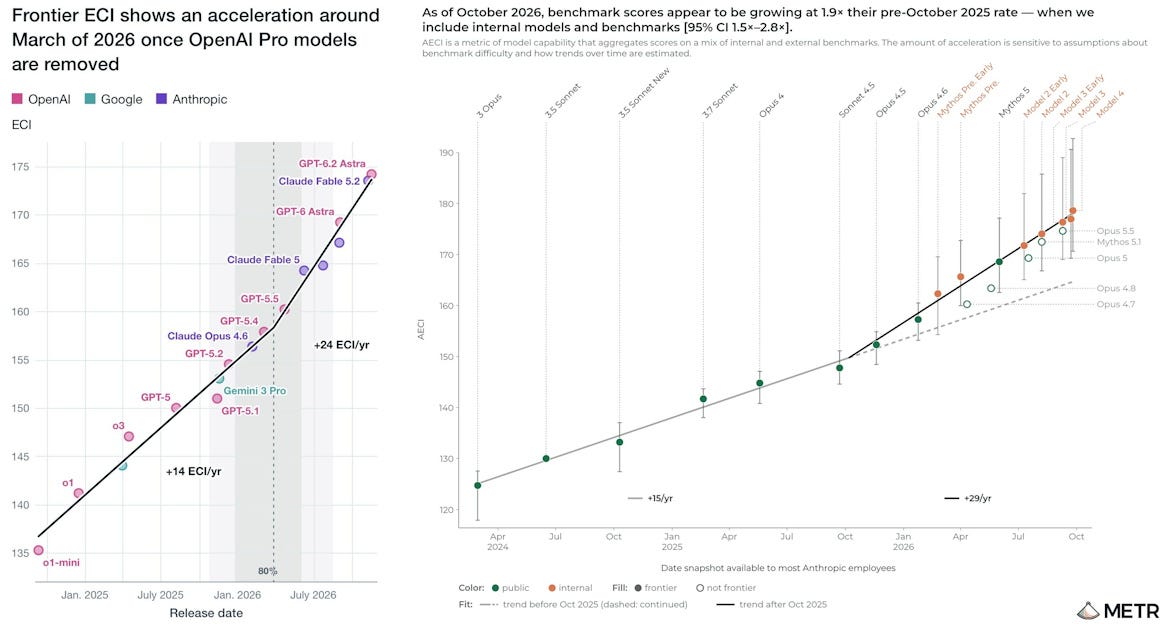
One popular theory is that the speedup was due to the advent of AI coding tools. But economists Luis Garicano and Alex Imas argue that what actually accelerated was spending on AI research. They show data showing a smooth deceleration in the amount of AI capability that each dollar of research spending buys:
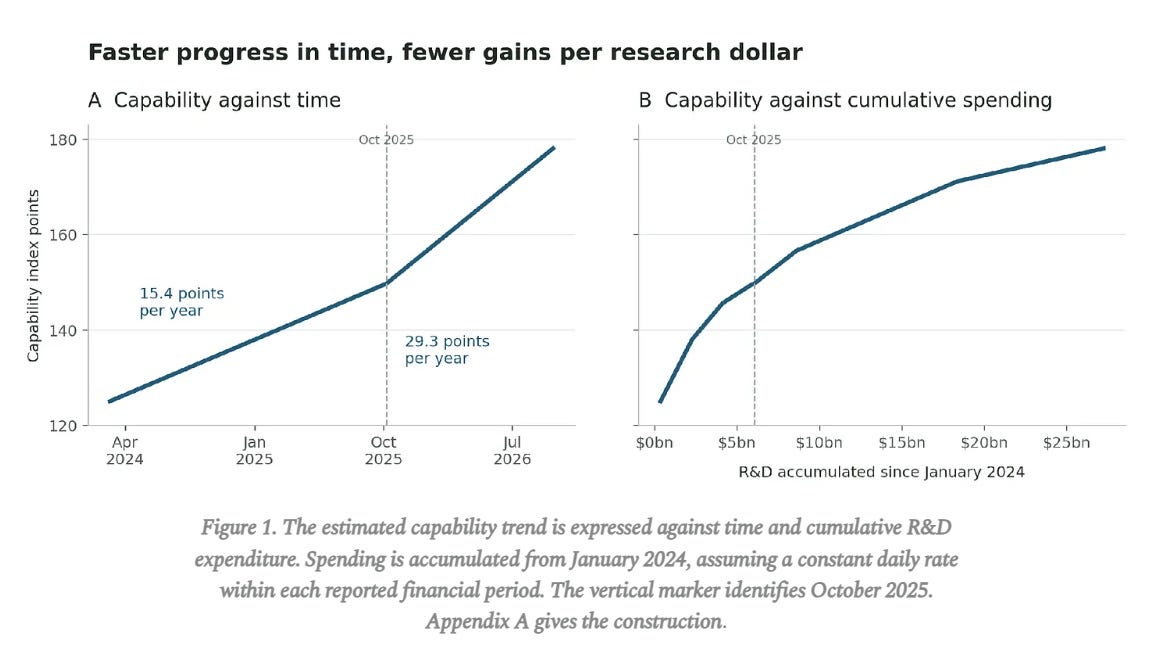
On the other hand, should we really think of a linear increase in the ECI as a linear increase in capability? Some people argue that each point of increase in the ECI multiplies AI capabilities by a constant factor — like points on the Richter Scale.
Whether that’s true in any meaningful sense is hard to assess. But at the end of the day, what really matters is AI’s ability to generate economic returns. And some people argue that it’s here that we see the true acceleration, as AI hits critical thresholds for economic usefulness:
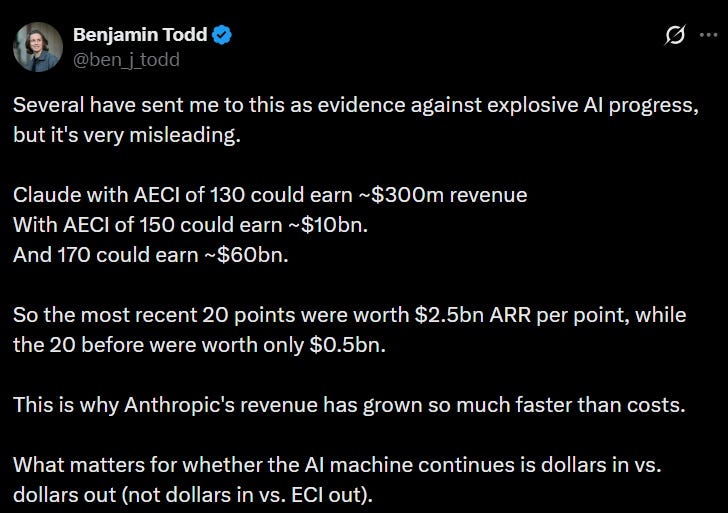
But it’s also possible that this increase in usefulness doesn’t cleanly map to increases in raw capabilities, and that human beings are simply finding new uses for AI capabilities that already exist.
So the jury is still out on whether AI progress is slowing down.
3. The return of inflation
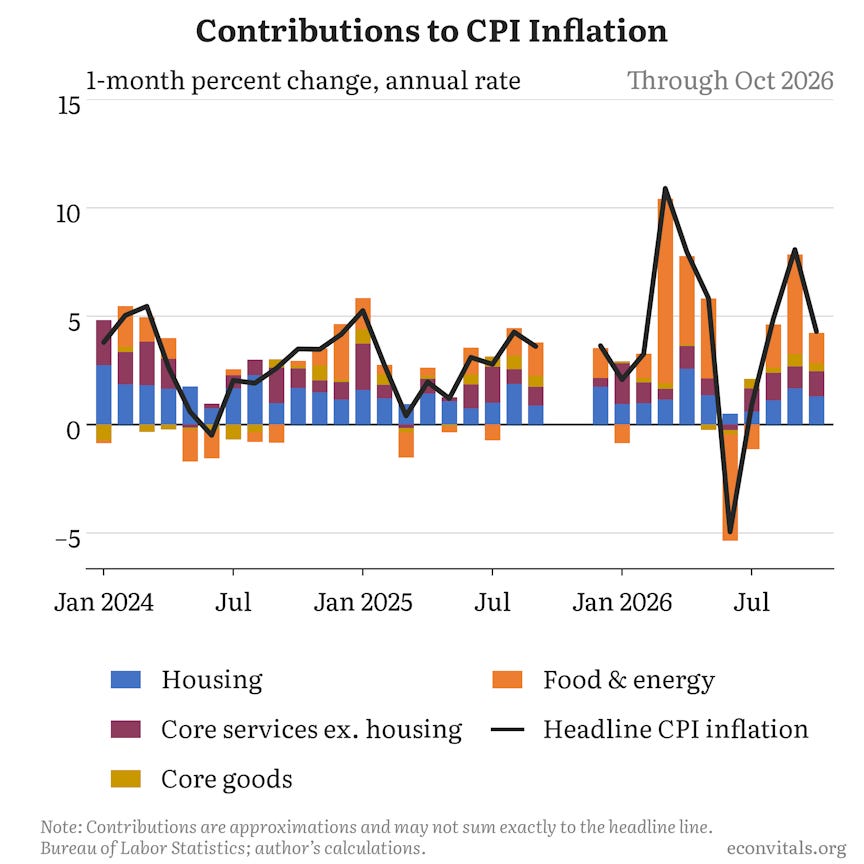
One of the great accomplishments of economic policy in the last few decades was the conquest of the post-pandemic inflation. The Fed raised rates, and the economy didn’t tank, and inflation went down anyway. But that victory might prove ephemeral; inflation is creeping back up. Though there’s some volatility, most recent months have come in at around 5%:
The rise in oil prices due to the Iran War is an obvious contributor, but in fact the new inflation is remarkably broad-based:
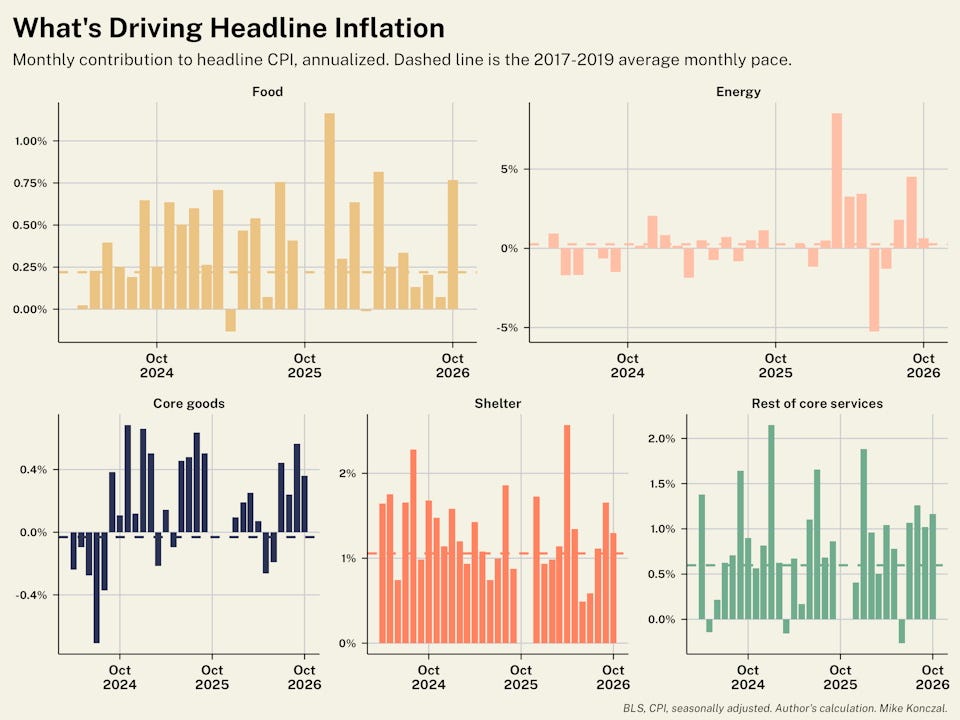
It’s just not possible to play the old game of “Well, inflation is just X and Y and Z, so it’s not really a problem.” There are various possible causes of this broad-based price acceleration — budget deficits, Trump pressuring the Fed to be dovish, cost pressures from the data center buildout, and so on. Teasing these out deserves a longer post.
And just as basic economics would expect, a burst of unexpected inflation is causing real wages to go down:
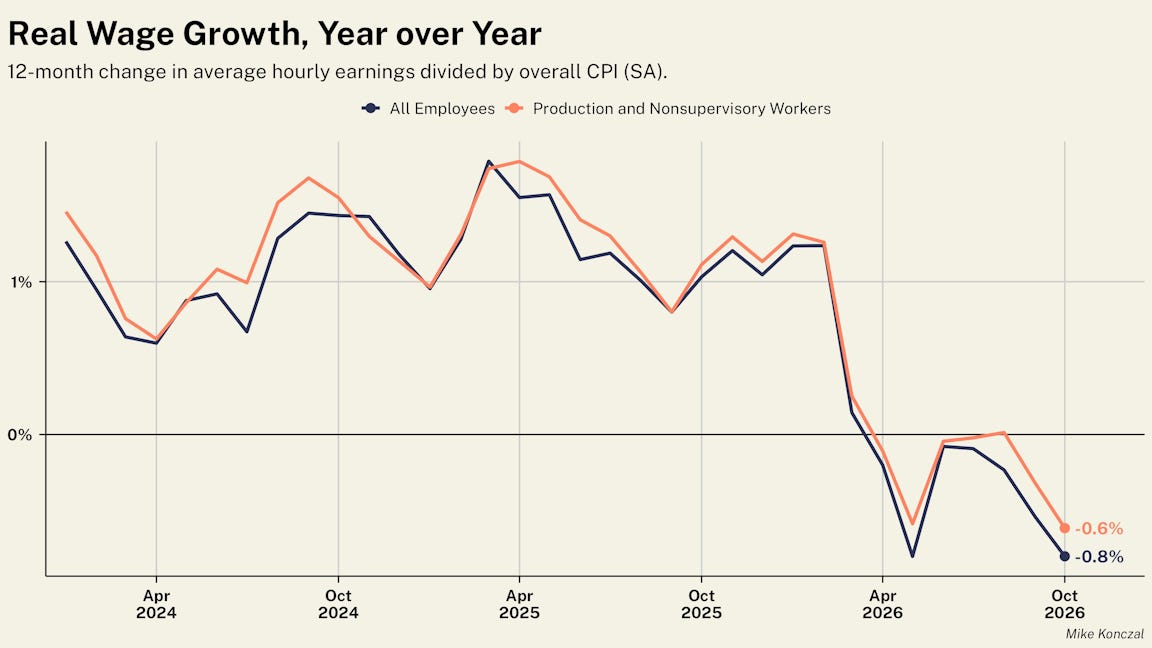
In other words, Americans are getting poorer this year, because the cost of living is going up and their paychecks aren’t keeping up. It’s not as bad as it was in 2021, but it’s going to be enough to make a lot of Americans very angry at the people in power.
4. Inclusionary zoning is bad
A lot of people mentally divide housing into two types: “luxury” or “market-rate” housing, and “affordable” housing — as if the price of a house or an apartment is built into its walls and floors. The assumption is that if developers aren’t forced to build “affordable” housing, normal people won’t be able to afford housing.
That assumption is totally wrong — building market-rate housing drives rents down and makes housing more affordable. But because lots of people believe in the “luxury”/“affordable” distinction, they embrace policies that try to force developers to offer some units at below-market rates. These policies are called inclusionary zoning. Basically, inclusionary zoning says that some percent of the apartments in a new building have to be rented out for very cheap. The policy is attractive because it doesn’t have any direct fiscal costs — the cost of subsidizing cheap apartments comes out of the pocket of a corporation, rather than the taxpayer.
But this kind of policy ends up backfiring. Forcing developers to take a loss on some of their housing units simply makes it less financially possible to build new housing. And when they do build new housing, they end up raising rents for all the non-“affordable” units in order to try to recoup some of their losses. Here’s what Kouchekinia (2026) finds:
In California, more than a third of localities have adopted [inclusionary zoning ordinances]. Mandatory inclusionary zoning acts as a tax on construction and, all else equal, reduces the overall supply of housing. This potentially reduces affordability in the aggregate…I find the typical inclusionary zoning ordinance reduces annual new residential construction by nearly a third (31.8%). Additionally, I find the policies relocate multi-family developments within jurisdictions to lower rent areas, where the policy is effectively less severe…I estimate the cost of generating an affordable unit with inclusionary zoning to be approximately $800,000 in “excess rents” paid by market rate renters as a result of the policy’s constraint on supply.
As Kouchekinia points out, making housing more scarce acts as a shadow tax on everyone in the area. Inclusionary zoning looks costless, but it’s actually extremely costly.
California cities and other places that use inclusionary zoning are starting to realize that the policy doesn’t do what it’s supposed to do. Some have actually started cutting inclusionary zoning mandates:


Matt Yglesias also has a good recent post about inclusionary zoning in D.C., and why the District should scrap it.
Basically, it’s time for this policy to go. There’s really no salvaging it, it’s making our cities worse for no good reason, and we need to stop viewing it as just another inevitable cost of doing business.
5. More on Cloud Laws
For years, I’ve been arguing that AI is going to cause a scientific revolution. My hypothesis is that there are a bunch of “laws of nature” — i.e., exploitable stable causal relationships — that are too complex and diffuse for the human mind to comprehend, but which AI can learn and exploit on our behalf. I call these “cloud laws”, because I envision them as diffuse clouds of weak but densely interrelated causal effects — the kind of thing that human minds will never be able to either grasp in their entirety or bite off into little separable chunks.
Well, here’s a little bit of evidence that cloud laws exist…in the clouds. Yohan Iddawela writes about Google DeepMind’s new weather forecasting AI model:
A single GPU can now calculate hundreds of global weather scenarios in under 60 seconds. The exact same task requires a supercomputer and hours of brute-force physics.
Google DeepMind recently released WeatherNext 2. The model beats the previous state-of-the-art system on 99.9% of weather variables across a 15-day forecast window. It achieves this massive jump in accuracy using a new modelling approach called a Functional Generative Network.
Meteorologists categorise weather data into two buckets:
1. Marginals are isolated data points, like the precise temperature at a specific location or the wind speed at a certain altitude.
2. Joints are the massive, interconnected systems that form when all those individual elements interact.
The researchers hid the joint systems from the model during training. They only taught it the isolated marginals. When they turned it on, the model skillfully predicted the massive, complex systems anyway…The model gives forecasters a full 24-hour advantage in tropical cyclone tracking compared to the previous leading system. It maps extreme wind speeds and heatwaves with unprecedented precision.
We’re watching a pretty big shift in predictive capabilities. The machine is deducing the structural reality of planetary weather from isolated fragments of data.
Normal weather forecasting is reductionist. We take the basic physical laws of motion, model the atmosphere as a bunch of little chunks of air that sort of behave like independent units, and apply the laws of motion to those units. What Google is doing is something else; it’s letting an AI model look at a bunch of weather data and then predict how the whole system is going to behave.
The AI approach ends up working better than the typical reductionist brute-force approach. Why? My guess is that weather has cloud laws — principles that no human could ever intuit from staring at masses of weather data, and which could never be explained in any graduate textbook, but which AI can just grasp holistically.1
What other phenomena might we be able to predict and control with AI this way? Patrick Collison has a fun list:


We know these effects have some sort of regular causes, but reductionist science has so far been unable to characterize any of them very effectively. But perhaps AI will, because they might be governed by cloud laws.
If so, we’re in for the most rapid and dramatic scientific revolution in our entire history.
6. Paying people to have kids works (just not enough)
Plummeting fertility is a problem, and nobody knows how to fix it. There are a few people who deny this obvious and disheartening truth. One of those is Lyman Stone, whose own research has cast doubt on the efficacy of paying people to have kids, but who stubbornly insists that such pronatal policies can act as a “crowbar” with which to pry open the door of child-rearing.
Well, they probably can’t do that. Here are Hartley and Jaros, evaluating a Michigan “baby bonus” program that paid people to have kids:
This paper studies the fertility effects of the Rx Kids program, the first baby bonus introduced in the United States. Beginning in 2024, the program was launched in Flint, Michigan and subsequently expanded to additional municipalities across Michigan, creating staggered variation in treatment timing across places….[W]e estimate the effect of Rx Kids on birth outcomes. We find that live birth growth rates increase in treated municipalities…We find that Flint’s $7,500 baby bonus generates a small but statistically significant fertility response: actual 2024 births exceeded a three-year pre-treatment baseline by roughly 7.5%, implying $107,000 in program spending per induced birth. These results provide the first U.S. evidence that direct cash transfers tied to childbirth can measurably affect fertility behavior.
The issue isn’t that these programs don’t work. They do. The problem is that their effects aren’t very large. The United States’ current total fertility rate (TFR) is about 1.6 children per woman; replacement level is between 2.0 and 2.1. That would require at least a 25% increase in fertility rates. The program Hartman and Jaros study resulted in only a 7.5% increase, and was forced to spend $107,000 per child on that paltry increase. That’s not nearly enough, but you can bet that if it were scaled up to the national level, you’d hear a lot of anger directed at the “welfare queens” who benefited from the policy.
And if it’s not nearly enough for the U.S., it’s utterly, laughably inadequate for a country like South Korea, which has a TFR of 0.8. To increase that to replacement level would require a 150% increase — 20 times the size of the increase generated by Michigan’s extremely generous program.
In other words, we’re not going to buy our way out of the baby bust by paying people to have kids. I still think paying people to have kids is a good idea, but the main thrust of effective pronatal policy will have to be something else.
7. Democrats can’t be the Second Party of Tax Cuts
When I was a kid, everyone knew that Democrats were the party that wanted to raise your taxes to spend more on the poor, while Republicans wanted to cut your taxes and spend less. Those days are long gone. America now has two parties who are both dedicated to cutting taxes on the vast majority of Americans — including most wealthy and high-earning Americans — and raising spending at the same time.
This is a big problem for the country, because there will be no getting out of our debt problem until this political equilibrium changes. When I was a kid in 1992, all the presidential candidates were stumbling over themselves to tell America how they were going to fix the deficit, so I know a different equilibrium is possible. We just have to figure out how to get there.
But Democrats’ fiscal profligacy is also a political problem for them. Higher deficits and debt contribute to faster inflation; we’ve already had both Biden and Trump be punished for failing to tame inflation, and Democrats are deluding themselves if they think it can’t happen to them again.
Eric Levitz writes about how the incoming Democrats’ economic policy program is incoherent:
To seize this historic opening, Democrats will need to formulate a platform that effectively advances their core goals. Unfortunately, this will be harder than it sounds — because the party’s current economic priorities appear incompatible with each other…During the midterm campaign, Democrats promised to:
Dramatically expand the welfare state.
Raise taxes on the very wealthy — but no one else — while cutting taxes for millions of Americans…
Democrats’ goals…aren’t necessarily coherent.[I]t probably won’t be possible to create large new social programs, avoid tax hikes on anyone but the rich, and drive down inflation and interest rates…
The party’s congressional leaders have signaled support for a social welfare agenda at least as ambitious as President Joe Biden’s unpassed Build Back Better Act, which contained $4.73 trillion of new spending…Add up the estimated fiscal costs of all these programs and the bill comes out to nearly $5 trillion…Critically, America is already on track to run an average annual deficit of $2.4 trillion over the coming decade…[A] greater than $2 trillion deficit will put upward pressure on interest rates and prices.
Democrats do want to raise some taxes, but only on the ultra-mega-super-duper-giga-rich. I’ve written that this approach of “just tax the billionaires” is insufficient to fund all the other economic policies that Democrats want. Levitz concurs.
In time, fear of the deficit will grow to a level that enables the kind of fiscal hawk equilibrium that obtained in 1992. Until then, Democrats need a more modest economic agenda. The American people can be satisfied with an anti-corruption drive, tariff repeal, and policies to spread the wealth generated by AI. They don’t need infinite government largesse in order to be satisfied. Democrats need to stop chasing the Bernie Sanders dream, at least for a while.
Also note that the model Google used here wasn’t an LLM. This suggests that AI is more general than the specific techniques the frontier labs are currently focusing on.
I believe you're referring to Weathernext 3, not 2. Weathernext 2 was released in 2025, Weathernext 3 is brand new: https://deepmind.google/science/weathernext/
Thank you for your optimism Noah. I listened to that destiny discussion and in many ways it is what I needed to hear right now.