

If I were a conservative, I’d argue against California’s proposed one-time 5% “billionaire tax” on the grounds that it would reduce the incentive for billionaires to invest and create jobs. I’d argue that in order to guard and support the engines of our prosperity, we have to keep taxes low, etc. etc.
But I am not a conservative. I actually support taxing rich people more, and I support taxing the super-rich at higher rates. Tax progressivity is good; there’s no reason America’s income tax brackets should stop increasing after $600,000. Capital availability isn’t a problem in America (as evidenced by the data center boom), and raising taxes on the super-rich isn’t going to make Elon Musk give up his American citizenship and move to Singapore. The moral case against high taxation of top incomes is weak; the United States government and social system is what made it possible for American billionaires to make their money, and they ought to give a lot back to support that system.
But California’s proposed plan — a one-time confiscation of 5% of the total net worth of everyone who has net worth of over $1 billion — is a silly way to go about doing this, for three reasons:
A one-time tax is bad, because it can’t provide consistent funding for anything, and because it just creates uncertainty about future taxes.
A state-level tax on the ultra-rich is not a very efficient way of raising revenue, since the rich can just move out of state.
In general, this tax idea fits into the increasing trend toward “slopulism” in Democratic policymaking — the idea that a modern government can be funded solely on the backs of the super-rich, while the merely-rich get big tax cuts.
Let’s start with the first two considerations here.
Pragmatic arguments against the California Billionaire Tax
The first big problem with California’s proposal is that it’s a one-time levy instead of a regular tax. Taxes are predictable — you pay some percent of your income every year. That predictability isn’t just good for the taxpayer — it’s also good for government, because government can plan its budgets around regular income streams.
Taxes aren’t entirely predictable — recessions and booms change the amount of income that people pay taxes on. Capital gains taxes, which depend on whether the market goes up or down in a given year, are especially volatile. But in general, a state’s tax revenue is pretty predictable over time:
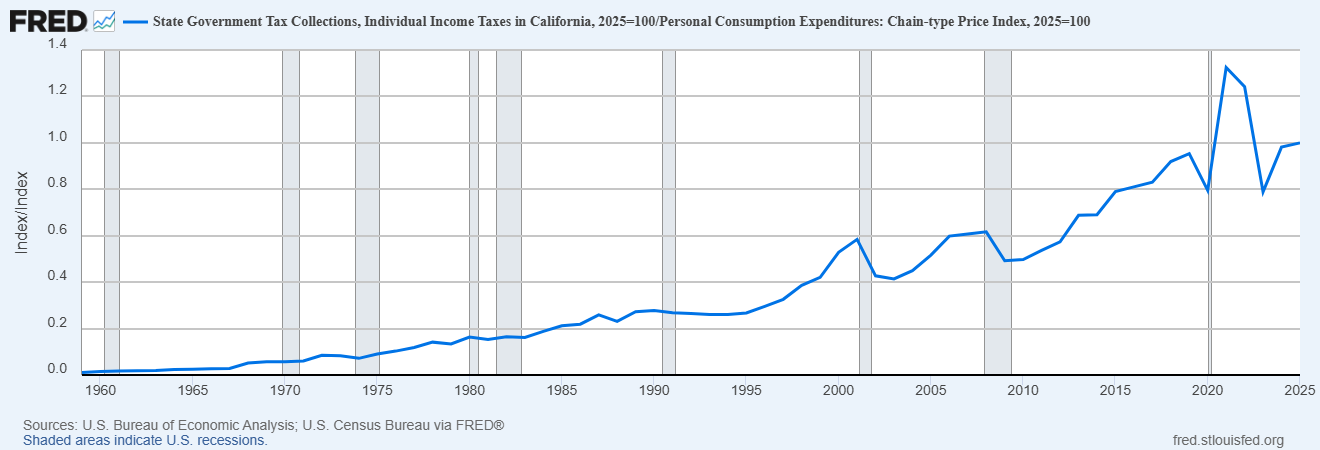
That allows the state to plan how much it’ll be able to spend on education, health, infrastructure, and so on — not just in the current year, but in five years’ time. States generally have balanced budget amendments, so they have to make sure that revenue approximately balances out expenditures.
But California’s proposed “billionaire tax” doesn’t work like this; it’s a one-time confiscation of 5% of billionaires’ total net worth. The proposal stipulates that this money would go toward health care, education, and food assistance. The problem is that since it’s a one-time levy, the money for those health care, education, and food assistance programs will eventually run out. In fact, the proposal stipulates that the money will be spent over five years.
At that point you’ll have three choices: raise tax rates, do another one-time levy, or cut the programs. This is basically a time bomb — it sets you up for another bruising political battle down the line. There’s no guarantee you’d win the battle for a second one-time levy in five years. If you don’t win, then you just created a ton of social programs that you have to yank away from people. And if you could just raise tax rates on an ongoing basis, why not just do that today instead?
This is a bit like when Congress enacts “temporary” tax cuts or a one-time rise in the debt ceiling — it just kicks the can down the road and sets the stage for chaos. But it’s worse, because states, unlike the federal government, have to balance their budgets; they can’t just borrow to cover up the holes in their funding.
If you want to tax billionaires, just raise their tax rates, like countries in Europe do — or like Massachusetts does with people making over $1M a year. Don’t mess around with this one-time levy stuff.
The other problem with California’s plan is that billionaires are likely to move out of the state to avoid the tax. 5% by itself isn’t huge, but if it were successful it would obviously set the stage for further confiscatory “one-time” levies. So billionaires have a big incentive to just move out of the state to avoid the eventual confiscation of a large portion of their wealth.
It’s actually fairly easy for billionaires to pick up and move to a different state. Normal rich people — mere millionaires — tend to be tied down by local friends and community ties, so they don’t move much in response to tax hikes. Young et al. (2016) found that millionaires move very little in response to state taxes on ultra-high-income residents. But billionaires are built different — Moretti and Wilson (2023) found that when a state implements an estate tax, about 35% of Forbes 400 billionaires move to another state.
