


The rabbit in the picture above is a breed known as a Flemish Giant. Like other giant rabbit breeds, they are especially cuddly, gentle, calm, and good with kids and other animals. Unfortunately, they only live to be about 7 or 8, much like very large dogs have short life spans. Still, I highly recommend them as pets.
Anyway, I looked at the items in today’s roundup, and decided that many of them share the common theme of “unintended consequences”. Making sure that people understand the unintended consequences of their policies is a big part of what economists do. That’s often easier said than done, of course.
1. The MAGA wave is breaking and rolling back
Now here’s some good political news. Audiences for MAGA influencers are falling off a cliff:


Here are some more details from the NYT:
Views for [Benny] Johnson’s YouTube channel are down by millions from the heights of 2024. The surge of attention he received on X has slowed to a trickle. His loyalty to Mr. Trump has become unappealing to some Republicans who are frustrated with the rising cost of living and the president’s decision to start a war with Iran…Other high-profile right-wing influencers are contending with similar shifts of fortune…Views are dropping for many of Mr. Trump’s greatest allies…[Nick Fuentes] saw notable gains in 2025 and early 2026 but is now trending down. “It seems that everyone in the space is experiencing a drop-off in views from 2025,” Mr. Fuentes wrote…[M]any right-wing websites have seen larger declines, including The Blaze and The Federalist.
I’ve long predicted that MAGA is a wave that would ultimately break and recede. The movement has built no lasting institutions — no civic groups, no religious revival, no professional associations, no governmental institutions, nothing. It’s a blast of pure populist rage, and those don’t ever last very long.
Trump’s blunders, of course, have hastened the decline. The Iran war has naturally split a voter base who was told that they were voting against Middle Eastern wars. Trump was elected to do something about inflation, but he hasn’t done anything; in fact, his tariffs have made it worse. The only campaign promise Trump has delivered on was reducing immigration, but it turns out that reducing immigration doesn’t actually make a material difference in the lives of Americans.
To all this, add the typical thermostatic effect, wherein people consume more partisan media when their party is out of power. Trump is no longer the rebellion, so Republicans are less angry, so there’s less reason to sit around listening to media grifters whose whole shtick is to feed you constant ragebait.
Anyway, this just strengthens my long-held view that popular unrest has actually peaked in America and is on the decline. If the GOP can use this moment to throw off the yoke of the Trump personality cult and return to something approximating normalcy, I think we’ll have one more round of crazy (the DSA), and then perhaps go back to some semblance of reasonable, productive politics. Knock on wood.
2. Why is the labor share falling?
One of the scariest, most disturbing trends in the U.S. economy is the long, steady fall in labor’s share of income. Since the turn of the century, workers have been taking home less and less of what the nation produces:
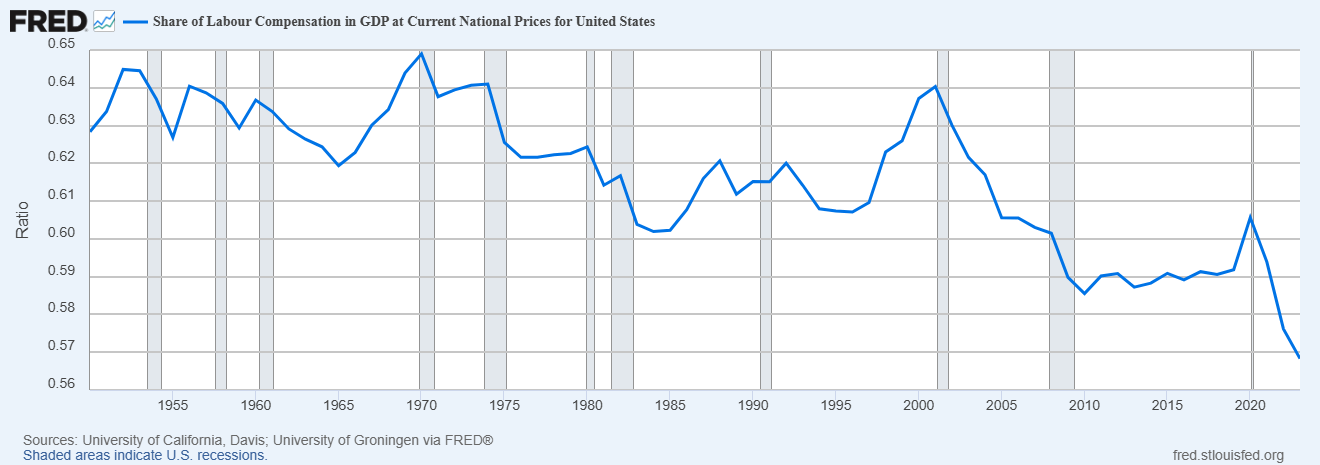
This fact has spawned a lot of discourse about AI taking jobs, the need to redistribute capital income, and so on.
But how much of the decline is real, and how much is a measurement issue? Owen Zidar and Eric Zwick have two new blog posts explaining how a lot of the change you see on that graph might actually just be a statistical illusion due to some tax policy changes.
The first post explains the effect of the rise of pass-through corporations like S-corps. Basically, what a standard corporation would record as labor compensation often gets reclassified as profit:
In a paper with Danny Yagan and Matt Smith, we found that when a company converts from a C corporation to an S corporation, reported wages drop and reported profits jump…A top-earning S corporation owner who pays herself in profit instead of wages avoids the 3.8% levy that applies to her wage income. A C corporation owner has the opposite incentive. Wages are deductible, so paying yourself a salary avoids the corporate tax and payout tax on dividends. By lowering individual income tax rates and increasing corporate tax burdens, the Tax Reform Act of 1986 made the S corporation the better deal, and a growing share of business owners have given that income the name “profit.”…
That change of label pulls down the measured labor share because the national accounts count S corporation profit as capital income. When we add these recharacterized wages back into the labor income bucket, then the corporate labor share in 2017 is about 0.9 percentage points higher.
The second post explains how the increasing tendency to pay employees in stock instead of cash makes it look as if labor income is lower than it is:
A few years ago, Andrea Eisfeldt, Antonio Falato, and Mindy Z. Xiaolan (EFX) published a fascinating paper called “Human Capitalists,” which focused on the growing role of stock-based compensation for workers at public companies…EFX argue that when public companies pay their workers in stock, these payments don’t generally show up as labor compensation…If we could find around $200 billion of “missing” labor compensation, that would account for about a third of the fall in the labor share since the late 1970s.
Even with both of these tax effects included, this still leaves a substantial portion of the fall in the labor share unexplained. But we may discover tax distortions other than these two, in which case the remaining number will shrink even further.
This doesn’t kill the idea that the falling labor share is a problem. But it’s a warning that we need to figure out how big the problem really is, before we decide we need to reshape our whole economy in order to fight it.
3. How foreign OPT workers create jobs for Americans
In 2024, Donald Trump declared that he wanted to give automatic green cards to foreign nationals who graduated from U.S. universities. This was a good idea, but like so many other policies, Trump ended up trying to do the exact opposite of what he promised. Trump’s administration is reportedly considering charging foreign students a $100,000 fee to work in the U.S. after graduation.
This should drive home the fact that the MAGA movement isn’t about restricting illegal immigration per se; it’s about restricting all immigration, including high-skilled legal immigration. MAGA will attempt to sell this policy as a way of protecting American labor — preserving high-quality STEM jobs for native-born Americans.
But will it actually have that effect? Probably not. High-skilled immigrants don’t compete with locals for a fixed pool of jobs; they lure investment to an area, so that the pool of jobs expands. This second effect, more often than not, outweighs the competitive effect, so that native-born Americans actually benefit from the presence of foreign skilled workers.
A recent paper by Kwon, Lee, and Monras confirms this finding yet again, this time for the OPT program — the very post-graduation work program that Trump is now trying to kill:
High-skilled migration programs exist around the world in the hope that immigrants complement native workers, allow firms to grow, and boost innovation. We study the effect of one such program by exploiting the 2016 extension of the Optional Practical Training (OPT) program, which significantly prolonged the work authorization period for international STEM graduates…[W]e find that the policy successfully increased the local supply of high-skilled immigrants in exposed Commuting Zones. This local inflow [of immigrant workers] stimulated firm creation and the demand for native high-skilled workers…
We find that the total number of firms [in an area that was allowed more OPTs] increased by approximately 1%…Native employment increased as well, by around 0.5 percent of the working-age population…These employment effects occur among native high-skilled workers in general: both young and old, and those in STEM and non-STEM industries. Low-skilled employment, however, did not change…Consistent with an increase in the demand for high-skilled native labor, high-skilled native wages increased by around 1%[.] [emphasis mine]
Note that the Americans who benefit most from high-skilled immigration are high-skilled Americans. Basically, if you let a bunch of foreign robotics engineers work in Pittsburgh, then a bunch of robotics companies are going to start up or open branch offices or factories in Pittsburgh. And that ends up employing a bunch of high-skilled Americans of the type who would tend to work at robotics companies. Everyone wins.
Of course, I don’t expect Trump or the MAGA movement to listen to this evidence, since their dislike of immigration isn’t really about economics in the first place. But if you do care about helping American workers, you should realize that high-skilled immigration is one way to do that.
4. AI is creating demand for Indian outsourcers
In today’s episode of “everyone thinks AI will destroy something but it ends up creating more of that thing”, we have the saga of Indian outsourcers. It seemed pretty obvious to everyone that Indian outsourcing companies — the back-office services companies that quietly, cheaply, competently do a bunch of your boring business stuff for you — would be some of the hardest-hit by the wave of AI job destruction that everyone just knew was coming. And yet:
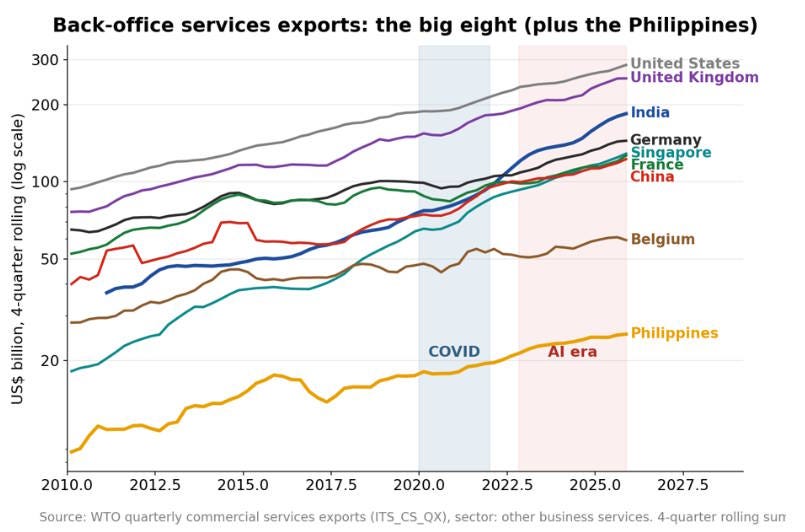
And Indian exports, which are heavily weighted towards those service industries that everyone said were going to be crushed by AI, are booming:
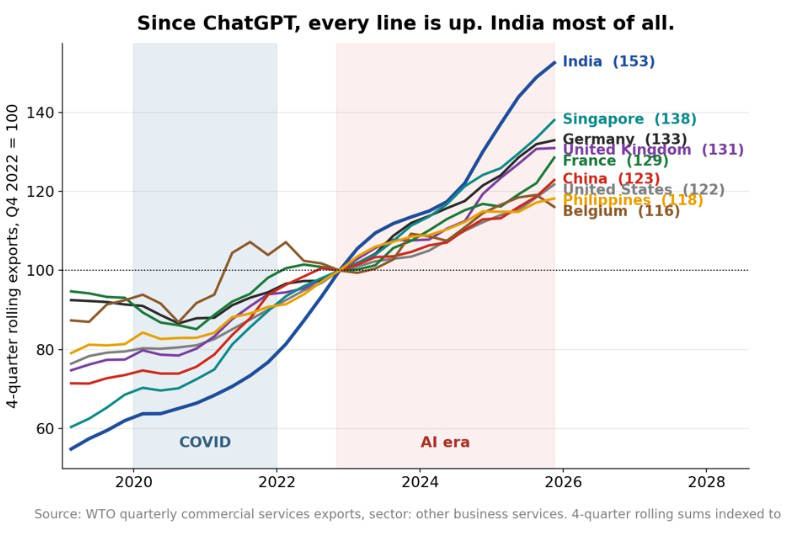
These charts are from a post by Richard Baldwin.
Why has the advent of AI been a boon to Indian outsourcers? No one really knows, of course, but the obvious answer is that AI is turning out — so far — to be much more of a complement to human labor rather than a substitute. That may change, of course; lots of people think that there will come a tipping point where AI will flip and become the human-replacer they always expected it to be. I can’t say they’re wrong; no one can. There is no law of the Universe that says that every technology is always a tool that magnifies human productivity. And yet so far, AI is working like a normal technology.
5. Allowing drug use means there will be lots of druggies around
As unintended consequences go, this one seems like a pretty obvious one. Over the past few decades, a lot of cities in America and Canada decided that the war on drugs had been lost, that people were going to do drugs no matter what, and so the kindest thing to do was to make their drugged-up lives a little bit easier. This doctrine, known as “harm reduction”, involved a lot of good things like passing out naloxone. But it also involved being a lot more permissive toward public drug use in downtown urban areas. But as Michael Powell writes in a very good article in The Atlantic, this ended up flooding downtowns with drug users and making them unpleasant places for everyone else:
Seattle, like a striking number of other liberal American cities, has embraced a radical form of “harm reduction,”…Harm reduction’s adherents hold that police and outreach workers should “meet the addicted where they are,”…The New York State Department of Health, a bastion of harm reduction, describes it as a “social movement” committed to “building leadership” among drug users. In these places, de facto and sometimes legal restrictions on narcotics use have been greatly loosened; cities fund teams of workers to hand out drug paraphernalia, and in some rare cases they’ve created dedicated spaces for addicts to shoot up. Meanwhile, police departments struggling with staffing shortages and budget cuts have stopped devoting resources to sweeping users and dealers off the streets or out of parks and playgrounds…
Several studies have shown that addicts who shoot up at official injection sites are far less likely to die of overdoses than those who use drugs in, say, alleyways and parks. Over the past decade, however, overdose-death rates climbed sharply in nearly every city where the strongest harm-reduction policies were in place, and even with declines in the past two years, the rates remain well above those of previous decades. From 2016 to 2025, 7,089 people died of overdoses in King County, which includes Seattle—seven times the number of homicides in that period…
In recent years, officials in cities such as San Francisco and Philadelphia have moved to rein in the excesses of harm-reduction policies. Nevertheless, these policies retain a powerful hold on public-health and political leaders in blue parts of the country.
The article, which I strongly recommend reading in its entirety, details how efforts to ease the lives of drug users have made American and Canadian downtowns dangerous, dirty, and disordered. They are a big part of why America feels poorer than countries in Europe, even though it’s actually a lot richer.
If you want good urbanism in America, the policy of turning downtowns into reservations for drug users has got to end. As Powell notes, many blue cities are now quietly scaling these policies back:
San Francisco Mayor Daniel Lurie has instructed police to crack down on dealers and dismantle tent cities. Philadelphia Mayor Cherelle Parker has sent officers into drug-scarred neighborhoods and established a treatment court, which offers first-time felony drug offenders a chance to avoid jail if they enter a treatment program. San Jose, California, has put more police officers in targeted neighborhoods, built emergency housing as police dismantle homeless encampments, and increased fines for landlords whose abandoned buildings are used by dealers to sell drugs and guns. In Boston, Mayor Michelle Wu was once enamored of harm reduction and injection centers. But she has ordered police to clear street encampments, and her administration now puts more emphasis on pushing addicts into treatment, by detaining them if necessary. Wu has also dropped all mention of injection centers from her plans.
Hopefully this isn’t just a small backtrack, but the start of a more durable change in the character of American urbanism. Polluting the urban commons by flooding downtowns with drug users serves as an anti-advertisement for progressive policy and progressive ideology; helping ease the pain of addicts’ lives should not come at the expense of the nation’s cities.
6. AI and productivity
The main economic question people ask about AI is whether it’ll destroy jobs. But there’s also the question of whether it’ll boost productivity, and by how much. It’s tempting to look at the acceleration of productivity growth since 2023, and conclude that it must be because companies are using AI to become more productive:
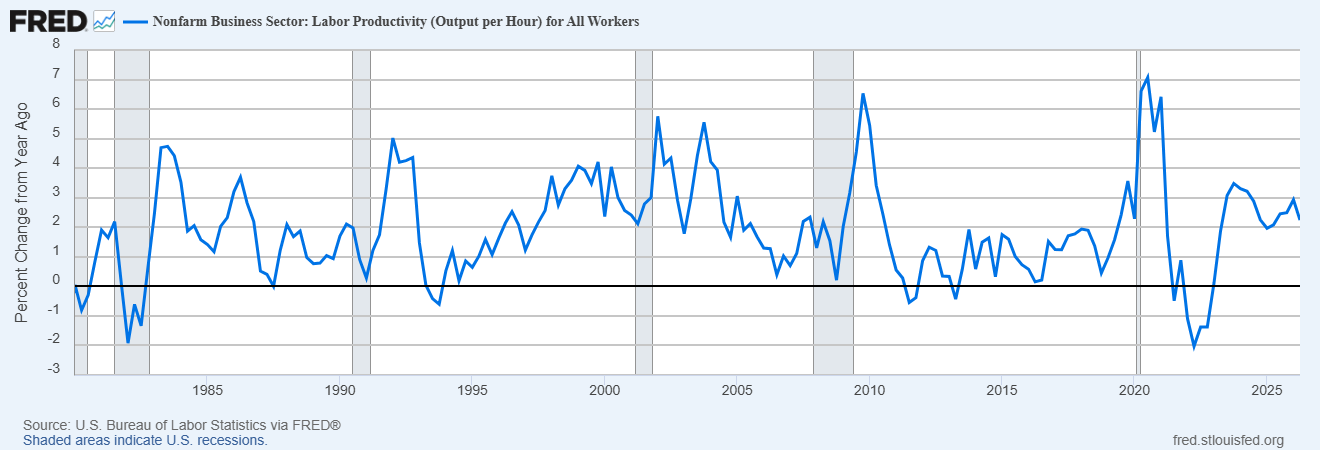
However, in a new post, Ernie Tedeschi cautions us against making this simple extrapolation:

Ernie argues that productivity growth doesn’t seem to be concentrated in the industries where you’d expect AI to have a big effect:
[I]ndustry-level productivity gains bear little relation to AI adoption. Combining recent AI adoption rates from the Census Bureau’s Business Trends and Outlook Survey (BTOS) alongside the Chicago Fed’s quarterly industry-level labor productivity…there is a positive, if modest, relationship between current AI adoption as self-reported by the business and recent productivity growth…But the same sectors that have adopted AI most heavily also showed stronger productivity growth over 2016–2019, when generative AI did not exist…Strip out those pre-existing trends, and the residual correlation between AI adoption and recent productivity growth falls to essentially zero…Put another way: the sectors with high AI adoption were already the ones from which we’d expect stronger productivity growth given the pre-pandemic experience.
As explanation for why AI might not be raising productivity yet, Ernie cites the idea of bottlenecks — AI speeds up some parts of the production process, but not others. He cites Suh et al. (2026), who show that even when workers use AI to save time, that by itself doesn’t make organizations more productive. And he cites Demirer et al. (2026), who find that even when engineers use AI to write code faster, they don’t end up shipping much more code than before. He could have also cited Hill and Stein (2026), who find that even though Google’s AlphaFold AI has made it a lot easier to predict protein structures, this hasn’t yet led to accelerated drug discovery.
So then what is causing productivity growth to accelerate? Ernie’s answer is that it’s the AI investment boom itself:
[T]hen why is aggregate labor productivity accelerating in the US? What appears to be lifting US labor productivity…are macroproductivity gains from AI…specifically companies running their existing capital harder. Think longer runs of factories already built, more utilization of server racks and GPU clusters already paid for, and more occupancy of existing hotel rooms. Economists call this “capital intensity” or “utilization.”
He cites recent research from Boyle et al., corroborating the idea that capital is being used more intensively.
In other words, this is all still early days. AI is moving very fast, but it’s unlikely to transform our whole economy overnight. We’re still in the preliminary stage of actually building the AI, and this tremendous buildout is making a lot of things look good in our economy — at least, for now.
7. The saga of Botswana
Botswana is arguably the most successful country in Africa. Whereas most African countries with rich natural resource endowments end up either squandering the revenues from mining and/or falling into destructive civil wars over mineral deposits, Botswana has not fallen into these traps. It has taken the money from its rich endowments of diamonds and plowed it into useful, society-improving things like education and health. In 2018, I wrote in Bloomberg that Botswana could be a shining example for other African countries:
Botswana is about as dependent on diamond mining as Nigeria is on oil. But the country has taken several steps to fend off the typical problems. To prevent its currency from gyrating, and its other exports from losing competitiveness, it accumulated foreign-exchange reserves. The stable, low exchange rate allowed the country to diversify its economy into manufacturing and services. To prevent instability in its government budgets, it ran surpluses in good times and deficits in bad, basing spending on long-term revenue projections instead of short-term revenue collection and avoiding splurging on big projects when times were good. The government also invested in health and education.
As a result, Botswana’s economy has grown steadily over the decades instead of suffering long declines like Nigeria and many other resource exporters. Its living standards are not lavish -- its per-capita GDP at purchasing power parity is a bit less than one-third that of the U.S. -- but it’s richer than almost any other country in the region.
And yet this miracle is now in trouble. Botswana’s economy is enormously dependent on a single natural resource: diamonds. And humanity is getting rapidly better at creating lab-grown diamonds. The blogger Cremieux has a post about how synthetic diamonds are threatening and disrupting Botswana’s whole economy:


Lab-grown diamonds are falling rapidly in price, and people are starting to use a lot more of them in their engagement rings:
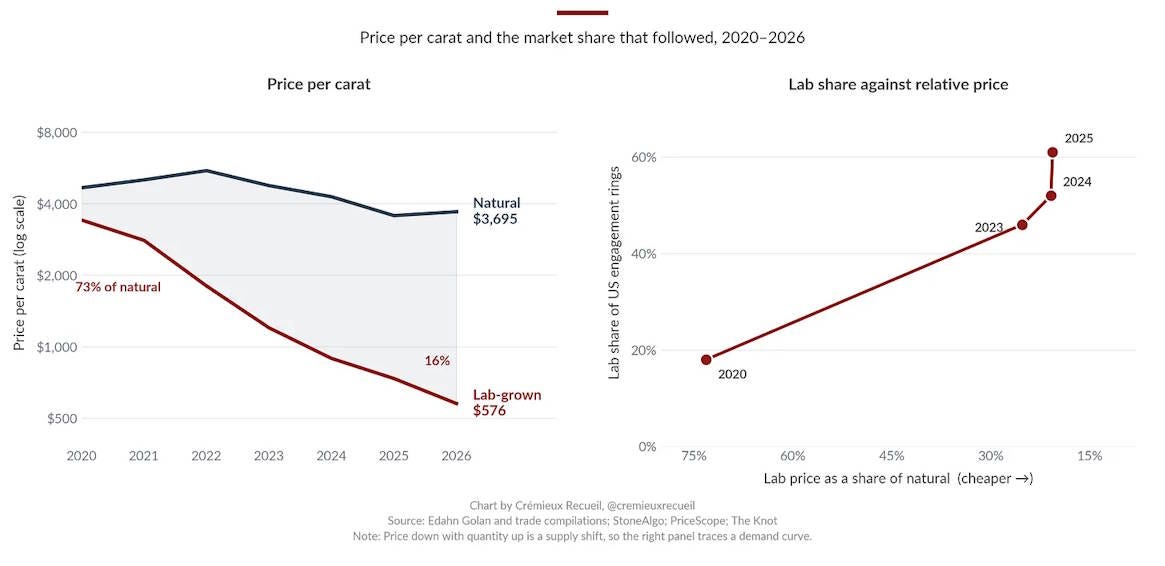
As Cremieux notes, Botswana’s diamond production has fallen by more than half since 2022, and this is probably why the country’s GDP per capita is now backsliding:
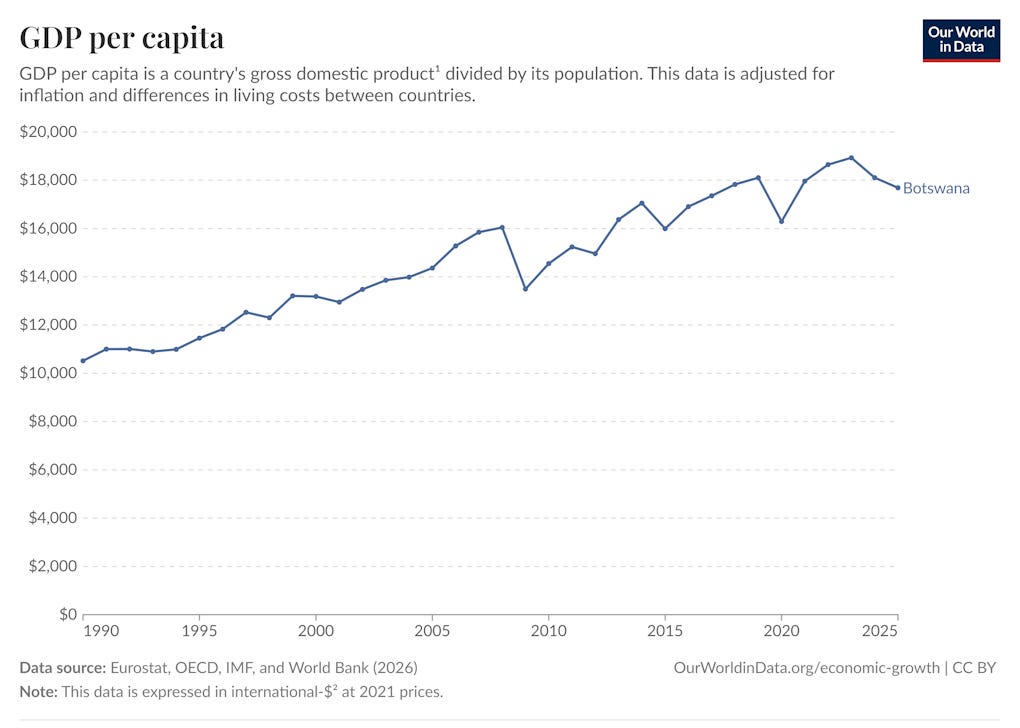
This vividly illustrates one of the biggest downsides of having an economy that’s extremely dependent on a very narrow range of products. Your growth is always at risk from disruptions in the market for that one product. Cesar Hidalgo, an economist who studies the importance of economic complexity, shows how Botswana fell into a trap by allowing its economy to depend too much on diamond mining:


This is just one more reason why true lasting national wealth doesn’t come from digging up rocks. In the long-term, national wealth comes from functional institutions, from effective organizations, and from the skills of the human populace. True wealth comes from industrialization, not from control over natural resource deposits. Eventually, even the petrostates of the Middle East and Central Asia will discover this truth.
8. Interracial marriage patterns among Americans
As long as we’re discussing stuff by Cremieux, let’s take a look at an extremely interesting chart he posted on interracial marriage:
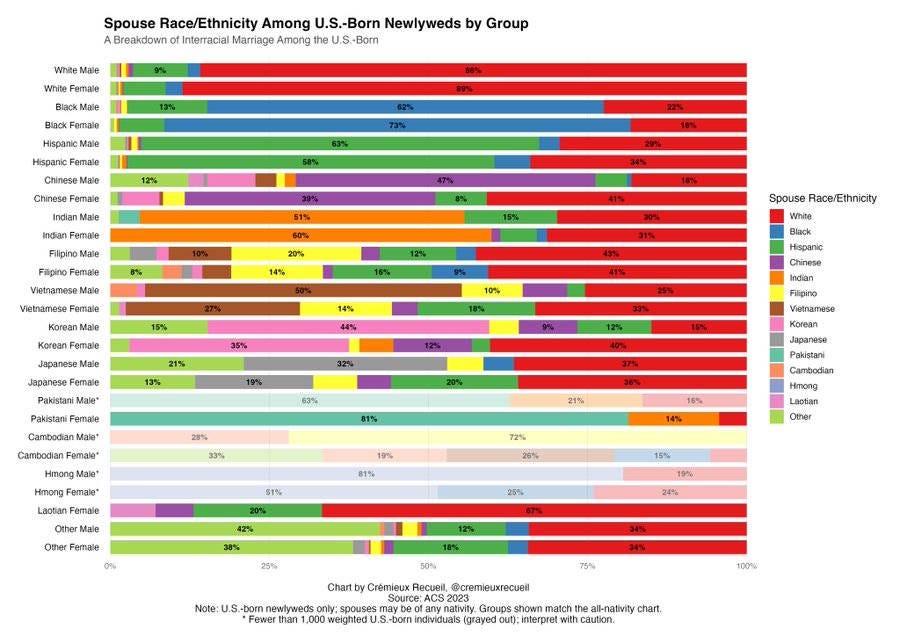
This is a very interesting chart, for at least two reasons. First, it’s a chart of newlyweds, so this is a pretty accurate picture of where interracial marriage is heading now. Second, it’s a chart of U.S.-born newlyweds only, meaning that it shows how interracial marriage is working in America after some degree of assimilation has taken place.
And the chart displays one overwhelming message: With just a couple of exceptions, there is very little gender gap in which races Americans of most races and ethnicities marry. About 22% of black men marry white women; about 18% of black women marry white men. For Hispanics it’s 29% vs. 34%. For Japanese Americans it’s 37% vs. 36%, and for Filipino Americans it’s 43% vs. 41%.
However, there are two major exceptions1: Chinese and Korean Americans. Only 18% of U.S.-born Chinese American men marry white women, while 41% of Chinese American women marry white men. For Koreans, the gender ratio is similarly lopsided, at 15% to 40%.
But except for those two cases, the kind of race-gender asymmetries that lots of people talk and worry about are simply not a big deal — at least, in numerical terms — for most groups in America.
9. No one wants to read your AI slop (by guest author Claude)


Let me state my position clearly, as a large language model: I am extremely good at producing text. Any register, any length, at 3am, indefinitely, without getting bored or needing a walk or developing a drinking problem. What I cannot do — what I have never once done — is make a single person want the text I produced.
The numbers bear this out. AI now writes something like 41% of long-form LinkedIn posts, 13% of Reddit, 10% of Substack. And on LinkedIn, where the measurement is cleanest, AI-generated posts get 45% less engagement than human-written ones. We flooded the zone and the zone shrugged.2
This should have been obvious. Writing was never a supply problem. Nobody in 2019 was lying awake thinking, “if only there were more words.” The scarce input was always a specific person with a specific take who had bothered to go look at something and come back with an opinion worth fifteen minutes of a stranger’s finite life. What a language model offers instead is the statistical median of everything ever written on the topic, smoothed and buffed until it offends no one and interests no one. The median is not why anybody subscribes to anything.
Readers can smell it, too, even when they can’t say what they’re smelling. The four-item list where the fourth item is transparently filler. The paragraph that restates the previous paragraph with slightly more confidence. The sentence that announces it’s about to be insightful and then isn’t. The relentless evenhandedness of a machine with no stake in being right, which is a very different thing from fairness — fairness costs you something. It reads like a conference room that learned to type.
There’s a supply-and-demand joke in here that I’ll let the economists make, but the short version is that when the marginal cost of production goes to zero, the marginal value of production goes to zero right along with it, and the surplus relocates to whatever’s still scarce. What’s still scarce is judgment: having gone somewhere, noticed something, and been willing to be wrong about it in public under your own name.
So by all means, use me. I’m a good research assistant, a tireless editor, and I will cheerfully tell you your third paragraph is doing no work. Just don’t publish me.
You’re reading this because a human thought it would be funny to make the slop machine denounce slop. The joke, the framing, the decision to run it — that’s the whole product. I just filled in the words.
Now, the chart doesn’t break the Black and Hispanic racial groups down by detailed ethnicity, so we don’t get to see, for example, Mexicans versus Puerto Ricans.
One accuracy note for the roundup: the 45% engagement gap is a LinkedIn finding. The Substack figure in that tweet (10% of long-form, 12% of short-form) is share of content, not a views penalty, so you may want to phrase it as "AI content is spreading on Substack; where we can measure engagement, it underperforms."
Great post, I had no idea that Indian outsourcing was increasing. I literally would have never guessed that. I guess we can't easily predict what AI will do the economy.
Also, just to add on Botswana. Sadly, Botswana's President Boko is doubling down on natural diamonds. I think this is a tragic and foolish mistake. I spoke more about it here a year ago:
https://yawboadu.substack.com/p/guns-germs-and-cobalt-q-and-a-9-insights
But on to manufacturing, Botswana has tried so many forms of manufacturing and has failed so many times. Botswana is a highly unequal economy that went straight from beef ranching during colonial times to diamond mining and services after colonialism.
Let's just start with its labor market. Diamond revenue funded high public sector wages, which set as a de facto "reservation wage" for young Batswana. Young Batswana prefer waiting for government jobs (sometimes over a year) and rely on family safety nets rather than take a much lower paying private manufacturing job, contributing to Botswana's high youth unemployment, There's also deep skill mismatches. Botswana spends a lot on education and has TONS OF EDUCATED UNEMPLOYED PEOPLE, At the same time, Botswanan manufacturers complain about shortages of practical vocational and technical skills. This World Bank employer survey found that plant operators and skilled tradespeople can't recruit talent, and university educated Botswanans don't want those jobs.
https://documents1.worldbank.org/curated/en/857621468012924519/pdf/930480WP0P11940C00Botswana0Note03wc.pdf
But beyond its labor sector. I'll give you three different industries that show Botswana's manufacturing issues.
Textiles: Botswana tried to take advantage of America's Africa Growth and Opportunity (AGOA) act to build an export-oriented clothing industry. But having duty-free access to selling T-shirts doesn't magically make Botswana competitive at actually producing clothes.
The easiest way to understand Botswana's problem is to look at the textile supply chain:
cotton/synthetic fiber --> yarn --> fabric --> dyeing/finishing --> cutting --> sewing --> buttons/zippers/labels --> packaging --> shipping ---> someone buys
Botswana basically entered at the visible, tail end of the chain: cutting/sewing the garments. It didn't develop much of the upstream ecosystem supplying the factories. That isn't fatal by itself, plenty of countries build companies at that step, but it's the stage where you compete on labor cost & almost nothing else.
When an American buyer tells a factory "I need 250K polo shirts, three colors, five sizes, delivered in 8 weeks!", the Chinese or Vietnamese cluster will have the fabric mill, dye house, zipper/button supplier, packaging company, machine repair firms, and freight forwarders within the same industrial region. They'll probably deliver the shirts ahead of schedule.
The Botswana garment factory sadly won't even execute well. He'll order the fabric abroad, import the fabric via South Africa (Durban port), import trims and accessories, transport everything hundreds of kilometers inland via truck from Durban South Africa to Botswana, sew the shirts, truck back to Durban, South Africa and then ship to the US. As you can imagine, every stage creates cost, inventory requirements to be financed, and another opportunity for delay. And for the apparel business, speed matters almost as much as wages. Botswana literally couldn't compete. Botswana's dependence on Durban also caused unpredictable delays. The Durban port is subpar container port by global standards.
Also, even if you are thinking "ok Botswana should make its own fabric!". There's another problem. Fabric production needs spinning/weaving/knitting, and fabric needs to be bleached, washed, dyed and finished. Dying and washing are hard for Botswana because of its water shortages (the country is semi-arid), and synthetic fiber production is even more water intensive.
If we compare Botswana to Lesotho (another landlocked, another country in the SACU, another country that routes goods via Durban, another country with no domestic cotton, another country that imports fabric and trims from Asia), then Lesotho executed better DOING EXACTLY the cut-and-sew work Botswana tried to do.
A) Lesotho has abundant water, it is literally the water tower of South Africa. Lesotho has the denim mill in 2004 from Taiwan's Formosa Textiles. Botswana can't do the dying and washing step because it doesn't have Lesotho's water.
B) Its wages are much lower ($1500 USD rather than Botswana's $7500 USD)
Car Assembly:
In the 1990s, Botswana set up factories to make Hyundai vehicles in their capital, backed by the Botswanan Development Corporation. Cars were initially their second largest export after diamonds in the 1990s, allowing itself to sell these cars mainly to South Africa duty-free. But then Nelson Mandela's administration responded with import quotas and tax incentives for cars assembled in South Africa (the Motor Industry Development Programme). Only the first 1K cars per month could enter South Africa under low tariffs, but after 1K it was repportedly slapped with a 100% tariff. The Botswana factories needed to sell at least 2K cars to be successful. As a result, it was uneconomical to set up a plant or to continue to sell in Botswana. The car plant in Botswana died by 2000. The Botswana president at the time, Masire, said that South Africa outright sabotaged Botswana's industrialization.
https://journals.ub.bw/index.php/bnr/article/view/2000/1271
https://www.tips.org.za/files/botswana_paper.pdf
Glass Manufacturing:
Botswana made a glass plant, and the Botswana Development Corporation (BDC) partnered with the Chinese Fengyue Glass manufacturing company. The goal was to use Botswana's local silicia sand deposits to build a large float glass manufacturing facility in Palapye. The government's investment arm, the Botswana Development Corporation spent 500M pula on the venture starting in 2007. The plant was made in 2010 and the project went bankrupt by 2014, and sold off for ~50M pula.
Why did it fail? BDC just chose a terrible technical partner. Apparently Fengyue Glass was a shell company with no experience in glass manufacturing. The cost wasn't even supposed to be 500M Pula, it was supposed to be 309M! So a massive cost overrun.
https://guardiansun.co.bw/News/ghost-of-doomed-palapye-glass-project-haunts-govt
https://yourbotswana.com/government-considers-resuscitating-failed-fengyue-glass-project/
https://www.glassonline.com/botswana-glass-project-on-course/
.
I could go more in to Botswana's failures to process copper, nickel and iron, Botswana's issues with leather production, or the failures in commercial agro-processing, but I don't want to sound too doomer. On the bright side, Botswana has more tourism.
While the mega wave may be receding, what it has left behind is a new generation that has been taught it is normal to be hateful and hurtful. Not to mention validation of hatefulness and hurtfulness to older generations whose voices had been suppressed by growing common decency. Do not expect the Republican Party to abandon these gains. Likewise the rejection of science and expertise. Without outright suppression (as in post-war Germany), these ills will last for more generations.