


Howdy, folks! Today’s roundup is mostly a bunch of follow-ups to posts I wrote before. It’s very hard to decide when to post about a particular topic, and it often happens that some relevant news story or piece of data comes out a little bit later. These roundups are a good way of cleaning up those loose ends.
Today we start with a truly wacky policy proposal by the esteemed Thomas Piketty…
1. What on Earth is Thomas Piketty talking about?
Unlike many people, I never pretended to have read Thomas Piketty’s book, Capital in the Twenty-First Century. I simply didn’t read it. I did read a number of the papers that the book was based on, which is often a better and quicker way of getting the key points of a book like that. I thought those papers were a good and important addition to the economics literature, even if the messy reality of inequality didn’t always fit the simple story Piketty told, and the data he relied on was less reliable than we might want.
Despite the limitations of Piketty’s work, it sparked a long-overdue and generally healthy debate about inequality. And Piketty’s basic policy solution — tax rich people more — was pretty reasonable, even if his proposed numbers were too extreme. I did roll my eyes when Piketty stood on a stage at an academic convention and accused Greg Mankiw of being in the pocket of rich people.1 But overall his work seemed pretty serious and often reasonable.
However, after years of relative silence, Piketty has burst back onto the scene with some work that seems very unreasonable. He and his team at the World Inequality Lab — which includes his longtime co-authors Emmanuel Saez and Gabriel Zucman — have come out with a grand plan for fixing the world. And for the most part, it’s total nonsense.
Piketty described the new plan in a thread on X. Its main focus, perhaps surprisingly, is not inequality — it’s climate change!


First of all, Piketty’s baseline climate change scenarios appear based on a very outdated model — the RCP8.5 scenario, an extreme projection that essentially all serious climate scientists have now rejected. This choice of baseline suggests that Piketty et al. were trying to find ways to justify maximal policy intervention, instead of starting from the science.
Piketty’s preferred solution to climate change is degrowth. He envisions detailed central planning to achieve deliberate impoverishment of large portions of the world’s population — mandated reductions in the consumption of various specific goods, including food.
In addition to the dubious morality of deliberately impoverishing untold millions of human beings based on scientific models that have already been rejected, this kind of scheme is just utterly unworkable. Back in 2021, when I wrote about why degrowth is a political nonstarter, I declared that “implementing the kind of reallocation schemes that degrowthers throw around with abandon would require global economic planning that would put Gosplan to shame.” Piketty knows this, and thinks it’s a good thing.
Even more ridiculously, Piketty envisions a global fiscal authority to carry out this insane plan via global taxation:

Let’s set aside the obvious fact that countries are just not going to agree to give up their spending and taxation power — even the EU refuses to have a fiscal union, and it’s rather insane to imagine Indians and Chinese people agreeing to let themselves be taxed by Tanzania and Nigeria — and just point out how this proposal ignores the basic economics of climate change.
Climate change is a global negative externality — the reason countries don’t all just impose their own local carbon taxes and solve the problem is that there’s an incentive to free ride and let other countries handle it. That exact same free rider problem applies to the global fiscal authority that Piketty envisions. There’s a clear incentive for any country to simply drop out of the fund and let other countries fix climate change for them.
It’s obvious that Piketty et al. are just looking for a reason to levy high taxes on the global rich. This is the “World Inequality Lab” we’re talking about here. And it probably made sense to try to ally with other factions of the progressive movement — degrowthers, “decolonial” leftists, and so on — in order to get support for their desired policies.
But the result here is not going to be a good one for Piketty, Saez, Zucman, and their team. No country is actually going to embrace the idea of a global fiscal authority to fight climate change. In calling for this sort of thing, Piketty et al. simply make themselves look less like serious economists and more like opportunistic activists on the fringe of a “green” movement that’s already in steep decline.
2. Tokenmaxxing, cont.
In a post this week, I noted that “tokenmaxxing” — simply using as much AI coding output as you can and hoping that it pops out something valuable — is hitting its limits:

Well, here’s a follow-up. John Burn-Murdoch of the Financial Times recently made this nice chart, using data from the Demirer et al. (2026) paper that I discussed in my post:
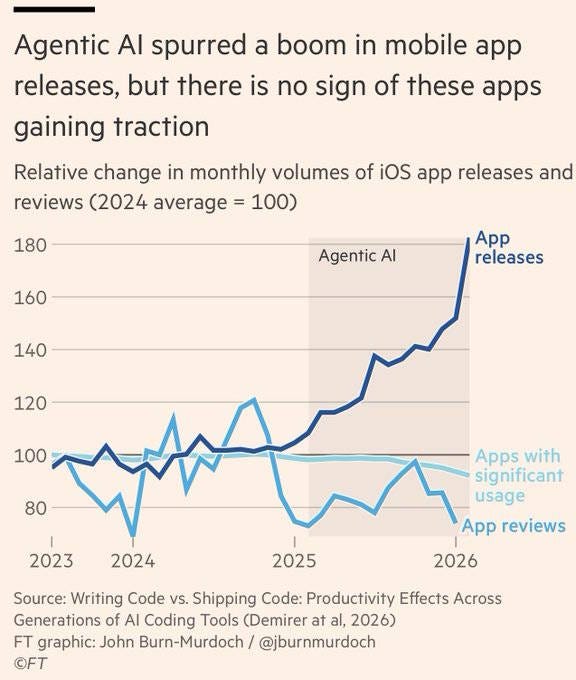
The number of apps with significant usage is actually going down in the age of AI, even as people are releasing floods of new apps into the world. Meanwhile, Bob Elliott notes that since generative AI was created, there has been a rapid acceleration in many measures of text output, even though the economy hasn’t accelerated much:


And Sam Altman is now warning of a significant pullback on AI spending — the first such pullback since generative AI appeared.
This doesn’t look like a simple story of “bottlenecks” and “weak links” — if it were that, we wouldn’t see so many new apps and e-books hitting the market. The deeper story here may be that demand for many of the things that generative AI produces might be a lot more inelastic than we thought. The things we really want a lot more of may not actually be the things that generative AI is yet equipped to provide. As the AI industry advances, of course, that will probably change.
3. Western militaries are obsolete, and Trump is making it worse
A couple of weeks ago, I wrote a post about how all militaries not based around large masses of cheap drones are now functionally obsolete:


This includes America’s military, which is based around a few big expensive “platforms” like fighter jets, aircraft carriers, and tanks. I’m not saying those weapons will all be useless in future wars, but if that’s all you have, and you don’t have masses of cheap drones, you will lose wars to countries that do have masses of cheap drones — such as China, if they ever get serious about turning their mighty industrial base toward making billions of weaponized drones.
The Lowy Institute has a good report explaining why Western militaries seem incapable of learning to use the essential weapons of modern warfare. They write:
Western military institutions…are failing to energetically learn from modern wars. Despite four years of unprecedented visibility into Ukrainian battlefield innovations, and the recent war in Iran, Western forces have not institutionalised key lessons into doctrine, force structure, or procurement priorities…The recent war in Iran has confirmed and amplified many of Ukraine’s lessons, particularly on the centrality of drone warfare, the inadequacy of Western counter-drone capabilities, [and] the effectiveness of cheaper long-range strike systems…And yet the response of Western institutions…has been characterised by rigidity, inertia, and what can be called a humility deficit: an unwillingness to genuinely confront the implications of what is being demonstrated in real time on real battlefields.
The U.S. military could, of course, learn from Ukraine — currently the #1 best country in the world in drone warfare. But the unrelenting hostility and disdain toward Ukraine from Donald Trump and the MAGA movement has prevented America from taking advantage of Ukraine’s expertise:
The Trump administration’s hesitancy in signing a major drone deal with Ukraine is slowing the U.S. military down in an area where it’s already trying to play catch-up…[T]he U.S. has so far refused to embrace Kyiv as a partner in its drone development…
[E]ven with senior Pentagon officials — including Defense Secretary Pete Hegseth and Army Secretary Dan Driscoll — lauding Kyiv’s drone abilities, the Trump administration is still biding its time on taking full advantage of the Ukrainian capabilities, a delay that experts say is potentially kneecapping the U.S. military…
“I don’t know what the hang-up would be in denying ourselves the ability to take advantage of that. I don’t think there’s any good reason,” Rebeccah Heinrichs, a senior fellow at the Hudson Institute think tank, said of Ukraine’s drone capabilities…One former official [called] the hold-up “lethargy” on the part of the Trump administration and “a certain amount of hostility towards Ukraine coming from the very top.”
MAGA basically created a fantasy world where Russia is a defender of Western values, Ukraine is somehow an arm of global wokeism, Ukraine is part of Russia’s legitimate “sphere of influence”, and Russia is a mighty superpower with a manly martial culture that would eventually be able to grind the Ukrainians down and inevitably triumph.
The problem with this fantasy was that it was fantasy, and if you believe in fantasy too long, reality tends to intercede. By allowing themselves to believe their own anti-Ukraine mythology, Trump and his followers are cutting themselves — and the U.S. Military — off from access to crucial modern military technology.
4. Tariffs on China are helping poor countries grow
In my last post, I argued that Europe should put tariffs and other trade barriers on Chinese imports, in order to protect its own strategic defense-related industries. But this is actually a lot harder than it sounds. Even if Europe blocks final goods from China, China can still export intermediate goods to “third countries” that assemble those goods for final export to Europe. In fact, China has done this in response to American tariffs, reducing (though not eliminating) the decoupling effect.
But if that happens, it’ll be very good for the “third countries”! Assembly work isn’t the most valuable part of the supply chain, but it does create value, and it does create lots of jobs, and it does create local companies that then have the potential to climb up the value chain someday and start making their own components. In fact, this is exactly what China did! Back in the 2000s, China did a lot of the low-value assembly work for components made in Japan, Korea, and Taiwan; now, most of that has been onshored, but it was still important for China to go through that initial phase of learning to slap together iPhones and computers and cars.
So if putting tariffs and other trade barriers on Chinese-made goods just ends up shifting assembly to poor countries…well, that’s not the worst outcome in the world. It’ll help counteract Chinese companies’ home bias — their natural tendency to want to build factories in China instead of overseas.
In fact, as the WSJ reports, this is already happening:
“Made in China” is becoming “made by China”—all over the world…Faced with higher Western tariffs and weak demand at home, many Chinese factories are moving abroad, making everything from appliances to automobiles everywhere from North and South America to Eastern Europe…In Mexico, Chinese investment in industries such as the automobile sector generated more than 100,000 jobs from 2020 to 2023, according to one analysis…In 2024, Chery Automobile, China’s top car exporter, helped to rescue a small factory in Barcelona that struggling Japanese automaker Nissan no longer wanted…
Jeep maker Stellantis this month said it planned to build EVs with two separate Chinese companies in Spain and France. Ford and Geely are in discussions about a potentially similar deal in Spain, and have also discussed whether the collaboration might extend to the U.S…Midea, the home appliance maker…opened a roughly $100 million factory in Brazil making refrigerators and washing machines in 2024. Its subsidiary, Welling Auto Parts, opened its first overseas manufacturing facility in Mexico last year.
In order to get around EU tariffs, Chinese companies are fueling a Moroccan manufacturing boom:
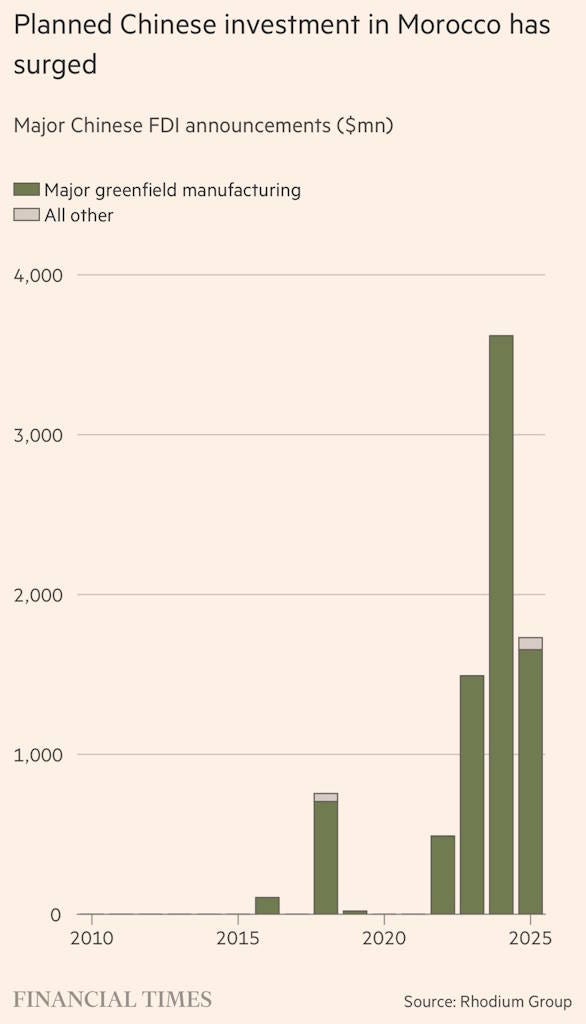
This has helped accelerate Morocco’s growth to 5%. That’s in the range where growth starts meaningfully transforming a country.
So even in the worst-case scenario where trade barriers don’t reduce dependence on Chinese supply chains, they can help spread the blessings and bounty of industrialization to a bunch of poor countries who need the factories more than China does. The flying geese must fly!
5. Is India’s growth under Modi impressive, or disappointing?
I recently came across this chart, showing various aspects of India’s infrastructure boom:
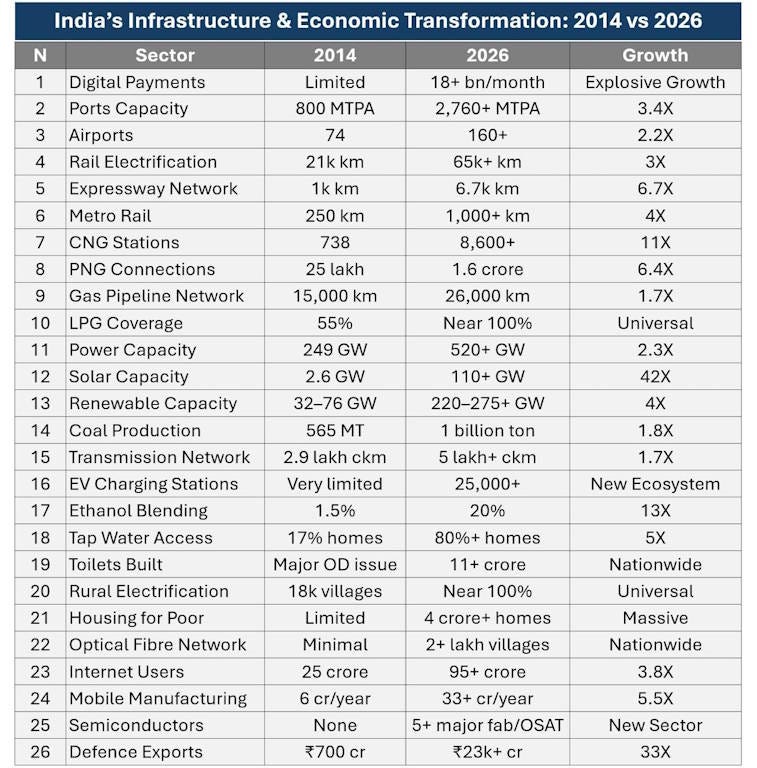
This is all pretty incredible. India’s poor infrastructure has long been regarded as a bottleneck to urbanization, manufacturing, and economic growth in general. Whatever else you think of the government of Narendra Modi, it has built a lot of infrastructure.
But over that same period, overall growth has been slower than we’d like to see. Anand, Felman, and Subramanian have a recent paper in which they argue that India’s GDP growth rate from 2011 to 2023 was overstated by somewhere between a quarter and a third:
India’s annual economic growth during the boom years between 2005 and 2011 may have been underestimated by about 1–1½ percentage points on average, and subsequent growth between 2012 and 2023 may have been overestimated by about 1½-2 percentage points…The first methodological issue leading to the misestimation is that the economy’s formal sector has been used as a proxy for the vast informal sector, even though the latter was disproportionately hit after 2015 by demonetization, the introduction of the goods and services tax, and the COVID-19 pandemic…The second methodological issue…is that the deflators for many sectors have been based on commodity prices, which have moved sharply relative to others. [emphasis mine]
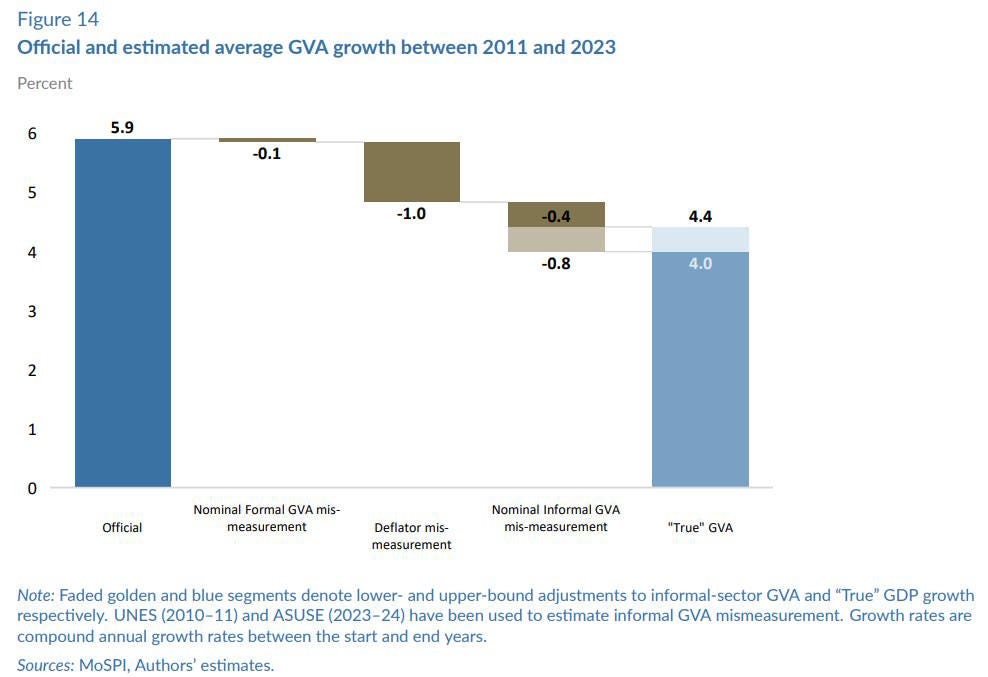
If Anand et al.’s estimates are right — and they marshal a huge amount of supporting evidence — then it suggests that Modi’s tenure in office has been mixed. A couple of big policy missteps — demonetization and a botched tax rollout — hurt the informal sector of the Indian economy, while massive infrastructure investments have helped.
The implication here is that Modi and his successors should lean into what works. They should focus more on marshaling national resources and applying those resources toward rapid growth — two things that China did very well in the 1990s and 2000s.
6. Friends don’t let friends cite George Borjas
I’ve been writing over the years about how the right’s favorite immigration economist does shoddy, subpar work. Despite having a job at Harvard, George Borjas — whose analyses miraculously always seem to find that immigration is much worse than all the other economists think it is — consistently uses both poor data and flawed methodology. In another roundup back in February, I pointed out how Jianxin He and Adam Ozimek had found yet another example of Borjas doing subpar economics:
Borjas’s February 2026 working paper attempted to answer whether H-1B workers earn less than comparable native-born workers…[His] findings result from substantial data errors.…The most significant mistake is a…mismatch between his H-1B and native-born samples: the H-1B applications span 2020-2023, while the ACS data covers just 2023…[Accounting for this discrepancy cuts] the wage gap roughly in half…
The second error stems from controlling for geographic wage drivers using each worker’s PUMA (public use microdata area)…The problem is that Dr. Borjas uses the PUMA where visa holders work alongside the PUMA where native workers live. Consider a native-born software developer working at Google in Mountain View who resides in a cheaper area like Fremont. If residential areas have lower average wages than business districts, this mismatch systematically inflates the apparent native wage and negatively biases the H-1B wage gap.
Again and again and again, economists catch Borjas at it. It seems pretty obvious that Borjas simply wants to conclude that immigration is bad, and doesn’t much care about methodological errors as long as they reach his desired conclusion.
In order to fight back against this accusation, Borjas decided to accuse his critics of ideologically-driven research instead. In a paper with Nate Breznau, he wrote:
Our study exploits an opportunity to observe 158 researchers working…during an experiment. After being asked their position on immigration policy, they used the same data to answer the same empirical question: Does immigration affect public support for social welfare programs? The researchers estimated 1253 alternative regression models, and the estimated impacts ranged from strongly negative to strongly positive. We find that teams composed of pro-immigration researchers estimated more positive impacts of immigration on public support for social programs, while anti-immigration teams estimated more negative impacts. The differences arise because different teams adopted different model specifications. The underlying research design decisions are the mechanism through which ideology enters the process of producing parameter estimates.
The idea here seems to be to turn one researcher’s clear pattern of errors into a he-said/she-said sort of situation. If all researchers just engineer results based on their ideology, then why should we selectively get mad at Borjas for doing what everyone else does too?
But — surprise! — it turned out that this Borjas paper also contained critical errors that invalidated the whole result! Katrin Auspurg and Josef Brüderl pointed out in a comment paper that if you fix one simple coding error in Borjas’s analysis, his entire result about ideologically-driven research just vanishes into thin air:
Borjas and Breznau…recently reported that researchers’ ideology influences their empirical findings. Although we were able to reproduce B&B’s numerical results, our reanalysis shows that the reported association is not robust. Specifically, the association hinges on a coding error. Data from four teams that contradict the ideology hypothesis were excluded from the analysis due to idiosyncratic variable coding. Correcting this error renders the ideology effect no longer statistically significant. Also, B&B employed a different outcome variable and weighting scheme to that used in a previous paper based on the same data. These two analytical decisions further contribute to the observed ideology effect. Correcting the coding error or using the same specification as in the previous paper renders the ideology effect indistinguishable from zero. Therefore, we conclude that B&B do not provide robust evidence of ideological bias in this context. Instead, the reported association appears to be a statistical artefact resulting from questionable modelling decisions. [emphasis mine]
How does this just keep happening again and again, and why is it always Borjas?
In any case, I think the implication here is pretty clear: Friends don’t let friends cite George Borjas.
Greg Mankiw makes his money by selling textbooks.
For this decade, the part of Thomas Malthus will be played by Thomas Piketty
The thing that people most often create with agentic AI is not an app in the traditional sense of a product that many people will use. It is really a personal utility or tool that solves your own very bespoke problem. And that's fine! The issue is that most people don't understand that yet. They still think they're the next Steve Jobs, because they lack experience and understanding of market fit, etc.