

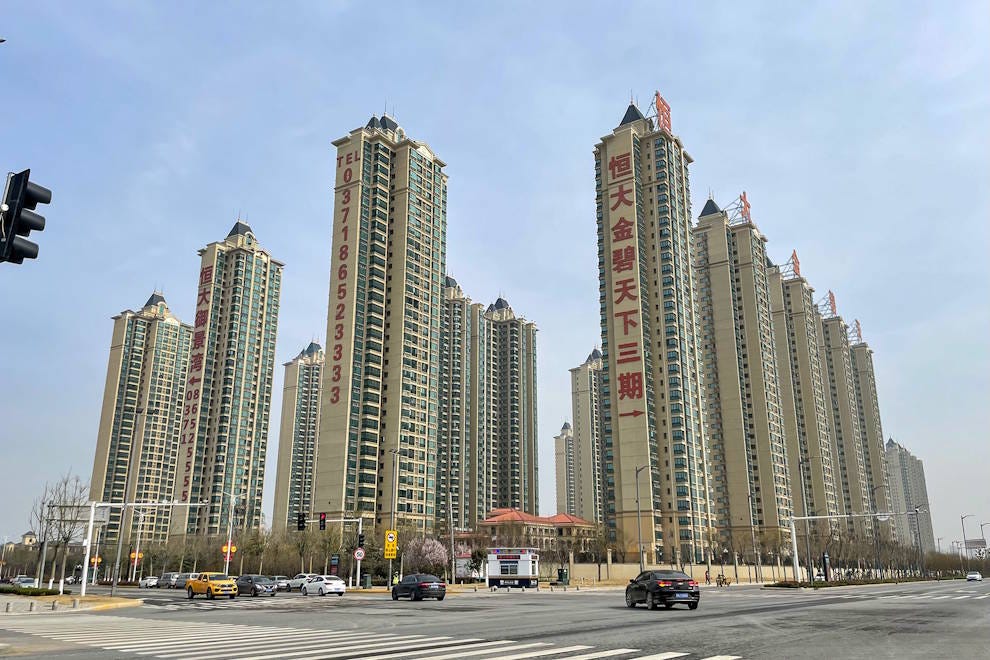
Back in the 2010s, a lot of people marveled at China’s seemingly recession-proof economy. Throughout the global financial crisis of 2008 and the Chinese stock market crash and capital flight of 2015, the country never recorded a single quarter of negative economic growth. Here’s what I wrote back in 2019:
China’s government seems to have developed a highly effective new form of economic stabilization. Its extensive control of the financial system allows it to turn on a flood of bank loans when the economy looks weak, and restrain credit when the danger has passed. China’s avoidance of recession in at least the past three decades suggests that this form of credit-based stabilization is more effective than traditional, more indirect stimulation of the economy through government deficits and central bank monetary easing…When a recession threatens, the government tells banks to lend --— to local governments, construction companies and real estate developers. Then, if the credits go bad, the government swoops in and takes the nonperforming loans off of financial companies’ books. Uninterrupted rapid growth then shrinks the government debt as a percentage of gross domestic product, and the system sails blithely forward[.]
And here’s what I wrote in 2018:
China…directed banks to lend lots more money [in 2009]. The World Bank estimated that increased bank credit represented 40 percent of China’s stimulus. Much of the lending was done by China’s four large state-owned banks. The money went to infrastructure, real estate and all kinds of corporate projects, many of which were carried out by the country’s state-owned enterprises.
Basically, most countries use two types of policy to get the economy moving again when some sort of negative shock hits it:
monetary policy (e.g. cutting interest rates), and
fiscal policy (e.g. stimulus spending).
Macroeconomists disagree about why interest rate cuts give the economy a boost, but most agree that the policy usually has an effect. Although there are many other theories and interpretations, one way you can think of rate cuts is as a financial policy — by making it easier for businesses to borrow and invest, low interest rates stimulate business activity. Fiscal policy, in contrast, pretty much bypasses the world of finance and aims directly at the real economy — you build a bridge or a road, which employs some people who might otherwise be unemployed, and then those people turn around and spend their money elsewhere in the economy, igniting a virtuous cycle of spending and working.
China uses both of those, but it also uses a third policy: financial policy. Instead of simply cutting interest rates and hoping that this filters through to bank lending, China’s government uses its direct control over the banking system to push banks to lend more. In the 2010s, after the Great Recession and the 2015 Chinese stock crash, this mostly meant lending to real estate companies. This lending fueled the biggest property boom the world has ever seen.
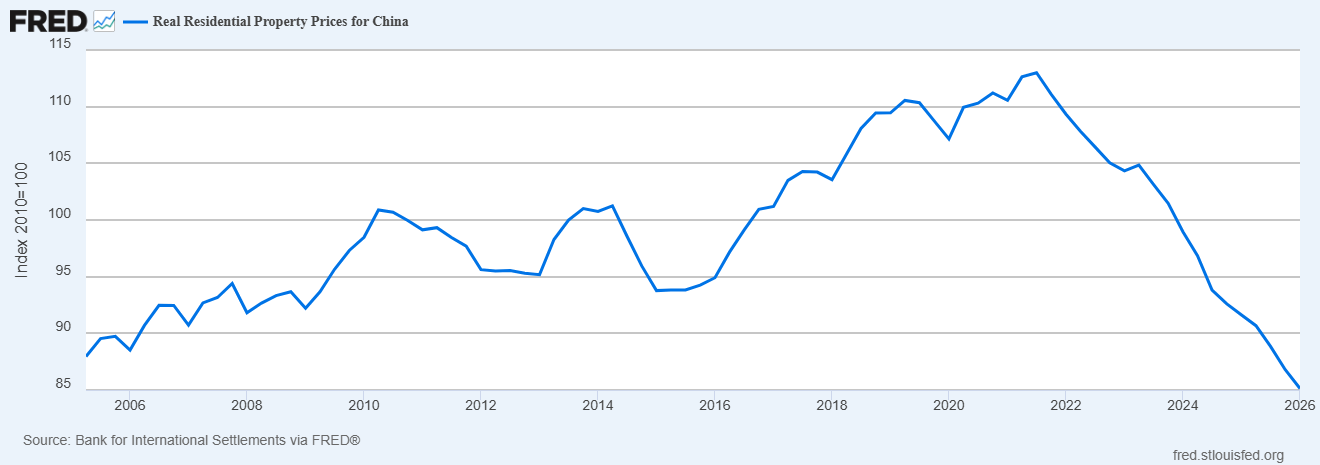
The boom ended in late 2021. The crash of the Chinese property developer Evergrande began a sequence of bankruptcies and defaults across the entire real estate sector. China’s property prices began to fall, and have not stopped falling to this day:
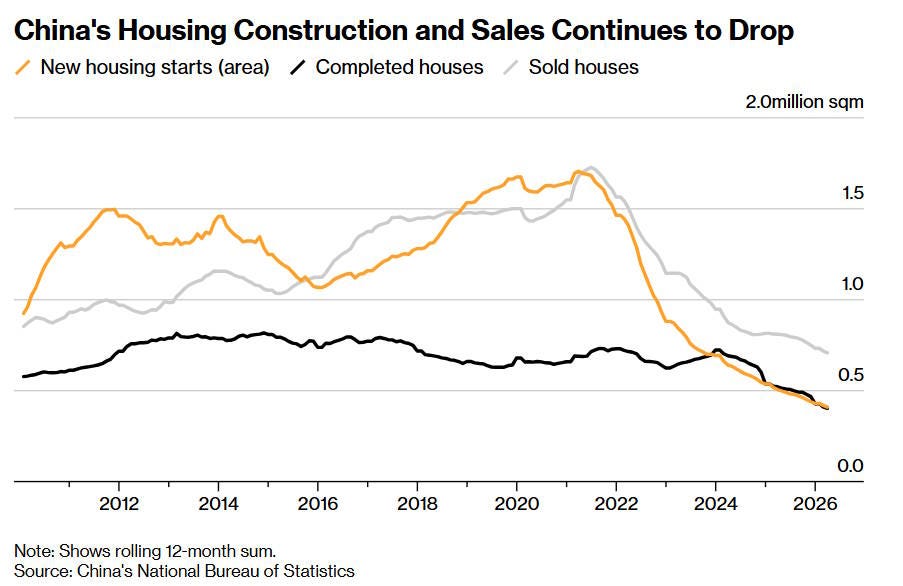
Chinese housing construction plummeted as well:
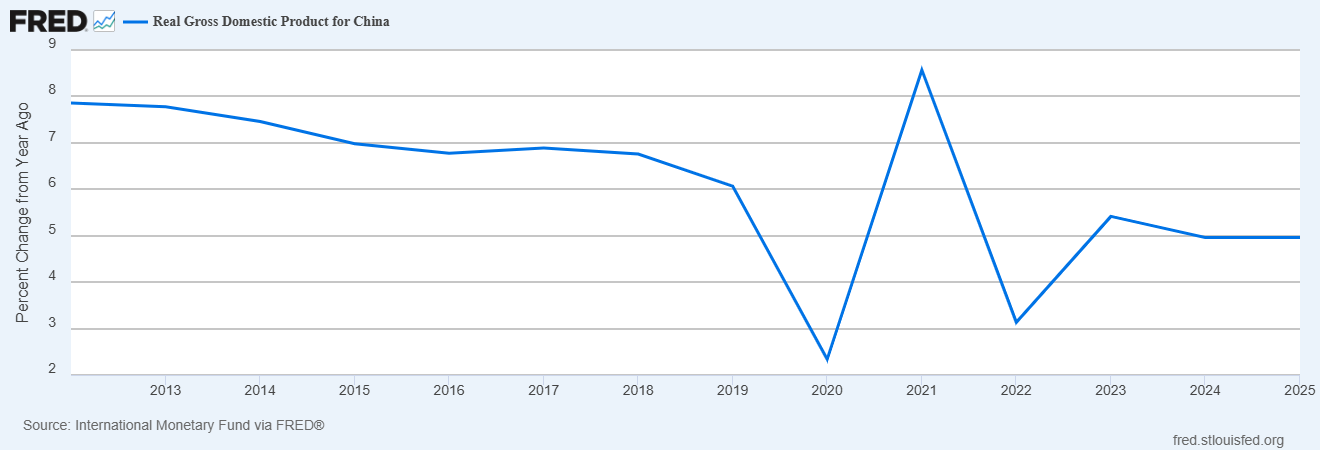
But despite the housing crash, China’s official growth rate never fell below zero — or even below 3%:
In fact, China did this by resorting to a version of the same playbook it used in 2009 and 2015. The Chinese party-state called up its captive banking system and told it to lend huge amounts of money to manufacturing companies. And that’s exactly what it did — industrial loans surged, even as real estate loans petered out:
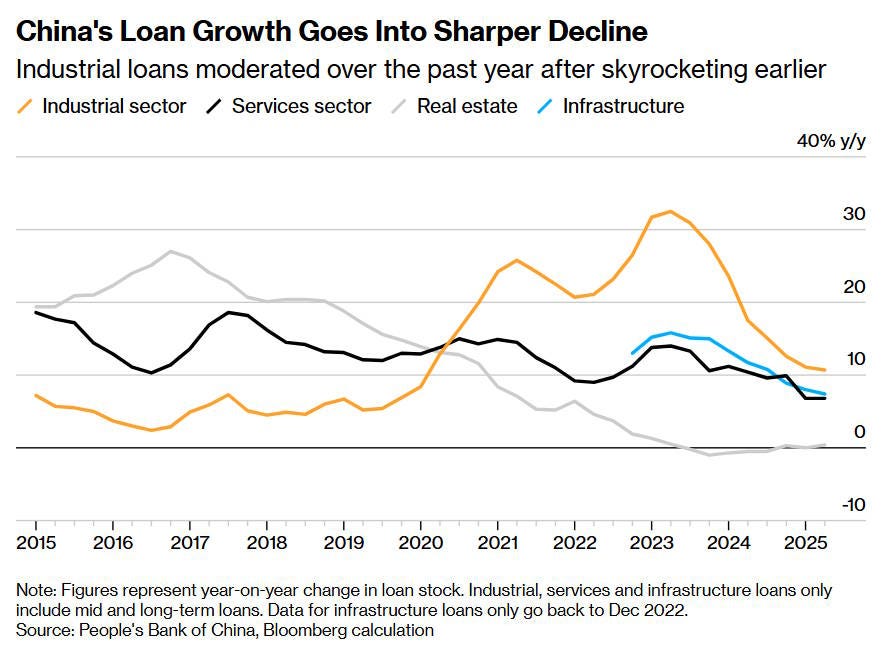
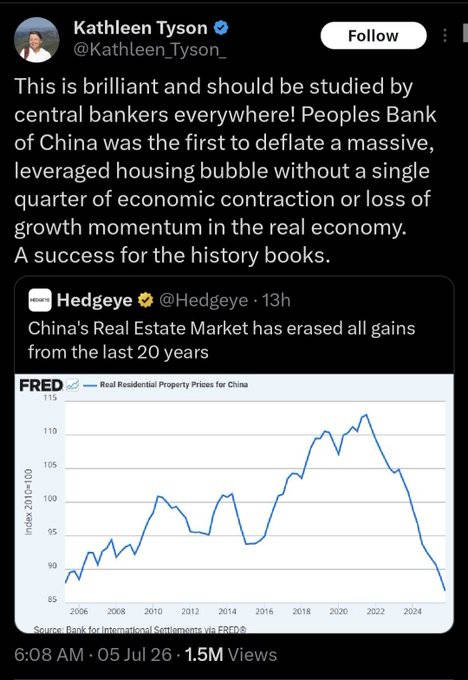
It’s tempting to cry “China’s done it again!” In fact, that’s exactly what some people are now doing:


Skeptics will caution, of course, that this sort of stabilization policy can come with a cost: lower productivity growth and economic inefficiency over the long term. That’s probably what happened in the 2010s, as China’s repeated use of real estate lending to stabilize the economy directed resources to inefficient real-estate companies and led to lower productivity growth. Now there’s the possibility that China’s wave of financial stimulus in 2022-2024 may lead to an overhang of unproductive “zombie” companies that keep soaking up labor and other resources for years to come:


But admirers of China’s economic system will be undeterred. They will point out that productivity is hard to measure; that long-term costs are both uncertain and hard to verify; and that long-term problems can always be fixed later. The more important fact, they’ll argue, is that China did exactly what Xi Jinping said it would do — to pivot away from an excessive reliance on real estate without causing the economy to shrink. “Chinamaxxers” will use this as reason to crow about the superiority of the Chinese way, while left-leaning intellectuals will use China’s performance as a foil to demonstrate the benefits of greater government control over the economy.
There’s just one problem with this triumphalism: China did, in fact, have an economic crash as a result of its real estate bust.
The first way to see this is to look at China’s job market. In 2023, China famously modified its youth unemployment data to use a narrow definition of unemployment, because the numbers were getting too high. But even the revision couldn’t mask the upward trend:
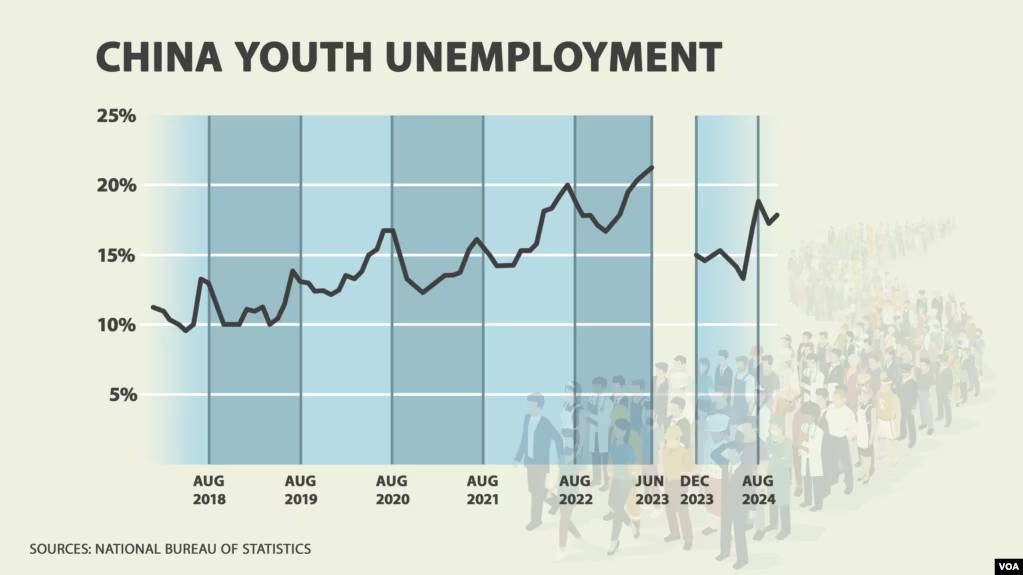
Overall unemployment was recorded as rising only a small amount. But as Bloomberg reported at the time, China’s total unemployment numbers aren’t a very good measure of the labor market, and alternative indicators told a much more pessimistic story:
Alternative indicators and anecdotal reports suggest unemployment is worse than the official monthly figures show…[T]he [official headline] figures aren’t sensitive to changes in the number of migrants from China’s rural areas who work in cities; they also don’t capture the number of people who have dropped out of the labor market for more than three months or those unable to start work…
The employment sub-index for China’s non-manufacturing purchasing manager’s index, which tracks hiring intentions in the service and construction sector, has stayed consistently below pre-pandemic levels for most of the past 12 months…Official data shows there’s been no growth in the migrant worker population since the pandemic…The average number of workers at industrial enterprises with revenues above 20 million yuan ($3.1 million) fell to 7,398 in November 2021 from 7,419 in November 2020, according to official statistics…Because of the weak labor market, record numbers of young people are preparing to take exams to qualify for post graduate courses or enter the civil service [and] would not be counted as job seekers[.]
What about GDP growth? In her tweet above, Kathleen Tyson declares that China “was the first to deflate a massive, leveraged housing bubble without a single quarter of economic contraction or loss of growth momentum in the real economy”. But is that true?
Well, no, it’s not. According to China’s official statistics, the Chinese economy shrank by 0.8% in the second quarter of 2022:
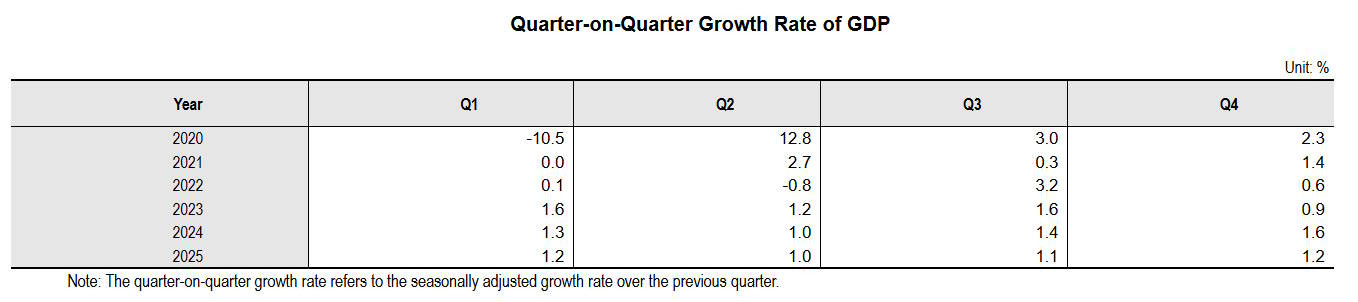
China’s growth is usually reported in year/year numbers, but quarter/quarter is how the U.S. and most countries do their reporting. So by the kind of measurement Americans are used to hearing about, China’s economy officially contracted at an annualized rate of over -3% in the second quarter of 2022. This was also revised down from the -9.3% that was reported in the initial version of the statistics. As for “loss of growth momentum”, China’s economy is officially growing around 2 percentage points slower than it was just before the pandemic.
So even if we accept the official numbers, the claim is wrong. But should we accept the official numbers? Probably not. There is evidence that the Chinese government “smooths” its growth numbers — in good years, it fudges downward, and in bad years it fudges upward. This is from Nakamura et al. (2016), who use detailed data on Chinese consumption to estimate how incomes changed:
Our estimates suggest that official statistics present a smoothed version of reality. We find that inflation was overestimated and growth underestimated by several percentage points per year in the late 1990s. In contrast, since 2002, official inflation statistics have risen only modestly, but our Engel curve based estimates have risen much more. Our estimates imply that growth was substantially lower than official statistics suggest since 2002, and actually dipped into negative territory in 2007 and 2008.
A bunch of analyses claim that China has also done this in response to the property crash. The Rhodium Group used alternative data sources to estimate that China’s economy actually shrank in 2022 and grew much more slowly in 2023 than the official numbers suggest:
Officially, China reported 3.0 percent real GDP growth in 2022, despite the fact that significant proportions of the economy were under strict lockdowns to prevent the spread of COVID-19 during large portions of the year, retail sales fell outright, and investment in the property sector was collapsing. In 2023, the decline in property investment continued, net exports and government spending were drags on growth, and household consumption growth remained relatively low. Beijing provided little direct assistance to households to facilitate spending, and Chinese households added to savings and paid down mortgage debt instead of spending more. Yet China officially reported 5.2 percent real GDP growth in 2023, barely slowing from the pre-pandemic pace of 6 percent in 2019, even though the property sector was experiencing a boom in 2019 and was collapsing in 2023…We estimate that real GDP growth was closer to a contraction of -0.3 percent to -0.8 percent in 2022, and there was only modest growth of 1.5 percent to 2 percent in 2023. [emphasis mine]
The Bank of Finland was a little less negative, but still estimated that growth stalled in 2022:
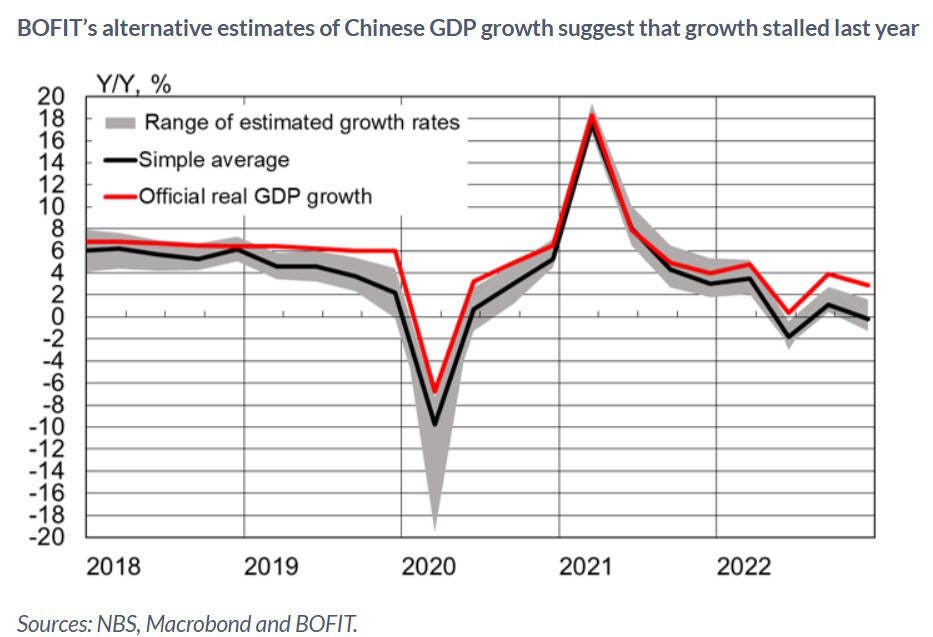
Capital Economics, which tracks a whole bunch of independent estimates, finds that China probably did experience a recession in 2022, though it’s pretty positive about growth since then.
One particularly pessimistic indicator is inflation, which has slipped into negative territory in China since the real estate bust:
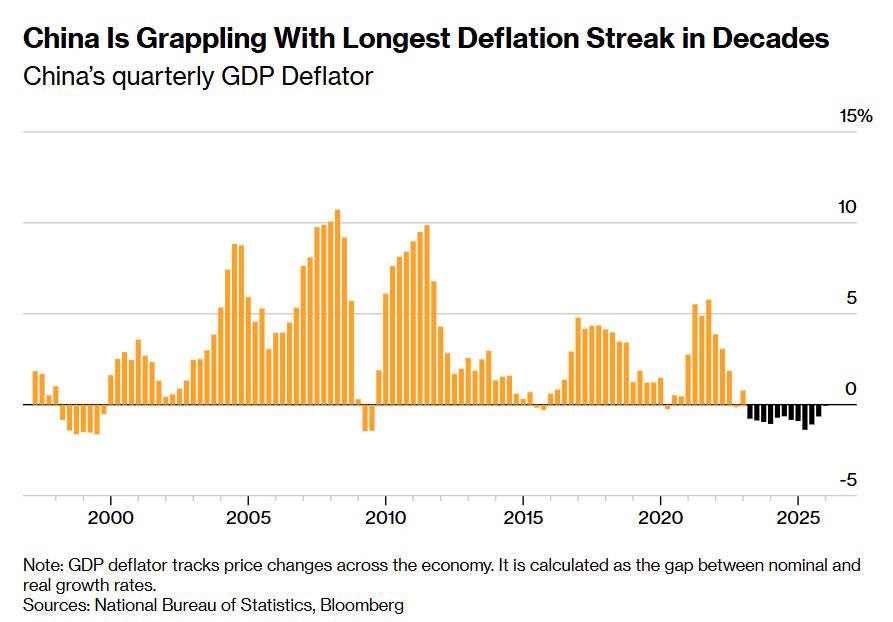
Deflation is a classic sign of low aggregate demand and a slowing economy.
It should be noted that there are a few analysts who disagree, and think that China’s growth numbers are basically accurate. But most independent assessments conclude that China’s growth not only suffered a sharp hit in 2022, but has been weaker in the years since the end of the pandemic.
It makes sense that China’s government would continue their traditional approach of smoothing out growth numbers in the short term in order to project an attitude of stability and calm. But smoothing only works if the economy eventually bounces back. If China is on a new longer-term trajectory of lower growth — which of course remains to be seen — then there will be too few good years to “pay back” the growth that was “borrowed” in the bad years of 2022 and beyond.
I don’t want to detract from China’s accomplishment here, or say that its macroeconomic stability is entirely fake. China has invented — or, perhaps, perfected — an alternative tool for macroeconomic stabilization. Countries all over the world, including the United States, should study China’s financial stabilization policy and think about how to accomplish something similar without direct government control over bank management.
But at the same time, I don’t think we ought to be idolizing Chinese macroeconomic policy either. Even if there don’t turn out to be long-term productivity costs — which is a big “if” — China still hasn’t managed to rewrite the rules of aggregate demand and aggregate supply.
The US banking system already has this system essentially in built out in place. Every bank has bank regulators who meticulously go through loan files to make sure all the boxes are checked and paperwork in place for the loans. Ostensibly they are scoring the loans and making the banks reserve more or less capital depending on the risky rating but in reality they are along for the ride of where the bank chooses to spend its capital. When a sector crashes the regulators begin to score all the loans in that sector in a way that makes sector specific loans unprofitable and force banks to move their loans to other sectors. Broadly, the two sectors are real estate (or asset) backed loans and commercial and industrial loans (business). I would imagine the Chinese copied this part of the regulatory system and built a monetary policy around it rather than a regulatory apparatus
Interesting essay, thanks. Is this in many ways the challenge faced by Japan 30 or so years ago? Similar themes of keeping zombie companies alive. With the additional problem of unalleviated rural poverty—due to the lack of job growth in the richer cities. And the problem,we seem to have in the US as well, of educated youth, some with requisite skills some without, very disappointed with their job prospects.
Noah, your essay leaves me thinking that growing its consumer economy is the way out of this conundrum. Are status symbols and shiny objects the key to a strong economy?