

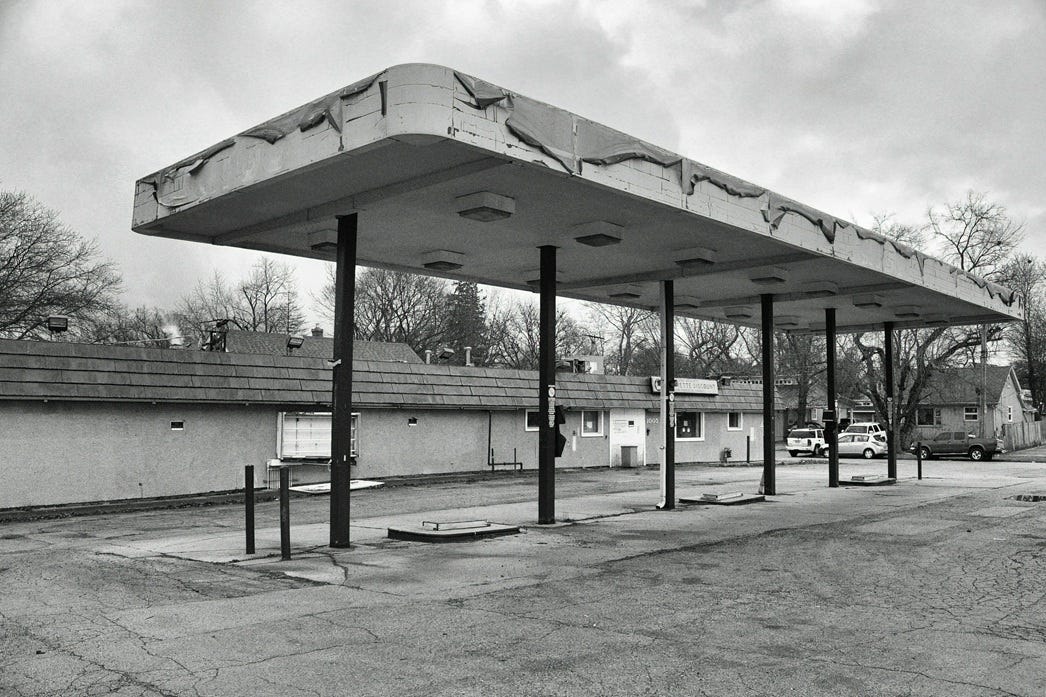
“Without fuel they were nothing. They'd built a house of straw. The thundering machines sputtered and stopped.” — “The Road Warrior”
Here is a chart of U.S. gasoline prices:
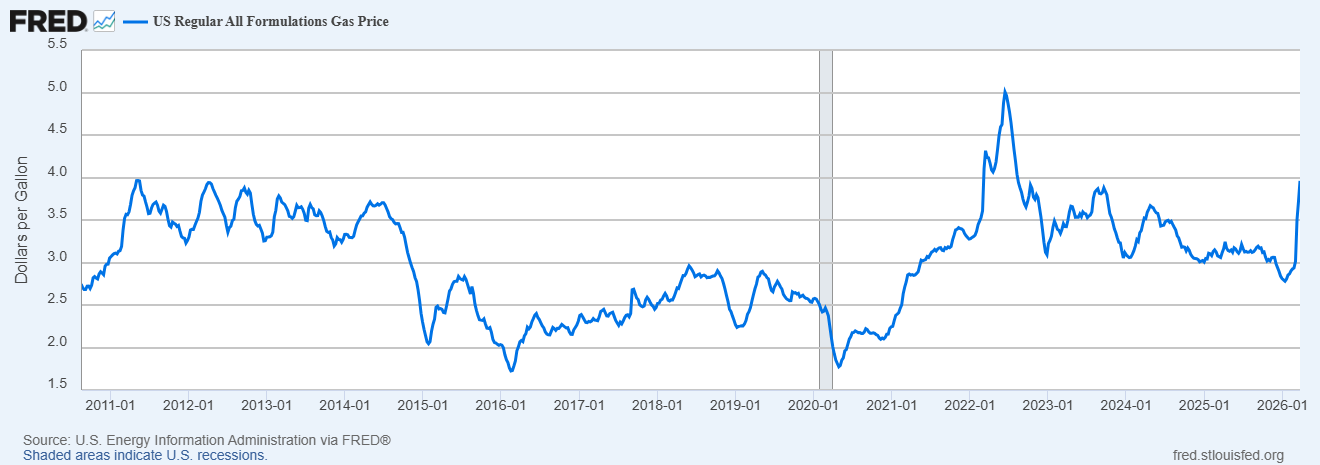
$4/gallon gas isn’t historically that high. If you measure relative to typical American incomes, it’s considerably lower now than it was in the early 2010s. But that’s cold comfort to people who have to commute every day to work, and who just saw their weekly gas bill increase by 50%. Those people have every right to be upset about Donald Trump’s war in Iran.
You know who’s not feeling the heat in their daily commute? People who drive electric cars. To them, the war in Iran isn’t a source of daily pain at the pump, because they don’t even go to the pump. Instead, they just park their cars in their driveways and garages every night, and attach a little cable to the back of the car, and in the morning the car is charged and ready to go.
And this means they get to drive around much more cheaply than people who fill up their cars at the pump. Yes, the price of electricity is higher than it was before the pandemic. But even so, an analysis last December by Autoblog found that it cost EV drivers only 5 cents to drive each mile, compared to 12 cents for good old gasoline-powered cars. And that was before the Iran War spiked the price of gas!
For years, whenever I’d say that EVs are the wave of the future, I was met with an absolute torrent of nonsense. “What about range anxiety?”, I’d hear from people who were unaware that EV range has tripled over the last decade. “But it takes so long to charge up,” I’d hear from people who don’t realize that EVs charge up while you sleep. “We’re going to run out of minerals!”, I’d hear from people who had never actually looked up the numbers. And so on.
This sort of nonsense failed to sway Yours Truly, obviously, but it did a number on the United States as a whole. Despite Elon Musk being one of their biggest backers, the Trump administration went on a crusade against EVs, canceling government support for American battery factories and canceling subsidies for EVs. In a free market, the end of those subsidies wouldn’t have mattered, since Chinese batteries and EVs are much cheaper anyway, but U.S. tariffs are so high that they make Chinese batteries and cars extremely artificially expensive. On top of that, Musk’s political antics made people stop wanting to buy Teslas. Ford utterly bungled its own EV rollout. And American consumers became increasingly reluctant to buy EVs in general, probably motivated by the aforementioned blizzard of FUD1 and nonsense surrounding the technology.
As a result, even as EV sales skyrocketed worldwide, they plateaued and fell in the United States:
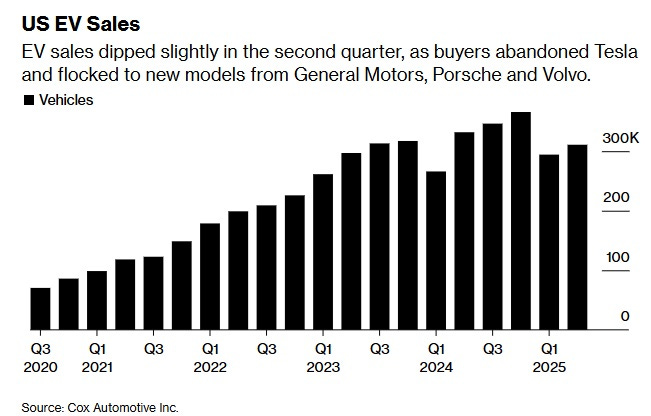
Everyone who was paying attention realized that the U.S. was falling alarmingly behind in this crucial technology. Here’s what Hengrui Liu and Kelly Sims Gallagher wrote in January:
Ford and General Motors had recently announced US$19.5 billion and $6 billion in EV-related write-downs, respectively…The message from Detroit was unmistakable: The United States is pulling back from a transition that much of the world is accelerating…
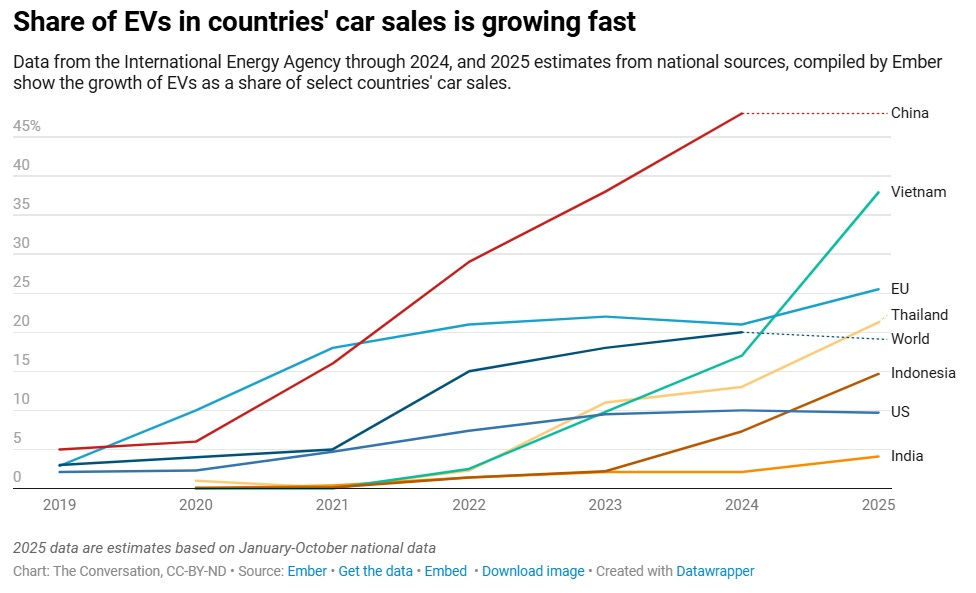
In China, Europe and a growing number of emerging markets, including Vietnam and Indonesia, electric vehicles now make up a higher share of new passenger vehicle sales than in the United States...That means the U.S. pullback on EV production is…an industrial competitiveness problem, with direct implications for the future of U.S. automakers, suppliers and autoworkers. Slower EV production and slower adoption in the U.S. can keep prices higher, delay improvements in batteries and software, and increase the risk that the next generation of automotive value creation will happen elsewhere.
And here’s a very illuminating chart:
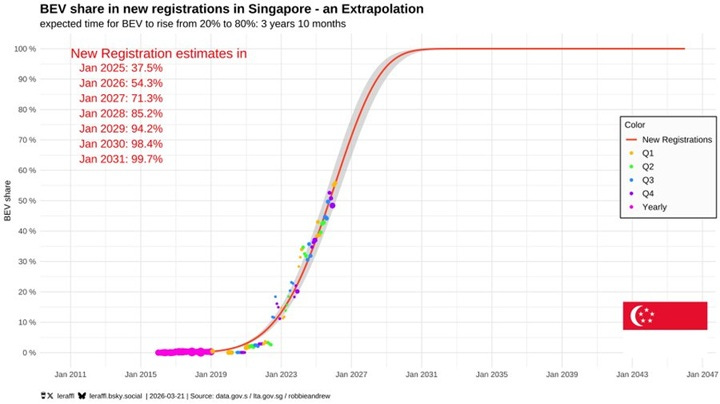
In some countries, the EV “flippening” is happening even faster. Here’s Singapore:
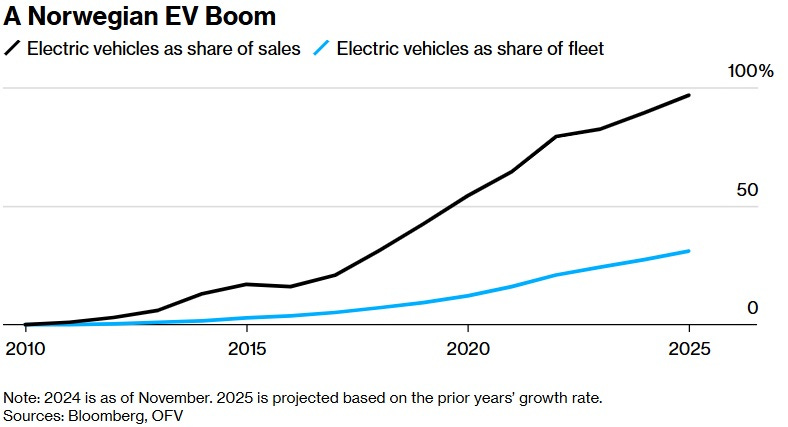
And here’s Norway:
Now, don’t get me wrong: EV drivers in these countries are still going to be very put out by Trump’s war in Iran. Liquefied natural gas exports are being severely disrupted, both by the closure of the Strait of Hormuz, and by Iran’s strikes on Qatari refining infrastructure. That will send global electricity prices up, especially if you live in Asia, where most of the Gulf’s LNG goes. But of course, even that won’t make EVs a bad deal for customers in Asia and Europe, since oil prices have risen even more than LNG prices.
And the U.S. is in a completely different situation. Natural gas markets are fragmented, since — unlike oil — it’s costly to transport natural gas in liquid form. That means that the U.S., with its abundant shale gas, isn’t very affected by overseas wars. Natural gas prices are up only a little bit in the U.S., and even that is mostly due to the AI boom and a cold winter.
In other words, if you’re an American who drives an EV, the Iran War is hurting you a lot less right now.
Yes, at some point the war will end — probably when Trump backs down and makes some sort of “deal”. Crude oil supplies will resume, and gasoline prices will slowly follow. But if you drive a gas-powered car, you have to realize that this is just going to keep happening.
The price of oil, and thus the price of gas, is extremely vulnerable to supply shocks. Oil demand is very inelastic in the short run. If there’s a small disruption to supply, it’s very hard for lots of people to stop driving to work, or moving things by truck and ship and plane. Oil is also an indispensable input into plastics, which are necessary for much of the modern economy. So when there’s some sort of supply disruption — for example, the Strait of Hormuz getting shut down by the Iran war — a few people can switch away from oil, but most people just desperately offer to pay more and more. So the price shoots up very quickly.
This is why even though only 20% of global oil flows through the Strait of Hormuz, disrupting much of that supply caused oil prices to almost double. As I wrote the other day, this isn’t apocalyptic, especially for America (which is a major oil producer). But it could send inflation creeping up and curb economic activity a bit. And for people who drive gasoline powered cars, it’s a major headache.
And it’s a headache that’s going to happen again, and again, and again. Here’s a comparison of oil and gasoline prices versus electricity prices in the U.S. since the turn of the century:
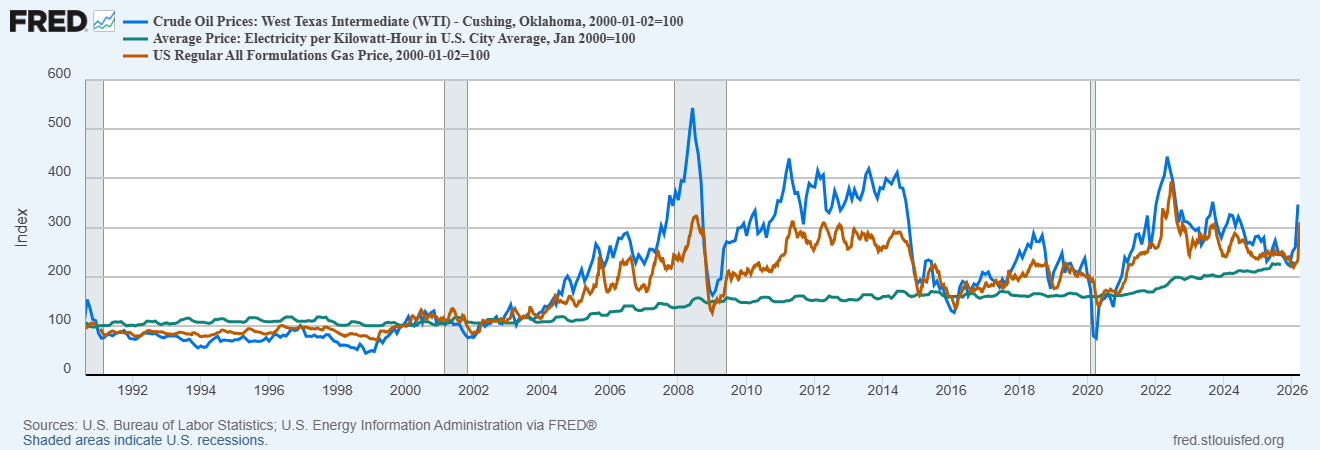
As you can see, oil and gasoline bounce around far more than electricity does. If you drive a gas-powered car, you are economically vulnerable to these periodic price shocks. If you drive an electric car, you are not vulnerable. It’s as simple as that.
In fact, the price shocks may get even worse over the coming decades. The Iranian closure of the Strait of Hormuz, and the Houthis’ closure of the Red Sea, show how modern drone warfare makes it much easier for land powers to shut down commerce through key maritime choke points. The fact that oil is a global market means that any war, anywhere in the world, can shut down those choke points and send the price of gasoline skyrocketing everywhere in the world — including in America.
And Trump’s flailing efforts in Iran show how U.S. power is no longer a bulwark against such conflicts — both because the U.S. is more of a force for chaos than a force for order now, and because changes in military technology make the U.S. much less capable of stopping the cheap fleets of drones that can threaten global shipping. In 1991, you could count on Uncle Sam to use its military might to keep oil prices low; today, you can’t. “Just go to war in the Mideast and make oil prices go down” simply doesn’t work anymore.
The Iran War provides a vivid demonstration that the energy transition isn’t a climate issue — it’s an issue of national security. If there’s a silver lining to Trump’s stupid war, it’s that it’ll speed the world’s transition to solar power, wind power, and electric vehicles. Countries around the world are realizing how vulnerable their dependence on fossil fuels makes them. From Shaiel Ben-Ephraim, here’s a rundown of emergency measures various nations are being forced to take in response to the Iran war:
The Philippines declared a national energy emergency…Sri Lanka instituted a weekly public holiday for public officials and schools. It has also revived a QR code-based fuel rationing system that limits private cars to 25 liters of petrol per week…Pakistan closed schools for two weeks and cut free fuel allocations for government vehicles by 50%. It also hiked high-octane fuel prices by 60%…Bangladesh…shut down universities and colleges and implemented five-hour rolling blackouts for households to prioritize the garment export sector…South Korea launched a nationwide energy-saving campaign and released a record 22.46 million barrels of strategic oil reserves. It also temporarily lifted limits on burning coal…Thailand ordered civil servants to work from home, set office air conditioning to 26–27°C, and halted petroleum exports to preserve domestic stock…Japan…announced its largest-ever release of strategic oil reserves, approximately 45 days' worth, to stabilize local markets…Egypt ordered early closures for malls, restaurants, and government offices while switching off illuminated billboards…Myanmar introduced an "odd-even" rationing system where private vehicles can only purchase fuel on alternating days based on their license plate numbers…India has invoked emergency powers to divert liquefied petroleum gas (LPG) away from industrial users to prioritize household cooking needs…Slovenia became the first EU member to implement fuel rationing, limiting private drivers to 50 liters of petrol per week and businesses to 200 liters.
Unlike in previous episodes of crisis and disruption in fossil fuel markets, countries now have another option — build more solar, wind, and batteries. Auston Vernon has some good back-of-the-envelope estimates of how much countries can compensate for lost oil supply by going electric. And Todd Woody has a rundown of various ways that people and countries are either going electric, or considering going electric, as a result of the war. Buying an EV, of course, is the most obvious way to go electric:
As gasoline prices climb — hitting $6.81 a gallon at a nearby station on Wednesday — a flurry of drivers are making appointments to check out Ever’s lightly used EVs, many priced under $30,000…Ever is just one dealership, but signs of a shift are playing out across the world. In Southeast Asia, buyers are flocking to Chinese EV giant BYD Co.’s stores…
High fuel prices in Europe are also sparking a new wave of interest in EVs. In the UK, car site Autotrader recorded a surge in EV inquiries since the first attacks at the end of February…In Denmark, used EV searches on Bilbasen, a major online car marketplace, have jumped by as much as 80,000 a week…
American online searches for electric cars rose 20% in the first week of the war and dealers have reported more inquiries from buyers.
As Woody notes, this would not be the first time an oil shock led to a sustained shift toward vehicles that used less oil — the oil crises of 1973 and 1979 inaugurated the era of cheap fuel-efficient Japanese cars.
That story ended with Detroit rebounding in the late 90s and 2000s after oil prices went back down, by shifting to high-margin gas-guzzling SUVs. This episode might eventually end the same way — as the Iran war ends and oil demand falls from the global shift to EVs, oil prices will eventually fall again, and Detroit will go back to its same old tired strategy. Woody notes that “US carmakers are sticking to their decisions to scale back on EVs even as demand grows in the rest of the world.”
But this time won’t be like the 90s. Batteries have fallen so much in price that EVs are simply better than gasoline-powered cars now. Even if Fortress America uses tariffs and toxic political nonsense to keep itself wedded to obsolete internal combustion technology, its car companies will be cut off from global markets. The rest of the world does not have the luxury of forcing itself to use outmoded legacy tech, and the appetite for Detroit’s ancient gas-guzzlers will be very low.
Meanwhile, America’s stubborn refusal to adopt EVs will have other negative long-term consequences. Since the same tech used to make EVs is also used to make drones, robots, and electronics, the U.S. lack of EVs will crimp demand for these fundamental technologies and limit the scale that American component manufacturers can achieve. That will hobble and weaken American manufacturing even as it delivers the industrial future to China on a silver platter.
And as for American drivers, they will continue to live forever with intermittent spikes in gasoline prices — sometimes lasting for months, sometimes lasting for years — while paying triple for each mile and standing around at a gas station once a week. Perhaps, as they anxiously scan the latest news from the Middle East, they will comfort themselves with decades-old nonsense about “range anxiety”. Meanwhile, the increasingly affluent and secure middle classes of more pragmatic nations wake up in the morning to their fully charged EVs, cheerfully unconcerned with developments in the Strait of Hormuz.
Choosing to disbelieve in technological innovation has real consequences.
Fear, Uncertainty, and Doubt
EV only household with 13 kW of solar and 60kWh of whole home backup! We're good and haven't thought about driving range or gas or energy prices in years.
Canadian Solar Panels (I live in Colorado), Iron Ridge racking, local electrical supply store wiring, EG4 DC String Inverter plus some hired-out install labor to help me get the panels placed - $15,000. EG4 Batteries $8,000. All hardware UL listed. Based King Joseph Robinette Biden and the Democratic Party got me a 30% discount on that via the IRA, so net price was ~$16,000. Payback period of 4-6 years given our electric usage ($3-6,000 per year between our EVs, AC, heat pump, oven, and clothes dryer). I also got the benefit of experiencing the world's lowest observed post-pandemic inflation rate thanks to Joe Biden. Even then the price and payback period makes sense.
Tesla Model Y also had a tax credit, and we picked up a Chevy Bolt EUV for the second EV. Both have been absolutely flawless. We regularly drive across the country in the Tesla and doing so is a completely thoughtless process. EVs just work no matter where you live. I would recommend Mr. Technology Connection's recent video, to all the many doubters in the comments, because you're all just plain wrong even after reading Noah's data. "You are being misled about renewable energy technology" https://youtu.be/KtQ9nt2ZeGM?si=tlMJZ2GC9cnawQiY
The crazy part of all of this is: everything I bought above could be 4-6 times cheaper today (not kidding) if only we dropped the abominably stupid tariffs that we have in the USA. Nuts!
There's something uniquely American about having the solution sitting right there and actively choosing not to use it.
The price volatility chart says it all. One line bounces around like a heart monitor, the other one barely moves. And we picked the heart monitor. I say this as someone who drives a gas car because the only real EV option for a while was Tesla, and I don't want a Tesla.
What does it actually take to get people to switch when the alternatives still feel limited?