

I think it’s pretty uncontroversial to say that the MAGA movement is the most powerful and important political movement in America today, by a wide margin. Trump’s control of the presidency, and his unprecedented domination of the Republican Party, mean that even though MAGA isn’t a majority of Americans, it has complete control over the federal government. That control will diminish, but not disappear, if Democrats take back one or both houses of Congress next fall. In the meantime, despite falling popularity, MAGA reigns supreme.
And yet I can’t help thinking that despite its current dominance, the MAGA movement doesn’t have much of a long-term future. It has managed to win some elections, by harnessing popular rage — against Democrats, against immigration, against educated elites, against economic conditions, etc. But rage doesn’t last forever. In order for a movement to have longevity, I think it needs to build something. Things like physical infrastructure, institutions, and culture have a lifetime that long exceeds the cascade of emotions that first brings a movement into being.
Successful political movements in America have always been, at least in part, constructive movements. The New Deal built vast infrastructure, government agencies, social insurance programs, regulatory regimes, and much more. The conservative movement of the late 20th century gave rise to modern American business culture, a Christian revival, a military whose power was unrivaled for a generation, and organizations like the Federalist Society. Even the New Left movement of the 1960s and 70s ended up leaving its mark on America by taking over university departments and creating a bunch of NGOs.
Trump’s administration is certainly fond of the symbolism of building a new America. Trump’s Department of Homeland Security recently posted the famous 1872 painting American Progress, depicting pioneers going to settle the West:
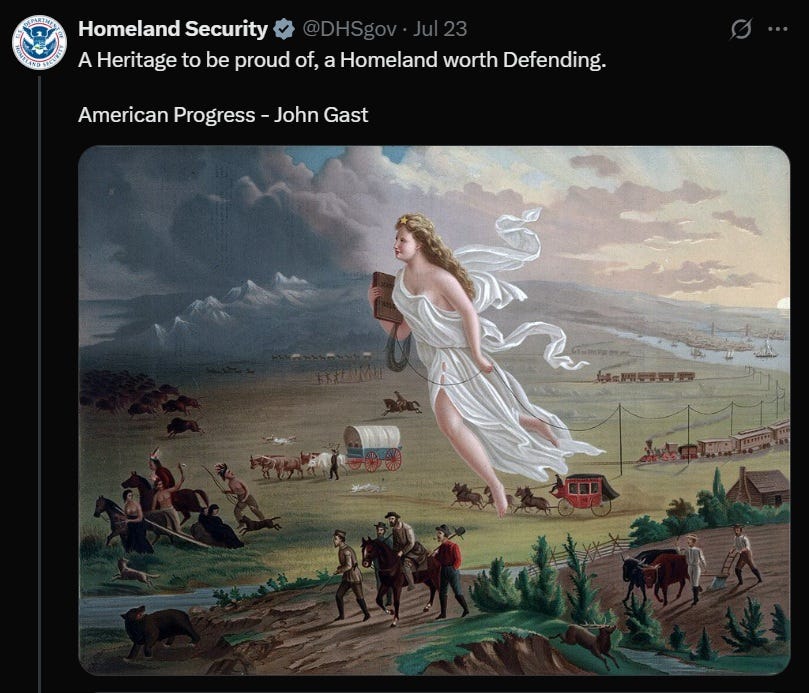
And yet in terms of the actual on-the-ground reality, I don’t see MAGA doing much pioneering. Instead, I see a fundamentally deconstructive movement — a furious assault on progressive culture, liberal institutions, and the structure of the U.S. economy in general, with no idea of what should replace it. On culture, factories, infrastructure, energy, technology, and institutions, MAGA is tearing things down without building things up.
MAGA isn’t building a new American culture
Let’s talk about culture, first, because I’ve already written a bit about that. When I was a kid in the 1990s, conservative culture was blossoming. Evangelical Christianity was the tentpole of that culture, of course, and there was an efflorescence of religious revival — megachurches, Christian TV stations, Christian rock, and so on. But it blended with other conservative cultural elements as well — patriotism, respect for the military, country music, etc.
I remember an event at my high school called See You at the Pole, where teenagers would go pray around the American flag. Although some of my liberal friends looked askance at this gathering, I admired its constructiveness and positivity. I certainly have much to criticize about late 20th century conservatism, but it was a grassroots outpouring of enthusiasm and devotion that built new traditions, communities, and group activities all over America.
Contrast that with Donald Trump’s right-wing movement over the past ten years. In a post back in March, I pointed out that there was no nationwide grassroots cultural movement associated with MAGA:
Trump’s movement has been around for a decade now, and in all that time it has built absolutely nothing. There is no Trump Youth League. There are no Trump community centers or neighborhood Trump associations or Trump business clubs…Christian affiliation and church attendance remain well below their levels at the turn of the century. Republicans still have more children than Democrats, but births in red states have fallen too.
In Trump’s first term, the attempts at organized civic participation on the Right were almost laughably paltry. A few hundred Proud Boys got together and went to brawl with antifa in the streets of Berkeley and Portland. There were a handful of smallish right-wing anti-lockdown protests in 2020. About two thousand people rioted on January 6th — mostly people in their 40s and 50s. And none of these ever crystallized into long-term grassroots organizations of the type that were the norm in the 1950s…And in Trump’s second term so far? Nothing. Even the rally numbers are way down…
The MAGA movement, you see, is an internet thing. It’s another vertical online community — a bunch of deracinated, atomized individuals, thinly connected across vast distances by the notional bonds of ideology and identity. There is nothing in it of family, community, or rootedness to a place. It’s a digital consumption good. It’s a subreddit. It is a fandom.
Say what you will about the woke movement, but it built plenty of culture. It created NGOs, protest movements, and campus groups. It created new quasi-religious rituals in the form of land acknowledgements and other customs. I was never particularly into that culture, or eager to join those groups, but they did represent a fairly cohesive cultural program for what a future America would look like.
The MAGA folks have focused a lot of energy on rooting out woke culture at universities and government agencies. But what will they put in its place? If woke dies, what comes next for America? Trump’s movement doesn’t seem to have an answer.
Trumpism isn’t bringing about a Christian religious revival; in fact, Christianity Today points out that Trump’s first term probably accelerated Christianity’s decline in America. Patriotism is falling under Trump too; most of the decline comes from Democrats and Independents, but I don’t see Trump supporters reviving any American civic national traditions like neighborhood barbecues, parades, etc.
Where do MAGA people want Americans to gather together? What organizations shall they join? What will be their shared activities? What customs, rituals, and so on will define their interactions?
Honestly, I just don’t see much. I see tired red hats and a few weak memes on social media platforms. MAGA culture isn’t about meeting up with other MAGA people in real life and doing any sort of shared activity; it’s about going online and praising Trump and denouncing “the left”. How long until that just gets boring?
And even more fundamentally, what sort of concrete benefits does Trump culture confer to its members? The Evangelical Christianity of the 80s and 90s could provide you with daycare for your kids, or help you meet a spouse who shared your values. Reagan’s military buildup defined the economies and cultures of whole towns and neighborhoods, like Colorado Springs, or parts of Southern California. What does MAGA culture actually get you, besides the chance to go online and shout about stuff you hate, along with other people who share the same enemies as you?
I understand that culture has shifted online in general, but I refuse to believe that half of the American populace can forever satisfy their hunger for human connection with the thin gruel of online outrage.
MAGA doesn’t build factories, infrastructure, or technology
The pioneers built thousands of towns in the West. The New Deal built roads, dams, power lines, schools, and lots of other things. Reaganite conservatism left the task of building most things to the private sector, but it engaged in a major defense buildup that ended up creating lots of manufacturing and new technology. And private business, encouraged by Reagan’s tax cuts and soft-touch regulatory approach — and the explicit deregulation and regulatory streamlining of Carter and Clinton — built much of modern American business.
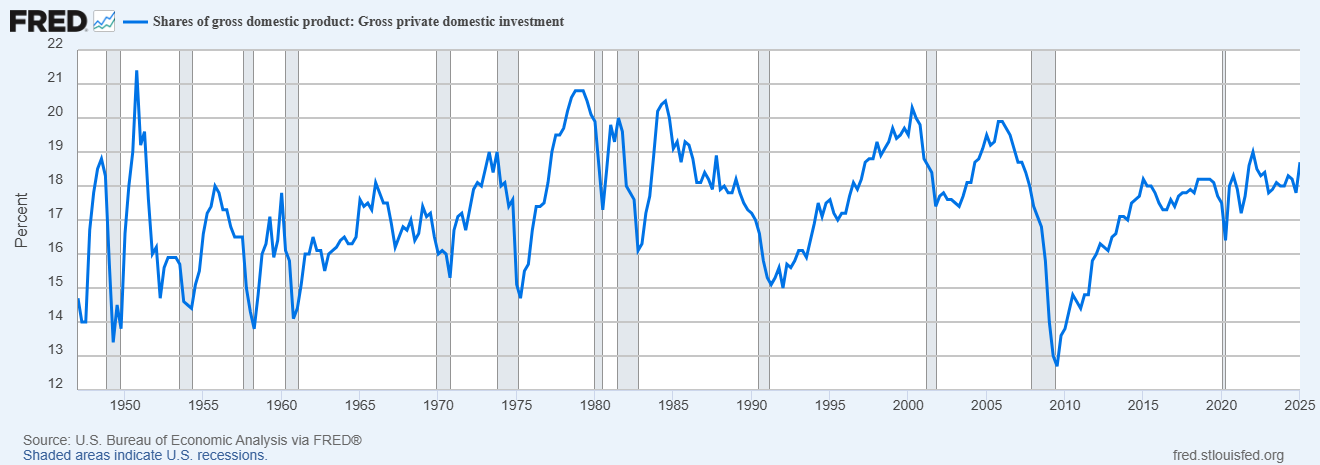
Trump makes a lot of noise about bringing manufacturing back to America. But what has he actually done to make that happen? In his first term he cut taxes for corporations (and recently extended those tax cuts). This did increase business investment somewhat, but when you look at investment as a percent of GDP, the effect is hard to spot:
Manufacturing production and employment barely budged during Trump’s first term, and they haven’t budged yet in his second.
And in his second term so far, Trump has been doing things that actively inhibit business investment.
First, and most obviously, there are the tariffs. Trump and his people believe very deeply that foreign competition is holding U.S. manufacturing back, and that if America closes off its markets, domestic factories will appear to replace the vanished imports with their wares. But they fail to understand the economics of supply chains. Tariffs starve U.S. manufacturers of the parts, materials, and components they need to make high-value products. If America is forced to mine all its own metals, chop all its own wood, and do low-value assembly work, that will pull American workers off of more valuable jobs doing the more technologically advanced parts of manufacturing. The result will be rising costs, diminished profitability, and decline.
This is already happening. Bloomberg reports:
US factory activity contracted in June for a fourth consecutive month as orders and employment shrank at a faster pace, extending the malaise in manufacturing…Bookings contracted by the most in three months and have been shrinking for the past five months, likely a reflection of higher tariffs and a general slowdown in the economy. An index of order backlogs fell 2.8 points, the most in a year, to 44.3. Backlogs have contracted a record 33 straight months.
And that same Bloomberg article lists some comments from manufacturing CEOs in the latest ISM survey:
“Business has notably slowed in last four to six weeks. Customers do not want to make commitments in the wake of massive tariff uncertainty.” — Fabricated Metals…
“The tariff mess has utterly stopped sales globally and domestically. Everyone is on pause. Orders have collapsed.” — Machinery
“Tariff volatility has impacted machinery, steel and specialized components. Also, potential shortages of skilled labor for construction, maintenance and installation.” — Food, Beverage & Tobacco Products
“Tariffs continue to cause confusion and uncertainty for long-term procurement decisions. The situation remains too volatile to firmly put such plans into place.” — Computer & Electronic Products
“Tariffs, chaos, sluggish economy, rising prices, Ukraine, Iran, geopolitical unrest around the world — all make for a landscape that is hellacious, and fatigue is setting in due to dealing with these issues across the spectrum.” — Primary Metals
“The word that best describes the current market outlook is ‘uncertainty.’ The erratic trade policy with on-again/off-again tariffs has led to price uncertainty for customers, who appear to be prepared to hold off large capital purchases until stability returns. This has resulted in further reductions in customer demand and softening sales for the balance of 2025.” — Transportation Equipment [emphasis mine]
And here’s what the National Association of Manufacturers had to say in May:
One Pennsylvania manufacturer was expecting the second Trump administration to fire up the American economy and bring his company a host of new orders. But the reality of the administration’s policies on trade have only harmed the business, JLS President and CEO and NAM Board Member Craig Souser told NBC News…“Nobody saw the magnitude of this coming. I don’t know if it was [Trump’s] plan or not, who knows, but it took what we thought was going to be a rebound year and made it really bad. We have some business, but it’s nowhere near what we expected—and we’re not alone.”…Some of the equipment that Souser’s food packaging company needs is simply not made by U.S. suppliers, he told NBC…“The key robotics equipment he needs to make his machines at his York, Pennsylvania, facility are made in Europe, and companies like his now have to pay a 10% tariff to import European products into the U.S. Souser said he has no choice but to pass that cost along to his customers in the form of higher prices,” according to the outlet…
Scott Livingston, president and CEO of HORST Engineering in East Hartford, Connecticut, is seeing price increases for the materials he uses to make components for aerospace and defense clients. However, he can’t raise prices to compensate due to the company’s long-term contracts and will have to absorb the costs directly…“I do think that there is some good that will come to existing U.S. manufacturers. However, if I cannot build the capacity because my input costs are now going up, what have we gained?” Livingston said.
Better policy: The NAM has been calling for the Trump administration to advance a “comprehensive manufacturing strategy,” which includes crucial pro-manufacturing tax reform, regulatory rebalancing, energy dominance through permitting reform, workforce development and commonsense trade policy.
If you think this is unfair to Trump, ask yourself: Why would the National Association of Manufacturers have any incentive to lie about the effects of the tariffs? If tariffs were really going to supercharge U.S. manufacturing by reducing foreign competition, don’t you think manufacturers would be cheering the tariffs on?
The idea that taxes on intermediate inputs hurt production is just basic economics. MAGA people constantly screech on social media that economics isn’t a science and that economists don’t understand tariffs. MAGA is a movement optimized for screeching on social media, and they do it quite a lot. But no amount of screeching on social media, and no amount of ranting about the economics profession, will eliminate the advantages that companies get from specialization and supply chains.
The Biden administration actually did something about America’s manufacturing decline. It promised tens of billions of dollars in subsidies for chip factories, battery factories, and so on. Those tens of billions of dollars acted as a coordinating mechanism, drawing in hundreds of billions of dollars in private investment pledges:
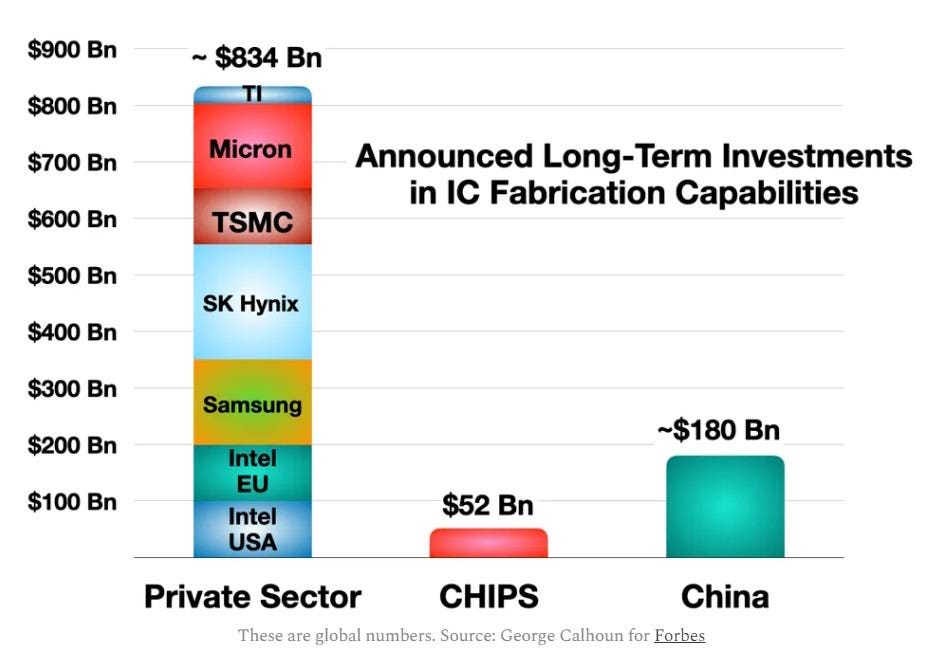
This caused an unprecedented boom in factory construction in the U.S., mostly in the sectors targeted by the industrial policy. Finally, America looked like it might reindustrialize.
Then Trump came into office, and canceled subsidies for batteries and other electrical technologies, and fired 40% of the office tasked with implementing the CHIPS Act. The general knowledge that Trump is hostile to all things associated with Joe Biden is probably one reason the air is starting to go out of the factory construction boom:
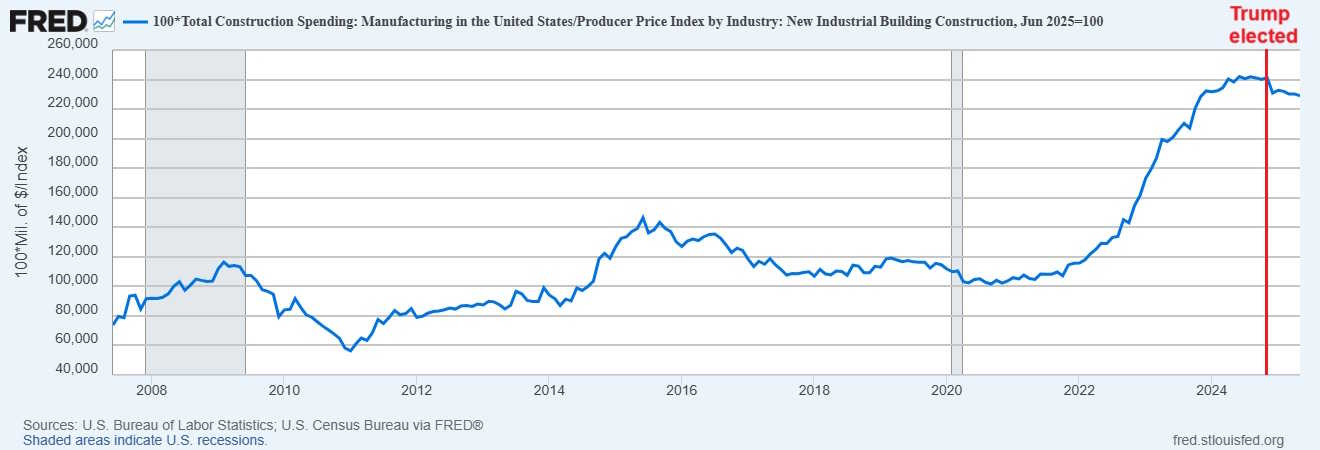
Of course, tariffs must deserve some of the blame here too.
Back in the 1980s, Reagan built up American industry through the military. But Trump isn’t doing much on this front either. He’s increased defense spending by about $150 billion over ten years, but that’s a pretty small amount — the DoD’s annual budget is over $860 billion, so this is less than a 2% increase.
How about infrastructure? In Trump’s first term, “infrastructure week” became a running joke. Eventually it was Biden — in cooperation with some Republicans in Congress — who finally had to step in and pass a bill to repair America’s creaking roads and bridges. Now Trump is back in office, and no one is talking about more infrastructure spending. In fact, he reduced funding for expansion of the electrical grid.
On energy — the most fundamental, basic input into any nation’s economy — Trump is actively trying to thwart the transition to cheap solar and wind energy. Instead of just removing subsidies for those energy technologies, Trump has blocked permitting for new solar and wind projects — even some projects on private land.
This shows a stark contrast between MAGA and the older conservative movement. Texas is building record amounts of solar and wind, simply because solar and wind are now cheap to build, and Texas is a conservative red state with low levels of regulation and red tape; when you have free markets, whatever is cheapest will get built. But MAGA views energy through a culture-war lens instead of dollars and cents; to them, replacing solar and wind with coal is a moral issue, not an economic one:

But at least Trump is supporting fossil fuels, right? Trump has definitely tried to help the fossil fuel industry with various favorable regulatory moves. But the oil industry is still suffering. Rig counts are falling fast:
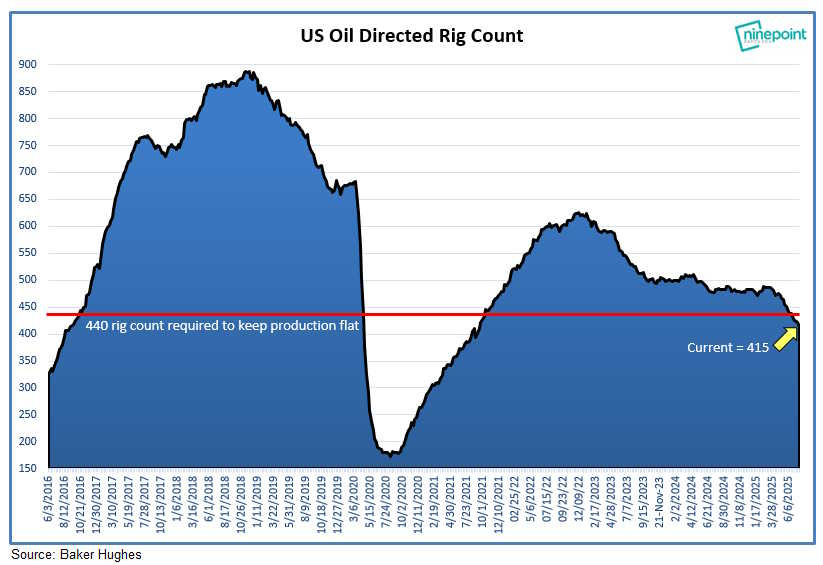
Why is this happening? Oil prices are about the same as they were in 2024. Instead, the main factor behind the oil industry’s woes is probably just tariffs. Dan Eberhart reported on this in May:
For the first time in more than a decade, U.S. crude oil production is projected to decline in the coming year…What’s behind this reversal? A convergence of global economic uncertainty, rising OPEC+ production, and self-inflicted harm from the Trump administration’s tariff campaign. The very tools meant to protect American industry could threaten its energy independence.
S&P analysts recently issued a stark assessment that tariffs and weakening global growth are “significantly cutting into global oil demand,” driving prices lower and forcing U.S. shale producers to hit the brakes. That drop in investment and activity is already visible. Rig counts are falling. Frac crew numbers are down. And capital budgets are being slashed.
As for coal, Trump’s push there isn’t working either:
U.S. President Donald Trump has singled out the coal industry as a key driver of U.S. energy dominance, but there are currently no new U.S. coal plants under construction and utilities have identified quicker and cheaper paths to boost power supplies…In the first few months of Trump's second term, he has signed several executive orders and deployed federal funding aimed at reviving the coal mining and power sectors…But U.S. utilities continue to prioritize adding renewables, batteries, gas and nuclear power ahead of new coal-fired capacity based on the cost and efficiency.
As for nuclear, provisions in Trump’s “One Big Beautiful Bill” that would have severely hurt the nuclear industry appear to have been taken out at the last minute, but the bill still shortens the time that nuclear developers can receive government subsidies. On the bright side, Trump has issued some executive orders in support of nuclear energy, which has spurred a little bit of investment into the industry. But that may not be enough to overcome the harm that Trump’s budget did.
If energy is the most basic input into an economy, science and technology are the most complex. Here, too, MAGA has tended only to destroy rather than to create, gutting federal science funding and personnel:

As in so many other domains, this is downstream of culture wars. Trump realizes that most of America’s scientific research institutions have been permeated by progressive ideology. But instead of trying to replace progressive policies and personnel with conservative or neutral ones, he’s just trying to tear down those research institutions — to lop off and cauterize limb after limb of the system that made America the world’s dominant technological power in decades past.
The most important thing Trump built in his first term, of course, was the miraculous Covid vaccine. But the MAGA movement turned against vaccines, and Trump’s Secretary of Health and Human services is now launching a frontal assault on the technology.
MAGA isn’t building new institutions
Finally, I should talk a little bit about institutions. The old conservative movement built plenty of institutions. It built the Federalist Society, which promoted conservatives in the U.S. judiciary. It built economics departments like the one at the University of Chicago, to advocate free-market principles. It built churches and all of the other institutions of evangelical culture. It helped foster the creation of plenty of modern business institutions as well.
MAGA doesn’t show much sign of doing the same. He has purged the civil service to a modest extent, which you’d think would give him the chance to set up a Federalist Society for the bureaucracy. But it looks like he plans to simply replace the departed bureaucrats with political appointees1 rather than change the rules of the civil service so that it attracts competent conservatives.
Trump is also hard at work forcing universities to adopt less progressive policies. But this often involves doing aggressive things like defunding universities, which makes both American research institutions and American educational institutions weaker. There appears to be no grassroots MAGA effort to get conservative professors into universities; instead, the prevailing idea this decade appears to be “Burn it all and start over”.
The problem isn’t just that burning America down is bad; it’s that the Trumpists don’t actually know what they want to start over with. Unlike the Christian Right or the business conservatives of my youth, they don’t seem to have a vision for what the country should look like after all the tearing down is complete.
As a result, MAGA looks less like a normal political movement than a protracted backlash — a lengthy blast of rage against all the ways progressivism was changing the country in the 2010s. It’s surprising how long that rage has managed to last, but eventually that fire will have to fade. And when it does, MAGA supporters will look around and realize that they didn’t have a constructive vision for the future of their nation.
These are not necessarily hacks, but they’re a lot more likely to be hacks.
There are three parts to the Trump political conglomerate: the MAGA faction, the tech bros and the Project 2025 Christian nationalists. It's the latter group that has the vision for America's Future. 2025's machinations (destroying the bureaucracy and the universities) are fused with MAGA (planting loyalists and loyal policies inside the institutions left standing). I agree with you that the destruction outweighs the construction, because, as in all things Trump, the President does not care about anything, not even the future, as much as he cares about himself.
> I don’t see Trump supporters reviving any American civic national traditions like neighborhood barbecues, parades, etc.
In fact, his parade for the 250th anniversary of the US Army (and also coincidentally for his birthday) became a global joke!
In Vietnam (my country) many people said that "after this parade many countries will dare to fight America", and "even North Korea, being sanctioned, can march properly; why can't G.I. do this?"
As for other countries...the best joke about this is that "Trump ordered this march through Temu, but with such high tariffs, he couldn't receive all of it!"