
Europe is under siege
Menaced by Russia and China, abandoned by America.

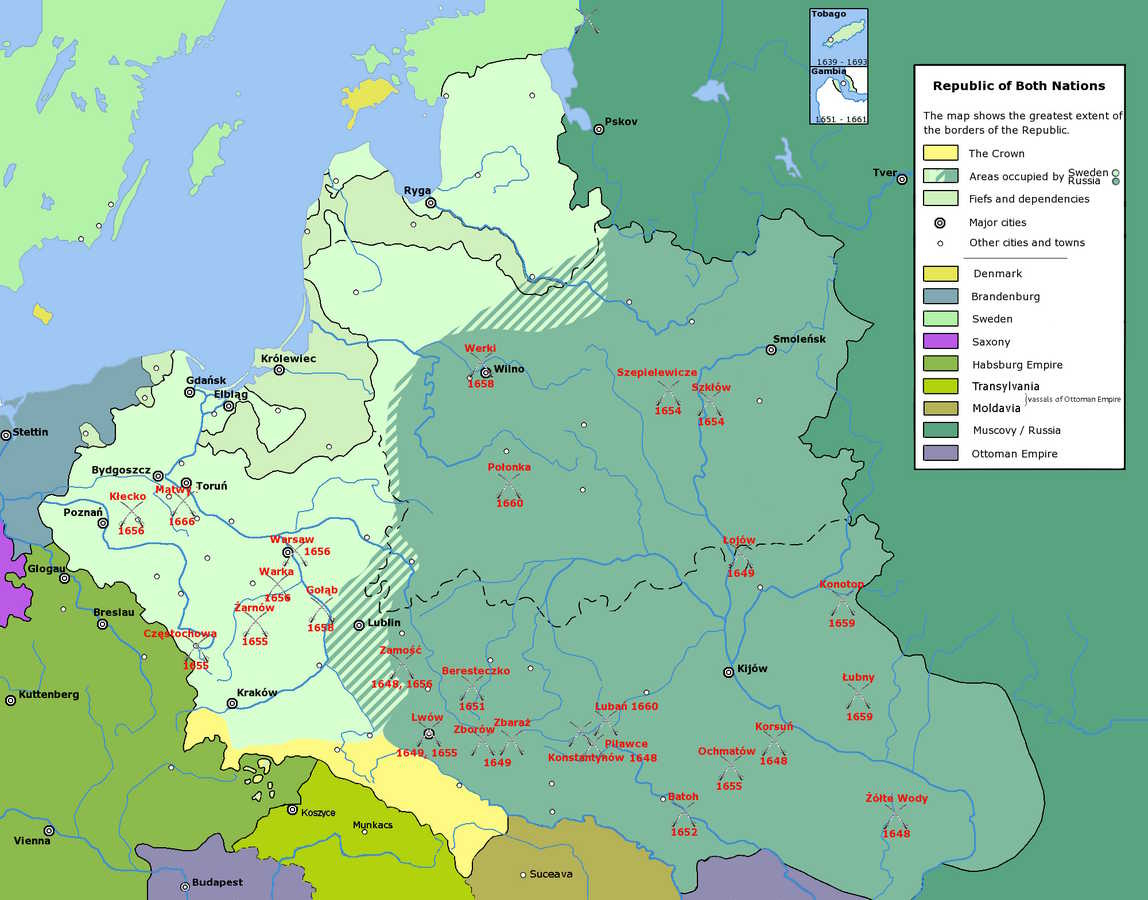
The map above is a depiction of The Deluge, a historical event in which the Polish-Lithuanian Commonwealth — which had been a major European power — was defeated and destroyed under the combined assaults of Russia and Sweden in the 1600s. After having its power broken, Poland was carved up in the 1700s and subjugated by Russia, Prussia, and Austria. It took more than two centuries, until the fall of communism in 1991, for Poland to reemerge as a strong, truly independent country.
The Deluge shows that power and independence are not permanent. If you are surrounded by hostile powers, and if you don’t have the ability to guard yourself against those powers, no amount of historical greatness can save you from being subjugated. This is an important lesson for Europeans to remember right now, as they find their region under siege from Russia, China, and the United States all at once.
The United States no longer cares about the European project
Why would America care about Europe at all? For most of our history, we didn’t. In the 19th century, the U.S. viewed European countries as dangerous rivals. In the early 20th century, Americans prided themselves on not getting involved in European affairs, and were incensed at their government for dragging them into World War 1. Only after World War 2 did Americans start caring about Europe, and we did so for three reasons:
West Europe was a bulwark against Soviet communism.
Europe was a key trading partner.
Many Americans came to value their ancestral ties to Europe.
The first of these reasons vanished in 1991. Europe is still a bulwark against Russia, but Americans no longer feel threatened by Russia. Russian power is far less than what it once was, and Russia’s rightist ideology does not threaten the rightists who now rule America.
As for communism, many (most?) Americans now believe that European countries are socialist. When American conservatives ask where in the world socialism has succeeded, American progressives will always reply “Europe” or “Scandinavia”. Whether Europe or Scandinavia is actually socialist is irrelevant; Americans have come to see it that way.
Europe is still an important trading partner. But Trump and the other people now in charge of the U.S. do not understand trade at all. They think about trade entirely in terms of the net trade balance, rather than in terms of total U.S. exports. Trump & co. don’t care that America sells $650 billion a year to Europe; the fact that Europe sells $800 billion a year to America means that Trump & co. think America is “losing” and would benefit from a cutoff of trade.
Remember that the U.S. is an unusually closed-off, self-sufficient economy, so Americans in general don’t think too hard about trade or try to understand why it’s valuable. Also, the people running now the country are especially ignorant about economic matters.
As for civilizational ties, this is the reason Trump and the MAGA movement have turned so strongly against Europe. The American right values Europe because they think of it as a White Christian homeland — the source and font of Western civilization. Here’s a post I wrote about that earlier this year:

_during_The_Deluge_and_Chmielnicki%27s_Uprising.png)
I wrote:
in the American mind, Europe stood across the sea as a place of timeless homogeneity, where the native white population had always been and would always remain…In the mind of many Americans, Europe thus stood as both a refuge and a reservoir. America itself was a rough, contested frontier, but Europe would always be white and Christian. If you ever felt the need to live around a bunch of white people of Christian heritage, you could always go “back”, but for most that wasn’t necessary — just knowing that the Old World was somewhere out there was enough.5
I think Europeans may underestimate how much this perception motivated America’s participation in the Transatlantic Alliance during the Cold War…[T]o conservative Americans in the 20th century — the type of people who joined the John Birch Society — the Cold War was about preserving Christendom from the threat of godless communism.
Anyway, in the 2010s, it dawned on those Americans that this hallowed image of Europe was no longer accurate. With their working population dwindling, European countries took in millions of Muslim refugees and other immigrants from the Middle East and Central and South Asia — many of whom didn’t assimilate nearly as well as their peers in the U.S. You’d hear people say things like “Paris isn’t Paris anymore.”6…At the same time, Europe had long since abandoned its traditional Christian values…
To Americans who valued the idea of America and Europe as part of a single Western civilization, this realization was catastrophic. Suddenly European countries — and the Anglosphere countries of Canada, Australia, and New Zealand — felt like they had left the club…
America’s rightists…want to know that someone, somewhere, is out there preserving an indigenous homeland for their identity groups. And that “someone” has to be Europe and the Anglosphere.
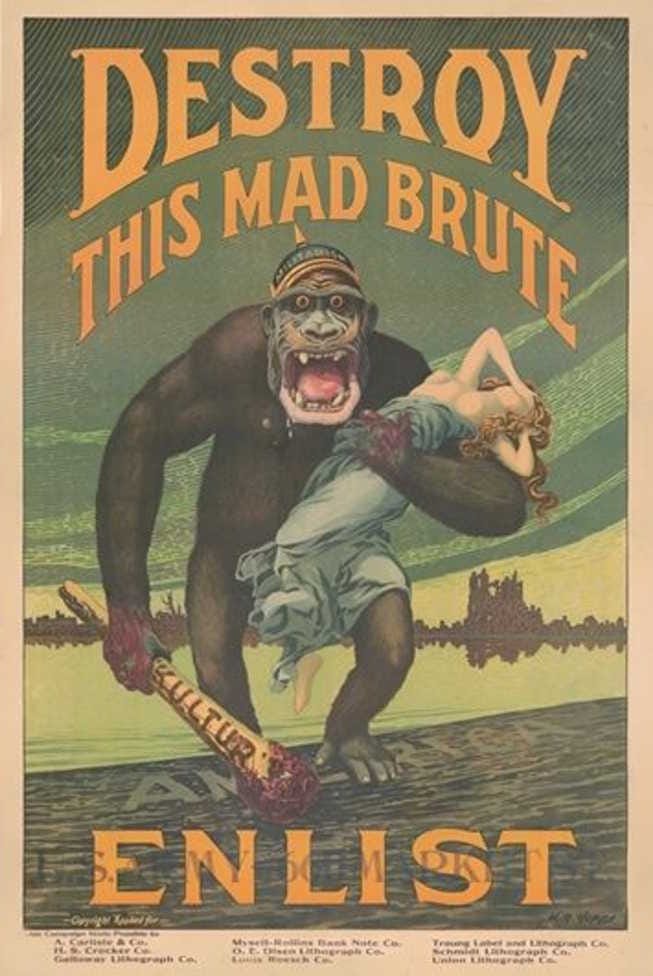
This isn’t a new attitude, either. Remember that in order to persuade a reluctant America to join World War 1, the U.S. government had to depict Germany as an ape abducting a white woman!
If you understand this, then nothing in America’s new National Security Strategy is mysterious, surprising, or confusing. Here’s how War on the Rocks summarizes the Trump administration’s attitude toward Europe:
[I]mmigration is elevated to the central national security problem. The text declares, bluntly, that “the era of mass migration must end,” and that “border security is the primary element of national security.” It frames mass migration as a driver of crime, social breakdown, and economic distortion, and calls for a world where sovereign states cooperate to “stop rather than facilitate destabilizing population flows” and tightly control whom they admit…
[P]rotecting American culture, “spiritual health,” and “traditional families” are framed as core national security requirements…The document insists that “restoration and reinvigoration of American spiritual and cultural health” are prerequisites for long-term security and links this to an America that “cherishes its past glories and its heroes” and is sustained by “growing numbers of strong, traditional families” raising “healthy children.” America is thus cast as defender of so-called traditional values, while Europe lacks “civilizational self-confidence and Western identity.”…
[T]he strategy elevates the culture wars into a governing logic for national security, and it does so through rhetoric that treats ideological and cultural disputes as matters of strategic consequence…This is clearest in the European section…The text…speculates about demographic and cultural shifts in Europe as a way to question whether future governments will share American views of their alliances. The strategy [implies] that cultural alignment is essential to strategic partnership.
The American right sees the “mad brute” in the ape cartoon as the dark-skinned Muslim immigrants who have entered Europe in large numbers in recent years. And they see themselves as needing to save the woman — representing their view of Europe as the traditional font of White Christian civilization — from that mad brute.
This tweet by Elon Musk pretty much sums up the American right’s attitude toward Europe:
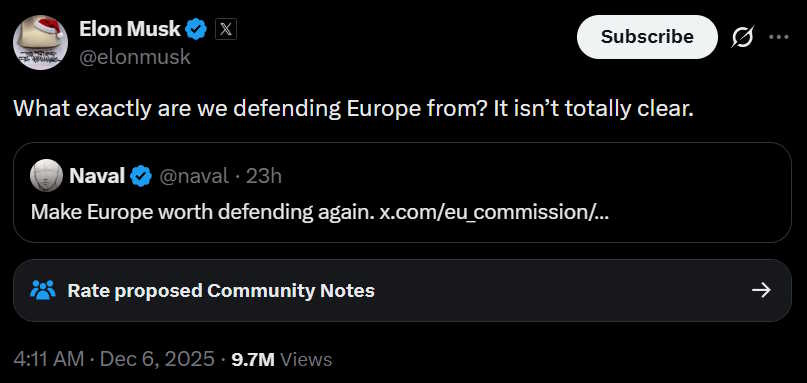
This is why no amount of European shaming or moral persuasion can have any effect on the Trump administration — or on any Republican administration in the decades to come. This kind of appeal to friendship is totally useless:
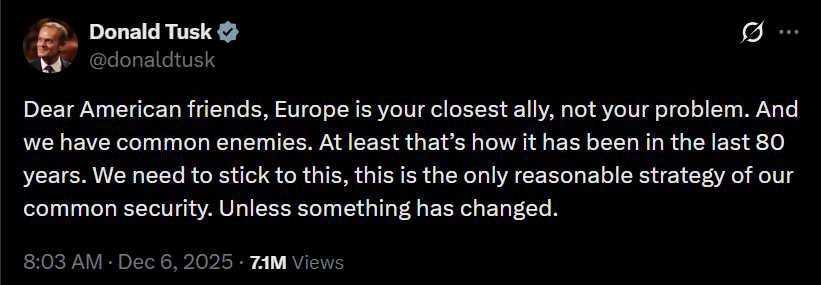
And this kind of bitter, angry hectoring is worse than useless:

The American right — i.e., the people now in charge of the country — do not care intrinsically about democracy, or about allyship, or about NATO, or about the European project. They care about “Western Civilization”. Unless Europe expels Muslim immigrants en masse and starts talking about its Christian heritage, the Republican Party is unlikely to lift a hand to help Europe with any of its problems. Democrats will want to help Europe, but they will only be in power intermittently, and helping Europe will not be high on their priority list.1
Thus, America is not riding to the rescue this time, or for the foreseeable future. I wish things were different, but my wishes count for nothing; this is the reality with which the Europeans must now deal.
Russia and China together are the real menace to Europe
Europeans do not need me to tell them that Putin’s Russia threatens not just Ukraine, but all of Europe. They are well aware of this fact. Russia now regularly flies its drones into Europe, and is probably behind a wave of sabotage attacks on European infrastructure.
How can Russia, a country of just 144 million people and $7 trillion in GDP (PPP), hope to overcome Europe, which has 520 million people and $33 trillion in GDP (including the UK), especially after Russia has expended so many of its young men and materiel in its war with Ukraine already? There are three answers here. The first is gray-zone warfare, including sabotage and political influence campaigns. But that’s only the beginning.
Russia’s second method for fighting Europe is what I call a “Ponzi empire” strategy. Russia has enslaved vast numbers of Ukrainians from the occupied regions of Ukraine to fight against the rest of their country. If Russia conquers the rest of Ukraine, it will similarly enslave the rest of the country’s population, and send them to fight against Poland, the Baltics, and Moldova. If they then defeat Poland, they will enslave the Poles and send them to fight against the next European target, and so on.
This is a very traditional Russian strategy. Enslaved Ukrainians were used to attack Poland in 1939. Enslaved Poles were forced to fight Russia’s wars in the days of the old Tsarist empire, and would have been forced to do so again as part of the Warsaw Pact. Just like zombies turn humans against their own, each slice of Europe that Russia can chop off ends up being turned against the rest.2
Russia’s final strategy for fighting Europe is to rely on Chinese assistance. Russia’s own industrial base is very weak, and relied heavily on imported European parts and machinery that has now been partially cut off. But Chinese tech has largely plugged that hole, as the Carnegie Endowment reports:
Since mid-2025, Chinese components have been detected in Russian drones and missiles, often shipped via front companies disguised as suppliers of industrial cooling equipment…Chinese machinery, including precision optics, lasers, and dual-use machine tools, now dominates Russia’s defense-related manufacturing. In August 2025 alone, China exported a record 328,000 miles of fiber-optic cable and nearly $50 million worth of lithium-ion batteries to Russia, reinforcing its role as the Kremlin’s primary wartime supplier of dual-use materials. Chinese engineers working at Russian drone facilities are adapting civilian quadcopters, such as the Autel Max 4T, for combat use.
China is a far bigger manufacturer than Europe, and can pour essentially infinite war production into Russia if it wants to. And China is now assisting Russia’s gray-zone warfare against Europe:
Since 2024, Chinese ships have been involved in incidents of targeting subsea infrastructure, particularly cutting subsea cables in the Baltic Sea…The country increasingly deploys ambitious espionage and cyber attacks against government networks and critical infrastructure across Europe. These attacks seem to overlap with—or even be actively coordinated with—Russia’s espionage and influence operations across Europe…Increasingly, Russia and China also cooperate in disinformation operations: Chinese campaigns such as “Spamouflage” are amplified by Russian media outlets and diplomatic channels. Both countries employ what look to be synchronized narratives accusing the West of being responsible for the war in Ukraine.
China even provides the Russians with battlefield intelligence, helping them strike and destroy Ukrainian targets in real time. In sum, China is supporting Russia’s war against Ukraine, and will likely support Russia in any further wars it undertakes against the rest of Europe.
With Chinese technology and production, and slave soldiers from East Europe, and with America withdrawing from the Transatlantic Alliance, Russia could conceivably overmatch Europe.
But that’s not the only threat that China poses. On the economic front, China’s new economic strategy — a combination of shutting out European products, sending out a massive wave of subsidized exports, and putting export controls on rare earths — threatens to forcibly deindustrialize Europe. Here’s what The Economist, normally a staunch defender of free trade, recently wrote:
China is not just dumping exports and subsidising its companies, it is also out-competing and out-innovating big European industries, including carmaking. Last year Germany’s trade deficit with China stood at €66bn ($76bn); this year it could widen to over €85bn, around 2% of GDP. Alarmingly, China is exploiting Europe’s dependence, weaponising embargoes or the threat of them in chips and rare earths.
Germany, traditionally Europe’s strongest manufacturing and exporting nation, is already the hardest hit:
China, many European manufacturers have concluded, is threatening to put them out of business, by both fair means and foul…The wails are loudest in Germany, which is Europe’s biggest exporter to China and its biggest investor in it by far…For the Mittelstand, the small manufacturers that constitute a big slice of German industry, China used to be a source not of angst but of profit. Their precision-engineered machine tools were an exquisite fit for its rapid industrialisation. Chinese consumers raced to buy German cars…
Times have changed…Once-stellar growth inside China has, for many foreign firms, slowed to a crawl as competition with local rivals intensifies. In addition, Germany’s previously small trade deficit with China has ballooned…Last year it reached €66bn ($76bn), or around 1.5% of GDP, driven by a collapse in German exports to China and a rush of imports, notably of cars, chemicals and machinery—hitherto German specialities.
Germany’s trade deficit with China this year is expected to surge again, to around €87bn…German cars command only 17% of the Chinese market, down from a peak of 27% in 2020…Worse, Chinese competition also jeopardises sales in other markets. China’s net exports of cars have risen from zero in 2020 to 5m units last year. Germany’s have halved over the same period, to 1.2m units…Such figures have triggered fears in Germany of a wave of deindustrialisation.
The Financial Times has a good article about this as well, and Brad Setser has a good writeup of that article.
This is all on top of the existing headwinds facing European manufacturing — the energy crisis from the cutoff of Russian gas and self-inflicted “green” policies, Trump’s tariffs, and so on.
So Europe finds itself in an extraordinary perilous position right now. Its main protector has suddenly withdrawn. It has a ravenous, brutal empire attacking its borders, supported by the world’s most powerful nation. Its main export markets are shriveling, and its manufacturing industries are under dire threat from waves of subsidized foreign competition. What can it do to fight back?
How Europe can resist the siege
The most important thing Europeans need is to panic. Europe is facing its own Deluge — a sudden pincer movement by hostile great powers that threatens to reduce it to a collection of small vassal states. This is a true crisis, and it will not be solved by social media rhetoric, or by brave declarations by EU leaders. It cannot be regulated away by eurocrats in Brussels. It will require bold policies that change Europe’s economic, political, and social models. Only a strong sense of urgency and purpose can motivate Europe to do what needs to be done.
What needs to be done? One important step is for Europe to act more as a single whole than as a collection of small countries. In the military realm, this means coordinating European militaries and defense industries much more. Matthew C. Klein writes:
From a properly European pespective, the security interests of each country should be shared across all countries, just as, for example, most Americans in Michigan or Maine would view an attack on California or Florida as an attack on them…The first step is to give the Ukrainians, who are already fighting the Russians, as much material and financial support as they need. From the perspective of European security, French, German, and British weapons are far more valuable in Ukraine than in their home countries. If the Ukrainians were subjugated, defending the rest of Europe would become much harder, with the effective EU-Russia border lengthening dramatically…
Europe’s national militaries have had a tendency to favor their home country’s producers, with the result that the continent is filled with subscale defense companies that are often slow and unproductive. Common defense procurement for a continental army should lead to higher output and lower costs—a few large companies handling large orders should have better unit economics than hundreds of artisanal manufacturers—but it would require Europe’s national defense elites to change their perspective. Philipp Hildebrand, Hélène Rey, and Moritz Schularick recently published a useful proposal for how to make this work.
And economically, Europeans can partially compensate for the loss of Chinese (and American) export markets by selling more to each other. The Economist writes:
A second task is for European countries to make better use of the power they have, by integrating their economies…By failing to integrate, the EU is leaving a vast sum of money on the table. A single market that was designed for goods is failing to help economies dominated by services.
And in his famous report on European competitiveness, Mario Draghi wrote:
We have also left our Single Market fragmented for decades, which has a cascading effect on our competitiveness. It drives high-growth companies overseas, in turn reducing the pool of projects to be financed and hindering the development of Europe’s capital markets…The EU’s new industrial strategy rests on a series of building blocks, the first of which is full implementation of the Single Market. The Single Market is critical for all aspects of the strategy: for enabling scale for young, innovative companies and large industrials that compete on global markets; for creating a deep and diversified common energy market, an integrated multimodal transport market and strong demand for decarbonisation solutions; for negotiating preferential trade deals and building more resilient supply chains; for mobilising greater volumes of private finance; and as a result, for unlocking higher domestic demand and investment. Remaining trade frictions in the EU mean that Europe is leaving around 10% of potential GDP on the table, according to one estimate.
And ideally, Europe should form a fiscal union — the EU itself should be able to borrow and spend, not just the member countries. As Klein writes, this needs to be accompanied by a greater tolerance for fiscal deficits — after all, countries borrow in emergencies.
In other words, Europe’s first step in resisting its siege is to act more like a country and less like a zone. It would also help to find some way to bring the UK back into the fold, especially because polls consistently find that British people regret Brexit.
Europe’s other top priority is to provide for the common defense. That means spending more money on the military, of course, and it also means greatly increasing the size of Europe’s nuclear deterrent. But it also means building a defense industrial base capable of resisting a China-backed Russia.
Europe’s current defense-industrial base was built for the Cold War, when battles were decided by heavy vehicles like tanks and ships and planes. Those are still somewhat important, but drones have risen very quickly to dominate the modern battlefield. Right now, drone manufacturing, as well as almost the entire supply chain for battery-powered drones, is overwhelmingly concentrated in China.
Europe needs to be able to build not just drones, but every single thing that goes into making a drone — batteries, motors, various types of computer chips, and so on. European industrial policy should therefore focus on onshoring these industries. In other words, Europe needs to master the entire Electric Tech Stack. (This will also help Europe get back in the EV race.) And it needs to master the AI software — computer vision, swarming tech, and so on — that will soon be needed in order to make drones a truly modern force.
The question of the proper policy instrument to accomplish this goal — tariffs, subsidies, fiscal borrowing, regulatory changes, and so on — is irrelevant. All of these policies should be done as necessary, and it’s better to do too much than too little. Policy procedure needs to be subordinated to the overriding goal of making Europe capable of defending itself. In fact, every European institution needs to be reformed and reverse-engineered in order to enable this.
Europe is also going to have to change its political mindset. Lavish pensions and other elements of Europe’s social model are going to have to be temporarily curbed to help give Europe the fiscal space and physical resources to fight off its enemies. All nuclear plants need to be restarted, and Europe should build more nuclear, ignoring “green” parties and environmental activists who irrationally hate nuclear power. Europe needs to reform its land-use regulation to require greater construction of solar and wind power. And Europe is going to have to back off of its aggressive regulation of AI software, in order to produce cutting-edge autonomous weaponry.
Finally, Europe needs to look for friends and allies — and export markets — other than America. India is an obvious choice. Although India is friendly with Russia, the country would undoubtedly welcome Germany’s help industrializing — and this would allow German companies to sell machines to India, as they once did to China. The EU should open its markets to Indian goods in exchange for Indians doing the same, recognizing that trade balances are less important than total export demand. Japan, South Korea, and other big developing countries like Indonesia, Vietnam, and Brazil are other good potential trading partners.
If Europe manages to unify more and to build up its military power, it will increase the number of great powers in the world by one. A planet with a strong Europe, America, China, Russia, and India is a better planet than one where only the last four of those are strong. If Europe shows it can act with unity and purpose, and that it has military power to be reckoned with, America and China — both countries whose leaders tend to respect raw power — may lose their disdain for the region, and return to a more diplomatic, conciliatory posture.
Ultimately, European weakness and division are the reasons the region is getting bullied by so many other powers. Reversing that weakness and division would make the bullies go away. But Europe’s people, and especially Europe’s elites, have to want it.
And of course if Europe does expel the Muslim immigrants and start talking up its Christian heritage, as the MAGA folks want, Democrats will conclude that Europe is fascist and be reluctant to help it out when they get back in power. Essentially, Europe is finding itself caught in America’s internal culture wars, and there’s no good way out; the only solution is to realize that the U.S. will not be a reliable partner for decades to come.
Would Russia actually try to conquer and rule all of Europe directly, as the Nazis tried to do? Unlikely. But would it try to dominate all of Europe the way the USSR dominated the Warsaw Pact? Yes, definitely. And this sort of domination would be very bad for Europeans, as the Poles could tell you.
Thanks for your writing! Big fan of yours from the Eastern flank here in Latvia. We'll be the first to take a hit if shit hits the fan, so to many here this does feel existential (still not everyone, unfortunately). I personally got into FPVs this year just in case, haha. If there's one good thing that came out of this mess of a year is that it has been made very clear to Europe that it's "adapt or die" for real now. TBD if we can adapt, but at least there's no illusion left that we can just wait this out.
You might mention that a major cause of the Muslim immigration into Europe is America's irresponsible wars. So American right-wingers are blaming Europeans for a problem they themselves caused.