

Let’s continue with the AI theme. We’ve done the dire warnings of doom, so now let’s be a little more pragmatic and optimistic.
A friend called me up the other day and asked me what I thought Democrats could offer Americans in terms of economic policy in this day and age. We discussed the limitations of the progressive economic program that coalesced in the late 2010s and was implemented during the Biden years. We then talked about possibilities for how AI might affect the economy, and what Democrats could offer in various scenarios. I promised my friend I would write a post outlining my thoughts, so here you go.
My basic argument is that the next Democratic policy offering should be robust to uncertainty. AI technology is changing very fast, and it will probably end up changing other technologies very quickly as well — robotics, energy, software, and so on. That rapid technological progress creates great uncertainty. Looking even just 10 years into the future, we basically don’t know:
What kind of jobs humans will be doing (and which will pay well)
What the macroeconomy — inflation, growth, and employment — is going to look like
How the distributions of income and wealth will change
Those are essentially all of the biggest questions in economics, and we don’t really know any of them. So what do you do when you can’t predict the future? You come up with ideas that will be likely to work no matter what the future ends up looking like. In other words, you try to be robust. AI is like a storm that’s buffeting the whole economy; Democrats need to be the rock in that storm.
In fact, I have several ideas for how Democrats can create a robust economic offering even in the face of radical uncertainty. My three basic principles are:
Abundance
Government taking an ownership stake in the corporate system
Policies to promote human work
Before I talk about those, however, I want to briefly go over what the 2010s progressive program looked like, and why Democrats can’t just keep pushing that.
The failures of the 2010s progressive economic program
The progressive economic ideas of the 2010s were, in large part, a reaction to the Great Recession and to the rise of inequality since the 1970s. But they also had their roots in political considerations — progressive activism, and the need to manage the emerging Democratic political coalition.
In a nutshell, the progressive program was:
Have the government spend money to sustain full employment
Spend money on subsidizing health care, education, and child care
Spend money on cash benefits for people with children
Spend money on mitigating climate change
Fund this spending by taxing billionaires
Attack corporate power in order to reduce political opposition to the progressive agenda
This was a pretty cohesive program — there was at least a bit of real research to back up most of these ideas,1 and these proposals seemed like they would both satisfy the core Democratic interest groups while also potentially having broad appeal.
But it turned out there were lots of problems with this approach. The first, as I wrote back in 2024, was that it basically assumed we were still in the macroeconomic environment of 2009 or 2016:

In 2009 or maybe even 2016, the economy still had a shortage of aggregate demand — spending more money had the potential to create jobs while also bringing inflation back to target. In fact, a high-pressure economy, along with higher local minimum wage laws, did raise low-end wages disproportionately in the 2010s.
But by the time progressives actually got into power in 2021, progressives’ diagnosis was no longer correct. In the years after the pandemic, America’s main macroeconomic problem was no longer underemployment — it was inflation. And by pushing aggregate demand even higher with massive deficit spending, the Biden administration probably exacerbated that inflation.
The warnings were there in advance. In 2021, the macroeconomist Olivier Blanchard used a standard, simple Keynesian economic analysis — the same kind of back-of-the-envelope exercise that would have been screaming “spend more money!” back in 2009 — to predict that Biden’s American Rescue Plan would raise inflation. Progressives ignored these warnings and charged ahead anyway. The result — exacerbated inflation — probably contributed marginally to Kamala Harris’ election loss in 2024.
The second problem was the natural tension between providing jobs in care industries and actually providing care services cheaply to the American populace. If you subsidize health care, education, and child care, the prices of these things will go up. This is exactly what happened with artificially cheap student loans, which drove up the cost of college. I pointed this out in 2021:


The progressive retort was that it doesn’t matter if the price that care providers charge goes up, as long as the price consumers pay goes down. The subsidy makes up the difference — it makes care services feel cheaper to the public, but also creates jobs in those industries. This is expensive, of course, but progressives planned to square the circle by taxing billionaires.
The problem was that the billionaire taxes never happened. Biden and Harris and progressives in Congress made a lot of noise about taxing the super-duper-rich, but it turns out that it’s very hard to get super-duper-rich people’s money. It’s a lot easier to get money from millionaires instead of billionaires, but millionaires had become the Democrats’ base, so they were reluctant to do this. And so instead, subsidies for care industries became giant deficit-funded make-work programs.2
Meanwhile, core parts of the progressive agenda turned out not to be as popular as their creators had hoped. Cash benefits failed to garner broad support, and Americans ended up not caring that much about climate change.
This is not to say that the progressive economic program failed completely, either in an economic or in a political sense. A high-pressure economy really did lift wages at the bottom and reduce wage inequality. Biden’s cash benefits and climate subsidies did some good for a while. And the program probably did help Biden get elected in 2020.
Overall, though, the progressive program was pretty underwhelming. And more importantly, the economic situation has changed so much that the program is no longer relevant. Democrats can’t just cruise on autopilot on the promise of more health care subsidies, more child tax credits, more green jobs, and more promises of billionaire taxes. In the late 2020s and early 2030s, this will be neither a winning program nor an effective one.
Which brings me to my own ideas about what the Democrats should do next.
When work is uncertain, abundance becomes more important
Abundance is one of the big ideas on the American left at the moment, and deservedly so. Instead of ideology about how to run an economy — big government, small government, etc. — it focuses on what Americans will get. It promises cheap housing, cheap energy, cheap food, cheap health care, etc.
This prioritization of goals over methods comes from the YIMBY movement. YIMBYism is being embraced by Democrats across the spectrum, from J.B. Pritzker to Zohran Mamdani:



Abundance is basically YIMBYism for everything.
Abundance is the right move for the Democrats because it deals with the cost of living, which is Americans’ most pressing concern right now. But it also provides a very smart and robust way of dealing with the disruptions from the rise of AI.
AI will disrupt patterns of specialization and comparative advantage across the economy. In simple terms, this means that a lot of people don’t know what kind of work they’ll be doing in ten years.
The traditional progressive approach to this uncertainty is to promise people jobs in certain industries — health care, education, etc. — that seem like they might be more resistant to AI. But while it’s true that those industries have provided a lot of jobs in recent years, that doesn’t mean they should function as a giant make-work program for people displaced by AI. That’s expensive and economically inefficient, and it very obviously raises questions about whether the people doing care jobs are really just on welfare.3
A second approach is to hand people cash. This is Andrew Yang’s preferred solution. But as we saw with Biden’s expanded Child Tax Credit, it can be hard to build political support for even a modest version of this sort of welfare program. A workable Universal Basic Income would cost far more than what Biden tried.
But abundance creates a third option here. If people know that they’ll have enough housing, food, energy, and the other basics of life, the threat of losing their jobs will be far less dire. And the cheaper the basics become, the more modest of a welfare check will be needed in order to sustain a minimum quality of life.
Democrats should therefore make it a priority to build more housing, build more energy, and provide more food and health care. This can mean cutting regulation, or it can also mean direct government provision. In general, it will mean a mix of both.
But in the age of AI, abundance will require a third approach: reserving resources for human consumption.
AI is incredibly hungry for computing power, and compute costs electricity. Data centers are consuming an exponentially rising fraction of America’s electric power production:
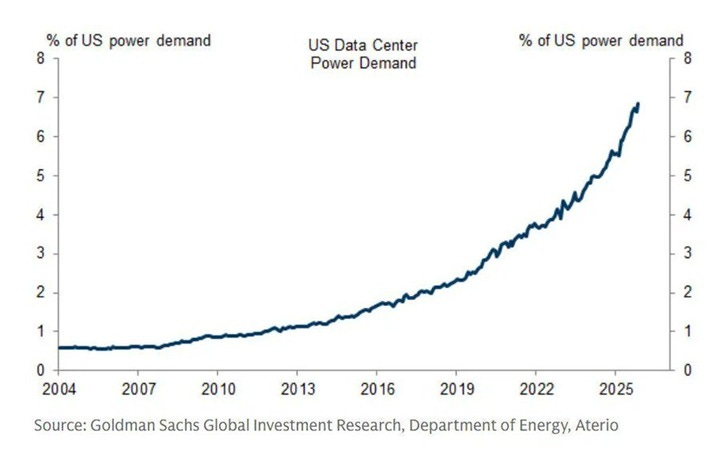
This means that AI and human consumers are going to increasingly be in direct competition for resources — electricity, land, and water. Right now it’s mostly electricity. But as AI continues to scale exponentially, hyperscalers will try to outbid farmers for land and convert their farms to data centers and power plants, driving up the cost of food. They will try to outbid residential real estate developers, making housing more expensive. In effect, AI will be muscling out the human race, without any army of robots involved.
And that’s a problem for Abundance Agenda 1.0. Abundance is about creating more supply, but if that supply just gets gobbled up by data centers, then abundance is failing.
The answer here is not to ban new data centers, as Bernie Sanders has called for. Instead, it’s to reserve some amount of land and other resources for human consumption — for food production, housing, and the production of electricity for households. This can be easily done with various zoning and land use policies. The implementation might be local and patchwork, but the message — “reserve resources for humanity” — is very simple.
This sort of “human reservation” policy fits very naturally into the overall abundance framework. It helps address both the cost-of-living problem and the fear of AI, and it’s complementary to efforts to produce more housing, energy, and so on.
Government as the owner of last resort
One big worry with AI is that by substituting for human labor, it will decrease the fraction of the nation’s income that goes to human workers. It’s easy to imagine a dark future where the lucky people who own the robots get everything, while people who depend on their own effort and smarts to earn a living are forced to the margins of society.
In fact, labor’s share of national income has already been going down, since the turn of the century:
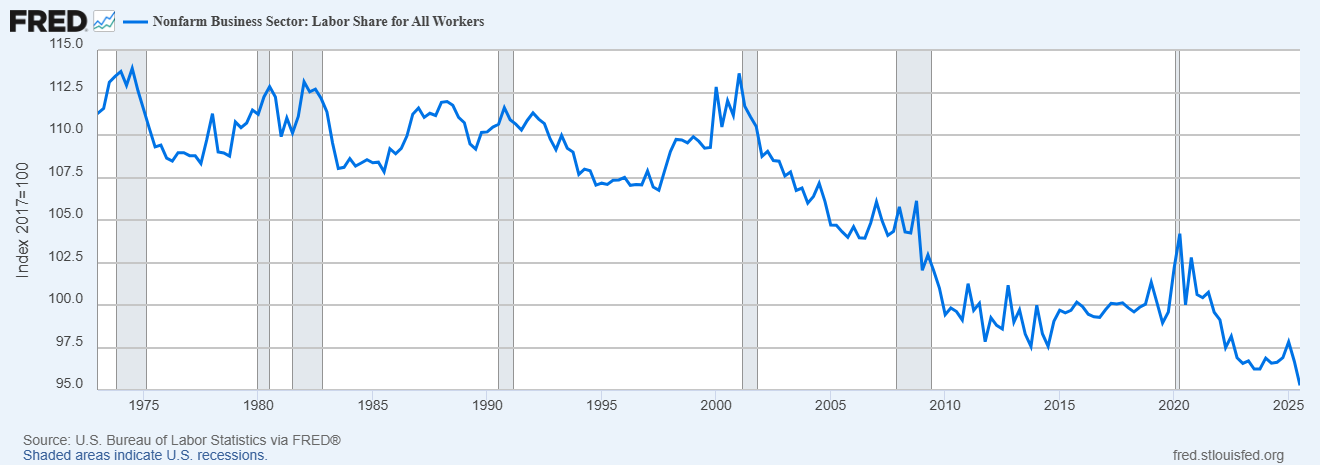
Worryingly, it took another sharp dive just in the third quarter of 2025. That probably isn’t AI — it’s too soon and too sudden — but a lot of people are going to be worried. And the longer trend is already disturbing.
The obvious solution here is redistribution. Contrary to what some progressives will tell you, the U.S. actually does a good job redistributing from the rich to the poor, and has been doing more and more of this over time:


The question is how to do it. These days, we mostly take from the rich using personal income taxes, and we give to the poor via government welfare and health care programs.
But if capital keeps eating the world, will we be able to do more of this? And will this satisfy the populace? I have my doubts. First of all, it turns out that it’s both politically and logistically difficult to raise taxes by a meaningful amount of GDP:
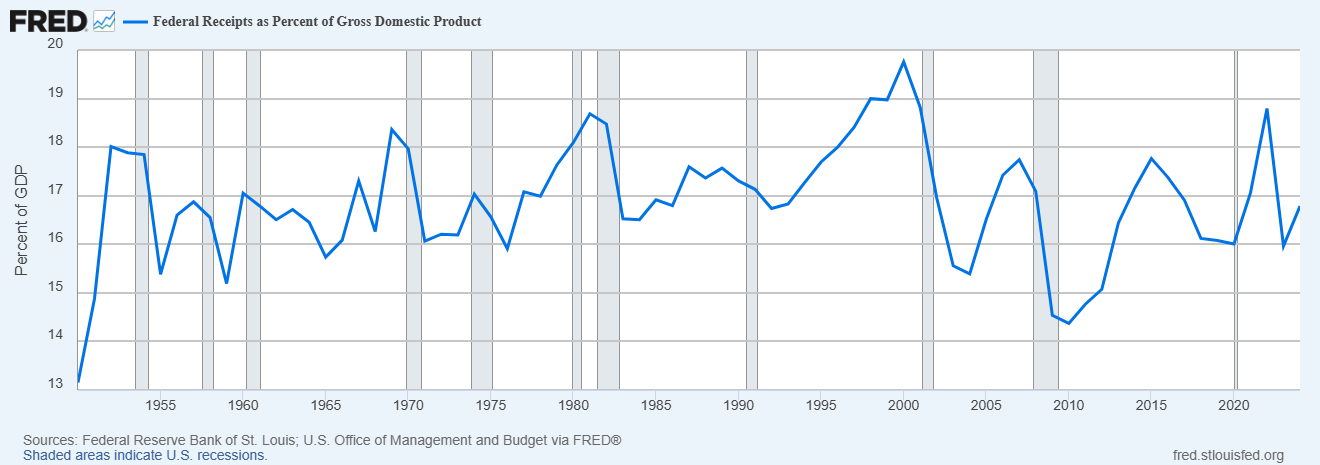
This is partly because rich people are pretty good at tax avoidance, and because Republicans periodically come into power and cut taxes.
There is another way. The government could use its tax revenue to acquire shares in companies. Then it would have a claim on those companies’ future profits in perpetuity. If Nvidia and OpenAI and Google end up eating more and more of the economy, and the government owns part of those companies, then the government can just redistribute part of those companies’ profit to the American people — either via welfare programs, or just by mailing everyone a dividend check.
This latter approach is what the Alaska Permanent Fund does. A U.S. sovereign wealth fund would do the same thing, except instead of getting its money from resource revenues, it would get its money from corporate dividends and share buybacks. Essentially, if AI is the new oil — a source of boundless wealth that needs very few human beings to produce — then a U.S. sovereign wealth fund should have a claim on that revenue stream.
Donald Trump has proposed creating a sovereign wealth fund, and has already started having the U.S. government take equity stakes in various companies. But this is a haphazard approach — it means the government owns part of some companies and not others, which can limit competition, distort the markets, and open up avenues for corruption.
The Democrats should simply systematize the process — have the U.S. sovereign wealth fund automatically buy a stake in the entire stock market, as well as large, established closely held companies like OpenAI. That way, no matter which companies succeed, the government will own a piece of that success. If capital’s share of income increases, the government can redistribute it, supplementing dwindling labor income.
There is a big question of how the fund would be funded. It could be funded by deficit spending, or it could be funded by increased taxes. One possible solution would be a temporary increase in the corporate tax, with the proceeds earmarked for the sovereign wealth fund. Companies would basically be handing money over to the government via corporate tax payments, only to see that money come right back to them as share purchases.
At this point, someone will probably point out that corporate taxes themselves work like government stock ownership — if you take 20% of a company’s profits every year, that’s not too different from owning 20% of it. But in fact, the sovereign wealth fund approach has several advantages.
First of all, like every other type of tax, corporate tax rates can be lowered as soon as a Republican gets into office — in fact, Trump did this in 2017. But Republicans are unlikely to have the government dump corporate shares, as this would cause the stock market to tank. Sovereign wealth funds are thus probably a lot more robust to the changing winds of political fortune.
It’s also possible to fund a sovereign wealth fund using taxes that are less distortionary than corporate tax. That would allow companies to reinvest more of their earnings, so that the payouts would be greater down the line.
Finally, a sovereign wealth fund probably conveys some intangible political advantages. Taxes naturally seem adversarial — a government taking money from its own citizens. Government ownership stakes, on the other hand, seem like an alignment of interests — the people of the nation having a direct stake in the success of their country’s businesses. Although the math isn’t much different, the optics could convey more of a message of “We’re all in this together” — a very Rooseveltian idea. And although the idea of a sovereign wealth fund might seem wonkish and cerebral, the slogan that everyone in America deserves a stake in the AI that their nation created could have some real populist appeal.
In fact, a few people on the left and in the center have been proposing this idea for a while. Democrats should do it.
Giving humans a chance
Finally, the rise of AI gives our leaders a chance to do something they ought to have done long ago — give American companies an incentive to invest more in their human workers.
Companies don’t train their employees nearly as much as they ought to. The reason is well-known — if you spend a bunch of money and time training an employee, and then they leave, you’ve paid to train someone else’s worker. This is why U.S. corporate training is so paltry and halfhearted — our workers are highly mobile.
In the age of AI, this problem will be even worse. Old types of work are becoming obsolete every day. In order to properly value their human workers, companies essentially need to engage in continuous research, experimenting with new types of workflow and complementarity. But if a company spends time and money figuring out new ways for humans to work with AI, those new insights will quickly spread to other companies, including their competitors. So instead, companies have a perverse incentive to simply try to replace human workers with AI, even if using both together would actually be more productive!4
In other words, on-the-job training is now a public good. And public goods need to be subsidized by the government.
The easiest way to do this is to have governments subsidize hiring. By some accounts, hiring of new graduates at big tech companies has almost completely collapsed:

The government can put its thumb on the scale for the humans here. It can pay companies to hire employees for at least two years. This will give companies an incentive to have more humans around. And while a company has some humans around, it might as well try to figure out how to get valuable work out of them, by having them try using AI in various ways.
Essentially, the government will be subsidizing private-sector research in the field of human-computer interaction.
If AI starts causing massive layoffs in white-collar industries, instead of just slowdowns in hiring, the government can also give temporary retention incentives. If keeping humans around for a while becomes cheap, companies will go back to hoarding labor like they did before the 1980s. And while those workers stick around, companies will have an incentive to find new types of jobs for them to do.
Hiring incentives and temporary retention incentives are not the same thing as paying companies to employ more humans over the long run. I am not calling for the government to put its thumb on the scale for humans over AIs. Economically speaking, my idea is really just a research subsidy. But importantly, the political optics of my idea might be just as good — in an age when everyone is scared of being replaced by machines, American workers will probably appreciate the government paying companies to hire humans.
All of these policies I’ve suggested are things that don’t really depend on how AI progresses over the next decade. They work just as well in a world of total human replacement as they do in a world where AI goes bust. These are rock-in-the-storm policies, meant to shield American workers from the winds of technological uncertainty and rapid change.
In that sense, although the substance is very different, my ideas are spiritually similar to the policies of the New Deal, which offered people a rock in the storm of the Depression, World War 2, and rapid industrialization. If Democrats want a winning economic policy program, I think it’s going to have to be something like this, that explicitly values American workers and American citizens while also refusing to make a bet on what the technology of ten years from now will look like.
Except the last one.
With some of the subsidies, of course, being captured by highly-paid executives and various asset owners in the care industries.
In fact, it raises those questions even for the workers whose jobs don’t actually depend on government subsidies, because it’s hard to be sure who the essential workers really are.
Daron Acemoglu and Simon Johnson make this point in their book Power and Progress. But they offer no concrete program of how to incentivize companies to invest in human-machine complementarity. Instead, they propose redirecting technological innovation toward technologies that complement humans more naturally and easily. I view this idea as more than a bit ridiculous. But the basic notion of investing in complementarity is good.
Brilliant and compelling, however, corporate ownership would give government a more direct say in corporate governance. I am concerned that a broken government, one led by corrupt, power hungry, egomaniacal, greedy politicians focused primarily on their own personal enrighment and prejudices would be the undoing of this approach. Noah, perhaps you can explore this concern and approaches to address it.
This policy advice is a bit too creative. Look for policy with more or a track record.
Human reservations? Data center demand for electricity is an issue, and in some cases, it could make sense to protect local ratepayers from higher electricity prices due to data center demand. But we don't need to reserve LAND! Data centers' land footprint is tiny compared to what's available.
As for a sovereign wealth fund, countries tend to do that as a way of saving a temporary windfall, like in a resource boom. Strategic investments in key companies could sometimes be smart, though both incompetence and corruption are big risks. But why borrow to buy into a stock market that looks overpriced?