


Well this is a strange thing to write about on an economics blog, isn’t it? When I started this blog, I made a deal with myself that I’d write about whatever I felt like writing about, even if it doesn’t fit my usual output. I’ve given my sci-fi and anime recommendations, talked about my clinical depression, and even published a chat with a robot. I also did one self-help post, about how to have friends past age 30:

But today might be the strangest post of all — I’m going to give some dating advice for men. If that doesn’t interest you, my apologies; I’ll be back with more econ-ish content in the next post.
For what it’s worth, I do think dating advice is an important topic of public concern. Data on romance and relationships is always iffy, because it’s based on surveys where definitions change, people lie, and samples tend to be biased. But it sure looks like young Americans aren’t dating as much anymore. Here’s Shadi Hamid in the Washington Post:
Over two-thirds of young adults have either not dated at all or only gone on a few dates in the last year. One of the main reasons? They lack confidence and don’t know how to approach the opposite sex, according to a report on America’s “dating recession” from the Wheatley Institute and the Institute for Family Studies…If trends continue, one-third of young adults will not get married and one-fourth won’t have kids.
Anecdotally, from talking to younger people and looking at other data sources, this seems to be the general trend. And I think it’s a negative trend, because having done happiness research in grad school, I’m well aware that romantic relationships are one of the most important predictors of long-term happiness.1 Young Americans have become much more unhappy, so I think if people had better dating lives, some of that could be reversed. Better romantic relationships could also help the fertility rate — these days, birth rate collapse is due mostly to fewer and fewer people forming couples at all.
So here’s a blog post with my dating advice. I realize that many of my readers will not find this post particularly useful. It’s specifically aimed at men, so if you’re a woman, I apologize — as a man, I’m just much more qualified to talk to other men about this. Also, most of my male readers are probably already married or in relationships, so they probably don’t need this advice. So I hope that even if it’s not useful, this post will still be entertaining to the people who don’t need it.
Also, before you read this post, please be warned: I’m going to talk very matter-of-factly about sex and sexuality. If you think sex is a topic unbecoming for a serious econ blogger to talk about, or if you feel it’s taboo or sacred, then please skip this post and accept my apologies. Personally, I think our society’s romantic problems are well past the point where we can afford to treat sex as something mystical that will just take care of itself without us needing to think or talk about it explicitly, but if you disagree, I respect that.
Additionally, please be warned that although I will sometimes use the word “girls” to mean “women”, in keeping with the American colloquial usage of the term “girls” to refer to adult women in a romantic context, everything I say should be taken to only apply to adults and adult relationships. (And now is a good time to say — and it should also go without saying — that the most important piece of advice when dating is to always obtain consent.)
You’ll also notice that my advice is very general stuff. It’s not about techniques for getting a date or getting someone into bed. It’s about how to think about dating — who to get advice from, what to expect from a normal dating life, how to be comfortable about various aspects of the process, and so on. I view specific techniques for attracting women as less important — they’re heavily dependent on cultural context, personality type, and a bunch of other factors. In general, I think once you have the right mindset about dating and romance, you can just experiment to find the specific methods that work.
My basic pieces of dating advice for men are:
Think carefully about what you actually want from dating and romance.
Be very distrustful of people who talk to you about dating and romance on the internet; these people rarely have your best interests in mind.
It’s crucial to realize that sex and romance are achievable by regular, average men — not just by hyper-attractive or high-status “Chads”.
Women want regular, average men for lots of reasons — for companionship, for sex, and for helping to raise kids.
Being attractive is important, but so are A) actually wanting romance, and B) learning to communicate with women.
First, let’s talk about why you would even want to take advice from me.
Why on Earth would you take dating advice from me?
There are a lot of guys on the internet and in the media who will offer you dating advice — on forums, in self-help books, even in coaching sessions you can sign up for. These gurus almost invariably tout their expertise in the matter — they pick up hot chicks with ease, they’ve slept with hundreds of women, and so on.
I’m definitely not one of those guys. I’m an unmarried man over 40, and my “body count” is certainly not in the hundreds. In fact, for a decade, I was uninterested in sex and dating (probably as an aftereffect of depression). If you want to learn how to walk into a party and go home with the hottest girl in the room, or hook up with 100 women on dating apps, I’m not someone who can tell you how to do that.
Instead, despite my long period of asexuality, I’m basically a normal, average guy. I’ve had a number of long-term relationships — I’m in one right now — and some shorter-term hookups too. I’m pretty unexceptional. As a lonely single man, why would you take advice from an average shlub like me?
Well, maybe you wouldn’t. If you really want to be the charming hot guy who gets all the girls — the “Chad”, as they say — you should go get advice from one of those guys. (Having read a few of those books, I think Mark Manson’s Models is probably the best.) Or maybe you should just practice until you get good enough to write a seduction guide of your own.
But is that really what you want? I think most men just don’t think about this question very much. A lot of men assume that getting laid is very hard, so they should just aim to become as good at it as humanly possible. Others simply accept the old stereotype that men want to sleep with as many women as they can, without considering whether they themselves fit that stereotype.
The truth is that lots of men wouldn’t actually like to be a Chad. Sleeping with hundreds of women might sound awesome if you’re currently sleeping with zero women, but once you start actually making a bit of progress in that direction, you quickly realize how soul-crushing and lonely that lifestyle can be. A lot of men — maybe even most men — get emotionally attached to our sex partners. There are well-known natural mechanisms for this. For those guys, going through one woman after another, again and again, for years and years, is just making and breaking those attachments again and again. That’s not fun, that’s self-punishment.
So if you wouldn’t really enjoy the Chad lifestyle, why would you want advice from a guy who does enjoy it? If you were looking for your dream home — or even just for a place to live for the next few years — would you really want to take house-hunting advice from a guy who switches apartments every week and lives out of a suitcase? Maybe, maybe not.
Maybe it would also help to get advice from some average, regular guys. In the days before the internet, most of the male role models in any guy’s life — fathers, athletic coaches, teachers, bosses — would be average, regular guys. When we all went online, we lost that. I don’t want to set myself up as a role model, but perhaps the internet could benefit from more average-guy input.
Another thing to consider is this: A lot of the people on the internet offering romantic advice are trying to exploit you. Seduction gurus, of course, make money from getting you to buy their books, watch their videos, take their courses, or attend their seminars. That’s just typical capitalism; some of them are probably offering good products, while others are probably just slick salesmen.
But most of the people on the internet are trying to exploit you in less obvious ways. Twitter trolls want your likes and retweets, and redditors want your upvotes. Political activists want you to attach yourself to their cause. Lonely people want your company, while sadists just want to enjoy your suffering. Very few of the people online who make pronouncements about sex and romance are doing it because they want you to get a girlfriend and be happy. If you did that, you might get off social media, and they’d be left all alone.
So why am I any different? Because this is just a one-off blog post, for one thing. I usually write about economics, and I have no plans to pivot to writing about sex and dating. I don’t actually care if you view me as an expert here, or if you agree with me — after this I’m going to go back to writing about interest rates and industrial policy.
My reason for writing this is simply that — as regular readers of this blog are probably aware — I want to see more people in this world be happy, well-adjusted, and fulfilled. Sex and romance are a big part of that. If just one or two people get a healthier outlook on that aspect of life from reading this post, then my time won’t have been wasted.
The incels are just wrong
It’s impossible to be on the internet these days without encountering “incels”. The term is short for “involuntary celibate”, meaning a guy who can’t get laid even though he wants to.2 In recent years, the term has come to mean a specific ideology. You can read an academic summary of incel ideas here, or a more simplified account here. I can try to summarize the basic worldview here.
Essentially, the incels believe that women are only attracted to a very small number of men — guys who are extremely handsome, extremely high-status, extremely rich, etc. This, they believe, naturally shuts almost all men out of the dating market and condemns them to involuntary celibacy. All the girls go for the top few guys (the “Chads”), leaving all the other guys out frustrated and alone.
For a lonely or sexually frustrated man — especially young men, without much sexual experience — this is an incredibly seductive and powerful idea. I would bet that most young men at least toy with ideas like this at some point in their lives. For about a year and a half while I was in college, I independently came up with ideas fairly similar to this. (I changed my mind when I got a girlfriend, but that’s precisely the problem — guys who believe the incel canon often get “blackpilled” into not even trying to find a girlfriend at all, which only seems to confirm their beliefs.) In fact, you can find instances of men making incel-adjacent claims for centuries.
It’s also natural — and not necessarily unhealthy — for men to get together and complain about their romantic difficulties as a way of bonding with other men. Women do this too. Getting together with your same-sex friends and saying “Men, amirite?” or “Women, amirite?” is a time-honored activity, and I think it’s probably usually benign.
The problem emerges when this activity moves onto the internet. When frustrated young guys gather in forums for like-minded people, they amplify each other’s worst fears and become an echo chamber. They also expose themselves to trolls — sadists who go on those same forums and tell naive young men that they’ll never get laid, just to laugh at their misery.
Nowadays, it’s almost impossible to talk about dating and romance on the public internet without being attacked by incels. Freddie DeBoer wrote about this a couple months ago, in an excellent post called “The Incel’s Veto and Other Observations”:

He writes:
The incel’s veto is the specific prohibition against men ever frankly discussing sex in any positive way that directly reflects the fact that they have sexual experience and thus have earned the consent of women…[I]n the 2020s we live in a weird discursive space where our perceptions of romantic and sexual behavior are constantly being filtered through the lens of the people who have experienced very little of either. The incel’s veto helps spread the ubiquitous online assumption that nobody is getting laid, anywhere, ever, and that it’s inherently pathological to treat sex and romance as not just healthy aspects of human life but as mundane and achievable.
I recently got a taste of the “incel’s veto”, when some incels found a video of my birthday dinner from 2025 and got very mad at the various happy couples in the video.
Incel ideology is certainly not the only toxic, unhelpful package of beliefs about sex and romance that’s going around on the internet. There are many others. But I find that young men are especially susceptible to this one.
And incel ideas also contribute to a peculiarly toxic strain of right-wing politics. Some percent of incels turn to the “red pill” — they believe that if women can be barred from having jobs, it will force them to accept lower-status men as mates out of pure economic necessity. Have you ever read a fairy tale about a prince who tries to force a poor girl to marry him, even though she clearly hates him? Red Pill ideology basically thinks we can scale that approach up to industrial levels, so that every regular guy becomes the evil prince.
None of this is good for our society. We shouldn’t want men getting “blackpilled” into despair or “redpilled” into right-wing nonsense. Fortunately, the incel worldview just isn’t true — it’s based on a hodgepodge of exaggerations, bad assumptions, and misreading of the data.
For example, the claim that only a few men get all the women is just empirically false. The blogger Maximus at the blog The Nuance Pill has documented this exhaustively:
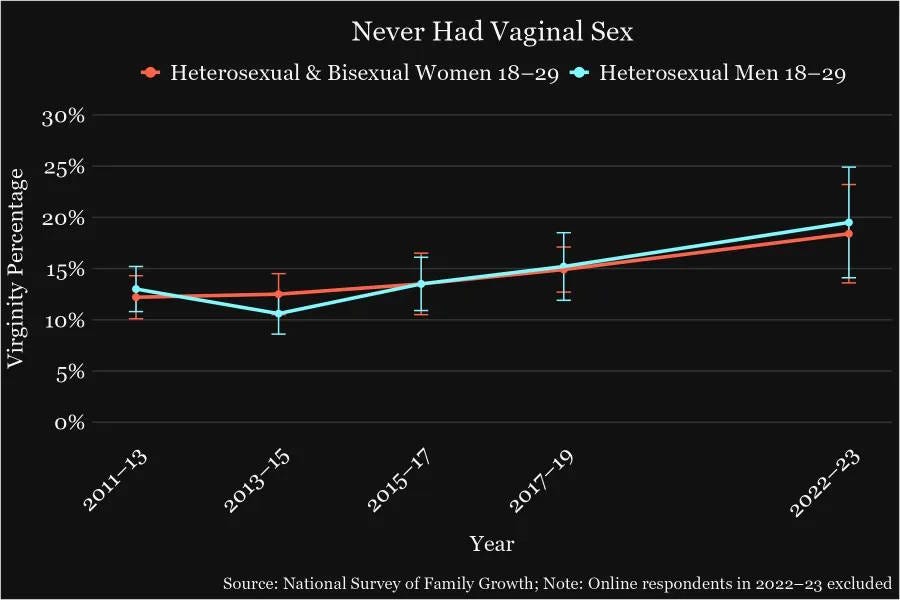
For one thing, according to surveys, although sexlessness has risen among young Americans in recent years, it’s about the same for young men and young women:
And when we look at who’s had sex in the past year, the picture is the same:
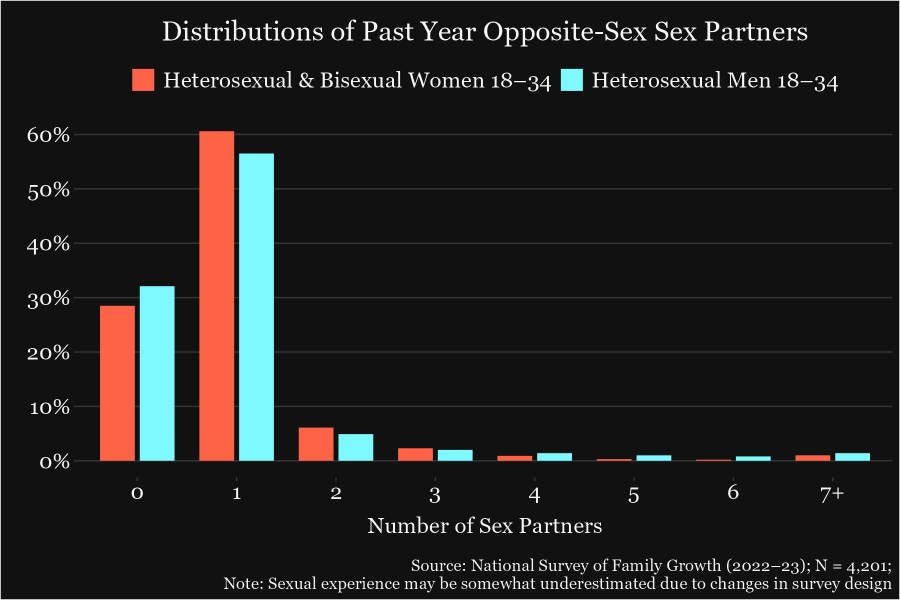
Sexlessness rates of ~30% for young people is pretty bad news, in my opinion, but the number is pretty equal for men and women. And in any given year, most men and women are monogamous, with only a few people having large numbers of sex partners. Other surveys like the General Social Survey show the exact same pattern, reducing the likelihood that these results are being driven by bad survey technique or large-scale lying.
It turns out that the tendencies that the incels believe drive all of sex and dating are real, but pretty weak. Yes, male sexlessness is more common than female sexlessness, but only a little bit. Yes, there are more men than women who report a large number of sex partners, but the difference is very small. A majority of young people are just having sex with exactly one other person — no more, no less.
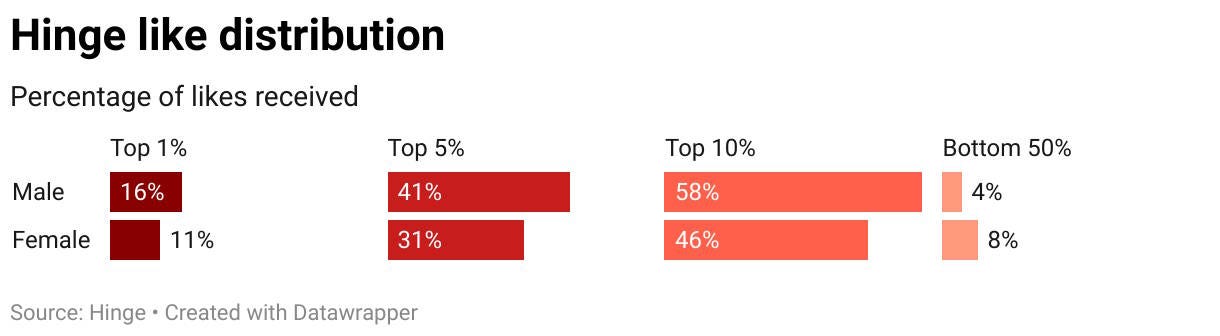
The same principle holds when we look at other standard incel beliefs. Maximus has a good X thread laying out the evidence of inequality on dating apps. Incels will often tell you that a few men get all the likes and matches on apps, while most women get both. In fact, it’s pretty gender-equal. For Hinge, men show a little more inequality, but not a lot more:
And the same is true of Tinder matches:
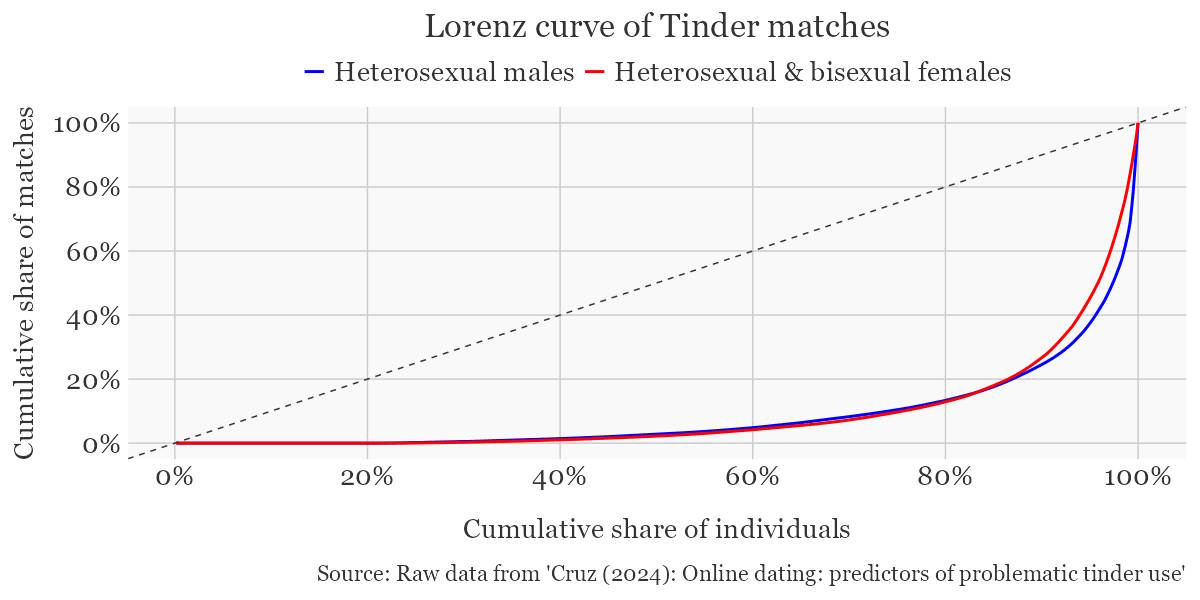
As the thread goes on to show, the fact that the average woman gets much more attention on dating apps than the average man is due not to inequality of interest, but to A) the fact that there are a lot more men on dating apps than women, and B) men are a lot more likely to initiate contact than women.
Other common incel talking points are similarly exaggerated. It’s true that in modern rich nations, men are somewhat more likely than women to never have children, but the difference is just a few percentage points in most rich countries:
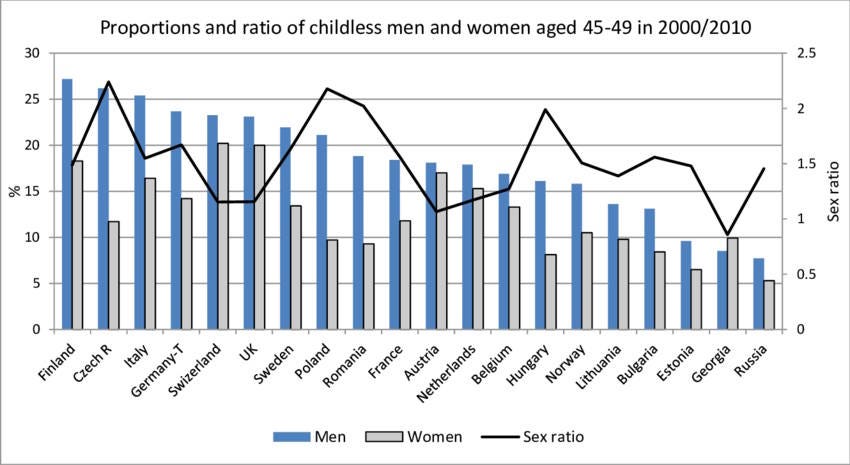
(And some of this difference may be due to more women wanting children.)
The same was usually true throughout human history. Before agriculture, more women reproduced than men, but the ratio was not large, and in some regions it was flipped. There was a period after the invention of agriculture where the ratio was very high, due to things like war, kings siring tons of kids, etc., but it’s hard to argue that this was due to women’s choices.
Anyway, this is only the tip of the iceberg; I can do a longer post about incel tropes if people want. The short version is that almost every incel trope is grounded in a slight statistical tendency that incels exaggerate wildly. When you look at the actual numbers, the same simple fact asserts itself again and again: Most men have sex, most men and women are both pretty monogamous, and most men reproduce.
It might seem like I spent a long time here debunking some fringe online ideology in a post about dating advice. But I did this because it gave me a chance to show, with data, the central fact that motivates the rest of my advice: Dating and sex are very achievable for a regular guy. You do not have to be 6’5”, work in finance, or have a trust fund. You just have to be a regular, normal, typical guy.
Are there guys who have some special problem that prevents them from dating? Yes, of course! There are men with physical disabilities that prevent sexual function. There are men with depression (which basically prevents you from doing anything), and other mental illnesses. There are men with erectile dysfunction. There are some men for whom the struggle for economic survival absorbs all their time and money. There are men in prison. There are men who are gay and in denial about it. There are asexuals who just don’t want to date.
My advice, unfortunately, is not going to work for those men. There are doctors, psychotherapists, and other professionals who can help with some of those problems, but not all of them. Some men really do draw the short straw and get screwed over by circumstance.
But for the average, typical guy, dating is a very possible mission. That’s who my advice — speaking as a guy who is fairly average in this regard — is aimed at.
Why women want regular, average men
As I said above, my general advice to men is to think less about what women want, and more about what you want from dating and romance in the first place. But OK, why would women want a regular, average man?
A lot of men genuinely have no idea how to answer this question. They have no idea what a regular, average man has to offer to women. You hear guys joke that they “tricked” women into sleeping with them, or dating them, or marrying them and spending the rest of their lives with them and bearing their children. That joke is based on a core of real insecurity — the idea that the average guy is fundamentally undesirable to women, and that to get a woman to want him, he has to either be exceptional — a Chad — or to pull the wool over women’s eyes and get them to act against their best interest.
This is crazy. As we saw from the chart above, most men have sex in any given year. That means some women must want them. They can’t all be super hot or super rich or super famous. Most of them must be regular, average guys. Short guys, ugly guys, poor guys, nerdy guys — most of them are getting laid. And it’s just not realistic to think that most women are “tricked” into sleeping with these men.
Freddie DeBoer puts it well:
Though it opens me up to criticism, I still believe that men getting women to engage in consensual and enthusiastic sex is not the moon landing. It’s not a feat of engineering requiring years of specialized training and a jaw that could cut glass. It is, in fact, one of the most democratically distributed activities in the entire history of our species, something that nervous people, ugly people, broke people, awkward people, people with bad teeth and worse haircuts and zero social media presence have been managing to do, successfully and repeatedly, for roughly three hundred and fifty thousand years of anatomically modern human existence.
The numbers simply don’t lie. Most women must have some reason to desire sexual, romantic relationships with regular, average men.
What are those reasons? In my experience — especially from having lots of female friends and watching them with their boyfriends and hookups and husbands — it boils down to three basic things:
Companionship
Good sex
Help with raising kids
Companionship is far and away the most important of the three. Once a woman stops living with her parents, her life becomes a lonely enterprise. If a man doesn’t keep a woman company, who will? She has friends, but most of them eventually move away or withdraw into their own families, and have less time for her. She has coworkers, but she’ll change jobs (or they will). Her romantic partner is the only person who sticks with her — who moves with her, who always sees her at the end of the day, who will be there for her at the end. Consider this chart:
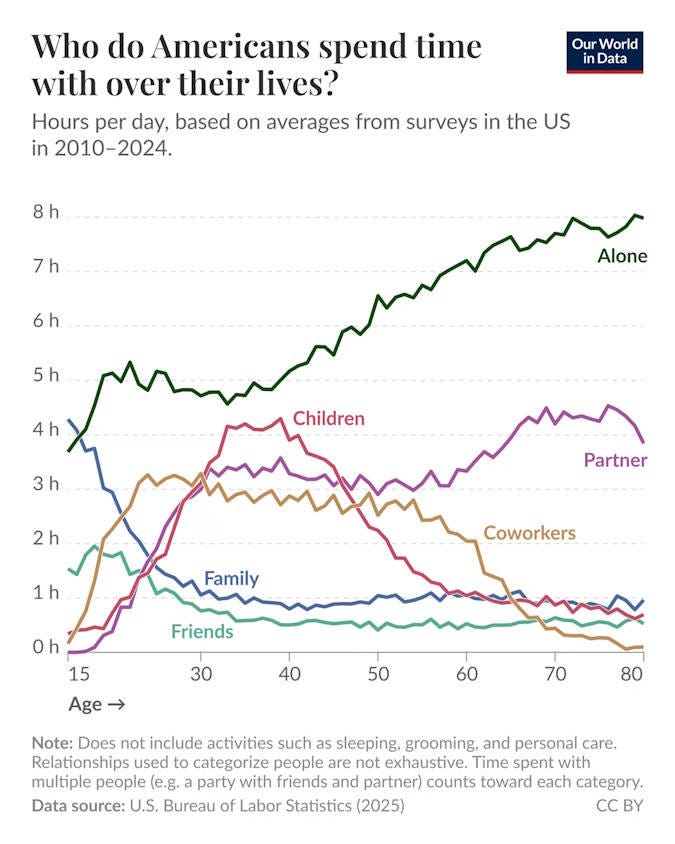
Now consider this poll:
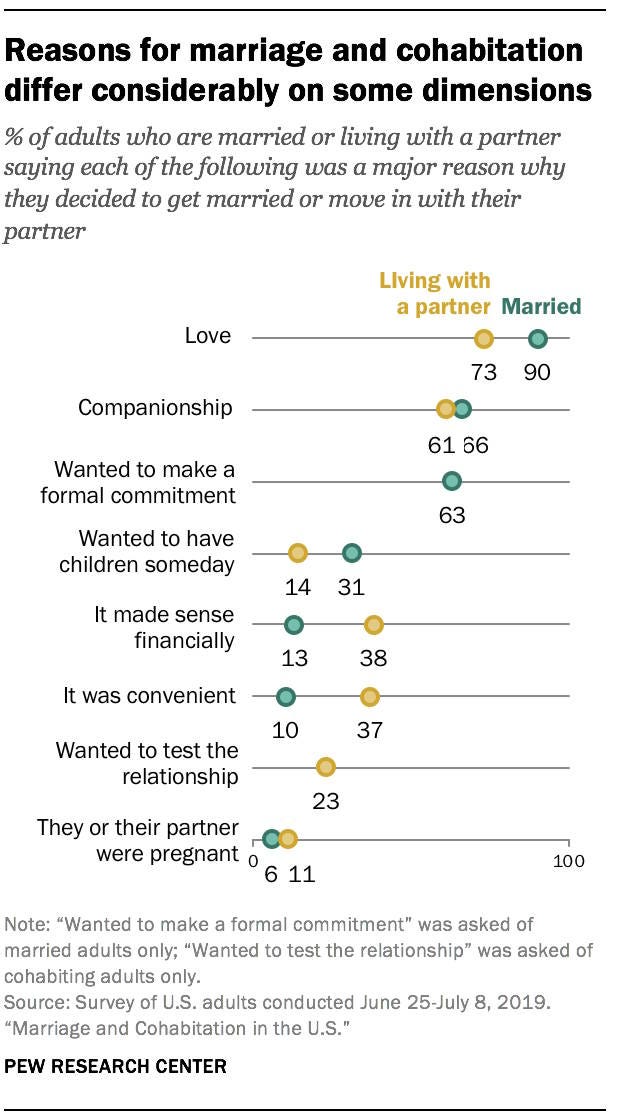
Companionship means keeping a woman company — going to dinner, cuddling on the couch, talking about life, etc. But it means a lot more than that. It means helping with unexpected challenges, like health problems or finances. It means giving her advice on her job or her personal problems. It means throwing spiders out of the house when she’s too scared to grab them in a cup.
This, from what I can see, is the main reason women want men. And the Chad who’s going to be on to a different woman next week, or who’s sleeping with five women at a time, just isn’t going to provide this sort of steady companionship.
The second thing women want from a man is good sex. Sex is a very important part of romantic relationships — there’s a reason we don’t marry our platonic friends. A lot of men seem to think that women are inherently asexual, or at least have much lower drive than men, but this is just wrong. Research shows that the strongest predictor of sexual satisfaction in women is just how often they have sex. Men do have stronger libidos than women on average, but the difference is small — by some reckonings, it’s less than half as big as the male-female difference in height.
For a man, this basically means two things:
You should learn to be comfortable about sex, including the idea of sex and the actual act itself.
You should learn to be good at sex.
A lot of guys have hangups about sex. Sometimes these are religious, sometimes they’re related to feelings of inadequacy, sometimes they’re related to simple squeamishness and modesty. But women have these hangups too! And more, in fact — women have the risk of pregnancy, and they run the risk of having a man get violent during sex.
Men have to help women out by being as comfortable about sex as they can. You basically just have to get over your hangups as much as possible. That’s easier said than done, of course. Obviously, one way to get comfortable with sex is to do it a whole bunch of times (but if you can do that, you probably won’t need my advice). But there are other ways. You can talk to friends about it. You can read stuff that people — especially women — write about sex on the internet. You can even go to therapy.
But the important piece of advice here is about the goal: to make sex something that you’re not scared of, disgusted by, mystified about, or overawed by.
You should also be good at it, of course. Being good in bed won’t just help you keep a girlfriend; it’ll make you more confident about the value you can provide to women, as a man. The most important way to be good in bed is simply to pay attention to your partner and observe what makes them feel good. It’s kind of astonishing how quickly this will make you a good lover.
Incidentally, this is why a woman might want to have sex with a regular, average guy, instead of a Chad type who has slept with a million women. The Chad type won’t have as much time for her, for one thing — he’ll be off with one of his other girls, or he’ll get bored and dump her. That doesn’t make for a great sex life. And despite his extensive experience, the Chad’s approach to sex will be pretty standardized and generic, since A) he’s calibrating to the average of a bunch of different women, and B) he’s not going to spend much time with any one woman so he doesn’t need to invest much time and effort learning what she likes.
Anyway, if you haven’t had much sex, there are still ways you can prepare. One thing you can do is read things women have written about sex, to get some ideas.3 If you do this, you’ll quickly learn what a huge variety of different things women desire.
In 1973, the author Nancy Friday asked a huge number of women about their sexual fantasies, and compiled them into a book called My Secret Garden. This book is incredibly eye-opening, because what you realize is that different women want a huge variety of different things. In fact, if you’re the kind of guy who thinks women are all the same, my advice is to read My Secret Garden and realize how incredibly different they actually are.
Anyway, a third thing many women want from men — eventually — is help raising kids. Most women want to have kids at some point, and being a single mom is very difficult, both financially and time-wise. They want to find a good, dependable man to help shoulder the financial, logistical, and physical burden of child-rearing. (This doesn’t mean a dad needs to make more money than the mom does — even if she makes $200,000 and he makes only $80,000, that’s a 40% boost to family income. That’s a lot.)
Most Chad-type guys aren’t going to be good dads. And so lots of women are just bored with these kinds of guys, since they can’t fantasize about being together for the long term. Hooking up with Chads might be convenient, or even fun, but for lots of women it’ll feel empty because they know it’s just a fleeting dalliance.4
Anyway, I’ll quote Freddie DeBoer’s essay one more time:
The woman across from you at the coffee shop may be someone who will never ever want to fuck you - that is often the case - but she’s also not a jewel locked in a vault that only a six-foot-three hedge fund manager with a Greek statue’s bone structure can crack. Rather, she’s a human being with free will and a body that wants things, a mind that gets lonely sometimes, a heart that may like very much to find someone else to press against in the dark… a person, in other words. Just like you, you absolute disaster, with your anxieties and your weird hobbies and your fridge that only has condiments in it! Just like you. Just like you.
Yes.
Attractivity, proceptivity, and receptivity
Biologist Frank A. Beach described three types of female sexual behavior: attractivity, proceptivity, and receptivity. When I took a class on human behavioral biology from the famous Robert Sapolsky, he noted that these terms could also describe three very general things that anyone — men or women included — needs in order to actually have sexual success.
You can think of attractivity as how attractive you are, proceptivity as how much you want sex and romance, and receptivity as how easily you can tell who wants you back.
Most dating advice for men focuses on attractivity. There’s the easy stuff: Stay at a healthy weight, go to the gym and get in shape, learn to dress well. I think you should definitely do all that stuff! Being hotter won’t automatically make women like you, but it certainly won’t hurt, and it’ll make you feel more confident.
There’s also a ton of stuff about “game” — pickup lines, flirtation, seduction techniques, and so on. This is definitely a part of being attractive, for both men and women. Attractiveness isn’t just physical — a hot-looking person who sits silently in a corner is probably not going to have as much romantic success as someone who goes out there and tries to talk to people in an attractive manner. My view on this is that each person should develop their own method of flirting — it’ll feel more authentic than trying to copy someone else’s canned routine. But really, I’m just not an expert in this at all.
Proceptivity, on the other hand, is incredibly neglected. As someone who spent a decade not wanting sex or romance at all, I can guarantee you that if you don’t actually want these things, you’re not going to get them.5 You might want a girlfriend in the abstract sense, but if you don’t have the raw drive to go out and get one — to ask out the girl at the coffee shop, to get on the dating apps, to have your friend set you up, etc. — the desire is likely to remain abstract and unfulfilled.
How can you make yourself want sex and romance more? Well, I do put some credence in the research showing that porn overuse decreases libido, so I advise men to cut down or eliminate their use of porn. But usually, I think the main problem with proceptivity is that men don’t think carefully about what they want from sex and romance.
If you think that dating means you have to approach a million women in bars or on apps, like the seduction gurus do, then it might not sound appealing — especially if you’re shy and introverted. If you’re a romantic kind of guy who just wants one special girl, and you think dating has to be about having one-night stands with dozens of people, you might just avoid the whole thing.
A good way to increase proceptivity, I think, is to sit around and imagine what your ideal dating and romantic life would look like. It probably won’t go exactly like that — reality rarely matches our fantasies — but it’ll help you envision a dating process that you would actually enjoy doing, rather than one you think you have to go do because someone told you to. The more clearly you can envision your ideal romantic life, the easier it’ll be to figure out the first steps toward that life, and the more motivated you’ll be to take those steps instead of sitting at home watching YouTube.
Another impediment to proceptivity is the fear of rejection. In American culture, men are expected to take the lead romantically, and this means they’ll often end up getting rejected. A lot of guys are so scared of this rejection that they dread even trying to date in the first place.
I don’t have any silver bullet to eliminate the fear of rejection; it’s something a lot of people struggle with, and nothing I say is going to magically make it fine. One thing you can do, of course, is just bite the bullet and practice asking people out and getting rejected until you get used to it. But a lot of guys who are shy or introverted aren’t going to be able to do that.
For those people, I think the only solution is to try to get a healthier perspective on rejection. One such perspective is: Rejection is not a bad thing. If a woman doesn’t want you, that’s fine; you’re in the same situation you were in before you even thought about asking her out. And if you keep getting rejected by a bunch of different women, that’s useful feedback — it helps tell you that you’re doing something wrong, and that you need to adjust. Thinking of rejection as some sort of personal humiliation is pointless. It doesn’t mean you’re a loser, or inherently unattractive, or destined to be alone, etc. It’s not some test that you should have passed. I realize it’s easier to say these things than to believe them, but I think it’s a healthy perspective to aim for.
Anyway, this brings us to receptivity. As a man, being able to figure out when a woman is interested in you is incredibly important. If you aren’t good at this, women might get scared by you, or think you’re a creep. But it’s hard! Most men aren’t born with the magic ability to know whether a woman likes them. You can get good at this, but it requires lots of practice — and in the meantime, it’s easy to make mistakes.
But I think there is a way to compensate for low receptivity, especially when you’re just starting out dating. It’s to be clear and explicit. If you are romantically interested in a woman, ask her on a date, and use the word “date”. Say “Would you like to go on a date with me?”.
This accomplishes several things. First of all, dating apps have made women very accustomed to using the word “date” all the time, so if you don’t use the word, they might feel strange or confused. Second of all, saying “date” removes ambiguity from a situation — instead of having to sit there wondering whether someone likes you or not, you can just ask them out and find out immediately. If she’s not interested, you can just move on quickly and not waste your time, instead of agonizing for weeks over the uncertainty. Third, saying “date” avoids the dreaded “friend zone”, because it makes it clear that you want something other than friendship.
In fact, this is really my one and only piece of concrete advice about how to get a date. There’s a heck of a lot more to it, of course, but I think that if men have the right mindset toward the whole thing, then learning how to do it in practice will be fun and exciting instead of heartbreaking and terrifying. If you start with the right attitude toward dating and romance and sex, the other pieces will eventually fall into place.
Update: If you don’t believe the hard data showing that regular, average men find romance all the time, you can just look at social media for anecdotes. There was recently a “mutuals to lovers” thread on X that showcased a bunch of couples who met on the app. Here are a few examples:


Here’s another tweet I enjoyed:


It’s the most regular, normal thing in the world. It happens millions upon millions of times every day. Always remember that.
Correlation isn’t causation, but the mechanism is well-understood.
A female incel is called a “femcel”.
Another is to have platonic female friends who you’re close enough to that you can talk openly about sex. But please don’t use this as a way to try to hit on your friends. The purpose of having platonic female friends is to have friends, not to get laid!
In fact, I have friends who are Chads who keep getting dumped every time they try to give up their promiscuous ways and settle down with one special girl. Women just don’t take them seriously, even when they want to be taken seriously. If you’ve slept with 200 women, it’s very difficult to convince the 201st that she’s different.
Well, not very often at least.
As a 44 year old man who has been happily married for 20 years to the girl he met in his high school library, I'd add a few pieces of advice on long-term happiness:
1) The traits that spark attraction and the traits that make for stable long term relationships are different. Not necessarily in conflict with each other for most people, but they are different. When you're young, it's easy to convince yourself that sheer force if attraction is enough to make it work and it is not. The two Big Five traits of conscientiousness and agreeableness in combination are usually associated with good outcomes for a partner for life.
2) The best test for if you've found the one is whether she sticks with you when times are hard. Naturally, you have to do this for her too.
3) As Noah said, it's okay to be a regular guy, but it helps to have your shit together. Have some goals and direction in your life and work actively toward them. Have hobbies that don't involve a screen (it's okay to like video games, but have more going on than that). Get good at something that will make people want to talk to you. You don't have to be a "chad", but being interesting and resilient is important.
Take this article's advice to heart, my young brothers. I'm what Ali Wong would classify a "kind 6," and I've had some long dry spells in my 83 years (well, 65 years since I paid a twenty-something bar girl in Tijuana to end my virginity), but I also had many fulfilling relationships before my marriage at 48 (the most fulfilling of all). Just be friendly, be honest, and if you want to know what a woman is thinking, ask her.