

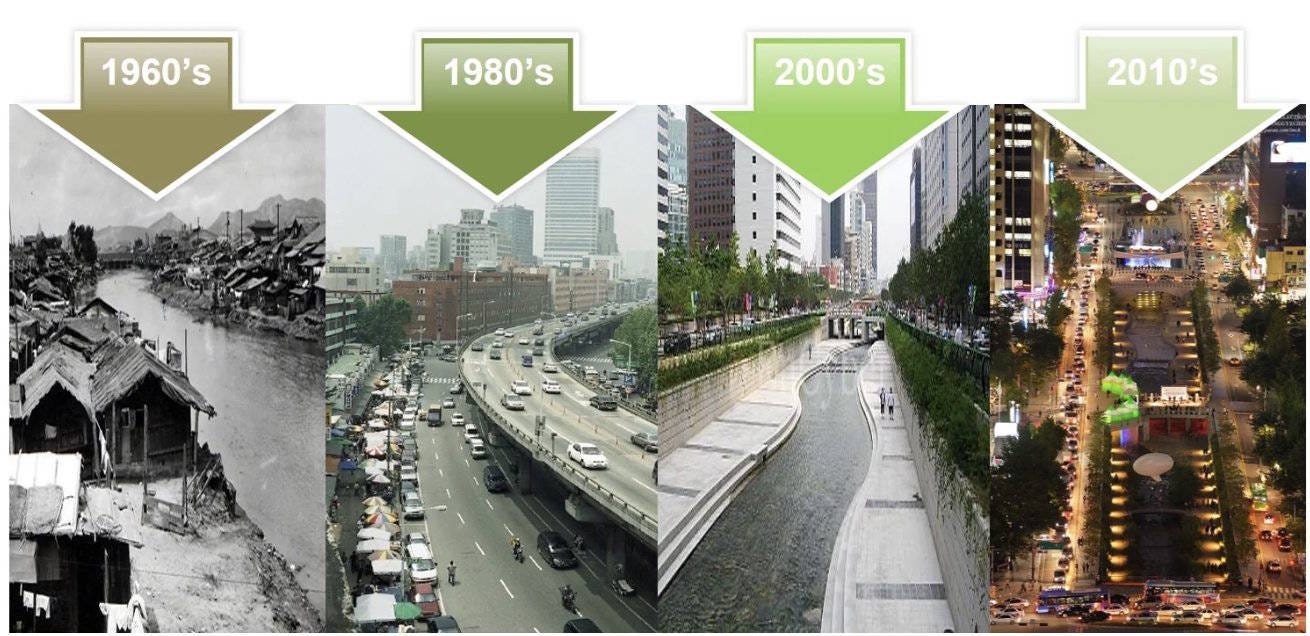
The above image is from a recent tweet by University of Pennsylvania economist Jesús Fernández-Villaverde (henceforth referred to as “JFV”), in which he criticizes the field of development economics for ignoring the big questions. He writes:
A fundamental lesson from my posts these last two weeks on modernization, industrial policy, and development is that development economics should be about understanding why South Korea got rich but Bolivia did not.
The current field has largely given up on that question. Sharply identified RCTs on small micro programs are a fine way to publish in the AER and get tenure at a fancy university, but a profession that knows everything about microfinance impact evaluations and almost nothing about industrialization has misallocated its own intellectual capital on a pretty heroic scale.
JFV’s critique of modern development econ isn’t new. Eminent economists have been complaining about randomized controlled trials for years. I wrote about this back in 2020:

In 2019, Lant Pritchett — then at Oxford — made an argument very similar to JFV’s when he criticized that year’s Nobel winners:
People keep saying that the recent Nobelists “studied global poverty.” This is exactly wrong. They made a commitment to [the RCT] method, not a subject, and their commitment to [that] method prevented them from studying global poverty…
[P]overty programs…account for less than 1 percent of total variation in poverty…[C]hanges in [actual] poverty…are overwhelming associated with growth in median income/consumption…[V]ariation in the size and efficacy of poverty programs had little or nothing to do with poverty reduction…So what the Nobelists really did was…using a particular method to study whatever could be studied with that method in poor countries (lots of which were “interventions” by NGOs at very small scale), knowing that this…severely limited their ability to study…global poverty.
In other words, what really beats poverty is economic growth, and you can’t do an RCT to study economic growth. This is basically a slightly broader version of what JFV says. JFV says that industrialization is the key, and industrialization is how almost every rich country got rich.
So basically, the idea here is that if you’re a development economist, and you’re not asking “How can countries industrialize?”, you’re being kind of useless.
The counterargument here — which I made in 2020 and which a number of economists made in response to JFV’s post — is that it’s better to study something knowable than to study something unknowable, even if the knowable things are less important.
For example, there are plenty of doctors working on finding slightly better treatments for acne. If we could solve the mystery of aging, and make it so that humans live healthy lives for 100 years, it would do a LOT more for human quality of life than treating acne would. But solving the mystery of aging is very hard, while finding slightly better acne treatments is very doable. So it doesn’t make a lot of sense to yell at doctors to all stop studying acne and only work on aging.
The field of economics doesn’t lack for big ideas about why countries go from poverty to riches. These include:
Institutions: The idea that property rights, legal frameworks, and other systems of human organization are long-lasting (“sticky”) and are crucial for development
Geography: The idea that countries’ natural endowments — navigable waterways, farmland, proximity to other regions, etc. — determine which place gets rich
Human capital: The idea that skills — reading, math, etc. — and population health determine national income
Industrialism: Various theories about how promotion of manufacturing, export-led growth, the “development state”, industrial policy, and so on are the key to rapid development
Culture: The idea that countries grow because of a culture of progress, innovation, and openness to technology
Coordination failure: The theory that countries naturally grow rich as long as they don’t have any significant roadblocks to growth, so that development happens when you remove all of the roadblocks at once
Flying geese theory: The idea that growth naturally happens in a sequential pattern as some countries luckily get rich first and then invest in poor countries until those countries catch up
Economic liberalism: The notion that all you really need to grow is free markets and openness to trade
State capacity: The theory that strong, efficient states are crucial for growth
National cohesion: The idea that a populace who see themselves as one unified people will support the public goods and other policies necessary for growth
That’s just a small sample of the huge diversity of big ideas out there. Each one of these ideas has received enormous attention and publicity, both inside of the economics profession and in the general public. You can read Why Nations Fail about institutions, Guns, Germs, and Steel about geography, How Asia Works on industrialism, A Culture of Growth on culture, and so on. There are plenty of high-profile academic papers laying out variants of each one of these theories, and plenty more that attempt to find evidence for or against them.
So why do all these theories still exist? And why do all of them still have prominent adherents and advocates, both in the economics profession and out in the world? Is it just because we haven’t allocated top talent to the job of generating and testing these theories? That seems unlikely — Daron Acemoglu worked on institutions, Joel Mokyr worked on culture, Arthur Lewis and Dani Rodrik worked on industrialism, Gary Becker and Robert Lucas both worked on human capital and growth, Paul Krugman worked on economic geography (which uses geography to generate “flying geese” effects), Alberto Alesina worked on national cohesion, Milton Friedman worked on economic liberalism, Chad Jones worked on coordination failures and so on.
Most of those researchers have Nobel prizes, and all of them are very highly respected in the field. Nor are they even close to being the only high-profile, respected economists who have worked on each of those ideas. There are probably a few of the theories — state capacity in particular, but also industrialism — that could use some more attention from top researchers, in part because they cut against the economic liberalism that dominated the culture of academic economics in the late 20th century. But overall, there are very few neglected big ideas on the list.
Perhaps the problem is that we have too few economists working on testing these theories? In general, every empirical economics program needs more than just a few big names — it needs a ton of lower-level researchers hunting down data, constructing good data sets, finding natural experiments, and so on. Each of the ten big ideas I listed above has a very active research program associated with it. Here are a few example papers from the last decade:
Institutions: “Institutions and economic development: new measurements and evidence”, by Acquah et al. (2023)
Geography: “The Global Distribution of Economic Activity: Nature, History, and the Role of Trade”, by Henderson et al. (2017)
Human capital: “Global universal basic skills: Current deficits and implications for world development”, by Gust et al. (2024)
Industrialism: “Manufacturing Revolutions: Industrial Policy and Industrialization in South Korea”, by Lane (2025) (Here are some more fun examples via Oliver Kim, just because I personally like industrialism)
Culture: “Culture, Institutions, and the Wealth of Nations”, by Gorodnichenko and Roland (2017)
Coordination failure: “Big Push in Distorted Economies”, by Buera et al. (2020)
Flying geese: “Have Robots Grounded the Flying Geese? Evidence from Greenfield FDI in Manufacturing”, by Driemeier and Nayyar (2019)
State capacity: “State Capacity and Growth Regimes”, by Imam and Temple (2025)
Economic liberalism: “Does economic globalisation promote economic growth? A meta‐analysis”, by Heimberger (2022)
National cohesion: “National identity, public goods, and modern economic development”, by Skaperdas and Testa (2025)
There are many, many more examples in each of these categories (and for the other theories of development that I didn’t list). Many are by researchers at good schools, publishing in respected journals.
In other words, there is tons of research effort dedicated to generating and testing sweeping theories of economic development. I’m not sure what “field” JFV is referring to when he says “The current field has largely given up” on the question of comparative development. If he means the field of economics as a whole, he’s just obviously, utterly wrong.
If he means the field of development economics specifically, it’s more arguable — a lot of the examples I listed above come from economists who aren’t known specifically as “development” economists, and most of the papers aren’t in development-econ field journals. Perhaps JFV believes that if development economists weren’t so busy doing RCTs, they would be throwing their time, effort, and intellectual heft into the grand quest to determine which big theories of development are right.
Even there, however, he’s on shaky ground. Jessica Leight found in 2022 that only about 19% of development econ papers include RCTs. In 2015, David McKenzie found that for development field journals, the percentage was 13%, though it was 31% for development econ papers published in top 5 journals. These are not insignificant numbers, but they’re not huge either.1 If all of the economists doing RCTs were to switch to doing work on the Big Questions, the increase in effort on those questions would be pretty marginal.
So I’m not sure what JFV is talking about here. He’s an economist I like and respect, but his perception of the state of research on the big questions of development doesn’t seem very accurate.
Which brings us to the question: Why haven’t we been able to tell which of the Big Ideas are right and which are wrong? The obvious answer here is that it’s just very hard to prove or disprove any of these theories.
Why did South Korea grow so much more than Bolivia from the 1960s through the 2010s? The divergence is certainly startling:
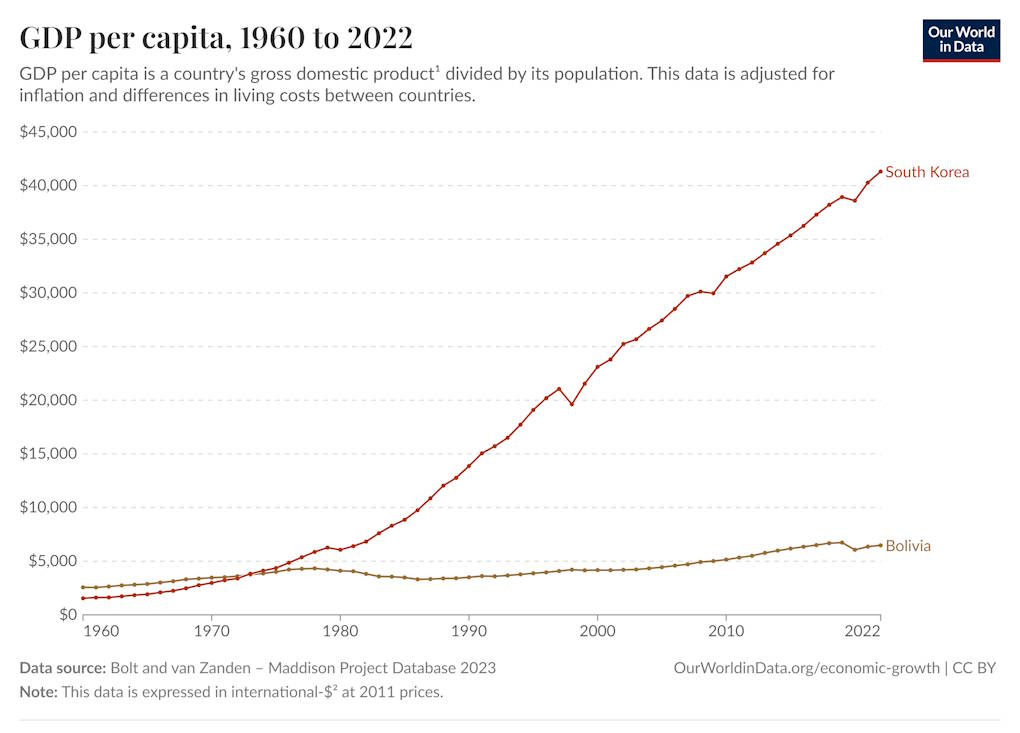
But this is an event that only happened once. There were a lot of differences between South Korea and Bolivia during this time, and it’s hard to know which ones were decisive. South Korea was much more highly educated than Bolivia in the 60s, despite its poverty. While Bolivia focused on selling its natural resources for as high a price as possible, South Korea focused on exporting manufactured goods and climbing up the value chain. Korea had a special relationship with the U.S. that provided it with a large, friendly, reliable market for its manufactured products, as well as government procurement contracts, aid, and technological assistance. Korea is ethnically homogeneous and has many centuries of history as a country with its own language; Bolivia is an ethnically diverse post-colonial state. Korea had a strong, professionalized bureaucracy; Bolivia, not so much. Korea has plenty of sea access; Bolivia is landlocked. Korea got to take advantage of Japanese know-how when its companies paid retired Japanese engineers to come teach their own workers; Bolivia had no such advantage. South Korea had to develop in order to ward off the military threat from North Korea; Bolivia had no such pressing imperative.
And so on. Depending on which Big Theory you believe, you could attribute Korea’s relative success to any combination of these natural advantages and policy choices. You could also tell a composite story — for example, in my own assessment of Poland’s economic miracle, I attributed the country’s breakout success to a combination of geography (proximity to the EU), institutions (changes made in order to be admitted to the EU), industrialism (promotion of manufactured exports and FDI), and flying geese (investment from Germany). I could have also mentioned high human capital, ethnolinguistic homogeneity, and the military threat from Russia. This makes for a good story — and you can call Poland’s success a “model” and try to emulate as much of it as you can — but it’s not a scientific explanation.
So what if you get a bunch of development success stories like Korea, and a bunch of failures like Bolivia, and you try to systematically figure out the most important factors? This is the idea of a cross-country regression, and it’s a common tool that development economists use, but it’s fraught with issues.
There aren’t that many development success stories, and a lot of them look very different from each other — you can group Korea with Qatar as “rich countries”, but that grouping will obscure more than it reveals. There’s tons of endogeneity present — you might observe that countries with efficient bureaucracies tend to grow faster, but that doesn’t mean the former caused the latter, because both might be caused by differences in the education system. Different time periods might yield different lessons. You might leave out some really important variables entirely. A large country might not be comparable to a small country. And so on.
Basically, lots of development economists run cross-country regressions, and they always lead to vigorous arguments about what the regressions mean and whether the models were appropriate. If you want to read such an argument, a great example is Rodrik (2008), which uses a cross-country regression to claim that countries grow faster when they keep their currencies undervalued. Michael Woodford offers a lengthy commentary in which he raises doubts regarding Rodrik’s statistical choices and the interpretation of his results. You can choose to believe that Rodrik is right — and some people do! — but it requires tons of assumptions.
So what else can you do? Another tool that lots of development economists use is a structural model — basically, a development theory whose parameters you estimate from data. But this approach has even more problems. First of all, structural models are a bit like toothbrushes — everyone has one, but nobody wants to use anyone else’s. There are a vast number of structural models, and none of them ever get rejected because they don’t fit the data — economists just find the parameters that best fit the model and call it a day, without ever questioning whether the model is just wrong. But because there are so many models, they can’t all be right — in fact, only a few of them can. As a result, making a structural model almost never helps tell you what’s really going on in the world — it’s just a way of extrapolating the implications of your assumptions.
Another thing you can do is narrative history — basically, looking at a historical episode of development and recording all the interesting details, so that hopefully someone can figure out which of those details mattered. People responded to JFV’s tweet with a number of examples of this, such as Douglas Irwin’s 2021 paper about the South Korean economic miracle, and Piatkowski and Zhang’s 2022 paper about shock therapy in China. Books like How Asia Works, Asia’s Next Giant, MITI and the Japanese Miracle, and Governing the Market are classic examples of narrative history with regards to various East Asian success stories, and I think they’re all excellent.
This is useful work, and you can make a good argument that development economists should be doing a lot more of this. But on its own, recording the facts isn’t enough to tell you which facts mattered, or which will matter in other countries.
The final thing you can do is to use microeconomic empirical work to assess the effects of policies. A good example of this is Nathan Lane’s 2025 paper on South Korea’s Heavy and Chemical Industry Drive, which looks at how a famous Korean industrial policy affected specific industries. Another example is Barteska et al. (2025), which measures the impact of U.S. defense procurement on specific Korean companies. A third example is Kim and Wang (2025), which studies Taiwanese land reform.
This is very useful work, but it also has some obvious limitations. It only studies policy; it has little to say about the importance of natural advantages like geography or human capital. It’s also hard to translate from a policy’s effect on specific companies or industries to its effect on the economy as a whole.
So while there’s much useful development economics to be done, even the brightest minds in the field are playing with a set of inherently weak tools. History only happens once, so our ability to make a science out of one-time historical events like economic development is very limited.
That’s why I think scoffing at RCTs and urging development economists to tackle the Big Questions more often will have a negligible effect. There’s really not a lot more that can be done, in terms of generating Big Theories of Why Countries Get Rich, or in terms of testing those theories. Unless and until AI gets smart enough to study human society from a bird’s-eye view, I think we should be humble about how much we expect development economists to be able to contribute to developing countries’ growth policies in real time.
Humility, I think, should be the key word here. Development economists can do lots of useful things for policymakers — they can explain various theories, cite a bunch of details about successful countries like Poland and Korea, point out failures, and draw on various suggestive empirical results. But there is no science of development, and it’s not clear there ever will be. So we should be careful that exhortations for development economists to focus on the Big Questions don’t pressure them to pretend that they have the Big Answers.
Rachel Glennerster listed some more relevant numbers in a thread.
This is a really useful perspective on this debate — and an illustrative survey of the breadth of development literature across a range of angles. But perhaps the breadth is the challenge.
Explain the theory persistence as a measurement problem is very plausible: the tools are weak, history happens once, so we can't decide between competing theories. But there's a question underneath it. What if the theories persist not because we can't measure well enough to decide between them, but because we're asking the wrong question?
The question "Which theory of development is right?" assumes that the theories are competing to explain the same outcome. What if they're not? What if industrial policy works in some institutional environments and fails in others because the surrounding conditions determine what the intervention actually produces?
Nathan Lane's 2025 paper shows Korea's industrial drive worked. The interesting comparison is why broadly similar policies, protection, directed credit, and performance requirements underperformed across much of Latin America in the same era. Korea's bureaucracy could enforce the export discipline. Brazil's, in the 1970s, largely couldn't. Similar policy architecture, different regime, different outcome.
This is actually what you'd expect if economies and polities function as complex adaptive systems — environments where the same input produces different outputs depending on the configuration of the surrounding system. In that kind of system, the search for a universally correct theory of development is probably the wrong research programme. The variety of theories, each working somewhere and failing elsewhere, isn't a measurement problem to be solved. It's the signal. But their divergence also means that there does not appear to be a coherent field of development theory.
Which means the missing thing isn't a better test of which universal theory wins. It's a prior framework for identifying which regime or system a country is in before assessing. And that's a different kind of research than anything currently on the menu. Whether it's tractable is genuinely unclear. But it's at least the right question.
The step both camps are skipping is the upstream one: before asking which intervention works or which theory wins, ask what kind of system you're dealing with. That prior diagnostic question is currently not part of anyone's research programme. And the debate might look quite different if it were.
I have been thinking about this a lot since reading Growth and the Case Against Randomista Development in 2020... there's almost no one that I know that is earnestly trying to eliminate extreme poverty other than Luke Eure of https://www.noidlesitting.com/profile/posts
I did really enjoy reading How Africa Works recently though! (Oliver Kim's treatment of it is pretty good too if you're short on time https://www.global-developments.org/p/how-africa-works )
(https://forum.effectivealtruism.org/posts/bsE5t6qhGC65fEpzN/growth-and-the-case-against-randomista-development)