

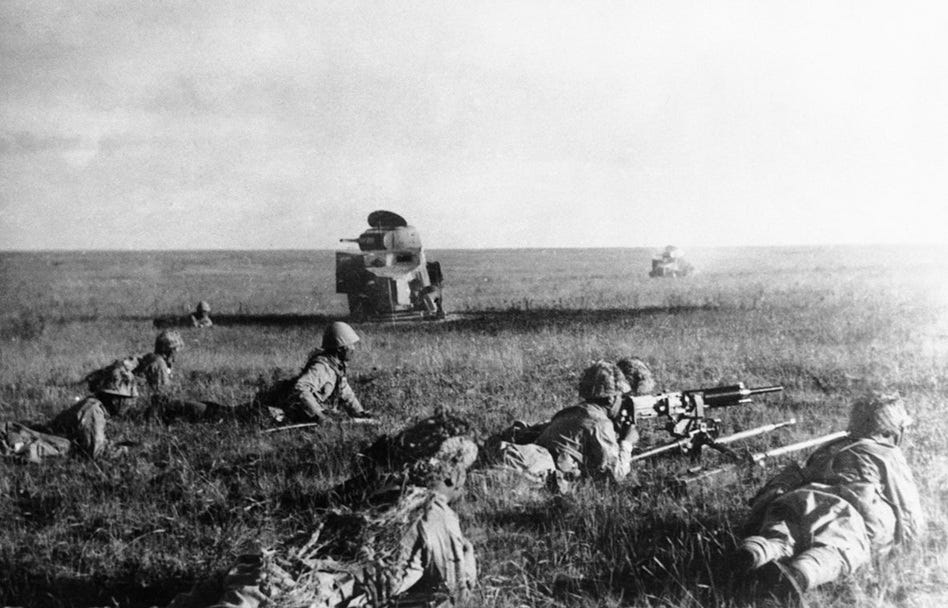
The photo above is from the Battle of Khalkhin Gol in 1939. This “battle” lasted four months, and was actually just the main phase of an undeclared war between Imperial Japan and the Soviet Union that effectively began in 1935, four years before the official start of the Second World War. The USSR won the conflict through superior use of tanks, foreshadowing the eventual outcome of WW2 itself.
This example illustrates that although World War 2 officially began when Germany invaded Poland, conflicts that either foreshadowed the final conflagration or eventually merged with it began years earlier, in the mid-1930s. WW2 had foothills. I wrote about this back in 2024:


It’s possible that the world will avoid a world war in the first half of the 21st century. But if one does occur, I think future historians will see it as having had foothills as well. In the Syrian Civil War, the U.S. and Russia began to test their new hardware against each other, and their troops even clashed once. Russia’s invasion of Ukraine was the big shift, as it inaugurated a new era of great-power territorial conquest, began to harden global alliance systems, and pushed Europe to remilitarize.
Now we have the Iran War. The U.S. and Israel started the war, attacking Iran and decapitating much of its leadership. The Iranians, somewhat oddly, responded by launching missile and drone attacks on practically every Arab nation in the Middle East, causing some of them to threaten to join the war on America and Israel’s side.
In the short term, this conflict seems likely to peter out in a few days to weeks without decisive results. Militarily speaking, the U.S. and Israel have generally had their way with Iran, assassinating the leadership at will, achieving air supremacy, and degrading missile and drone strike capability. But this seems unlikely to actually bring down the Iranian regime; protesters are generally not returning to the streets, still cowed after the regime massacred tens of thousands of them in January. Unlike in Syria, there’s no breakaway region or oppressed ethnic majority that can be armed from afar to bring down the regime; as long as Iran’s Revolutionary Guard and other security services remain unified and willing to shoot infinite protesters in order to hang on to power, and there’s no ground invasion, it’s not clear who could actually topple the Islamic Republic in the next few weeks.
In the long term, of course, it’s a different story; the regime doesn’t look strong or stable. But Trump seems unlikely to be in for the long term; instead, he seems likely to quit the war soon, as he usually retreats from most of his initially bold moves. Trump recently called the war “very complete”, and his advisers are reportedly urging him to find a way out of the conflict.
One reason for this is that the Iran War has been fairly unpopular in America from the beginning:
About half of registered voters — 53% — oppose U.S. military action against Iran, according to a new Quinnipiac Poll conducted over the weekend. Only 4 in 10 support it, and about 1 in 10 are uncertain. A new Ipsos poll also found more disapprove than approve of the strikes…That’s similar to the results of text message snap polls from The Washington Post and CNN, both conducted shortly after the joint U.S.-Israel attacks began, which also indicated that more Americans rejected the military action than embraced it…A recent Fox News poll found opinions more evenly divided: Half of registered voters approved of the U.S. military action, while half disapproved.
Wars usually create a “rally round the flag” effect early on, and support only fades later; this war was unpopular from day one. Most Republicans seem to have conveniently forgotten that Trump ran as the candidate of peace, isolationism, and non-intervention. But Independents, who form the bulk of the American electorate now, have no partisan commitments that force them to conveniently forget. And they are rightfully wary of yet another American involvement in a Middle Eastern war — especially one that America started without being attacked first.
But there’s an even bigger reason Trump is looking for the exits — oil. Oil prices have been jumping wildly up and down, as everyone tries to figure out whether Iran will manage to disrupt oil production from the Persian Gulf (possibly by closing the Strait of Hormuz, possibly by destroying Gulf oil infrastructure with drones). But the general trend is up:
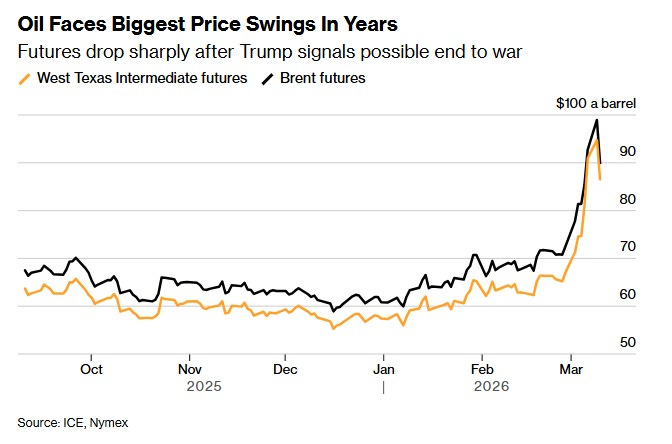
Higher oil prices mean higher gasoline prices, and higher inflation in general — both things that tend to make Americans very mad, and which they are already mad at Trump about. Gas prices are now shooting up:
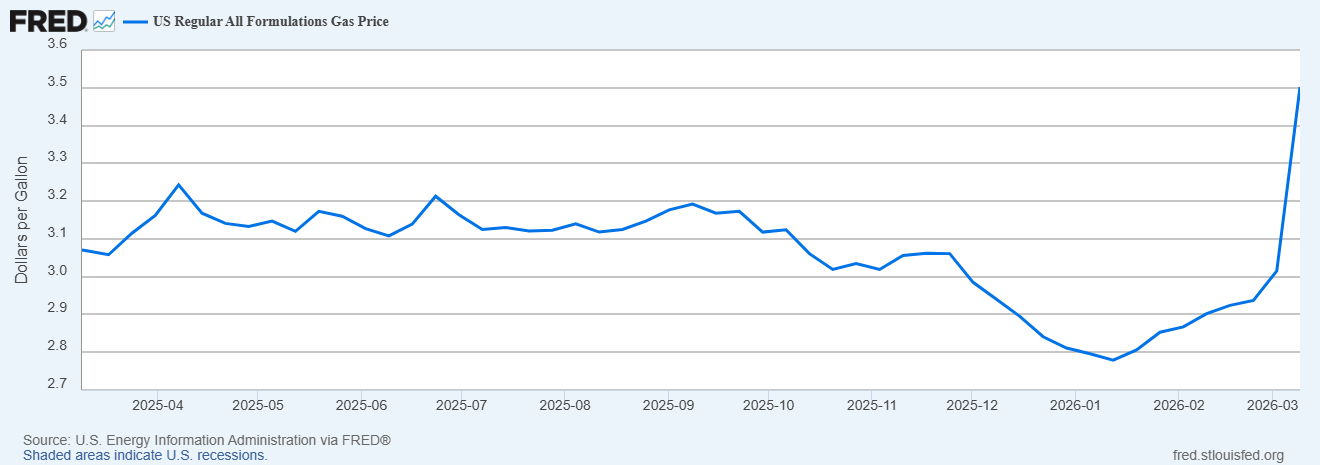
So this war seems highly unlikely to result in Iraq War 2.0 — a massive U.S. ground invasion of Iran. Instead, it’ll probably end up like a bigger version of the Twelve-Day War last year — Iran’s defenses will be laid prostrate before the might of foreign air power, but the regime will survive.
(Again, in the long term, things look very bad for the Iranian regime. The economy is dysfunctional and crumbling, and high oil prices will provide only a temporary palliative. The regime’s popular legitimacy is gone after the January massacres. The entire Gulf has now turned against Iran, and Lebanon’s government has turned against Hezbollah. With Syria now shifting into the Israel/Gulf camp and Hamas basically a spent force, Iran has only one effective proxy left — the Houthis in Yemen. This is not a recipe for long-term success.)
But anyway, this is all a bit of a side track from the point of this post, which is about World War 3. The Iran War will probably not be the start of WW3, but I think it does bring us closer to the brink, in several ways.
First, in the Western theater — Europe and the Middle East — the coalitional lines are becoming clearer. When Trump was elected, a lot of people thought that America had effectively “switched sides” — that Trump viewed Putin as an ally against global wokeness, and the Europeans and the Ukrainians as betrayers of Western Civilization. I myself entertained this notion — there really was (and still is) a lot of this sentiment on the American right, and ending the Transatlantic Alliance was consistent with classic American right-wing isolationism.
But the narrative that “America is a Russian ally now” has been looking a lot shakier in recent months. First, the U.S. toppled a Russian proxy in Venezuela, and seized a bunch of Russian “shadow fleet” oil tankers. Elon Musk then shut the Russians off from using Starlink, allowing the Ukrainians to seize the initiative in the war. Now, the U.S. is trying to topple a key Russian arms supplier — Iran is the source of the Shahed long-range strike drone, which Russia has been using to bombard Ukraine’s cities from afar.
Russia didn’t leap to Iran’s defense. It has its hands full with Ukraine, and with planning for a possible wider war against Europe, and the U.S. is too powerful for it to fight. But the Russians did lend a hand, helping Iran to target U.S. forces:
Russia is providing Iran with intelligence about the locations and movements of American troops, ships and aircraft, according to multiple people familiar with US intelligence reporting on the issue…Much of the intelligence Russia has shared with Iran has been imagery from Moscow’s sophisticated constellation of overhead satellites[.]
This is similar to what the U.S. does for Ukraine. Russian targeting intelligence may have helped Iran take out some U.S. missile defense radar installations — almost certainly Iran’s most significant success of the war.
Meanwhile, Ukraine has leapt to the defense of both the U.S. and the Gulf countries being targeted by Iran’s fleets of attack drones. Long years of playing defense against Russia’s Iranian-provided Shaheds have given Ukraine tons of expertise in shooting this sort of drone out of the sky; now, the U.S. badly needs that expertise. America had rejected Ukraine’s help on anti-drone technology before, but it turns out military necessity usually trumps ideological bias.
As for Europe, they’ve certainly had a lot of tensions with the Trump administration, but most of the European countries haven’t opposed America’s actions in Iran the way they opposed the Iraq War a generation ago. Britain and France made some disapproving noises at first, but eventually acquiesced; only Spain tried to stand up and oppose Trump.
So for now, the coalitions in the Western theater look clearer than they did before — America, Ukraine, Israel, and Europe on one side, Russia and Iran on the other side. Various factions in the U.S. and Europe may despise each other, or despise Israel, or despise Ukraine, but at the end of the day, Russia and Iran are the greater enemies.
In the Eastern theater, things are less certain. India traditionally tries to be friends with America, Russia, Israel, and Iran all at once — this requires it to be effectively neutral when it comes to conflicts like the Ukraine War and the Iran War. China is supposedly on Iran’s side, but it has mostly limited itself to criticism of America’s actions.
The big question, of course, is whether the Iran War makes a Chinese attack on Taiwan more likely. One school of thought says it’s more likely, because the war has forced America to consider shifting missile defense systems out of Asia. On the other hand, the almost unbelievable American/Israeli competence in terms of finding and killing Iran’s top leaders seems to have given Chinese military analysts pause — although China can outmatch the U.S. in terms of defense production, if America could assassinate Xi Jinping and the entire CCP Central Committee in the early days of a war over Taiwan, that could be an effective form of deterrence.
So in a way, what we’re looking at now feels a little like the situation in 1935 or 1937. The Western theater today is like the Pacific theater then — wars and invasions that feel localized, and which don’t involve the most capable players, but which destabilize the world and have the potential to merge into a wider global conflict. Meanwhile, the Eastern theater today is more like the European theater of WW2 — it has the most powerful economies and militaries, but the alliances are still uncertain. If and when China attacks Taiwan, that will probably be similar to Hitler invading Poland — an unambiguous signal that a wider war has begun. It might happen, or it might not.
Meanwhile, the Iran War feels like the lead-up to World War 3 in another way — it’s showcasing and developing the technologies that would be central to a wider war. The Ukraine War has demonstrated that drones — FPV drones at the front, and Shahed-style strike drones behind the lines — are the key weapon of modern warfare. Similarly, America and Israel’s decapitation strikes on Iran have shown the power of AI for modern precision warfare. Here’s the WSJ:
The U.S. and Israeli attacks on Iran have unfolded at unprecedented speed and precision thanks to…a cutting-edge weapon never before deployed on this scale: artificial intelligence…AI tools are helping gather intelligence, pick targets, plan bombing missions and assess battle damage at speeds not previously possible…The use of AI in the campaign against Iran follows years of work by the Pentagon and lessons learned from other militaries. Ukraine—with U.S. help—increasingly relies on AI in its war against Russia. Israel has tapped AI in conflicts at least since the October 2023 Hamas attacks.
And this is from an article in Rest of World (a very underrated news source):
The U.S. military is using the most advanced AI it has ever used in warfare, with Anthropic’s Claude AI reported to be assessing intelligence, identifying targets, and simulating battle scenarios…The biggest role that AI now has in U.S. military operations in Iran, as well as Venezuela, is in decision-support systems, or AI-powered targeting systems, Feldstein said. AI can process reams of surveillance information, satellite imagery, and other intelligence, and provide insights for potential strikes. The AI systems offer speed, scale, and cost-efficiency, and “are a game-changer,” he said…[T]he use of chatbots such as Claude in decision-support systems is new…
China is prototyping AI capabilities that can pilot unmanned combat vehicles, detect and respond to cyberattacks, and identify and strike targets on land, at sea, and in space, researchers at Georgetown University’s Center for Security and Emerging Technology said.
This is a bit reminiscent of how aerial bombing was used at Guernica in the Spanish Civil War, or how the USSR used tanks to beat the Japanese at Khalkhin Gol. If we ever do see an all-out war between America, China, Russia, Japan, and Europe, AI is going to be incredibly central to performance on the battlefield. That’s why for all the bad blood between the Pentagon and Anthropic, the two organizations have a huge incentive to patch things over and learn to cooperate more closely. (Fortunately, Anthropic’s CEO, Dario Amodei, is extremely patriotic, which will probably help.)
Unfortunately, new military technologies won’t just define the wars of the future — they also help cause them. Why did the world fight two World Wars in the early 20th century? Ideologies and competing empires certainly played a role, but it’s also probably true that the rise of industrial technology disrupted the existing balance of power.
Artillery manufacturing, logistics, and railroads made Germany a great power capable of defeating France in the 1870s; that upset the continental balance of power and caused the proliferation of alliances that led to WW1. In the interwar period, air power made America, Germany, and Japan more powerful, while the rise of tanks empowered Germany and the USSR, all at the expense of Britain and France. The rapid progress of industrial weaponry made it unclear where power really lay in the world, which probably made the great powers of the day more willing to roll the dice and test their strength against each other.
Countries may be more cautious now than they were a century ago. Nuclear weapons still exist, and still provide some deterrent to great-power war — though there are a lot fewer of them now than there used to be, and AI and missile defense make it possible to stop more of them before they hit. Countries are richer now too, which makes a war even less appealing from an economic perspective than in 1914.
But still, the rise of AI and drones means that no one knows who’s really the most powerful country in the world — the U.S. or China. And regional balances of power — Russia versus Europe and Ukraine, Iran versus Israel and the Gulf — are similarly uncertain. Uncertain balances of power are scarier than known balances of power.
So while World War 3 doesn’t seem imminent, we may be inching closer in that direction. If it sneaks up and surprises us, we’ll probably conclude that the Iran War was part of the lead-up.
Outside euro-centric circles, the start of the (2nd) Sino-Japanese war in 1937 has long been considered the start of WWII.
Russia losing Iran as a supplier of Shaheeds is a minor hassle, and likely a temporary one. Iran's production of Shaheeds has been outstripped by Russia since the end of 2023.
As for the war proving Trump isn't pro-Putin, let's put that to rest. Trump has spent more time consulting Putin about this war than Congress. And that has resulted in Trump lifting sanctions on Russian oil sales.
That's the most pro-Putin move you can make. Because it also means that hunting down the shadow fleet might be coming to an end too (we'll see what the Europeans think about that).
I’m confused regarding your earlier support for these strikes given that you’re now acknowledging that thousands of deaths and billions of dollars will result in no “decisive results” other than pushing the world a step closer to a mass global conflict.